


2 Kings 14:25
Bible text: King James Version (1769 Blayney text) · Public domain
Bible text: King James Version with Strong's numbers · Public domain
Bible text: Berean Standard Bible · Public domain
Bible text: American Standard Version (1901) · Public domain
Bible text: World English Bible, Messianic edition · Public domain
Bible text: Geneva Bible (1599) · Public domain
Bible text: Young's Literal Translation · Public domain
- הוּאHu'heH1931Pro-3msPronoun Personal 3rd Singular Masculine
- הֵשִׁיבhe·Shivhe restoredH7725V-Hiphil-Perf-3msVerb Hiphil Perfect 3rd Singular Masculine
- אֶת'et<obj.>H853DirObjMParticle Object Indicator
- גְּבוּלge·Vul[the] border ofH1366N-mscNoun Singular Masculine Construct
- יִשְׂרָאֵלYis·ra·'ElIsraelH3478N-properNoun Proper Location
- מִלְּבוֹאmi·le·Vo'from LeboH935Prep-m ¦ N-properNoun Proper LocationמִfromלְּבוֹאLebo
- חֲמָתcha·MatHamathH2574N-properNoun Proper Location
- עַד'adtoH5704PrepPreposition
- יָםyam[the] sea ofH3220N-mscNoun Singular Masculine Construct
- הָעֲרָבָהha·'a·ra·Vahthe ArabahH6160Art ¦ N-fsNoun Singular Feminine AbsoluteהָtheעֲרָבָהArabah
- כִּדְבַרkid·Varaccording to [the] word ofH1697Prep-k ¦ N-mscNoun Singular Masculine Constructכִּaccording toדְבַר[the] word of
- יְהוָהYah·wehYahwehH3068N-properNoun Proper Title
- אֱלֹהֵי'e·lo·Hei[the] God ofH430N-mpcNoun Plural Masculine Construct
- יִשְׂרָאֵלYis·ra·'ElIsraelH3478N-properNoun Proper Location
- אֲשֶׁר'a·SherwhichH834RelParticle Relative
- דִּבֶּרdi·Berhe spokeH1696V-Piel-Perf-3msVerb Piel Perfect 3rd Singular Masculine
- בְּיַדbe·yadby [the] hand ofH3027Prep-b ¦ N-cscNoun Singular common gender Constructבְּbyיַד[the] hand of
- עַבְדּוֹav·Dohis servantH5650N-msc ¦ 3msNoun Singular Masculine Constructעַבְדּservantוֹhis
- יוֹנָהyo·NahJonahH3124N-proper-mNoun Proper Masculine
- בֶןven[the] son ofH1121N-mscNoun Singular Masculine Construct
- אֲמִתַּי'a·mi·TaiAmittaiH573N-proper-mNoun Proper Masculine
- הַנָּבִיאha·na·Vi'the prophetH5030Art ¦ N-msNoun Singular Masculine Absoluteהַtheנָּבִיאprophet
- אֲשֶׁר'a·SherwhoH834RelParticle Relative
- מִגַּתmi·Gat[was] from GathH1662Prep-m ¦ N-properNoun Proper Locationמִ[was] fromגַּתGath
- הַחֵפֶרha·Che·fer<the> HepherH1662Art ¦ N-properNoun Proper Locationהַ<the>חֵפֶרHepher
English is a literal word-by-word gloss of the Hebrew, not the KJV's wording. Why?
This is the original text the KJV's translators worked from — each Hebrew word with its own literal English meaning in this verse, prepared by scholars at Tyndale House, Cambridge. The KJV translates whole sentences, not word by word, so its wording differs: one Hebrew word can become several English words, and the KJV may choose “the LORD” where the gloss reads “Yahweh”. Both are faithful — they answer different questions. For the KJV's own rendering, switch to the KJV text.
Details
See on the biblical-era maps
Study this verse
Public-domain commentary
Matthew Henry
From his Commentary on the Whole Bible. Henry comments on passages, not single verses — this entry covers 2 Kings 14:23–29. His two-level outline is real structure in the source text, so it is rendered as structure.
Here is an account of the reign of Jeroboam the second. I doubt it is an indication of the affection and adherence of the house of Jehu to the sins of Jeroboam the son of Nebat, who made Israel to sin, that they called an heir-apparent to the crown by his name, thinking that an honourable name which in the book of God is infamous and stigmatized as much as any.
I.His reign was long, the longest of all the reigns of the kings of Israel:
He reigned forty-one years; yet his contemporary Azariah, the king of Judah, reigned longer, even fifty-two years. This Jeroboam reigned just as long as Asa had done (Kg1 15:10), yet one did that which was good and the other that which was evil. We cannot measure men's characters by the length of their lives or by their outward prosperity. There is one event to the righteous and to the wicked.
II.His character was the same with that of the rest of those kings:
He did that which was evil (Kg2 14:24), for he departed not from the sins of Jeroboam; he kept up the worship of the calves, and never left that, thinking there was no harm in it, because it had been the way of all his ancestors and predecessors. But a sin is never the less evil in God's sight, whatever it is in ours, for its being an ancient usage; and a frivolous plea it will be against doing good, that we have been accustomed to do evil.
III.Yet he prospered more than most of them, for though, in that one thing, he did evil in the sight of the Lord, yet it is likely, in other respects, there was some good found in him and therefore God owned him,
1.By prophecy. He raised up Jonah the son of Amittai, a Galilean (so much were those mistaken that said, Out of Galilee ariseth no prophet, Joh 7:52), and by him intimated the purposes of his favour to Israel, notwithstanding their provocations, encouraged him and his kingdom to take up arms for the recovery of their ancient possessions, and (which would contribute not a little to their success) assured them of victory. It is a sign that God has not cast off his people if he continue faithful ministers among them; when Elisha, who strengthened the hands of Joash, was removed, Jonah was sent to encourage his son. Happy is the land that has a succession of prophets running parallel with a succession of princes, that the word of the Lord may endure for ever. Of this Jonah we read much in that little book of scripture that bears his name. It is probable that it was when he was a young man, and fit for such an expedition, that God sent him to Nineveh, and that it was when he had yet been but a little conversant with the visions of God that he flew off and fretted as he did; and, if so, this is an undoubted evidence of the forgiveness of his faults and follies, that he was afterwards employed as a messenger of mercy to Israel. A commission amounts to a pardon, and he that had himself found mercy, notwithstanding his provocations, could the better encourage them with the hope of mercy notwithstanding theirs. Some that have been foolish and passionate, and have gone about their work very awkwardly at first, yet afterwards have proved useful and eminent. Men must not be thrown away for every fault.
2.By providence. The event was according to the word of the Lord: his arms were successful; he restored the coast of Israel, recovered those frontier-towns and countries that lay from Hamath in the north to the sea of the plain, (that is, the sea of Sodom) in the south, all which the Syrians had possessed themselves of, v. 25. Two reasons are here given why God blessed them with those victories: - (1.) Because their distress was very great, which made them the objects of his compassion, v. 26. Though he saw not any signs of their repentance and formation, yet he saw their affliction, that it was very bitter. Those that lived in those countries which the enemies were masters of were miserably oppressed and enslaved, and could call nothing their own; the rest, we may suppose, were much impoverished by the frequent incursions the enemy made upon them to plunder them, and continually terrified by their threatenings, so that there was none shut up or left, both towns and countries were laid waste and stripped of their wealth, and no helper appeared. To this extremity were they reduced, in many parts of the country, in the beginning of Jeroboam's reign, when God, in mere pity to them, heard the cry of their affliction (for no mention is made here of the cry of their prayers), and wrought this deliverance for them by the hand of Jeroboam. Let those whose case is pitiable take comfort from the divine pity; we read of God's bowels of mercy (Isa 63:15; Jer 31:20) and that he is full of compassion, Psa 86:15. (2.) Because the decree had not yet gone forth for their utter destruction; he had not as yet said he would blot out the name of Israel (Kg2 14:27), and because he had not said it he would not do it. If this be understood of the dispersion of the ten tribes, he did say it and do it, for that name still remains under heaven in the gospel Israel, and will to the end of time; and because they, at present, bore that name which was to have this lasting honour, he showed them this favour, as well as for the sake of the ancient honour of that name, Kg2 13:23.
IV.Here is the conclusion of Jeroboam's reign.
We read (Kg2 14:28) of his might, and how he warred, but (Kg2 14:29) he slept with his fathers; for the mightiest must yield to death, and there is no discharge in that war. Many prophets there had been in Israel, a constant succession of them in every age, but none of the prophets had left any of their prophecies in writing till those of this age began to do it, and their prophecies are part of the canon of scripture. It was in the reign of this Jeroboam that Hosea (who continued very long a prophet) began to prophesy, and he was the first that wrote his prophecies; therefore the word of the Lord by him is called the beginning of the word of the Lord, Hos 1:2. Then that part of the word of the Lord began to be written. At the same time Amos prophesied, and wrote his prophecy, soon afterwards Micah, and then Isaiah, in the days of Ahaz and Hezekiah. Thus God never left himself without witness, but, in the darkest and most degenerate ages of the church, raised up some to be burning and shining lights in it to their own age by their preaching and living, and a few by their writings to reflect light upon us on whom the ends of the world have come.
Historical interpretation
Fourteen Centuries of Reception
3 surviving comments on this verse. Each one is dated, so this reads as a timeline rather than a list.
Select a marker to jump to its quote. Markers stagger vertically where authors wrote within a few decades of each other.
“In the fifteenth year of King Amaziah son of Joash of Judah, King Jeroboam son of Joash of Israel began to reign in Samaria; he reigned forty-one years. He restored the border of Israel from Lebo-hamath as far as the Sea of the Arabah, according to the word of the Lord, the God of Israel, which he spoke by his servant Jonah son of Amittai, the prophet.” This is the same Jonah who preached the repentance of Nineveh. And the Sea of Arabah is the same that the Scripture calls elsewhere the “salt sea,” situated on the border with Canaan, of which the city of Hamath, beside the Mount Lebanon, is the other northern border. Jeroboam honored the prophet Jonah as his father had honored Elisha and recurred to his useful work, so that, being encouraged by his predictions and advice, was able to conquer back the cities occupied by the Syrians.
"He restored the boundaries of Israel from the entrance of Hamath, etc." [2 Kings 14:25] It is said of Jeroboam, king of Israel: He restored the boundaries of Israel from the entrance of Hamath to the sea of the Arabah. Hamath, which is now called Epiphania, was the northern boundary of Israel. However, the sea of the Arabah, which in Hebrew is called Araba, designates the Dead Sea, which in length extends for 580 stadia to Zoaras of Arabia, and in width for 150 stadia to the nearby Sodoms.
Opher: The tribe of Zabulon.
Continue studying 2 Kings 14:25 across the web’s major study libraries — every link below opens this exact verse, chapter, or book on the destination site.
Read & Compare
 BibleGatewayThis verse in more than 200 translations and 70 languages.
 Bible.comThe YouVersion reader — hundreds of translations, reading plans, and highlights.
 ESV.orgCrossway's official English Standard Version reader.
 NET BibleThe NET translation with 60,000+ translators' notes on every rendering decision.
 STEP BibleTyndale House's free study tool — original text, vocabulary, and scholarly resources.
 BibliaLogos Bible Software's free web reader.
 USCCBThe New American Bible (Revised Edition) with the U.S. bishops' study notes.
Commentaries
 BibleHub CommentariesDozens of classic commentaries on this verse, gathered on one page.
 StudyLightMore than 100 commentary sets — the largest collection on the web.
 BibleRefPlain-English commentary on what this verse means, verse by verse.
 Enduring WordDavid Guzik's free commentary on this chapter, widely used by Bible teachers.
 Bible Study ToolsVerse commentary alongside Greek and Hebrew study aids.
Original Language & Research
- BibleHub InterlinearThe verse word by word — original language, transliteration, and English.
- BibleHub LexiconEvery word's original-language definition and Strong's entry.
 Blue Letter BibleDeep-study tools — Strong's numbers, concordance, and word studies.
 SefariaThe Hebrew text with Rashi and centuries of Jewish commentary.
Sermons, Hymns & Audio


TrulyRandomVerse is not affiliated with these sites and doesn’t control their content. They’re linked because they’re genuinely useful.
Summary
Second Kings 14:25 records a remarkable period of territorial resurgence for the Northern Kingdom of Israel under King Jeroboam II. Despite Jeroboam's personal unfaithfulness and adherence to the idolatrous practices of his predecessors, this significant expansion, which saw Israel's borders stretch from the strategic northern pass of Hamath to the southern extent of the Dead Sea, is unequivocally attributed to the sovereign will of the LORD God of Israel. This verse powerfully highlights the precise fulfillment of a prophecy delivered by the prophet Jonah, son of Amittai, thereby underscoring God's unwavering faithfulness to His declared word and His enduring compassion for His covenant people, even in their persistent disobedience and spiritual decline.
Context
ShowHideLiterary Context
This pivotal verse is situated within the account of Jeroboam II's lengthy reign over the Northern Kingdom (approximately 793-753 BC), detailed in 2 Kings 14:23-29. It immediately follows a period of severe national decline and oppression at the hands of the Arameans, as vividly described in 2 Kings 13:3-7. The narrative explicitly states Jeroboam II's spiritual failings, noting that he "did that which was evil in the sight of the LORD" and "departed not from all the sins of Jeroboam the son of Nebat" (2 Kings 14:24). This sets up a profound theological tension: how could a wicked king experience such unprecedented national prosperity? Verse 25 provides the divine explanation, attributing the restoration not to the king's merit but to God's word. The subsequent verses further elucidate this paradox, revealing that God granted this relief out of compassion for Israel's severe affliction, as He "saw the affliction of Israel, that it was very bitter" (2 Kings 14:26).
Historical & Cultural Context
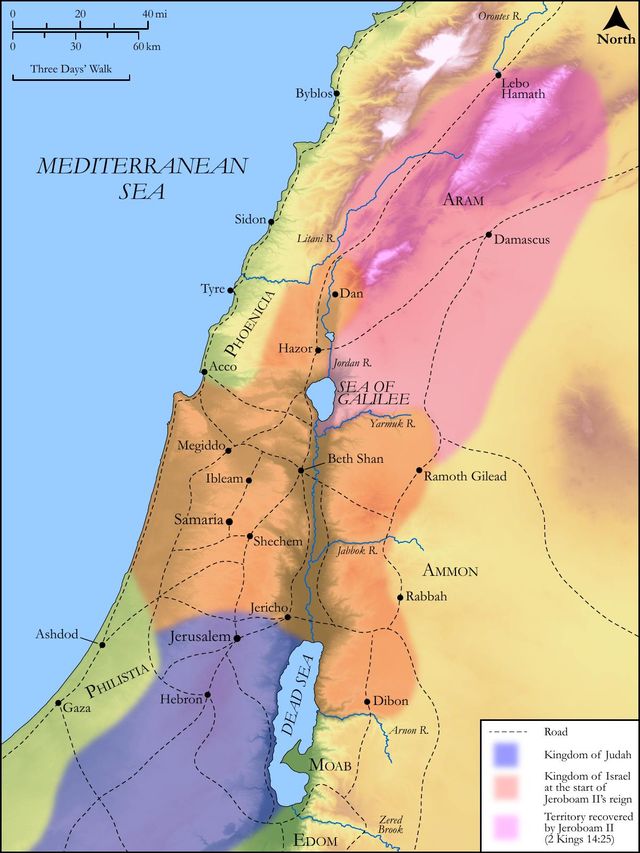
Jeroboam II's reign occurred during a strategic window in the affairs of Israel, Syria and Assyria. The powerful Assyrian Empire, which had long threatened the smaller states of the Levant, was experiencing a period of internal weakness and withdrawal, particularly under Adad-nirari III and Shalmaneser IV. This temporary power vacuum allowed regional kingdoms, including Israel and Judah, to regain strength. Specifically, it enabled Jeroboam II to decisively defeat the Arameans (Syrians) of Damascus, who had previously crippled Israel's military and seized significant territory. The "entering of Hamath" (Lebo-Hamath) refers to a key strategic pass in modern-day Lebanon, near the Orontes River, which marked the traditional northern boundary of the promised land. "The sea of the plain" refers to the Dead Sea, indicating the southernmost extent of Israel's influence. Jeroboam's campaigns effectively restored Israel's borders to an extent not seen since the united monarchy under David and Solomon, leading to immense economic prosperity. However, this wealth often fueled injustice, oppression of the poor, and spiritual complacency, issues vigorously condemned by contemporary prophets like Amos and Hosea, whose ministries largely overlap with Jeroboam II's reign.
Key Themes
ShowHideThis verse powerfully illustrates several core theological themes woven throughout the books of Kings and the broader Old Testament narrative. Foremost is the theme of Divine Sovereignty, demonstrating that God's overarching purposes and covenant promises are not ultimately contingent upon human faithfulness or the righteousness of a particular king. Even an idolatrous and unrighteous king like Jeroboam II can be an unwitting instrument in God's hands to bring about His predetermined will. Secondly, the explicit mention of Jonah's prophecy being fulfilled highlights the Reliability and Fulfillment of God's Word. What God declares through His chosen prophets, whether for judgment or restoration, will inevitably come to pass, often in surprising ways. This underscores the absolute trustworthiness of divine revelation. Finally, the broader context of Jeroboam II's reign, particularly the divine motivation articulated in 2 Kings 14:26-27, underscores God's Enduring Compassion and Mercy for His covenant people. Despite Israel's persistent sin and idolatry, God did not utterly abandon them but provided periods of relief and restoration in response to their severe affliction, not necessarily their repentance.
Exposition and Analysis
ShowHideKey Word Analysis
ShowHideThe verb שׁוּב (shûwb) fundamentally means "to turn back," "to return," or "to bring back." In this context, it signifies a dramatic reversal of fortunes, a recovery of lost territory, and a turning back of the tide of decline that had plagued Israel for decades. It implies that the land was not merely conquered anew, but reclaimed, bringing it back to a former state of greatness, reminiscent of the Solomonic empire. This restoration was not a new creation but a re-establishment of previous boundaries and influence.
The Hebrew word גְּבוּל (gᵉbûwl) refers to a "border," "boundary," or "territory." Its usage here emphasizes the comprehensive geographical extent of the recovery. It's not merely a city or a small region, but the entire defined territorial limits of the nation, from its northernmost reach to its southern plain. This indicates a significant and complete re-establishment of national integrity, power, and security, effectively reversing the territorial losses Israel had suffered.
The phrase בְּיַד (bĕyad), literally "in the hand of" (from yâd, meaning "hand"), is a common Hebrew idiom indicating agency, means, or instrumentality. When applied to a prophet, as here, it means that the message or action was delivered "through" or "by means of" that individual. It underscores that Jonah was merely the messenger, the instrument through whom God's divine word was conveyed and ultimately fulfilled, highlighting God as the ultimate author and executor of the prophecy, not Jonah's personal power or wisdom.
Verse Breakdown
ShowHide"He restored the coast of Israel from the entering of Hamath unto the sea of the plain"
This clause details the remarkable geographical extent of Jeroboam II's military success and the resulting territorial expansion. "The entering of Hamath" (Lebo-Hamath) was a strategic northern gateway, near the Orontes River, marking the traditional northern boundary of the promised land as outlined in Numbers 34:8. "The sea of the plain" refers to the Dead Sea, which formed Israel's southern and eastern border. This indicates a vast territorial expansion, effectively restoring Israel's borders to a size comparable to the united monarchy under King David and Solomon, reversing decades of decline and loss to the Arameans.
"according to the word of the LORD God of Israel"
This crucial phrase attributes the success not to Jeroboam's military genius, political acumen, or the strength of his army, but directly to the sovereign will and prophetic declaration of God. It emphasizes that this restoration was part of God's predetermined plan and purpose for His people, underscoring divine orchestration in human affairs, even when executed through an unrighteous king. It highlights God's faithfulness to His own declarations.
"which he spake by the hand of his servant Jonah, the son of Amittai, the prophet, which [was] of Gathhepher"
This identifies the specific prophet through whom God's word concerning this restoration was delivered. Jonah, son of Amittai, from Gath-hepher (a town in Galilee, near Nazareth, in the territory of Zebulun), is the same prophet whose dramatic story is told in the Book of Jonah. This precise detail confirms the fulfillment of a specific, though unrecorded elsewhere in the biblical narrative, prophecy, reinforcing the absolute reliability of God's word and the vital role of prophets as His authoritative spokespersons.
Literary Devices
ShowHideThe verse employs several significant literary devices that enrich its theological impact. Attribution is central, as the narrator explicitly attributes Jeroboam's military success not to his own strength or righteousness but "according to the word of the LORD God of Israel." This immediately establishes a theological framework for understanding the events, shifting the focus from human agency to divine sovereignty and purpose. The Geographical Delimitation ("from the entering of Hamath unto the sea of the plain") functions as a powerful Merism, a figure of speech in which two contrasting parts represent the whole. By specifying the northernmost and southernmost traditional boundaries, the text emphasizes the completeness and grandeur of the territorial restoration, implying the entire traditional land of Israel was reclaimed. Furthermore, the precise identification of Jonah ("the son of Amittai, the prophet, which [was] of Gathhepher") functions as a form of Authentication or Verification, lending historical credibility and authority to the divine origin of the prophecy and its subsequent fulfillment, grounding the theological claim in concrete, verifiable detail.
Theological and Thematic Connections
ShowHideThis verse profoundly illustrates God's sovereign control over history, demonstrating that His plans and purposes will unfold regardless of human faithfulness or merit. The restoration of Israel's territory under Jeroboam II, an unrighteous king who continued in the sins of Jeroboam I, serves as a powerful testament to God's unwavering commitment to His covenant people and His declared word. It reminds us that God can use unlikely instruments to achieve His will, and His compassion often extends beyond what human merit might dictate. This divine intervention, driven by compassion for Israel's severe affliction (as explained in 2 Kings 14:26), underscores God's enduring mercy and steadfast love (Hebrew: hesed) despite persistent sin and idolatry. It highlights that God's faithfulness is rooted in His character and promises, not in the performance of His people.
Reflection and Application
ShowHideThe account of Jeroboam II's reign, particularly 2 Kings 14:25, offers profound and enduring lessons for contemporary believers. It challenges our often-human-centric view of success and prosperity, reminding us that true flourishing and restoration ultimately flow from God's sovereign hand, not solely from human effort, political prowess, or even the righteousness of our leaders. In a world that frequently measures progress by visible achievements and human-engineered solutions, this verse redirects our gaze to the unseen, powerful work of God, who faithfully fulfills His word even through imperfect vessels and in unexpected circumstances. It encourages us to cultivate a deeper trust in God's unwavering faithfulness to His promises, even when circumstances seem dire, when leaders fall short, or when our own spiritual walk is less than perfect. Moreover, it highlights God's deep and active compassion for His people, a compassion that extends even to the undeserving, offering hope, relief, and periods of grace in times of affliction. This should inspire us to cultivate a profound reliance on God's grace and to recognize His hand at work in surprising ways, even amidst our own imperfections or societal failings, fostering both humility and hope.
Questions for Reflection
ShowHideFAQ
ShowHideWas the prophet Jonah mentioned here the same Jonah from the Book of Jonah?
ShowHideYes, the text explicitly identifies him as "Jonah, the son of Amittai, the prophet, which [was] of Gathhepher." This is indeed the same prophet whose dramatic story of being swallowed by a great fish and preaching repentance to Nineveh is recounted in the Book of Jonah. This reference in 2 Kings 14:25 provides an important historical anchor for Jonah's ministry, placing him within the context of the Northern Kingdom of Israel during the reign of Jeroboam II (c. 793-753 BC). It also suggests that Jonah had a prophetic ministry to Israel that extended beyond his well-known mission to Nineveh, although the specific prophecy regarding Jeroboam II's territorial restoration is not recorded elsewhere in the biblical text. This demonstrates that biblical prophets often had multiple messages and ministries, not all of which are fully detailed in the canonical books bearing their names.
Christ-Centered Fulfillment
ShowHideWhile 2 Kings 14:25 describes a temporal, earthly restoration of geographical borders under an imperfect and idolatrous king, it profoundly points forward to the ultimate and eternal restoration accomplished through Jesus Christ. Jeroboam's reign, marked by both impressive territorial expansion and continued spiritual unfaithfulness (2 Kings 14:24), highlights the inherent inadequacy of human kings and the profound need for a perfect, righteous deliverer. The "restoration" of the "coast of Israel" under Jeroboam II foreshadows the far greater spiritual restoration and boundless expansion of God's kingdom, a kingdom not confined by geographical borders but encompassing all nations and peoples. Just as God used Jonah, His "servant," to declare a word of physical relief and restoration for Israel, so too did He send His Son, Jesus, as the ultimate Prophet, Priest, and King, to declare and accomplish the comprehensive restoration of humanity to God. Jesus, the true Lamb of God who takes away the sin of the world, restores not merely lost territory but lost fellowship with God, breaking the power of sin and death. His sacrificial death and glorious resurrection establish a new and better covenant, fulfilling all prophecies concerning a spiritual kingdom that stretches "from the entering of Hamath unto the sea of the plain" and indeed to the "uttermost part of the earth" (Acts 1:8). Through Christ, the ultimate "servant" of the Lord, God's word of salvation, reconciliation, and eternal life is fully realized, bringing about a restoration far grander, more spiritual, and infinitely more enduring than any earthly king could ever achieve (Hebrews 9:15).