


2 Kings 14:27
Bible text: King James Version (1769 Blayney text) · Public domain
Bible text: Berean Standard Bible · Public domain
Bible text: American Standard Version (1901) · Public domain
Bible text: World English Bible, Messianic edition · Public domain
Bible text: Geneva Bible (1599) · Public domain
Bible text: Young's Literal Translation · Public domain
- וְלֹאve·lo'and notH3808Conj-w ¦ NegParticle Negativeוְandלֹאnot
- דִבֶּרdi·Berhe had spokenH1696V-Piel-Perf-3msVerb Piel Perfect 3rd Singular Masculine
- יְהוָהYah·wehYahwehH3068N-properNoun Proper Title
- לִמְחוֹתlim·chOtto wipe outH4229Prep-l ¦ V-Qal-InfVerb Qal Infinitive Constructלִtoמְחוֹתwipe out
- אֶת'et<obj.>H853DirObjMParticle Object Indicator
- שֵׁםshem[the] name ofH8034N-mscNoun Singular Masculine Construct
- יִשְׂרָאֵלYis·ra·'ElIsraelH3478N-properNoun Proper Location
- מִתַּחַתmi·Ta·chatfrom underH8478Prep-m ¦ N-mscNoun Singular Masculine Constructמִfromתַּחַתunder
- הַשָּׁמָיִםha·sha·Ma·yimthe heavensH8064Art ¦ N-mpNoun Plural Masculine Absoluteהַtheשָּׁמָיִםheavens
- וַיּוֹשִׁיעֵםvai·Yo·o·shi·'Emand he delivered themH3467Conj-w ¦ V-Hiphil-ConsecImperf-3ms ¦ 3mpVerb Hiphil Consecutive Imperfect 3rd Singular Masculineוַandיּוֹשִׁיעֵhe deliveredםthem
- בְּיַדbe·Yadby [the] hand ofH3027Prep-b ¦ N-cscNoun Singular common gender Constructבְּbyיַד[the] hand of
- יָרָבְעָםya·ra·ve·'AmJeroboamH3379N-proper-mNoun Proper Masculine
- בֶּןben[the] son ofH1121N-mscNoun Singular Masculine Construct
- יוֹאָשׁyo·'AshJoashH3101N-proper-mNoun Proper Masculine
English is a literal word-by-word gloss of the Hebrew, not the KJV's wording. Why?
This is the original text the KJV's translators worked from — each Hebrew word with its own literal English meaning in this verse, prepared by scholars at Tyndale House, Cambridge. The KJV translates whole sentences, not word by word, so its wording differs: one Hebrew word can become several English words, and the KJV may choose “the LORD” where the gloss reads “Yahweh”. Both are faithful — they answer different questions. For the KJV's own rendering, switch to the KJV text.
Details
See on the biblical-era maps
Study this verse
Public-domain commentary
Matthew Henry
From his Commentary on the Whole Bible. Henry comments on passages, not single verses — this entry covers 2 Kings 14:23–29. His two-level outline is real structure in the source text, so it is rendered as structure.
Here is an account of the reign of Jeroboam the second. I doubt it is an indication of the affection and adherence of the house of Jehu to the sins of Jeroboam the son of Nebat, who made Israel to sin, that they called an heir-apparent to the crown by his name, thinking that an honourable name which in the book of God is infamous and stigmatized as much as any.
I.His reign was long, the longest of all the reigns of the kings of Israel:
He reigned forty-one years; yet his contemporary Azariah, the king of Judah, reigned longer, even fifty-two years. This Jeroboam reigned just as long as Asa had done (Kg1 15:10), yet one did that which was good and the other that which was evil. We cannot measure men's characters by the length of their lives or by their outward prosperity. There is one event to the righteous and to the wicked.
II.His character was the same with that of the rest of those kings:
He did that which was evil (Kg2 14:24), for he departed not from the sins of Jeroboam; he kept up the worship of the calves, and never left that, thinking there was no harm in it, because it had been the way of all his ancestors and predecessors. But a sin is never the less evil in God's sight, whatever it is in ours, for its being an ancient usage; and a frivolous plea it will be against doing good, that we have been accustomed to do evil.
III.Yet he prospered more than most of them, for though, in that one thing, he did evil in the sight of the Lord, yet it is likely, in other respects, there was some good found in him and therefore God owned him,
1.By prophecy. He raised up Jonah the son of Amittai, a Galilean (so much were those mistaken that said, Out of Galilee ariseth no prophet, Joh 7:52), and by him intimated the purposes of his favour to Israel, notwithstanding their provocations, encouraged him and his kingdom to take up arms for the recovery of their ancient possessions, and (which would contribute not a little to their success) assured them of victory. It is a sign that God has not cast off his people if he continue faithful ministers among them; when Elisha, who strengthened the hands of Joash, was removed, Jonah was sent to encourage his son. Happy is the land that has a succession of prophets running parallel with a succession of princes, that the word of the Lord may endure for ever. Of this Jonah we read much in that little book of scripture that bears his name. It is probable that it was when he was a young man, and fit for such an expedition, that God sent him to Nineveh, and that it was when he had yet been but a little conversant with the visions of God that he flew off and fretted as he did; and, if so, this is an undoubted evidence of the forgiveness of his faults and follies, that he was afterwards employed as a messenger of mercy to Israel. A commission amounts to a pardon, and he that had himself found mercy, notwithstanding his provocations, could the better encourage them with the hope of mercy notwithstanding theirs. Some that have been foolish and passionate, and have gone about their work very awkwardly at first, yet afterwards have proved useful and eminent. Men must not be thrown away for every fault.
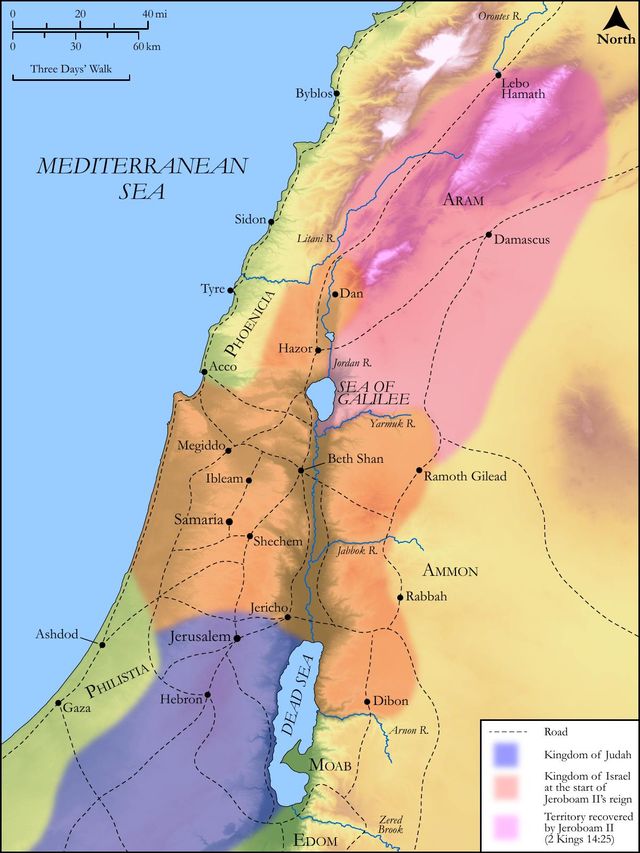
2.By providence. The event was according to the word of the Lord: his arms were successful; he restored the coast of Israel, recovered those frontier-towns and countries that lay from Hamath in the north to the sea of the plain, (that is, the sea of Sodom) in the south, all which the Syrians had possessed themselves of, v. 25. Two reasons are here given why God blessed them with those victories: - (1.) Because their distress was very great, which made them the objects of his compassion, v. 26. Though he saw not any signs of their repentance and formation, yet he saw their affliction, that it was very bitter. Those that lived in those countries which the enemies were masters of were miserably oppressed and enslaved, and could call nothing their own; the rest, we may suppose, were much impoverished by the frequent incursions the enemy made upon them to plunder them, and continually terrified by their threatenings, so that there was none shut up or left, both towns and countries were laid waste and stripped of their wealth, and no helper appeared. To this extremity were they reduced, in many parts of the country, in the beginning of Jeroboam's reign, when God, in mere pity to them, heard the cry of their affliction (for no mention is made here of the cry of their prayers), and wrought this deliverance for them by the hand of Jeroboam. Let those whose case is pitiable take comfort from the divine pity; we read of God's bowels of mercy (Isa 63:15; Jer 31:20) and that he is full of compassion, Psa 86:15. (2.) Because the decree had not yet gone forth for their utter destruction; he had not as yet said he would blot out the name of Israel (Kg2 14:27), and because he had not said it he would not do it. If this be understood of the dispersion of the ten tribes, he did say it and do it, for that name still remains under heaven in the gospel Israel, and will to the end of time; and because they, at present, bore that name which was to have this lasting honour, he showed them this favour, as well as for the sake of the ancient honour of that name, Kg2 13:23.
IV.Here is the conclusion of Jeroboam's reign.
We read (Kg2 14:28) of his might, and how he warred, but (Kg2 14:29) he slept with his fathers; for the mightiest must yield to death, and there is no discharge in that war. Many prophets there had been in Israel, a constant succession of them in every age, but none of the prophets had left any of their prophecies in writing till those of this age began to do it, and their prophecies are part of the canon of scripture. It was in the reign of this Jeroboam that Hosea (who continued very long a prophet) began to prophesy, and he was the first that wrote his prophecies; therefore the word of the Lord by him is called the beginning of the word of the Lord, Hos 1:2. Then that part of the word of the Lord began to be written. At the same time Amos prophesied, and wrote his prophecy, soon afterwards Micah, and then Isaiah, in the days of Ahaz and Hezekiah. Thus God never left himself without witness, but, in the darkest and most degenerate ages of the church, raised up some to be burning and shining lights in it to their own age by their preaching and living, and a few by their writings to reflect light upon us on whom the ends of the world have come.
Continue studying 2 Kings 14:27 across the web’s major study libraries — every link below opens this exact verse, chapter, or book on the destination site.
Read & Compare
 BibleGatewayThis verse in more than 200 translations and 70 languages.
 Bible.comThe YouVersion reader — hundreds of translations, reading plans, and highlights.
 ESV.orgCrossway's official English Standard Version reader.
 NET BibleThe NET translation with 60,000+ translators' notes on every rendering decision.
 STEP BibleTyndale House's free study tool — original text, vocabulary, and scholarly resources.
 BibliaLogos Bible Software's free web reader.
 USCCBThe New American Bible (Revised Edition) with the U.S. bishops' study notes.
Commentaries
 BibleHub CommentariesDozens of classic commentaries on this verse, gathered on one page.
 StudyLightMore than 100 commentary sets — the largest collection on the web.
 BibleRefPlain-English commentary on what this verse means, verse by verse.
 Enduring WordDavid Guzik's free commentary on this chapter, widely used by Bible teachers.
 Bible Study ToolsVerse commentary alongside Greek and Hebrew study aids.
Original Language & Research
- BibleHub InterlinearThe verse word by word — original language, transliteration, and English.
- BibleHub LexiconEvery word's original-language definition and Strong's entry.
 Blue Letter BibleDeep-study tools — Strong's numbers, concordance, and word studies.
 SefariaThe Hebrew text with Rashi and centuries of Jewish commentary.
Sermons, Hymns & Audio


TrulyRandomVerse is not affiliated with these sites and doesn’t control their content. They’re linked because they’re genuinely useful.
Summary
Second Kings 14:27 provides a profound theological commentary on God's unwavering covenant faithfulness to the Northern Kingdom of Israel, even in the midst of their deep spiritual apostasy and persistent idolatry. Despite Israel's deserving utter destruction for their rebellion, the Lord mercifully declared His explicit intention not to completely annihilate them. Instead, in a remarkable display of sovereign providence, He raised up King Jeroboam II, a morally compromised ruler, to deliver His people from severe oppression and restore their territorial integrity, thereby demonstrating His enduring commitment to His chosen nation and preserving their existence.
Context
ShowHideLiterary Context
This verse serves as the theological climax and interpretive key to understanding the reign of Jeroboam II, which is summarized in 2 Kings 14:23-29. Preceding this, Israel had suffered severe oppression under Aram, with their military strength significantly diminished to a mere "fifty horsemen, and ten chariots, and ten thousand footmen" (2 Kings 13:7). The narrative explicitly states Jeroboam II's personal wickedness, noting that he "did that which was evil in the sight of the LORD; he departed not from all the sins of Jeroboam the son of Nebat, who made Israel to sin" (2 Kings 14:24). Yet, paradoxically, it was through this unrighteous king that God brought about a significant period of national recovery, territorial expansion, and prosperity for Israel, fulfilling a prophecy delivered by Jonah, the son of Amittai (2 Kings 14:25). Verse 27, therefore, functions as the divine explanation for this surprising intervention, emphasizing God's mercy and covenant fidelity over Israel's deserving judgment.
Historical & Cultural Context
Jeroboam II reigned over the Northern Kingdom of Israel from approximately 793 to 753 BC. This period is often referred to as Israel's "Golden Age" of the Northern Kingdom, marked by a temporary resurgence of power, wealth, and territorial expansion. This prosperity was largely facilitated by the weakening of Aram (Syria) due to the rising threat of the Neo-Assyrian Empire, which diverted Aram's attention and military resources. Jeroboam II successfully recovered territories previously lost, including parts of Hamath and Damascus, restoring Israel's borders to their former glory, as prophesied by Jonah (2 Kings 14:25). However, this material prosperity was tragically accompanied by profound spiritual decay, rampant idolatry, oppression, and moral corruption, as vehemently condemned by contemporary prophets such as Amos (e.g., Amos 2:6-8) and Hosea (e.g., Hosea 4:1-2). The phrase "blot out the name" (Hebrew: machah shem) was a Hebrew idiom signifying complete annihilation, as when the LORD said at Horeb, "Let me alone, that I may destroy them, and blot out their name from under heaven," implying the eradication of a people's memory, lineage, and very existence from the earth. God's explicit declaration not to do this underscores His unique covenant fidelity and His patience.
Key Themes
ShowHide2 Kings 14:27 powerfully underscores several foundational theological themes. First, it highlights God's Unwavering Covenant Faithfulness. Despite Israel's persistent idolatry, covenant breaking, and rebellion, God's commitment to His promises made to Abraham, Isaac, and Jacob (e.g., Genesis 12:1-3) remained steadfast. He would not allow His chosen people to be utterly destroyed, demonstrating His enduring grace and the unconditional nature of His foundational covenant with them (compare Deuteronomy 7:7-8). Second, the verse showcases Divine Sovereignty and Providence. God, in His absolute control over all of history and human affairs, utilized an unrighteous king, Jeroboam II, as an instrument to fulfill His redemptive purposes and bring temporary relief to His afflicted people. This illustrates that God's plans are not contingent on human righteousness but on His own sovereign will and mercy, demonstrating His ability to work through any means, even those that seem unlikely or morally compromised (compare Daniel 2:21). Third, it reveals Mercy Amidst Judgment. While Israel's profound sins justly deserved divine wrath and complete annihilation, God's compassion for their suffering and affliction (as noted in 2 Kings 14:26) led Him to intervene with mercy, providing a temporary reprieve and preventing total destruction. This act of salvation was a demonstration of His patience and grace, not an endorsement of Israel's spiritual state or their sinful practices.
Exposition and Analysis
ShowHideKey Word Analysis
ShowHideThis verb (H4229) signifies to wipe clean, erase, obliterate, or annihilate. In a theological context, particularly regarding a people or nation, it refers to the complete destruction of their existence, memory, and lineage, as if their name were erased from a register or their presence wiped from the face of the earth. God's explicit declaration not to "blot out the name of Israel" emphasizes His deliberate choice to preserve their identity and continued existence, even when their actions justly warranted utter destruction.
More than just an appellation, "name" (H8034) in Hebrew thought represents one's identity, reputation, character, authority, and very existence. To "blot out the name" means to erase all trace and memory, to bring about complete non-existence and dishonor. God's commitment to Israel's "name" underscores His promise to maintain them as His distinct covenant people, ensuring their continued presence in history as a testament to His enduring covenant and faithfulness.
This verb (H3467) means to deliver, rescue, or bring salvation. It implies active, decisive intervention to bring relief from distress, danger, or oppression. Here, God "saved" Israel from the severe oppression of Aram, providing a period of respite and recovery. The phrase "by the hand of" (H3027, yâd) indicates that Jeroboam II was merely the human instrument or means through whom God's divine salvation and deliverance were enacted, highlighting God's ultimate agency and power in the situation.
Verse Breakdown
ShowHide"And the LORD said not that he would blot out the name of Israel from under heaven"
This opening clause reveals God's sovereign decision, profound restraint, and enduring covenant faithfulness. Despite Israel's persistent idolatry, spiritual decline, and covenant unfaithfulness—actions that often warranted severe divine judgment, including complete annihilation—God explicitly chose not to bring about their utter destruction. This declaration underscores His enduring covenant love and His commitment to preserve a remnant of His people, preventing their complete erasure from history and the earth. It speaks to a divine patience and steadfast faithfulness that transcends human merit and rebellion.
"but he saved them by the hand of Jeroboam the son of Joash"
This second clause presents the paradoxical and unexpected means of God's salvation. Instead of judging Israel with total destruction, God actively intervened to "save" them from their oppressors, the Arameans, who had severely afflicted them. Crucially, this deliverance was accomplished "by the hand of" King Jeroboam II, a king who "did evil in the sight of the LORD" (2 Kings 14:24) and continued in the sins of his namesake. This highlights God's absolute sovereignty and His ability to use even unrighteous human instruments to accomplish His divine purposes and manifest His mercy, independent of the instrument's moral character or worthiness.
Literary Devices
ShowHideThe verse employs several powerful literary devices to convey its profound theological message. Idiom is prominently featured in the phrase "blot out the name of Israel from under heaven," which is a well-established Hebrew expression for complete and utter destruction, signifying the eradication of a people's memory, lineage, and very existence. The use of this idiom emphasizes the severity of the judgment Israel deserved and the magnitude of God's mercy in withholding it. There is also a striking element of Divine Irony, as God chooses to "save" His people and bring about a period of national restoration through an unrighteous king, Jeroboam II, who continued in the very sins that provoked God's wrath. This ironic twist underscores God's absolute sovereignty and His capacity to work through unexpected and even morally flawed instruments to achieve His divine will, demonstrating that His purposes are not dependent on human righteousness. Furthermore, the verse presents a clear Contrast between Israel's deserving judgment due to their persistent sin and God's unwavering faithfulness and mercy, which ultimately prevented their total annihilation, highlighting the tension between divine justice and divine grace.
Theological and Thematic Connections
ShowHideSecond Kings 14:27 is a profound testament to God's enduring covenant faithfulness, a theme woven throughout the entire biblical narrative from Genesis to Revelation. It demonstrates that God's commitment to His promises is not contingent upon human performance or righteousness but flows from His own unchanging character and sovereign will. Even when His people are deeply unfaithful and deserving of severe judgment, God's mercy prevails, preventing their complete annihilation and preserving a remnant for His ultimate redemptive purposes. This divine patience and steadfast love are central to understanding God's relationship with humanity, pointing to a God who is "merciful and gracious, slow to anger, and abounding in steadfast love and faithfulness" (Exodus 34:6). The verse foreshadows the broader biblical truth that God's plan for salvation would ultimately be realized not through human merit, but through His unmerited favor and sovereign grace.
Reflection and Application
ShowHideSecond Kings 14:27 offers profound encouragement and a powerful challenge for believers today. It reminds us that God's faithfulness is not dependent on our own, nor is His power limited by the instruments He chooses to use. In our personal lives, when we face the consequences of our own failures, when we feel overwhelmed by the spiritual decline around us, or when we observe seemingly unrighteous leadership, this verse assures us that God's covenant promises and His character of mercy remain steadfast. He sees our affliction, and in His sovereign wisdom, He can bring about unexpected deliverance and restoration, often through means we might not anticipate or deem worthy. This truth calls us to profound humility, recognizing that any blessing, relief, or period of peace we experience is ultimately a testament to His grace and providential care, not our deserving. It also challenges us to trust in God's overarching plan, even when circumstances seem bleak or when unrighteous leaders are in power, knowing that He remains sovereign over all human affairs and can use any situation to advance His purposes. Our hope is firmly rooted in His unchanging character and His unfailing love.
Questions for Reflection
ShowHideFAQ
ShowHideWhy did God use an unrighteous king like Jeroboam II to save Israel?
ShowHideGod's use of Jeroboam II highlights His absolute sovereignty and His ability to work through any means, even those that are morally flawed or rebellious, to accomplish His divine purposes. This does not imply God's endorsement of Jeroboam's wickedness, but rather demonstrates that God's plans are not dependent on human righteousness or merit. Just as God used Pharaoh for His glory (as seen in Romans 9:17) or Cyrus the Great, a pagan king, to restore Israel from exile (as prophesied in Isaiah 45:1-6), He can raise up or bring down rulers and nations as He wills (Daniel 2:21). His primary concern here was the preservation of His covenant people and the fulfillment of His promises, which He achieved through Jeroboam II's military successes, despite Jeroboam's personal spiritual failures.
Does this verse mean God would never judge Israel, even if they continued in sin?
ShowHideNo, this verse does not mean God would never judge Israel. The phrase "blot out the name" refers to complete and utter annihilation, a final eradication of their identity and existence as a distinct people. While God declared He would not do that to Israel, He certainly did bring severe judgments upon them for their continued sin and idolatry, culminating in the Assyrian exile of the Northern Kingdom (as recounted in 2 Kings 17:6-18) and later the Babylonian exile of the Southern Kingdom. However, even in judgment, God always preserved a remnant, demonstrating His faithfulness to His covenant and His ultimate purpose to bring about salvation through them. This verse signifies God's patience, His enduring love, and His commitment to preserve a future for Israel, even amidst their present failings, preventing their complete disappearance from history.
Christ-Centered Fulfillment
ShowHideThe divine restraint and sovereign mercy displayed in 2 Kings 14:27, where God refused to "blot out the name of Israel," find their ultimate and most profound fulfillment in Jesus Christ. Israel's tumultuous history, marked by repeated unfaithfulness and God's persistent, undeserved grace, points forward to the perfect faithfulness of God embodied in His Son. Jesus is the true Israel, the perfectly obedient Son who never departed from the Lord's ways, unlike the kings of Israel (as affirmed in Hebrews 4:15). Through His atoning sacrifice on the cross, God provided the ultimate "salvation" for His people, not merely from physical oppressors or temporary afflictions, but from the eternal bondage of sin and death (as declared in Romans 5:8). Just as God preserved Israel from total annihilation to fulfill His covenant promises, so too in Christ, He ensures that the "name" of those who believe will never be blotted out from the book of life (as promised in Revelation 3:5). The New Covenant, established through Christ's blood, guarantees an enduring and unbreakable relationship with God, where His faithfulness triumphs over all human failure, securing an eternal inheritance for all who are "in Christ" (Ephesians 1:11-14). This Old Testament passage thus serves as a powerful echo of God's unwavering commitment to His people, culminating in the comprehensive and eternal salvation offered through the Lamb of God, who takes away the sin of the world (John 1:29).