


2 Kings 14:24
- וַיַּעַשׂvai·Ya·'asand he didH6213Conj-w ¦ V-Qal-ConsecImperf-3msVerb Qal Consecutive Imperfect 3rd Singular Masculineוַandיַּעַשׂhe did
- הָרַעha·Ra'the evilH7451Art ¦ Adj-msAdjective Singular Masculine Absoluteהָtheרַעevil
- בְּעֵינֵיbe·'ei·Neiin [the] eyes ofH5869Prep-b ¦ N-fdcNoun Dual Feminine Constructבְּinעֵינֵי[the] eyes of
- יְהוָהYah·wehYahwehH3068N-properNoun Proper Title
- לֹאlo'notH3808NegParticle Negative
- סָרSarhe turned asideH5493V-Qal-Perf-3msVerb Qal Perfect 3rd Singular Masculine
- מִכָּלmi·kolfrom allH3605Prep-m ¦ N-mscNoun Singular Masculine Constructמִfromכָּלall
- חַטֹּאותcha·tOt[the] sins ofH2403N-fpcNoun Plural Feminine Construct
- יָרָבְעָםya·ra·ve·'AmJeroboamH3379N-proper-mNoun Proper Masculine
- בֶּןben[the] son ofH1121N-mscNoun Singular Masculine Construct
- נְבָטne·VatNebatH5028N-proper-mNoun Proper Masculine
- אֲשֶׁר'a·SherwhichH834RelParticle Relative
- הֶחֱטִיאhe·che·Ti'he caused to sinH2398V-Hiphil-Perf-3msVerb Hiphil Perfect 3rd Singular Masculine
- אֶת'et<obj.>H853DirObjMParticle Object Indicator
- יִשְׂרָאֵלYis·ra·'ElIsraelH3478N-properNoun Proper Location
English is a literal word-by-word gloss of the Hebrew, not the KJV's wording. Why?
This is the original text the KJV's translators worked from — each Hebrew word with its own literal English meaning in this verse, prepared by scholars at Tyndale House, Cambridge. The KJV translates whole sentences, not word by word, so its wording differs: one Hebrew word can become several English words, and the KJV may choose “the LORD” where the gloss reads “Yahweh”. Both are faithful — they answer different questions. For the KJV's own rendering, switch to the KJV text.
Details
See on the biblical-era map
Study this verse
Public-domain commentary
Matthew Henry
From his Commentary on the Whole Bible. Henry comments on passages, not single verses — this entry covers 2 Kings 14:23–29. His two-level outline is real structure in the source text, so it is rendered as structure.
Here is an account of the reign of Jeroboam the second. I doubt it is an indication of the affection and adherence of the house of Jehu to the sins of Jeroboam the son of Nebat, who made Israel to sin, that they called an heir-apparent to the crown by his name, thinking that an honourable name which in the book of God is infamous and stigmatized as much as any.
I.His reign was long, the longest of all the reigns of the kings of Israel:
He reigned forty-one years; yet his contemporary Azariah, the king of Judah, reigned longer, even fifty-two years. This Jeroboam reigned just as long as Asa had done (Kg1 15:10), yet one did that which was good and the other that which was evil. We cannot measure men's characters by the length of their lives or by their outward prosperity. There is one event to the righteous and to the wicked.
II.His character was the same with that of the rest of those kings:
He did that which was evil (Kg2 14:24), for he departed not from the sins of Jeroboam; he kept up the worship of the calves, and never left that, thinking there was no harm in it, because it had been the way of all his ancestors and predecessors. But a sin is never the less evil in God's sight, whatever it is in ours, for its being an ancient usage; and a frivolous plea it will be against doing good, that we have been accustomed to do evil.
III.Yet he prospered more than most of them, for though, in that one thing, he did evil in the sight of the Lord, yet it is likely, in other respects, there was some good found in him and therefore God owned him,
1.By prophecy. He raised up Jonah the son of Amittai, a Galilean (so much were those mistaken that said, Out of Galilee ariseth no prophet, Joh 7:52), and by him intimated the purposes of his favour to Israel, notwithstanding their provocations, encouraged him and his kingdom to take up arms for the recovery of their ancient possessions, and (which would contribute not a little to their success) assured them of victory. It is a sign that God has not cast off his people if he continue faithful ministers among them; when Elisha, who strengthened the hands of Joash, was removed, Jonah was sent to encourage his son. Happy is the land that has a succession of prophets running parallel with a succession of princes, that the word of the Lord may endure for ever. Of this Jonah we read much in that little book of scripture that bears his name. It is probable that it was when he was a young man, and fit for such an expedition, that God sent him to Nineveh, and that it was when he had yet been but a little conversant with the visions of God that he flew off and fretted as he did; and, if so, this is an undoubted evidence of the forgiveness of his faults and follies, that he was afterwards employed as a messenger of mercy to Israel. A commission amounts to a pardon, and he that had himself found mercy, notwithstanding his provocations, could the better encourage them with the hope of mercy notwithstanding theirs. Some that have been foolish and passionate, and have gone about their work very awkwardly at first, yet afterwards have proved useful and eminent. Men must not be thrown away for every fault.
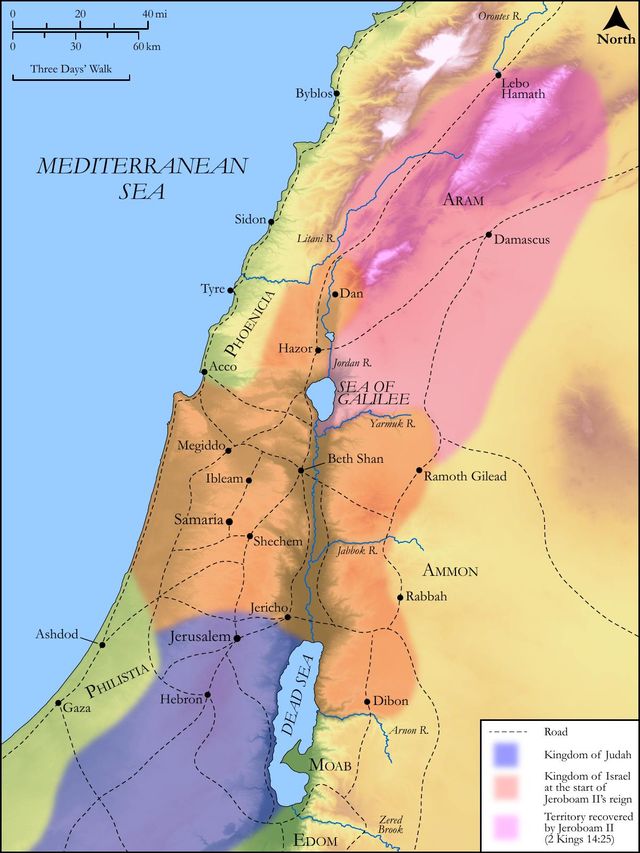
2.By providence. The event was according to the word of the Lord: his arms were successful; he restored the coast of Israel, recovered those frontier-towns and countries that lay from Hamath in the north to the sea of the plain, (that is, the sea of Sodom) in the south, all which the Syrians had possessed themselves of, v. 25. Two reasons are here given why God blessed them with those victories: - (1.) Because their distress was very great, which made them the objects of his compassion, v. 26. Though he saw not any signs of their repentance and formation, yet he saw their affliction, that it was very bitter. Those that lived in those countries which the enemies were masters of were miserably oppressed and enslaved, and could call nothing their own; the rest, we may suppose, were much impoverished by the frequent incursions the enemy made upon them to plunder them, and continually terrified by their threatenings, so that there was none shut up or left, both towns and countries were laid waste and stripped of their wealth, and no helper appeared. To this extremity were they reduced, in many parts of the country, in the beginning of Jeroboam's reign, when God, in mere pity to them, heard the cry of their affliction (for no mention is made here of the cry of their prayers), and wrought this deliverance for them by the hand of Jeroboam. Let those whose case is pitiable take comfort from the divine pity; we read of God's bowels of mercy (Isa 63:15; Jer 31:20) and that he is full of compassion, Psa 86:15. (2.) Because the decree had not yet gone forth for their utter destruction; he had not as yet said he would blot out the name of Israel (Kg2 14:27), and because he had not said it he would not do it. If this be understood of the dispersion of the ten tribes, he did say it and do it, for that name still remains under heaven in the gospel Israel, and will to the end of time; and because they, at present, bore that name which was to have this lasting honour, he showed them this favour, as well as for the sake of the ancient honour of that name, Kg2 13:23.
IV.Here is the conclusion of Jeroboam's reign.
We read (Kg2 14:28) of his might, and how he warred, but (Kg2 14:29) he slept with his fathers; for the mightiest must yield to death, and there is no discharge in that war. Many prophets there had been in Israel, a constant succession of them in every age, but none of the prophets had left any of their prophecies in writing till those of this age began to do it, and their prophecies are part of the canon of scripture. It was in the reign of this Jeroboam that Hosea (who continued very long a prophet) began to prophesy, and he was the first that wrote his prophecies; therefore the word of the Lord by him is called the beginning of the word of the Lord, Hos 1:2. Then that part of the word of the Lord began to be written. At the same time Amos prophesied, and wrote his prophecy, soon afterwards Micah, and then Isaiah, in the days of Ahaz and Hezekiah. Thus God never left himself without witness, but, in the darkest and most degenerate ages of the church, raised up some to be burning and shining lights in it to their own age by their preaching and living, and a few by their writings to reflect light upon us on whom the ends of the world have come.
Historical interpretation
Historical reception
1 surviving comment on this verse from the historical church.
“In the fifteenth year of King Amaziah son of Joash of Judah, King Jeroboam son of Joash of Israel began to reign in Samaria; he reigned forty-one years. He restored the border of Israel from Lebo-hamath as far as the Sea of the Arabah, according to the word of the Lord, the God of Israel, which he spoke by his servant Jonah son of Amittai, the prophet.” This is the same Jonah who preached the repentance of Nineveh. And the Sea of Arabah is the same that the Scripture calls elsewhere the “salt sea,” situated on the border with Canaan, of which the city of Hamath, beside the Mount Lebanon, is the other northern border. Jeroboam honored the prophet Jonah as his father had honored Elisha and recurred to his useful work, so that, being encouraged by his predictions and advice, was able to conquer back the cities occupied by the Syrians.
Continue studying 2 Kings 14:24 across the web’s major study libraries — every link below opens this exact verse, chapter, or book on the destination site.
Read & Compare
 BibleGatewayThis verse in more than 200 translations and 70 languages.
 Bible.comThe YouVersion reader — hundreds of translations, reading plans, and highlights.
 ESV.orgCrossway's official English Standard Version reader.
 NET BibleThe NET translation with 60,000+ translators' notes on every rendering decision.
 STEP BibleTyndale House's free study tool — original text, vocabulary, and scholarly resources.
 BibliaLogos Bible Software's free web reader.
 USCCBThe New American Bible (Revised Edition) with the U.S. bishops' study notes.
Commentaries
 BibleHub CommentariesDozens of classic commentaries on this verse, gathered on one page.
 StudyLightMore than 100 commentary sets — the largest collection on the web.
 BibleRefPlain-English commentary on what this verse means, verse by verse.
 Enduring WordDavid Guzik's free commentary on this chapter, widely used by Bible teachers.
 Bible Study ToolsVerse commentary alongside Greek and Hebrew study aids.
Original Language & Research
- BibleHub InterlinearThe verse word by word — original language, transliteration, and English.
- BibleHub LexiconEvery word's original-language definition and Strong's entry.
 Blue Letter BibleDeep-study tools — Strong's numbers, concordance, and word studies.
 SefariaThe Hebrew text with Rashi and centuries of Jewish commentary.
Sermons, Hymns & Audio


TrulyRandomVerse is not affiliated with these sites and doesn’t control their content. They’re linked because they’re genuinely useful.
Summary
Second Kings 14:24 delivers a concise yet profound theological assessment of King Jeroboam II, whose lengthy and outwardly prosperous reign over the Northern Kingdom of Israel was ultimately deemed a failure in the divine court. Despite significant military and economic achievements, the verse declares that "he did [that which was] evil in the sight of the LORD" because "he departed not from all the sins of Jeroboam the son of Nebat, who made Israel to sin." This recurring verdict underscores the biblical principle that worldly success is secondary to covenant faithfulness and obedience to God, revealing the persistent spiritual apostasy that plagued the Northern Kingdom.
CONTEXT
ShowHideExposition and Analysis
ShowHideKey Word Analysis
ShowHideThis term (H7451) is a comprehensive descriptor in the Old Testament, denoting not only moral wickedness but also anything that is displeasing, harmful, or contrary to God's will and covenant. In the context of the kings of Israel, it specifically signifies actions that violate the covenant relationship with Yahweh, particularly through idolatry and disobedience to His commands. It points to a profound spiritual misalignment with God's character and expectations for His people.
The phrase "departed not" (H5493, lo' sar) uses the negative particle lo' with the verb sar (to turn aside, remove, depart). This emphasizes Jeroboam II's deliberate and persistent refusal to change his course of action. It signifies a profound lack of repentance and a stubborn adherence to established sinful patterns, demonstrating a hardened heart and a continuation of the spiritual rebellion that plagued the Northern Kingdom.
This is a causative verb (H2398, Hiphil stem of châṭâʼ, "to miss" or "to sin"), meaning "caused to sin" or "led into sin." It highlights the active and direct role of the king in leading the nation astray. Jeroboam I's initial establishment of the golden calves was a deliberate act to secure his throne, and subsequent kings, including Jeroboam II, perpetuated this system, thereby actively maintaining the spiritual apostasy of the entire nation, not merely tolerating it.
Verse Breakdown
ShowHide"And he did [that which was] evil in the sight of the LORD"
This opening clause serves as the divine verdict on Jeroboam II's reign, immediately establishing God's perspective as the ultimate and unchallengeable standard of judgment. Despite any worldly successes, his actions were fundamentally contrary to God's character and covenant commands. This phrase is a recurring theological assessment in the Book of Kings, signaling a king's failure to uphold the exclusive worship of Yahweh.
"he departed not from all the sins of Jeroboam the son of Nebat"
This clause specifies the nature of Jeroboam II's evil: his unwavering adherence to the idolatrous practices initiated by Jeroboam I. These "sins" primarily refer to the establishment of golden calves at Bethel and Dan, the creation of an illegitimate priesthood, and alternative festivals, all designed to prevent the people from worshipping in Jerusalem. This phrase became a shorthand for the pervasive apostasy of the Northern Kingdom, signifying a deep-seated rejection of the covenant with Yahweh.
"who made Israel to sin"
This final clause clarifies the lasting and devastating impact of Jeroboam I's original sin. His actions were not merely personal transgressions but foundational acts that led the entire nation into idolatry. By perpetuating these sins, Jeroboam II, like his predecessors, continued to be an instrument of national spiritual corruption, demonstrating the profound and often generational consequences of unrighteous leadership.
Literary Devices
ShowHideThe passage employs several key literary devices to convey its powerful message. Formulaic Language is prominent, with the recurring phrase "he did [that which was] evil in the sight of the LORD" serving as a consistent evaluative framework for the kings of Israel, immediately signaling their spiritual failure. This is often paired with the specific Allusion to "the sins of Jeroboam the son of Nebat," which functions as a concise theological shorthand, instantly recalling the foundational idolatry of the Northern Kingdom and its persistent nature. This Repetition across the narratives of various kings underscores the deep-seated spiritual apostasy of Israel and the consistent divine judgment against it. Furthermore, there is a subtle Irony present: despite Jeroboam II's significant military and economic achievements detailed in the surrounding verses, the spiritual assessment in verse 24 prioritizes his failure to worship Yahweh alone, highlighting the stark contrast between human measures of success and God's ultimate standard of righteousness.
Theological and Thematic Connections
ShowHideThe condemnation of Jeroboam II in 2 Kings 14:24 underscores several enduring theological truths. It powerfully illustrates that God's ultimate standard for human conduct, especially for those in leadership, is not measured by worldly success, political stability, or economic prosperity, but by covenant faithfulness and exclusive devotion to Him. The persistent "sins of Jeroboam" highlight the insidious nature of idolatry, which often masquerades as practical politics or cultural tradition, yet fundamentally undermines the relationship with the one true God. This verse serves as a stark reminder that true worship demands undivided loyalty and that any deviation, even if seemingly minor or inherited, constitutes "evil in the sight of the LORD." It also emphasizes the profound responsibility of leaders, whose choices have far-reaching spiritual consequences, shaping the moral and spiritual trajectory of those they govern.
Reflection and Application
ShowHideThe spiritual assessment of Jeroboam II in 2 Kings 14:24 offers timeless and challenging lessons for contemporary believers. It compels us to look beyond outward appearances and worldly metrics of success, reminding us that true flourishing, in God's eyes, is defined by our faithfulness and obedience to Him, not by our material wealth, social status, or professional achievements. This verse calls us to a radical re-evaluation of what we truly value and pursue. Furthermore, the persistent nature of "the sins of Jeroboam" challenges us to examine our own lives and communities for inherited patterns of disobedience, spiritual compromise, or subtle forms of idolatry that may have become normalized over time. We are called to actively break these generational cycles, seeking God's grace for genuine repentance and transformation, rather than passively continuing in paths that are "evil in the sight of the LORD." Finally, for those in any position of influence—whether in family, church, workplace, or society—this verse serves as a solemn warning and a profound call to integrity. Our choices and examples have far-reaching spiritual consequences for those we lead, underscoring the vital importance of living a life of unwavering devotion to God, ensuring that our leadership guides others towards righteousness, not away from it.
Questions for Reflection
ShowHideFAQ
ShowHideWhat exactly were "the sins of Jeroboam the son of Nebat" that are so frequently condemned?
ShowHide"The sins of Jeroboam the son of Nebat" refer primarily to the religious innovations introduced by Jeroboam I after the division of the kingdom (c. 931 BC). To prevent his people from returning to Jerusalem for worship, which he feared would lead to their political allegiance shifting back to the Davidic dynasty, Jeroboam I established alternative cultic centers at Bethel and Dan. At these sites, he set up golden calves for the people to worship, declaring, "Here are your gods, O Israel, who brought you up out of the land of Egypt!" (1 Kings 12:28-30). He also appointed non-Levitical priests and instituted new festivals. These actions constituted a direct violation of the first two commandments, leading Israel into idolatry and syncretism, and became the defining spiritual apostasy by which all subsequent kings of the Northern Kingdom were judged.
Why is Jeroboam II condemned if he brought prosperity and restored Israel's borders, fulfilling prophecy?
ShowHideJeroboam II's condemnation highlights a crucial biblical principle: God's judgment is based on covenant faithfulness and spiritual obedience, not on political, economic, or military success. While Jeroboam II did indeed restore Israel's borders and usher in a period of prosperity, even fulfilling a prophecy through Jonah (2 Kings 14:25), these achievements did not negate his fundamental failure to lead the nation in true worship of Yahweh. The prosperity may have been a temporary reprieve, perhaps due to God's mercy despite their sin, or a natural consequence of the geopolitical landscape (e.g., Assyria's temporary weakness). However, God's ultimate concern was Israel's spiritual fidelity to the covenant (Deuteronomy 28), which Jeroboam II, like his predecessors, utterly failed to uphold by perpetuating the idolatry of the golden calves. His worldly success was ultimately hollow in the face of his spiritual rebellion.
Is this a common pattern in the Book of Kings, this kind of formulaic condemnation?
ShowHideYes, the formulaic condemnation of kings, particularly those of the Northern Kingdom, is a pervasive literary and theological device in the Book of Kings. For nearly every king of Israel, the recurring phrase "he did [that which was] evil in the sight of the LORD" followed by the specific indictment "he departed not from the sins of Jeroboam the son of Nebat, who made Israel to sin" serves as a consistent evaluative standard. This repetition powerfully underscores the deep-seated and persistent spiritual apostasy of the Northern Kingdom, which never truly turned back to exclusive worship of Yahweh. It highlights the Deuteronomistic theology that obedience to the covenant brings blessing, while disobedience, particularly idolatry, brings judgment and eventually, exile.
Christ-Centered Fulfillment
ShowHideThe spiritual failure of King Jeroboam II, who perpetuated the "sins of Jeroboam the son of Nebat" and "made Israel to sin," powerfully foreshadows the desperate need for a perfect King, one who would not lead His people astray but would guide them in righteousness. The consistent condemnation of Israel's kings for their idolatry and disobedience reveals humanity's pervasive tendency to turn from the true God and create idols, whether literal golden calves or the more subtle idols of prosperity, power, or self-reliance. Unlike Jeroboam II, whose reign, despite its worldly success, was spiritually bankrupt, Jesus Christ is the true and faithful King. He perfectly obeyed the Father, even to the point of death on a cross (Philippians 2:8), never departing from God's will. He is the Lamb of God who takes away the sin of the world, providing the ultimate sacrifice that cleanses us from the very idolatry and rebellion that characterized the kings of Israel. Through faith in Him, we are freed from the power of sin and enabled to worship God in spirit and truth, no longer bound by the generational patterns of disobedience. Jesus is the Good Shepherd who leads His sheep in paths of righteousness, establishing a kingdom not of this world, but one founded on righteousness, peace, and joy in the Holy Spirit, a stark contrast to the fleeting and spiritually compromised reign of Jeroboam II.