


2 Kings 14:23
Bible text: King James Version (1769 Blayney text) · Public domain
Bible text: King James Version with Strong's numbers · Public domain
Bible text: Berean Standard Bible · Public domain
Bible text: American Standard Version (1901) · Public domain
Bible text: World English Bible, Messianic edition · Public domain
Bible text: Geneva Bible (1599) · Public domain
Bible text: Young's Literal Translation · Public domain
- בִּשְׁנַתbish·Natin yearH8141Prep-b ¦ N-fscNoun Singular Feminine Constructבִּinשְׁנַתyear
- חֲמֵשׁcha·meshfif-H2568N-cscNoun Singular common gender Construct
- עֶשְׂרֵה'es·RehteenH6240N-csNoun Singular common gender Absolute
- שָׁנָהsha·NahyearH8141N-fsNoun Singular Feminine Absolute
- לַאֲמַצְיָהוּla·'a·matz·Ya·huof AmaziahH558Prep-l ¦ N-proper-mNoun Proper MasculineלַofאֲמַצְיָהוּAmaziah
- בֶןven[the] son ofH1121N-mscNoun Singular Masculine Construct
- יוֹאָשׁyo·'AshJoashH3101N-proper-mNoun Proper Masculine
- מֶלֶךְMe·lekh[the] king ofH4428N-mscNoun Singular Masculine Construct
- יְהוּדָהye·hu·DahJudahH3063N-properNoun Proper Location
- מָלַךְMa·lakhhe became kingH4427V-Qal-Perf-3msVerb Qal Perfect 3rd Singular Masculine
- יָרָבְעָםya·ra·ve·'AmJeroboamH3379N-proper-mNoun Proper Masculine
- בֶּןben[the] son ofH1121N-mscNoun Singular Masculine Construct
- יוֹאָשׁyo·'AshJoashH3101N-proper-mNoun Proper Masculine
- מֶלֶךְMe·lekh[the] king ofH4428N-mscNoun Singular Masculine Construct
- יִשְׂרָאֵלYis·ra·'ElIsraelH3478N-properNoun Proper Location
- בְּשֹׁמְרוֹןbe·Sho·me·Ronin SamariaH8111Prep-b ¦ N-properNoun Proper LocationבְּinשֹׁמְרוֹןSamaria
- אַרְבָּעִים'ar·ba·'ImfortyH705N-mpNoun Plural Masculine Absolute
- וְאַחַתve·'a·Chatand oneH259Conj-w ¦ N-fscNoun Singular Feminine Constructוְandאַחַתone
- שָׁנָהsha·Nahyear[s]H8141N-fsNoun Singular Feminine Absolute
English is a literal word-by-word gloss of the Hebrew, not the KJV's wording. Why?
This is the original text the KJV's translators worked from — each Hebrew word with its own literal English meaning in this verse, prepared by scholars at Tyndale House, Cambridge. The KJV translates whole sentences, not word by word, so its wording differs: one Hebrew word can become several English words, and the KJV may choose “the LORD” where the gloss reads “Yahweh”. Both are faithful — they answer different questions. For the KJV's own rendering, switch to the KJV text.
Details
See on the biblical-era maps
Study this verse
Public-domain commentary
Matthew Henry
From his Commentary on the Whole Bible. Henry comments on passages, not single verses — this entry covers 2 Kings 14:23–29. His two-level outline is real structure in the source text, so it is rendered as structure.
Here is an account of the reign of Jeroboam the second. I doubt it is an indication of the affection and adherence of the house of Jehu to the sins of Jeroboam the son of Nebat, who made Israel to sin, that they called an heir-apparent to the crown by his name, thinking that an honourable name which in the book of God is infamous and stigmatized as much as any.
I.His reign was long, the longest of all the reigns of the kings of Israel:
He reigned forty-one years; yet his contemporary Azariah, the king of Judah, reigned longer, even fifty-two years. This Jeroboam reigned just as long as Asa had done (Kg1 15:10), yet one did that which was good and the other that which was evil. We cannot measure men's characters by the length of their lives or by their outward prosperity. There is one event to the righteous and to the wicked.
II.His character was the same with that of the rest of those kings:
He did that which was evil (Kg2 14:24), for he departed not from the sins of Jeroboam; he kept up the worship of the calves, and never left that, thinking there was no harm in it, because it had been the way of all his ancestors and predecessors. But a sin is never the less evil in God's sight, whatever it is in ours, for its being an ancient usage; and a frivolous plea it will be against doing good, that we have been accustomed to do evil.
III.Yet he prospered more than most of them, for though, in that one thing, he did evil in the sight of the Lord, yet it is likely, in other respects, there was some good found in him and therefore God owned him,
1.By prophecy. He raised up Jonah the son of Amittai, a Galilean (so much were those mistaken that said, Out of Galilee ariseth no prophet, Joh 7:52), and by him intimated the purposes of his favour to Israel, notwithstanding their provocations, encouraged him and his kingdom to take up arms for the recovery of their ancient possessions, and (which would contribute not a little to their success) assured them of victory. It is a sign that God has not cast off his people if he continue faithful ministers among them; when Elisha, who strengthened the hands of Joash, was removed, Jonah was sent to encourage his son. Happy is the land that has a succession of prophets running parallel with a succession of princes, that the word of the Lord may endure for ever. Of this Jonah we read much in that little book of scripture that bears his name. It is probable that it was when he was a young man, and fit for such an expedition, that God sent him to Nineveh, and that it was when he had yet been but a little conversant with the visions of God that he flew off and fretted as he did; and, if so, this is an undoubted evidence of the forgiveness of his faults and follies, that he was afterwards employed as a messenger of mercy to Israel. A commission amounts to a pardon, and he that had himself found mercy, notwithstanding his provocations, could the better encourage them with the hope of mercy notwithstanding theirs. Some that have been foolish and passionate, and have gone about their work very awkwardly at first, yet afterwards have proved useful and eminent. Men must not be thrown away for every fault.
2.By providence. The event was according to the word of the Lord: his arms were successful; he restored the coast of Israel, recovered those frontier-towns and countries that lay from Hamath in the north to the sea of the plain, (that is, the sea of Sodom) in the south, all which the Syrians had possessed themselves of, v. 25. Two reasons are here given why God blessed them with those victories: - (1.) Because their distress was very great, which made them the objects of his compassion, v. 26. Though he saw not any signs of their repentance and formation, yet he saw their affliction, that it was very bitter. Those that lived in those countries which the enemies were masters of were miserably oppressed and enslaved, and could call nothing their own; the rest, we may suppose, were much impoverished by the frequent incursions the enemy made upon them to plunder them, and continually terrified by their threatenings, so that there was none shut up or left, both towns and countries were laid waste and stripped of their wealth, and no helper appeared. To this extremity were they reduced, in many parts of the country, in the beginning of Jeroboam's reign, when God, in mere pity to them, heard the cry of their affliction (for no mention is made here of the cry of their prayers), and wrought this deliverance for them by the hand of Jeroboam. Let those whose case is pitiable take comfort from the divine pity; we read of God's bowels of mercy (Isa 63:15; Jer 31:20) and that he is full of compassion, Psa 86:15. (2.) Because the decree had not yet gone forth for their utter destruction; he had not as yet said he would blot out the name of Israel (Kg2 14:27), and because he had not said it he would not do it. If this be understood of the dispersion of the ten tribes, he did say it and do it, for that name still remains under heaven in the gospel Israel, and will to the end of time; and because they, at present, bore that name which was to have this lasting honour, he showed them this favour, as well as for the sake of the ancient honour of that name, Kg2 13:23.
IV.Here is the conclusion of Jeroboam's reign.
We read (Kg2 14:28) of his might, and how he warred, but (Kg2 14:29) he slept with his fathers; for the mightiest must yield to death, and there is no discharge in that war. Many prophets there had been in Israel, a constant succession of them in every age, but none of the prophets had left any of their prophecies in writing till those of this age began to do it, and their prophecies are part of the canon of scripture. It was in the reign of this Jeroboam that Hosea (who continued very long a prophet) began to prophesy, and he was the first that wrote his prophecies; therefore the word of the Lord by him is called the beginning of the word of the Lord, Hos 1:2. Then that part of the word of the Lord began to be written. At the same time Amos prophesied, and wrote his prophecy, soon afterwards Micah, and then Isaiah, in the days of Ahaz and Hezekiah. Thus God never left himself without witness, but, in the darkest and most degenerate ages of the church, raised up some to be burning and shining lights in it to their own age by their preaching and living, and a few by their writings to reflect light upon us on whom the ends of the world have come.
Historical interpretation
Historical reception
1 surviving comment on this verse from the historical church.
“In the fifteenth year of King Amaziah son of Joash of Judah, King Jeroboam son of Joash of Israel began to reign in Samaria; he reigned forty-one years. He restored the border of Israel from Lebo-hamath as far as the Sea of the Arabah, according to the word of the Lord, the God of Israel, which he spoke by his servant Jonah son of Amittai, the prophet.” This is the same Jonah who preached the repentance of Nineveh. And the Sea of Arabah is the same that the Scripture calls elsewhere the “salt sea,” situated on the border with Canaan, of which the city of Hamath, beside the Mount Lebanon, is the other northern border. Jeroboam honored the prophet Jonah as his father had honored Elisha and recurred to his useful work, so that, being encouraged by his predictions and advice, was able to conquer back the cities occupied by the Syrians.
Continue studying 2 Kings 14:23 across the web’s major study libraries — every link below opens this exact verse, chapter, or book on the destination site.
Read & Compare
 BibleGatewayThis verse in more than 200 translations and 70 languages.
 Bible.comThe YouVersion reader — hundreds of translations, reading plans, and highlights.
 ESV.orgCrossway's official English Standard Version reader.
 NET BibleThe NET translation with 60,000+ translators' notes on every rendering decision.
 STEP BibleTyndale House's free study tool — original text, vocabulary, and scholarly resources.
 BibliaLogos Bible Software's free web reader.
 USCCBThe New American Bible (Revised Edition) with the U.S. bishops' study notes.
Commentaries
 BibleHub CommentariesDozens of classic commentaries on this verse, gathered on one page.
 StudyLightMore than 100 commentary sets — the largest collection on the web.
 BibleRefPlain-English commentary on what this verse means, verse by verse.
 Enduring WordDavid Guzik's free commentary on this chapter, widely used by Bible teachers.
 Bible Study ToolsVerse commentary alongside Greek and Hebrew study aids.
Original Language & Research
- BibleHub InterlinearThe verse word by word — original language, transliteration, and English.
- BibleHub LexiconEvery word's original-language definition and Strong's entry.
 Blue Letter BibleDeep-study tools — Strong's numbers, concordance, and word studies.
 SefariaThe Hebrew text with Rashi and centuries of Jewish commentary.
Sermons, Hymns & Audio


TrulyRandomVerse is not affiliated with these sites and doesn’t control their content. They’re linked because they’re genuinely useful.
Summary
This verse precisely chronicles the ascension of Jeroboam II to the throne of the Northern Kingdom of Israel, establishing his reign in Samaria during the fifteenth year of Amaziah, king of Judah. It notably records his exceptionally long rule of forty-one years, setting the stage for a period of significant national resurgence and prosperity for Israel, yet one paradoxically marked by profound spiritual decline and prophetic warnings. This chronological anchor is crucial for understanding the intertwined histories of the divided monarchy.
Context
ShowHideLiterary Context
2 Kings 14:23 is strategically positioned within the Books of Kings, a historical narrative detailing the reigns of the kings of both Judah and Israel. It immediately follows the account of King Amaziah of Judah, whose reign is extensively covered in 2 Kings 14:1-22, concluding with his assassination. This verse marks a significant shift in focus back to the Northern Kingdom, introducing Jeroboam II as the successor to his father, Joash, king of Israel (whose reign is detailed in 2 Kings 13:10-25). The mention of "Samaria" immediately identifies Jeroboam II as the ruler of the Northern Kingdom, whose capital it was. This precise chronological synchronism between the reigns of the kings of Judah and Israel is a consistent feature of the Books of Kings, providing a vital framework for understanding the parallel and often interconnected histories of the two nations. The verse thus serves as a pivotal point, preparing the reader for the detailed account of Jeroboam II's remarkably long and impactful rule that follows.
Historical & Cultural Context
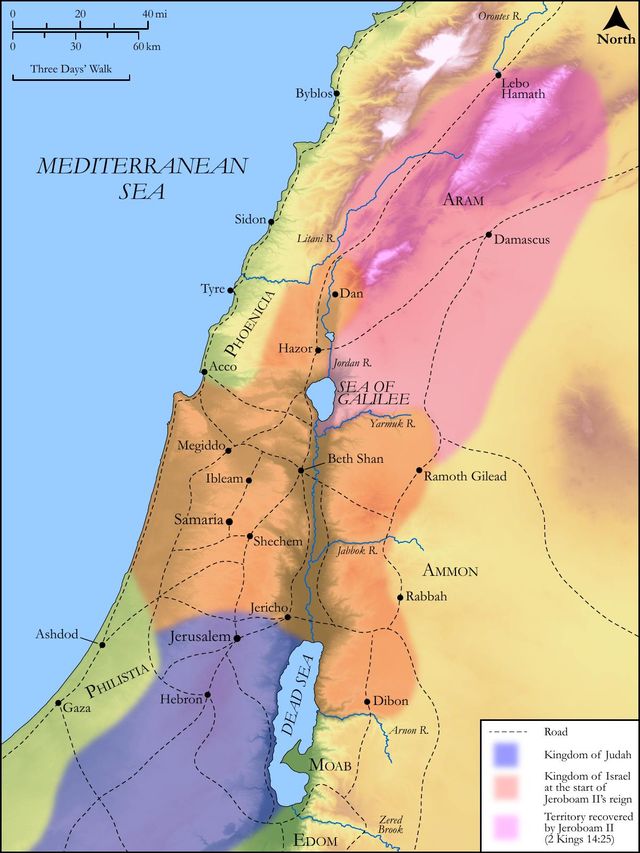
The era of Jeroboam II's reign (c. 793-753 BC) represented a unique and prosperous period for the Northern Kingdom of Israel. Historically, this time coincided with a temporary decline in the power of the Neo-Assyrian Empire, which had previously exerted immense pressure on the Syro-Palestinian region. This power vacuum allowed Israel to expand its borders significantly, reclaiming territories that had been lost, as explicitly prophesied and recorded in 2 Kings 14:25. Culturally, this expansion and the resulting peace led to unprecedented economic prosperity, fueled by increased trade and territorial control. However, this material wealth was often accompanied by severe injustice, the oppression of the poor, and widespread idolatry, particularly the worship of Baal and the golden calves established by Jeroboam I. These societal ills and spiritual compromises are vividly condemned by the prophets Amos and Hosea, who ministered during this very period, offering scathing critiques of Israel's moral and spiritual decay (e.g., Amos 2:6-8 and Hosea 4:1-2). Samaria, as the capital, became a symbol of both this outward prosperity and its accompanying inward corruption.
Key Themes
ShowHideThis verse contributes to several overarching themes within the Books of Kings and the broader biblical narrative. Firstly, it exemplifies the chronological precision employed by the biblical authors, meticulously dating the reigns of kings in both Judah and Israel to provide a coherent and verifiable historical record of God's interaction with His covenant people. Secondly, it subtly underscores the theme of divine sovereignty over human history, demonstrating that even the rise and fall of kings, regardless of their personal righteousness or unrighteousness, occurs within God's overarching plan and for His ultimate purposes (Daniel 2:21). Thirdly, by introducing Jeroboam II's long and prosperous reign, it implicitly sets up the profound tension between worldly success and spiritual health. While Jeroboam II brought significant material prosperity and national strength to Israel, his reign was fundamentally marked by continued spiritual apostasy, a stark reminder that outward success does not equate to divine favor or spiritual integrity. This tension is a recurring motif throughout the prophetic books and the historical narrative, particularly as the story progresses towards Israel's eventual exile due to its unfaithfulness.
Exposition and Analysis
ShowHideKey Word Analysis
ShowHideThis verb (H4427), meaning "to rule as king" or "to ascend the throne," is central to the Books of Kings, which chronicle the succession of monarchs and the nature of their rule. Its use here signifies the official commencement of Jeroboam II's authority and leadership over the Northern Kingdom. The repeated emphasis on kingship throughout these historical books highlights the human institution of monarchy within God's sovereign plan, underscoring both the power and the inherent limitations of earthly rulers.
The capital city of the Northern Kingdom of Israel (H8111), founded by Omri (1 Kings 16:24). By this point in Israel's history, Samaria had grown into a powerful and wealthy administrative and commercial center. However, it was also a notorious hub of idolatry, oppression, and moral corruption, frequently denounced by the prophets. Its mention in this verse immediately grounds Jeroboam II's rule in the heartland of the Northern Kingdom, a place emblematic of both national strength and profound spiritual compromise.
This noun (H8141), meaning "a year" or "a revolution of time," is crucial for the chronological framework of the Books of Kings. It appears multiple times in this verse, first in "fifteenth year" and then in "forty and one years." The precise counting of years for each king's reign underscores the meticulous historical record-keeping of the biblical authors. The exceptional duration of Jeroboam II's rule, noted in "forty and one years," signifies a period of unusual stability and influence for Israel, contrasting sharply with the often-turbulent and short reigns of many of his predecessors and successors.
Verse Breakdown
ShowHide"In the fifteenth year of Amaziah the son of Joash king of Judah"
This initial clause provides the precise chronological marker, synchronizing the beginning of Jeroboam II's reign with that of the contemporary king of Judah. This dating convention is a hallmark of the Books of Kings, crucial for the biblical historian to construct a coherent timeline of events across the divided kingdoms. It firmly places Jeroboam II's ascension within the broader historical narrative of both Israel and Judah.
"Jeroboam the son of Joash king of Israel began to reign in Samaria"
This segment identifies the new king of the Northern Kingdom, specifying his lineage and his capital city. The name "Jeroboam" immediately evokes the first king of the divided Northern Kingdom (Jeroboam I), a figure infamous for establishing the idolatrous worship of golden calves, thereby leading Israel into persistent sin. This naming might subtly foreshadow a continuation of the spiritual failures characteristic of the Northern Kingdom's leadership, despite the potential for national resurgence.
"[and reigned] forty and one years"
This final clause states the duration of Jeroboam II's rule. The exceptional length of his reign—forty-one years—is a key detail, indicating a significant period of stability, influence, and national strength for Israel. This longevity sets the stage for the subsequent narrative, which details the territorial expansion and material prosperity that occurred under his leadership, often in stark contrast to the spiritual decline that would eventually lead to severe prophetic warnings and divine judgment.
Literary Devices
ShowHideThe verse primarily functions as a Chronological Marker, a foundational literary device in the Books of Kings. It meticulously dates the commencement of Jeroboam II's reign by cross-referencing it with the reign of the contemporary king of Judah, Amaziah. This precise dating provides a clear historical framework for the reader, enabling the synchronization of events between the two kingdoms and highlighting the meticulous nature of the biblical record. Furthermore, the verse acts as a Framing Device, introducing a significant and extended period in Israel's history. By stating the remarkable length of Jeroboam II's reign upfront, it sets the stage for the subsequent narrative detailing his accomplishments and the complex spiritual climate of his era. There is also an element of subtle Foreshadowing in the mention of the "forty and one years," hinting at the substantial and impactful reign that is about to be described—a reign that would be characterized by both national resurgence and profound spiritual decay, as later elaborated by the prophets Amos and Hosea.
Theological and Thematic Connections
ShowHide2 Kings 14:23, while a seemingly straightforward historical record, carries significant theological weight. It underscores God's meticulous involvement in human history, even in the succession of kings who may not fully align with His will. The precise dating and the mention of a long reign for Jeroboam II, a king "who did evil in the eyes of the Lord" (2 Kings 14:24), illustrate the paradox of divine sovereignty: God permits and even orchestrates the rise and fall of leaders for His purposes, sometimes granting prosperity even to the unrighteous, to fulfill His larger redemptive plan or to demonstrate His patience. This period of national strength under Jeroboam II, despite spiritual apostasy, serves as a powerful reminder that worldly success is not always an indicator of divine approval or spiritual health. The true measure of a nation or leader, from a biblical perspective, is faithfulness to God's covenant and the pursuit of justice and righteousness.
Reflection and Application
ShowHideThe seemingly dry historical data of 2 Kings 14:23 offers profound insights for contemporary reflection and application. It reminds us that God's hand is actively at work in the grand sweep of history, orchestrating the reigns of leaders, even those who do not acknowledge Him or walk in His ways. Jeroboam II's long and prosperous reign, despite his spiritual failings, serves as a sobering caution: material success or national strength does not automatically equate to divine blessing or spiritual integrity. In our own lives and societies, we must guard against equating worldly prosperity with spiritual health. Are we, like Jeroboam's Israel, experiencing outward success while our hearts or communities drift from God's commands and justice? This verse calls us to look beyond superficial indicators and to prioritize righteousness, justice, and faithful adherence to God's word, recognizing that true flourishing is found not in accumulated wealth or power, but in a right relationship with the Creator and obedience to His will. It challenges us to examine our own priorities and to ensure that our pursuit of success is always tempered by a commitment to spiritual integrity.
Questions for Reflection
ShowHideFAQ
ShowHideWhy is the precise dating of Jeroboam II's reign so important in this verse?
ShowHideThe precise dating of Jeroboam II's reign, synchronized with the fifteenth year of Amaziah of Judah, is crucial for several reasons. Firstly, it provides a vital chronological anchor for the biblical narrative, allowing historians and readers to accurately place events within the broader timeline of the divided monarchy. The Books of Kings consistently use this method to interweave the histories of Judah and Israel, creating a coherent and verifiable historical record. Secondly, it underscores the historical reliability and meticulous attention to detail of the biblical authors in documenting the succession of kings. Finally, it sets the stage for understanding the interconnectedness of the two kingdoms, even in their separation, as their destinies often influenced one another. This chronological precision allows for a fuller appreciation of the prophetic messages delivered during this era, such as those of Amos and Hosea, who ministered during Jeroboam II's long and impactful reign, addressing the specific spiritual and social conditions of that time.
Christ-Centered Fulfillment
ShowHideThe historical account of Jeroboam II's reign, introduced in 2 Kings 14:23, finds its ultimate theological fulfillment in the person and work of Jesus Christ. While Jeroboam II brought a temporary period of prosperity and territorial expansion to Israel, his rule, like all human kingships, was ultimately flawed and transient, marked by continued spiritual apostasy and leading eventually to national judgment. This highlights the inherent limitations of earthly kings and their inability to bring about true, lasting salvation or spiritual restoration. The longing for a perfect, righteous king who would not merely restore borders but heal the heart and establish an eternal kingdom is a pervasive theme throughout the Old Testament. Jesus Christ is the ultimate fulfillment of this longing. He is the true King, not of a temporal kingdom like Israel, but of an eternal, spiritual kingdom (John 18:36). Unlike Jeroboam II, who "did evil in the sight of the Lord" (2 Kings 14:24), Jesus is the perfectly righteous King who perfectly obeyed the Father (Hebrews 4:15). His reign brings not just material prosperity, but spiritual abundance, forgiveness of sins, and eternal life (John 10:10). The temporary nature of Jeroboam's "forty and one years" contrasts sharply with Christ's eternal reign, "of His kingdom there will be no end" (Luke 1:33). Thus, the historical record of Jeroboam II serves as a backdrop, pointing to the essential need for and ultimate glory of the perfect, everlasting reign of Christ.