


Jonah 1:1
Bible text: King James Version (1769 Blayney text) · Public domain
Bible text: Berean Standard Bible · Public domain
Bible text: American Standard Version (1901) · Public domain
Bible text: World English Bible, Messianic edition · Public domain
Bible text: Geneva Bible (1599) · Public domain
Bible text: Young's Literal Translation · Public domain
- וַיְהִיvay·Hiand it cameH1961Conj-w ¦ V-Qal-ConsecImperf-3msVerb Qal Consecutive Imperfect 3rd Singular Masculineוַandיְהִיit came
- דְּבַרde·var[the] word ofH1697N-mscNoun Singular Masculine Construct
- יְהוָהYah·wehYahwehH3068N-properNoun Proper Title
- אֶל'eltoH413PrepPreposition
- יוֹנָהyo·NahJonahH3124N-proper-mNoun Proper Masculine
- בֶןven[the] son ofH1121N-mscNoun Singular Masculine Construct
- אֲמִתַּי'a·mi·TaiAmittaiH573N-proper-mNoun Proper Masculine
- לֵאמֹרle·Mor<to> sayingH559Prep-l ¦ V-Qal-InfVerb Qal Infinitive Constructלֵ<to>אמֹרsaying
English is a literal word-by-word gloss of the Hebrew, not the KJV's wording. Why?
This is the original text the KJV's translators worked from — each Hebrew word with its own literal English meaning in this verse, prepared by scholars at Tyndale House, Cambridge. The KJV translates whole sentences, not word by word, so its wording differs: one Hebrew word can become several English words, and the KJV may choose “the LORD” where the gloss reads “Yahweh”. Both are faithful — they answer different questions. For the KJV's own rendering, switch to the KJV text.
Details
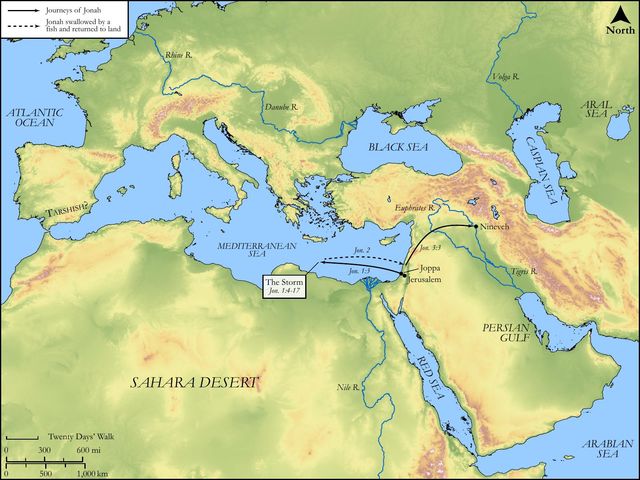
See on the biblical-era map
Study this verse
Public-domain commentary
Matthew Henry
From his Commentary on the Whole Bible. Henry comments on passages, not single verses — this entry covers Jonah 1:1–3.
Observe, 1. The honour God put upon Jonah, in giving him a commission to go and prophesy against Nineveh. Jonah signifies a dove, a proper name for all God's prophets, all his people, who ought to be harmless as doves, and to mourn as doves for the sins and calamities of the land. His father's name was Amittai - My truth; for God's prophets should be sons of truth. To him the word of the Lord came - to him it was (so the word signifies), for God's word is a real thing; men's words are but wind, but God's words are substance. He has been before acquainted with the word of the Lord, and knew his voice from that of a stranger; the orders now given him were, Arise, go to Nineveh, that great city, Jon 1:2. Nineveh was at this time the metropolis of the Assyrian monarchy, an eminent city (Gen 10:11), a great city, that great city, forty-eight miles in compass (some make it much more), great in the number of the inhabitants, as appears by the multitude of infants in it (Jon 4:11), great in wealth (there was no end of its store, Nah 2:9), great in power and dominion; it was the city that for some time ruled over the kings of the earth. But great cities, as well as great men, are under God's government and judgment. Nineveh was a great city, and yet a heathen city, without the knowledge and worship of the true God. How many great cities and great nations are there that sit in darkness and in the valley of the shadow of death! This great city was a wicked city: Their wickedness has come up before me (their malice, so some read it); their wickedness was presumptuous, and they sinned with a high hand. It is sad to think what a great deal of sin is committed in great cities, where there are many sinners, who are not only all sinners, but making one another sin. Their wickedness has come up, that is, it has come to a high degree, to the highest pitch; the measure of it is full to the brim; their wickedness has come up, as that of Sodom, Gen 18:20, Gen 18:21. It has come up before me - to my face (so the word is); it is a bold and open affront to God; it is sinning against him, in his sight; therefore Jonah must cry against it; he must witness against their great wickedness, and must warn them of the destruction that was coming upon them for it. God is coming forth against it, and he sends Jonah before, to proclaim war, and to sound an alarm. Cry aloud, spare not. He must not whisper his message in a corner, but publish it in the streets of Nineveh; he that hath ears let him hear what God has to say by his prophet against that wicked city. When the cry of sin comes up to God the cry of vengeance comes out against the sinner. He must go to Nineveh, and cry there upon the spot against the wickedness of it. Other prophets were ordered to send messages to the neighbouring nations, and the prophecy of Nahum is particularly the burden of Nineveh; but Jonah must go and carry the message himself: "Arise quickly; apply thyself to the business with speed and courage, and the resolution that becomes a prophet; arise, and go to Nineveh." Those that go on God's errands must rise and go, must stir themselves to the work cut out for them. The prophets were sent first to the lost sheep of the house of Israel, yet not to them only; they had the children's bread, but Nineveh eats of the crumbs. 2. The dishonour Jonah did to God in refusing to obey his orders, and to go on the errand on which he was sent (Jon 1:3): But Jonah, instead of rising to go to Nineveh, rose up to flee to Tarshish, to the sea, not bound for any port, but desirous to get away from the presence of the Lord; and, if he might but do that, he card not whither he went, not as if he thought he could go any where from under the eye of God's inspection, but from his special presence, from the spirit of prophecy, which, when it put him upon this work, he thought himself haunted with, and coveted to get out of the hearing of. Some think Jonah went upon the opinion of some of the Jews that the spirit of prophecy was confined to the land of Israel (which in Ezekiel and Daniel was effectually proved to be a mistake), and therefore he hoped he should get clear of it if he could but get out of the borders of that land. (1.) Jonah would not go to Nineveh to cry against it either because it was a long and dangerous journey thither, and in a road he knew not, or because he was afraid it would be as much as his life was worth to deliver such an ungrateful message to that great and potent city. He consulted with flesh and blood, and declined the embassy because he could not go with safety, or because he was jealous for the prerogatives of his country, and not willing that any other nation should share in the honour of divine revelation; he feared it would be the beginning of the removal of the kingdom of God from the Jews to another nation, that would bring forth more of the fruits of it. He owns himself (Jon 4:2) that the reason of his aversion to this journey was because he foresaw that the Ninevites would repent, and God would forgive them and take them into favour, which would be a slur upon the people of Israel, who had been so long a peculiar people to God. (2.) He therefore went to Tarshish, to Tarsus in Cilicia (so some), probably because he had friends and relations there, with whom he hoped for some time to sojourn. He went to Joppa, a famous seaport in the land of Israel, in quest of a ship bound for Tarshish, and there he found one. Providence seemed to favour his design, and give him an opportunity to escape. We may be out of the way of duty and yet may meet with a favourable gale. The ready way is not always the right way. He found the ship just ready to weigh anchor perhaps, and to set sail for Tarshish, and so he lost no time. Or, perhaps, he went to Tarshish because he found the ship going thither; otherwise all places were alike to him. He did not think himself out of his way, the way he would go, provided he was not in his way, the way he should go. So he paid the fare thereof; for he did not regard the charge, so he could but gain his point, and get to a distance from the presence of the Lord. He went with them, with the mariners, with the passengers, with the merchants, whoever they were that were going to Tarshish. Jonah, forgetting his dignity as well as his duty, herded with them, and went down into the ship to go with them to Tarshish. See what the best of men are when God leaves them to themselves, and what need we have, when the word of the Lord comes to us, to have the Spirit of the Lord come along with the word, to bring every thought within us into obedience to it. The prophet Isaiah owns that therefore he was not rebellious, neither turned away back, because God not only spoke to him, but opened his ear, Isa 50:5. Let us learn hence to cease from man, and not to be too confident either of ourselves or others in a time of trial; but let him that thinks he stands take heed lest he fall.
Historical interpretation
Six Centuries of Reception
9 surviving comments on this verse. Each one is dated, so this reads as a timeline rather than a list.
Select a marker to jump to its quote. Markers stagger vertically where authors wrote within a few decades of each other.
In trying to run away from the Lord, you show up the fickleness of all who plan flight. A certain headstrong prophet also had run away from the Lord, crossing the sea from Joppa to Tarsus, as if he could escape from God. But God found him not on land or on sea but in the belly of a beast, where for three days he could not die or even in that way escape from the eyes of God. Is that man not better off who, though he fears the enemy of God, does not flee from but despises him? Who trusts in the protection of God or, if you will, has an even greater fear of God, having stood the longer in his eyes? He says, “He is the Lord, he is mighty, all things are his, and wherever I shall be I am in his hands. Let him do what he will, I shall not run away. If he wishes me to die, let him destroy me, as long as I faithfully serve him. Much would I rather bring odium on him, by dying according to his will, than to live by my own cowardice.”
The history of Jonah contains a great mystery. For it seems that the whale signifies Time, which never stands still, but is always going on, and consumes the things which are made by long and shorter intervals. But Jonah, who fled from the presence of God, is himself the first man who, having transgressed the law, fled from being seen naked of immortality, having lost through sin his confidence in the Deity. And the ship in which he embarked, and which was tempest-tossed, is this brief and hard life in the present time; just as though we had turned and removed from that blessed and secure life, to that which was most tempestuous and unstable, as from solid land to a ship. For what a ship is to the land, that our present life is to that which is immortal. And the storm and the tempests which beat against us are the temptations of this life, which in the world, as in a tempestuous sea, do not permit us to have a fair voyage free from pain, in a calm sea, and one which is free from evils. And the casting of Jonah from the ship into the sea, signifies the fall of the first man from life to death, who received that sentence because, through having sinned, he fell from righteousness: "Dust thou art, and unto dust shalt thou return," [Gen. iii. 19]. And his being swallowed by the whale signifies our inevitable removal by time. For the belly in which Jonah, when he was swallowed, was concealed, is the all-receiving earth, which receives all things which are consumed by time.
Jonah knew better than anyone the purpose of his message to the Ninevites and that, in planning his flight, although he changed his location, he did not escape from God. Nor is this possible for anyone else, either by concealing himself in the bosom of the earth, or in the depths of the sea, or by soaring on wings, if there be any means of doing so, and rising into the air, or by abiding in the lowest depths of hell, or by any other of the many devices for ensuring escape. For God alone of all things cannot be escaped from or contended with. If he wills to seize and bring them under his hand, he outstrips the swift. He outwits the wise. He overthrows the strong. He cuts down the lofty. He subdues rashness. He resists power.
But there Jonah calls upon God, and marvelous as it is, on the third day, he, like Christ, is delivered.… In my own case, what could be said? What defense could be made if I remained unsettled and rejected the yoke of ministry, which, though I know not whether to call it light or heavy, had at any rate been laid upon me.… On this account I had much toilsome consideration to discover my duty, being set in the middle between two fears, of which the one held me back and the other urged me on. For a long while I was at a loss between them. After wavering from side to side, and, like a current driven by inconstant winds, inclining first in this direction then in that, I at last yielded to the stronger. The fear of disobedience overcame me.
What then is the story, and wherein lies its application? For, perhaps, it would not be amiss to relate it, for its general validation. Jonah also was fleeing from the face of God, or rather, thought that he was fleeing. But he was overtaken by the sea, and the storm, and the lot, and the whale’s belly, and the three days’ entombment. All this is a type of a greater mystery. He fled from having to announce the dread of the awful message to the Ninevites and from being subsequently, if the city was saved by repentance, convicted of falsehood. It was not that he was displeased at the salvation of the wicked, but he was ashamed of being made an instrument of falsehood and exceedingly zealous for the credit of prophecy, which was in danger of being destroyed in his own person. Indeed most would be unable to penetrate the depth of the divine dispensation in such cases.
"Now the word of the LORD came unto Jonah the son of Amittai, saying, Arise, go to Nineveh, that great city, and cry against it; for their wickedness is come up before me." Apart from that which the Septuagint translates as, "the noise of their wickedness has risen up even to me", it has translated the rest similarly. Jonah is sent to the gentiles to condemn Israel, because Nineveh had to repent, but the Israelites still persisted in their sin. And when God says, "their wickedness has come up to me", or "the noise of their wickedness…" it is exactly the text of Genesis: "the noise of Sodom and of Gomorrah is very loud" [Gen. 18:20], and to Cain: "the blood of your brother cries to me from the earth" [Gen. 4:10]. According to tropology the Lord, our Jonah, that is to say 'dove' or 'suffering', (he is given both meaning, either because the Holy Spirit descends in the form of a dove and stays with him [Mark. 1:10; Luke 3:22; John 1:32-33], or because he has suffered for our wounds, wept for Jerusalem [Luke 19:41], and because we have been cured by his malice [Is. 53:5]) is truly the son of Truth, for God is Truth [John 14:6]. He is sent to Nineveh the beautiful, that is to the world, where there is nothing more beautiful to our eyes than flesh. In Greek the idea of adornment is in the word cosmos. And when everything had been completed, each one by one, it was said, "and God saw that it was good" [Gen. 1:10]. It is to Nineveh that he goes, the great city, so that although Israel has not wanted to listen, the whole world of peoples will hear God's word. And this is because their wickedness has gone up to God. For although God had made the most beautiful house for man who was devoted to serving his creator, man deprived himself of this by his own will; from childhood his heart fixed upon wickedness [Gen. 8:21; 6:5]. He turned his face to the heaven [Ps. 72:9] and constructed a tower of pride [Gen 11]. He deserves then God to come down to him so that he may be able to rise to heaven by the destruction of repentance, he that did not succeed by the swell of pride.
About three years have now passed since I first started writing the commentaries on the five Prophets, Micah, Nahum, Habakkuk, Zephaniah, and Haggai. Detained by another work, I was not able to finish what I had undertaken. For I was writing a book on famous men and two volumes against Jovinian, an apology and an essay on 'the best way to translate', which was addressed to Pammachius, two books to or about Nepotian, and other works which it would be lengthy to recount. Therefore I retake up my commentaries with Jonah after such a long absence. Jonah, a type of Saviour, who prefiguring the resurrection of the Lord by spending "three days and three nights in the belly of a whale" [Mt. 12:40], was able to attain the first ardour so that we might deserve the arrival of the Holy Spirit to us. If indeed Jonah is to be translated as 'dove', and if the dove can be seen as the Holy Spirit, then we can also interpret the Dove as signifying the dove's entrance into us. I know that some classical authors, both Latin and Greek, have spoken much about this book, and through all of their Questions have less enlightened than obscured the ideas, so that in effect their interpretation needs to be interpreted and with the result that the reader comes away feeling less sure of the meaning than beforehand. I am not saying this to criticise these great minds, to abase others in order to extol myself, but rather because it is the place of the commentator to clarify in short and clearly what is obscure; they should be less concerned with displaying their eloquence than with explaining the meaning of the author. We ask therefore where else the prophet Jonah appears in the Holy Scriptures apart from this book and the allusion made to him by the Lord in the Gospels [Mt. 12:39, Luke 11:30]. And if I am not mistaken he is mentioned in the book of Kings in this way: "in the fifth year of Amasiah, the son of Joash, King of Judah, began to rule the son of Jeroboam son of Joash King of Israel in Samaria, for forty-one years. He did much wickedness before the Lord and did not distance himself from all the sins of Jeroboam, son of Nebat, who caused Israel to sin. He re-established the frontier of Israel in Samaria from the entrance of Emathia to the Sea of Solitude, according to the word of the Lord God of Israel, which was spoken by the mouth of his servant Jonah, son of Amittai the prophet, from Gath which is in Ofer." [4 Kings 14:23-25] The Hebrews recount that he was the son of the widow of Sarepta, incited by the prophet Elijah; his mother later said to him, "I know now that you are indeed a man of God, and that the word of God is truly in your mouth" [3 Kings 17:24]; on account of this the child was called Truth. For Amittai in Hebrew can be rendered 'truth' in our language, and because Elijah spoke true, he who was encouraged was called the son of Truth. And Gath is located two miles from Sepphoris, which is now called Diocaesarea, when you are travelling to Tiberia: there is a small castle where his tomb can be seen. Others, however, prefer to place his birth and tomb near Diospolis, which is in Lydia. They do not see that when he writes 'Ofer', this is to distinguish Gath from other towns of this name that can be seen now near to Eleutheropolis or Diospolis. The book of Tobit, though not in the canon, is all the same used by the men of the Church, and it mentions Jonah when Tobit says to his son, "my son, I am old and ready to leave this life. Take your sons and go to Media, my son. For I know what the prophet Jonah has said about Nineveh: she will be destroyed" [Tob. 14:3]. And, indeed, according to the Hebrew and Greek historians, Herodotus in particular, we read that Nineveh was destroyed in the time of King Josiah according to the Hebrews, and King Astyage of the Medians. From this we understand that in the past Jonah predicted that the Ninivites would repent and seek pardon; but afterwards, as they persisted in their sins,they brought the judgement of God upon themselves. The Hebrew tradition is that Hosea, Amos, Isaiah and Jonah prophesied at the same time. This is historical tradition. Not forgetting the others of course: the venerable Pope Chromatius, who took great pains to recount to the Saviour the story of the prophet: he flees, he sleeps, he is thrown into the sea, he is swallowed by a whale, thrown back onto the shore and prays for repentance. And saddened by the safety of this town of many people, he finds comfort in the shade of a fig tree. There he is reproached by God for having taken more care of a green vine which had dried up, than of such a great number of men, and the other details I will try to explain in this volume. But to grasp the complete meaning of the prophet in this short preface there is no better interpretation than that which inspired the prophets and which marked out the lines of the truth of the future for its servants. He therefore speaks to the Jews who do not believe his words and are ignorant of Christ, the son of God: "the men of Nineveh will rise up at the time of judgement with that generation and they will condemn it, for they repented as Jonah required, and here there is more than Jonah!" [Mt. 12:41]. The generation of the Jews is condemned, while the world has faith and Nineveh repents, Israel the disbeliever dies. The Jews have the books themselves, we have the Lord of books; they hold the prophets, we have an understanding of the prophets; "the letter kills them", "the spirit makes us live" [2 Cor. 3:6]; with them Barabbas the robber is released, for us Christ the Son of God is freed.
The Divinely inspired Jonah was the son of Amittai, and came from Gath-hepher, a little city or town of the land of the Jews, so the story goes.
You could find Jonah uttering a great number of oracles to the Jewish people, transmitting the words from God on high and clearly foretelling the future. Though no other prophetic text from him is extant than this one, though, the divinely inspired Scripture confirms that he continued predicting to the Jewish masses what would happen in the future times.
The Hebrews say that Jonah was the son of a widow in Zarephath; Elijah raised him from the dead, and when he had been returned to his mother, she gave thanks, and said, "Now by this I know that you are a man of the Lord, and the word of the Lord in your mouth is true." (1Kings 17:24)
HAIMO They say that Jonah's grave is in Geth, which is in Ophir. Others speak of his birth and burial in Lydda, that is, Diospolis.
Continue studying Jonah 1:1 across the web’s major study libraries — every link below opens this exact verse, chapter, or book on the destination site.
Read & Compare
 BibleGatewayThis verse in more than 200 translations and 70 languages.
 Bible.comThe YouVersion reader — hundreds of translations, reading plans, and highlights.
 ESV.orgCrossway's official English Standard Version reader.
 NET BibleThe NET translation with 60,000+ translators' notes on every rendering decision.
 STEP BibleTyndale House's free study tool — original text, vocabulary, and scholarly resources.
 BibliaLogos Bible Software's free web reader.
 USCCBThe New American Bible (Revised Edition) with the U.S. bishops' study notes.
Commentaries
 BibleHub CommentariesDozens of classic commentaries on this verse, gathered on one page.
 StudyLightMore than 100 commentary sets — the largest collection on the web.
 BibleRefPlain-English commentary on what this verse means, verse by verse.
 Enduring WordDavid Guzik's free commentary on this chapter, widely used by Bible teachers.
 Bible Study ToolsVerse commentary alongside Greek and Hebrew study aids.
Original Language & Research
- BibleHub InterlinearThe verse word by word — original language, transliteration, and English.
- BibleHub LexiconEvery word's original-language definition and Strong's entry.
 Blue Letter BibleDeep-study tools — Strong's numbers, concordance, and word studies.
 SefariaThe Hebrew text with Rashi and centuries of Jewish commentary.
Sermons, Hymns & Audio


TrulyRandomVerse is not affiliated with these sites and doesn’t control their content. They’re linked because they’re genuinely useful.
Summary
The book of Jonah commences with a direct and authoritative declaration of divine initiative: "Now the word of the LORD came unto Jonah the son of Amittai, saying." This foundational verse immediately establishes God as the sovereign initiator of the narrative, highlighting His active engagement with humanity through prophetic revelation and setting the stage for the dramatic and unique account of a prophet's call, disobedience, and the surprising extension of divine mercy.
Context
ShowHideLiterary Context
Jonah 1:1 serves as the crucial opening to a unique prophetic book. Unlike most prophetic literature, which primarily consists of oracles and messages delivered by the prophet, the Book of Jonah is largely a narrative about the prophet himself. This verse introduces the central character, Jonah, and immediately establishes the divine origin of the mission that will drive the entire story. The phrase "the word of the LORD came" is a standard prophetic formula, signaling a direct, authoritative divine communication, akin to the openings of other prophetic books. This sets the expectation for a divine message, though the content of that message and Jonah's subsequent response are deferred to Jonah 1:2 and beyond. The structure of the book, beginning with this divine call, emphasizes God's sovereignty as the primary mover in the unfolding drama.
Historical & Cultural Context
Jonah, identified as "the son of Amittai," is a historical figure also mentioned in 2 Kings 14:25. This passage places him as a prophet from Gath-hepher, a town in Zebulun, who prophesied during the reign of King Jeroboam II of Israel (c. 793–753 BC). This makes Jonah one of the earliest writing prophets, predating Amos and Hosea. His ministry occurred during a period of relative prosperity and national expansion for Israel, but also one of moral and spiritual decline. The command to go to Nineveh, the capital of Assyria, is highly significant. Assyria was a brutal and feared empire, a major oppressor of Israel. For a Hebrew prophet to be commanded to preach repentance to such an enemy would have been deeply shocking and culturally offensive, challenging the prevailing nationalistic and ethnocentric views of God's covenant people.
Key Themes
ShowHideThis opening verse introduces several overarching themes that permeate the book. Foremost is the theme of Divine Commission and Revelation, as God's "word" directly "came" to Jonah, signifying an undeniable and authoritative call to service. This highlights God's active involvement in human affairs and His choice of specific individuals to carry out His will. Closely related is the theme of God's Sovereignty, as the LORD is presented as the primary actor, initiating the events of the book and demonstrating His supreme authority over all creation and all nations. Finally, the verse subtly introduces the theme of Prophetic Responsibility, as Jonah is presented as the recipient of this divine word, setting the stage for his unique and ultimately reluctant response to God's command, a deviation from the typical portrayal of prophets who readily accept their call, as seen in Isaiah 6:8 or Jeremiah 1:6-7.
Exposition and Analysis
ShowHideKey Word Analysis
ShowHideThis term signifies more than just spoken sound; it encompasses a matter, thing, business, or command. In this context, "the word of the LORD" implies an authoritative utterance that carries divine purpose, instruction, and the power to bring about what it declares. It is God's active communication, initiating a specific task or revelation.
This is the sacred, covenantal name of God, often transliterated as Yahweh. It denotes the self-existent, eternal God who is faithful to His promises and actively involved in the affairs of His creation and His people. Its use here emphasizes that the command to Jonah comes from the ultimate, sovereign authority, the God of Israel, who is also the God of all nations.
The name means "dove." This is profoundly ironic given the prophet's character and actions throughout the book. While a dove often symbolizes peace, purity, or a messenger (as in Noah's ark, Genesis 8:8-12), Jonah's initial response is anything but peaceful or compliant. His name subtly foreshadows the contrast between his rebellious nature and the divine message of peace and mercy he is called to deliver.
Verse Breakdown
ShowHide"Now the word of the LORD came"
This opening phrase, a common prophetic formula, immediately establishes the divine origin and authority of the message. It signifies a direct, undeniable, and active communication from God, initiating the entire narrative. The use of "LORD" (Yahweh) emphasizes that this is the covenant God of Israel, whose word carries ultimate weight and purpose.
"unto Jonah the son of Amittai,"
This clause identifies the specific recipient of the divine word. Jonah is not a generic figure but a named individual, further identified by his father's name, Amittai. This grounding in historical reality underscores the authenticity of the prophetic call, even for such an unusual narrative. The personal address highlights God's particular choice and commissioning of this specific prophet.
"saying,"
This final word indicates that the communication is not merely an internal impression but a direct, verbal command or message that follows. It sets up the expectation for the content of God's word, which is revealed in the subsequent verse, detailing the specific mission God has for Jonah.
Literary Devices
ShowHideJonah 1:1 masterfully employs several literary devices to set the tone and introduce the narrative. The most prominent is the Prophetic Formula, "Now the word of the LORD came," which immediately signals to the reader that this is a divine revelation and that the events that follow are divinely ordained. This formula is a staple in prophetic literature, lending authority and gravitas to the message. There is also a subtle use of Irony in the naming of the prophet; Jonah, whose name means "dove" (a symbol of peace or messenger), is introduced as the recipient of a divine command that he will vehemently resist, directly contrasting with the typical symbolism associated with his name. Furthermore, the verse functions as a powerful Introduction, efficiently setting the scene by identifying the divine initiator, the human recipient, and the nature of the interaction (a direct command), thereby launching the entire story with conciseness and impact.
Theological and Thematic Connections
ShowHideJonah 1:1 powerfully asserts the foundational theological truth that God is a God who speaks and actively intervenes in human history. His word is not passive but dynamic, carrying authority and purpose, initiating His redemptive plan. This verse underscores the concept of divine election and commissioning, where God sovereignly chooses individuals to be His messengers, regardless of their personal inclinations or perceived suitability. It also implicitly introduces the theme of God's universal concern, as the subsequent verses will reveal His command to Jonah regarding the Gentile city of Nineveh, foreshadowing a broader scope of divine mercy beyond Israel.
Reflection and Application
ShowHideJonah 1:1 serves as a profound reminder that our journey of faith often begins with a divine initiative, a "word of the LORD" that comes to us. Just as God called Jonah, He continues to call individuals today into various forms of service, whether it's a specific ministry, a challenging act of obedience, or simply a deeper walk with Him. This verse prompts us to cultivate an attentive ear and a responsive heart to God's voice, recognizing that His commands may sometimes push us beyond our comfort zones, challenge our prejudices, or require us to step into uncomfortable situations. The initial call to Jonah, though simple in its phrasing, carries immense weight, signifying that all genuine spiritual endeavor flows from God's sovereign command. We are invited to consider: Are we listening for God's word in our lives? Are we prepared to respond, even when His instructions seem counter-intuitive or demand a sacrifice of our own desires?
Questions for Reflection
ShowHideFAQ
ShowHideWhat is the significance of the phrase "the word of the LORD came"?
ShowHideThis phrase is a common and highly significant prophetic formula found throughout the Old Testament (e.g., 1 Samuel 15:10, Isaiah 38:4). It signifies a direct, authoritative, and undeniable revelation from God. It indicates that the message or command originates solely with the divine, not from human thought or desire, and carries the full weight of God's sovereignty and purpose. Its presence at the very beginning of Jonah immediately establishes the divine initiative and the supernatural origin of the events that follow, setting the stage for a narrative driven by God's will.
Why is Jonah identified as "the son of Amittai"?
ShowHideIdentifying a prophet by their father's name (patronymic) was a standard practice in ancient Israel, serving as a genealogical marker and affirming the prophet's historical reality. It grounds the narrative in a specific historical context, differentiating this Jonah from others who might share the same name. In Jonah's case, his father's name, Amittai, means "my truth" or "truthful." While often a simple identifier, some scholars suggest it creates a subtle theological contrast with Jonah's initial unwillingness to speak God's truth to Nineveh or to fully embrace the truth of God's universal mercy. It authenticates Jonah as a real person, not a fictional character, thereby underscoring the reality of his divine encounter and the message of the book.
Christ-Centered Fulfillment
ShowHideJonah 1:1, by declaring that "the word of the LORD came unto Jonah," foreshadows the ultimate and perfect embodiment of God's word in Jesus Christ. While God spoke through prophets in various ways in the Old Testament, Hebrews 1:1-2 proclaims that "in these last days he has spoken to us by his Son." Jesus is not merely a messenger of God's word; He is the Word made flesh (John 1:14), the full and final revelation of God's character and will. Just as God initiated a mission through Jonah, He initiated the ultimate mission of salvation through His Son, sending Him into a world rebellious against God. Furthermore, Jonah's commission to a Gentile nation, Nineveh, subtly prefigures the universal scope of the Gospel. While Jonah was reluctant to see God's mercy extended beyond Israel, Christ's death and resurrection established a new covenant that embraces people from "every tribe and language and people and nation" (Revelation 5:9). Jonah's three days and nights in the belly of the great fish, a sign Jesus Himself referenced in Matthew 12:40, directly points to Christ's own death, burial, and resurrection, the ultimate act of divine obedience and the foundation for the worldwide proclamation of God's saving word.