


Obadiah 1:21
Bible text: King James Version (1769 Blayney text) · Public domain
Bible text: Berean Standard Bible · Public domain
Bible text: American Standard Version (1901) · Public domain
Bible text: World English Bible, Messianic edition · Public domain
Bible text: Geneva Bible (1599) · Public domain
Bible text: Young's Literal Translation · Public domain
- וְעָלוּve·'a·Luand they will go upH5927Conj-w ¦ V-Qal-ConsecPerf-3cpVerb Qal Consecutive Perfect 3rd Plural common genderוְandעָלוּthey will go up
- מוֹשִׁעִיםmo·shi·'ImdeliverersH3467V-Hiphil-Prtcpl-mpVerb Hiphil Participle Plural Masculine Absolute
- בְּהַרbe·Haron [the] mountain ofH2022Prep-b ¦ N-mscNoun Singular Masculine Constructבְּonהַר[the] mountain of
- צִיּוֹןtzi·YonZionH6726N-properNoun Proper Location
- לִשְׁפֹּטlish·Potto ruleH8199Prep-l ¦ V-Qal-InfVerb Qal Infinitive Constructלִtoשְׁפֹּטrule
- אֶת'et<obj.>H853DirObjMParticle Object Indicator
- הַרhar[the] mountain ofH2022N-mscNoun Singular Masculine Construct
- עֵשָׂו'e·SavEsauH6215N-properNoun Proper Location
- וְהָיְתָהve·ha·ye·Tahand it will belongH1961Conj-w ¦ V-Qal-ConsecPerf-3fsVerb Qal Consecutive Perfect 3rd Singular Feminineוְandהָיְתָהit will belong
- לַיהוָהla·Yah·wehto YahwehH3068Prep-l ¦ N-properNoun Proper TitleלַtoיהוָהYahweh
- הַמְּלוּכָהha·me·lu·Khahthe kingshipH4410Art ¦ N-fsNoun Singular Feminine Absoluteהַtheמְּלוּכָהkingship
English is a literal word-by-word gloss of the Hebrew, not the KJV's wording. Why?
This is the original text the KJV's translators worked from — each Hebrew word with its own literal English meaning in this verse, prepared by scholars at Tyndale House, Cambridge. The KJV translates whole sentences, not word by word, so its wording differs: one Hebrew word can become several English words, and the KJV may choose “the LORD” where the gloss reads “Yahweh”. Both are faithful — they answer different questions. For the KJV's own rendering, switch to the KJV text.
Details
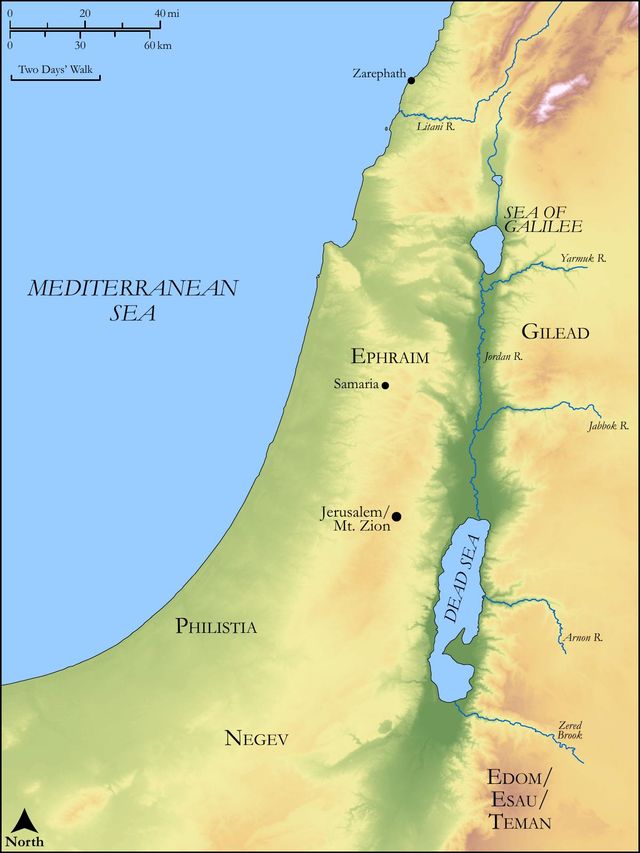
See on the biblical-era map
Study this verse
Public-domain commentary
Matthew Henry
From his Commentary on the Whole Bible. Henry comments on passages, not single verses — this entry covers Obadiah 1:17–21. His three-level outline is real structure in the source text, so it is rendered as structure.
After the destruction of the church's enemies is threatened, which will be completely accomplished in the great day of recompence, and that judgment for which Christ came once, and will come again, into this world, here follow precious promises of the salvation of the church, with which this prophecy concludes, and those of Joel and Amos did, which, however they might be in part fulfilled in the return of the Jews out of Babylon notwithstanding the triumphs of Edom in their captivity, as if it were perpetual, are yet, doubtless, to have their full accomplishment in that great salvation wrought out by Jesus Christ, to which all the prophets bore witness. It is promised here,
I.That there shall be salvation upon Mount Zion, that holy hill where God sets his anointed King (Psa 2:6):
Upon Mount Zion shall be deliverance, Oba 1:17. There shall be those that escape; so the margin. A remnant of Israel, upon the holy mountain shall be saved, Oba 1:16. Christ said, Salvation is of the Jews, Joh 4:22. God wrought deliverances for the Jews, typical of our redemption by Christ. But Mount Zion is the gospel-church, from which the New Testament law went forth, Isa 2:3. There salvation shall be preached and prayed for; to the gospel-church those are added who shall be saved; and for those who come in faith and hope to this Mount Zion deliverance shall be wrought from wrath and the curse, from sin, and death, and hell, while those who continue afar off shall be left to perish.
II.That, where there is salvation, there shall be sanctification in order to it:
And there shall be holiness, to prepare and qualify the children of Zion for this deliverance; for wherever God designs glory he gives grace. Temporal deliverances are indeed wrought for us in mercy when with them there is holiness, when there is wrought in us a disposition to receive them with love and gratitude to God; when we are sanctified, they are sanctified to us. Holiness is itself a great deliverance, and an earnest of that eternal salvation which we look for. There, upon Mount Zion, in the gospel-church, shall be holiness; for that is it which becomes God's house for ever, and the great design of the gospel, and its grace, is to plant and promote holiness. There shall be the Holy Spirit, the holy ordinances, the holy Jesus, and a select remnant of holy souls, in whom, and among whom, the holy God will delight to dwell. Note, Where there is holiness there shall be deliverance.
III.That this salvation and sanctification shall spread, and prevail, and get ground in the world:
The house of Jacob, even this Mount Zion, with the deliverance and their holiness there wrought, shall possess their possessions; that is, the gospel-church shall be set up among the heathen, and shall replenish the earth; the apostles of Christ by their preaching shall gain possession of the hearts of men for him whose messengers and ministers they are, and when they possess their hearts they shall possess their possessions, for those who have given up themselves to the Lord give up all they have to him. When Lydia's heart was opened to Christ her house was opened to his ministers. When the Gentile nations became nations of those that were saved, were disciplined, walked in the light of the Lord, and brought their glory and honour into the new Jerusalem (Rev 21:24), then the house of Jacob possessed their possessions. This is the part fulfilled by the planting of the Christian religion in the world, and shall be fulfilled yet more and more by the setting up of Christ's throne where Satan's seat is, and the erecting of trophies of his victory upon the ruins of the devil's kingdom. Now here is foretold,
1.How this possession shall be gained, and the opposition given to it got over (Oba 1:18): The house of Jacob shall be a fire, and the house of Joseph a flame, for their God is, and will be, a consuming fire; and the house of Esau shall be for stubble, easily devoured and consumed by this fire. This is fulfilled,
(1.)In the conversion of multitudes by the grace of Christ; the gospel, preached in the house of Jacob and Joseph, and there owned and professed, shall be as a fire and a flame to melt and to soften hard hearts, to burn up the dross of sin and corruption, that they may be purified and refined with the spirit of judgment and the spirit of burning. Christ, when he comes, shall be as a refiner's fire, Mal 3:1, Mal 3:2.
(2.)In the confusion of all the impenitent implacable enemies of the gospel of Christ, that oppose it and do all they can to hinder the setting up of the kingdom of the Messiah by it. The gospel day is a day that burns like an oven, in which all the proud, and all that do wickedly, shall be a stubble, Mal 4:1. Jacob and Joseph shall be as a fire and a flame; for those that meddle with them, to do them hurt, will find that they do so at their peril; they shall be to them as a torch of fire in a sheaf, Zac 12:6. The word of God in the mouth of his ministers is said to be like fire, and the people as wood to be devoured by it, Jer 5:14. And the man of sin is to be consumed by the breath of Christ's mouth, Th2 2:8. Those that are not refined as gold by fire of the gospel shall be consumed as dross by it; for it will be a savour either of life or of death. When idols and idolatry were abolished, and the wealth and power of nations were brought into the service of Christ and his gospel, and the spoils of the strong man armed were divided by him that was stronger than he, then the house of Jacob and Joseph devoured the house of Esau, so that there was none of them left remaining. This the Lord spoke by his prophets, and this he did by his apostles.
2.How far this possession shall extend, Oba 1:19, Oba 1:20. This is described in Jewish language, which speaks the accession made to the land of Israel, after the return out of captivity into Babylon. The captivity of this host of Israel, that is, this host of Israel that have been so long in captivity and now they have come back are still called the children of the captivity, these shall not only recover their own land, but shall gain ground upon their neighbours adjoining to them, some of whom shall become proselytes and shall incorporate with the Jews, who, by possessing them in a holy communion, possess their land. We must reckon ourselves truly enriched by the conversion of our neighbours to the fear of God and the faith of Christ, and their coming to join with us in the worship of God. Such an accession to our Christian communion we must reckon to be more our wealth and strength than an accession to our estates. Or, The ancient inhabitants of those lands that were carried away into captivity being lost, and never returning to their estates, the children of Israel shall take possession of that which lies next them; for their numbers shall so increase that their own land shall be too strait for them, and their neighbours' estates shall escheat to them ob defectum sanguinis - through default of heirs. They shall enter upon that which is adjoining to them. The country of Esau shall be possessed by those of the south parts of Canaan, for to them it lies contiguous. Those of the plain, on the west of Canaan, which was a champaign country, shall enter upon the land of the Philistines, their neighbours. Those of Judah, which was the chief of the two returning tribes, shall possess the field of Ephraim and Samaria, which before belonged to the ten tribes; and Benjamin, the other tribe, shall possess Gilead on the other side of Jordan, which had belonged to the two tribes and a half. The kingdom of Israel shall join with that of Judah both in civil and sacred interests, and, as friends and brethren, shall mutually possess and enjoy one another; and both together shall possess the Canaanites, even to Zarephath, which belongeth to Zidon; and Jerusalem shall possess the cities of the south, even to Sepharad. Thus did the Jews enlarge their borders on all sides. The modern rabbin teach their scholars by Zarephath and Sepharad to understand France and Spain, grounding upon this a foolish groundless expectation that some time or other the Jews shall be masters of those countries; and they call and count the Christians Edomites, over whom they are to have dominion. But the promise here, no doubt, has a spiritual signification, and had its accomplishment in the setting up of the Christian church, the gospel-Israel, in the world, and shall have its accomplishment more and more in the enlargement of it and the additions made to it, till the mystical body is completed. When ministers and Christians prevail with their neighbours to come to Christ, to yield themselves to the Lord, they possess them. The converts that Abraham had are said to be the souls that he had gotten, Gen 12:5. The possession is gained, not vi et armis - by force and arms; for the weapons of our warfare are not carnal, but spiritual; it is by the preaching of the gospel, and the power of divine grace going along with it, that this possession is got and kept.
IV.That the kingdom of the Redeemer shall be erected and maintained, to the comfort of his loyal subjects and the terror and shame of all his enemies (Oba 1:21): The kingdom shall be the Lord's, the Lord Christ's. God shall give it to him, by putting all things into his hand, all power both in heaven and in earth; men shall give it to him, by resigning themselves to him as his willing people, and appointing him their head. Now the work of kings is to protect their subjects and suppress their enemies; and this Christ will do; he will both reward and punish.
1.The mountain of Zion shall be saved; on it saviours shall come, the preachers of the gospel, who are called saviours, because their business is to save themselves and those that hear them; and in this they are workers together with Christ, but to little purpose if he by his grace did not work together with them.
2.The mountain of Esau shall be judged; and the same that come as saviours on Mount Zion shall judge the mountain of Esau; for the word of the gospel in their mouth, that saves believers, judges unbelievers, convinces and condemns them. Christ's ministers are saviours on Mount Zion when they preach that he that believes shall be saved; but they judge the mount of Esau when they preach that he that believeth not shall be damned, which they are not only commissioned, but commanded to do, Mar 16:16. And in the course of God's providence his scripture is fulfilled; when God raises up friends to the church in her distress (as he raised up judges to deliver Israel of old, Jdg 2:16), then saviours come on Mount Zion, to save it from being sunk and ruined; and when the enemies of the church are brought down, and their power broken, then is the mount of Esau judged; and this shall be done in every age in such a way as God thinks best; we may depend upon it that the gates of hell shall not prevail against the church, but the church shall prevail against them; for the kingdom shall be the Lord's; the kingdoms of the world shall become his, and he has taken, and will take, to himself his great power and reign.
Historical interpretation
Historical reception
5 surviving comments on this verse. Each one is dated, so this reads as a timeline rather than a list.
Select a marker to jump to its quote. Markers stagger vertically where authors wrote within a few decades of each other.
Here he indicates the prisoners of both the kingdoms of Samaria and Jerusalem, and also those who had gone to very far regions. Therefore he recalls the transmigration to Spain, because this is the name of a province, which is extremely distant from Judea, in order to show that this is the great gathering, which God had promised to bring together again from the four corners of the world. Those who have been saved shall go up to Mount Zion to rule Mount Esau, in order to defeat and destroy the nation of the Edomites. And the kingdom shall be the Lord’s. All the nations will be subjugated and subjected to the people of God, that is, to the people that God shall make.
The Jewish interpreters explained this similarly that the Lord sent a Savior who would save the people from captivity and they would ascend and go to Mount Zion in order to judge and decide regarding the Mountain of Esau. And when everything is subjugated, there will be a kingdom to the Lord.
Obadiah, so far as his writings are concerned the briefest of all the prophets, speaks against Edom, that is, the nation of Esau, that reprobate elder of the twin sons of Isaac and of the grandsons of Abraham. Now by that form of speech in which a part is understood for the whole, we understand Edom as referring to the nations. We may understand what Christ says in the same way: "But upon Mount Zion shall be safety, and there shall be a holy one." And a little further, at the end of the same prophecy, he says concerning Paul, "And the redeemed shall come up out of Mount Zion, that they may defend Mount Esau, and it shall be a kingdom to the Lord." It is quite evident that this was fulfilled when the redeemed out of Mount Zion (that is, the believers in Christ from Judea, of whom the apostles are chiefly to be acknowledged) went up to defend Mount Esau. How could they defend it except by making safe through the preaching of the gospel those who believed that they might be "delivered from the power of darkness and translated into the kingdom of God." Consequently he expressed this by adding, "And it shall be to the Lord a kingdom." For Mount Zion signifies Judea, where it is predicted there shall be safety and a holy one, that is, Jesus Christ. But Mount Esau is Edom. It signifies the church of the Gentiles, which is defended by the redeemed from Mount Zion, so that it should become a kingdom to the Lord. This was obscure before it took place, but what believer does not understand it now that it has happened?
And people will ascend, gathered on top of Zion, which sums up the goal of the prophecy. For the inhabitants of Zion, he says, are saved by God, who will burst through their chains of servitude. At that time he will ascend and take vengeance against Mount Esau. For they will fight, as I have said, against Edom after the time of captivity, and God will rule over all, although God rejected Esau long ago and withdrew from Judah because of apostasy. For they served Baal and the golden calf. But now in mercy and reconciliation he will reign again over them.
Ezekiel also predicts something similar at the end of his prophecy when he describes the division of the land. He too predicts the return of the people, and after they return we learn they will receive power and obtain strength from God. O that we also would obtain this from our most generous God. And we will receive this from the Lord if we do not imitate the model of Esau and his posterity [who rejoiced in Israel’s destruction]. Rather, following the apostolic tradition, we should rejoice with those who rejoice and weep with those who weep, and we ought to think the same for others [as we would have them think of us]. For this reason we possess the gifts of the Lord of all life, which is the grace of our Lord Jesus Christ, to whom be glory with the Father and the Holy Spirit now and forever, world without end. Amen.
Continue studying Obadiah 1:21 across the web’s major study libraries — every link below opens this exact verse, chapter, or book on the destination site.
Read & Compare
 BibleGatewayThis verse in more than 200 translations and 70 languages.
 Bible.comThe YouVersion reader — hundreds of translations, reading plans, and highlights.
 ESV.orgCrossway's official English Standard Version reader.
 NET BibleThe NET translation with 60,000+ translators' notes on every rendering decision.
 STEP BibleTyndale House's free study tool — original text, vocabulary, and scholarly resources.
 BibliaLogos Bible Software's free web reader.
 USCCBThe New American Bible (Revised Edition) with the U.S. bishops' study notes.
Commentaries
 BibleHub CommentariesDozens of classic commentaries on this verse, gathered on one page.
 StudyLightMore than 100 commentary sets — the largest collection on the web.
 BibleRefPlain-English commentary on what this verse means, verse by verse.
 Enduring WordDavid Guzik's free commentary on this chapter, widely used by Bible teachers.
 Bible Study ToolsVerse commentary alongside Greek and Hebrew study aids.
Original Language & Research
- BibleHub InterlinearThe verse word by word — original language, transliteration, and English.
- BibleHub LexiconEvery word's original-language definition and Strong's entry.
 Blue Letter BibleDeep-study tools — Strong's numbers, concordance, and word studies.
 SefariaThe Hebrew text with Rashi and centuries of Jewish commentary.
Sermons, Hymns & Audio


TrulyRandomVerse is not affiliated with these sites and doesn’t control their content. They’re linked because they’re genuinely useful.
Summary
Obadiah 1:21 culminates the shortest book in the Old Testament with a profound declaration of God's ultimate sovereignty and the vindication of His people. This verse shifts from the preceding pronouncements of judgment against Edom to a glorious vision of Israel's restoration, where deliverers from Mount Zion will execute divine justice upon Edom, ultimately affirming that the kingdom belongs entirely to the LORD. It serves as an eschatological promise, assuring that despite temporary oppression, God's righteous rule will prevail over all earthly powers.
Context
ShowHideLiterary Context
Obadiah's prophecy is a singular, concise oracle primarily directed against the nation of Edom, the descendants of Esau. The book opens with a divine summons for judgment against Edom (Obadiah 1:1-9), detailing their pride and impending downfall. This judgment is specifically pronounced due to Edom's egregious actions against Judah during a time of crisis, likely the Babylonian conquest of Jerusalem (Obadiah 1:10-14). Edom not only rejoiced in Judah's misfortune but also actively participated in their plunder and prevented refugees from escaping. Verses 15-20 then broaden the scope to the "day of the LORD" and the restoration of Israel's land. Obadiah 1:21 serves as the climactic conclusion, transitioning from the specific judgment on Edom to a universal declaration of God's ultimate reign and the triumph of His people, providing a final, hopeful resolution to the preceding pronouncements of doom.
Historical & Cultural Context
The historical animosity between Israel (Jacob) and Edom (Esau) dates back to their patriarchal founders, brothers whose rivalry continued through their descendants (see Genesis 25:23). Edom, located southeast of Judah in the mountainous region of Seir, was often a hostile neighbor. Their actions described in Obadiah 1:10-14, particularly their "violence against thy brother Jacob," refer to specific instances where Edom exploited Judah's weakness, possibly during the Babylonian siege of Jerusalem (586 BC) or earlier invasions. Such betrayal by a "brother" nation was considered a profound violation of the bond of brotherhood. Mount Zion, representing Jerusalem and the people of Judah, stands in stark contrast to Mount Esau, symbolizing the Edomite nation. The prophecy reflects the deep-seated grievances and the theological conviction that God would avenge His people against those who oppressed them, especially those who should have shown solidarity.
Key Themes
ShowHideObadiah 1:21 encapsulates several major themes present throughout the book and the broader prophetic literature. Foremost is the theme of Divine Justice and Retribution, where God's righteous character demands accountability for the actions of nations, particularly Edom's cruelty towards Judah. The "day of the LORD" (Obadiah 1:15) is a central concept, signifying a time of divine intervention, bringing judgment upon the wicked and salvation for the righteous. Another key theme is Zion's Vindication and Restoration, as the prophecy moves from Edom's destruction to the ultimate triumph and expansion of God's people (Obadiah 1:17-20). This restoration is not merely political but theological, affirming God's covenant faithfulness. Finally, the culminating declaration, "and the kingdom shall be the LORD'S," underscores the overarching theme of God's Absolute Sovereignty. Despite the rise and fall of earthly empires and the suffering of His people, God's ultimate authority and dominion are eternal and supreme, a truth echoed in passages like Zechariah 14:9 and Daniel 2:44.
Exposition and Analysis
ShowHideKey Word Analysis
ShowHideDerived from a primitive root meaning "to be open, wide or free," this word implies safety, freedom, or deliverance. Causatively, it means "to free or succor." In this context, "saviours" (plural) refers to those who bring about salvation, deliverance, or vindication. They are agents through whom God's saving power and justice are manifested, not necessarily a single messianic figure, but rather deliverers or leaders from Judah who will execute divine judgment and establish order, bringing about the restoration of God's people.
A primitive root meaning "to judge," "pronounce sentence (for or against)," "vindicate," or "punish." By extension, it can also mean "to govern." Here, it signifies the act of administering divine justice upon Edom. The saviours from Zion will act as God's instruments, carrying out His righteous decree against those who oppressed His people, thereby vindicating Judah and punishing Edom. This judgment is not merely punitive but also restorative, establishing proper order.
A feminine passive participle meaning "something ruled," i.e., a realm or dominion. This term signifies royal authority, sovereignty, and the sphere of rule. The declaration "and the kingdom shall be the LORD'S" is the ultimate theological statement of the verse, asserting God's supreme and universal dominion over all nations and all history, transcending all earthly powers and conflicts. It is a declaration of ultimate divine sovereignty.
Verse Breakdown
ShowHide"And saviours shall come up on mount Zion"
This clause introduces the agents of God's redemptive plan. The "saviours" are not explicitly identified but are understood to be human instruments, perhaps leaders or a restored people, emerging from "Mount Zion," a potent symbol for Jerusalem, the dwelling place of God, and the spiritual and political center of Judah. Their "coming up" implies an ascent to prominence and authority, signifying the reversal of fortunes for God's people, who were previously oppressed but are now empowered by God to act.
"to judge the mount of Esau"
This phrase states the purpose of the saviours' emergence: to execute judgment. "Mount Esau" is a direct metonymy for the nation of Edom, the historical adversary of Israel. The judgment is a divine retribution for Edom's pride and their violent actions against Judah. This part of the verse ensures that the earlier prophecies of Edom's destruction (Obadiah 1:1-14) are brought to their just conclusion through the agency of God's restored people.
"and the kingdom shall be the LORD'S"
This is the climactic and universal declaration that transcends the specific conflict between Judah and Edom. It proclaims the ultimate, undisputed sovereignty of Yahweh over all creation and all history. This final statement elevates the particular judgment on Edom into a universal truth: all earthly kingdoms and powers are temporary, but God's kingdom is eternal and supreme. It provides the ultimate theological context for the entire prophecy, assuring that divine justice and restoration are part of God's overarching plan to establish His perfect rule.
Literary Devices
ShowHideObadiah 1:21 is rich in Symbolism and Contrast. "Mount Zion" is a powerful symbol representing Jerusalem, the chosen city of God, the center of His covenant people, and the place from which salvation and judgment emanate. It stands in direct Contrast to "Mount Esau," which symbolizes the nation of Edom, characterized by pride, violence, and opposition to God's people. This geographical and symbolic contrast highlights the reversal of fortunes: the oppressed (Zion) will become the agents of justice against the oppressor (Esau). The phrase "saviours shall come up" implies a divine empowerment and a Prophetic Vision of future vindication and restoration. The final declaration, "and the kingdom shall be the LORD'S," serves as a powerful Climax and an Affirmation of Divine Sovereignty, elevating the specific historical judgment into a universal theological truth. The use of the plural "saviours" can be seen as a form of Collective Representation, where the restored people of God collectively fulfill a role of divine agency.
Theological and Thematic Connections
ShowHideObadiah 1:21 serves as a powerful theological capstone, not only for the book of Obadiah but for the broader biblical narrative concerning divine justice and ultimate sovereignty. It affirms God's unwavering commitment to His covenant people and His righteous response to injustice. The "saviours" from Zion demonstrate that God often uses human agents to accomplish His purposes, even in acts of judgment and restoration. The final declaration, "the kingdom shall be the LORD'S," is a foundational truth that resonates throughout Scripture, reminding believers that despite the chaos and injustice of human history, God's reign is eternal, supreme, and ultimately victorious. This verse provides enduring hope, assuring that all wrongs will be righted and God's perfect will established.
Reflection and Application
ShowHideObadiah 1:21 offers a profound message of hope and assurance for believers facing various forms of oppression, injustice, or despair. It reminds us that God is not indifferent to the suffering of His people or the wickedness of the world. Just as Edom's pride and cruelty were met with divine judgment, so too will all forms of injustice ultimately be confronted by God's righteous rule. This verse encourages us to trust in God's sovereign plan, even when circumstances seem bleak, knowing that He will ultimately establish His perfect kingdom and bring about full vindication for His own. It calls us to align our lives with the values of this coming kingdom, living justly, showing mercy, and patiently enduring, confident that the final word belongs to the LORD. Our hope is not in earthly powers or human efforts alone, but in the ultimate triumph of God's eternal dominion.
Questions for Reflection
ShowHideFAQ
ShowHideWho are the "saviours" mentioned in Obadiah 1:21?
ShowHideThe "saviours" (Hebrew: yoshe'im) are generally understood to be human agents, likely leaders or the restored people of Judah, empowered by God to execute His judgment and bring about deliverance. They are not necessarily a single messianic figure in this context, but rather instruments through whom God's justice and vindication are realized. Their role is to "judge the mount of Esau," meaning to carry out God's righteous retribution against the nation of Edom for their historical animosity and specific acts of violence against Judah, thereby establishing order and demonstrating God's ultimate authority from Mount Zion.
What is the significance of "the kingdom shall be the LORD'S" in this verse?
ShowHideThis phrase is the theological climax of Obadiah's prophecy, transcending the specific historical conflict between Judah and Edom. It is a universal declaration of God's absolute and eternal sovereignty. It means that ultimately, all authority, dominion, and rule belong to Yahweh alone. Despite the rise and fall of earthly empires and the temporary suffering of God's people, God's kingdom is supreme, unshakeable, and will ultimately prevail over all. This echoes similar declarations found throughout Scripture, such as Daniel 2:44 and Zechariah 14:9, providing ultimate hope and assurance of God's final victory.
Christ-Centered Fulfillment
ShowHideWhile Obadiah 1:21 speaks of human "saviours" from Mount Zion who will judge Edom, its ultimate fulfillment points to the singular and supreme Saviour, Jesus Christ, and the establishment of His eternal kingdom. The "saviours" foreshadow the greater work of redemption and judgment accomplished by Christ. He is the true Deliverer who came from heavenly Zion to execute divine justice and establish God's reign. Just as the saviours were to judge "the mount of Esau," Christ, at His first coming, began the judgment of sin and evil, and at His second coming, He will fully judge all nations and powers that oppose God, bringing all things under His feet (see Philippians 2:9-11). The declaration "and the kingdom shall be the LORD'S" finds its ultimate and glorious realization in Christ, who is the King of kings and Lord of lords, reigning eternally at the right hand of the Father (as seen in Revelation 11:15). Through His atoning work and resurrection, Christ has inaugurated God's kingdom, inviting all to enter it, and He will bring it to its consummation, ensuring that God's perfect rule is fully established over all creation.