


Genesis 39:4
Bible text: King James Version (1769 Blayney text) · Public domain
Bible text: Berean Standard Bible · Public domain
Bible text: American Standard Version (1901) · Public domain
Bible text: World English Bible, Messianic edition · Public domain
Bible text: Geneva Bible (1599) · Public domain
Bible text: Young's Literal Translation · Public domain
- וַיִּמְצָאvai·yim·Tza'and he foundH4672Conj-w ¦ V-Qal-ConsecImperf-3msVerb Qal Consecutive Imperfect 3rd Singular Masculineוַandיִּמְצָאhe found
- יוֹסֵףyo·SefJosephH3130N-proper-mNoun Proper Masculine
- חֵןchenfavorH2580N-msNoun Singular Masculine Absolute
- בְּעֵינָיוbe·'ei·Navin his viewH5869Prep-b ¦ N-fdc ¦ 3msNoun Dual Feminine Constructבְּinעֵינָיviewוhis
- וַיְשָׁרֶתvay·Sha·retand he servedH8334Conj-w ¦ V-Piel-ConsecImperf-3msVerb Piel Consecutive Imperfect 3rd Singular Masculineוַandיְשָׁרֶתhe served
- אֹתוֹ'o·To<obj.> himH853DirObjM ¦ 3msParticle Object Indicatorאֹת<obj.>וֹhim
- וַיַּפְקִדֵהוּvai·yaf·ki·De·huand he appointed himH6485Conj-w ¦ V-Hiphil-ConsecImperf-3ms ¦ 3msVerb Hiphil Consecutive Imperfect 3rd Singular Masculineוַandיַּפְקִדֵhe appointedהוּhim
- עַל'aloverH5921PrepPreposition
- בֵּיתוֹbei·Tohis householdH1004N-msc ¦ 3msNoun Singular Masculine Constructבֵּיתhouseholdוֹhis
- וְכָלve·kholand allH3605Conj-w ¦ N-msNoun Singular Masculine Absoluteוְandכָלall
- יֶשׁyesh[that] thereH3426Adj-csAdjective Numerical Singular common gender Absolute
- לוֹlo[belonged] to <the> himPrep-l ¦ 3msSuffix Personal 3rd Singular Masculineל[belonged] to <the>וֹhim
- נָתַןna·Tanhe gaveH5414V-Qal-Perf-3msVerb Qal Perfect 3rd Singular Masculine
- בְּיָדוֹbe·ya·Doin his handH3027Prep-b ¦ N-csc ¦ 3msNoun Singular common gender Constructבְּinיָדhandוֹhis
English is a literal word-by-word gloss of the Hebrew, not the KJV's wording. Why?
This is the original text the KJV's translators worked from — each Hebrew word with its own literal English meaning in this verse, prepared by scholars at Tyndale House, Cambridge. The KJV translates whole sentences, not word by word, so its wording differs: one Hebrew word can become several English words, and the KJV may choose “the LORD” where the gloss reads “Yahweh”. Both are faithful — they answer different questions. For the KJV's own rendering, switch to the KJV text.
Details
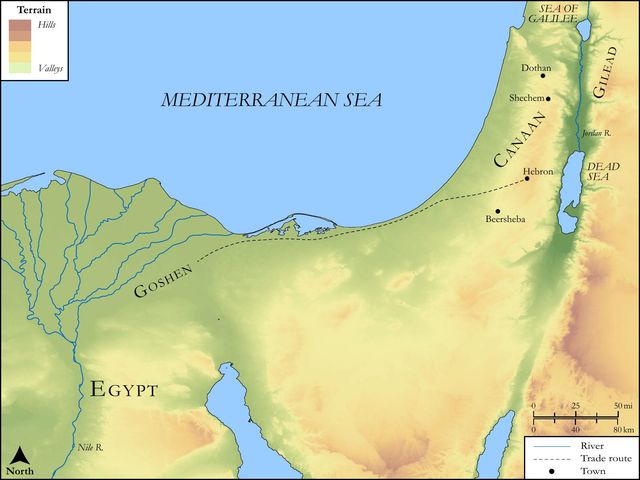
See on the biblical-era maps


Study this verse
Public-domain commentary
Matthew Henry
From his Commentary on the Whole Bible. Henry comments on passages, not single verses — this entry covers Genesis 39:1–6. His three-level outline is real structure in the source text, so it is rendered as structure.
Here is, I. Joseph bought (Gen 39:1), and he that bought him, whatever he gave for him, had a good bargain of him; it was better than the merchandise of silver. The Jews have a proverb, "If the world did not know the worth of good men, they would hedge them about with pearls." He was sold to an officer of Pharaoh, with whom he might get acquainted with public persons and public business, and so be fitted for the preferment for which he was designed. Note, 1. What God intends men for he will be sure, some way or other, to qualify them for. 2. Providence is to be acknowledged in the disposal even of poor servants and in their settlements, and therein may perhaps be working towards something great and important.
II.Joseph blessed, wonderfully blessed, even in the house of his servitude.
1.God prospered him, Gen 39:2, Gen 39:3. Perhaps the affairs of Potiphar's family had remarkably gone backward before; but, upon Joseph's coming into it, a discernible turn was given to them, and the face and posture of them altered on a sudden. Though, at first, we may suppose that his hand was put to the meanest services, even in those appeared his ingenuity and industry; a particular blessing of Heaven attended him, which, as he rose in his employment, became more and more discernible. Note,
(1.)Those that have wisdom and grace have that which cannot be taken away from them, whatever else they are robbed of. Joseph's brethren had stripped him of his coat of many colours, but they could not strip him of his virtue and prudence.
(2.)Those that can separate us from all our friends, yet cannot deprive us of the gracious presence of our God. When Joseph had none of all his relations with him, he had his God with him, even in the house of the Egyptian. Joseph was separated from his brethren, but not from his God; banished from his father's house, but the Lord was with him, and this comforted him.
(3.)It is God's presence with us that makes all we do prosperous. Those that would prosper must therefore make God their friend; and those that do prosper must therefore give God the praise.
2.His master preferred him, by degrees made him steward of his household, Gen 39:4. Note,
(1.)Industry and honesty are the surest and safest way both of rising and thriving: Seest thou a man prudent, and faithful, and diligent in his business? He shall stand before kings at length, and not always before mean men.
(2.)It is the wisdom of those that are in any sort of authority to countenance and employ those with whom it appears that the presence of God is, Psa 101:6. Potiphar knew what he did when he put all into the hands of Joseph; for he knew it would prosper better there than in his own hand.
(3.)He that is faithful in a few things stand fair for being made ruler over many things, Mat 25:21. Christ goes by this rule with his servants.
(4.)It is a great ease to a master to have those employed under him that are trusty. Potiphar was so well satisfied with Joseph's conduct that he knew not aught he had, save the bread which he did eat, Gen 39:6. The servant had all the care and trouble of the estate; the master had only the enjoyment of it: an example not to be imitated by any master, unless he could be sure that he had one in all respects like Joseph for a servant.
3.God favoured his master for his sake (Gen 39:5): He blessed the Egyptian's house, though he was an Egyptian, a stranger to the true God, for Joseph's sake; and he himself, like Laban, soon learned it by experience, Gen 30:27. Note,
(1.)Good men are the blessings of the places where they live; even good servants may be so, though mean, and lightly esteemed.
(2.)The prosperity of the wicked is, one way or other, for the sake of the godly. Here was a wicked family blessed for the sake of one good servant in it.
Historical interpretation
Historical reception
1 surviving comment on this verse from the historical church.
Then the loving God, though wanting to make Joseph feel completely secure, did not release him from slavery or set him at liberty. This, after all, is ever God’s way, not to free virtuous people from dangers or preserve them from trials but, in the midst of such trials, to give evidence of his characteristic grace to such an extent that the very trials prove an occasion of festivity for them. Hence blessed David also said, “In my distress you gave me room to move”; “you did not take away the distress,” he is saying, “or free me from it and make me be completely at ease, but, what is quite remarkable, you brought me peace though I was in fact still in distress.” This is exactly what the loving Lord does in this case: “He blessed the house of the Egyptian in Joseph.” Even the barbarian now learned that the man thought to be a slave was particularly close to God. “He turned over all his possessions into Joseph’s keeping,” the text says, “and had no care for anything except the food he ate.” It was as if he had appointed him master of his whole household. The slave, the captive, held in his care all his master’s possessions. This is what virtue is like: wherever it appears, it prevails over all things and controls them. You see, just as darkness is driven out with the rising sun, so too in this case every evil is absent with the approach of virtue.
Continue studying Genesis 39:4 across the web’s major study libraries — every link below opens this exact verse, chapter, or book on the destination site.
Read & Compare
 BibleGatewayThis verse in more than 200 translations and 70 languages.
 Bible.comThe YouVersion reader — hundreds of translations, reading plans, and highlights.
 ESV.orgCrossway's official English Standard Version reader.
 NET BibleThe NET translation with 60,000+ translators' notes on every rendering decision.
 STEP BibleTyndale House's free study tool — original text, vocabulary, and scholarly resources.
 BibliaLogos Bible Software's free web reader.
 USCCBThe New American Bible (Revised Edition) with the U.S. bishops' study notes.
Commentaries
 BibleHub CommentariesDozens of classic commentaries on this verse, gathered on one page.
 StudyLightMore than 100 commentary sets — the largest collection on the web.
 BibleRefPlain-English commentary on what this verse means, verse by verse.
 Enduring WordDavid Guzik's free commentary on this chapter, widely used by Bible teachers.
 Bible Study ToolsVerse commentary alongside Greek and Hebrew study aids.
Original Language & Research
- BibleHub InterlinearThe verse word by word — original language, transliteration, and English.
- BibleHub LexiconEvery word's original-language definition and Strong's entry.
 Blue Letter BibleDeep-study tools — Strong's numbers, concordance, and word studies.
 SefariaThe Hebrew text with Rashi and centuries of Jewish commentary.
Sermons, Hymns & Audio


TrulyRandomVerse is not affiliated with these sites and doesn’t control their content. They’re linked because they’re genuinely useful.
Summary
Genesis 39:4 powerfully illustrates God's active hand in Joseph's life, even amidst the dire circumstances of slavery. Despite being unjustly sold into Egypt, Joseph quickly found exceptional favor in Potiphar's eyes, leading to his rapid elevation from a mere slave to the chief administrator of Potiphar's entire household. This verse underscores how divine presence and blessing transform adversity into opportunity, enabling Joseph to manage all of Potiphar's possessions with remarkable trustworthiness and competence, thereby setting the stage for his future, pivotal role in God's redemptive plan.
Context
ShowHideLiterary Context
This verse is situated immediately after Joseph's arrival in Egypt, having been sold by his brothers (Genesis 37) and bought by Potiphar, an officer of Pharaoh and captain of the guard (Genesis 39:1). The preceding verse, Genesis 39:2, is crucial, explicitly stating, "The LORD was with Joseph, and he was a prosperous man; and he was in the house of his master the Egyptian." This divine accompaniment is the foundational explanation for Joseph's success and the favor he receives in verse 4. The narrative flow demonstrates a direct cause-and-effect: God's presence leads to Joseph's prosperity, which in turn leads to Potiphar's recognition and promotion of Joseph, culminating in the comprehensive trust described in Genesis 39:4. This sets the stage for the subsequent temptations and trials Joseph will face, all while God's sovereign hand continues to guide his path.
Historical & Cultural Context
In ancient Egypt, slavery was a common institution, but the treatment and roles of slaves varied widely. While some slaves endured harsh labor, others, particularly those with skills or trusted by their masters, could rise to positions of considerable responsibility, managing estates or businesses. Potiphar, as "captain of the guard," was a high-ranking official, likely overseeing a large household and significant assets. Entrusting a foreign slave with complete oversight of his house and possessions, as described in Genesis 39:4, was an extraordinary act of confidence. This level of trust would have been highly unusual, reflecting not only Joseph's exceptional character and competence but also a divine influence that made him uniquely appealing and reliable in Potiphar's estimation. Such a promotion would have placed Joseph in a position akin to a modern-day chief of staff or estate manager.
Key Themes
ShowHideGenesis 39:4 contributes significantly to several major themes within the book of Genesis and biblical theology. Foremost is the theme of Divine Providence, demonstrating God's sovereign control over seemingly random or unjust events, orchestrating them for His ultimate purposes. Joseph's elevation, despite his enslavement, is a clear sign that God is working behind the scenes. Another key theme is Integrity and Diligence in Adversity. Joseph's faithfulness and excellent work ethic, even as a slave, are highlighted as instrumental in earning Potiphar's trust, showcasing how godly character can shine even in the darkest circumstances. The verse also introduces the theme of Stewardship, as Joseph is entrusted with comprehensive management of Potiphar's wealth, foreshadowing his later, even greater role as a steward over all Egypt (as seen in Genesis 41:40-41). Finally, the pervasive theme of God's Presence (explicitly stated in Genesis 39:2-3) undergirds Joseph's success, emphasizing that true prosperity and favor come from the Lord.
Exposition and Analysis
ShowHideGenesis 39:4 reveals the tangible outcomes of God's blessing on Joseph, translating divine favor into human recognition and significant responsibility. Joseph's inherent character, coupled with the visible prosperity that accompanied his endeavors, made him an exceptionally reliable and capable individual in Potiphar's eyes, earning him an unprecedented level of trust.
Key Word Analysis
ShowHideThis word signifies graciousness, kindness, or favor. In Joseph's context, it denotes the goodwill and acceptance he found in Potiphar's sight. This "grace" was not merely a result of Joseph's charming personality but was divinely enabled, as God's presence made Joseph's work prosper and his character shine, inclining Potiphar to bestow favor upon him. It reflects a subjective kindness from Potiphar and an objective pleasantness or favorability associated with Joseph.
This root means "to visit (with friendly or hostile intent); by analogy, to oversee, muster, charge, care for, miss, deposit, etc." When applied to Joseph, it describes his appointment to a position of authority and responsibility, specifically to "oversee" or "superintend" Potiphar's household. This was not a passive role but an active charge to manage, administer, and care for all aspects of the estate, indicating a profound level of trust and delegated authority.
This primitive word refers to the open hand, often indicating power, means, or direction. In the phrase "put into his hand," it signifies complete control, authority, and possession. Potiphar relinquished all management and decision-making authority over his possessions to Joseph, placing them entirely under Joseph's command and stewardship. This idiom powerfully conveys the comprehensive nature of Joseph's delegated power.
Verse Breakdown
ShowHide"And Joseph found grace in his sight"
This clause highlights Joseph's immediate and remarkable acceptance by Potiphar. The phrase "found grace" (Hebrew: matsa chen) implies that Joseph's demeanor, diligence, and the evident blessing of God upon him made him exceptionally appealing and trustworthy to his master. This was not a gradual process but a swift recognition of Joseph's unique qualities and capabilities.
"and he served him"
This emphasizes Joseph's active and faithful response to the favor he received. Despite his status as a slave, Joseph did not merely exist in Potiphar's house; he diligently and effectively performed his duties. His service was characterized by excellence and commitment, demonstrating a strong work ethic and integrity that further solidified Potiphar's trust.
"and he made him overseer over his house"
This signifies Joseph's extraordinary promotion. From a slave, Joseph was elevated to the highest position of authority within Potiphar's domestic and economic affairs, becoming the chief manager or steward. This role involved significant administrative responsibilities, requiring not only skill but also absolute integrity and discretion in handling Potiphar's entire estate.
"and all [that] he had he put into his hand"
This final clause underscores the comprehensive nature of Joseph's new authority. Potiphar completely relinquished control over all his possessions—his property, servants, finances, and daily operations—entrusting them entirely to Joseph's management. This level of trust, extended to a foreign slave, is exceptional and speaks volumes about Joseph's character and the visible prosperity that attended his work, which Potiphar clearly attributed to Joseph's presence.
Literary Devices
ShowHideThe narrative of Genesis 39:4 employs several literary devices to convey its profound meaning. Divine Providence is the overarching motif, as Joseph's rapid ascent is not merely a stroke of luck or human merit but a clear demonstration of God's active, guiding hand in his life, orchestrating events for a greater purpose. The phrase "found grace in his sight" functions as a form of hyperbole or exaggeration, emphasizing the extraordinary and immediate favor Joseph received, far beyond what would be typical for a slave. Furthermore, this verse serves as powerful foreshadowing, hinting at Joseph's future role as a chief administrator over an even larger domain—the entire land of Egypt—and his eventual position of power that would save his family and nation. The comprehensive nature of Potiphar entrusting "all that he had" into Joseph's "hand" uses metonymy, where "hand" represents Joseph's authority, control, and executive power.
Theological and Thematic Connections
ShowHideGenesis 39:4 beautifully illustrates the profound interplay between God's sovereign favor and human faithfulness. While the Lord's presence was the ultimate source of Joseph's success, Joseph's diligent service and unwavering integrity enabled Potiphar to recognize and act upon that divine favor. This dynamic teaches us that God often works through our faithfulness in mundane tasks, preparing us for greater responsibilities and opening doors that human effort alone could not. Joseph's stewardship of Potiphar's house is a microcosm of his later, grander role, demonstrating that faithfulness in "little" things is a prerequisite for being entrusted with "much."
Reflection and Application
ShowHideJoseph's experience in Genesis 39:4 offers profound encouragement and practical guidance for believers navigating their own lives. It reminds us that our circumstances, no matter how unjust or difficult, do not limit God's ability to work powerfully in and through us. Joseph, a slave in a foreign land, chose diligence and integrity, and God honored that faithfulness by granting him exceptional favor and opening doors of opportunity. This teaches us to cultivate a spirit of excellence in all our endeavors, trusting that our character and work ethic, when empowered by God's presence, can speak volumes and earn us respect and trust even from those who do not share our faith. Furthermore, being trustworthy and diligent in the responsibilities we are given, no matter how small or seemingly insignificant, prepares us for greater roles and demonstrates our readiness for God's unfolding plan in our lives. Joseph's story is a testament to God's faithfulness, reminding us that He orchestrates events for His ultimate good and our benefit, even when the path seems bleak or unfair.
Questions for Reflection
ShowHideFAQ
ShowHideHow does Joseph "find grace" in Potiphar's sight, and what does this imply about God's role?
ShowHideThe Hebrew phrase matsa chen (מָצָא חֵן), translated as "found grace" or "found favor," signifies gaining approval, goodwill, or acceptance from someone. In Joseph's case, this favor was not merely a result of his human qualities or a stroke of luck. As established in Genesis 39:2-3, "The LORD was with Joseph... and his master saw that the LORD was with him." This implies that God's active presence and blessing on Joseph's life made him exceptionally capable, trustworthy, and prosperous in all his undertakings. Potiphar, an astute observer, recognized this divine enablement and saw the tangible benefits of Joseph's presence, leading him to trust Joseph implicitly and grant him extraordinary authority. Thus, Joseph's finding of grace was a direct manifestation of God's providential hand, orchestrating events to elevate Joseph for His greater purposes.
Christ-Centered Fulfillment
ShowHideJoseph's journey from beloved son to betrayed slave, then to exalted overseer, and ultimately to the savior of his family, serves as a profound type of Christ. Just as Joseph, though innocent, was sold for silver by his own brethren and suffered unjustly, yet was ultimately exalted to a position of power to save his people from famine, so too Christ, the sinless Son of God, was betrayed by His own, suffered unjustly, and died on the cross, only to be exalted by God to the highest place (Philippians 2:9-11) to bring salvation and eternal life to all who believe. Joseph's finding "grace" (favor) in Potiphar's sight and being made "overseer" over "all that he had" foreshadows Christ's ultimate authority and stewardship over all creation. The Father has "put all things under his feet" (Ephesians 1:22) and given Him "all authority in heaven and on earth" (Matthew 28:18). Joseph's faithful management of Potiphar's house points to Christ's perfect stewardship of God's kingdom, where He is the faithful Son over God's house (Hebrews 3:6), managing all things for the glory of God and the salvation of His people.