


1 Kings 20:15
Bible text: King James Version (1769 Blayney text) · Public domain
Bible text: King James Version with Strong's numbers · Public domain
Bible text: Berean Standard Bible · Public domain
Bible text: American Standard Version (1901) · Public domain
Bible text: World English Bible, Messianic edition · Public domain
Bible text: Geneva Bible (1599) · Public domain
Bible text: Young's Literal Translation · Public domain
- וַיִּפְקֹדvai·yif·Kodand he musteredH6485Conj-w ¦ V-Qal-ConsecImperf-3msVerb Qal Consecutive Imperfect 3rd Singular Masculineוַandיִּפְקֹדhe mustered
- אֶת'et<obj.>H853DirObjMParticle Object Indicator
- נַעֲרֵיna·'a·Rei[the] young men ofH5288N-mpcNoun Plural Masculine Construct
- שָׂרֵיsa·Rei[the] officials ofH8269N-mpcNoun Plural Masculine Construct
- הַמְּדִינוֹתha·me·di·Notthe provincesH4082Art ¦ N-fpNoun Plural Feminine Absoluteהַtheמְּדִינוֹתprovinces
- וַיִּהְיוּvai·yih·Yuand they wereH1961Conj-w ¦ V-Qal-ConsecImperf-3mpVerb Qal Consecutive Imperfect 3rd Plural Masculineוַandיִּהְיוּthey were
- מָאתַיִםma·Ta·yimtwo hundredH3967N-fdNoun Dual Feminine Absolute
- שְׁנַיִםshe·Na·yimtwoH8147N-cdNoun Dual common gender Absolute
- וּשְׁלֹשִׁיםu·she·lo·Shimand thirtyH7970Conj-w ¦ N-mpNoun Plural Masculine Absoluteוּandשְׁלֹשִׁיםthirty
- וְאַחֲרֵיהֶםve·'a·cha·rei·Hemand after themH310Conj-w ¦ Adj-mpc ¦ 3mpAdjective Numerical Plural Masculine Constructוְandאַחֲרֵיafterהֶםthem
- פָּקַדpa·Kadhe musteredH6485V-Qal-Perf-3msVerb Qal Perfect 3rd Singular Masculine
- אֶת'et<obj.>H853DirObjMParticle Object Indicator
- כָּלkolallH3605N-mscNoun Singular Masculine Construct
- הָעָםha·'Amthe peopleH5971Art ¦ N-msNoun Singular Masculine Absoluteהָtheעָםpeople
- כָּלkolallH3605N-mscNoun Singular Masculine Construct
- בְּנֵיbe·Nei[the] people ofH1121N-mpcNoun Plural Masculine Construct
- יִשְׂרָאֵלYis·ra·'ElIsraelH3478N-properNoun Proper Location
- שִׁבְעַתshiv·'At[were] sevenH7651N-cscNoun Singular common gender Construct
- אֲלָפִים'a·la·Fimthousand<s>H505N-cpNoun Plural common gender Absolute
English is a literal word-by-word gloss of the Hebrew, not the KJV's wording. Why?
This is the original text the KJV's translators worked from — each Hebrew word with its own literal English meaning in this verse, prepared by scholars at Tyndale House, Cambridge. The KJV translates whole sentences, not word by word, so its wording differs: one Hebrew word can become several English words, and the KJV may choose “the LORD” where the gloss reads “Yahweh”. Both are faithful — they answer different questions. For the KJV's own rendering, switch to the KJV text.
Details
See on the biblical-era maps

Study this verse
Public-domain commentary
Matthew Henry
From his Commentary on the Whole Bible. Henry comments on passages, not single verses — this entry covers 1 Kings 20:12–21. His three-level outline is real structure in the source text, so it is rendered as structure.
The treaty between the besiegers and the besieged being broken off abruptly, we have here an account of the battle that ensued immediately.
I.The Syrians, the besiegers, had their directions from a drunken king, who gave orders over his cups, as he was drinking (Kg1 20:12), drinking himself drunk (Kg1 20:16) with the kings in the pavilions, and this at noon. Drunkenness is a sin which armies and their officers have of old been addicted to. Say not thou then that the former days were, in this respect, better than these, though these are bad enough. Had he not been very secure he would not have sat to drink; and, had he not bee intoxicated, he would not have been so very secure. Security and sensuality went together in the old world, and Sodom, Luk 17:26, etc. Ben-hadad's drunkenness was the forerunner of his fall, as Belshazzar's was, Dan. 5. How could he prosper that preferred his pleasure before his business, and kept his kings to drink with him when they should have been at their respective posts to fight for him? In his drink, 1. He orders the town to be invested, the engines fixed, and every thing got ready for the making of a general attack (Kg1 20:12), but stirs not from his drunken club to see it done. Woe unto thee, O land! when thy king is such a child. 2. When the besieged made a sally (and, by that time, he was far gone) he gave orders to take them alive (Kg1 20:18), not to kill them, which might have been done more easily and safely, but to seize them, which gave them an opportunity of killing the aggressors; so imprudent was he in the orders he gave, as well as unjust, in ordering them to be taken prisoners though they came for peace and to renew the treaty. Thus, as is usual, he drinks, and forgets the law, both the policies and the justice of war.
II.The Israelites, the besieged, had their directions from an inspired prophet, one of the prophets of the Lord, whom Ahab had hated and persecuted: And behold a prophet, even one, drew near to the king of Israel; so it may be read, Kg1 20:13.
1.Behold, and wonder, that God should send a prophet with a kind and gracious message to so wicked a prince as Ahab was; but he did it,
(1.)For his people Israel's sake, who, though wickedly degenerated, were the seed of Abraham his friend and Jacob his chosen, the children of the covenant, and not yet cast off.
(2.)That he might magnify his mercy, in doing good to one so evil and unthankful, might either bring him to repentance or leave him the more inexcusable.
(3.)That he might mortify the pride of Ben-hadad and check his insolence. Ahab's idolatry shall be punished hereafter, but Ben-hadad's haughtiness shall be chastised now; for God resists the proud, and is pleased to say that he fears the wrath of the enemy, Deu 32:26, Deu 32:27. There was but one prophet perhaps to be had in Samaria, and he drew near with this message, intimating that he had been forced to keep at a distance. Ahab, in his prosperity, would not have borne the sight of him, but now he bids him welcome, when none of the prophets of the groves can give him any assistance. He enquired not for a prophet of the Lord, but God sent one to him unasked, for he waits to be gracious.
2.Two things the prophet does: - (1.) He animates Ahab with an assurance of victory, which was more than all the elders of Israel could give him (Kg1 20:8), though they promised to stand by him. This prophet, who is not named (for he spoke in God's name), tells him from God that this very day the siege shall be raised, and the army of the Syrians routed, Kg1 20:13. When the prophet said, Thus saith the Lord, we may suppose Ahab began to tremble, expecting a message of wrath; but he is revived when it proves a gracious one. He is informed what use he ought to make of this blessed turn of affairs: "Thou shalt know that I am Jehovah, the sovereign Lord of all." God's foretelling a thing that was so very unlikely proved that it was his own doing. (2.) He instructs him what to do for the gaining of this victory. [1.] He must not stay till the enemy attacked him, but must sally out upon them and surprise them in their trenches. [2.] The persons employed must be the young men of the princes of the provinces, the pages, the footmen, who were few in number, only 232, utterly unacquainted with war, and the unlikeliest men that could be thought of for such a bold attempt; yet these must do it, these weak and foolish things must be instruments of confounding the wise and strong, that, while Ben-hadad's boasting is punished, Ahab's may be prevented and precluded, and the excellency of the power may appear to be of God. [3.] Ahab must himself so far testify his confidence in the word of God as to command in person, though, in the eye of reason, he exposed himself to the utmost danger by it. But it is fit that those who have the benefit of God's promises should enter upon them. Yet, [4.] He is allowed to make use of what other forces he has at hand, to follow the blow, when these young men have broken the ice. All he had in Samaria, or within call, were but 7000 men, Kg1 20:15. It is observable that it is the same number with theirs that he not bowed the knee to Baal (Kg1 19:18), though, it is likely, not the same men.
III.The issue was accordingly.
The proud Syrians were beaten, and the poor despised Israelites were more than conquerors. The young men gave an alarm to the Syrians just at noon, at high dinner-time, supported by what little force they had, Kg1 20:16. Ben-hadad despised them at first (Kg1 20:18), but when they had, with unparalleled bravery and dexterity, slain every one his man, and so put the army into disorder, that proud man durst not face them, but mounted immediately, drunk as he was, and made the best of his way, Kg1 20:20. See how God takes away the spirit of princes, and makes himself terrible to the kings of the earth. Now where are the silver and gold he demanded of Ahab? Where are the handfuls of Samaria's dust? Those that are most secure are commonly least courageous. Ahab failed not to improve this advantage, but slew the Syrians with a great slaughter, Kg1 20:21. Note, God oftentimes makes one wicked man a scourge to another.
Continue studying 1 Kings 20:15 across the web’s major study libraries — every link below opens this exact verse, chapter, or book on the destination site.
Read & Compare
 BibleGatewayThis verse in more than 200 translations and 70 languages.
 Bible.comThe YouVersion reader — hundreds of translations, reading plans, and highlights.
 ESV.orgCrossway's official English Standard Version reader.
 NET BibleThe NET translation with 60,000+ translators' notes on every rendering decision.
 STEP BibleTyndale House's free study tool — original text, vocabulary, and scholarly resources.
 BibliaLogos Bible Software's free web reader.
 USCCBThe New American Bible (Revised Edition) with the U.S. bishops' study notes.
Commentaries
 BibleHub CommentariesDozens of classic commentaries on this verse, gathered on one page.
 StudyLightMore than 100 commentary sets — the largest collection on the web.
 BibleRefPlain-English commentary on what this verse means, verse by verse.
 Enduring WordDavid Guzik's free commentary on this chapter, widely used by Bible teachers.
 Bible Study ToolsVerse commentary alongside Greek and Hebrew study aids.
Original Language & Research
- BibleHub InterlinearThe verse word by word — original language, transliteration, and English.
- BibleHub LexiconEvery word's original-language definition and Strong's entry.
 Blue Letter BibleDeep-study tools — Strong's numbers, concordance, and word studies.
 SefariaThe Hebrew text with Rashi and centuries of Jewish commentary.
Sermons, Hymns & Audio


TrulyRandomVerse is not affiliated with these sites and doesn’t control their content. They’re linked because they’re genuinely useful.
Summary
First Kings 20:15 meticulously records King Ahab's mustering of his forces in preparation for a divinely orchestrated battle against the formidable Syrian army led by Ben-hadad. This verse details the seemingly meager numbers of Israelite soldiers—a vanguard of 232 "young men of the princes of the provinces" and a main body of 7,000 "children of Israel"—highlighting the stark numerical inferiority that God would miraculously overcome. This precise count underscores God's intent to demonstrate His absolute sovereignty and power, proving that victory belongs to Him, not to human might or strategic advantage.
Context
ShowHideLiterary Context
This verse is deeply embedded within a narrative of divine intervention and a profound test of faith for King Ahab, a monarch notorious for his wickedness and idolatry. The preceding verses establish the escalating conflict: Ben-hadad, King of Aram (Syria), has besieged Samaria and issued increasingly audacious and humiliating demands for tribute from Ahab, including his wives, children, and all his treasures. While Ahab initially concedes to these demands, Ben-hadad's subsequent demand for his servants to plunder Samaria's treasures provokes Ahab to refuse, famously declaring, "Let not him that girdeth on his harness boast himself as he that putteth it off!" At this critical juncture, a prophet of the Lord approaches Ahab, delivering an astonishing message: despite the overwhelming Syrian might, God Himself promises to deliver the vast enemy army into Ahab's hand specifically to demonstrate His identity as "the Lord". Verse 15, therefore, marks Ahab's initial, albeit cautious, step of obedience in preparing for battle based on this divine, counter-intuitive promise. The subsequent verses detail the miraculous victory achieved by this small force, where "the children of Israel went out against them" and "smote every one his man", leading to a great slaughter of the Syrians.
Historical & Cultural Context
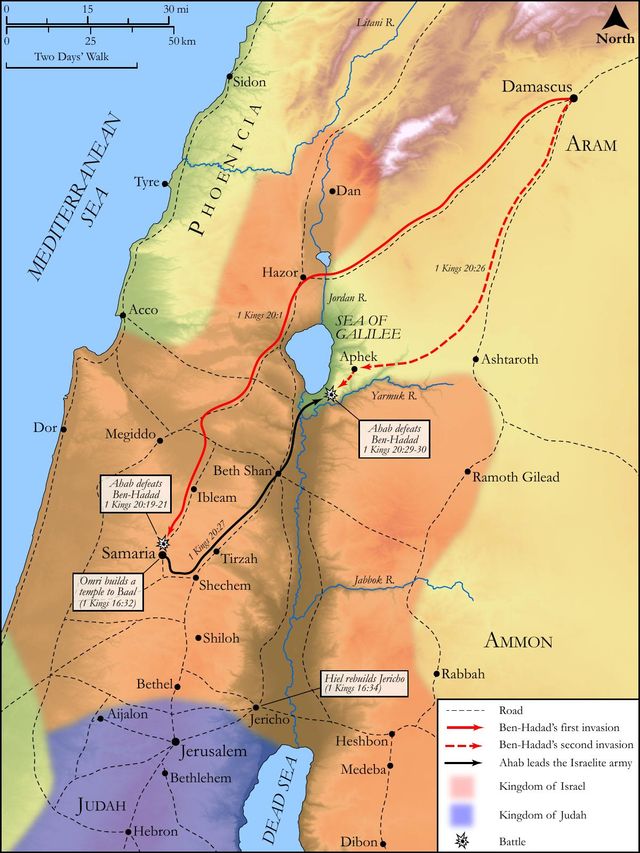
The Northern Kingdom of Israel, under the Omride dynasty (including Ahab), was a significant regional power, yet it frequently found itself in conflict with its powerful northern neighbor, Aram (Syria), whose capital was Damascus. Samaria, Israel's capital, was a strategically important and well-fortified city, making its siege by Ben-hadad a grave threat. Armies of the kings of that day often consisted of tens of thousands, sometimes hundreds of thousands, of soldiers, making Israel's total force of 7,232 (232 + 7,000) exceptionally small for a pitched battle against a besieging army of a major regional power. The "princes of the provinces" likely refers to regional governors or influential leaders, whose "young men" would constitute an elite, perhaps cavalry or chariot, unit or a vanguard force. The mustering process itself, "numbering" or "mustering," was a common military practice to assess available manpower, but here it underscores the stark reality of Israel's limited human resources in contrast to God's unlimited power. This period was also marked by significant religious apostasy in Israel, particularly the widespread worship of Baal promoted by Ahab and Jezebel, making God's intervention on their behalf a profound demonstration of His covenant faithfulness despite their unfaithfulness.
Key Themes
ShowHideThis verse powerfully contributes to several overarching themes within 1 Kings and the broader biblical narrative. Firstly, it highlights Divine Sovereignty Over Human Might, demonstrating that God's ability to grant victory is entirely independent of human numerical strength or military prowess. The overwhelming odds against Israel serve as a canvas for God to display His power, echoing similar accounts where God uses small numbers to achieve great victories, such as Gideon's army in Judges 7. Secondly, it touches upon the theme of Obedience and Faith, as Ahab, despite his general wickedness, exhibits a crucial moment of obedience to the prophet's unconventional strategy, which is immediately rewarded with divine intervention. This underscores that even partial or reluctant obedience can open the door for God's purposes to unfold. Thirdly, the number Seven Thousand is highly significant, subtly reinforcing the theme of God's Chosen Remnant. This number famously appears in 1 Kings 19:18, where God reveals to Elijah that He has reserved 7,000 in Israel who have not bowed to Baal. While not explicitly stated as the same group, its recurrence here suggests a divine preservation and a working through a faithful, or at least chosen, remnant even in times of widespread apostasy.
Exposition and Analysis
ShowHideKey Word Analysis
ShowHideThe Hebrew verb פָּקַד (pâqad', H6485) is rich in meaning, encompassing "to visit (with friendly or hostile intent)," "to oversee," "to muster," "to charge," "to care for," or "to take an account of." In a military context, as here, it specifically denotes the act of mustering, reviewing, or enrolling troops, implying a careful and deliberate accounting of available manpower for strategic deployment. The precise use of this verb here emphasizes the exact and seemingly inadequate tally of Israel's forces, setting the stage for God's miraculous intervention to be undeniably His work.
The Hebrew term נַעַר (naʻar', H5288) refers to a boy or youth, typically from infancy to adolescence, but can also imply a servant or, by extension, a young man chosen for active service. In this context, "young men of the princes of the provinces" (which includes the word naʻar) refers to an elite contingent, likely chosen for their vigor, strength, and possibly their social standing as attendants or sons of regional leaders. Their small number (232) suggests they were a highly specialized or symbolic vanguard unit, distinct from the main body of the army.
The Hebrew word בֵּן (bên', H1121) literally means "son" but is used in a very wide sense to denote relationship, including descendants, subjects, or members of a nation. Here, "children of Israel" (בְּנֵי יִשְׂרָאֵל, bênê Yisrâʼêl) refers to the general populace or the collective body of the Israelite people who comprised the main fighting force. This phrase emphasizes their identity as God's covenant people, whose deliverance would serve to demonstrate His power and faithfulness, even when their human strength was utterly insufficient.
Verse Breakdown
ShowHide"Then he numbered the young men of the princes of the provinces"
"He" refers to King Ahab, acting on the prophet's instruction to prepare for battle. The act of "numbering" (from pâqad') implies a formal muster, a careful assessment of his available forces. This first group, the "young men of the princes of the provinces," represents an elite or vanguard contingent, possibly drawn from the noble families or regional leaders, indicating a strategic deployment of his most capable, albeit few, men.
"and they were two hundred and thirty two"
This precise and remarkably small number for an elite unit underscores the severe numerical disadvantage Israel faced. It highlights the human inadequacy of Ahab's forces, setting the stage for God's miraculous intervention to be clearly seen as divine rather than a result of human strength or strategy.
"and after them he numbered all the people, [even] all the children of Israel, [being] seven thousand"
Following the elite vanguard, Ahab mustered the main body of his fighting force, described as "all the people, even all the children of Israel." This phrase emphasizes that this was the entirety of his available national army for this engagement. The number "seven thousand" for the main force, combined with the 232, brings the total to 7,232. This total is still astonishingly small when facing a major regional power's army, further emphasizing the theme of divine power overcoming human weakness.
Literary Devices
ShowHideThe passage employs several potent literary devices to underscore its theological message. Juxtaposition is central, contrasting the minuscule Israelite force (232 + 7,000) with the implied vastness and overwhelming might of the besieging Syrian army. This stark numerical disparity magnifies the miraculous nature of the impending victory, ensuring that God, not human strength, receives all the glory. Symbolism is profoundly evident in the number 7,000, which resonates with the "remnant" motif found elsewhere in 1 Kings, particularly in Elijah's encounter with God, where 7,000 had not bowed to Baal 1 Kings 19:18. This numerical echo subtly suggests a divinely preserved and chosen group through whom God works, even amidst widespread apostasy. Furthermore, the passage uses Foreshadowing, as the very act of mustering such a small, seemingly inadequate army, based on a prophetic word, anticipates and sets the stage for the miraculous divine deliverance that follows. This builds suspense and reinforces the narrative's focus on God's active involvement in human affairs.
Theological and Thematic Connections
ShowHide1 Kings 20:15 serves as a powerful testament to God's ability to work through weakness to display His strength. It challenges the human tendency to rely on visible resources and numerical superiority, instead asserting that divine power is unconstrained by human limitations. This principle is foundational to biblical theology, consistently demonstrating that God often chooses the weak, the few, or the unlikely to accomplish His greatest works, ensuring that the glory redounds to Him alone. The specific numbers, particularly the 7,000, also connect to the broader theme of God preserving a faithful remnant even in times of widespread apostasy, a theme crucial for understanding God's covenant faithfulness throughout Israel's history. This episode underscores that God's purposes will prevail, not through human strength or strategy, but through His sovereign will and power.
Reflection and Application
ShowHideThe account in 1 Kings 20:15, detailing the seemingly insignificant numbers of Israel's army, offers profound encouragement for believers today. It serves as a powerful reminder that our God is not limited by our resources, our numerical strength, or the overwhelming odds we may face. When confronted with "giants" in our lives—whether they be insurmountable challenges, daunting tasks, personal weaknesses, or spiritual battles—this passage calls us to shift our focus from our limitations to God's limitless power. It challenges us to embrace faith over sight, to trust in God's unconventional strategies, and to obey His leading even when it defies human logic. Just as God used a small, outnumbered force to defeat a formidable foe, He can achieve extraordinary things through seemingly ordinary or inadequate means, demonstrating His glory and sovereignty through us when we rely on Him. This narrative invites us to step out in obedience, knowing that true victory comes not from our might, but from His.
Questions for Reflection
ShowHideFAQ
ShowHideWhy did God instruct Ahab to use such a small army against a much larger one?
ShowHideGod deliberately instructed Ahab to use a numerically inferior force to ensure that the ensuing victory would be unequivocally attributed to Him, not to Israel's military strength or strategic genius. This is a recurring pattern in the Old Testament, exemplified by Gideon's army in Judges 7. The primary purpose was to demonstrate God's sovereignty and power to Ahab, to Israel, and to the surrounding nations, proving that "I am the Lord". It was a test of faith for Ahab and a dramatic display of divine intervention, teaching that God saves "not by might nor by power, but by my Spirit" (Zechariah 4:6).
Is the "seven thousand" in 1 Kings 20:15 the same "seven thousand" mentioned to Elijah in 1 Kings 19:18?
ShowHideWhile the text does not explicitly state that the 7,000 soldiers are the exact same 7,000 individuals who had not bowed to Baal, the numerical echo is highly significant and intentional. In 1 Kings 19:18, God assures Elijah that He has preserved a faithful remnant of 7,000 in Israel during a time of widespread apostasy. The recurrence of this specific number in 1 Kings 20:15 strongly suggests a symbolic connection. It implies that even amidst Ahab's wickedness and Israel's idolatry, God was still working through a divinely appointed, if small, group of His people to accomplish His purposes and demonstrate His power, preserving His covenant and ensuring His will was done. It highlights God's faithfulness to His promises, even when His people are unfaithful.
Christ-Centered Fulfillment
ShowHideThe narrative of 1 Kings 20:15, with its emphasis on God achieving victory through seemingly weak and numerically inferior means, finds its ultimate and most profound fulfillment in the person and work of Jesus Christ. The world expected a conquering king, a mighty warrior to overthrow Roman oppression, but God's chosen "army" was a humble carpenter from Nazareth, surrounded by a small band of uneducated disciples. The ultimate victory over sin, death, and the devil was not achieved through overwhelming military might or political power, but through the scandalous weakness of the cross, which is "foolishness to those who are perishing, but to us who are being saved it is the power of God". Just as God used a small Israelite force to defeat a vast Syrian army, He used the seemingly powerless act of Christ's crucifixion to "disarm the powers and authorities, he made a public spectacle of them, triumphing over them by the cross". Furthermore, the "seven thousand" remnant in 1 Kings foreshadows the church, the "little flock" chosen by God to be His agents in the world, empowered not by their own strength or numbers, but by the Holy Spirit, receiving "power when the Holy Spirit has come upon you". Christ's kingdom advances not through worldly might, but through the humble proclamation of the Gospel and the transformative power of God's Spirit working through His people, demonstrating that God's "power is made perfect in weakness".