


1 Kings 20:21
- וַיֵּצֵאvai·ye·Tze'and he went outH3318Conj-w ¦ V-Qal-ConsecImperf-3msVerb Qal Consecutive Imperfect 3rd Singular Masculineוַandיֵּצֵאhe went out
- מֶלֶךְMe·lekh[the] king ofH4428N-mscNoun Singular Masculine Construct
- יִשְׂרָאֵלYis·ra·'ElIsraelH3478N-properNoun Proper Location
- וַיַּךְvai·Yakhand he struck downH5221Conj-w ¦ V-Hiphil-ConsecImperf-3msVerb Hiphil Consecutive Imperfect 3rd Singular Masculineוַandיַּךְhe struck down
- אֶת'et<obj.>H853DirObjMParticle Object Indicator
- הַסּוּסha·Susthe horse[s]H5483Art ¦ N-msNoun Singular Masculine Absoluteהַtheסּוּסhorse[s]
- וְאֶתve·'Etand <obj.>H853Conj-w ¦ DirObjMParticle Object Indicatorוְandאֶת<obj.>
- הָרָכֶבha·Ra·khevthe chariotryH7393Art ¦ N-msNoun Singular Masculine Absoluteהָtheרָכֶבchariotry
- וְהִכָּהve·hi·Kahand he struck downH5221Conj-w ¦ V-Hiphil-ConsecPerf-3msVerb Hiphil Consecutive Perfect 3rd Singular Masculineוְandהִכָּהhe struck down
- בַאֲרָםva·'a·Ramamong AramH758Prep-b ¦ N-properNoun Proper LocationבַamongאֲרָםAram
- מַכָּהma·Kaha slaughterH4347N-fsNoun Singular Feminine Absolute
- גְדוֹלָהge·do·LahgreatH1419Adj-fsAdjective Singular Feminine Absolute
English is a literal word-by-word gloss of the Hebrew, not the KJV's wording. Why?
This is the original text the KJV's translators worked from — each Hebrew word with its own literal English meaning in this verse, prepared by scholars at Tyndale House, Cambridge. The KJV translates whole sentences, not word by word, so its wording differs: one Hebrew word can become several English words, and the KJV may choose “the LORD” where the gloss reads “Yahweh”. Both are faithful — they answer different questions. For the KJV's own rendering, switch to the KJV text.
Details
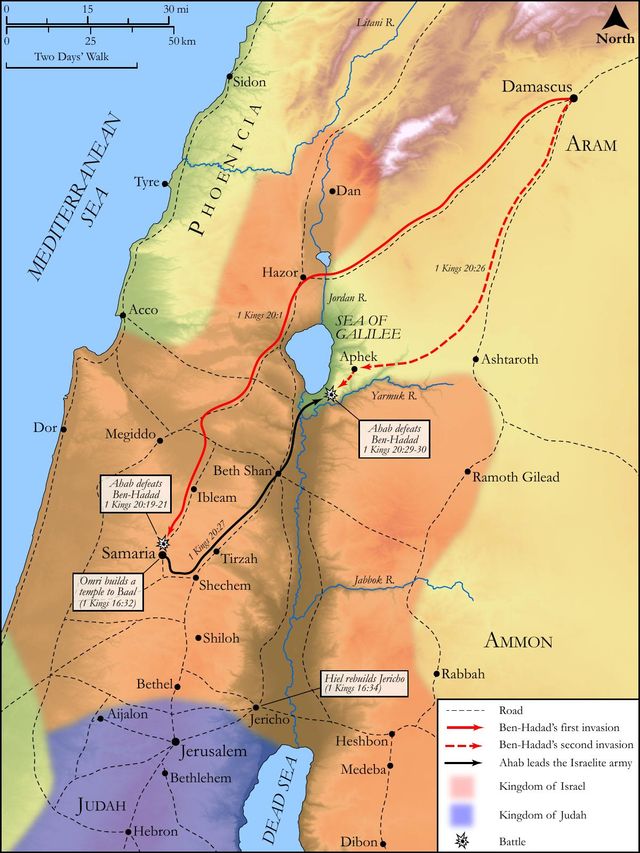
See on the biblical-era map

Study this verse
Public-domain commentary
Matthew Henry
From his Commentary on the Whole Bible. Henry comments on passages, not single verses — this entry covers 1 Kings 20:12–21. His three-level outline is real structure in the source text, so it is rendered as structure.
The treaty between the besiegers and the besieged being broken off abruptly, we have here an account of the battle that ensued immediately.
I.The Syrians, the besiegers, had their directions from a drunken king, who gave orders over his cups, as he was drinking (Kg1 20:12), drinking himself drunk (Kg1 20:16) with the kings in the pavilions, and this at noon. Drunkenness is a sin which armies and their officers have of old been addicted to. Say not thou then that the former days were, in this respect, better than these, though these are bad enough. Had he not been very secure he would not have sat to drink; and, had he not bee intoxicated, he would not have been so very secure. Security and sensuality went together in the old world, and Sodom, Luk 17:26, etc. Ben-hadad's drunkenness was the forerunner of his fall, as Belshazzar's was, Dan. 5. How could he prosper that preferred his pleasure before his business, and kept his kings to drink with him when they should have been at their respective posts to fight for him? In his drink, 1. He orders the town to be invested, the engines fixed, and every thing got ready for the making of a general attack (Kg1 20:12), but stirs not from his drunken club to see it done. Woe unto thee, O land! when thy king is such a child. 2. When the besieged made a sally (and, by that time, he was far gone) he gave orders to take them alive (Kg1 20:18), not to kill them, which might have been done more easily and safely, but to seize them, which gave them an opportunity of killing the aggressors; so imprudent was he in the orders he gave, as well as unjust, in ordering them to be taken prisoners though they came for peace and to renew the treaty. Thus, as is usual, he drinks, and forgets the law, both the policies and the justice of war.
II.The Israelites, the besieged, had their directions from an inspired prophet, one of the prophets of the Lord, whom Ahab had hated and persecuted: And behold a prophet, even one, drew near to the king of Israel; so it may be read, Kg1 20:13.
1.Behold, and wonder, that God should send a prophet with a kind and gracious message to so wicked a prince as Ahab was; but he did it,
(1.)For his people Israel's sake, who, though wickedly degenerated, were the seed of Abraham his friend and Jacob his chosen, the children of the covenant, and not yet cast off.
(2.)That he might magnify his mercy, in doing good to one so evil and unthankful, might either bring him to repentance or leave him the more inexcusable.
(3.)That he might mortify the pride of Ben-hadad and check his insolence. Ahab's idolatry shall be punished hereafter, but Ben-hadad's haughtiness shall be chastised now; for God resists the proud, and is pleased to say that he fears the wrath of the enemy, Deu 32:26, Deu 32:27. There was but one prophet perhaps to be had in Samaria, and he drew near with this message, intimating that he had been forced to keep at a distance. Ahab, in his prosperity, would not have borne the sight of him, but now he bids him welcome, when none of the prophets of the groves can give him any assistance. He enquired not for a prophet of the Lord, but God sent one to him unasked, for he waits to be gracious.
2.Two things the prophet does: - (1.) He animates Ahab with an assurance of victory, which was more than all the elders of Israel could give him (Kg1 20:8), though they promised to stand by him. This prophet, who is not named (for he spoke in God's name), tells him from God that this very day the siege shall be raised, and the army of the Syrians routed, Kg1 20:13. When the prophet said, Thus saith the Lord, we may suppose Ahab began to tremble, expecting a message of wrath; but he is revived when it proves a gracious one. He is informed what use he ought to make of this blessed turn of affairs: "Thou shalt know that I am Jehovah, the sovereign Lord of all." God's foretelling a thing that was so very unlikely proved that it was his own doing. (2.) He instructs him what to do for the gaining of this victory. [1.] He must not stay till the enemy attacked him, but must sally out upon them and surprise them in their trenches. [2.] The persons employed must be the young men of the princes of the provinces, the pages, the footmen, who were few in number, only 232, utterly unacquainted with war, and the unlikeliest men that could be thought of for such a bold attempt; yet these must do it, these weak and foolish things must be instruments of confounding the wise and strong, that, while Ben-hadad's boasting is punished, Ahab's may be prevented and precluded, and the excellency of the power may appear to be of God. [3.] Ahab must himself so far testify his confidence in the word of God as to command in person, though, in the eye of reason, he exposed himself to the utmost danger by it. But it is fit that those who have the benefit of God's promises should enter upon them. Yet, [4.] He is allowed to make use of what other forces he has at hand, to follow the blow, when these young men have broken the ice. All he had in Samaria, or within call, were but 7000 men, Kg1 20:15. It is observable that it is the same number with theirs that he not bowed the knee to Baal (Kg1 19:18), though, it is likely, not the same men.
III.The issue was accordingly.
The proud Syrians were beaten, and the poor despised Israelites were more than conquerors. The young men gave an alarm to the Syrians just at noon, at high dinner-time, supported by what little force they had, Kg1 20:16. Ben-hadad despised them at first (Kg1 20:18), but when they had, with unparalleled bravery and dexterity, slain every one his man, and so put the army into disorder, that proud man durst not face them, but mounted immediately, drunk as he was, and made the best of his way, Kg1 20:20. See how God takes away the spirit of princes, and makes himself terrible to the kings of the earth. Now where are the silver and gold he demanded of Ahab? Where are the handfuls of Samaria's dust? Those that are most secure are commonly least courageous. Ahab failed not to improve this advantage, but slew the Syrians with a great slaughter, Kg1 20:21. Note, God oftentimes makes one wicked man a scourge to another.
Historical interpretation
Historical reception
3 surviving comments on this verse. Each one is dated, so this reads as a timeline rather than a list.
Select a marker to jump to its quote. Markers stagger vertically where authors wrote within a few decades of each other.
Here the Scripture relates the two battles of the king of Israel against the Arameans, at which we have already hinted, and the twin slaughters of the Arameans, of which the second caused the death of 127, men, as God took his revenge on the impious voice of the Arameans, who said about the true God worshiped by the Israelites, “The Lord is a god of the hills, but he is not a god of the valleys.”
Thus the saints go up to the Lord, the wicked go down to sin; the saints are on the mountains, the guilty in the valleys. “For he is the God of the mountains and not the God of the valleys.” Those who dwelt in the houses of the plain where God does not dwell could not have the house of God within them, for this is the house that God sought from them so that they might build up themselves and rear within themselves the temple of God from living stones of faith. He did not want buildings made with earthen walls or wooden roofs, for the hand of an enemy would have been able to overthrow them. He wanted that temple that is built in human hearts, to whom it might be said, “You are the temple of God,” in which the Lord Jesus might dwell and from there set out to redeem all humankind. There also could be prepared a sacred chamber in the womb of the Virgin where the King of heaven might live and a human body become the temple of God, which, though it was destroyed, might yet be restored to life on the third day.
Did not the Lord wish Ben-hadad, king of Syria, whom besides countless thousands of his own people, thirty-two kings and armies of the same number of kings served, to be conquered by a few foot soldiers of the princes in order that he who was the author of such victory would be acknowledged?
Continue studying 1 Kings 20:21 across the web’s major study libraries — every link below opens this exact verse, chapter, or book on the destination site.
Read & Compare
 BibleGatewayThis verse in more than 200 translations and 70 languages.
 Bible.comThe YouVersion reader — hundreds of translations, reading plans, and highlights.
 ESV.orgCrossway's official English Standard Version reader.
 NET BibleThe NET translation with 60,000+ translators' notes on every rendering decision.
 STEP BibleTyndale House's free study tool — original text, vocabulary, and scholarly resources.
 BibliaLogos Bible Software's free web reader.
 USCCBThe New American Bible (Revised Edition) with the U.S. bishops' study notes.
Commentaries
 BibleHub CommentariesDozens of classic commentaries on this verse, gathered on one page.
 StudyLightMore than 100 commentary sets — the largest collection on the web.
 BibleRefPlain-English commentary on what this verse means, verse by verse.
 Enduring WordDavid Guzik's free commentary on this chapter, widely used by Bible teachers.
 Bible Study ToolsVerse commentary alongside Greek and Hebrew study aids.
Original Language & Research
- BibleHub InterlinearThe verse word by word — original language, transliteration, and English.
- BibleHub LexiconEvery word's original-language definition and Strong's entry.
 Blue Letter BibleDeep-study tools — Strong's numbers, concordance, and word studies.
 SefariaThe Hebrew text with Rashi and centuries of Jewish commentary.
Sermons, Hymns & Audio


TrulyRandomVerse is not affiliated with these sites and doesn’t control their content. They’re linked because they’re genuinely useful.
Summary
1 Kings 20:21 vividly portrays the climactic and divinely orchestrated defeat of the formidable Syrian army by Israel under King Ahab. This verse marks the decisive moment of a miraculous military triumph, where God, despite the profound unworthiness of Israel's king, powerfully demonstrates His absolute sovereignty over nations and His capacity to humble the arrogant, delivering a crushing and comprehensive blow to the seemingly superior forces of Ben-Hadad.
Context
ShowHideLiterary Context
This verse serves as the powerful culmination of the initial major confrontation between the northern kingdom of Israel and Aram (Syria), meticulously detailed in 1 Kings 20. The narrative unfolds with Ben-Hadad's audacious siege of Samaria and his escalating, arrogant demands upon King Ahab (1 Kings 20:1-6). Despite Ahab's initial, humiliating capitulation, a prophet of the Lord miraculously appears, promising victory. This promised triumph is explicitly stated not to be a result of Israel's strength or Ahab's righteousness, but solely to demonstrate God's unparalleled sovereignty over all nations and to humble the proud Ben-Hadad (1 Kings 20:13). The prophet even specifies the unexpected agents of this victory: "the young men of the princes of the provinces" (1 Kings 20:14). Verses 1 Kings 20:15-20 describe the small Israelite force engaging the massive Syrian army, leading directly into the devastating rout and "great slaughter" described in 1 Kings 20:21. The swiftness and totality of this defeat unequivocally underscore the divine hand at work, setting the stage for subsequent events where Ben-Hadad escapes and God's identity is further affirmed (1 Kings 20:22-28).
Historical & Cultural Context
The protracted conflict between Israel and Aram (Syria) was a defining and recurring feature of the geopolitical landscape during the Omride dynasty in the 9th century BCE. Samaria, as the strategically vital capital of the northern kingdom of Israel, represented a prime target for expansionist powers. Ancient Near Eastern warfare frequently involved extensive sieges, and the demands made by Ben-Hadad were characteristic of victorious kings asserting dominance and exacting tribute and submission. The military might of an army in this era was often measured by its complement of chariots and cavalry, which constituted the elite, shock-and-awe components of military power, capable of breaking enemy lines and pursuing fleeing forces. For the Israelite army to "smote the horses and chariots" meant not merely a tactical victory, but a complete and devastating incapacitation of the enemy's most formidable assets, ensuring a decisive rout and precluding any effective counter-attack or pursuit. The narrative also illuminates the pervasive ancient Near Eastern belief in national gods, where military victory or defeat was routinely attributed to the superior power of a nation's deity. God's dramatic intervention here serves as a direct and profound challenge to this polytheistic worldview, unequivocally asserting His universal sovereignty over all nations and their purported gods, especially in His capacity to humble the proud and arrogant.
Key Themes
ShowHideThis verse powerfully encapsulates and illustrates several overarching theological and narrative themes within 1 Kings 20 and the broader Deuteronomistic History. Foremost among these is the theme of Divine Sovereignty and Intervention, where God actively and decisively intervenes in human affairs and geopolitical conflicts, often employing flawed and unlikely instruments like King Ahab, to accomplish His divine purposes and reveal His unparalleled power. The victory is emphatically not attributed to Israel's military might or Ahab's merit, but to God's explicit declaration that He would deliver the Syrians "into your hand, that you may know that I am the LORD" (1 Kings 20:28). This directly ties into the theme of God's Self-Revelation, where He acts powerfully in history to make His unique name and character known to both His people and the surrounding nations. Another prominent theme is the Humbling of the Proud, as Ben-Hadad's audacious arrogance and blasphemous boasts are met with swift, overwhelming, and divinely orchestrated judgment, serving as a stark and timeless warning against human hubris (Proverbs 16:18). Finally, the narrative powerfully underscores the Reliability of God's Prophetic Word, as the precise details of the prophet's prediction regarding the victory and its unexpected agents are meticulously fulfilled, reinforcing the absolute trustworthiness and efficacy of God's communication to His people (Isaiah 55:11).
Exposition and Analysis
ShowHideKey Word Analysis
ShowHideThis verb (H3318) signifies "to go forth, to come out, to proceed." In this military context, it denotes the decisive action of King Ahab leading his forces out of the besieged city to engage the enemy. It marks the initiation of the battle, a bold and obedient move on Ahab's part in response to the prophetic word, demonstrating an active step of faith, however limited, in God's promised victory.
This powerful and versatile verb (H5221) is used twice in the verse, meaning "to strike, to hit, to beat, to kill, to defeat." Its repetition underscores the comprehensive and devastating nature of the Israelite attack. First, it describes the disabling of the enemy's vital military assets ("smote the horses and chariots"), and second, the direct lethal action against the Syrian soldiers ("slew the Syrians"). It implies not just an attack, but a decisive and effective blow leading to incapacitation and death.
This noun (H4347), derived from the same root as nâkâh, refers to a "blow, wound, defeat, plague, slaughter." When combined with the adjective "great" (H1419, gâdôwl), it denotes an overwhelming and catastrophic military defeat. It paints a vivid picture of a one-sided battle, a rout where the enemy is not merely beaten but utterly devastated and decimated, signifying the completeness and severity of Israel's divinely granted victory.
Verse Breakdown
ShowHide"And the king of Israel went out"
This initial clause establishes King Ahab's direct leadership and participation in the battle. His "going out" from the relative safety of Samaria signifies his obedience to the prophet's instruction to engage the formidable Syrian army, despite the overwhelming odds. It marks the decisive moment of engagement, initiating the divinely promised military action.
"and smote the horses and chariots"
This crucial clause describes the strategic and devastating blow delivered to the core strength of the Syrian army. Horses and chariots represented the pinnacle of ancient military technology, embodying speed, power, and the primary offensive capability. By targeting and effectively disabling these elite units, the Israelite forces crippled the Syrian army's mobility, cohesion, and offensive power, rendering them vulnerable and disorganized, which was pivotal for the subsequent rout.
"and slew the Syrians with a great slaughter"
This final clause summarizes the catastrophic outcome for the Syrian forces. The phrase "slew the Syrians" indicates direct lethal action, while "with a great slaughter" emphasizes the extraordinary magnitude of the casualties and the overwhelming nature of the Israelite victory. It underscores that this was not a minor skirmish but a decisive, comprehensive, and divinely enabled rout that utterly devastated Ben-Hadad's army, fulfilling God's prophetic word.
Literary Devices
ShowHideThe verse employs several potent literary devices to convey the profound impact and divine nature of the event. Hyperbole is powerfully evident in the phrase "great slaughter," which, while certainly reflecting a significant defeat, emphasizes the overwhelming and devastating nature of the victory beyond mere factual reporting, highlighting its divine origin and scope. The narrative itself functions as Narrative Irony, as God conspicuously uses the notoriously wicked King Ahab, who was deeply steeped in idolatry and rebellion against the Lord, to achieve a glorious and decisive victory over a proud pagan king. This unexpected alliance of divine power with an unworthy human agent dramatically underscores God's absolute sovereignty and His ability to work through any means, even the most unlikely, to accomplish His immutable purposes. Furthermore, the explicit focus on the destruction of "horses and chariots" carries profound Symbolism, representing the pinnacle of human military might, self-reliance, and worldly power. Their decisive and total destruction symbolizes the futility of trusting in human strength or armaments when confronted by the sovereign and irresistible power of God, a recurring and foundational theme throughout biblical narratives.
Theological and Thematic Connections
ShowHideThe triumph depicted in 1 Kings 20:21 profoundly illustrates God's absolute sovereignty over all earthly powers and His unwavering commitment to His covenant purposes, even when His people are profoundly undeserving. The victory was emphatically not a testament to Ahab's righteousness or Israel's military prowess, but a clear and undeniable demonstration that the Lord alone is God, capable of humbling the proud and delivering His people against overwhelming odds. This narrative serves as a powerful and enduring reminder that God's power is not contingent on human strength, merit, or strategic advantage, but is exercised solely according to His divine will and for the ultimate revelation of His glory. It teaches that true security, lasting victory, and ultimate deliverance come from trusting implicitly in the Lord, rather than in human armaments, military might, or cunning strategies.
Reflection and Application
ShowHideThe account in 1 Kings 20:21 offers profound encouragement and a challenging call to faithful living for believers today. It powerfully reminds us that our God is a God who actively and decisively intervenes in the affairs of humanity, often transforming seemingly impossible situations into glorious and undeniable victories. This narrative calls us to a deep and honest evaluation of where we place our ultimate trust: do we instinctively rely on our own strength, our accumulated resources, or our perceived strategic advantages (our modern-day "horses and chariots"), or do we place our unwavering confidence in the sovereign and limitless power of God? Even when we feel weak, outnumbered, or acutely aware of our unworthiness, this passage assures us that God can powerfully use us as instruments to accomplish His magnificent purposes and reveal His glory to a watching world. The dramatic humbling of Ben-Hadad also serves as a potent and timeless warning against pride, arrogance, and self-sufficiency, urging us to cultivate genuine humility before God and in our interactions with others. Ultimately, this verse invites us to audacious faith, believing that God can bring about a "great slaughter" of our spiritual battles, overwhelming our adversaries, dismantling obstacles, and establishing His righteous kingdom in and through our lives.
Questions for Reflection
ShowHideFAQ
ShowHideWhy did God help Ahab, who was known for his wickedness and idolatry?
ShowHideGod's intervention in 1 Kings 20:21 was not a reward for Ahab's personal righteousness or a validation of his idolatrous practices. Instead, it was a profound demonstration of God's own absolute sovereignty, His covenant faithfulness, and His unique identity. The prophet explicitly states that the victory was given "that you may know that I am the LORD" (1 Kings 20:13 and reiterated in 1 Kings 20:28). God used this specific situation to humble the arrogant King Ben-Hadad, who had not only attacked Israel but had also blasphemed the God of Israel by boasting of his superior power and attributing his strength to his own pagan gods. This narrative powerfully underscores that God's purposes transcend human merit or unworthiness; He is sovereign and can use anyone, even the unrighteous or those in rebellion against Him, to accomplish His divine will, reveal His glory, and fulfill His overarching plan for both His people and the nations.
Christ-Centered Fulfillment
ShowHideThe decisive victory of Israel over the Syrian forces in 1 Kings 20:21, orchestrated by God despite the profound weakness and unworthiness of His people and their king, powerfully foreshadows the ultimate and eternally decisive victory achieved by Jesus Christ. Just as God "smote the horses and chariots" of Syria, crippling their worldly power and might, so Christ, the true King of Israel, utterly disarmed and triumphed over the spiritual "principalities and powers" that held humanity captive (Colossians 2:15). He did not achieve this "great slaughter" through physical warfare, earthly armies, or human might, but through His perfect sacrificial death on the cross and His glorious resurrection from the dead. Through His death, Jesus destroyed "him who has the power of death, that is, the devil" (Hebrews 2:14-15), delivering a fatal and irreversible blow to the spiritual enemies of humanity: sin, death, and the devil. His victory is the ultimate fulfillment of God's promise to humble the proud and establish His righteous, eternal reign, not just over a single nation, but over all creation, as He is the Lamb of God who takes away the sin of the world (John 1:29) and the victorious Rider on the white horse, coming to judge and make war in righteousness (Revelation 19:11-16).