


Judges 7:25
Bible text: King James Version (1769 Blayney text) · Public domain
Bible text: King James Version with Strong's numbers · Public domain
Bible text: Berean Standard Bible · Public domain
Bible text: American Standard Version (1901) · Public domain
Bible text: World English Bible, Messianic edition · Public domain
Bible text: Geneva Bible (1599) · Public domain
Bible text: Young's Literal Translation · Public domain
- וַיִּלְכְּדוּvai·yil·ke·Duand they capturedH3920Conj-w ¦ V-Qal-ConsecImperf-3mpVerb Qal Consecutive Imperfect 3rd Plural Masculineוַandיִּלְכְּדוּthey captured
- שְׁנֵיshe·nei[the] twoH8147N-cdcNoun Dual common gender Construct
- שָׂרֵיsa·Rei[the] commanders ofH8269N-mpcNoun Plural Masculine Construct
- מִדְיָןmid·YanMidianH4080N-properNoun Proper Location
- אֶת'et<obj.>H853DirObjMParticle Object Indicator
- עֹרֵב'o·RevOrebH6159N-proper-mNoun Proper Masculine
- וְאֶתve·'Etand <obj.>H853Conj-w ¦ DirObjMParticle Object Indicatorוְandאֶת<obj.>
- זְאֵבze·'EvZeebH2062N-proper-mNoun Proper Masculine
- וַיַּהַרְגוּvai·ya·har·Guand they killedH2026Conj-w ¦ V-Qal-ConsecImperf-3mpVerb Qal Consecutive Imperfect 3rd Plural Masculineוַandיַּהַרְגוּthey killed
- אֶת'et<obj.>H853DirObjMParticle Object Indicator
- עוֹרֵבo·RevOrebH6159N-proper-mNoun Proper Masculine
- בְּצוּרbe·tzurat [the] rock ofH6697Prep-b ¦ N-mscNoun Singular Masculine Constructבְּatצוּר[the] rock of
- עוֹרֵבo·RevOrebH6159N-proper-mNoun Proper Masculine
- וְאֶתve·'Etand <obj.>H853Conj-w ¦ DirObjMParticle Object Indicatorוְandאֶת<obj.>
- זְאֵבze·'EvZeebH2062N-proper-mNoun Proper Masculine
- הָרְגוּha·re·Guthey killedH2026V-Qal-Perf-3cpVerb Qal Perfect 3rd Plural common gender
- בְיֶקֶבve·ye·kevat [the] winepress ofH3342Prep-b ¦ N-mscNoun Singular Masculine Constructבְatיֶקֶב[the] winepress of
- זְאֵבze·'EvZeebH2062N-proper-mNoun Proper Masculine
- וַיִּרְדְּפוּvai·yir·de·Fuand they pursuedH7291Conj-w ¦ V-Qal-ConsecImperf-3mpVerb Qal Consecutive Imperfect 3rd Plural Masculineוַandיִּרְדְּפוּthey pursued
- אֶל'el<to>H413PrepPreposition
- מִדְיָןmid·YanMidianH4080N-properNoun Proper Location
- וְרֹאשׁve·roshand [the] head ofH7218Conj-w ¦ N-mscNoun Singular Masculine Constructוְandרֹאשׁ[the] head of
- עֹרֵב'o·RevOrebH6159N-proper-mNoun Proper Masculine
- וּזְאֵבu·ze·'Evand ZeebH2062Conj-w ¦ N-proper-mNoun Proper MasculineוּandזְאֵבZeeb
- הֵבִיאוּhe·Vi·'uthey broughtH935V-Hiphil-Perf-3cpVerb Hiphil Perfect 3rd Plural common gender
- אֶל'eltoH413PrepPreposition
- גִּדְעוֹןgid·'onGideonH1439N-proper-mNoun Proper Masculine
- מֵעֵבֶרme·'E·verfrom [the] other sideH5676Prep-m ¦ N-msNoun Singular Masculine Absoluteמֵfromעֵבֶר[the] other side
- לַיַּרְדֵּןlai·yar·Denof the JordanH3383Prep-l ¦ N-properNoun Proper Locationלַof theיַּרְדֵּןJordan
English is a literal word-by-word gloss of the Hebrew, not the KJV's wording. Why?
This is the original text the KJV's translators worked from — each Hebrew word with its own literal English meaning in this verse, prepared by scholars at Tyndale House, Cambridge. The KJV translates whole sentences, not word by word, so its wording differs: one Hebrew word can become several English words, and the KJV may choose “the LORD” where the gloss reads “Yahweh”. Both are faithful — they answer different questions. For the KJV's own rendering, switch to the KJV text.
Details
See on the biblical-era maps
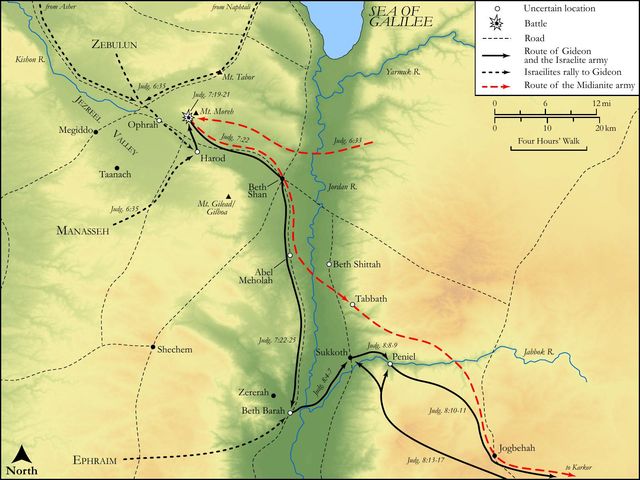
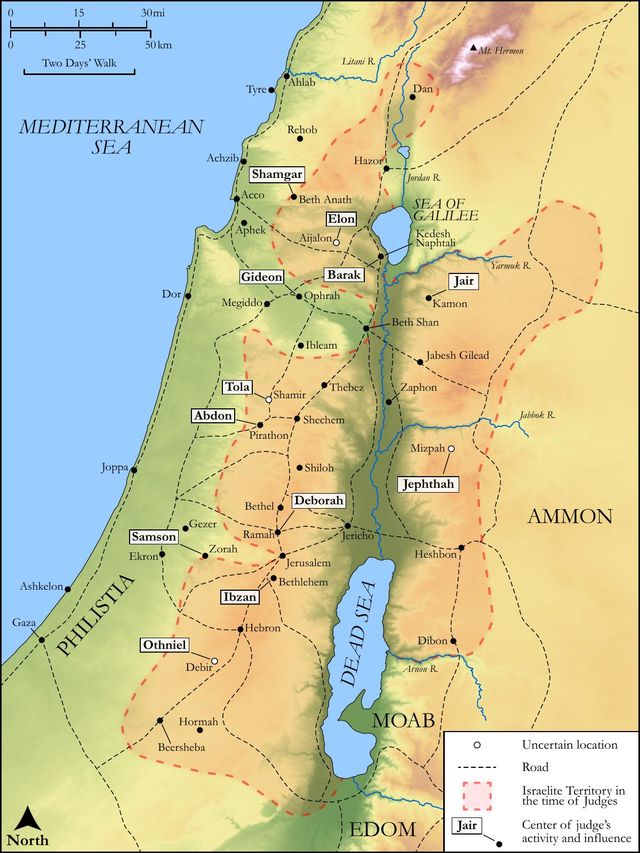
Study this verse
Public-domain commentary
Matthew Henry
From his Commentary on the Whole Bible. Henry comments on passages, not single verses — this entry covers Judges 7:23–25.
We have here the prosecution of this glorious victory. 1. Gideon's soldiers that had been dismissed, and perhaps had begun to disperse themselves, upon notice of the enemies' flight got together again, and vigorously pursued those whom they had not courage to face. The men of Israel out of Naphtali and Asher who did this (Jdg 7:23) were not such as now came from those distant countries, but the same that had enlisted themselves (Jdg 6:35), but had been cashiered. Those who were fearful and afraid to fight (Jdg 7:3) now took heart, when the worst was over, and were ready enough to divide the spoil, though backward to make the onset. Those also that might not fight though they had a mind to it, and were disbanded by order from God, did not as those, Ch2 25:10, Ch2 25:13, return in great anger, but waited for an opportunity of doing service in pursuing the victory, though they were denied the honour of helping to force the lines. 2. The Ephraimites, upon a summons from Gideon, came in unanimously, and secured the passes over Jordan, by the several fords, to cut off the enemies' retreat into their own country, that they might be entirely destroyed, to prevent the like mischief to Israel another time. Now that they had begun to fall, it was easy to say, Down with them, Est 6:13. They took the waters (Jdg 7:24), that is, posted themselves along the river side, so that the Midianites, who fled from those who pursued them, fell into the hands of those that waited to intercept them. Here were fear, and the pit, and the snare, Isa 24:17. 3. Two of the chief commanders of the host of Midian were taken and slain by the Ephraimites on this side Jordan, Jdg 7:25. Their names perhaps signified their nature, Oreb signifies a raven, and Zeeb a wolf (corvus and lupus). These in their flight had taken shelter, one in a rock (Isa 2:21; Rev 6:15), the other by a wine-press, as Gideon for fear of them had lately hid his corn by a wine-press, Jdg 6:11. But the places of their shelter were made the places of their slaughter, and the memory of it was preserved to posterity in the names of the places, to their perpetual infamy: Here fell the princes of Midian.
Historical interpretation
Fourteen Centuries of Reception
2 surviving comments on this verse. Each one is dated, so this reads as a timeline rather than a list.
Select a marker to jump to its quote. Markers stagger vertically where authors wrote within a few decades of each other.
They who were glorying in their army, whose king was the Assyrian and who used to boast “I will scale the heavens,” not only fell down to earth but on the ground became dung.“Make their nobles.” What nobles? Those who fight against your people. “Like Oreb and Zeeb; all their chiefs like Zebah and Zalmunna.” I suppose you have read in the book of Judges the story of Gideon, who is also called Jerubbaal, how he outwitted those four kings while fighting for the people of God and put an end to them. And notice the kind of nobles these Midianites are who abandoned the judgment of God: “Oreb and Zeeb; all their chiefs like Zebah and Zalmunna.” Who would dream that such words contain mysteries of the Savior? The philosophers read them and smile; the rhetoricians read them and sneer. Not only the rhetoricians, however, but the Jews, too; they have not the key to their treasures, for a veil covers their eyes. “Oreb” means a “hole in which a snake lurks”; “Zeeb” equals “wolf.” Mark, now, the names of the chiefs of Christ’s opponents: “Zebah,” “victim or spoil that the wolf will strangle”; and “Zalmunna,” “masters of malice.” See, then, the divine secrets hidden away in names?
Two men: That is, two of their chiefs.
Continue studying Judges 7:25 across the web’s major study libraries — every link below opens this exact verse, chapter, or book on the destination site.
Read & Compare
 BibleGatewayThis verse in more than 200 translations and 70 languages.
 Bible.comThe YouVersion reader — hundreds of translations, reading plans, and highlights.
 ESV.orgCrossway's official English Standard Version reader.
 NET BibleThe NET translation with 60,000+ translators' notes on every rendering decision.
 STEP BibleTyndale House's free study tool — original text, vocabulary, and scholarly resources.
 BibliaLogos Bible Software's free web reader.
 USCCBThe New American Bible (Revised Edition) with the U.S. bishops' study notes.
Commentaries
 BibleHub CommentariesDozens of classic commentaries on this verse, gathered on one page.
 StudyLightMore than 100 commentary sets — the largest collection on the web.
 BibleRefPlain-English commentary on what this verse means, verse by verse.
 Enduring WordDavid Guzik's free commentary on this chapter, widely used by Bible teachers.
 Bible Study ToolsVerse commentary alongside Greek and Hebrew study aids.
Original Language & Research
- BibleHub InterlinearThe verse word by word — original language, transliteration, and English.
- BibleHub LexiconEvery word's original-language definition and Strong's entry.
 Blue Letter BibleDeep-study tools — Strong's numbers, concordance, and word studies.
 SefariaThe Hebrew text with Rashi and centuries of Jewish commentary.
Sermons, Hymns & Audio


TrulyRandomVerse is not affiliated with these sites and doesn’t control their content. They’re linked because they’re genuinely useful.
Summary
Judges 7:25 chronicles the decisive and triumphant conclusion of Gideon's divinely empowered campaign against the Midianites, detailing the capture and execution of their two formidable princes, Oreb and Zeeb. This pivotal verse not only signifies the complete routing of Israel's long-standing oppressors but also serves as undeniable proof of God's thorough and definitive deliverance, bringing a conclusive end to Midianite tyranny and restoring a measure of peace and security to the land of Israel.
Context
ShowHideLiterary Context
Judges 7:25 provides the climactic resolution to the initial phase of the Midianite defeat, immediately following the miraculous and chaotic rout of the vast Midianite army. This rout was initiated by Gideon's small, divinely chosen force of 300 men, whose unconventional tactics—trumpets, jars, and torches—caused widespread panic and friendly fire among the Midianites (see the dramatic account in Judges 7:19-22). As the Midianites fled in disarray, the pursuit commenced, with additional Israelite tribes, notably Ephraim, joining the chase to cut off escape routes (as detailed in Judges 7:23-24). This verse, therefore, marks the successful culmination of that pursuit, confirming the decisive elimination of Midianite leadership and securing the initial victory, setting the stage for the subsequent interactions between Gideon and the Ephraimites and the final mopping-up operations against the remaining Midianite kings.
Historical & Cultural Context
For seven oppressive years, the Midianites, allied with the Amalekites and other "people of the East," had severely afflicted Israel, systematically plundering their crops and livestock, and forcing the Israelites to seek refuge in caves and strongholds (a period vividly described in Judges 6:1-6). This verse reflects the brutal realities of warfare in that day, where the intense pursuit of a defeated enemy was crucial to ensure their complete incapacitation and prevent future resurgence. The capture and execution of enemy leaders, followed by the presentation of their heads, was a common, albeit gruesome, custom. This act served as undeniable proof of total victory, a public humiliation of the enemy, and a clear message to any remaining resistance. The phrase "on the other side Jordan" (Transjordan) indicates the extensive reach of the pursuit, pushing the Midianites back into their own territory or beyond Israel's immediate borders, signifying the thoroughness of the Israelite response.
Key Themes
ShowHideJudges 7:25 powerfully underscores the overarching theme of Divine Victory and Deliverance, demonstrating that God's deliverance is thorough, complete, and decisive, even when achieved through seemingly insignificant means against overwhelming odds. It highlights Justice and Retribution, as the oppressive leaders, Oreb and Zeeb, face swift and definitive judgment, symbolizing the breaking of Midian's power and the restoration of security for Israel. The specific mention of their deaths at locations bearing their names also emphasizes the theme of God's Sovereignty and Poetic Justice, where the very symbols of the oppressors become enduring monuments to their downfall. This definitive end to the Midianite threat fulfills God's promise to Gideon and His people, showcasing His unwavering faithfulness to His covenant (compare God's initial call to Gideon in Judges 6:14).
Exposition and Analysis
ShowHideKey Word Analysis
ShowHideThis primitive root means "to catch (in a net, trap or pit); generally, to capture or occupy." In the context of Judges 7:25, it emphasizes the successful apprehension of the Midianite princes, Oreb and Zeeb. This was not a mere encounter but a deliberate act of capture, signifying the end of their flight and the beginning of their judgment. The word implies a decisive and effective action, ensuring that these key leaders could not escape the consequences of their oppression.
This primitive root means "to smite with deadly intent; destroy, kill, murder." The repeated use of this verb ("they slew Oreb," "Zeeb they slew") underscores the intentional and fatal nature of the act. It signifies the complete and irreversible elimination of the Midianite leadership, demonstrating the finality of God's judgment against those who afflicted His people. The action is presented as a definitive execution, not merely a battle casualty.
This term refers to "a head person (of any rank or class); captain, chief, general, governor, lord, prince, ruler." Oreb and Zeeb were not ordinary soldiers but high-ranking military or tribal leaders. Their status as "princes" indicates their significant authority and influence within the Midianite forces. Their capture and execution therefore represent the decapitation of the enemy's command structure, ensuring the collapse of organized resistance and a truly decisive victory for Israel.
Verse Breakdown
ShowHide"And they took two princes of the Midianites, Oreb and Zeeb;"
This initial clause highlights the successful apprehension of the two most significant Midianite leaders. The indefinite "they" refers primarily to the Israelite forces, specifically the men of Ephraim, who had been strategically deployed by Gideon to cut off the Midianites' escape routes across the Jordan River (as detailed in Judges 7:24). The capture of these "princes" (שָׂרִים, śārîm) was a crucial strategic victory, as their leadership was integral to the Midianite threat and their organized oppression of Israel.
"and they slew Oreb upon the rock Oreb, and Zeeb they slew at the winepress of Zeeb, "
This part details the execution of the captured princes at specific, symbolically resonant locations. The fact that Oreb was killed at a "rock" named after him and Zeeb at a "winepress" named after him is a powerful act of poetic justice. It ensures that their defeat is not only complete but also permanently memorialized at sites that bear witness to their downfall, transforming places associated with their identity into monuments of their destruction. The "winepress" imagery is particularly potent, suggesting the crushing of the enemy, much like grapes are crushed for wine.
"and pursued Midian, and brought the heads of Oreb and Zeeb to Gideon on the other side Jordan."
This final clause emphasizes the thoroughness of the Israelite pursuit and the conclusive nature of the victory. The act of bringing the severed heads of the enemy leaders to Gideon served as undeniable, gruesome proof of their deaths and the complete elimination of the Midianite command structure. The phrase "on the other side Jordan" (Transjordan) signifies the extensive reach of the pursuit, pushing the enemy out of Israelite territory and ensuring a comprehensive and definitive end to their long-standing oppression.
Literary Devices
ShowHideJudges 7:25 masterfully employs several literary devices to enhance its impact and convey deeper meaning. Symbolism is prominently featured in the very names of the Midianite princes: Oreb, meaning "raven," and Zeeb, meaning "wolf." These names vividly portray their predatory nature and the destructive impact of the Midianite oppression on Israel. This symbolism is powerfully extended to the locations of their demise: "the rock Oreb" and "the winepress of Zeeb." The Irony is striking, as these leaders are killed at places named after them, turning what might have been intended as monuments to their power into markers of their humiliation and defeat. The "winepress" particularly carries a symbolic weight of divine judgment, where the wicked are "crushed." There is also a subtle yet effective use of Repetition in the naming of the places after the princes, which serves to emphasize the completeness and finality of their downfall, ensuring that their defeat is permanently etched into the landscape and memory of Israel.
Theological and Thematic Connections
ShowHideJudges 7:25 profoundly illustrates God's decisive and thorough judgment against those who oppress His covenant people. The swift and complete elimination of Oreb and Zeeb underscores the unwavering principle that divine justice will ultimately prevail, and the enemies of God's chosen will face inevitable consequences. This victory, achieved through seemingly weak and unconventional means (Gideon's 300 men), powerfully highlights God's sovereign power to deliver fully and definitively, often in ways that defy human expectation, ensuring all glory redounds solely to Him. It serves as a potent reminder that while human agents are involved in the process, the ultimate triumph belongs to the Lord, who brings an end to tyranny and restores His people to a state of peace and security.
Reflection and Application
ShowHideJudges 7:25 offers both profound encouragement and a stark warning for believers today. It powerfully reminds us that God is fully capable of bringing about complete victory over spiritual enemies and oppressive forces, often through unexpected and seemingly weak means, so that the glory belongs to Him alone. Just as the Midianite princes were decisively dealt with, we are called to trust in God's power to overcome challenges and to persist in the spiritual battles we face, knowing that ultimate triumph belongs to the Lord. This verse also reinforces the principle that those who oppress God's people will ultimately face divine consequences, providing comfort and assurance that God sees and will act on behalf of His suffering children. It calls us to participate in God's redemptive work, even when our resources seem meager, trusting that His strength is made perfect in weakness and that His justice will ultimately prevail.
Questions for Reflection
ShowHideFAQ
ShowHideWho were Oreb and Zeeb, and why were their deaths so important?
ShowHideOreb and Zeeb were two prominent princes or commanders of the Midianite forces. Their names, meaning "raven" and "wolf" respectively, likely reflected their predatory and destructive nature as leaders of a people who had severely oppressed Israel for seven years (as recounted in Judges 6:1-6). Their deaths were of paramount importance because they signified the complete decapitation of the Midianite leadership, ensuring that the victory was not just a temporary reprieve but a decisive and lasting end to the organized threat. Their demise was a public declaration of God's complete deliverance and a powerful symbol of the breaking of Midian's power over Israel.
What is the significance of Oreb and Zeeb being killed at "the rock Oreb" and "the winepress of Zeeb"?
ShowHideThe specific locations of their deaths, named after them, add a profound layer of symbolic and ironic significance to the narrative. "The rock Oreb" and "the winepress of Zeeb" were likely places where these princes had previously asserted their authority or where their names were already associated. By being killed at these very spots, their defeat was permanently memorialized, transforming places of their past influence into monuments of their humiliation and downfall. The "winepress" imagery for Zeeb's death is particularly potent, symbolizing the crushing judgment of God upon the oppressor, much like grapes are crushed in a winepress. This poetic justice underscores the completeness and finality of God's judgment against those who oppose Him and His people.
Who are "they" who captured and slew the princes?
ShowHideThe "they" in Judges 7:25 refers primarily to the men of Ephraim, whom Gideon had called upon to join the pursuit of the fleeing Midianites (as described in Judges 7:24). Gideon specifically instructed them to seize the fords of the Jordan, effectively cutting off the Midianites' escape routes. It was during this phase of the pursuit that the Ephraimites successfully captured and executed Oreb and Zeeb. This detail highlights the crucial cooperation among Israelite tribes in securing the victory, even though the initial decisive blow was struck by Gideon's small, divinely chosen force.
Christ-Centered Fulfillment
ShowHideThe decisive victory over Oreb and Zeeb, bringing a definitive end to Midianite oppression, powerfully foreshadows the ultimate and complete triumph of Jesus Christ over sin, death, and all spiritual enemies. Just as the Midianite princes symbolized the destructive forces preying on Israel, so too does humanity face the oppressive powers of darkness. However, Christ, the true and greater Gideon, achieved a victory far more profound and eternal. Through His sacrificial death and glorious resurrection, He disarmed and triumphed over the principalities and powers, making a public spectacle of them (as declared in Colossians 2:15). He is the one who, through His own apparent weakness on the cross, utterly defeated the one who holds the power of death—that is, the devil—and set free those who were held in slavery by their lifelong fear of death (a truth expounded in Hebrews 2:14-15). Unlike the temporary peace secured by Gideon, Christ's victory ushers in an everlasting kingdom where His enemies will ultimately be put under His feet (a promise articulated in 1 Corinthians 15:25-26). The crushing of Oreb and Zeeb at their namesake places finds its ultimate fulfillment in Christ's definitive judgment against all evil, ensuring that every oppressive force will one day be brought to nothing before the King of Kings and Lord of Lords, who will reign forever (a vision powerfully depicted in Revelation 19:11-21).