


Judges 7:24
Bible text: King James Version (1769 Blayney text) · Public domain
Bible text: King James Version with Strong's numbers · Public domain
Bible text: Berean Standard Bible · Public domain
Bible text: American Standard Version (1901) · Public domain
Bible text: World English Bible, Messianic edition · Public domain
Bible text: Geneva Bible (1599) · Public domain
Bible text: Young's Literal Translation · Public domain
- וּמַלְאָכִיםu·mal·'a·Khimand messengersH4397Conj-w ¦ N-mpNoun Plural Masculine Absoluteוּandמַלְאָכִיםmessengers
- שָׁלַחsha·Lachhe sentH7971V-Qal-Perf-3msVerb Qal Perfect 3rd Singular Masculine
- גִּדְעוֹןgid·'OnGideonH1439N-proper-mNoun Proper Masculine
- בְּכָלbe·kholin allH3605Prep-b ¦ N-mscNoun Singular Masculine Constructבְּinכָלall
- הַרhar[the] hill country ofH2022N-mscNoun Singular Masculine Construct
- אֶפְרַיִם'ef·Ra·yimEphraimH669N-proper-mNoun Proper Masculine
- לֵאמֹרle·Mor<to> sayingH559Prep-l ¦ V-Qal-InfVerb Qal Infinitive Constructלֵ<to>אמֹרsaying
- רְדוּre·Ducome downH3381V-Qal-Imp-2mpVerb Qal Imperative 2nd Plural Masculine
- לִקְרַאתlik·Ratto meetH7122Prep-l ¦ V-Qal-InfVerb Qal Infinitive Constructלִtoקְרַאתmeet
- מִדְיָןmid·YanMidianH4080N-properNoun Proper Location
- וְלִכְדוּve·likh·Duand captureH3920Conj-w ¦ V-Qal-Imp-2mpVerb Qal Imperative 2nd Plural Masculineוְandלִכְדוּcapture
- לָהֶםla·Hemto <the> themPrep-l ¦ 3mpSuffix Personal 3rd Plural Masculineלָto <the>הֶםthem
- אֶת'et<obj.>H853DirObjMParticle Object Indicator
- הַמַּיִםha·Ma·yimthe watersH4325Art ¦ N-mpNoun Plural Masculine Absoluteהַtheמַּיִםwaters
- עַד'adtoH5704PrepPreposition
- בֵּיתbeitBethH1012N-properNoun Proper Location
- בָּרָהba·RahBarahH1012N-properNoun Proper Location
- וְאֶתve·'Etand <obj.>H853Conj-w ¦ DirObjMParticle Object Indicatorוְandאֶת<obj.>
- הַיַּרְדֵּןhai·yar·Denthe JordanH3383Art ¦ N-properNoun Proper LocationהַtheיַּרְדֵּןJordan
- וַיִּצָּעֵקvai·yi·tza·'Ekand he was summonedH6817Conj-w ¦ V-Niphal-ConsecImperf-3msVerb Niphal Consecutive Imperfect 3rd Singular Masculineוַandיִּצָּעֵקhe was summoned
- כָּלkoleveryH3605N-mscNoun Singular Masculine Construct
- אִישׁ'ish<the> man ofH376N-mscNoun Singular Masculine Construct
- אֶפְרַיִם'ef·Ra·yimEphraimH669N-proper-mNoun Proper Masculine
- וַיִּלְכְּדוּvai·yil·ke·Duand they capturedH3920Conj-w ¦ V-Qal-ConsecImperf-3mpVerb Qal Consecutive Imperfect 3rd Plural Masculineוַandיִּלְכְּדוּthey captured
- אֶת'et<obj.>H853DirObjMParticle Object Indicator
- הַמַּיִםha·Ma·yimthe watersH4325Art ¦ N-mpNoun Plural Masculine Absoluteהַtheמַּיִםwaters
- עַד'adtoH5704PrepPreposition
- בֵּיתbeitBethH1012N-properNoun Proper Location
- בָּרָהba·RahBarahH1012N-properNoun Proper Location
- וְאֶתve·'Etand <obj.>H853Conj-w ¦ DirObjMParticle Object Indicatorוְandאֶת<obj.>
- הַיַּרְדֵּןhai·yar·Denthe JordanH3383Art ¦ N-properNoun Proper LocationהַtheיַּרְדֵּןJordan
English is a literal word-by-word gloss of the Hebrew, not the KJV's wording. Why?
This is the original text the KJV's translators worked from — each Hebrew word with its own literal English meaning in this verse, prepared by scholars at Tyndale House, Cambridge. The KJV translates whole sentences, not word by word, so its wording differs: one Hebrew word can become several English words, and the KJV may choose “the LORD” where the gloss reads “Yahweh”. Both are faithful — they answer different questions. For the KJV's own rendering, switch to the KJV text.
Details
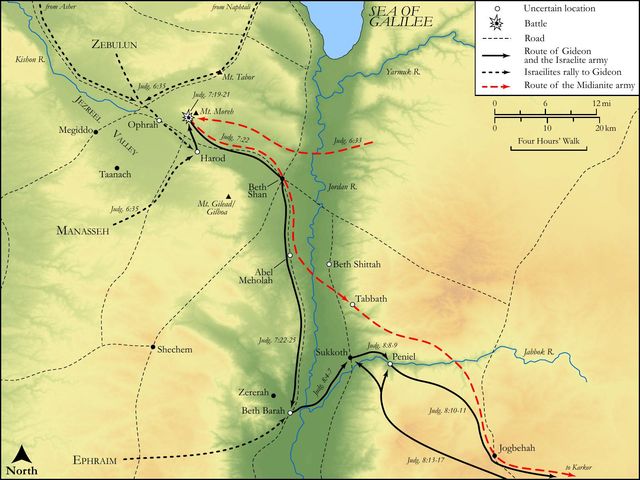
See on the biblical-era maps

Study this verse
Public-domain commentary
Matthew Henry
From his Commentary on the Whole Bible. Henry comments on passages, not single verses — this entry covers Judges 7:23–25.
We have here the prosecution of this glorious victory. 1. Gideon's soldiers that had been dismissed, and perhaps had begun to disperse themselves, upon notice of the enemies' flight got together again, and vigorously pursued those whom they had not courage to face. The men of Israel out of Naphtali and Asher who did this (Jdg 7:23) were not such as now came from those distant countries, but the same that had enlisted themselves (Jdg 6:35), but had been cashiered. Those who were fearful and afraid to fight (Jdg 7:3) now took heart, when the worst was over, and were ready enough to divide the spoil, though backward to make the onset. Those also that might not fight though they had a mind to it, and were disbanded by order from God, did not as those, Ch2 25:10, Ch2 25:13, return in great anger, but waited for an opportunity of doing service in pursuing the victory, though they were denied the honour of helping to force the lines. 2. The Ephraimites, upon a summons from Gideon, came in unanimously, and secured the passes over Jordan, by the several fords, to cut off the enemies' retreat into their own country, that they might be entirely destroyed, to prevent the like mischief to Israel another time. Now that they had begun to fall, it was easy to say, Down with them, Est 6:13. They took the waters (Jdg 7:24), that is, posted themselves along the river side, so that the Midianites, who fled from those who pursued them, fell into the hands of those that waited to intercept them. Here were fear, and the pit, and the snare, Isa 24:17. 3. Two of the chief commanders of the host of Midian were taken and slain by the Ephraimites on this side Jordan, Jdg 7:25. Their names perhaps signified their nature, Oreb signifies a raven, and Zeeb a wolf (corvus and lupus). These in their flight had taken shelter, one in a rock (Isa 2:21; Rev 6:15), the other by a wine-press, as Gideon for fear of them had lately hid his corn by a wine-press, Jdg 6:11. But the places of their shelter were made the places of their slaughter, and the memory of it was preserved to posterity in the names of the places, to their perpetual infamy: Here fell the princes of Midian.
Continue studying Judges 7:24 across the web’s major study libraries — every link below opens this exact verse, chapter, or book on the destination site.
Read & Compare
 BibleGatewayThis verse in more than 200 translations and 70 languages.
 Bible.comThe YouVersion reader — hundreds of translations, reading plans, and highlights.
 ESV.orgCrossway's official English Standard Version reader.
 NET BibleThe NET translation with 60,000+ translators' notes on every rendering decision.
 STEP BibleTyndale House's free study tool — original text, vocabulary, and scholarly resources.
 BibliaLogos Bible Software's free web reader.
 USCCBThe New American Bible (Revised Edition) with the U.S. bishops' study notes.
Commentaries
 BibleHub CommentariesDozens of classic commentaries on this verse, gathered on one page.
 StudyLightMore than 100 commentary sets — the largest collection on the web.
 BibleRefPlain-English commentary on what this verse means, verse by verse.
 Enduring WordDavid Guzik's free commentary on this chapter, widely used by Bible teachers.
 Bible Study ToolsVerse commentary alongside Greek and Hebrew study aids.
Original Language & Research
- BibleHub InterlinearThe verse word by word — original language, transliteration, and English.
- BibleHub LexiconEvery word's original-language definition and Strong's entry.
 Blue Letter BibleDeep-study tools — Strong's numbers, concordance, and word studies.
 SefariaThe Hebrew text with Rashi and centuries of Jewish commentary.
Sermons, Hymns & Audio


TrulyRandomVerse is not affiliated with these sites and doesn’t control their content. They’re linked because they’re genuinely useful.
Summary
Judges 7:24 marks a pivotal moment in Gideon's campaign, detailing his strategic dispatch of messengers throughout the powerful tribe of Ephraim. Following the miraculous, divinely orchestrated rout of the Midianite forces by Gideon's 300 men, this verse highlights the crucial next step: calling for broader Israelite participation to secure the Jordan River crossings, particularly near Bethbarah. This decisive action was designed to cut off the fleeing Midianites' escape route back to their eastern territories, underscoring the necessity of human cooperation and strategic follow-through to consolidate and complete God's granted victory.
Context
ShowHideLiterary Context
This verse serves as a critical transition point in the narrative of Gideon's judgeship. It immediately follows the dramatic, divinely engineered panic and self-destruction of the Midianite army, as detailed in Judges 7:19-23. Having witnessed God's overwhelming power reduce a vast enemy to chaos with a mere 300 men, Gideon now shifts from a small, specialized force to a broader mobilization of Israelite tribes. This strategic call to Ephraim sets the stage for the subsequent pursuit and capture of Midianite kings and commanders, as well as the contentious interaction with the Ephraimites themselves, which is fully explored in Judges 8. It demonstrates that while God provides the miraculous breakthrough, human effort is still required for the diligent consolidation of victory.
Historical & Cultural Context
For seven years, the Midianites, alongside the Amalekites and other "people of the East," had subjected Israel to severe oppression, devastating their agricultural economy and livestock (Judges 6:1-6). This period of subjugation forced Israelites to seek refuge in caves and strongholds. The Jordan River, a significant geographical feature, acted as a natural barrier, with its fords serving as vital crossing points, especially for nomadic groups like the Midianites returning to their lands east of the Jordan. Mount Ephraim represented a strategically central and populous tribal territory, renowned for its military strength and, at times, its assertive nature, as evidenced by their later confrontation with Gideon in Judges 8:1-3. The specific mention of "Bethbarah" (Hebrew: בֵּית בָּרָה, Beit Barah), meaning "house of the ford," highlights its recognized importance as a crucial river crossing.
Key Themes
ShowHideJudges 7:24 powerfully illustrates several enduring themes within the book of Judges and biblical theology. Firstly, it underscores the principle of divine victory requiring human follow-through. While God alone secured the initial, overwhelming defeat of Midian through a miraculous intervention, human effort, strategic planning, and tribal cooperation were indispensable for completing the task and preventing the enemy's escape. Secondly, the verse highlights the theme of unity and cooperation among the tribes of Israel. Gideon's urgent summons to Ephraim emphasizes the necessity of collective action in securing national deliverance, even after a divinely orchestrated miracle. This echoes the New Testament concept of the body of Christ working together, where each part contributes to the whole, as described in 1 Corinthians 12:12-27. Lastly, the passage showcases strategic leadership in action, as Gideon, despite God's direct intervention, exercises practical wisdom in consolidating the victory, understanding that the enemy's retreat must be cut off to ensure complete triumph and prevent future threats.
Exposition and Analysis
ShowHideKey Word Analysis
ShowHideFrom the root meaning "feller" or "hewer," Gideon (H1439) is presented here not just as the divinely chosen deliverer, but as a pragmatic military leader. His name, suggesting a warrior, aligns with his decisive action in sending messengers to ensure the complete defeat of Midian, demonstrating his role in executing God's will on the ground.
This primitive root (H3920) means "to catch (in a net, trap or pit); generally, to capture or occupy." In the context of "take before them the waters," it signifies the strategic imperative to seize and hold the critical Jordan River fords. This action was not merely to occupy territory but to effectively trap the fleeing Midianites, preventing their escape and ensuring their capture or destruction.
Meaning "house of (the) ford" (H1012), Bethbarah identifies a specific, well-known crossing point on the Jordan River. Its strategic importance lies in its function as a primary escape route for those attempting to cross from west to east. Gideon's precise instruction to seize this location underscores his detailed tactical understanding and the critical role of geographical control in military campaigns.
Verse Breakdown
ShowHide"And Gideon sent messengers throughout all mount Ephraim, saying, Come down against the Midianites"
Immediately following the miraculous rout, Gideon, recognizing the vastness of the fleeing enemy and the limitations of his 300 men for a full pursuit, demonstrates astute leadership. He dispatches messengers to the influential and populous tribe of Ephraim, located strategically to intercept the retreating forces. This call is an urgent summons to join the ongoing battle, emphasizing the need for a larger Israelite force to complete the victory.
"and take before them the waters unto Bethbarah and Jordan"
This clause reveals Gideon's precise military objective. The "waters" refer to the fords or crossing points of the Jordan River. By instructing the Ephraimites to "take before them" these vital passages, Gideon intended for them to seize control of the escape routes. This action would effectively trap the Midianites, who were attempting to cross the river back to the safety of their territories east of the Jordan, with Bethbarah being a particularly critical and well-known ford.
"Then all the men of Ephraim gathered themselves together, and took the waters unto Bethbarah and Jordan."
This concluding part of the verse highlights the swift and effective response of the Ephraimites. Despite their later complaints about not being part of the initial battle, they immediately mobilized and successfully executed Gideon's command. Their prompt seizure of the Jordan fords ensured that the Midianites were indeed cut off, leading directly to their further defeat and the capture of their leaders, demonstrating the immediate impact of strategic cooperation.
Literary Devices
ShowHideThe passage employs several effective literary devices. Strategic Foresight is immediately evident in Gideon's actions, as he swiftly moves from a miraculous victory to a practical, comprehensive strategy for consolidating the win, demonstrating a leader's ability to capitalize on momentum. The narrative also utilizes a Call to Action, as Gideon's message serves as an urgent summons to the Ephraimites, which is met with prompt and effective Fulfillment/Resolution as they gather and secure the fords. This swift sequence creates a sense of decisive and coordinated military operation. Furthermore, Geographical Specificity is crucial, with the explicit mention of "Mount Ephraim," "Bethbarah," and "Jordan" grounding the narrative in a tangible reality and underscoring the strategic importance of these locations in the military campaign.
Theological and Thematic Connections
ShowHideJudges 7:24 powerfully illustrates the dynamic interplay between divine sovereignty and human responsibility within God's redemptive plan. While God had already secured the decisive, miraculous victory over the Midianites through Gideon's small, divinely chosen army, Gideon's subsequent call to Ephraim underscores that God often expects and requires human participation in the full realization of His purposes. The initial, overwhelming breakthrough is undeniably God's work, but the "mop-up" operation—the diligent pursuit, strategic consolidation, and complete eradication of the threat—necessitates human effort, cooperation, and obedience. This passage serves as a profound reminder that spiritual victories are rarely completed in a single, dramatic moment but often demand sustained effort and the collective action of God's people. It highlights that God, in His infinite wisdom, utilizes both the supernatural and the practical, the few and the many, to accomplish His will, calling His people to actively engage in the work He has initiated.
Reflection and Application
ShowHideJudges 7:24 offers profound and actionable lessons for contemporary believers. It teaches us that spiritual victories, whether personal breakthroughs from sin or corporate advancements in ministry, often demand diligent and sustained follow-through. God may graciously grant the initial, miraculous deliverance from a spiritual stronghold or provide sudden clarity in a challenging situation, but we are frequently called to participate actively in the "mop-up" operations. This means resisting complacency after a significant win and instead continuing to press forward, often by enlisting the help and cooperation of others within the community of faith. Just as Ephraim was summoned to secure the Jordan crossings, believers are called to stand firm, to pursue God's purposes with intentionality, and to strategically engage in the ongoing spiritual battle until the victory is fully realized. This requires discerning the "strategic points" in our lives or ministries where we need to "cut off the enemy's retreat," preventing old habits, destructive patterns, or spiritual adversaries from regaining ground. It is a compelling call to active partnership with God, recognizing that our obedience, diligence, and cooperation are vital for the full manifestation of His kingdom in and through us.
Questions for Reflection
ShowHideFAQ
ShowHideWhy did Gideon specifically call the tribe of Ephraim, and not other tribes?
ShowHideGideon likely called Ephraim for several compelling strategic reasons. Firstly, Ephraim was renowned as a powerful and populous tribe, capable of quickly mobilizing a substantial fighting force. Secondly, their geographical location was ideal; they were situated relatively close to the critical Jordan River fords, making them the most efficient choice to intercept the fleeing Midianites who were attempting to escape eastward. While other tribes might have been called, Ephraim's strength and immediate proximity made them the most practical and effective choice for this specific, time-sensitive mission of cutting off the enemy's retreat. The narrative in Judges 8:1 also suggests Ephraim was a proud tribe, and Gideon's strategic call, though effective, inadvertently set the stage for their later complaint about not being involved in the initial, dramatic battle.
What was the significance of "Bethbarah and Jordan" in this context?
ShowHide"Bethbarah" (meaning "house of the ford") and the "Jordan" River refer to critical geographical and strategic locations. The Jordan River was a significant natural barrier, and its fords (shallow crossing points) were the only practical ways to traverse it. For the Midianites, who were fleeing westward from the battle into their own territory east of the Jordan, these fords represented their primary and most accessible escape routes. By instructing the Ephraimites to "take the waters unto Bethbarah and Jordan," Gideon was ordering them to seize and hold these vital crossing points, thereby effectively trapping the Midianites and preventing their escape. This strategic move was absolutely essential for consolidating the victory and ensuring the complete defeat and capture of the enemy forces.
Does Gideon's call for human help diminish God's role in the victory over Midian?
ShowHideNot at all; quite the opposite. Gideon's call for human help does not diminish God's role but rather profoundly illustrates how God often works through human cooperation and responsibility to complete His divine purposes. God had already demonstrated His absolute power and sovereignty by miraculously defeating the vast Midianite army with only 300 men, ensuring that the victory was undeniably His alone (Judges 7:2). However, the subsequent pursuit and capture of the fleeing enemy, while part of the divinely initiated victory, required practical human effort, strategic follow-through, and inter-tribal cooperation. This passage beautifully illustrates the biblical principle that God initiates, empowers, and provides the ultimate victory, but He often calls His people to participate actively and responsibly in the process of its full realization. It is a partnership where divine power enables and empowers human obedience.
Christ-Centered Fulfillment
ShowHideJudges 7:24, with Gideon's strategic call for the larger Israelite community to consolidate a divinely granted victory, beautifully foreshadows the comprehensive nature of Christ's triumph and the ongoing mission of His Church. Just as God secured the initial, decisive victory over Midian through Gideon's small, unlikely band, Christ achieved the ultimate, definitive victory over sin, death, and the devil through His singular, perfect sacrifice on the cross (Colossians 2:15). This victory is complete, unassailable, and eternally secured. However, like Gideon's need for Ephraim to "take the waters" and cut off the enemy's retreat, Christ calls His followers—the Church, His very body—to participate in the ongoing application and proclamation of this victory. We are commissioned to "make disciples of all nations" (Matthew 28:19), to "preach the gospel to all creation" (Mark 16:15), and to engage in spiritual warfare, "taking every thought captive to obey Christ" (2 Corinthians 10:5). Our role is not to secure the victory, for that is Christ's alone, but to strategically "take the waters"—to occupy key spiritual ground, to cut off the enemy's influence, and to ensure that the full implications of Christ's triumph are realized in the lives of individuals and throughout the world, empowered by the Holy Spirit who enables our witness (Acts 1:8).