


Romans 15:30
Bible text: King James Version (1769 Blayney text) · Public domain
Bible text: King James Version with Strong's numbers · Public domain
Bible text: Berean Standard Bible · Public domain
Bible text: American Standard Version (1901) · Public domain
Bible text: World English Bible, Messianic edition · Public domain
Bible text: Geneva Bible (1599) · Public domain
Bible text: Young's Literal Translation · Public domain
- ΠαρακαλῶParakalōI exhortG3870V-PAI-1SVerb Present Active Indicative 1st Singular
- δὲdenowG1161CONJConjunction
- ὑμᾶςhumasyouG4771P-2APPersonal pronoun Accusative 2nd Plural
- ἀδελφοίadelphoibrothersG80N-VPMNoun Vocative Plural Masculine
- διὰdiathroughG1223PREPPreposition
- τοῦtoutheG3588T-GSMDefinite article Genitive Singular Masculine
- κυρίουkuriouLordG2962N-GSM-TNoun Genitive Singular Masculine Title
- ἡμῶνhēmōnof usG3165P-1GPPersonal pronoun Genitive 1st Plural
- ἸησοῦIēsouJesusG2424N-GSM-PNoun Genitive Singular Masculine Individual
- ΧριστοῦChristouChristG5547N-GSM-TNoun Genitive Singular Masculine Title
- καὶkaiandG2532CONJConjunction
- διὰdiathroughG1223PREPPreposition
- τῆςtēstheG3588T-GSFDefinite article Genitive Singular Feminine
- ἀγάπηςagapēsloveG26N-GSFNoun Genitive Singular Feminine
- τοῦtouof theG3588T-GSNDefinite article Genitive Singular Neuter
- πνεύματοςpneumatosSpiritG4151N-GSNNoun Genitive Singular Neuter
- συναγωνίσασθαίsunagōnisasthaito strive together withG4865V-AMNVerb Aorist Middle Infinitive
- μοιmoimeG3165P-1DSPersonal pronoun Dative 1st Singular
- ἐνeninG1722PREPPreposition
- ταῖςtaistheG3588T-DPFDefinite article Dative Plural Feminine
- προσευχαῖςproseuchaisprayersG4335N-DPFNoun Dative Plural Feminine
- ὑπὲρhuperforG5228PREPPreposition
- ἐμοῦemoumeG1473S-1SGSNPossessive pronoun Genitive 1st Person Singular Neuter
- πρὸςprostoG4314PREPPreposition
- τὸνton<the>G3588T-ASMDefinite article Accusative Singular Masculine
- θεόνtheonGodG2316N-ASM-TNoun Accusative Singular Masculine Title
English is a literal word-by-word gloss of the Greek, not the KJV's wording. Why?
This is the original text the KJV's translators worked from — each Greek word with its own literal English meaning in this verse, prepared by scholars at Tyndale House, Cambridge. The KJV translates whole sentences, not word by word, so its wording differs: one Greek word can become several English words, and the KJV may choose “charity” where the gloss reads “love”. Both are faithful — they answer different questions. For the KJV's own rendering, switch to the KJV text.
Details
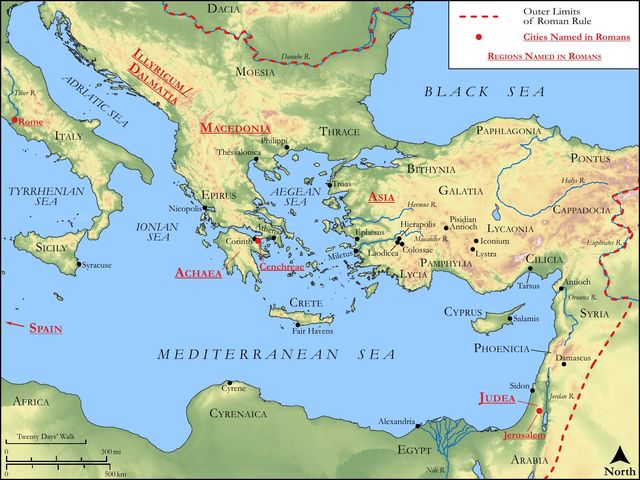
See on the biblical-era maps

Study this verse
Public-domain commentary
Matthew Henry
From his Commentary on the Whole Bible. Henry comments on passages, not single verses — this entry covers Romans 15:30–33. His three-level outline is real structure in the source text, so it is rendered as structure.
Here we have, I. St. Paul's desire of a share in the prayers of the Romans for him, expressed very earnestly, Rom 15:30-32. Though Paul was a great apostle, yet he begged the prayers of the meanest Christians, not here only, but in several other of the epistles. He had prayed much for them, and this he desires as the return of his kindness. Interchanging prayers is an excellent token of the interchanging of loves. Paul speaks like one that knew himself, and would hereby teach us how to value the effectual fervent prayer of the righteous. How careful should we be lest we do any thing to forfeit our interest in the love and prayers of god's praying people!
1.Observe why they must pray for him. He begs it with the greatest importunity. He might suspect they would forget him in their prayers, because they had no personal acquaintance with him, and therefore he urges it so closely, and begs it with the most affectionate obtestations, by all that is sacred and valuable: I beseech you, (1.) "For the Lord Jesus Christ's sake. He is my Master, I am going about his work, and his glory is interested in the success of it: if you have any regard to Jesus Christ, and to his cause and kingdom, pray for me. You love Christ, and own Christ; for his sake then do me this kindness." (2.) "For the love of the Spirit. As a proof and instance of that love which the Spirit works in the hearts of believers one to another, pray for me; as a fruit of that communion which we have one with another by the Spirit though we never saw one another. If ever you experienced the Spirit's love to you, and would be found returning your love to the Spirit, be not wanting in this office of kindness."
2.How they must pray for him: That you strive together.
(1.)That you strive in prayer. We must put forth all that is within us in that duty; pray with fixedness, faith, and fervency; wrestle with God, as Jacob did; pray in praying, as Elias did (Jam 5:17), and stir up ourselves to take hold on God (Isa 64:7); and this is not only when we are praying for ourselves, but when we are praying for our friends. True love to our brethren should make us as earnest for them as sense of our own need makes us for ourselves.
(2.)That you strive together with me. When he begged their prayers for him, he did not intend thereby to excuse his praying for himself; no, "Strive together with me, who am wrestling with God daily, upon my own and my friends' account." He would have them to ply the same oar. Paul and these Romans were distant in place, and likely to be so, and yet they might join together in prayer; those who are put far asunder by the disposal of God's providence may yet meet together at the throne of his grace. Those who beg the prayers of others must not neglect to pray for themselves.
3.What they must beg of God for him. He mentions particulars; for, in praying both for ourselves and for our friends, it is good to be particular. What wilt thou that I shall do for thee? So says Christ, when he holds out the golden sceptre. Though he knows our state and wants perfectly, he will know them from us. He recommends himself to their prayers, with reference to three things: - (1.) The dangers which he was exposed to: That I may be delivered from those that do not believe in Judea. The unbelieving Jews were the most violent enemies Paul had and most enraged against him, and some prospect he had of trouble from them in this journey; and therefore they must pray that God would deliver him. We may, and must, pray against persecution. This prayer was answered in several remarkable deliverances of Paul, recorded Acts 21, 22, 23, and 24. (2.) His services: Pray that my service which I have for Jerusalem may be accepted of the saints. Why, was there any danger that it would not be accepted? Can money be otherwise than acceptable to the poor? Yes, there was some ground of suspicion in this case; for Paul was the apostle of the Gentiles, and as the unbelieving Jews looked spitefully at him, which was their wickedness, so those that believed were shy of him upon that account, which was their weakness. He does not say, "Let them choose whether they will accept it or no; if they will not, it shall be better bestowed;" but, "Pray that it may be accepted." As God must be sought unto for the restraining of the ill will of our enemies, so also for the preserving and increasing of the good will of our friends; for God has the hearts both of the one and of the other in his hands. (3.) His journey to them. To engage their prayers for him, he interests them in his concerns (Rom 15:32): That I may come unto you with joy. If his present journey to Jerusalem proved unsuccessful, his intended journey to Rome would be uncomfortable. If he should not do good, and prosper, in one visit, he thought he should have small joy of the next: may come with joy, by the will of God. All our joy depends upon the will of God. The comfort of the creature is in every thing according to the disposal of the Creator.
II.Here is another prayer of the apostle for them (Rom 15:33):
Now the God of peace be with you all, Amen. The Lord of hosts, the God of battle, is the God of peace, the author and lover of peace. He describes God under this title here, because of the divisions among them, to recommend peace to them; if God be the God of peace, let us be men of peace. The Old Testament blessing was, Peace be with you; now, The god of peace be with you. Those who have the fountain cannot want any of the streams. With you all; both weak and strong. To dispose them to a nearer union, he puts them altogether in this prayer. Those who are united in the blessing of God should be united in affection one to another.
Historical interpretation
Two Centuries of Reception
4 surviving comments on this verse. Each one is dated, so this reads as a timeline rather than a list.
Select a marker to jump to its quote. Markers stagger vertically where authors wrote within a few decades of each other.
Paul asks for their prayers … not because he deserves them but because he is following the principle that the church ought to pray for its pastor. For when many ordinary people come together and agree they become great, and the prayers of many cannot be ignored. Therefore, if the Romans want to see the apostle, let them pray earnestly that he may be set free so that they may receive him in the joy of brotherly love.
"Now I beseech you, brethren, for the Lord Jesus Christ's sake, and for the love of the Spirit."
Here he again puts forward Christ and the Spirit, and makes no mention whatever of the Father. And I say this, that when you find him mentioning the Father and the Son, or the Father only, you may not despise either the Son or the Spirit. And he does not say the Spirit, but "the love of the Spirit." For as Christ loved the world, and as the Father doth, so doth the Spirit also. And what is it that thou beseechest us, let me hear? "To strive together with me in your prayers to God for me,"
Paul asks the whole church to pray for him, because he knows that when many people pray together their prayers have great effect. When James was killed, Peter was set free from prison by the prayers of the brethren, who prayed not so much for his good as for their own, so that they could be strengthened by his teaching. Spiritual love leads us to pray for one another.
And again: "Now I beseech you, brethren, for our Lord Jesus Christ's sake, and by the love of the Spirit."
Continue studying Romans 15:30 across the web’s major study libraries — every link below opens this exact verse, chapter, or book on the destination site.
Read & Compare
 BibleGatewayThis verse in more than 200 translations and 70 languages.
 Bible.comThe YouVersion reader — hundreds of translations, reading plans, and highlights.
 ESV.orgCrossway's official English Standard Version reader.
 NET BibleThe NET translation with 60,000+ translators' notes on every rendering decision.
 STEP BibleTyndale House's free study tool — original text, vocabulary, and scholarly resources.
 BibliaLogos Bible Software's free web reader.
 USCCBThe New American Bible (Revised Edition) with the U.S. bishops' study notes.
Commentaries
 BibleHub CommentariesDozens of classic commentaries on this verse, gathered on one page.
 StudyLightMore than 100 commentary sets — the largest collection on the web.
 BibleRefPlain-English commentary on what this verse means, verse by verse.
 Enduring WordDavid Guzik's free commentary on this chapter, widely used by Bible teachers.
 Bible Study ToolsVerse commentary alongside Greek and Hebrew study aids.
Original Language & Research
- BibleHub InterlinearThe verse word by word — original language, transliteration, and English.
- BibleHub LexiconEvery word's original-language definition and Strong's entry.
 Blue Letter BibleDeep-study tools — Strong's numbers, concordance, and word studies.
 CNTR CollationThe earliest Greek manuscripts of this verse, collated letter by letter.
Sermons, Hymns & Audio


TrulyRandomVerse is not affiliated with these sites and doesn’t control their content. They’re linked because they’re genuinely useful.
Summary
In Romans 15:30, the Apostle Paul issues an impassioned and deeply personal plea to the Roman believers, urging them to join him in a concerted effort of intercessory prayer. This verse powerfully underscores the vital role of communal prayer in Christian ministry, revealing Paul's profound humility and his absolute reliance on God's power, channeled through the unified petitions of the saints, even for an apostle of his stature. It highlights the spiritual partnership between Paul and the Roman church, motivated by their shared devotion to Christ and the indwelling love of the Holy Spirit.
Context
ShowHideLiterary Context
Romans 15:30 is situated near the conclusion of Paul's magnum opus, where he transitions from profound theological exposition to practical matters concerning his ministry and future travel plans. Immediately preceding this verse, Paul has detailed his long-held desire to visit Rome and then proceed to Spain, but first, he must travel to Jerusalem to deliver a financial collection for the impoverished saints there (Romans 15:25-27). Paul is acutely aware of the potential dangers awaiting him in Jerusalem, particularly from unbelieving Jews, and the challenges of his broader missionary endeavors. His earnest request for prayer in this verse thus serves as a direct prelude to the specific prayer points he outlines in the subsequent verses, concerning his deliverance from opposition and the acceptance of his service by the saints in Jerusalem (Romans 15:31). This appeal for prayer is not a casual request but an urgent call for spiritual solidarity, demonstrating Paul's dependence on God's intervention through the prayers of the community as he faces significant trials and seeks to advance the Gospel.
Historical & Cultural Context
Paul's journey to Jerusalem was fraught with peril, a reality well understood in the ancient world where travel was inherently dangerous due to bandits, shipwrecks, and hostile populations. Moreover, Paul, as a former Pharisee and now a prominent advocate for Gentile inclusion in the church, faced significant opposition from certain Jewish factions who viewed him as a renegade and a threat to their traditions. The collection he was bringing to Jerusalem was intended to demonstrate the unity between Gentile and Jewish believers, but its acceptance was not guaranteed. In this context, the early Christian community, though geographically dispersed, maintained strong bonds of fellowship and mutual support, often expressed through intercessory prayer. The concept of "striving together" would have resonated with the Roman believers, who understood the communal effort required for survival and success in a challenging environment, whether in military campaigns or athletic contests, making Paul's appeal for prayer a call to active, spiritual partnership.
Key Themes
ShowHideThis verse contributes significantly to several overarching themes within Romans and Paul's broader theology. Firstly, it highlights the Power of Intercessory Prayer, underscoring that even an apostle like Paul, endowed with extraordinary spiritual gifts and authority, recognized his absolute dependence on God's intervention, mediated through the prayers of others. This reinforces the idea that prayer is not merely a spiritual discipline but a potent means by which God's will is accomplished and His kingdom advanced. Secondly, the phrase "strive together with me" powerfully conveys the theme of Unity and Partnership in Ministry. Paul views the Roman believers not merely as recipients of his teaching but as active, indispensable partners in his apostolic mission through their fervent prayers. This fosters a profound sense of communal responsibility for the advancement of the Gospel, echoing themes of the church as one body found elsewhere in Paul's letters, such as in 1 Corinthians 12. Thirdly, Paul grounds his plea in a Divine Motivation for Prayer: "for the Lord Jesus Christ's sake" and "for the love of the Spirit." This emphasizes that prayer should be motivated by a desire to honor Christ and advance His kingdom, and by the divine love that the Holy Spirit pours into believers' hearts, prompting them to care deeply for one another and God's work, as described in Romans 5:5. Finally, the verse implicitly teaches the Humility of Leaders, demonstrating that even the greatest spiritual leaders are not self-sufficient but are profoundly reliant on the spiritual support and intercession of the wider body of Christ.
Exposition and Analysis
ShowHideKey Word Analysis
ShowHideThis word (G3870) carries the meaning of "to call near," "to invite," "to invoke," and by implication, "to implore," "to exhort," or "to comfort." Paul's use here is not a casual request but an earnest, heartfelt appeal, an urgent entreaty for spiritual support. It implies a deep personal need and a strong desire for the Roman believers to engage fully in this spiritual act on his behalf.
This term (G26) refers to divine, unconditional love—affection or benevolence. In the context of "the love of the Spirit," it signifies either the love that the Holy Spirit produces in believers (as a fruit of the Spirit, e.g., Galatians 5:22) or the love that believers have for the Spirit. Given the context of earnest prayer for a fellow believer, it most powerfully refers to the Spirit-inspired love that compels believers to pray fervently for one another and for God's purposes, demonstrating a profound spiritual bond.
This compound word (G4865), formed from syn (with) and agōnízomai (to contend, struggle, wrestle), is exceptionally strong. It literally means "to struggle in company with," "to be a partner in a contest," or "to wrestle together." It evokes the imagery of an athlete exerting maximum effort in a competition or a soldier fighting alongside comrades in battle. Paul is not asking for a polite, perfunctory prayer but for intense, persistent, and even agonizing intercession, indicating the spiritual warfare inherent in his ministry.
Verse Breakdown
ShowHide"Now I beseech you, brethren,"
Paul begins with a direct and earnest appeal to his fellow believers in Rome, addressing them affectionately as "brethren" (adelphoi), emphasizing their shared spiritual family bond. The verb "beseech" (parakaléō) conveys the urgency and sincerity of his request, highlighting his personal vulnerability and dependence.
"for the Lord Jesus Christ's sake,"
This clause establishes the primary motivation for their prayer: it is not for Paul's personal comfort or success alone, but for the honor and advancement of Christ's kingdom. Their prayers are to be offered out of devotion to Jesus Christ, recognizing His ultimate authority and purpose in Paul's ministry.
"and for the love of the Spirit,"
This second motivation points to the divine love that emanates from or is empowered by the Holy Spirit. It suggests that their prayers should flow from the Spirit-given love that binds believers together, fostering a deep concern for one another and for the work of God. This love compels them to actively participate in Paul's spiritual struggles through intercession.
"that ye strive together with me in [your] prayers to God for me;"
This is the core of Paul's request. The phrase "strive together" (synagōnízomai) powerfully conveys the intensity and collaborative nature of the prayer he seeks. It's not passive well-wishing but active, strenuous engagement in prayer, likened to a wrestling match or a fierce athletic contest. Their prayers are directed "to God," emphasizing the divine recipient and the source of all power and aid, and are specifically "for me" (Paul), indicating his need for their intercession in his upcoming challenges.
Literary Devices
ShowHidePaul employs several powerful literary devices in Romans 15:30. The most prominent is Exhortation, as Paul directly urges the Roman believers to a specific course of action—strenuous prayer. This is amplified by the use of Pathos, an appeal to emotion, evident in his affectionate address "brethren" and the earnestness conveyed by "I beseech you." The phrase "strive together" functions as a potent Metaphor, drawing on the imagery of athletic struggle or military combat to vividly describe the intensity and collaborative nature of the prayer Paul desires. This metaphor elevates prayer from a mere utterance to an active, demanding spiritual engagement. Furthermore, Paul uses Parallelism by presenting two distinct but complementary motivations for their prayer: "for the Lord Jesus Christ's sake" and "for the love of the Spirit." This dual motivation underscores the Trinitarian foundation of Christian life and ministry, grounding their intercession in both Christ's authority and the Spirit's empowering love. The overall effect is one of urgent appeal, uniting the believers in a shared spiritual battle.
Theological and Thematic Connections
ShowHideRomans 15:30 profoundly illustrates the theological truth that Christian ministry, even apostolic work, is not a solitary endeavor but a communal enterprise sustained by divine power through intercessory prayer. Paul, despite his unique calling and spiritual authority, recognized his absolute dependence on God's grace and the spiritual support of the believing community. This verse highlights the Trinitarian basis for Christian action: prayer is offered "to God" (the Father), motivated "for the Lord Jesus Christ's sake" (the Son's glory), and empowered by "the love of the Spirit" (the Holy Spirit's work). It underscores the mutual interdependence within the body of Christ, where every member plays a vital role in advancing God's kingdom through their petitions. This shared spiritual struggle fosters unity and demonstrates that the effectiveness of ministry is often directly tied to the fervent, collective prayers of the saints.
Reflection and Application
ShowHideRomans 15:30 serves as a timeless and powerful reminder for believers today regarding the indispensable nature of intercessory prayer. Paul's earnest plea, even as a seasoned apostle, shatters any illusion of self-sufficiency in Christian service and underscores our profound mutual dependence within the body of Christ. We are called not merely to pray for ourselves but to "strive together" in prayer for one another, for our leaders, for missionaries, and for the advancement of God's kingdom. This "striving" implies a level of earnestness, persistence, and spiritual intensity that goes beyond casual requests, reflecting a deep, Spirit-empowered love for Christ and His purposes. Our prayers should be motivated by a desire to glorify Jesus and by the love that the Holy Spirit cultivates within us, compelling us to engage in the spiritual battle on behalf of others. This verse challenges us to consider the depth of our commitment to intercessory prayer, recognizing that our prayers are a vital means through which God works in the world and sustains His servants.
Questions for Reflection
ShowHideFAQ
ShowHideWhy did Paul, an apostle, need the prayers of the Roman believers?
ShowHidePaul's request for prayer, far from indicating weakness, highlights his profound humility and his deep understanding of the spiritual realities of ministry. Despite his apostolic authority and direct commission from Christ, Paul recognized that he was still utterly dependent on God's power and protection, which God often chooses to mediate through the prayers of His people. He faced real dangers—persecution, opposition from unbelievers, and challenges in the acceptance of his ministry (Romans 15:31). Paul's need for their prayers underscored the corporate nature of the church's mission; no individual, regardless of their spiritual stature, is self-sufficient. It also demonstrated his belief in the efficacy of intercessory prayer and the spiritual partnership shared among believers in advancing the Gospel.
What does "the love of the Spirit" mean in this verse?
ShowHide"The love of the Spirit" (Greek: agape tou pneumatos) refers to the divine love that is either produced by the Holy Spirit within believers or is the love that believers have for the Spirit. In this context, it is most likely referring to the love that the Holy Spirit pours into the hearts of believers, enabling them to care deeply for one another and for God's work. This Spirit-empowered love compels them to pray fervently and selflessly for Paul and his ministry. It's a love that transcends human affection, enabling Christians to engage in the spiritual "striving" of prayer for the sake of Christ and His kingdom, aligning with the Spirit's role in empowering believers for service and spiritual fruitfulness (Galatians 5:22).
Christ-Centered Fulfillment
ShowHideRomans 15:30, while a direct appeal for intercessory prayer, finds its ultimate fulfillment and deepest meaning in the person and work of Jesus Christ. Paul's plea to "strive together" in prayer "for the Lord Jesus Christ's sake" points directly to the one for whom all ministry exists and through whom all prayers are made effective. Christ Himself is the supreme intercessor, continually pleading on behalf of His people before the Father (Romans 8:34 and Hebrews 7:25). Our ability to approach God in prayer, let alone to "strive together" with such earnestness, is entirely predicated on Christ's finished work on the cross, which grants us access to the Father (Ephesians 2:18). Furthermore, the "love of the Spirit" that motivates such prayer is the very love of God poured into our hearts through the Holy Spirit, whom Christ sent after His ascension (John 14:26 and Acts 2:33). Thus, Paul's request is not merely a human appeal but a participation in the divine economy of salvation, where Christ's ongoing intercession empowers and gives meaning to the prayers of His body, the church, enabling them to advance His redemptive purposes in the world.