


2 Corinthians 1:11
- συνυπουργούντωνsunupourgountōnjoining togetherG4943V-PAP-GPMVerb Present Active Participle Genitive Plural Masculine
- καὶkaialsoG2532CONJConjunction
- ὑμῶνhumōnof youG4771P-2GPPersonal pronoun Genitive 2nd Plural
- ὑπὲρhuperforG5228PREPPreposition
- ἡμῶνhēmōnusG3165P-1GPPersonal pronoun Genitive 1st Plural
- τῇtēa<the>G3588T-DSFDefinite article Dative Singular Feminine
- δεήσειdeēseiby supplicationG1162N-DSFNoun Dative Singular Feminine
- ἵναinaso thatG2443CONJConjunction
- ἐκekbyG1537PREPPreposition
- πολλῶνpollōnmanyG4183A-GPNAdjective Genitive Plural Neuter
- προσώπωνprosōpōnpersonsG4383N-GPNNoun Genitive Plural Neuter
- τὸtofor theG3588T-NSNDefinite article Nominative Singular Neuter
- εἰςeistowardG1519PREPPreposition
- ἡμᾶςhēmasusG3165P-1APPersonal pronoun Accusative 1st Plural
- χάρισμαcharismagrace bestowedG5486N-NSNNoun Nominative Singular Neuter
- διὰdiathroughG1223PREPPreposition
- πολλῶνpollōnmanyG4183A-GPMAdjective Genitive Plural Masculine
- εὐχαριστηθῇeucharistēthēathanks may be givenG2168V-APS-3SVerb Aorist Passive Subjunctive 3rd Singular
- ὑπὲρhuperforG5228PREPPreposition
- ἡμῶνhēmōnusG3165P-1GPPersonal pronoun Genitive 1st Plural
English is a literal word-by-word gloss of the Greek, not the KJV's wording. Why?
This is the original text the KJV's translators worked from — each Greek word with its own literal English meaning in this verse, prepared by scholars at Tyndale House, Cambridge. The KJV translates whole sentences, not word by word, so its wording differs: one Greek word can become several English words, and the KJV may choose “charity” where the gloss reads “love”. Both are faithful — they answer different questions. For the KJV's own rendering, switch to the KJV text.
Details
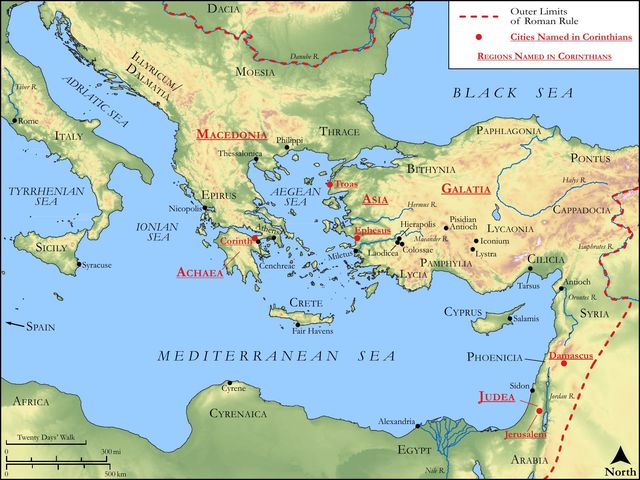
See on the biblical-era map

Study this verse
Public-domain commentary
Matthew Henry
From his Commentary on the Whole Bible. Henry comments on passages, not single verses — this entry covers 2 Corinthians 1:7–11.
In these verses the apostle speaks for the encouragement and edification of the Corinthians; and tells them (Co2 1:7) of his persuasion or stedfast hope that they should receive benefit by the troubles he and his companions in labour and travel had met with, that their faith should not be weakened, but their consolations increased. In order to this he tells them, 1. What their sufferings had been (Co2 1:8): We would not have you ignorant of our trouble. It was convenient for the churches to know what were the sufferings of their ministers. It is not certain what particular troubles in Asia are here referred to; whether the tumult raised by Demetrius at Ephesus, mentioned Acts 19, or the fight with beasts at Ephesus, mentioned in the former epistle (Co1 15:32), or some other trouble; for the apostle was in deaths often. This however is evident, that they were great tribulations. They were pushed out of measure, to a very extraordinary degree, above the common strength of men, or of ordinary Christians, to bear up under them, insomuch that they despaired even of life (Co2 1:8), and thought they should have been killed, or have fainted away and expired. 2. What they did in their distress: They trusted in God. And they were brought to this extremity in order that they should not trust in themselves but in God, Co2 1:9. Note, God often brings his people into great straits, that they may apprehend their own insufficiency to help themselves, and may be induced to place their trust and hope in his all-sufficiency. Our extremity is God's opportunity. In the mount will the Lord be seen; and we may safely trust in God, who raiseth the dead, Co2 1:9. God's raising the dead is a proof of his almighty power. He that can do this can do any thing, can do all things, and is worthy to be trusted in at all times. Abraham's faith fastened upon this instance of the divine power: He believed God who quickeneth the dead, Rom 4:17. If we should be brought so low as to despair even of life, yet we may then trust in God, who can bring back not only from the gates, but from the jaws, of death. 3. What the deliverance was that they had obtained; and this was seasonable and continued. Their hope and trust were not in vain, nor shall any who trust in him be ashamed. God had delivered them, and did still deliver them, Co2 1:10. Having obtained help of God, they continued to that day, Act 26:22. 4. What use they made of this deliverance: We trust that he will yet deliver us (Co2 1:10), that God will deliver to the end, and preserve to his heavenly kingdom. Note, Past experiences are great encouragements to faith and hope, and they lay great obligations to trust in God for time to come. We reproach our experiences if we distrust God in future straits, who hath delivered as in former troubles. David, even when a young man, and when he had but a small stock of experiences, argued after the manner of the apostle here, Sa1 17:37. 5. What was desired of the Corinthians upon this account: That they would help together by prayer for them (Co2 1:11), by social prayer, agreeing and joining together in prayer on their behalf. Note, our trusting in God must not supersede the use of any proper and appointed means; and prayer is one of those means. We should pray for ourselves and for one another. The apostle had himself a great interest in the throne of grace, yet he desires the help of others' prayers. If we thus help one another by our prayers, we may hope for an occasion of giving thanks by many for answer of prayer. And it is our duty not only to help one another with prayer, but in praise and thanksgiving, and thereby to make suitable returns for benefits received.
Historical interpretation
Historical reception
1 surviving comment on this verse from the historical church.
"And we have set our hope that He will also still deliver us; ye also helping together on our behalf by your supplication, that for the gift bestowed upon us by the means of many, thanks may be given by many persons on our behalf."
Since the words, "that we should not trust in ourselves," might seem to be a common charge and an accusation that pointed to some amongst them; he softeneth again what he said, by calling their prayers a great protection and at the same time showing that [this] our life must be throughout a scene of conflict. For in those words, "And we have set our hope that He will also still deliver us," he predicts a future sleet of many trials: but still no where aught of being forsaken, but of succor again and support.
But what is this: "That for the gift bestowed upon us by means of many, thanks may be given by many on our behalf?" He delivered us from those deaths," saith he, "ye also helping together by prayer;" that is, praying all of you for us. For "the gift bestowed upon us," that is, our being saved, He was pleased to grant to you all, in order that many persons might give Him thanks, because that many also received the boon.
And this he said, at once to stir them up to prayer for others, and to accustom them always to give thanks to God for whatever befalleth others, showing that He too willeth this exceedingly. For they that are careful to do both these for others, will much more for themselves show an example of both. And besides this, he both teacheth them humility and leadeth on to more fervent love. For if he who was so high above them owneth himself to have been saved by their prayers: and that to their prayers himself had been granted as a boon of God, think what their modesty and disposition ought to have been.
Continue studying 2 Corinthians 1:11 across the web’s major study libraries — every link below opens this exact verse, chapter, or book on the destination site.
Read & Compare
 BibleGatewayThis verse in more than 200 translations and 70 languages.
 Bible.comThe YouVersion reader — hundreds of translations, reading plans, and highlights.
 ESV.orgCrossway's official English Standard Version reader.
 NET BibleThe NET translation with 60,000+ translators' notes on every rendering decision.
 STEP BibleTyndale House's free study tool — original text, vocabulary, and scholarly resources.
 BibliaLogos Bible Software's free web reader.
 USCCBThe New American Bible (Revised Edition) with the U.S. bishops' study notes.
Commentaries
 BibleHub CommentariesDozens of classic commentaries on this verse, gathered on one page.
 StudyLightMore than 100 commentary sets — the largest collection on the web.
 BibleRefPlain-English commentary on what this verse means, verse by verse.
 Enduring WordDavid Guzik's free commentary on this chapter, widely used by Bible teachers.
 Bible Study ToolsVerse commentary alongside Greek and Hebrew study aids.
Original Language & Research
- BibleHub InterlinearThe verse word by word — original language, transliteration, and English.
- BibleHub LexiconEvery word's original-language definition and Strong's entry.
 Blue Letter BibleDeep-study tools — Strong's numbers, concordance, and word studies.
 CNTR CollationThe earliest Greek manuscripts of this verse, collated letter by letter.
Sermons, Hymns & Audio


TrulyRandomVerse is not affiliated with these sites and doesn’t control their content. They’re linked because they’re genuinely useful.
Summary
Second Corinthians 1:11 powerfully articulates the profound interdependence within the body of Christ, illustrating how the collective prayers of believers contribute directly to the divine work of deliverance and subsequently elicit widespread thanksgiving. Paul, having experienced severe affliction and miraculous rescue, attributes his preservation not only to God's intervention but also to the active intercession of the Corinthian church, emphasizing that such a "gift" of deliverance should culminate in corporate praise and gratitude to God from many.
Context
ShowHideLiterary Context
This verse concludes Paul's opening section (2 Corinthians 1:3-11), where he offers a profound theological reflection on suffering, comfort, and divine deliverance. He begins by blessing God as the "Father of mercies and God of all comfort" 2 Corinthians 1:3, who comforts believers in their afflictions so they, in turn, can comfort others. Paul then recounts his recent, life-threatening ordeal in Asia 2 Corinthians 1:8, describing a despair so deep that he "despaired even of life" 2 Corinthians 1:8. This extreme suffering, however, served a crucial purpose: to teach him to rely not on himself but on God who raises the dead 2 Corinthians 1:9. Having been delivered from such a "deadly peril," Paul expresses confidence in God's continued deliverance 2 Corinthians 1:10, leading directly into verse 11, which reveals the Corinthians' integral role in this ongoing divine process through their intercessory prayers.
Historical & Cultural Context
Paul's "trouble which came to us in Asia" 2 Corinthians 1:8 is often speculated to refer to a severe illness, persecution, or perhaps a riot (like that in Ephesus, described in /acts/19 "Acts 19 - The Riot in Ephesus"). Regardless of the specific event, it was a period of intense suffering that brought him to the brink of death. In the Greco-Roman world, patronage was a significant social construct, where a patron would bestow a favor (a "gift") and the recipient would respond with public gratitude and loyalty. Paul subtly reorients this concept: God is the ultimate patron, bestowing the "gift" of deliverance, and the community of believers, including the Corinthians, are co-participants in this divine economy through their prayers, leading to corporate thanksgiving that acknowledges God as the source of all good. The communal nature of prayer and thanksgiving was also deeply rooted in Jewish tradition, which heavily influenced early Christian practice.
Key Themes
ShowHideThis verse contributes significantly to several overarching themes in 2 Corinthians and Paul's theology. Firstly, it underscores the power and necessity of intercessory prayer, demonstrating that even an apostle like Paul, uniquely called and gifted, relies heavily on the prayers of the church. This highlights the mutual dependence within the Body of Christ 1 Corinthians 12:27, where each member's contribution, particularly through prayer, is vital for the well-being and effectiveness of the whole. Secondly, it emphasizes that God's deliverance from suffering is not merely for the individual's benefit but ultimately for His glory, intended to elicit widespread thanksgiving and praise 2 Corinthians 4:15. The "gift" (charisma) of deliverance is a manifestation of God's grace, prompting a communal response of gratitude, reinforcing the idea that God's acts of grace are meant to lead to corporate worship.
Exposition and Analysis
ShowHideKey Word Analysis
ShowHideFrom δέομαι; a petition:--prayer, request, supplication. This term emphasizes a specific request or plea, often arising from a sense of need or urgency. It highlights the direct, intentional nature of the Corinthians' intercession for Paul and his companions, suggesting a heartfelt and earnest appeal to God on their behalf.
From σύν and a derivative of a compound of ὑπό and the base of ἔργον; to be a co-auxiliary, i.e. assist:--help together. This compound verb is highly significant, conveying the idea of active cooperation and joint effort. It implies that the Corinthians' prayers were not passive wishes but an active, collaborative participation in God's work, making them co-laborers with Paul in his ministry and deliverance. Their intercession was a tangible form of assistance.
From χαρίζομαι; a (divine) gratuity, i.e. deliverance (from danger or passion); (specially), a (spiritual) endowment, i.e. (subjectively) religious qualification, or (objectively) miraculous faculty:--(free) gift. In this context, "gift" refers specifically to the divine favor or grace bestowed by God, manifested as Paul's deliverance from his perilous situation. It underscores that his rescue was not earned but was a gracious act of God, often facilitated by the prayers of His people.
Verse Breakdown
ShowHide"Ye also helping together by prayer for us,"
This phrase establishes the active participation of the Corinthian believers. The Greek word for "helping together" (synypourgéō) signifies a collaborative effort, indicating that their prayers were not merely passive well-wishes but a vital, cooperative contribution to Paul's ministry and safety. It highlights their solidarity and shared burden with the apostle.
"that for the gift [bestowed] upon us by the means of many persons"
This clause reveals the purpose and source of the "gift." The "gift" (charisma) refers to God's gracious deliverance of Paul from his recent trials. It explicitly states that this divine favor was granted "by the means of many persons" (dia pollōn prosōpōn), emphasizing that God often works through the collective intercession of His people. The "many persons" refers to the numerous believers in Corinth whose prayers were instrumental.
"thanks may be given by many on our behalf."
This final clause articulates the ultimate goal and glorious outcome of God's deliverance and the church's intercession. The intention is that the gratitude for God's gracious act would not be confined to Paul and his companions but would be a widespread, communal expression of thanksgiving offered to God by a multitude of believers. It underscores the corporate nature of worship and the glorification of God.
Literary Devices
ShowHidePaul employs several literary devices to convey his message. The phrase "helping together by prayer" uses Synecdoche, where "prayer" stands for the entire act of spiritual support and intercession, representing a crucial part of their overall partnership. The concept of "the gift [bestowed] upon us" functions as a form of Metonymy, where "gift" stands for the act of divine deliverance itself, emphasizing its gracious, unmerited nature. Furthermore, the repeated use of "many" ("by the means of many persons," "by many on our behalf") creates a sense of Emphasis and Hyperbole, highlighting the widespread nature of both the intercession and the subsequent thanksgiving. This repetition underscores the communal aspect of both suffering and celebration within the Christian community.
Theological and Thematic Connections
ShowHideThis verse deeply enriches our understanding of the reciprocal relationship between God's people and His work in the world. It posits that divine intervention and deliverance are often intricately linked to the fervent, collective prayers of the saints. Paul's experience demonstrates that God, in His sovereign wisdom, chooses to involve His people in His redemptive purposes, not out of necessity, but out of a desire for their participation and for the resulting corporate glory. The ultimate aim of such deliverance is not merely the comfort of the individual but the widespread, communal acknowledgment of God's goodness and power, transforming personal trials into public praise.
Reflection and Application
ShowHideSecond Corinthians 1:11 serves as a profound reminder of the vital role of intercessory prayer and the beautiful interconnectedness of the Christian community. It challenges us to move beyond individualistic spirituality and embrace our calling as members of a body, where the well-being and effectiveness of one part are deeply influenced by the active support of others. When we engage in prayer for fellow believers, especially those facing trials or engaged in demanding ministry, we are not merely offering well-wishes but actively "helping together" with God in His work of comfort and deliverance. This verse encourages us to cultivate a spirit of communal dependence and a readiness to offer corporate thanksgiving, recognizing that God's grace, often mediated through the prayers of many, should redound to His glory from many. It transforms our understanding of suffering, viewing it not just as a personal burden but as an opportunity for God to display His power and for His people to unite in prayer and praise.
Questions for Reflection
ShowHideFAQ
ShowHideDoes Paul's statement imply that God's actions are dependent on human prayer?
ShowHideNo, Paul's statement does not imply that God's sovereignty is limited or that His actions are strictly dependent on human prayer. Rather, it reveals God's chosen method of working in the world. God, in His infinite wisdom, often chooses to accomplish His purposes through the active participation of His people, particularly through their prayers. This verse highlights a divine-human partnership where God invites believers to be co-laborers with Him. He is sovereignly able to act without human intercession, but He graciously includes us in His plan, allowing our prayers to be a genuine means through which His will is accomplished and His glory is revealed, as seen in passages like James 4:2. Our prayers are not a means to manipulate God, but a humble alignment with His will, enabling His power to flow through us for His purposes.
Christ-Centered Fulfillment
ShowHideWhile 2 Corinthians 1:11 speaks directly to the power of communal prayer for Paul's deliverance, its ultimate Christ-centered fulfillment lies in the profound intercession of Jesus Christ Himself and the corporate thanksgiving that flows from His finished work. Jesus, as our great High Priest, continually intercedes for His people before the Father, a truth beautifully articulated in Romans 8:34 and Hebrews 7:25. His perfect, ongoing "prayer for us" is the ultimate "helping together" that secures our spiritual deliverance from sin and death, a far greater "gift" than any temporal rescue. The "gift" of salvation, bestowed upon us through Christ's sacrifice, leads to the ultimate "thanks...given by many on our behalf"—the corporate worship of the redeemed from every tribe and tongue, praising God for the Lamb who was slain (Revelation 5:9-10). Thus, Paul's experience foreshadows the grander reality of Christ's ceaseless advocacy and the universal chorus of thanksgiving that will eternally ascend to God because of His Son.