


Acts 12:5
Bible text: King James Version (1769 Blayney text) · Public domain
Bible text: Berean Standard Bible · Public domain
Bible text: American Standard Version (1901) · Public domain
Bible text: World English Bible, Messianic edition · Public domain
Bible text: Geneva Bible (1599) · Public domain
Bible text: Young's Literal Translation · Public domain
- ὉHo<the>G3588T-NSMDefinite article Nominative Singular Masculine
- μὲνmenIndeedG3303PRTParticle or Disjunctive
- οὖνounthereforeG3767CONJConjunction
- ΠέτροςPetrosPeterG4074N-NSM-PNoun Nominative Singular Masculine Individual
- ἐτηρεῖτοetēreitowas keptG5083V-IPI-3SVerb Imperfect Passive Indicative 3rd Singular
- ἐνeninG1722PREPPreposition
- τῇtēatheG3588T-DSFDefinite article Dative Singular Feminine
- φυλακῇ·phulakēaprisonG5438N-DSFNoun Dative Singular Feminine
- προσευχὴproseuchēprayerG4335N-NSFNoun Nominative Singular Feminine
- δὲdehoweverG1161CONJConjunction
- ἦνēnwasG1510V-IAI-3SVerb Imperfect Active Indicative 3rd Singular
- ἐκτενῶςektenōsferventlyG1619ADVAdverb
- γινομένηginomenēbeing madeG1096V-PNP-NSFVerb Present Middle Or Passive Deponent Participle Nominative Singular Feminine
- ὑπὸhupobyG5259PREPPreposition
- τῆςtēstheG3588T-GSFDefinite article Genitive Singular Feminine
- ἐκκλησίαςekklēsiaschurchG1577N-GSFNoun Genitive Singular Feminine
- πρὸςprostoG4314PREPPreposition
- τὸνton<the>G3588T-ASMDefinite article Accusative Singular Masculine
- θεὸνtheonGodG2316N-ASM-TNoun Accusative Singular Masculine Title
- περὶpericoncerningG4012PREPPreposition
- αὐτοῦautouhimG846P-GSMPersonal pronoun Genitive Singular Masculine
English is a literal word-by-word gloss of the Greek, not the KJV's wording. Why?
This is the original text the KJV's translators worked from — each Greek word with its own literal English meaning in this verse, prepared by scholars at Tyndale House, Cambridge. The KJV translates whole sentences, not word by word, so its wording differs: one Greek word can become several English words, and the KJV may choose “charity” where the gloss reads “love”. Both are faithful — they answer different questions. For the KJV's own rendering, switch to the KJV text.
Details
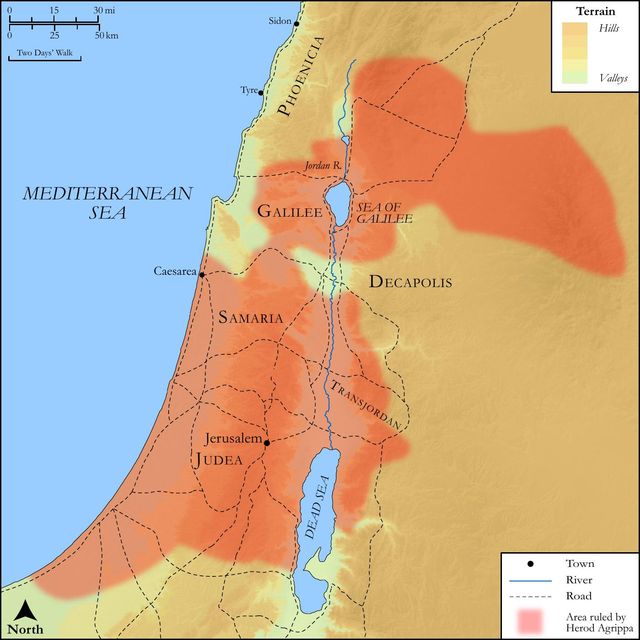
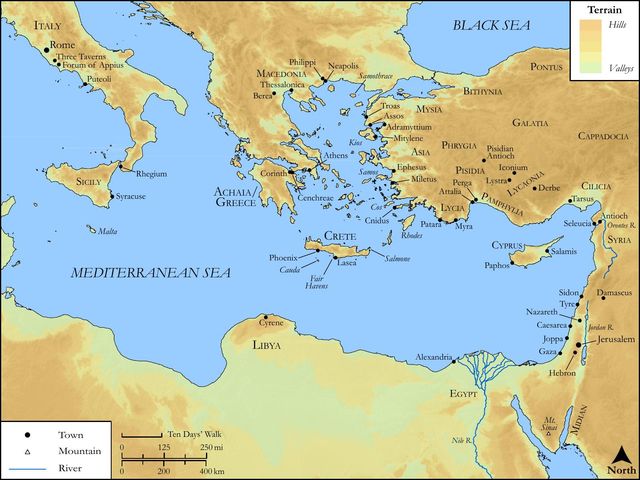
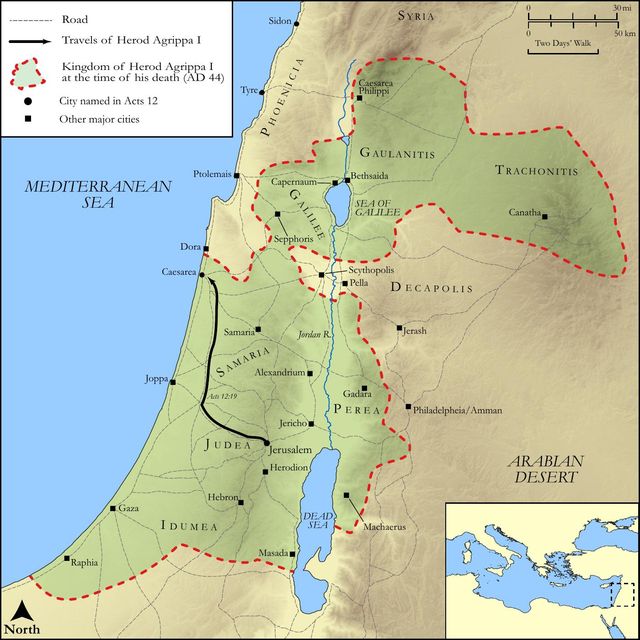
See on the biblical-era maps
Study this verse
Public-domain commentary
Matthew Henry
From his Commentary on the Whole Bible. Henry comments on passages, not single verses — this entry covers Acts 12:5–19. His four-level outline is real structure in the source text, so it is rendered as structure.
We have here an account of Peter's deliverance out of prison, by which the design of Herod against him was defeated, and his life preserved for further service, and a stop given to this bloody torrent. Now,
I.One thing that magnified his deliverance was that it was a signal answer to prayer (Act 12:5):
Peter was kept in prison with a great deal of care, so that it was altogether impossible, either by force or by stealth, to get him out. But prayer was made without ceasing of the church unto God for him, for prayers and tears are the church's arms; therewith she fights, not only against her enemies, but for her friends: and to these means they have recourse.
1.The delay of Peter's trial gave them time for prayer. It is probable that James was hurried off so suddenly and so privately that they had not time to pray for him, God so ordering it that they should not have space to pray, when he designed they should not have the thing they prayed for. James must be offered upon the sacrifice and service of their faith, and therefore prayer for him is restrained and prevented; but Peter must be continued to them, and therefore prayer for him is stirred up, and time is given them for it, by Herod's putting off the prosecution. Howbeit, he meant not so, neither did his heart think so.
2.They were very particular in their prayers for him, that it would please God, some way or other, to defeat Herod's purpose, and to snatch the lamb out of the jaws of the lion. The death of James alarmed them to a greater fervency in their prayer for Peter; for, if they be broken thus with breach upon breach, they fear that the enemy will make a full end. Stephen is not, and James is not, and will they take Peter also? All these things are against them; this will be sorrow upon sorrow, Phi 2:27. Note, Though the death and sufferings of Christ's ministers may be made greatly to serve the interests of Christ's kingdom, yet it is the duty and concern of the church earnestly to pray for their life, liberty, and tranquillity; and sometimes Providence orders it that they are brought into imminent danger, to stir up prayer for them.
3.Prayer was made without ceasing; it was, proseuchē ektenēs - fervent prayer. It is the word that is used concerning Christ's praying in his agony more earnestly; it is the fervent prayer of the righteous man, that is effectual, and availeth much. Some think it denotes the constancy and continuance of their prayers; so we take it: They prayed without ceasing. It was an extended prayer; they prayed for his release in their public assemblies (private ones, perhaps, for fear of the Jews); then they went home, and prayed for it in their families; then retired into their closets, and prayed for it there; so they prayed without ceasing: or first one knot of them, and then another, and then a third, kept a day of prayer, or rather a night of prayer, for him, Act 12:12. Note, Times of public distress and danger should be praying times with the church; we must pray always, but then especially.
II.Another thing that magnified his deliverance was that when the king's commandment and decree drew near to be put in execution, then his deliverance was wrought, as Est 9:1, Est 9:2. Let us observe when his deliverance came.
1.It was the very night before Herod designed to bring him forth, which made it to be so much the greater consolation to his friends and confusion to his enemies. It is probable some who had an interest in Herod, or those about him, had been improving it to get a discharge for Peter, but in vain; Herod resolves he shall die. And now they despair of prevailing in this way, for tomorrow is the day set for the bringing of him forth; and, it is likely, they will make as quick work with him as with his Master; and now God opened a door of escape for him. Note, God's time to help is when things are brought to the last extremity, when there is none shut up nor left (Deu 32:36), and for this reason it has been said, "The worse the better." When Isaac is bound upon the altar, and the knife in the hand, and the hand stretched out to slay him, then Jehovah-jireh, the Lord will provide.
2.It was when he was fast bound with two chains, between two soldiers; so that if he offer to stir he wakes them; and, besides this, though the prison-doors, no doubt, were locked and bolted, yet, to make sure work, the keepers before the door kept the prison, that no one might so much as attempt to rescue him. Never could the art of man do more to secure a prisoner. Herod, no doubt, said, as Pilate (Mat 27:65), make it as sure as you can. When men will think to be too hard for God, God will make it appear that he is too hard for them.
3.It was when he was sleeping between the soldiers, fast asleep;
(1.)Not terrified with his danger, though it was very imminent, and there was no visible way for his escape. There was but a step between him and death, and yet he could lay himself down in peace, and sleep - sleep in the midst of his enemies - sleep when, it may be, they were awake, having a good cause that he suffered for, and a good conscience that he suffered with, and being assured that God would issue his trial that way that should be most for his glory. Having committed his cause to him that judgeth righteously, his soul dwells at ease; and even in prison, between two soldiers, God gives him sleep, as he doth to his beloved.
(2.)Not expecting his deliverance. He did not keep awake, looking to the right hand, or to the left, for relief, but lay asleep, and was perfectly surprised with his deliverance. Thus the church (Psa 126:1): We were like those that dream.
III.It also magnified his deliverance very much that an angel was sent from heaven on purpose to rescue him, which made his escape both practicable and warrantable. This angel brought him a legal discharge, and enabled him to make use of it.
1.The angel of the Lord came upon him; epestē - stood over him. He seemed as one abandoned by men, yet not forgotten of his God; The Lord thinketh upon him. Gates and guards kept all his friends from him, but could not keep the angels of God from him: and they invisibly encamp round about those that fear God, to deliver them (Psa 34:7), and therefore they need not fear, though a host of enemies encamp against them, Psa 27:3. Wherever the people of God are, and however surrounded, they have a way open heavenward, nor can any thing intercept their intercourse with God.
2.A light shone in the prison. Though it is a dark place, and in the night, Peter shall see his way clear. Some observe that we do not find in the Old Testament that where angels appeared the light shone round about them; for that was a dark dispensation, and the glory of angels was then veiled. But in the New Testament, when mention is made of the appearing of the angels, notice is taken of the light that they appeared in; for it is by the gospel that the upper world is brought to light. The soldiers to whom Peter was chained were either struck into a deep sleep for the present (as Saul and his soldiers were when David carried off his spear and cruise of water), or, if they were awake, the appearance of the angel made them to shake, and to become as dead men, as it was with the guard set on Christ's sepulchre.
3.The angel awoke Peter, by giving him a blow on his side, a gentle touch, enough to rouse him out of his sleep, though so fast asleep that the light that shone upon him did not awaken him. When good people slumber in a time of danger, and are not awakened by the light of the word, and the discoveries it gives them, let them expect to be smitten on the side by some sharp affliction; better be raised up so than left asleep. The language of this stroke was, Arise up quickly; not as if the angel feared coming short by his delay, but Peter must not be indulged in it. When David hears the sound of the going on the tops of the mulberry trees, then he must rise up quickly, and bestir himself.
4.His chains fell off from his hands. It seems they had handcuffed him, to make him sure, but God loosed his bands; and, if they fall off from his hands, it is as well as if he had the strength of Samson to break them like threads of tow. Tradition makes a mighty rout about these chains, and tells a formal story that one of the soldiers kept them for a sacred relic, and they were long after presented to Eudoxia the empress, and I know not what miracles are said to have been wrought by them; and the Romish church keeps a feast on the first of August yearly in remembrance of Peter's chains, festum vinculorum Petri - The feast of Peter's chains; whereas this was at the passover. Surely they are thus fond of Peter's chains in hope with them to enslave the world!
5.He was ordered to dress himself immediately, and follow the angel; and he did so, Act 12:8, Act 12:9. When Peter was awake he knew not what to do but as the angel directed him.
(1.)He must gird himself; for those that slept in their clothes ungirded themselves, so that they had nothing to do, when they got up, but to fasten their girdles.
(2.)He must bind on his sandals, that he might be fit to walk. Those whose bonds are loosed by the power of divine grace must have their feet shod with the preparation of the gospel of peace.
(3.)He must cast his garments about him, and come away as he was, and follow the angel; and he might go with a great deal of courage and cheerfulness who had a messenger from heaven for his guide and guard. He went out, and followed him. Those who are delivered out of a spiritual imprisonment must follow their deliverer, as Israel when they went out of the house of bondage did; they went out, not knowing whither they went, but whom they followed. Now it is said, when Peter went out after the angel, he knew not that it was true which was done by the angel, that it was really a matter of fact, but thought he saw a vision; and, if he did, it was not the first he had seen: but by this it appears that a heavenly vision was so plain, and carried so much of its own evidence along with it, that it was difficult to distinguish between what was done in fact and what was done in vision. When the Lord brought back the captivity of his people we were like those that dream, Psa 126:1. Peter was so; he thought the news was too good to be true.
6.He was led safely by the angel out of danger, Act 12:10. Guards were kept at one pass and at another, which they were to make their way through when they were out of the prison, and they did so without any opposition; nay, for aught that appears, without any discovery: either their eyes were closed; or their hands were tied, or their hearts failed them; so it was that the angel and Peter safely passed the first and second ward. Those watchmen represented the watchmen of the Jewish church, on whom God had poured out a spirit of slumber, eyes that they should not see and ears that they should not hear, Rom 11:8. His watchmen are blind, sleeping, lying down, and loving to slumber. But still there is an iron gate, after all, that will stop them, and, if the guards can but recover themselves, there they may recover their prisoner, as Pharaoh hoped to retake Israel at the Red Sea. However, up to that gate they march, and, like the Red Sea before Israel, it opened to them. They did not so much as put a hand to it, but it opened of its own accord, by an invisible power; and thus was fulfilled in the letter what was figuratively promised to Cyrus (Isa 45:1, Isa 45:2): I will open before him the two-leaved gates, will break in pieces the gates of brass, and cut in sunder the bars of iron. And probably the iron gate shut again of itself, that none of the guards might pursue Peter. Note, When God will work salvation for his people, no difficulties in their way are insuperable; but even gates of iron are made to open of their own accord. This iron gate led him into the city out of the castle or tower; whether within the gates of the city or without is not certain, so that, when they were through this, they were got into the street. This deliverance of Peter represents to us our redemption by Christ, which is often spoken of as the setting of prisoners free, not only the proclaiming of liberty to the captives, but the bringing of them out of the prison-house. The application of the redemption in the conversion of souls is the sending forth of the prisoners, by the blood of the covenant, out of the pit wherein is no water, Zac 9:11. The grace of God, like this angel of the Lord, brings light first into the prison, by the opening of the understanding, smites the sleeping sinner on the side by the awakening of the conscience, causes the chains to fall off from the hands by the renewing of the will, and then gives the word of command, Gird thyself, and follow me. Difficulties are to be passed through, and the opposition of Satan and his instruments, a first and second ward, an untoward generation, from which we are concerned to save ourselves; and we shall be saved by the grace of God, if we put ourselves under the divine conduct. And at length the iron gate shall be opened to us, to enter into the New Jerusalem, where we shall be perfectly freed from all the marks of our captivity, and brought into the glorious liberty of the children of God.
7.When this was done, the angel departed from him, and left him to himself. He was out of danger from his enemies, and needed no guard. He knew where he was, and how to find out his friends, and needed no guide, and therefore his heavenly guard and guide bids him farewell. Note, Miracles are not to be expected when ordinary means are to be used. When Peter has now no more wards to pass, nor iron gates to get through, he needs only the ordinary invisible ministration of the angels, who encamp round about those that fear God, and deliver them.
IV.Having seen how his deliverance was magnified, we are next to see how it was manifested both to himself and others, and how, being made great, it was made known. We are here told,
1.How Peter came to himself, and so came himself to the knowledge of it, Act 12:11. So many strange and surprising things coming together upon a man just awoke out of sleep put him for the present into some confusion; so that he knew not where he was, nor what he did, nor whether it was fancy or fact; but at length Peter came to himself, was thoroughly awake, and found that it was not a dream, but a real thing: "Now I know of a surety, now I know alēthōs - truly, now I know that it is truth, and not an illusion of the fancy. Now I am well satisfied concerning it that the Lord Jesus hath sent his angel, for angels are subject to him and go on his errands, and by him hath delivered me out of the hands of Herod, who thought he had me fast, and so hath disappointed all the expectation of the people of the Jews, who doubted not to see Peter cut off the next day, and hoped it was the one neck of Christianity, in which it would all be struck off at one blow." For this reason it was a cause of great expectation, among not only the common people, but the great people of the Jews. Peter, when he recollected himself, perceived of a truth what great things God had done for him, which at first he could not believe for joy. Thus souls who are delivered out of a spiritual bondage are not at first aware what God has wrought in them. Many have the truth of grace that want the evidence of it. They are questioning whether there be indeed this change wrought in them, or whether they have not been all this while in a dream. But when the Comforter comes, whom the Father will send sooner or later, he will let them know of a surety what a blessed change is wrought in them, and what a happy state they are brought into.
2.How Peter came to his friends, and brought the knowledge of it to them. Here is a particular account of this, and it is very interesting.
(1.)He considered the thing (Act 12:12), considered how imminent his danger was, how great his deliverance; and now what has he to do? What improvement must he make of this deliverance? What must he do next? God's providence leaves room for the use of our prudence; and, though he has undertaken to perform and perfect what he has begun, yet he expects we should consider the thing.
(2.)He went directly to a friend's house, which, it is likely, lay near to the place where he was; it was the house of Mary, a sister of Barnabas, and mother of John Mark, whose house, it should seem, was frequently made use of for the private meeting of the disciples, either because it lay obscure, or because she was more forward than others were to open her doors to them; and, no doubt, it was, like the house of Obededom, blessed for the ark's sake. A church in the house makes it a little sanctuary.
(3.)There he found many that were gathered together praying, at the dead time of the night, praying for Peter, who was the next day to come upon his trial, that God would find out some way or other for his deliverance. Observe,
[1.]They continued in prayer, in token of their importunity; they did not think it enough once to have presented his case to God, but they did it again and again. Thus men ought always to pray, and not to faint. As long as we are kept waiting for a mercy we must continue praying for it.
[2.]It should seem that now when the affair came near to a crisis, and the very next day was fixed for the determining of it, they were more fervent in prayer than before; and it was a good sign that God intended to deliver Peter when he thus stirred up a spirit of prayer for his deliverance, for he never said to the seed of Jacob, Seek ye my face in vain.
[3.]They gathered together for prayer on this occasion; though this would made them obnoxious to the government if they were discovered, yet they know what an encouragement Christ gave to joint-prayer, Mat 18:19, Mat 18:20. And it was always the practice of God's praying people to unite their forces in prayer, as Ch2 20:4; Est 4:16.
[4.]They were many that were got together for this work, as many perhaps as the room would hold; and first one prayed, and then another, of those who gave themselves to the word and prayer, the rest joining with them; or, if they had not ministers among them, no doubt but there were many private Christians that knew how to pray, and to pray pertinently, and to continue long in prayer when the affections of those who joined were so stirred as to keep pace with them upon such an occasion. This was in the night, when others were asleep, which was an instance both of their prudence and of their zeal. Note, It is good for Christians to have private meetings for prayer, especially in times of distress, and not to let fall nor forsake such assemblies.
[5.]Peter came to them when they were thus employed, which was an immediate present answer to their prayer. It was as if God should say, "You are praying that Peter may be restored to you; now here he is." While they are yet speaking, I will hear, Isa 65:24. Thus the angel was sent with an answer of peace to Daniel's prayer, while he was praying, Dan 9:20, Dan 9:21. Ask, and it shall be given.
(4.)He knocked at the gate, and had much ado to get them to let him in (Act 12:13-16): Peter knocked at the door of the gate, designing by it to awaken them out of their sleep, and, for aught that appears, not knowing that he disturbed them in their devotions. Yet, if his friends were permitted to speak with him in private in the prison, it is possible he might know of this appointment, and it was this which he recollected and considered when he determined to go to that house, where he knew he should find many of his friends together. Now when he knocked there,
[1.]A damsel came to hearken; not to open the door till she knew who was there, a friend or a foe, and what their business was, fearing informers. Whether this damsel was one of the family or one of the church, whether a servant or a daughter, does not appear; it should seem, by her being named, that she was of note among the Christians, and more zealously affected to the better part than most of her age.
[2.]She knew Peter's voice, having often heard him pray, and preach, and discourse, with a great deal of pleasure. But, instead of letting him in immediately out of the cold, she opened not the gate for gladness. Thus sometimes, in a transport of affection to our friends, we do that which is unkind. In an ecstasy of joy she forgets herself, and opened not the gate.
[3.]She ran in, and probably went up to an upper room where they were together, and told them that Peter was certainly at the gate, though she had not courage enough to open the gate, for fear she should be deceived, and it should be the enemy. But, when she spoke of Peter's being there, they said, "Thou art mad; it is impossible it should be he, for he is in prison." Sometimes that which we most earnestly wish for we are most backward to believe, because we are afraid of imposing upon ourselves, as the disciples, who, when Christ had risen, believed not for joy. However, she stood to it that it was he. Then said they, It is his angel, Act 12:15. First, "It is a messenger from him, that makes use of his name;" so some take it; angelos often signifies no more than a messenger. It is used of John's messengers (Luk 7:24, Luk 7:27), of Christ's, Luk 9:52. When the damsel was confident it was Peter, because she knew his voice, they thought it was because he that stood at the door had called himself Peter, and therefore offer this solution of the difficulty, "It is one that comes with an errand from him, and thou didst mistake as if it had been he himself." Dr. Hammond thinks this the easiest way of understanding it. Secondly, "It is his guardian angel, or some other angel that has assumed his shape and voice, and stands at the gate in his resemblance." Some think that they supposed his angel to appear as a presage of his death approaching; and this agrees with a notion which the vulgar have, that sometimes before persons have died their ward has been seen, that is, some spirit exactly in their likeness for countenance and dress, when they themselves have been at the same time in some other place; they call it their ward, that is, their angel, who is their guard. If so, they concluded this an ill omen, that their prayers were denied, and that the language of the apparition was, "Let it suffice you, Peter must die, say no more of that matter." And, if we understand it so, it only proves that they had then such an opinion of a man's ward being seen a little before his death, but does not prove that there is such a thing. Others think they took this to be an angel from heaven, sent to bring them a grant to their prayers. But why should they imagine that angel to assume the voice and shape of Peter, when we find not any thing like it in the appearance of angels? Perhaps they herein spoke the language of the Jews, who had a fond conceit that every good man has a particular tutelar angel, that has the charge of him, and sometimes personates him. the heathen called it a good genius, that attended a man; but, since no other scripture speaks of such a thing, this alone is too weak to bear the weight of such a doctrine. We are sure that the angels are ministering spirits for the good of the heirs of salvation, that they have a charge concerning them, and pitch their tents round about them; and we need not be solicitous that every particular saint should have his guardian angel, when we are assured he has a guard of angels.
(5.)At length they let him in (Act 12:16): He continued knocking though they delayed to open to him, and at last they admitted him. The iron gate which opposed his enlargement opened of itself, without so much as once knocking at it; but the door of his friend's house that was to welcome him does not open of its own accord, but must be knocked at, long knocked at; lest Peter should be puffed up by the honours which the angel did him, he meets with this mortification, by a seeming slight which his friends put upon him. But, when they saw him, they were astonished, were filled with wonder and joy in him, as much as they were but just now with sorrow and fear concerning him. It was both surprising and pleasing to them in the highest degree.
(6.)Peter gave them an account of his deliverance. When he came to the company that were gathered together with so much zeal to pray for him, they gathered about him with no less zeal to congratulate him on his deliverance; and herein they were so noisy that when Peter himself begged them to consider what peril he was yet in, if they should be overheard, he could not make them hear him, but was forced to beckon to them with the hand to hold their peace, and had much ado thereby to command silence, while he declared unto them how the Lord Jesus had by an angel brought him out of prison; and it is very likely, having found them praying for his deliverance, he did not part with them till he and they had together solemnly given thanks to God for his enlargement; or, if he could not stay to do it, it is probable they staid together to do it; for what is won by prayer must be worn with praise; and God must always have the glory of that which we have the comfort of. When David declares what God had done for his soul, he blesses God who had not turned away his prayer, Psa 66:16, Psa 66:20.
(7.)Peter sent the account to others of his friends: Go, show these things to James, and to the brethren with him, who perhaps were met together in another place at the same time, upon the same errand to the throne of grace, which is one way of keeping up the communion of saints and wrestling with God in prayer-acting in concert, though at a distance, like Esther and Mordecai. He would have James and his company to know of his deliverance, not only that they might be eased of their pain and delivered from their fears concerning Peter, but that they might return thanks to God with him and for him. Observe, Though Herod had slain one James with the sword, yet here was another James, and that in Jerusalem too, that stood up in his room to preside among the brethren there; for, when God has work to do, he will never want instruments to do it with.
(8.)Peter had nothing more to do for the present than to shift for his own safety, which he did accordingly: He departed, and went into another place more obscure, and therefore more safe. He knew the town very well, and knew where to find a place that would be a shelter to him. Note, Even the Christian law of self-denial and suffering for Christ has not abrogated and repealed the natural law of self-preservation, and care for our own safety, as far as God gives an opportunity of providing for it by lawful means.
V.Having seen the triumph of Peter's friends in his deliverance, let us next observe the confusion of his enemies thereupon, which was so much the greater because people's expectation was so much raised of the putting of him to death.
1.The guards were in the utmost consternation upon it, for they knew how highly penal it was to them to let a prisoner escape that they had charge of (Act 12:18): As soon as it was day, and they found the prisoner gone, there was no small stir or strife, as some read it, among the soldiers, what had become of Peter; he is gone, and nobody knows how or which way. They thought themselves as sure as could be of him but last night; yet now the bird is flown, and they can hear no tale nor tidings of him. This set them together by the ears; one says, "It was your fault;" the other, "Nay, but it was yours;" having no other way to clear themselves, but by accusing one another. With us, if but a prisoner for debt escape, the sheriff must answer for the debt. Thus have the persecutors of the gospel of Christ been often filled with vexation to see its cause conquering, notwithstanding the opposition they have given to it.
2.Houses were searched in vain for the rescued prisoner (Act 12:19): Herod sought for him, and found him not. Who can find whom God hath hidden? Baruch and Jeremiah are safe, though searched for, because the Lord has hidden them, Jer 36:26. In times of public danger, all believers have God for their hiding-place, which is such a secret, that there the ignorant world cannot find them; such a strength, that the impotent world cannot reach them.
3.The keepers were reckoned with for a permissive escape: Herod examined the keepers, and finding that they could give no satisfactory account how Peter got away, he commanded that they should be put to death, according to the Roman law, and that Kg1 20:39, If by any means he be missing, then shall thy life go for his life. It is probable that these keepers had been more severe with Peter than they needed to be (as the jailor, Act 16:24), and had been abusive to him, and to others that had been their prisoners upon the like account; and now justly are they put to death for that which was not their fault, and by him too that had set them to work to vex the church. When the wicked are thus snared in the work of their own hands, the Lord is known by the judgments which he executes. Or, if they had not thus made themselves obnoxious to the justice of God, and it be thought hard that innocent men should suffer thus for that which was purely the act of God, we may easily admit the conjectures of some, that though they were commanded to be put to death, to please the Jews, who were sadly disappointed by Peter's escape, yet they were not executed; but Herod's death, immediately after, prevented it.
4.Herod himself retired upon it: He went down from Judea to Cesarea, and there abode. He was vexed to the heart, as a lion disappointed of his prey; and the more because he had so much raised the expectation of the people of the Jews concerning Peter, had told them how he would very shortly gratify them with the sight of Peter's head in a charger, which would oblige them as much as John Baptist's did Herodias; it made him ashamed to be robbed of this boasting, and to see himself, notwithstanding his confidence, disabled to make his words good. This is such a mortification to his proud spirit that he cannot bear to stay in Judea, but away he goes to Cesarea. Josephus mentions this coming of Herod to Cesarea, at the end of the third year of his reign over all Judea (Antiq. 19.343), and says, he came thither to solemnize the plays that were kept there, by a vast concourse of the nobility and gentry of the kingdom, for the health of Caesar, and in honour of him.
Historical interpretation
Historical reception
4 surviving comments on this verse. Each one is dated, so this reads as a timeline rather than a list.
Select a marker to jump to its quote. Markers stagger vertically where authors wrote within a few decades of each other.
Peter therefore was kept in prison. But this was all the better for Peter, who was thereby made more approved, and evinced his own manly courage. And it says, "there was earnest prayer making." It was the prayer of filial affection: it was for a father they asked, a father mild. "There was," it says, "earnest prayer." Hear how they were affected to their teachers. No factions, no perturbation: but they betook them to prayer, to that alliance which is indeed invincible, to this they betook them for refuge. They did not say, "What? I, poor insignificant creature that I am, to pray for him!" for, as they acted of love, they did not give these things a thought. And observe, it was during the feast, that their enemies brought these trials upon them, that their worth might be the more approved.
So Peter was kept in the prison. They, being at large, were at prayer: he, bound, was in sleep.
Peter therefore was kept in prison: but prayer was made without ceasing of the Church unto God for him. For the contest was now for life and death: both the slaying of the one made them fearful, and the casting of the other into prison.
This we urge you, by both supplications and tears, to contribute to us—insignificant ones. For the shared sufferings of the church call for shared prayers, just as when Peter, the head of the apostles, was bound in prison by two chains and watched over by guards … “there was made constant prayer by the church to God for him.” When this is the case for an apostle, who needs help, and prayers are offered up by the church, how would we, the uninitiated and brood of sin, not all the more beg these prayers to be offered for us by the faithful, those noble limbs of the church and educated to groan with godly and spiritual perception?
Continue studying Acts 12:5 across the web’s major study libraries — every link below opens this exact verse, chapter, or book on the destination site.
Read & Compare
 BibleGatewayThis verse in more than 200 translations and 70 languages.
 Bible.comThe YouVersion reader — hundreds of translations, reading plans, and highlights.
 ESV.orgCrossway's official English Standard Version reader.
 NET BibleThe NET translation with 60,000+ translators' notes on every rendering decision.
 STEP BibleTyndale House's free study tool — original text, vocabulary, and scholarly resources.
 BibliaLogos Bible Software's free web reader.
 USCCBThe New American Bible (Revised Edition) with the U.S. bishops' study notes.
Commentaries
 BibleHub CommentariesDozens of classic commentaries on this verse, gathered on one page.
 StudyLightMore than 100 commentary sets — the largest collection on the web.
 BibleRefPlain-English commentary on what this verse means, verse by verse.
 Enduring WordDavid Guzik's free commentary on this chapter, widely used by Bible teachers.
 Bible Study ToolsVerse commentary alongside Greek and Hebrew study aids.
Original Language & Research
- BibleHub InterlinearThe verse word by word — original language, transliteration, and English.
- BibleHub LexiconEvery word's original-language definition and Strong's entry.
 Blue Letter BibleDeep-study tools — Strong's numbers, concordance, and word studies.
 CNTR CollationThe earliest Greek manuscripts of this verse, collated letter by letter.
Sermons, Hymns & Audio


TrulyRandomVerse is not affiliated with these sites and doesn’t control their content. They’re linked because they’re genuinely useful.
Summary
Acts 12:5 presents a pivotal moment in the early church's history, highlighting their unified and persistent response to intense persecution. As Peter is held under strict guard, facing imminent execution by King Herod Agrippa I, the nascent Christian community dedicates itself to fervent and continuous prayer, demonstrating their profound faith in God's power to intervene against seemingly insurmountable human opposition. This verse sets the stage for a miraculous divine deliverance, underscoring the spiritual warfare inherent in the spread of the gospel and the church's reliance on divine rather than human strength.
Context
ShowHideLiterary Context
Acts 12:5 is situated within a broader narrative of escalating persecution against the early church, initiated by King Herod Agrippa I. The preceding verses detail Herod's execution of James, the brother of John, by the sword, a move that pleased the Jewish authorities (Acts 12:1-2). Emboldened by this success, Herod then arrests Peter, intending to publicly execute him after the Passover festival, a time when Jerusalem would be crowded with pilgrims, maximizing the political impact (Acts 12:3-4). Peter is placed under exceptionally heavy guard, with four squads of soldiers assigned to watch him, signifying the extreme measures taken to prevent his escape. In this dire context, surrounded by human power and seemingly inescapable doom, verse 5 shifts the focus from Herod's oppressive actions to the church's spiritual counter-response: collective, unceasing prayer, which then immediately precedes the miraculous intervention detailed in the subsequent verses (Acts 12:6-11).
Historical & Cultural Context
The historical backdrop is the reign of Herod Agrippa I (AD 37-44), a grandson of Herod the Great, who ruled Judea and Samaria. Unlike his predecessors, Agrippa I cultivated favor with the Jewish populace, meticulously observing Jewish law and traditions. His persecution of Christians, particularly the execution of James and the arrest of Peter, was a calculated political move to appease the influential Jewish leadership and gain popularity, especially during the significant festival of Passover. Roman imprisonment, as depicted here, was often harsh, characterized by chains, vigilant guards, and a lack of due process, with public trials and executions being common forms of imperial control and spectacle. The detailed description of Peter being "kept in prison" under "four quaternions of soldiers" (four groups of four, indicating a rotating 24-hour watch) underscores the severity of his confinement and the human impossibility of escape, amplifying the miraculous nature of his subsequent deliverance. The church, as a nascent and often misunderstood movement, found itself vulnerable to such political machinations and relied heavily on internal solidarity and divine intervention.
Key Themes
ShowHideActs 12:5 contributes significantly to several overarching themes within the book of Acts and the broader New Testament. Foremost is the Power of Prayer, which is presented not merely as a pious exercise but as an active force that can influence divine action and overcome seemingly insurmountable obstacles. The church's response to crisis is not political maneuvering or armed resistance, but fervent intercession, echoing the principle that God responds to the earnest petitions of His people (James 5:16). Another crucial theme is Corporate Unity and Solidarity within the early Christian community. The phrase "of the church" emphasizes that this was a collective, unified effort, demonstrating the believers' mutual care and commitment to one another in times of adversity, a hallmark of the early Christian fellowship described throughout the book of Acts. The Perseverance in Faith and Prayer is highlighted by the phrase "without ceasing," indicating a continuous, unyielding dedication to prayer despite the grim circumstances, aligning with apostolic exhortations to "pray without ceasing" (1 Thessalonians 5:17). Finally, the verse implicitly points to Divine Sovereignty and Intervention, setting the stage for God's miraculous deliverance of Peter, showcasing that even in the face of human tyranny, God's purposes for His church will prevail (Acts 12:7-11).
Exposition and Analysis
ShowHideKey Word Analysis
ShowHideThis verb signifies to "guard from loss or injury, properly, by keeping the eye upon." It implies careful, vigilant custody, suggesting that Peter was not merely incarcerated but was under constant, watchful surveillance. The choice of this word emphasizes the human effort to secure Peter and prevent his escape, thereby magnifying the miraculous nature of his subsequent release.
This term refers specifically to an act of prayer or worship, a petition directed to God. It denotes a solemn, earnest address to the divine, often implying a sense of need or supplication. Its use here highlights the spiritual nature of the church's response, turning to God as their ultimate source of help and authority.
This adverb means "intensely," "earnestly," or "fervently." It conveys a sense of zealous, persistent, and heartfelt effort. It's not merely continuous in time but intense in quality, suggesting a prayer poured out with great emotional and spiritual energy, reflecting the urgency and gravity of Peter's situation. This word implies a stretched-out, earnest, and unremitting effort in their supplication.
Derived from a compound meaning "a calling out," this term refers to a popular meeting or, concretely, a religious congregation. In the New Testament, it signifies the assembly of believers, the community of those called out by God. Its presence here emphasizes the corporate, unified nature of the prayer effort, highlighting the solidarity and collective spiritual action of the Christian community.
Verse Breakdown
ShowHide"Peter therefore was kept in prison:"
This clause establishes the immediate and dire circumstance. Peter, a prominent apostle, is under strict custody following the execution of James. The word "therefore" (G3767, oûn) connects this imprisonment directly to Herod's previous actions and intentions, indicating a continuation of the persecution. The passive voice "was kept" underscores Peter's helplessness in human terms, emphasizing that his fate was entirely in the hands of his captors.
"but prayer was made without ceasing"
This phrase introduces a profound contrast ("but" - G1161, dé). While Peter is physically restrained, the church engages in powerful spiritual action. The passive construction "prayer was made" (G1096, gínomai - to become, come into being) suggests that prayer was not merely an activity but a continuous, active force being generated. The adverbial phrase "without ceasing" (G1618, ektenḗs) emphatically describes the quality and persistence of this prayer, indicating it was fervent, earnest, and continuous, not a fleeting or casual petition.
"of the church unto God for him."
This final segment identifies the source, recipient, and object of the prayer. It was a corporate effort, originating "of the church" (G1577, ekklēsía), signifying the unified body of believers. Their petition was directed "unto God" (G2316, theós), acknowledging His supreme authority and power to intervene. Finally, the prayer was specifically "for him" (G846, autós), for Peter, demonstrating their deep concern and intercessory love for their imprisoned leader.
Literary Devices
ShowHideThe verse effectively employs Contrast as a primary literary device. The physical confinement and imminent danger faced by Peter ("kept in prison") are starkly contrasted with the spiritual freedom and power of the church's response ("prayer was made without ceasing"). This juxtaposition highlights the spiritual nature of the conflict and the profound difference between human limitations and divine intervention. There is also an element of Foreshadowing, as the fervent and unceasing nature of the prayer implicitly anticipates the miraculous deliverance that immediately follows in the narrative, building suspense and emphasizing the efficacy of the church's intercession. Furthermore, the phrase "without ceasing" serves as a powerful Emphasis on the intensity and persistence of the church's devotion, underscoring the vital role of sustained, earnest prayer in the face of adversity. The collective nature, "of the church," also highlights Synecdoche, where the church (the whole body) is represented by its action (prayer), signifying their unified spiritual stance.
Theological and Thematic Connections
ShowHideActs 12:5 profoundly illustrates the theological truth that God actively engages with His people's earnest prayers, particularly in times of crisis and persecution. It underscores the church's role as an intercessory body, demonstrating that corporate prayer is a powerful spiritual weapon, capable of moving the hand of God and altering seemingly unchangeable circumstances. This passage reinforces the New Testament teaching that while believers may face tribulation, their ultimate reliance is on God's sovereign power and His responsiveness to the petitions of His unified people. It presents a model of faith that, even when human solutions are exhausted, turns to divine intervention with unwavering hope and persistence.
Reflection and Application
ShowHideActs 12:5 offers timeless and profound lessons for believers today, serving as a powerful reminder of the transformative power of prayer, especially in the face of daunting challenges. In a world often characterized by anxiety, helplessness, and a reliance on human ingenuity, this verse calls us to re-center our hope and efforts on God's divine capacity to intervene. It encourages us to cultivate a posture of persistent and fervent prayer, not merely as a last resort, but as our primary and most potent response to personal crises, community struggles, and global injustices. The emphasis on "the church" praying "without ceasing" underscores the vital importance of corporate prayer, reminding us that there is unique power when believers unite in supplication, bearing one another's burdens and collectively appealing to God's mercy and might. This passage challenges us to move beyond superficial petitions to a deep, earnest, and continuous communion with God, trusting that He hears and acts, often in ways that defy human expectation, for the glory of His name and the advancement of His kingdom.
Questions for Reflection
ShowHideFAQ
ShowHideWhat does "without ceasing" truly mean in the context of prayer?
ShowHideThe phrase "without ceasing" (Greek: ektenḗs) does not necessarily mean praying every single moment of the day without interruption. Instead, it conveys a profound sense of intensity, earnestness, and persistence. It implies a prayer that is fervent, stretched out, and unremitting in its quality and focus, reflecting a deep spiritual burden and unwavering commitment. It suggests that the church maintained a continuous attitude of prayer, frequently returning to the petition for Peter, pouring out their hearts to God with great spiritual energy and urgency. This aligns with Paul's exhortation in 1 Thessalonians 5:17 to "pray without ceasing," which speaks to a lifestyle of prayerful dependence on God.
Why was Peter's imprisonment so severe, and what does this tell us about the early church's situation?
ShowHidePeter's imprisonment was exceptionally severe, indicated by the detailed mention of him being guarded by "four quaternions of soldiers" (sixteen soldiers total, rotating shifts). This level of security, including being bound with two chains between two soldiers, was typically reserved for high-profile prisoners or those considered a significant threat. King Herod Agrippa I had already executed James, the brother of John (Acts 12:2), and saw that this pleased the Jewish authorities. His intent to publicly execute Peter after Passover (Acts 12:3-4) was a calculated political move to gain further favor. This tells us that the early church was facing intense and politically motivated persecution, not just random acts of violence. They were perceived as a growing threat to the established religious and political order, and their leaders were specifically targeted. This context highlights the immense pressure and danger under which the early believers lived and underscores why their fervent, corporate prayer was their primary and most powerful response.
Christ-Centered Fulfillment
ShowHideActs 12:5, while focusing on the church's intercession for Peter, ultimately points to the greater reality of Christ's ongoing work and His supreme authority over all earthly powers. The church's fervent prayer for Peter's deliverance is a reflection of the intercessory ministry of Christ Himself, who "ever liveth to make intercession" for His people (Hebrews 7:25). Just as the church cried out to God for Peter, so too does Christ intercede for His entire body, ensuring their ultimate preservation and victory. Peter's miraculous release from prison, a human impossibility, foreshadows the ultimate triumph of Christ over sin, death, and all the powers of darkness. His resurrection from the grave (Matthew 28:1-10) is the definitive demonstration that no prison, no chain, no human authority can hold back God's purposes or His chosen ones. The church's prayer in Acts 12:5, therefore, is an act of faith in the resurrected and reigning Christ, who has been given "all authority in heaven and on earth" (Matthew 28:18), and who empowers His church to participate in His ongoing mission through prayer, knowing that He is "with you always, even unto the end of the world" (Matthew 28:20). Thus, the deliverance of Peter is not merely an isolated miracle but a powerful testament to the living Christ's active reign and His faithfulness to His church, even in the face of the fiercest opposition.