


1 Kings 20:20
Bible text: King James Version (1769 Blayney text) · Public domain
Bible text: King James Version with Strong's numbers · Public domain
Bible text: Berean Standard Bible · Public domain
Bible text: American Standard Version (1901) · Public domain
Bible text: World English Bible, Messianic edition · Public domain
Bible text: Geneva Bible (1599) · Public domain
Bible text: Young's Literal Translation · Public domain
- וַיַּכּוּvai·ya·Kuand they struck downH5221Conj-w ¦ V-Hiphil-ConsecImperf-3mpVerb Hiphil Consecutive Imperfect 3rd Plural Masculineוַandיַּכּוּthey struck down
- אִישׁ'isheveryoneH376N-msNoun Singular Masculine Absolute
- אִישׁוֹ'i·Shohis manH376N-msc ¦ 3msNoun Singular Masculine Constructאִישׁmanוֹhis
- וַיָּנֻסוּvai·ya·Nu·suand they fledH5127Conj-w ¦ V-Qal-ConsecImperf-3mpVerb Qal Consecutive Imperfect 3rd Plural Masculineוַandיָּנֻסוּthey fled
- אֲרָם'a·RamAramH758N-properNoun Proper Location
- וַיִּרְדְּפֵםvai·yir·de·Femand it pursued themH7291Conj-w ¦ V-Qal-ConsecImperf-3ms ¦ 3mpVerb Qal Consecutive Imperfect 3rd Singular Masculineוַandיִּרְדְּפֵit pursuedםthem
- יִשְׂרָאֵלYis·ra·'ElIsraelH3478N-properNoun Proper Location
- וַיִּמָּלֵטvai·yi·ma·Letand he escapedH4422Conj-w ¦ V-Niphal-ConsecImperf-3msVerb Niphal Consecutive Imperfect 3rd Singular Masculineוַandיִּמָּלֵטhe escaped
- בֶּןbenBenH1130N-proper-mNoun Proper Masculine
- הֲדַדha·DadHadadH1130N-proper-mNoun Proper Masculine
- מֶלֶךְMe·lekh[the] king ofH4428N-mscNoun Singular Masculine Construct
- אֲרָם'a·RamAramH758N-properNoun Proper Location
- עַל'alonH5921PrepPreposition
- סוּסsusa horseH5483N-msNoun Singular Masculine Absolute
- וּפָרָשִׁיםu·fa·ra·Shimand horsemenH6571Conj-w ¦ N-mpNoun Plural Masculine Absoluteוּandפָרָשִׁיםhorsemen
English is a literal word-by-word gloss of the Hebrew, not the KJV's wording. Why?
This is the original text the KJV's translators worked from — each Hebrew word with its own literal English meaning in this verse, prepared by scholars at Tyndale House, Cambridge. The KJV translates whole sentences, not word by word, so its wording differs: one Hebrew word can become several English words, and the KJV may choose “the LORD” where the gloss reads “Yahweh”. Both are faithful — they answer different questions. For the KJV's own rendering, switch to the KJV text.
Details
See on the biblical-era maps
Study this verse
Public-domain commentary
Matthew Henry
From his Commentary on the Whole Bible. Henry comments on passages, not single verses — this entry covers 1 Kings 20:12–21. His three-level outline is real structure in the source text, so it is rendered as structure.
The treaty between the besiegers and the besieged being broken off abruptly, we have here an account of the battle that ensued immediately.
I.The Syrians, the besiegers, had their directions from a drunken king, who gave orders over his cups, as he was drinking (Kg1 20:12), drinking himself drunk (Kg1 20:16) with the kings in the pavilions, and this at noon. Drunkenness is a sin which armies and their officers have of old been addicted to. Say not thou then that the former days were, in this respect, better than these, though these are bad enough. Had he not been very secure he would not have sat to drink; and, had he not bee intoxicated, he would not have been so very secure. Security and sensuality went together in the old world, and Sodom, Luk 17:26, etc. Ben-hadad's drunkenness was the forerunner of his fall, as Belshazzar's was, Dan. 5. How could he prosper that preferred his pleasure before his business, and kept his kings to drink with him when they should have been at their respective posts to fight for him? In his drink, 1. He orders the town to be invested, the engines fixed, and every thing got ready for the making of a general attack (Kg1 20:12), but stirs not from his drunken club to see it done. Woe unto thee, O land! when thy king is such a child. 2. When the besieged made a sally (and, by that time, he was far gone) he gave orders to take them alive (Kg1 20:18), not to kill them, which might have been done more easily and safely, but to seize them, which gave them an opportunity of killing the aggressors; so imprudent was he in the orders he gave, as well as unjust, in ordering them to be taken prisoners though they came for peace and to renew the treaty. Thus, as is usual, he drinks, and forgets the law, both the policies and the justice of war.
II.The Israelites, the besieged, had their directions from an inspired prophet, one of the prophets of the Lord, whom Ahab had hated and persecuted: And behold a prophet, even one, drew near to the king of Israel; so it may be read, Kg1 20:13.
1.Behold, and wonder, that God should send a prophet with a kind and gracious message to so wicked a prince as Ahab was; but he did it,
(1.)For his people Israel's sake, who, though wickedly degenerated, were the seed of Abraham his friend and Jacob his chosen, the children of the covenant, and not yet cast off.
(2.)That he might magnify his mercy, in doing good to one so evil and unthankful, might either bring him to repentance or leave him the more inexcusable.
(3.)That he might mortify the pride of Ben-hadad and check his insolence. Ahab's idolatry shall be punished hereafter, but Ben-hadad's haughtiness shall be chastised now; for God resists the proud, and is pleased to say that he fears the wrath of the enemy, Deu 32:26, Deu 32:27. There was but one prophet perhaps to be had in Samaria, and he drew near with this message, intimating that he had been forced to keep at a distance. Ahab, in his prosperity, would not have borne the sight of him, but now he bids him welcome, when none of the prophets of the groves can give him any assistance. He enquired not for a prophet of the Lord, but God sent one to him unasked, for he waits to be gracious.
2.Two things the prophet does: - (1.) He animates Ahab with an assurance of victory, which was more than all the elders of Israel could give him (Kg1 20:8), though they promised to stand by him. This prophet, who is not named (for he spoke in God's name), tells him from God that this very day the siege shall be raised, and the army of the Syrians routed, Kg1 20:13. When the prophet said, Thus saith the Lord, we may suppose Ahab began to tremble, expecting a message of wrath; but he is revived when it proves a gracious one. He is informed what use he ought to make of this blessed turn of affairs: "Thou shalt know that I am Jehovah, the sovereign Lord of all." God's foretelling a thing that was so very unlikely proved that it was his own doing. (2.) He instructs him what to do for the gaining of this victory. [1.] He must not stay till the enemy attacked him, but must sally out upon them and surprise them in their trenches. [2.] The persons employed must be the young men of the princes of the provinces, the pages, the footmen, who were few in number, only 232, utterly unacquainted with war, and the unlikeliest men that could be thought of for such a bold attempt; yet these must do it, these weak and foolish things must be instruments of confounding the wise and strong, that, while Ben-hadad's boasting is punished, Ahab's may be prevented and precluded, and the excellency of the power may appear to be of God. [3.] Ahab must himself so far testify his confidence in the word of God as to command in person, though, in the eye of reason, he exposed himself to the utmost danger by it. But it is fit that those who have the benefit of God's promises should enter upon them. Yet, [4.] He is allowed to make use of what other forces he has at hand, to follow the blow, when these young men have broken the ice. All he had in Samaria, or within call, were but 7000 men, Kg1 20:15. It is observable that it is the same number with theirs that he not bowed the knee to Baal (Kg1 19:18), though, it is likely, not the same men.
III.The issue was accordingly.
The proud Syrians were beaten, and the poor despised Israelites were more than conquerors. The young men gave an alarm to the Syrians just at noon, at high dinner-time, supported by what little force they had, Kg1 20:16. Ben-hadad despised them at first (Kg1 20:18), but when they had, with unparalleled bravery and dexterity, slain every one his man, and so put the army into disorder, that proud man durst not face them, but mounted immediately, drunk as he was, and made the best of his way, Kg1 20:20. See how God takes away the spirit of princes, and makes himself terrible to the kings of the earth. Now where are the silver and gold he demanded of Ahab? Where are the handfuls of Samaria's dust? Those that are most secure are commonly least courageous. Ahab failed not to improve this advantage, but slew the Syrians with a great slaughter, Kg1 20:21. Note, God oftentimes makes one wicked man a scourge to another.
Historical interpretation
Historical reception
3 surviving comments on this verse. Each one is dated, so this reads as a timeline rather than a list.
Select a marker to jump to its quote. Markers stagger vertically where authors wrote within a few decades of each other.
Here the Scripture relates the two battles of the king of Israel against the Arameans, at which we have already hinted, and the twin slaughters of the Arameans, of which the second caused the death of 127, men, as God took his revenge on the impious voice of the Arameans, who said about the true God worshiped by the Israelites, “The Lord is a god of the hills, but he is not a god of the valleys.”
Thus the saints go up to the Lord, the wicked go down to sin; the saints are on the mountains, the guilty in the valleys. “For he is the God of the mountains and not the God of the valleys.” Those who dwelt in the houses of the plain where God does not dwell could not have the house of God within them, for this is the house that God sought from them so that they might build up themselves and rear within themselves the temple of God from living stones of faith. He did not want buildings made with earthen walls or wooden roofs, for the hand of an enemy would have been able to overthrow them. He wanted that temple that is built in human hearts, to whom it might be said, “You are the temple of God,” in which the Lord Jesus might dwell and from there set out to redeem all humankind. There also could be prepared a sacred chamber in the womb of the Virgin where the King of heaven might live and a human body become the temple of God, which, though it was destroyed, might yet be restored to life on the third day.
Did not the Lord wish Ben-hadad, king of Syria, whom besides countless thousands of his own people, thirty-two kings and armies of the same number of kings served, to be conquered by a few foot soldiers of the princes in order that he who was the author of such victory would be acknowledged?
Continue studying 1 Kings 20:20 across the web’s major study libraries — every link below opens this exact verse, chapter, or book on the destination site.
Read & Compare
 BibleGatewayThis verse in more than 200 translations and 70 languages.
 Bible.comThe YouVersion reader — hundreds of translations, reading plans, and highlights.
 ESV.orgCrossway's official English Standard Version reader.
 NET BibleThe NET translation with 60,000+ translators' notes on every rendering decision.
 STEP BibleTyndale House's free study tool — original text, vocabulary, and scholarly resources.
 BibliaLogos Bible Software's free web reader.
 USCCBThe New American Bible (Revised Edition) with the U.S. bishops' study notes.
Commentaries
 BibleHub CommentariesDozens of classic commentaries on this verse, gathered on one page.
 StudyLightMore than 100 commentary sets — the largest collection on the web.
 BibleRefPlain-English commentary on what this verse means, verse by verse.
 Enduring WordDavid Guzik's free commentary on this chapter, widely used by Bible teachers.
 Bible Study ToolsVerse commentary alongside Greek and Hebrew study aids.
Original Language & Research
- BibleHub InterlinearThe verse word by word — original language, transliteration, and English.
- BibleHub LexiconEvery word's original-language definition and Strong's entry.
 Blue Letter BibleDeep-study tools — Strong's numbers, concordance, and word studies.
 SefariaThe Hebrew text with Rashi and centuries of Jewish commentary.
Sermons, Hymns & Audio


TrulyRandomVerse is not affiliated with these sites and doesn’t control their content. They’re linked because they’re genuinely useful.
Summary
First Kings 20:20 powerfully depicts the immediate and divinely orchestrated rout of the Aramean army by Israel, fulfilling God's prophetic word to King Ahab. This verse vividly portrays the overwhelming effectiveness of the Israelite forces, the chaotic flight of the Syrians, and the ignominious escape of their king, Ben-Hadad, who had previously boasted of his might. It stands as a testament to God's absolute sovereignty over nations, His commitment to humbling the proud, and His capacity to grant victory to His people, even when they are seemingly outmatched and undeserving.
Context
ShowHideLiterary Context
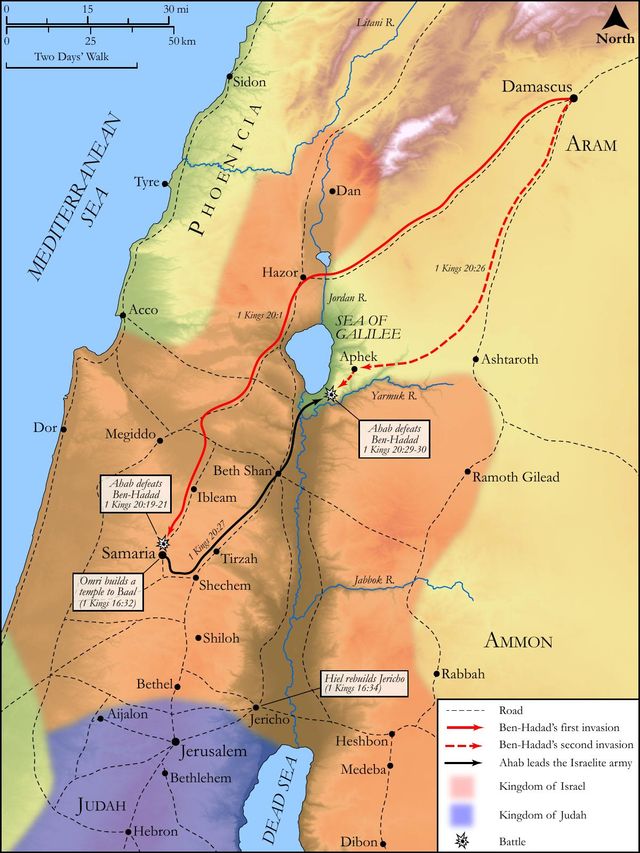
This verse marks the climactic moment of the first major military confrontation between King Ahab of Israel and King Ben-Hadad of Aram-Damascus, as narrated in 1 Kings 20. The chapter opens with Ben-Hadad's audacious siege of Samaria and his escalating, arrogant demands for tribute from Ahab (1 Kings 20:1-6). Despite Ahab's initial submission, Ben-Hadad's insatiable pride leads him to further boasts and threats, vowing to utterly annihilate Samaria (1 Kings 20:10-12). At this critical juncture, a prophet of the Lord intervenes, assuring Ahab of a divine victory, not based on Israel's strength, but solely on God's power, "that you may know that I am the Lord" (1 Kings 20:13-14). Following divine instruction, Ahab deploys a small, seemingly insignificant force of 232 young men and 7,000 Israelites, who launch a surprise attack while Ben-Hadad and his allied kings are engaged in drunken revelry (1 Kings 20:15-18). Verse 20 describes the immediate and astonishing result of this divinely orchestrated engagement, serving as the dramatic fulfillment of the prophet's promise and setting the stage for Ben-Hadad's capture and Ahab's controversial decision in the subsequent verses (1 Kings 20:21-34).
Historical & Cultural Context
The protracted conflict between Israel and Aram (Syria), particularly the powerful kingdom of Aram-Damascus, was a defining feature of the geopolitical landscape during the Omride dynasty in Israel. Ben-Hadad II (or possibly Ben-Hadad I, depending on scholarly dating) was a formidable regional power, often leading coalitions of smaller city-states against rival kingdoms. Samaria, founded by Omri and fortified by Ahab, served as the strategically vital capital of the northern kingdom of Israel. Siege warfare was a common military tactic, involving surrounding a city to cut off supplies and eventually breach its defenses. The boasts and demands of Ben-Hadad reflect the typical bravado and psychological warfare employed by the kings of that day, often accompanied by excessive feasting and revelry, even amidst military campaigns. The miraculous nature of Israel's victory, where a small, outmatched force routed a large army, would have been immediately recognized by the original audience as a clear demonstration of divine intervention, challenging the prevailing belief that victory was determined solely by the size or strength of armies or the favor of national deities. The prophet's explicit emphasis on God revealing Himself as "the Lord" (Yahweh) directly counters any notion that the "gods of the hills" (as the Syrians later claimed in 1 Kings 20:23) were limited in their power or domain.
Key Themes
ShowHideThis verse powerfully illustrates several key themes central to the broader narrative of 1 Kings and the biblical witness:
Divine Sovereignty and Empowerment
The victory is unequivocally attributed to God's direct intervention, rather than Israel's military prowess. The striking phrase "they slew every one his man" suggests either a supernatural enablement of each Israelite soldier or a divinely induced panic that caused the Syrians to turn on each other, highlighting that "victory belongs to the Lord" (Proverbs 21:31). This underscores God's absolute control over the outcomes of battles and the destinies of nations, even when His people are weak or unfaithful.
Humiliation of Arrogance and Pride
Ben-Hadad, who had boasted of his overwhelming power and openly defied the Lord, is depicted fleeing in utter ignominy. His hasty escape on horseback, abandoning his army, serves as a stark reminder that "pride goes before destruction, and a haughty spirit before a fall" (Proverbs 16:18). This theme is consistently woven throughout Scripture, demonstrating God's opposition to the proud and His exaltation of the humble.
Prophetic Fulfillment and God's Faithfulness
The swift and comprehensive rout of the Syrians is a direct and dramatic fulfillment of the prophet's assurance to Ahab that God would deliver the enemy into his hand (1 Kings 20:13). This demonstrates God's unwavering faithfulness to His word, even when delivered to a king like Ahab, who was largely unfaithful. It reinforces the authority and reliability of God's messengers and His active involvement in human affairs, ensuring His purposes prevail.
Exposition and Analysis
ShowHideKey Word Analysis
ShowHideA primitive root meaning "to strike (lightly or severely, literally or figuratively)." In this context, it signifies a decisive and lethal blow. The use of this verb, especially in conjunction with "every one his man," conveys the overwhelming and devastating impact of the Israelite attack, or the internal chaos among the Syrians, leading to a complete collapse of their forces. It implies not just a defeat, but a slaughter.
Meaning "a man as an individual or a male person." The repetition in "every one his man" (literally "a man his man") emphasizes the individual effectiveness of the Israelite soldiers or, more strikingly, the internal conflict and self-destruction within the Syrian ranks. This highlights a chaotic, almost supernatural, disarray where each soldier contributed to the enemy's demise, whether by direct combat or by causing their foes to turn on themselves.
A primitive root meaning "to flit, i.e., vanish away (subside, escape; causatively, chase, impel, deliver)." This verb denotes a sudden, rapid, and disorderly retreat, indicative of panic and complete disorganization. It contrasts sharply with the earlier confidence and numerical superiority of the Syrian forces. The immediate and widespread flight signifies a comprehensive collapse of morale and military cohesion, leaving no room for regrouping or a sustained defense. It emphasizes the completeness of their defeat.
A primitive root meaning "to be smooth, i.e. (by implication) to escape (as if by slipperiness); causatively, to release or rescue." This verb implies a narrow, desperate, and often ignominious flight from danger. For Ben-Hadad, a powerful king who had boasted of his overwhelming force, to "escape" on horseback with only his horsemen signifies a profound personal humiliation. It depicts him abandoning his army and allies, prioritizing his own survival over the fate of his troops or the honor of his kingdom. This hasty, undignified flight is a direct consequence and symbolic representation of the crushing defeat and the reversal of fortunes.
Verse Breakdown
ShowHide"And they slew every one his man:"
This opening clause immediately establishes the astonishing effectiveness of the Israelite counter-attack. The "they" refers to the small Israelite force, specifically the 232 young men who initiated the engagement, followed by the 7,000 Israelites. The phrase "every one his man" emphasizes the individual, decisive impact of each Israelite soldier, or, as discussed in Key Word Analysis, the chaotic self-destruction within the Syrian ranks, both pointing to a divinely empowered or induced rout.
"and the Syrians fled;"
This clause describes the immediate and direct consequence of the Israelite's initial assault. The vast Syrian army, previously confident and numerically superior, breaks ranks and flees in disarray. This sudden and widespread flight underscores the panic and demoralization that gripped the enemy, confirming the supernatural element of the victory.
"and Israel pursued them:"
This indicates that the Israelite victory was not merely defensive but a comprehensive rout. The pursuit aimed to maximize the enemy's losses, prevent regrouping, and secure a decisive outcome. It demonstrates the momentum of the Israelite forces and the completeness of the Syrian collapse, ensuring no immediate threat of a counter-attack.
"and Benhadad the king of Syria escaped on an horse with the horsemen."
This final clause highlights the personal humiliation of the Syrian king. Ben-Hadad, who had been reveling in his perceived victory and making arrogant demands, is now reduced to a desperate flight, abandoning his army and his allies. His escape "on a horse with the horsemen" suggests a hasty, undignified retreat, perhaps with his personal guard, leaving the bulk of his forces to their fate. This image serves as a powerful symbol of the downfall of pride and the swift, divinely orchestrated reversal of fortunes.
Literary Devices
ShowHideThe verse employs several powerful literary devices to convey its message. Dramatic Irony is prominently featured, as the once boastful and seemingly invincible Ben-Hadad, who had threatened to reduce Samaria to dust, is now seen fleeing ignominiously for his life. His earlier arrogance (1 Kings 20:10-12) stands in stark Contrast to his desperate escape, highlighting the swift and unexpected reversal of fortunes. The phrase "slew every one his man" can be interpreted as a form of Hyperbole, emphasizing the extraordinary and overwhelming nature of the Israelite victory, perhaps suggesting a level of efficiency or internal chaos beyond typical human combat. This hyperbole serves to underscore the divine intervention at play. Finally, Ben-Hadad's flight on horseback with his cavalry functions as potent Symbolism, representing not just his personal defeat but the complete collapse of his army's morale and the humbling of Aram's perceived might before the irresistible power of the Lord.
Theological and Thematic Connections
ShowHideThis verse powerfully articulates the biblical truth that God is sovereign over all nations and that human strength, numbers, or arrogance are no match for His divine will. The victory granted to Israel, a nation often prone to idolatry and weakness, against a formidable enemy like Aram, serves as a clear demonstration that God acts to fulfill His purposes and to reveal His identity as the one true Lord. It reinforces the principle that pride precedes destruction, and those who defy God's authority will ultimately be humbled. This divine intervention in battle is not merely a historical event but a profound theological statement about God's active involvement in the affairs of humanity, demonstrating His justice, faithfulness, and power to deliver His people, often through unexpected means, ensuring that the glory belongs to Him alone.
Reflection and Application
ShowHideThe account of Israel's stunning victory over Aram in 1 Kings 20:20 offers profound lessons for believers facing overwhelming odds or arrogant opposition in their own lives. Just as God intervened for a weak and undeserving Israel, He remains faithful to His promises and capable of delivering His people today. This passage calls us to cultivate a posture of humility and absolute dependence on God, rather than relying on our own strength, resources, or perceived advantages. When confronted with seemingly insurmountable challenges—whether personal struggles, professional pressures, or spiritual battles—we are reminded that the victory belongs to the Lord. Our role is to obey His commands, trust His word, and step out in faith, knowing that He often chooses to work through the weak and the few to confound the strong and the many, ensuring that His glory is magnified. This should inspire courage and unwavering faith, knowing that God is actively involved in our lives, ready to humble the proud and lift up the humble, just as He did for Ahab's Israel. It reminds us that true security and triumph are found not in human might, but in the omnipotence and unwavering faithfulness of God.
Questions for Reflection
ShowHideFAQ
ShowHideWhat does the phrase "slew every one his man" truly imply about the battle?
ShowHideThe phrase "slew every one his man" (Hebrew: vayyakkū 'îš 'îšô) is a powerful and somewhat ambiguous expression, pointing to a divinely orchestrated, overwhelming victory. It can be interpreted in two primary ways. Firstly, it could mean that each Israelite soldier was incredibly effective, individually striking down a Syrian opponent, highlighting their extraordinary prowess or divine enablement in combat. Secondly, and perhaps more dramatically, it could imply that the Syrians, in their panic and disarray, became so disoriented that they turned their weapons on one another, mistaking their comrades for enemies. This phenomenon of internal chaos and self-destruction among an enemy army due to divine terror is seen elsewhere in Scripture (e.g., Judges 7:22 or 2 Chronicles 20:23). In either case, the phrase emphasizes the completeness and supernatural nature of the rout, making it clear that this was no ordinary military victory but a direct act of God.
Why was Ben-Hadad's escape on horseback significant?
ShowHideBen-Hadad's escape "on an horse with the horsemen" is highly significant because it underscores his profound humiliation and the completeness of his defeat. As the king and commander of a vast and confident army, he had boasted arrogantly and made excessive demands of Ahab (1 Kings 20:1-12). For such a powerful figure to be reduced to a desperate, undignified flight, abandoning his army and allies, is a stark reversal of fortune. It symbolizes the downfall of pride and the swift, decisive judgment of God against those who defy Him. His ignominious escape contrasts sharply with his earlier pomp and circumstance, serving as a visual testament to God's power to humble the haughty and elevate the humble.
How does this victory relate to God's character, especially given Ahab's unfaithfulness?
ShowHideThis victory profoundly reveals God's character, particularly His sovereignty, faithfulness, and justice, even in the face of human unfaithfulness. Despite King Ahab's consistent idolatry and wickedness, God still chose to deliver Israel and fulfill His prophetic word (1 Kings 20:13). This demonstrates that God's actions are not solely contingent on human merit but are driven by His own purposes: to reveal His identity ("that you may know that I am the Lord"), to protect His covenant people (even when they stray), and to demonstrate His power over all earthly kingdoms and their gods. It highlights God's unwavering commitment to His divine plan and His willingness to use even flawed instruments to achieve His redemptive and revelatory goals, ultimately ensuring that all glory redounds to Him alone.
Christ-Centered Fulfillment
ShowHideThe dramatic rout of Ben-Hadad and his Syrian army in 1 Kings 20:20, orchestrated by God to humble the proud and deliver His people, finds its ultimate and most profound fulfillment in the person and work of Jesus Christ. Just as an earthly king, full of pride and boasting, was decisively defeated, so too Christ, the true King, utterly triumphed over the spiritual forces of darkness that held humanity captive. The victory in 1 Kings 20 foreshadows Christ's ultimate conquest of sin, death, and the devil—enemies far more formidable than any earthly army. Through His crucifixion, where He appeared weak and defeated, and His glorious resurrection, Jesus "disarmed the powers and authorities, he made a public spectacle of them, triumphing over them by the cross" (Colossians 2:15). The ignominious flight of Ben-Hadad parallels the ultimate defeat of Satan, who, though once a formidable accuser, is now stripped of his power and destined for eternal judgment (Revelation 20:10). The "Lamb of God" (John 1:29), who appeared humble and meek, is the true Lion of Judah (Revelation 5:5), who will return as the victorious King of kings and Lord of lords (Revelation 19:11-16), bringing final and complete deliverance to all who trust in Him. This ancient victory points forward to the eternal triumph of God's Son, securing not just physical peace but spiritual freedom and eternal life for all who believe, demonstrating that God's ultimate victory is achieved through His Son, Jesus Christ, for the salvation of His people.