


1 Kings 20:17
Bible text: King James Version (1769 Blayney text) · Public domain
Bible text: King James Version with Strong's numbers · Public domain
Bible text: Berean Standard Bible · Public domain
Bible text: American Standard Version (1901) · Public domain
Bible text: World English Bible, Messianic edition · Public domain
Bible text: Geneva Bible (1599) · Public domain
Bible text: Young's Literal Translation · Public domain
- וַיֵּצְאוּvai·ye·tze·'Uand they went outH3318Conj-w ¦ V-Qal-ConsecImperf-3mpVerb Qal Consecutive Imperfect 3rd Plural Masculineוַandיֵּצְאוּthey went out
- נַעֲרֵיna·'a·Rei[the] young men ofH5288N-mpcNoun Plural Masculine Construct
- שָׂרֵיsa·Rei[the] officials ofH8269N-mpcNoun Plural Masculine Construct
- הַמְּדִינוֹתha·me·di·Notthe provincesH4082Art ¦ N-fpNoun Plural Feminine Absoluteהַtheמְּדִינוֹתprovinces
- בָּרִאשֹׁנָהba·ri·sho·Nahat the firstH7223Prep-b ¦ Adj-fsAdjective Numerical Position Singular Feminine Absoluteבָּat theרִאשֹׁנָהfirst
- וַיִּשְׁלַחvai·yish·Lachand he sentH7971Conj-w ¦ V-Qal-ConsecImperf-3msVerb Qal Consecutive Imperfect 3rd Singular Masculineוַandיִּשְׁלַחhe sent
- בֶּןbenBenH1130N-proper-mNoun Proper Masculine
- הֲדַדha·DadHadadH1130N-proper-mNoun Proper Masculine
- וַיַּגִּידוּvai·ya·Gi·duand people toldH5046Conj-w ¦ V-Hiphil-ConsecImperf-3mpVerb Hiphil Consecutive Imperfect 3rd Plural Masculineוַandיַּגִּידוּpeople told
- לוֹloto himPrep-l ¦ 3msSuffix Personal 3rd Singular Masculineלtoוֹhim
- לֵאמֹרle·Mor<to> sayingH559Prep-l ¦ V-Qal-InfVerb Qal Infinitive Constructלֵ<to>אמֹרsaying
- אֲנָשִׁים'a·na·ShimmenH582N-mpNoun Plural Masculine Absolute
- יָצְאוּya·tze·'Uthey have come outH3318V-Qal-Perf-3cpVerb Qal Perfect 3rd Plural common gender
- מִשֹּׁמְרוֹןmi·sho·me·Ronfrom SamariaH8111Prep-m ¦ N-properNoun Proper LocationמִfromשֹּׁמְרוֹןSamaria
English is a literal word-by-word gloss of the Hebrew, not the KJV's wording. Why?
This is the original text the KJV's translators worked from — each Hebrew word with its own literal English meaning in this verse, prepared by scholars at Tyndale House, Cambridge. The KJV translates whole sentences, not word by word, so its wording differs: one Hebrew word can become several English words, and the KJV may choose “the LORD” where the gloss reads “Yahweh”. Both are faithful — they answer different questions. For the KJV's own rendering, switch to the KJV text.
Details
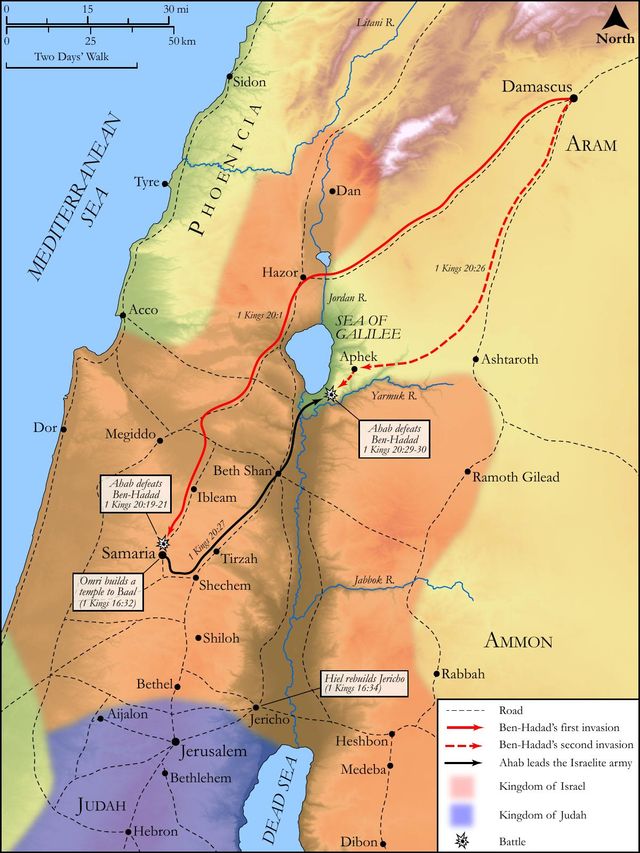
See on the biblical-era maps

Study this verse
Public-domain commentary
Matthew Henry
From his Commentary on the Whole Bible. Henry comments on passages, not single verses — this entry covers 1 Kings 20:12–21. His three-level outline is real structure in the source text, so it is rendered as structure.
The treaty between the besiegers and the besieged being broken off abruptly, we have here an account of the battle that ensued immediately.
I.The Syrians, the besiegers, had their directions from a drunken king, who gave orders over his cups, as he was drinking (Kg1 20:12), drinking himself drunk (Kg1 20:16) with the kings in the pavilions, and this at noon. Drunkenness is a sin which armies and their officers have of old been addicted to. Say not thou then that the former days were, in this respect, better than these, though these are bad enough. Had he not been very secure he would not have sat to drink; and, had he not bee intoxicated, he would not have been so very secure. Security and sensuality went together in the old world, and Sodom, Luk 17:26, etc. Ben-hadad's drunkenness was the forerunner of his fall, as Belshazzar's was, Dan. 5. How could he prosper that preferred his pleasure before his business, and kept his kings to drink with him when they should have been at their respective posts to fight for him? In his drink, 1. He orders the town to be invested, the engines fixed, and every thing got ready for the making of a general attack (Kg1 20:12), but stirs not from his drunken club to see it done. Woe unto thee, O land! when thy king is such a child. 2. When the besieged made a sally (and, by that time, he was far gone) he gave orders to take them alive (Kg1 20:18), not to kill them, which might have been done more easily and safely, but to seize them, which gave them an opportunity of killing the aggressors; so imprudent was he in the orders he gave, as well as unjust, in ordering them to be taken prisoners though they came for peace and to renew the treaty. Thus, as is usual, he drinks, and forgets the law, both the policies and the justice of war.
II.The Israelites, the besieged, had their directions from an inspired prophet, one of the prophets of the Lord, whom Ahab had hated and persecuted: And behold a prophet, even one, drew near to the king of Israel; so it may be read, Kg1 20:13.
1.Behold, and wonder, that God should send a prophet with a kind and gracious message to so wicked a prince as Ahab was; but he did it,
(1.)For his people Israel's sake, who, though wickedly degenerated, were the seed of Abraham his friend and Jacob his chosen, the children of the covenant, and not yet cast off.
(2.)That he might magnify his mercy, in doing good to one so evil and unthankful, might either bring him to repentance or leave him the more inexcusable.
(3.)That he might mortify the pride of Ben-hadad and check his insolence. Ahab's idolatry shall be punished hereafter, but Ben-hadad's haughtiness shall be chastised now; for God resists the proud, and is pleased to say that he fears the wrath of the enemy, Deu 32:26, Deu 32:27. There was but one prophet perhaps to be had in Samaria, and he drew near with this message, intimating that he had been forced to keep at a distance. Ahab, in his prosperity, would not have borne the sight of him, but now he bids him welcome, when none of the prophets of the groves can give him any assistance. He enquired not for a prophet of the Lord, but God sent one to him unasked, for he waits to be gracious.
2.Two things the prophet does: - (1.) He animates Ahab with an assurance of victory, which was more than all the elders of Israel could give him (Kg1 20:8), though they promised to stand by him. This prophet, who is not named (for he spoke in God's name), tells him from God that this very day the siege shall be raised, and the army of the Syrians routed, Kg1 20:13. When the prophet said, Thus saith the Lord, we may suppose Ahab began to tremble, expecting a message of wrath; but he is revived when it proves a gracious one. He is informed what use he ought to make of this blessed turn of affairs: "Thou shalt know that I am Jehovah, the sovereign Lord of all." God's foretelling a thing that was so very unlikely proved that it was his own doing. (2.) He instructs him what to do for the gaining of this victory. [1.] He must not stay till the enemy attacked him, but must sally out upon them and surprise them in their trenches. [2.] The persons employed must be the young men of the princes of the provinces, the pages, the footmen, who were few in number, only 232, utterly unacquainted with war, and the unlikeliest men that could be thought of for such a bold attempt; yet these must do it, these weak and foolish things must be instruments of confounding the wise and strong, that, while Ben-hadad's boasting is punished, Ahab's may be prevented and precluded, and the excellency of the power may appear to be of God. [3.] Ahab must himself so far testify his confidence in the word of God as to command in person, though, in the eye of reason, he exposed himself to the utmost danger by it. But it is fit that those who have the benefit of God's promises should enter upon them. Yet, [4.] He is allowed to make use of what other forces he has at hand, to follow the blow, when these young men have broken the ice. All he had in Samaria, or within call, were but 7000 men, Kg1 20:15. It is observable that it is the same number with theirs that he not bowed the knee to Baal (Kg1 19:18), though, it is likely, not the same men.
III.The issue was accordingly.
The proud Syrians were beaten, and the poor despised Israelites were more than conquerors. The young men gave an alarm to the Syrians just at noon, at high dinner-time, supported by what little force they had, Kg1 20:16. Ben-hadad despised them at first (Kg1 20:18), but when they had, with unparalleled bravery and dexterity, slain every one his man, and so put the army into disorder, that proud man durst not face them, but mounted immediately, drunk as he was, and made the best of his way, Kg1 20:20. See how God takes away the spirit of princes, and makes himself terrible to the kings of the earth. Now where are the silver and gold he demanded of Ahab? Where are the handfuls of Samaria's dust? Those that are most secure are commonly least courageous. Ahab failed not to improve this advantage, but slew the Syrians with a great slaughter, Kg1 20:21. Note, God oftentimes makes one wicked man a scourge to another.
Continue studying 1 Kings 20:17 across the web’s major study libraries — every link below opens this exact verse, chapter, or book on the destination site.
Read & Compare
 BibleGatewayThis verse in more than 200 translations and 70 languages.
 Bible.comThe YouVersion reader — hundreds of translations, reading plans, and highlights.
 ESV.orgCrossway's official English Standard Version reader.
 NET BibleThe NET translation with 60,000+ translators' notes on every rendering decision.
 STEP BibleTyndale House's free study tool — original text, vocabulary, and scholarly resources.
 BibliaLogos Bible Software's free web reader.
 USCCBThe New American Bible (Revised Edition) with the U.S. bishops' study notes.
Commentaries
 BibleHub CommentariesDozens of classic commentaries on this verse, gathered on one page.
 StudyLightMore than 100 commentary sets — the largest collection on the web.
 BibleRefPlain-English commentary on what this verse means, verse by verse.
 Enduring WordDavid Guzik's free commentary on this chapter, widely used by Bible teachers.
 Bible Study ToolsVerse commentary alongside Greek and Hebrew study aids.
Original Language & Research
- BibleHub InterlinearThe verse word by word — original language, transliteration, and English.
- BibleHub LexiconEvery word's original-language definition and Strong's entry.
 Blue Letter BibleDeep-study tools — Strong's numbers, concordance, and word studies.
 SefariaThe Hebrew text with Rashi and centuries of Jewish commentary.
Sermons, Hymns & Audio


TrulyRandomVerse is not affiliated with these sites and doesn’t control their content. They’re linked because they’re genuinely useful.
Summary
1 Kings 20:17 serves as the surprising prelude to Israel's divinely orchestrated counter-attack against the formidable Aramean army besieging Samaria. This verse meticulously details the unexpected emergence of a seemingly insignificant vanguard—"the young men of the princes of the provinces"—from the beleaguered capital. Their initial sortie immediately captures the attention of Ben-Hadad's forces, who promptly report this development to their overconfident king, thereby setting the stage for a miraculous victory that defies conventional military expectations and powerfully underscores God's sovereign power to deliver His people through unconventional and often humbling means.
Context
ShowHideLiterary Context
This verse is a critical turning point within the broader narrative of King Ahab's tumultuous reign, specifically initiating the first of two significant military engagements between Israel and Aram detailed in 1 Kings 20 and 1 Kings 22. Chapter 20 commences with the audacious demands and subsequent siege of Samaria by Ben-Hadad, followed by Ahab's initial, humiliating capitulation. However, a prophetic intervention dramatically alters the course of events. A prophet of the Lord assures Ahab of a resounding victory against the numerically superior Aramean forces, despite Israel's inherent weakness and Ahab's profound moral failings. The divine strategy, meticulously outlined in 1 Kings 20:13-19, mandates a small, unconventional force to lead the charge. Verse 17 directly precedes the miraculous and decisive defeat of Ben-Hadad's forces, who are depicted as indulging in boastful feasting and revelry in their presumed victory, as strikingly portrayed in 1 Kings 20:12. This juxtaposition powerfully highlights the stark contrast between Aramean hubris and Israel's humble, divinely-empowered advance.
Historical & Cultural Context
The protracted conflict between the Northern Kingdom of Israel and Aram (Syria), particularly under the powerful Aramean king Ben-Hadad II, was a defining feature of the geopolitical landscape during the Omride dynasty. Samaria, established as the capital by Omri, was a strategically vital and heavily fortified city, making a prolonged siege a common and effective tactic of the warfare of that day. Ben-Hadad II commanded a formidable army, comprising chariots, cavalry, and a large infantry contingent, characteristic of a dominant regional power. The specific mention of "princes of the provinces" (שָׂרֵי הַמְּדִינוֹת, sarei hamedinot) alludes to a feudal or administrative system where regional rulers contributed their own contingents to the national army. Their "young men" (נְעָרִים, ne'arim) would likely have been their personal attendants, squires, or even sons, rather than seasoned, front-line warriors. This detail profoundly underscores the unconventional and seemingly insignificant nature of this initial sortie, which would have appeared utterly negligible to a professional, mighty army like Ben-Hadad's, accustomed to grand military maneuvers and overwhelming force.
Key Themes
ShowHideThe deployment of this small, seemingly insignificant group of "young men" profoundly contributes to several overarching themes woven throughout 1 Kings 20 and the broader Deuteronomistic History. Firstly, it serves as a powerful illustration of Divine Strategy and Humility. God deliberately chooses weak, unconventional, and often overlooked means to achieve His victories, ensuring that the glory and credit belong solely to Him and not to human strength, wisdom, or military might. This stands in stark contrast to Ben-Hadad's profound pride and overconfidence, which ultimately precipitates his spectacular downfall. Secondly, the verse highlights the critical Element of Surprise. This unexpected sortie catches the feasting and complacent Arameans entirely off guard, initiating a chain of events that dramatically overturns the seemingly hopeless situation for besieged Israel. Finally, and perhaps most significantly, this episode underscores the enduring theme of God's Faithfulness Amidst Unfaithfulness. Despite the notorious wickedness and idolatry of King Ahab, God remains unwavering in His commitment to His covenant people. He intervenes decisively to protect Israel and to powerfully demonstrate His absolute sovereignty over nations and battles, irrespective of the moral failings of their human leadership.
Exposition and Analysis
ShowHideKey Word Analysis
ShowHideFrom נָעַר; (concretely) a boy (as active), from the age of infancy to adolescence; by implication, a servant; also (by interch. of sex), a girl (of similar latitude in age); babe, boy, child, damsel (from the margin), lad, servant, young (man). In this context, the term emphasizes that the initial force was not a formidable military contingent of seasoned warriors, but rather a specific, perhaps hand-picked, group of attendants or sons associated with regional rulers. This deliberate choice of personnel profoundly underscores the miraculous nature of the impending victory, reinforcing that it was achieved by God's hand and strategic design, not by human strength or conventional military might.
A primitive root; to go (causatively, bring) out, in a great variety of applications, literally and figuratively, direct and prim.; [idiom] after, appear, [idiom] assuredly, bear out, [idiom] begotten, break out, bring forth (out, up), carry out, come (abroad, out, thereat, without), [phrase] be condemned, depart(-ing, -ure), draw forth, in the end, escape, exact, fail, fall (out), fetch forth (out), get away (forth, hence, out), (able to, cause to, let) go abroad (forth, on, out), going out, grow, have forth (out), issue out, lay (lie) out, lead out, pluck out, proceed, pull out, put away, be risen, [idiom] scarce, send with commandment, shoot forth, spread, spring out, stand out, [idiom] still, [idiom] surely, take forth (out), at any time, [idiom] to (and fro), utter. This verb signifies a decisive and deliberate action of emerging from the besieged city. In this narrative, it marks the initiation of the counter-offensive, a movement that defies the logic of a beleaguered city and signals the surprising, divinely-empowered shift in momentum.
From בֵּן and הֲדַד; son of Hadad; Ben-Hadad, the name of several Syrian kings; Benhadad. This proper noun identifies the formidable Aramean king, the primary adversary of Israel in this account. His presence signifies the overwhelming military power and arrogant confidence that Israel, by human standards, had no hope of overcoming. His name, "son of Hadad" (a Syrian storm god), also subtly highlights the pagan power Israel is up against, further emphasizing the divine nature of the impending victory.
Verse Breakdown
ShowHide"And the young men of the princes of the provinces went out first"
This clause vividly describes the unexpected and unconventional vanguard of Israel's forces. Instead of a seasoned, formidable military unit, a small, specific group of "young men" associated with regional leaders are sent forth. This action signals a divinely inspired strategy designed to humble the enemy and emphatically highlight God's power over human might. Their going "first" signifies their role as the initial, surprising wave of Israel's counter-attack, setting the stage for the dramatic events to follow.
"and Benhadad sent out, and they told him, saying"
This segment details Ben-Hadad's immediate, though likely dismissive, reaction to the unexpected movement. His forces, strategically positioned around the besieged city, observed the sortie and promptly reported it to their king. This suggests an initial underestimation of the threat, as Ben-Hadad was likely preoccupied with feasting, revelry, and the presumed ease of his impending victory, as indicated in the preceding verses.
"There are men come out of Samaria"
This is the simple, factual, and seemingly understated report delivered to Ben-Hadad. The language is neutral, merely stating the observation without conveying the full significance or the divine strategy underpinning this seemingly minor sortie. This concise report sets the critical stage for Ben-Hadad's fatal misjudgment and the subsequent, utterly surprising turn of events that would lead to his army's swift and ignominious defeat.
Literary Devices
ShowHideThe verse effectively employs several potent literary devices to heighten the dramatic tension and underscore its theological message. Irony is profoundly prominent, as the mighty Aramean army, led by the arrogant and overconfident Ben-Hadad, is first confronted not by Israel's main fighting force, but by a seemingly insignificant and unconventional group of "young men." This contrasts sharply with Ben-Hadad's hubris and the perceived weakness of besieged Samaria. The deployment of this small, unexpected group also functions as powerful Foreshadowing, subtly hinting at the unexpected and miraculous victory that is about to unfold, where God will decisively use the weak and the foolish to confound the strong and the wise. Furthermore, the narrative masterfully utilizes Contrast between the feasting, complacency, and perceived invincibility of Ben-Hadad's camp and the determined, divinely-empowered action initiated by Israel, setting the stage for the dramatic and divinely orchestrated reversal of fortunes.
Theological and Thematic Connections
ShowHide1 Kings 20:17 profoundly illustrates God's sovereign control over the outcomes of battles and His consistent preference for demonstrating His power through unexpected, humble, and often counter-intuitive means. This verse emphatically underscores that divine victory is never dependent on human strength, numerical superiority, or conventional military strategy, but rests solely on God's omnipotent will and intervention. It serves as a timeless and powerful reminder that God delights in using the weak, the foolish, and the overlooked things of the world to shame the wise and the strong, thereby ensuring that all glory and credit redound exclusively to Him. Even amidst the profound moral failings and idolatry of King Ahab, God remains utterly faithful to His covenant people, intervening decisively to protect them and to display His overwhelming might against their arrogant adversaries, demonstrating His unwavering commitment to His redemptive plan.
Reflection and Application
ShowHideThis seemingly small detail in 1 Kings 20:17 carries profound and enduring implications for our contemporary walk of faith. It challenges us to critically re-evaluate our inherent tendency to rely on conventional wisdom, human strength, or overwhelming resources when confronted with daunting challenges and seemingly insurmountable obstacles. Just as God strategically used a small, unconventional band of "young men" to initiate the downfall of a mighty, overconfident army, so too does He frequently work in ways that defy our logical expectations, choosing the humble, the overlooked, and the seemingly insignificant to accomplish His grand and glorious purposes. This narrative powerfully encourages us to cultivate a posture of profound and unwavering trust in God's often unconventional methods, even when our circumstances appear dire, our resources seem meager, or the odds are stacked against us. It serves as a potent reminder that true strength, ultimate victory, and enduring success come not from our own might, cleverness, or strategic acumen, but from humbly acknowledging God's absolute sovereignty and faithfully stepping out in obedient response to His often surprising call. Furthermore, it functions as a timeless and sobering warning against the spiritual dangers of pride, arrogance, and overconfidence, exemplified so vividly by Ben-Hadad, reminding us that genuine humility before God is the indispensable pathway to true security, lasting peace, and ultimate triumph.
Questions for Reflection
ShowHideFAQ
ShowHideWho were "the young men of the princes of the provinces" and why were they sent out first?
ShowHideThe "young men of the princes of the provinces" were likely the personal attendants, squires, or perhaps even the sons of the regional governors or officials within Israel. They were not the main fighting force or seasoned warriors. They were sent out first as part of a divinely revealed strategy, as explicitly instructed by the prophet of the Lord to King Ahab (see 1 Kings 20:13-19). This unconventional vanguard was strategically intended to surprise the overconfident Aramean army and to unequivocally demonstrate that the impending victory would be attributed solely to God's power and intervention, not to Israel's military might or human ingenuity. It was a deliberate, counter-intuitive choice to use seemingly weak and underestimated means to humble the enemy and to supremely glorify God.
Why did God choose to deliver Israel through such a small and unconventional force?
ShowHideGod's choice to use a small and unconventional force, such as the "young men of the princes of the provinces," is consistent with a profound and recurring pattern throughout biblical history. This divine methodology serves multiple theological purposes: primarily, it highlights His absolute sovereignty over all human affairs and ensures that the glory for victory belongs entirely to Him, precluding any possibility of human boasting or self-aggrandizement. This principle is powerfully articulated in passages like 1 Corinthians 1:27-29, where the Apostle Paul explains that God "chose what is foolish in the world to shame the wise; God chose what is weak in the world to shame the strong; God chose what is low and despised in the world, even things that are not, to bring to nothing things that are, so that no human being might boast in the presence of God." By using a seemingly insignificant group against a mighty army, God powerfully demonstrated that His power is made perfect in weakness, stripping away any possibility of human pride.
What was Ben-Hadad's reaction to the news that men were coming out of Samaria?
ShowHideWhile 1 Kings 20:17 only states that Ben-Hadad was informed of the sortie, the subsequent verses (1 Kings 20:18-20) vividly reveal his dismissive, arrogant, and ultimately fatal reaction. He commanded his men to capture them alive, regardless of whether they came out for peace or for war, indicating his severe underestimation of their intent and significance. His profound overconfidence, further fueled by excessive feasting and revelry (as noted in 1 Kings 20:12), led him to misjudge the situation entirely. This hubris and miscalculation ultimately contributed directly to his swift, unexpected, and utterly humiliating defeat, demonstrating the consequences of pride before a sovereign God.
Christ-Centered Fulfillment
ShowHideThe narrative of God using the "young men of the princes of the provinces" to initiate a miraculous victory over a powerful enemy in 1 Kings 20:17 finds its ultimate, most profound, and eternally significant fulfillment in the person and redemptive work of Jesus Christ. Just as God chose a seemingly weak, unconventional, and humanly unimpressive means to deliver ancient Israel, so too did He choose the path of profound humility and apparent weakness to achieve the greatest spiritual victory for all humanity. Jesus, the eternal Son of God, willingly emptied Himself of His divine prerogatives, taking the very form of a servant and being born into humble circumstances, as exquisitely described in Philippians 2:7-8. His earthly ministry was not characterized by worldly power, military might, or political dominance. Instead, His ultimate triumph over sin, death, and the demonic powers was achieved not through a display of overwhelming force, but through His sacrificial death on the cross—an event that, to human eyes, appeared to be the ultimate weakness, defeat, and foolishness. Yet, it was precisely through this "foolishness of the cross" that God displayed His ultimate wisdom and omnipotent power, as articulated with profound clarity in 1 Corinthians 1:18 and 1 Corinthians 1:23-24. The humble sortie from Samaria, initiating an unexpected victory, powerfully foreshadows the ultimate sacrifice of the Lamb of God, who takes away the sin of the world!, a victory that decisively disarmed the spiritual powers and authorities, triumphing over them by the cross (Colossians 2:15). Thus, 1 Kings 20:17 serves as a powerful Old Testament echo of God's consistent divine strategy: using apparent weakness, humility, and unconventional means to accomplish His glorious redemptive purposes, perfectly and eternally embodied in the person and work of Jesus Christ.