


1 Kings 20:18
Bible text: King James Version (1769 Blayney text) · Public domain
Bible text: Berean Standard Bible · Public domain
Bible text: American Standard Version (1901) · Public domain
Bible text: World English Bible, Messianic edition · Public domain
Bible text: Geneva Bible (1599) · Public domain
Bible text: Young's Literal Translation · Public domain
- וַיֹּאמֶרvai·Yo·merand he saidH559Conj-w ¦ V-Qal-ConsecImperf-3msVerb Qal Consecutive Imperfect 3rd Singular Masculineוַandיֹּאמֶרhe said
- אִם'imifH518PrtParticle Conditional
- לְשָׁלוֹםle·sha·Lomfor peaceH7965Prep-l ¦ N-msNoun Singular Masculine Absoluteלְforשָׁלוֹםpeace
- יָצָאוּya·Tza·'uthey have come outH3318V-Qal-Perf-3cpVerb Qal Perfect 3rd Plural common gender
- תִּפְשׂוּםtif·Sumseize themH8610V-Qal-Imp-2mp ¦ 3mpVerb Qal Imperative 2nd Plural Masculineתִּפְשׂוּseizeםthem
- חַיִּיםchai·YimaliveH2416Adj-mpAdjective Plural Masculine Absolute
- וְאִםve·'Imand ifH518Conj-w ¦ PrtParticle Conditionalוְandאִםif
- לְמִלְחָמָהle·mil·cha·Mahfor battleH4421Prep-l ¦ N-fsNoun Singular Feminine Absoluteלְforמִלְחָמָהbattle
- יָצָאוּya·Tza·'uthey have come outH3318V-Qal-Perf-3cpVerb Qal Perfect 3rd Plural common gender
- חַיִּיםchai·YimaliveH2416Adj-mpAdjective Plural Masculine Absolute
- תִּפְשׂוּםtif·Sumseize themH8610V-Qal-Imp-2mp ¦ 3mpVerb Qal Imperative 2nd Plural Masculineתִּפְשׂוּseizeםthem
English is a literal word-by-word gloss of the Hebrew, not the KJV's wording. Why?
This is the original text the KJV's translators worked from — each Hebrew word with its own literal English meaning in this verse, prepared by scholars at Tyndale House, Cambridge. The KJV translates whole sentences, not word by word, so its wording differs: one Hebrew word can become several English words, and the KJV may choose “the LORD” where the gloss reads “Yahweh”. Both are faithful — they answer different questions. For the KJV's own rendering, switch to the KJV text.
Details
See on the biblical-era maps

Study this verse
Public-domain commentary
Matthew Henry
From his Commentary on the Whole Bible. Henry comments on passages, not single verses — this entry covers 1 Kings 20:12–21. His three-level outline is real structure in the source text, so it is rendered as structure.
The treaty between the besiegers and the besieged being broken off abruptly, we have here an account of the battle that ensued immediately.
I.The Syrians, the besiegers, had their directions from a drunken king, who gave orders over his cups, as he was drinking (Kg1 20:12), drinking himself drunk (Kg1 20:16) with the kings in the pavilions, and this at noon. Drunkenness is a sin which armies and their officers have of old been addicted to. Say not thou then that the former days were, in this respect, better than these, though these are bad enough. Had he not been very secure he would not have sat to drink; and, had he not bee intoxicated, he would not have been so very secure. Security and sensuality went together in the old world, and Sodom, Luk 17:26, etc. Ben-hadad's drunkenness was the forerunner of his fall, as Belshazzar's was, Dan. 5. How could he prosper that preferred his pleasure before his business, and kept his kings to drink with him when they should have been at their respective posts to fight for him? In his drink, 1. He orders the town to be invested, the engines fixed, and every thing got ready for the making of a general attack (Kg1 20:12), but stirs not from his drunken club to see it done. Woe unto thee, O land! when thy king is such a child. 2. When the besieged made a sally (and, by that time, he was far gone) he gave orders to take them alive (Kg1 20:18), not to kill them, which might have been done more easily and safely, but to seize them, which gave them an opportunity of killing the aggressors; so imprudent was he in the orders he gave, as well as unjust, in ordering them to be taken prisoners though they came for peace and to renew the treaty. Thus, as is usual, he drinks, and forgets the law, both the policies and the justice of war.
II.The Israelites, the besieged, had their directions from an inspired prophet, one of the prophets of the Lord, whom Ahab had hated and persecuted: And behold a prophet, even one, drew near to the king of Israel; so it may be read, Kg1 20:13.
1.Behold, and wonder, that God should send a prophet with a kind and gracious message to so wicked a prince as Ahab was; but he did it,
(1.)For his people Israel's sake, who, though wickedly degenerated, were the seed of Abraham his friend and Jacob his chosen, the children of the covenant, and not yet cast off.
(2.)That he might magnify his mercy, in doing good to one so evil and unthankful, might either bring him to repentance or leave him the more inexcusable.
(3.)That he might mortify the pride of Ben-hadad and check his insolence. Ahab's idolatry shall be punished hereafter, but Ben-hadad's haughtiness shall be chastised now; for God resists the proud, and is pleased to say that he fears the wrath of the enemy, Deu 32:26, Deu 32:27. There was but one prophet perhaps to be had in Samaria, and he drew near with this message, intimating that he had been forced to keep at a distance. Ahab, in his prosperity, would not have borne the sight of him, but now he bids him welcome, when none of the prophets of the groves can give him any assistance. He enquired not for a prophet of the Lord, but God sent one to him unasked, for he waits to be gracious.
2.Two things the prophet does: - (1.) He animates Ahab with an assurance of victory, which was more than all the elders of Israel could give him (Kg1 20:8), though they promised to stand by him. This prophet, who is not named (for he spoke in God's name), tells him from God that this very day the siege shall be raised, and the army of the Syrians routed, Kg1 20:13. When the prophet said, Thus saith the Lord, we may suppose Ahab began to tremble, expecting a message of wrath; but he is revived when it proves a gracious one. He is informed what use he ought to make of this blessed turn of affairs: "Thou shalt know that I am Jehovah, the sovereign Lord of all." God's foretelling a thing that was so very unlikely proved that it was his own doing. (2.) He instructs him what to do for the gaining of this victory. [1.] He must not stay till the enemy attacked him, but must sally out upon them and surprise them in their trenches. [2.] The persons employed must be the young men of the princes of the provinces, the pages, the footmen, who were few in number, only 232, utterly unacquainted with war, and the unlikeliest men that could be thought of for such a bold attempt; yet these must do it, these weak and foolish things must be instruments of confounding the wise and strong, that, while Ben-hadad's boasting is punished, Ahab's may be prevented and precluded, and the excellency of the power may appear to be of God. [3.] Ahab must himself so far testify his confidence in the word of God as to command in person, though, in the eye of reason, he exposed himself to the utmost danger by it. But it is fit that those who have the benefit of God's promises should enter upon them. Yet, [4.] He is allowed to make use of what other forces he has at hand, to follow the blow, when these young men have broken the ice. All he had in Samaria, or within call, were but 7000 men, Kg1 20:15. It is observable that it is the same number with theirs that he not bowed the knee to Baal (Kg1 19:18), though, it is likely, not the same men.
III.The issue was accordingly.
The proud Syrians were beaten, and the poor despised Israelites were more than conquerors. The young men gave an alarm to the Syrians just at noon, at high dinner-time, supported by what little force they had, Kg1 20:16. Ben-hadad despised them at first (Kg1 20:18), but when they had, with unparalleled bravery and dexterity, slain every one his man, and so put the army into disorder, that proud man durst not face them, but mounted immediately, drunk as he was, and made the best of his way, Kg1 20:20. See how God takes away the spirit of princes, and makes himself terrible to the kings of the earth. Now where are the silver and gold he demanded of Ahab? Where are the handfuls of Samaria's dust? Those that are most secure are commonly least courageous. Ahab failed not to improve this advantage, but slew the Syrians with a great slaughter, Kg1 20:21. Note, God oftentimes makes one wicked man a scourge to another.
Continue studying 1 Kings 20:18 across the web’s major study libraries — every link below opens this exact verse, chapter, or book on the destination site.
Read & Compare
 BibleGatewayThis verse in more than 200 translations and 70 languages.
 Bible.comThe YouVersion reader — hundreds of translations, reading plans, and highlights.
 ESV.orgCrossway's official English Standard Version reader.
 NET BibleThe NET translation with 60,000+ translators' notes on every rendering decision.
 STEP BibleTyndale House's free study tool — original text, vocabulary, and scholarly resources.
 BibliaLogos Bible Software's free web reader.
 USCCBThe New American Bible (Revised Edition) with the U.S. bishops' study notes.
Commentaries
 BibleHub CommentariesDozens of classic commentaries on this verse, gathered on one page.
 StudyLightMore than 100 commentary sets — the largest collection on the web.
 BibleRefPlain-English commentary on what this verse means, verse by verse.
 Enduring WordDavid Guzik's free commentary on this chapter, widely used by Bible teachers.
 Bible Study ToolsVerse commentary alongside Greek and Hebrew study aids.
Original Language & Research
- BibleHub InterlinearThe verse word by word — original language, transliteration, and English.
- BibleHub LexiconEvery word's original-language definition and Strong's entry.
 Blue Letter BibleDeep-study tools — Strong's numbers, concordance, and word studies.
 SefariaThe Hebrew text with Rashi and centuries of Jewish commentary.
Sermons, Hymns & Audio


TrulyRandomVerse is not affiliated with these sites and doesn’t control their content. They’re linked because they’re genuinely useful.
Summary
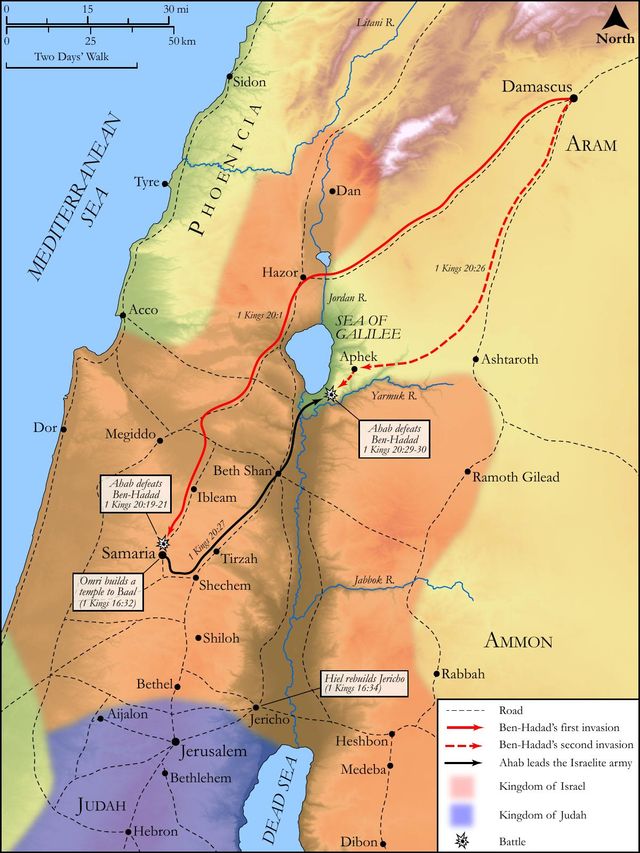
1 Kings 20:18 captures a critical juncture in the second military confrontation between King Ben-hadad of Aram (Syria) and King Ahab of Israel, powerfully illustrating Ben-hadad's strategic hubris and profound overconfidence. As his scouts report movement from the besieged city of Samaria, the Aramean king issues a swift and unequivocal directive: whether the emerging Israelites are a peace delegation or an attacking force, they are to be captured alive. This command reveals Ben-hadad's desire for tactical intelligence, his assertion of absolute dominance, and his persistent underestimation of Israel's God, thereby setting the stage for a divinely orchestrated reversal of fortune.
Context
ShowHideLiterary Context
This verse is deeply embedded within the narrative of 1 Kings 20, which meticulously details two significant military engagements between Aram and Israel. The preceding verses (1 Kings 20:1-21) recount Ben-hadad's initial siege of Samaria, his outrageous demands, and his subsequent humiliating defeat at the hands of a small Israelite force—a victory explicitly attributed to divine intervention. Following this, Ben-hadad's advisors, reflecting a common polytheistic worldview, attribute Israel's success to their God being a "god of the hills" and suggest a battle on the plains (1 Kings 20:23-25). Undeterred by his previous loss and still brimming with arrogance, Ben-hadad gathers an even larger army. Verse 18 occurs just before the second major battle at Aphek, as Ben-hadad's scouts report men emerging from Samaria. His command here is a direct, immediate tactical response to this intelligence, reflecting his unwavering confidence. The subsequent verses (1 Kings 20:29-30) vividly describe the decisive Israelite victory, fulfilling the prophetic word from God (1 Kings 20:28).
Historical & Cultural Context
The kingdoms round about Israel were frequently at war with one another. Kings like Ben-hadad routinely sought to expand their territories, secure trade routes, and exert influence through conquest. Intelligence gathering was a paramount aspect of ancient warfare; capturing prisoners alive was a common and highly effective tactic to extract crucial information regarding enemy troop strength, intentions, fortifications, and supply lines. Such captives could also be exploited for forced labor, utilized as bargaining chips in negotiations, or paraded as a public display of power and dominance. The Aramean belief in "gods of the hills" (1 Kings 20:23) reflects a widespread polytheistic worldview of the era, where deities were often localized and associated with specific geographical regions or natural phenomena. This profound cultural and theological misunderstanding of Yahweh, the God of Israel, as a limited, localized deity, rather than the sovereign Lord of all creation, directly contributed to Ben-hadad's strategic miscalculations and ultimate downfall. The city of Aphek, where this pivotal battle unfolded, was a strategically vital location, controlling access to the fertile Jezreel Valley, thus making it a highly desirable military objective.
Key Themes
ShowHideThe passage in 1 Kings 20:18 contributes significantly to several overarching themes within the book of Kings and the broader biblical narrative. Firstly, it powerfully highlights Divine Sovereignty over Nations and Kings. Despite Ben-hadad's overwhelming military might and sophisticated strategic cunning, the narrative consistently demonstrates that ultimate victory or defeat rests solely with Yahweh, not with human armies or their perceived strength. This truth is explicitly articulated in 1 Kings 20:28, where God declares He will deliver the vast Aramean army into Israel's hand specifically to prove His identity as the Lord. Secondly, the verse vividly exemplifies Human Arrogance and Hubris. Ben-hadad's repeated overconfidence, despite clear divine intervention in his prior defeat, serves as a stark warning about the danger of pride, a theme consistently echoed throughout Scripture, such as in Proverbs 16:18. His command to "take them alive" regardless of their intent reflects a deep-seated belief in his own invincibility and absolute control over the situation. Lastly, the passage underscores the profound theme of God's Faithfulness to His People, even when their king (Ahab) is demonstrably unfaithful. God intervenes not primarily for Ahab's sake, but to uphold His holy name and demonstrate His unparalleled power to both Israel and the surrounding nations.
Exposition and Analysis
ShowHideKey Word Analysis
ShowHideThis is the root verb from which the Piel imperative plural form "תִּפְשׂוּם" (tifsum) is derived. According to H8610, tâphas means "to manipulate, i.e. seize; chiefly to capture, wield, specifically, to overlay; figuratively, to use unwarrantably." In this context, the imperative form conveys a direct, forceful military command to actively apprehend or capture the individuals. The intensity of the verb underscores the urgency and strategic importance Ben-hadad placed on securing these men.
This word (H2416) is defined as "from חָיָה; alive; hence, raw (flesh); fresh (plant, water, year), strong; also (as noun, especially in the feminine singular and masculine plural) life (or living thing), whether literally or figuratively." The plural form "חַיִּים" (chayyim) is used adverbially here, meaning "while living" or "alive." The explicit instruction to take them "alive" is crucial, emphasizing that the objective was not to kill them but to secure them in their living state, highlighting the intelligence-gathering aspect of the command, as dead men yield no information.
This ubiquitous Hebrew word (H7965) is defined as "safe, i.e. (figuratively) well, happy, friendly; also (abstractly) welfare, i.e. health, prosperity, peace." In a military context, it refers to a state of non-aggression, a proposal for a truce, or an offer of surrender. Ben-hadad's inclusion of "peace" as a possibility, alongside "war," demonstrates his readiness to deal with any posture from the Israelites, but always from a position of perceived strength and control, where the ultimate outcome is their capture.
Verse Breakdown
ShowHide"And he said,"
This concise introductory phrase immediately establishes Ben-hadad's authority as the supreme king and military commander. It sets the stage for a pivotal tactical decision, highlighting that this is a direct, authoritative utterance from the leader.
"Whether they be come out for peace, take them alive;"
This clause presents the first of two distinct possibilities for the approaching Israelite contingent. If they are emerging with an offer of peace, implying surrender or negotiation, Ben-hadad's order remains unequivocally to capture them. This reveals his absolute intent to control the terms of any engagement, even diplomatic ones. Capturing a peace delegation would prevent them from returning with intelligence and would serve as a powerful psychological blow, demonstrating the Aramean king's absolute dominance and his refusal to negotiate from a position of anything less than overwhelming superiority.
"or whether they be come out for war, take them alive."
This second clause addresses the alternative scenario: if the Israelites are emerging with the intent to fight. Even in this situation, the command remains precisely the same – capture them alive. This is a highly unusual order for an attacking force, as the primary objective in battle is typically to neutralize or kill the enemy. Ben-hadad's insistence on taking them alive, even if they are a fighting force, further underscores his desire for intelligence (through interrogation), a public display of power (by parading captives), or perhaps even a strategic move to demoralize the Israelite army by showing their leaders or vanguard captured rather than killed. It profoundly reflects his supreme confidence that his forces are so superior that they can easily capture, rather than merely defeat, the enemy.
Literary Devices
ShowHideThe most prominent literary device at play in 1 Kings 20:18 is Repetition, specifically of the phrase "take them alive." This emphatic repetition serves to underscore Ben-hadad's unwavering resolve and the singular, non-negotiable objective of his command. It highlights his strategic priority, which is not merely to defeat the enemy but to utterly dominate them through capture for intelligence or as a display of power. The repetition also subtly emphasizes Ben-hadad's profound Arrogance and overconfidence; he is so certain of victory that the specific intent of the approaching Israelites (peace or war) is rendered irrelevant to his desired outcome. Furthermore, a powerful element of Irony permeates this verse. Ben-hadad's confident command to capture the Israelites alive, regardless of their intent, stands in stark contrast to the divine plan that will soon see his own vast army utterly defeated and himself captured and humiliated by Ahab (1 Kings 20:30-34). This dramatic ironic reversal powerfully underscores the theme of divine sovereignty over human pride and the futility of relying on one's own strength against God's will.
Theological and Thematic Connections
ShowHideThis seemingly simple military command in 1 Kings 20:18 serves as a profound theological statement about the nature of God and the inherent folly of human pride. Ben-hadad's overconfidence, rooted in a limited and erroneous understanding of Yahweh as merely a "god of the hills," leads him to believe he can dictate terms to the God of Israel. His command to "take them alive" is a clear manifestation of his perceived invincibility and absolute control, yet it is precisely this hubris that God intends to shatter. The subsequent narrative powerfully demonstrates that God is not confined by geography or human strategic brilliance; He is the sovereign Lord of all creation, perfectly capable of delivering victory through unconventional means and humbling the most powerful and arrogant of kings. This passage reinforces the timeless biblical truth that God resists the proud but extends abundant grace to the humble, and that true power, wisdom, and ultimate victory belong to Him alone.
Reflection and Application
ShowHideBen-hadad's command in 1 Kings 20:18, born of arrogance and a tragically limited view of God, offers profound and enduring lessons for believers today. In our own lives, we frequently encounter challenges that appear insurmountable, or we might, much like Ben-hadad, become overly confident in our own strategies, resources, or intellectual understanding. This verse serves as a potent reminder of the inherent danger in underestimating the boundless power and absolute sovereignty of God, who consistently works in ways that defy human logic and expectation. It calls us to cultivate a deep sense of humility, encouraging us to recognize that true victory, lasting peace, and genuine security come not from our cleverness or strength, but from wholeheartedly trusting in the Lord, who is indeed the God of both the "hills" and the "valleys"—the God who is sovereign over every circumstance, whether easy or difficult. When we face spiritual battles, personal struggles, or complex societal challenges, our primary response should never be to rely solely on human wisdom or might, but rather to earnestly seek divine guidance and humbly acknowledge God's ultimate control. This narrative powerfully encourages us to surrender our pride and our meticulously crafted plans to Him, resting in the profound assurance that His ways are infinitely higher than ours, and His power is truly limitless.
Questions for Reflection
ShowHideFAQ
ShowHideWhy was Ben-hadad so insistent on taking the Israelites alive, regardless of their intent?
ShowHideBen-hadad's command to "take them alive" stemmed from a combination of strategic and psychological motives, reflecting his overconfidence. Militarily, capturing prisoners alive was a primary method for intelligence gathering in ancient warfare. Interrogation could reveal crucial information about enemy troop strength, fortifications, supply lines, and intentions. Psychologically, parading captured enemy soldiers or delegates, especially from a besieged city, would serve as a powerful demoralizing tactic for the Israelite defenders. It asserted Ben-hadad's absolute dominance and control, demonstrating his perceived ability to not just defeat but utterly subjugate his opponents, even before the main battle began. This command reflects his profound hubris, believing his forces were so superior that capture was a foregone conclusion, whether the Israelites sought peace or war.
What was the outcome of this battle for Ben-hadad and the Arameans?
ShowHideDespite Ben-hadad's immense army and confident command, the outcome was a devastating defeat for the Arameans, a profound reversal of fortune. As prophesied by God through a prophet (1 Kings 20:28), the Israelites, though vastly outnumbered, inflicted a crushing blow. 1 Kings 20:29 states that the Israelites killed 100,000 Aramean foot soldiers in one day. The remaining Aramean forces fled to the city of Aphek, where a wall collapsed on 27,000 more (1 Kings 20:30). Ben-hadad himself was forced to humble himself and seek mercy from Ahab, ultimately being captured (1 Kings 20:31-34). This dramatic reversal powerfully demonstrated God's sovereignty over all nations and His ability to humble the proud.
Christ-Centered Fulfillment
ShowHideThe narrative of Ben-hadad's arrogance and ultimate defeat, despite his strategic cunning and overwhelming military might, serves as a powerful foreshadowing of the ultimate triumph of God's kingdom over all earthly powers and spiritual adversaries through Jesus Christ. Ben-hadad's desire to "take them alive" to assert dominance and gather intelligence pales in comparison to Christ's profound victory, where He willingly laid down His life to conquer sin and death, thereby taking captivity captive and leading a host of captives (Ephesians 4:8). Unlike Ben-hadad, who sought to capture for control and information, Jesus' divine mission was to liberate humanity from the bondage of sin and death. His victory on the cross disarmed the spiritual rulers and authorities, triumphing over them publicly (Colossians 2:15). The pride and miscalculation of earthly kings like Ben-hadad find their ultimate antithesis in the profound humility of Christ, who, though existing in the very nature of God, did not consider equality with God something to be grasped, but emptied Himself, taking the very form of a servant (Philippians 2:6-8). His triumph is not achieved through brute force or strategic capture, but through sacrificial love, resurrection power, and the establishment of an eternal kingdom, securing lasting peace and true freedom for all who believe. The "God of the hills and the valleys" who humbled Ben-hadad is the same sovereign God revealed perfectly in Jesus, the Lamb of God who takes away the sin of the world, whose kingdom is not of this world but will ultimately reign supreme over all creation (John 18:36; Revelation 11:15).