


1 Kings 20:29
Bible text: King James Version (1769 Blayney text) · Public domain
Bible text: King James Version with Strong's numbers · Public domain
Bible text: Berean Standard Bible · Public domain
Bible text: American Standard Version (1901) · Public domain
Bible text: World English Bible, Messianic edition · Public domain
Bible text: Geneva Bible (1599) · Public domain
Bible text: Young's Literal Translation · Public domain
- וַיַּחֲנוּvai·ya·cha·Nuand they encampedH2583Conj-w ¦ V-Qal-ConsecImperf-3mpVerb Qal Consecutive Imperfect 3rd Plural Masculineוַandיַּחֲנוּthey encamped
- אֵלֶּה'E·lehtheseH428PrtParticle Demonstrative
- נֹכַחNo·khachopposite toH5227Adj-mscAdjective Numerical Singular Masculine Construct
- אֵלֶּה'E·lehtheseH428PrtParticle Demonstrative
- שִׁבְעַתshiv·'AtsevenH7651N-cscNoun Singular common gender Construct
- יָמִיםya·MimdaysH3117N-mpNoun Plural Masculine Absolute
- וַיְהִיvay·Hiand it wasH1961Conj-w ¦ V-Qal-ConsecImperf-3msVerb Qal Consecutive Imperfect 3rd Singular Masculineוַandיְהִיit was
- בַּיּוֹםbai·Yomon the dayH3117Prep-b ¦ N-msNoun Singular Masculine Absoluteבַּon theיּוֹםday
- הַשְּׁבִיעִיha·she·vi·'I<the> seventhH7637Art ¦ Adj-msAdjective Numerical Position Singular Masculine Absoluteהַ<the>שְּׁבִיעִיseventh
- וַתִּקְרַבva·tik·Ravand it drew nearH7126Conj-w ¦ V-Qal-ConsecImperf-3fsVerb Qal Consecutive Imperfect 3rd Singular Feminineוַandתִּקְרַבit drew near
- הַמִּלְחָמָהha·mil·cha·Mahthe battleH4421Art ¦ N-fsNoun Singular Feminine Absoluteהַtheמִּלְחָמָהbattle
- וַיַּכּוּvai·ya·Kuand they struck downH5221Conj-w ¦ V-Hiphil-ConsecImperf-3mpVerb Hiphil Consecutive Imperfect 3rd Plural Masculineוַandיַּכּוּthey struck down
- בְנֵיve·nei[the] people ofH1121N-mpcNoun Plural Masculine Construct
- יִשְׂרָאֵלYis·ra·'ElIsraelH3478N-properNoun Proper Location
- אֶת'et<obj.>H853DirObjMParticle Object Indicator
- אֲרָם'a·RamAramH758N-properNoun Proper Location
- מֵאָהme·'ahone hundredH3967N-fsNoun Singular Feminine Absolute
- אֶלֶף'E·lefthousandH505N-csNoun Singular common gender Absolute
- רַגְלִיrag·Lifoot soldier[s]H7273Adj-msAdjective Singular Masculine Absolute
- בְּיוֹםbe·Yomin a dayH3117Prep-b ¦ N-msNoun Singular Masculine Absoluteבְּinיוֹםa day
- אֶחָד'e·ChadoneH259N-fsNoun Singular Feminine Absolute
English is a literal word-by-word gloss of the Hebrew, not the KJV's wording. Why?
This is the original text the KJV's translators worked from — each Hebrew word with its own literal English meaning in this verse, prepared by scholars at Tyndale House, Cambridge. The KJV translates whole sentences, not word by word, so its wording differs: one Hebrew word can become several English words, and the KJV may choose “the LORD” where the gloss reads “Yahweh”. Both are faithful — they answer different questions. For the KJV's own rendering, switch to the KJV text.
Details
See on the biblical-era maps

Study this verse
Public-domain commentary
Matthew Henry
From his Commentary on the Whole Bible. Henry comments on passages, not single verses — this entry covers 1 Kings 20:22–30. His two-level outline is real structure in the source text, so it is rendered as structure.
We have here an account of another successful campaign which Ahab, by divine aid, made against the Syrians, in which he gave them a greater defeat than in the former. Strange! Ahab idolatrous and yet victorious, a persecutor and yet a conqueror! God has wise and holy ends in suffering wicked men to prosper, and glorifies his own name thereby.
I.Ahab is admonished by a prophet to prepare for another war, Kg1 20:22.
It should seem, he was now secure, and looked but a little way before him. Those that are careless of their souls are often as careless of their outwards affairs; but the prophet (to whom God made known the following counsels of the Syrians) told him they would renew their attempt at the return of the year, hoping to retrieve the honour they had lost and be avenged for the blow they had received. He therefore bade him strengthen himself, put himself into a posture of defence, and be ready to give them a warm reception. God had decreed the end, but Ahab must use the means, else he tempts God: "Help thyself, strengthen thyself, and God will help and strengthen thee." The enemies of God's Israel are restless in their malice, and, though they may take some breathing-time for themselves, yet they are still breathing out threatenings and slaughter against the church. It concerns us always to expect assaults from our spiritual enemies, and therefore to mark and see what we do.
II.Ben-hadad is advised by those about him concerning the operations of the next campaign.
1.They advised him to change his ground, Kg1 20:23. They took it for granted that it was not Israel, but Israel's gods, that beat them (so great a regard was then universally had to invisible powers); but they speak very ignorantly of Jehovah - that he was many, whereas he is one and his name one, - that he was their God only, a local deity, peculiar to that nation, whereas he is the Creator and ruler of all the world, - and that he was a God of the hills only, because David their great prophet had said, I will lift up my eyes to the hills whence cometh my help (Psa 121:1), and that his foundation was in the holy mountain (Psa 87:1; Psa 78:54), and much was said of his holy hill (Psa 15:1; Psa 24:3); supposing him altogether such a one as their imaginary deities, they fancied he was confined to his hills, and could not or would not come down from them, and therefore an army in the valley would be below his cognizance and from under his protection. Thus vain were the Gentiles in their imaginations concerning God, so wretchedly were their foolish hearts darkened, and, professing themselves to be wise, they became fools.
2.They advised him to change his officers (Kg1 20:24, Kg1 20:25), not to employ the kings, who were commanders by birth, but captains rather, who were commanders by merit, who were inured to war, would not affect to make a show like the kings, but would go through with business. Let every man be employed in that which he is brought up to and used to, and preferred to that which he is fit for. Syria, it seems, was rich and populous, when it could furnish recruits sufficient, after so great a defeat, horse for horse, chariot for chariot.
III.Both armies take the field.
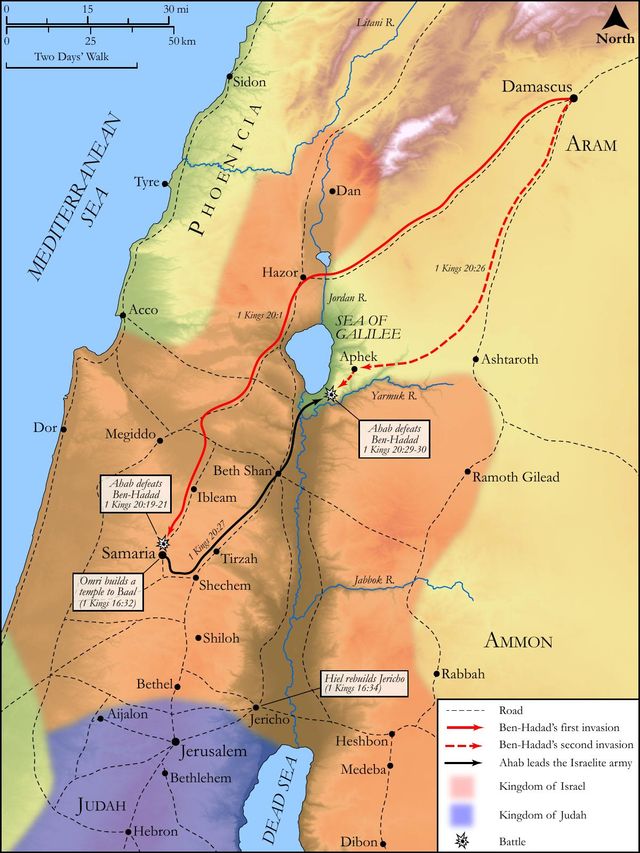
Ben-hadad, with his Syrians, encamps near Aphek, in the tribe of Asher. It is probable that Asher was a city in his own possession, one of those which his father had won (Kg1 20:34), and the country about it was flat and level, and fit for his purpose, Kg1 20:26. Ahab, with his forces, posted himself at some distance over against them, Kg1 20:27. The disproportion of numbers was very remarkable. The children of Israel, who were cantoned in two battalions, looked like two little flocks of kids, their numbers small, their equipage mean, and the figure they made contemptible; but the Syrians filled the country with their numbers, their noise, their chariots, their carriages, and their baggage.
IV.Ahab is encouraged to fight the Syrians, notwithstanding their advantages and confidence.
A man of God is sent to him, to tell him that this numerous army shall all be delivered into his hand (Kg1 20:28), but not for his sake; be it known to him, he is utterly unworthy for whom God will do this. God would not do it because Ahab had praised God or prayed to him (we do not read that he did either), but because the Syrians had blasphemed God, and had said, He is the God of the hills and not of the valleys; therefore God will do it in his own vindication, and to preserve the honour of his own name. If the Syrians had said, "Ahab and his people have forgotten their God, and so put themselves out of his protection, and therefore we may venture to attack them," God would probably have delivered Israel into their hands; but when they go upon a presumption so very injurious to the divine omnipotence, and the honour of him who is Lord of all hosts, not only in hills and valleys, but in heaven and earth, which they are willingly ignorant of, they shall be undeceived, at the expense of that vast army which is so much their pride and confidence.
V.After the armies had faced one another seven days (the Syrians, it is likely, boasting, and the Israelites trembling), they engaged, and the Syrians were totally routed, 100,000 men slain by the sword of Israel in the field of battle (Kg1 20:29), and 27,000 men, that thought themselves safe under the walls of Aphek, a fortified city (from the walls of which the shooters might annoy the enemy if they pursued them, Sa2 11:24), found their bane where they hoped for protection: the wall fell upon them, probably overthrown by an earthquake, and, the cities of Canaan being walled up to heaven, it reached a great way, and they were all killed, or hurt, or overwhelmed with dismay. Ben-hadad, who thought his city Aphek would hold out against the conquerors, finding it thus unwalled, and the remnant of his forces dispirited and dispersed, had nothing but secresy to rely upon for safety, and therefore hid himself in a chamber within a chamber, lest the pursuers should seize him. See how the greatest confidence often ends in the greatest cowardice. "Now is the God of Israel the God of the valleys or no?" He shall know now that he is forced into an inner chamber to hide himself, see Kg1 22:25.
Historical interpretation
Historical reception
3 surviving comments on this verse. Each one is dated, so this reads as a timeline rather than a list.
Select a marker to jump to its quote. Markers stagger vertically where authors wrote within a few decades of each other.
Here the Scripture relates the two battles of the king of Israel against the Arameans, at which we have already hinted, and the twin slaughters of the Arameans, of which the second caused the death of 127, men, as God took his revenge on the impious voice of the Arameans, who said about the true God worshiped by the Israelites, “The Lord is a god of the hills, but he is not a god of the valleys.”
Thus the saints go up to the Lord, the wicked go down to sin; the saints are on the mountains, the guilty in the valleys. “For he is the God of the mountains and not the God of the valleys.” Those who dwelt in the houses of the plain where God does not dwell could not have the house of God within them, for this is the house that God sought from them so that they might build up themselves and rear within themselves the temple of God from living stones of faith. He did not want buildings made with earthen walls or wooden roofs, for the hand of an enemy would have been able to overthrow them. He wanted that temple that is built in human hearts, to whom it might be said, “You are the temple of God,” in which the Lord Jesus might dwell and from there set out to redeem all humankind. There also could be prepared a sacred chamber in the womb of the Virgin where the King of heaven might live and a human body become the temple of God, which, though it was destroyed, might yet be restored to life on the third day.
Did not the Lord wish Ben-hadad, king of Syria, whom besides countless thousands of his own people, thirty-two kings and armies of the same number of kings served, to be conquered by a few foot soldiers of the princes in order that he who was the author of such victory would be acknowledged?
Continue studying 1 Kings 20:29 across the web’s major study libraries — every link below opens this exact verse, chapter, or book on the destination site.
Read & Compare
 BibleGatewayThis verse in more than 200 translations and 70 languages.
 Bible.comThe YouVersion reader — hundreds of translations, reading plans, and highlights.
 ESV.orgCrossway's official English Standard Version reader.
 NET BibleThe NET translation with 60,000+ translators' notes on every rendering decision.
 STEP BibleTyndale House's free study tool — original text, vocabulary, and scholarly resources.
 BibliaLogos Bible Software's free web reader.
 USCCBThe New American Bible (Revised Edition) with the U.S. bishops' study notes.
Commentaries
 BibleHub CommentariesDozens of classic commentaries on this verse, gathered on one page.
 StudyLightMore than 100 commentary sets — the largest collection on the web.
 BibleRefPlain-English commentary on what this verse means, verse by verse.
 Enduring WordDavid Guzik's free commentary on this chapter, widely used by Bible teachers.
 Bible Study ToolsVerse commentary alongside Greek and Hebrew study aids.
Original Language & Research
- BibleHub InterlinearThe verse word by word — original language, transliteration, and English.
- BibleHub LexiconEvery word's original-language definition and Strong's entry.
 Blue Letter BibleDeep-study tools — Strong's numbers, concordance, and word studies.
 SefariaThe Hebrew text with Rashi and centuries of Jewish commentary.
Sermons, Hymns & Audio


TrulyRandomVerse is not affiliated with these sites and doesn’t control their content. They’re linked because they’re genuinely useful.
Summary
This verse encapsulates the dramatic and decisive climax of the second military confrontation between King Ahab's northern kingdom of Israel and the Aramean forces led by King Ben-Hadad. After a strategic and tense seven-day encampment where the opposing armies stood in a standoff, the battle was finally joined on the divinely appointed seventh day. This engagement culminated in an overwhelming and miraculous victory for Israel, marked by the staggering defeat of one hundred thousand Syrian infantrymen in a single day, a clear demonstration of God's universal sovereignty and power.
Context
ShowHideLiterary Context
1 Kings 20:29 serves as the powerful culmination of the second major military encounter between Israel and Aram (Syria) within 1 Kings 20. The narrative immediately preceding this verse details Ben-Hadad's arrogant demands and his initial, surprising defeat in an earlier skirmish. Following this, Ben-Hadad's advisors, in their limited theological understanding, attributed Israel's victory to their God being merely a "god of the hills," suggesting that a battle fought on a plain would yield a different outcome (1 Kings 20:23). In direct response to this blasphemous and geographically constrained view of divine power, a prophet of the Lord explicitly declared God's intention to deliver the vast Syrian army into Ahab's hand, stating, "that ye may know that I am the LORD" (1 Kings 20:28). Thus, the seven-day standoff and the subsequent overwhelming victory described in 1 Kings 20:29 are presented as the direct, undeniable fulfillment of this divine promise, emphatically demonstrating God's universal sovereignty and His power to humble those who defy Him.
Historical & Cultural Context
The historical setting for this conflict is the ongoing struggle for regional dominance between the burgeoning kingdom of Israel and the powerful Aramean kingdom of Damascus. Ben-Hadad II was a formidable opponent, and the implied scale of his forces (suggested by the presence of 32 kings in 1 Kings 20:1) indicates a significant threat to Israelite autonomy. The Syrian belief in "gods of the hills" (1 Kings 20:23) reflects a pervasive polytheistic worldview among the nations, where deities were often associated with specific geographical territories, natural phenomena, or even particular cities. This cultural understanding made the battle's location in the plain of Aphek particularly significant; it was a direct challenge to the Syrians' theological framework, allowing the Lord to unequivocally demonstrate His absolute power over all creation, not just the mountainous regions of Israel. The seven-day period of encampment before battle was a common practice in ancient warfare, allowing for strategic positioning, psychological maneuvering, and often, the seeking of omens or divine favor before a major engagement.
Key Themes
ShowHideThe primary theme powerfully underscored by 1 Kings 20:29 is the universal sovereignty and omnipresence of God. This verse serves as a dramatic refutation of the limited, territorial understanding of God held by the Syrians, proving that the Lord is not confined to specific terrains or human expectations but exercises absolute dominion over all creation, whether hills or plains, as explicitly stated in 1 Kings 20:28. Closely related is the theme of divine intervention and the fulfillment of prophecy, as the overwhelming victory is a direct, miraculous act of God, precisely as foretold by His prophet. This intervention serves to vindicate God's name and reveal His true identity ("that ye may know that I am the LORD") to both Israel and their pagan enemies, affirming His uniqueness among all deities. Finally, the sheer scale and overwhelming nature of the victory highlight God's unparalleled ability to deliver His people decisively against seemingly insurmountable odds, demonstrating His unmatched power and unwavering commitment to His covenant.
Exposition and Analysis
ShowHideKey Word Analysis
ShowHideThis verb signifies "to incline," and by implication, "to decline (of the slanting rays of evening)," but specifically, "to pitch a tent," or generally, "to encamp (for abode or siege)." In this context, it describes the strategic deployment of the two armies, setting up camp "one over against the other," signifying a tense standoff and readiness for conflict. It implies not just physical presence but a deliberate positioning for a decisive engagement.
And H3117 respectively. Shebaʻ refers to the number seven, often carrying symbolic weight in biblical narratives, denoting completeness, perfection, or divine appointment. Yôwm refers to a day, whether literal (from sunrise to sunset or sunset to sunset) or figurative (a space of time). Here, the "seven days" of standoff is not merely a chronological detail but suggests a divinely ordained period of waiting, perhaps for God to fully prepare the hearts of His people or to allow the Syrians to fully commit to their blasphemous challenge, before His judgment was unleashed. It marks the appointed time for God's plan to unfold.
This term specifically refers to infantry soldiers or those who travel on foot, distinguishing them from cavalry or charioteers. The emphasis on "footmen" highlights the ground troops, underscoring the massive scale of the direct, hand-to-hand combat and the immense human cost of the Syrian defeat. The sheer number—one hundred thousand—emphasizes the devastating and comprehensive nature of Israel's divinely assisted victory, focusing on the common soldier who bore the brunt of the battle.
Verse Breakdown
ShowHide"And they pitched one over against the other seven days."
This opening clause sets the scene for the impending conflict, depicting the two opposing armies, Israel and Aram, encamped in direct confrontation. The phrase "one over against the other" conveys a sense of intense tension and strategic readiness. The "seven days" signifies a period of deliberate waiting, not merely a random duration, but a divinely appointed interval, building anticipation for the climactic event.
"And [so] it was, that in the seventh day the battle was joined"
This phrase marks the precise moment of engagement and the climax of the standoff. The repetition of "seventh day" emphatically underscores the divine timing of the battle, highlighting that this was not accidental but a pre-ordained moment for God's intervention. The battle was "joined," meaning the armies clashed in full-scale combat, initiating the decisive conflict that had been building for a week. This emphasizes the direct fulfillment of God's promise to deliver the Syrians.
"and the children of Israel slew of the Syrians an hundred thousand footmen in one day."
This final clause reveals the staggering and overwhelming outcome of the battle. The scale of the Syrian losses—a hundred thousand infantrymen (H7273 raglî)—is immense, emphasizing the devastating and comprehensive nature of Israel's victory. The phrase "in one day" highlights the swiftness and decisiveness of the divine intervention, leaving no doubt that this was not merely a human triumph but a miraculous and divinely orchestrated act of God's power, designed to humble the arrogant and reveal His universal sovereignty.
Literary Devices
ShowHideThe narrative of 1 Kings 20:29 employs several powerful literary devices to convey its profound theological message. The most prominent is Symbolism, particularly evident in the "seven days" standoff and the battle commencing "in the seventh day." The number seven, frequently associated with divine completeness, perfection, and covenant in biblical numerology, emphasizes that this was not a random occurrence but a divinely appointed moment for God's judgment and a clear demonstration of His power. The staggering number of casualties, "an hundred thousand footmen," functions as Hyperbole or Exaggeration (even if literally true, the emphasis is on the overwhelming scale), underscoring the devastating and decisive nature of the victory, which can only be attributed to supernatural intervention rather than mere human military prowess. This dramatic outcome also serves as a powerful Contrast to the earlier Syrian arrogance and their limited, territorial view of God, highlighting His boundless and universal sovereignty. The entire account is framed as an act of Divine Intervention, where God's explicit promise in 1 Kings 20:28 is literally and dramatically fulfilled, showcasing His direct involvement in human affairs and His unwavering commitment to defending His name and revealing His identity.
Theological and Thematic Connections
ShowHide1 Kings 20:29 profoundly illustrates God's absolute sovereignty and His unchallengeable power over all creation and all human endeavors. This victory serves as a tangible refutation of any notion that God's authority is limited by geography, human strategy, or the strength of opposing forces. It is a powerful demonstration that the Lord is the God of both the hills and the valleys, actively involved in the affairs of nations to accomplish His purposes and vindicate His name. The overwhelming nature of the victory underscores His ability to deliver His people against seemingly insurmountable odds, reinforcing the theme of divine faithfulness to covenant promises, even when His people, like King Ahab, are far from perfect in their obedience. This passage reminds us that God's power is not constrained by human understanding or limitations, but is boundless and effective in bringing about His will.
Reflection and Application
ShowHideThe dramatic account in 1 Kings 20:29 offers profound encouragement and a vital theological lesson for believers today. Just as God decisively intervened to demonstrate His boundless sovereignty over the plains of Aphek, refuting the limited understanding of His power, so too does He remain sovereign over every circumstance, challenge, and perceived limitation in our lives. This passage calls us to cultivate an unshakeable faith in God's universal dominion, recognizing that His power is not constrained by our circumstances, our weaknesses, or the formidable nature of our adversaries. It reminds us that when we face "giants" or seemingly insurmountable odds, our trust must be placed not in our own strength or strategy, but in the God who can deliver an overwhelming victory in a single day. This divine intervention serves as a timeless testament to God's unwavering control, His commitment to defending His name, and His ultimate triumph over all opposition. We are called to live with the confidence that the God of the hills is also the God of the valleys, and indeed, the God of all creation, actively working on behalf of His people.
Questions for Reflection
ShowHideFAQ
ShowHideWhy did the battle take place on the seventh day?
ShowHideThe timing of the battle on the seventh day is highly significant, reflecting a common biblical motif where the number seven denotes completeness, divine appointment, or the culmination of a divine plan. It suggests that the seven-day standoff was not merely a random period of waiting but a divinely ordained interval, preparing for God's decisive intervention. This timing underscores that the victory was not accidental or purely human-driven, but a precise fulfillment of God's promise to demonstrate His sovereignty and humble the arrogant Syrians, as declared in 1 Kings 20:28. It emphasizes the Lord's control over time and events.
Was the number "one hundred thousand" a literal count or a symbolic exaggeration?
ShowHideWhile ancient casualty counts can sometimes be hyperbolic to emphasize the scale of a victory, the biblical text presents "one hundred thousand footmen" as a literal and staggering number of Syrian casualties. The purpose of recording such a precise and immense figure is to underscore the miraculous and overwhelming nature of Israel's victory, which could only have been achieved through direct divine intervention. It serves to highlight God's power to defeat a vastly superior enemy in a single day, leaving no doubt that the Lord, not human military might, was responsible for the triumph, directly refuting the Syrian's limited view of God's power in 1 Kings 20:23. The sheer scale magnifies the divine hand at work.
Christ-Centered Fulfillment
ShowHideThe decisive victory recounted in 1 Kings 20:29, where God overwhelmingly defeats Israel's enemies in a single day, powerfully foreshadows the ultimate and final victory achieved by Jesus Christ. Just as God demonstrated His universal sovereignty over all terrains and powers, so Christ, the true King of Israel and the Son of God, demonstrated His absolute dominion over sin, death, and the forces of darkness. The "seventh day" motif, signifying completion and divine appointment, finds its ultimate fulfillment in Christ's finished work on the cross, where He declared, "It is finished!" and secured a decisive, eternal victory over all spiritual adversaries. His resurrection on the first day of the week, following the "seventh day" of rest in the tomb, inaugurates a new creation and a new era of overwhelming triumph for all who believe, fulfilling the prophecies of a new covenant (Jeremiah 31:31-34). The slaughter of one hundred thousand footmen pales in comparison to the spiritual victory won by the Lamb of God, who takes away the sin of the world, a victory that frees humanity from the bondage of sin and death, offering eternal life and a share in His glorious reign (Revelation 5:9-10). This Old Testament battle, therefore, serves as a powerful type, pointing to the greater, eternal triumph of Christ, whose single sacrifice secured a victory far more profound and lasting than any earthly conquest, establishing His kingdom that will never end (Daniel 7:14 and Luke 1:33).