


1 Kings 20:1
Bible text: King James Version (1769 Blayney text) · Public domain
Bible text: King James Version with Strong's numbers · Public domain
Bible text: Berean Standard Bible · Public domain
Bible text: American Standard Version (1901) · Public domain
Bible text: World English Bible, Messianic edition · Public domain
Bible text: Geneva Bible (1599) · Public domain
Bible text: Young's Literal Translation · Public domain
- וּבֶןu·venand BenH1130Conj-w ¦ N-proper-mNoun Proper MasculineוּandבֶןBen
- הֲדַדha·DadHadadH1130N-proper-mNoun Proper Masculine
- מֶלֶךְMe·lekh[the] king ofH4428N-mscNoun Singular Masculine Construct
- אֲרָם'a·RamAramH758N-properNoun Proper Location
- קָבַץka·Vatzhe gatheredH6908V-Qal-Perf-3msVerb Qal Perfect 3rd Singular Masculine
- אֶת'et<obj.>H853DirObjMParticle Object Indicator
- כָּלkolallH3605N-mscNoun Singular Masculine Construct
- חֵילוֹchei·Lohis armyH2428N-msc ¦ 3msNoun Singular Masculine Constructחֵילarmyוֹhis
- וּשְׁלֹשִׁיםu·she·lo·Shimand thirtyH7970Conj-w ¦ N-mpNoun Plural Masculine Absoluteוּandשְׁלֹשִׁיםthirty
- וּשְׁנַיִםu·she·Na·yimand twoH8147Conj-w ¦ N-cdNoun Dual common gender Absoluteוּandשְׁנַיִםtwo
- מֶלֶךְMe·lekhking[s]H4428N-msNoun Singular Masculine Absolute
- אִתּוֹ'i·To[were] with himH854Prep ¦ 3msPrepositionאִתּ[were] withוֹhim
- וְסוּסve·Susand horse[s]H5483Conj-w ¦ N-msNoun Singular Masculine Absoluteוְandסוּסhorse[s]
- וָרָכֶבva·Ra·khevand chariotryH7393Conj-w ¦ N-msNoun Singular Masculine Absoluteוָandרָכֶבchariotry
- וַיַּעַלvai·Ya·'aland he went upH5927Conj-w ¦ V-Qal-ConsecImperf-3msVerb Qal Consecutive Imperfect 3rd Singular Masculineוַandיַּעַלhe went up
- וַיָּצַרvai·Ya·tzarand he laid siegeH6696Conj-w ¦ V-Qal-ConsecImperf-3msVerb Qal Consecutive Imperfect 3rd Singular Masculineוַandיָּצַרhe laid siege
- עַל'alonH5921PrepPreposition
- שֹׁמְרוֹןsho·me·RonSamariaH8111N-properNoun Proper Location
- וַיִּלָּחֶםvai·yi·La·chemand he foughtH3898Conj-w ¦ V-Niphal-ConsecImperf-3msVerb Niphal Consecutive Imperfect 3rd Singular Masculineוַandיִּלָּחֶםhe fought
- בָּהּBahagainst itPrep-b ¦ 3fsSuffix Personal 3rd Singular Feminineבָּagainstהּit
English is a literal word-by-word gloss of the Hebrew, not the KJV's wording. Why?
This is the original text the KJV's translators worked from — each Hebrew word with its own literal English meaning in this verse, prepared by scholars at Tyndale House, Cambridge. The KJV translates whole sentences, not word by word, so its wording differs: one Hebrew word can become several English words, and the KJV may choose “the LORD” where the gloss reads “Yahweh”. Both are faithful — they answer different questions. For the KJV's own rendering, switch to the KJV text.
Details
See on the biblical-era maps

Study this verse
Public-domain commentary
Matthew Henry
From his Commentary on the Whole Bible. Henry comments on passages, not single verses — this entry covers 1 Kings 20:1–11. His three-level outline is real structure in the source text, so it is rendered as structure.
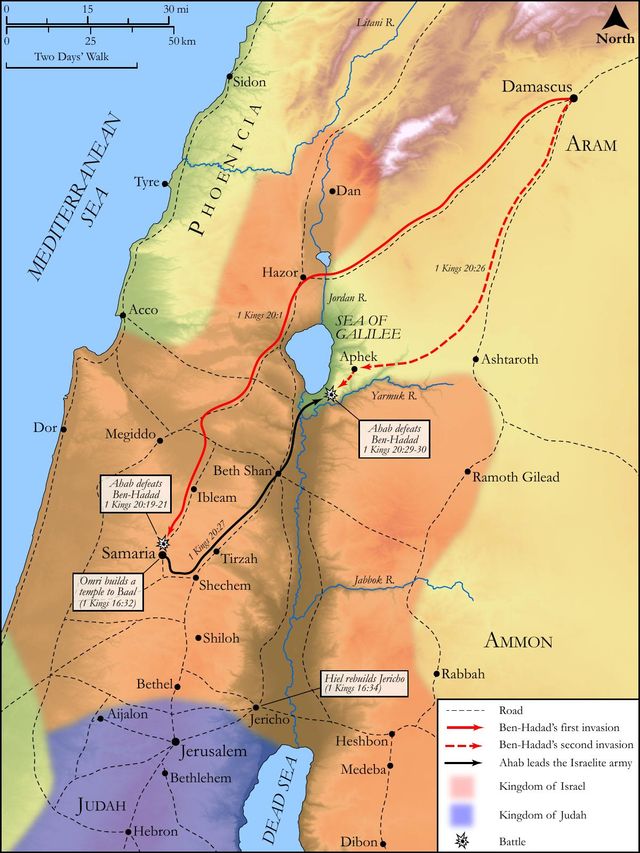
Here is, I. The threatening descent which Ben-hadad made upon Ahab's kingdom, and the siege he laid to Samaria, his royal city, Kg1 20:1. What the ground of the quarrel was we are not told; covetousness and ambition were the principle, which would never want some pretence or other. David in his time had quite subdued the Syrians and made them tributaries to Israel, but Israel's apostasy from God makes them formidable again. Asa had tempted the Syrians to invade Israel once (Kg1 15:18-20), and now they did it of their own accord. It is dangerous bringing a foreign force into the country: posterity may pay dearly for it. Ben-hadad had with him thirty-two kings, who were either tributaries to him, and bound in duty to attend him, or confederates with him, and bound in interest to assist him. How little did the title of king look when all these poor petty governors pretended to it!
II.The treaty between these two kings.
Surely Israel's defence had departed from them, or else the Syrians could not have marched so readily, and with so little opposition, to Samaria, the head and heart of the country, a city lately built, and therefore, we may suppose, not well fortified, but likely to fall quickly into the hands of the invaders; both sides are aware of this, and therefore,
1.Ben-hadad's proud spirit sends Ahab a very insolent demand, Kg1 20:2, Kg1 20:3. A parley is sounded, and a trumpeter (we may suppose) is sent into the city, to let Ahab know that he will raise the siege upon condition that Ahab become his vassal (Nay, his villain), and not only pay him a tribute out of what he has, but make over his title to Ben-hadad, and hold all at his will, even his wives and children, the godliest of them. The manner of expression is designed to gall them; "All shall be mine, without exception."
2.Ahab's poor spirit sends Ben-hadad a very disgraceful submission. It is general indeed (he cannot mention particulars in his surrender with so much pleasure as Ben-hadad did in his demand), but it is effectual: I am thine, and all that I have, Kg1 20:4. See the effect of sin.
(1.)If he had not by sin provoked God to depart from him, Ben-hadad could not have made such a demand. Sin brings men into such straits, by putting them out of divine protection. If God may not rule us, our enemies shall. A rebel to God is a slave to all besides. Ahab had prepared his silver and gold for Baal, Hos 2:8. Justly therefore is it taken from him; such an alienating amounts to a forfeiture.
(2.)If he had not by sin wronged his own conscience, and set that against him, he could not have made such a mean surrender. Guilt dispirits men, and makes them cowards. He knew Baal could not help, and had no reason to think that God would, and therefore was content to buy his life upon any terms. Skin for skin, and all that is dear to him, he will give for it; he will rather live a beggar than not die a prince.
3.Ben-hadad's proud spirit rises upon his submission, and becomes yet more insolent and imperious, Kg1 20:5, Kg1 20:6. Ahab had laid his all at his feet, at his mercy, expecting that one king would use another generously, that this acknowledgment of Ben-hadad's sovereignty would content him, the honour was sufficient for the present, and he might hereafter make use of it if he saw cause (Satis est prostrasse leoni - It suffices the lion to have laid his victim prostrate); but this will not serve.
(1.)Ben-hadad is as covetous as he is proud, and cannot go away unless he have the possession as well as the dominion. He thinks it not enough to call it his, unless he have it in his hands. He will not so much as lend Ahab the use of his own goods above a day longer.
(2.)He is as spiteful as he is haughty. Had he come himself to select what he had a mind for, it would have shown some respect to a crowned head; but he will send his servants to insult the prince, and hector over him, to rifle the palace, and strip it of all its ornaments; nay, to give Ahab the more vexation, they shall be ordered, not only to take what they please, but, if they can learn which are the persons or things that Ahab is in a particular manner fond of, to take those: Whatsoever is pleasant in thy eyes they shall take away. We are often crossed in that which we most dote upon; and that proves least safe which is most dear.
(3.)He is as unreasonable as he is unjust, and will construe the surrender Ahab made for himself as made for all his subjects too, and will have them also to lie at his mercy: "They shall search, not only thy house, but the houses of thy servants too, and plunder them at discretion." Blessed be God for peace and property, and that what we have we can call our own.
4.Ahab's poor spirit begins to rise too, upon this growing insolence; and, if it becomes not bold, yet it becomes desperate, and he will rather hazard his life than give up all thus.
(1.)How he takes advice of his privy-council, who encourage him to stand it out. He speaks but poorly (Kg1 20:7), appeals to them whether Ben-hadad be not an unreasonable enemy, and do not seek mischief. What else could he expect from one who, without any provocation given him, had invaded his country and besieged his capital city? He owns to them how he had truckled to him before, and will have them advise him what he should do in this strait; and they speak bravely (Hearken not to him, nor consent, Kg1 20:8), promising no doubt to stand by him in the refusal.
(2.)Yet he expresses himself very modestly in his denial, Kg1 20:9. He owns Ben-hadad's dominion over him: "Tell my lord the king I have no design to affront him, nor to receded from the surrender I have already made; what I offered at first I will stand to, but this thing I may not do; I must not give what is none of my own." It was a mortification to Ben-hadad that even such an abject spirit as Ahab's durst deny him; yet it should seem, by his manner of expressing himself, that he durst not have done it if his people had not animated him.
5.Ben-hadad proudly swears the ruin of Samaria. The threatening waves of his wrath, meeting with this check, rage and foam, and make a noise. In his fury, he imprecates the impotent revenge of his gods, if the dust of Samaria serve for handfuls for his army (Kg1 20:10), so numerous, so resolute, an army will be bring into the field against Samaria, and so confident is he of their success; it will be done as easily as the taking up of a handful of dust; all shall be carried away, even the ground on which the city stands. Thus confident is his pride, thus cruel is his malice; this prepares him to be ruined, though such a prince and such a people are unworthy of the satisfaction of seeing him ruined.
6.Ahab sends him a decent rebuke to his assurance, dares not defy his menaces, only reminds him of the uncertain turns of war (Kg1 20:11): "Let not him that begins a war, and is girding on his sword, his armour, his harness, boast of victory, or think himself sure of it, as if he had put it off, and had come home a conqueror." This was one of the wisest words that ever Ahab spoke, and is a good item or momento to us all; it is folly to boast beforehand of any day, since we know not what it may bring forth (Pro 27:1), but especially to boast of a day of battle, which may prove as much against us as we promise ourselves it will be for us. It is impolitic to despise an enemy, and to be too sure of victory is the way to be beaten. Apply it to our spiritual conflicts. Peter fell by his confidence. While we are here we are but girding on the harness, and therefore must never boast as though we had put it off. Happy is the man that feareth always, and is never off his watch.
Continue studying 1 Kings 20:1 across the web’s major study libraries — every link below opens this exact verse, chapter, or book on the destination site.
Read & Compare
 BibleGatewayThis verse in more than 200 translations and 70 languages.
 Bible.comThe YouVersion reader — hundreds of translations, reading plans, and highlights.
 ESV.orgCrossway's official English Standard Version reader.
 NET BibleThe NET translation with 60,000+ translators' notes on every rendering decision.
 STEP BibleTyndale House's free study tool — original text, vocabulary, and scholarly resources.
 BibliaLogos Bible Software's free web reader.
 USCCBThe New American Bible (Revised Edition) with the U.S. bishops' study notes.
Commentaries
 BibleHub CommentariesDozens of classic commentaries on this verse, gathered on one page.
 StudyLightMore than 100 commentary sets — the largest collection on the web.
 BibleRefPlain-English commentary on what this verse means, verse by verse.
 Enduring WordDavid Guzik's free commentary on this chapter, widely used by Bible teachers.
 Bible Study ToolsVerse commentary alongside Greek and Hebrew study aids.
Original Language & Research
- BibleHub InterlinearThe verse word by word — original language, transliteration, and English.
- BibleHub LexiconEvery word's original-language definition and Strong's entry.
 Blue Letter BibleDeep-study tools — Strong's numbers, concordance, and word studies.
 SefariaThe Hebrew text with Rashi and centuries of Jewish commentary.
Sermons, Hymns & Audio


TrulyRandomVerse is not affiliated with these sites and doesn’t control their content. They’re linked because they’re genuinely useful.
Summary
First Kings 20:1 dramatically opens a new phase in the narrative of King Ahab's reign, depicting an overwhelming military assault on Samaria, the capital of the Northern Kingdom of Israel. It introduces Ben-Hadad, the powerful king of Aram (Syria), leading a vast coalition of thirty-two kings, supported by a formidable array of horses and chariots, as he initiates a full-scale siege and war against the strategically vital city. This verse immediately establishes the immense threat facing Israel, setting the stage for a profound exploration of divine intervention, human leadership, and the dynamics of regional power.
Context
ShowHideLiterary Context
This verse marks a significant shift in the book of 1 Kings. Chapters 17-19 primarily focused on the prophet Elijah's ministry, confronting King Ahab and the nation over their idolatry, particularly the worship of Baal. The narrative moved from drought and famine to dramatic contests on Mount Carmel and Elijah's flight. Chapter 20, beginning with this verse, pivots to external threats and military conflict, demonstrating that Israel's challenges were not solely internal or spiritual. It sets up a series of interactions between Ahab and Ben-Hadad, revealing God's continued involvement in Israel's affairs, even amidst the unfaithfulness of its king, and foreshadows the complex relationship between Israel and Aram throughout the subsequent chapters of Kings. The events described here directly precede God's surprising deliverance of Samaria and Ahab's controversial decision regarding Ben-Hadad, which will have long-term consequences for his reign as seen in 1 Kings 20:42.
Historical & Cultural Context
The mid-9th century BCE, during which King Ahab reigned (c. 874-853 BCE), was a period of intense political flux among the nations round about Israel. Aram, with its capital at Damascus, was a rising regional power, often clashing with Israel for control of trade routes and fertile territories. Ben-Hadad II (likely the king mentioned here, as distinct from his father, Ben-Hadad I, who warred with Asa in 1 Kings 15:18), was a formidable ruler who commanded significant influence over surrounding city-states and smaller kingdoms, evidenced by the "thirty and two kings" who accompanied him. This number signifies a vast coalition of rulers, chieftains, or governors who served him, not necessarily independent monarchs, all contributing their forces. Horses and chariots represented the pinnacle of ancient military technology, symbolizing overwhelming power and mobility, akin to modern armored divisions. Samaria itself, built by Ahab's father Omri (1 Kings 16:24), was a relatively new capital, strategically located on a defensible hill, but its very existence as a symbol of Israelite sovereignty made it a prime target for rival powers.
Key Themes
ShowHideThe immediate themes emerging from this verse include Overwhelming Odds and Human Vulnerability. The sheer scale of Ben-Hadad's forces—a massive coalition backed by cutting-edge military technology—presents an almost insurmountable challenge to Israel, highlighting the precariousness of their position in the geopolitical landscape. This sets up the subsequent narrative to explore the theme of Divine Sovereignty and Intervention, as God's power will be demonstrated to be far superior to any human military might, even that of a vast confederacy, echoing themes of divine deliverance found in passages like Psalm 33:16-17. Furthermore, the siege of Samaria underscores the Consequences of National Unfaithfulness, as external threats often served as a divine chastisement or a test for Israel, even if the immediate cause was geopolitical rivalry, as warned in Deuteronomy 28:49-52. The verse also subtly introduces the theme of Leadership Under Pressure, as King Ahab's character and faith will be severely tested in the face of this existential threat, similar to other kings facing crises, such as Hezekiah in 2 Kings 19.
Exposition and Analysis
ShowHideKey Word Analysis
ShowHideThis name, meaning "son of Hadad," refers to a common dynastic name among Aramean kings, indicating their devotion to the storm god Hadad. The specific Ben-Hadad here is widely identified as Ben-Hadad II, a powerful monarch of Aram-Damascus, known from both biblical and extra-biblical sources. His name evokes a legacy of military prowess and regional dominance, immediately signaling a formidable adversary for Israel.
While often translated as "host" or "army," chayil carries a broader semantic range, encompassing "strength," "wealth," "valor," and "military force." In this context, it emphasizes not just the number of soldiers, but the collective might, resources, and formidable power of Ben-Hadad's entire military apparatus, including his coalition of kings, horses, and chariots. It conveys the overwhelming nature of the force assembled.
A primitive root meaning "to feed on" or "to consume," this word figuratively implies "to battle" or "to destroy." In this context, "warred against it" signifies the aggressive, destructive intent of Ben-Hadad's forces. It goes beyond a mere siege, indicating active combat and the intention to overcome and devastate Samaria, emphasizing the severity and brutality of the conflict.
Verse Breakdown
ShowHide"¶ And Benhadad the king of Syria gathered all his host together"
This opening clause immediately identifies the aggressor and his nationality, Aram (Syria), a long-standing rival of Israel. The act of "gathering all his host together" signifies a deliberate, organized, and comprehensive military mobilization, indicating a full-scale invasion rather than a mere skirmish. The use of "all" emphasizes the totality of his military power being brought to bear, highlighting the complete commitment to this offensive.
"and [there were] thirty and two kings with him, and horses, and chariots"
This part elaborates on the composition and strength of Ben-Hadad's "host." The presence of "thirty and two kings" underscores the vastness of his coalition, demonstrating his widespread influence and the formidable manpower he could command. These "kings" were likely rulers or chieftains who served him. The mention of "horses, and chariots" highlights the advanced military technology at his disposal. Chariots were the most potent offensive weapon of that day, capable of devastating charges, and their presence signifies a highly equipped, modern army prepared for decisive engagement. This detail paints a picture of overwhelming, superior force, designed to intimidate and overpower.
"and he went up and besieged Samaria, and warred against it."
This final clause describes the immediate objective and action. "Went up" suggests an ascent, as Samaria was built on a defensible hill. "Besieged Samaria" indicates a sustained military blockade, aiming to cut off supplies and force surrender through attrition. This was a common and brutal form of ancient warfare, designed to starve out the inhabitants. The phrase "and warred against it" confirms the aggressive intent and the initiation of active hostilities, setting the stage for the dramatic and desperate events of the chapter.
Literary Devices
ShowHideThe verse employs several powerful Literary Devices to convey the gravity of the situation. Hyperbole is evident in the mention of "thirty and two kings," which, while perhaps literally true of rulers who served him, serves to emphasize the overwhelming and seemingly insurmountable scale of the invading force. This creates a strong sense of Foreshadowing, hinting at the immense challenge Israel faces and setting the stage for a dramatic display of divine power, as only an extraordinary intervention could overcome such odds. The vivid Imagery of a vast army, complete with the cutting-edge technology of "horses, and chariots," immediately establishes the formidable nature of the threat. This imagery evokes fear and desperation, highlighting the extreme vulnerability of Samaria. Furthermore, the verse uses Contrast implicitly, setting the stage for a later demonstration of God's power against this formidable human might, underscoring that true victory does not depend on military superiority but on divine intervention.
Theological and Thematic Connections
ShowHideThis initial depiction of overwhelming external threat serves as a powerful theological statement about God's sovereignty over nations and His people's reliance on Him. Even when Israel's leadership, personified by Ahab, is deeply flawed and unfaithful, God remains actively involved in their history, often using external pressures to bring His purposes to pass, to test their faith, or to demonstrate His power. The seemingly insurmountable odds presented by Ben-Hadad's vast coalition underscore the truth that human strength and strategic alliances are ultimately insufficient against the will of God. This narrative arc, beginning with such a dire situation, sets up a profound lesson in divine deliverance, reminding us that God's ability to save is not limited by the magnitude of the enemy or the weakness of His people. He can turn the tide of battle, even against the most formidable adversaries, revealing His glory and faithfulness.
Reflection and Application
ShowHideThe scene set in 1 Kings 20:1 resonates deeply with the human experience of facing overwhelming challenges. Just as Samaria was besieged by a seemingly unstoppable force, we often encounter "sieges" in our lives—whether they are financial crises, health battles, relational conflicts, or spiritual attacks. This verse reminds us that such moments are not new to God's people. The sheer scale of Ben-Hadad's army was designed to instill fear and despair, much like the "hosts" of problems that can surround us. However, the subsequent narrative of 1 Kings 20 reveals that God's power is not constrained by human limitations or the size of our adversaries. It encourages us to look beyond the visible strength of our enemies and to remember that our ultimate security and deliverance come from a source far greater than any earthly power. It challenges us to consider where we place our trust when the odds seem stacked against us, prompting us to lean into divine sovereignty rather than despair in human weakness. This narrative serves as a powerful reminder that even in our darkest hours, when all seems lost, God remains capable of miraculous intervention, turning the tide in ways we cannot foresee.
Questions for Reflection
ShowHideFAQ
ShowHideWho was Ben-Hadad, and what was his significance?
ShowHideBen-Hadad was the king of Aram (Syria), with his capital in Damascus. The Ben-Hadad mentioned in 1 Kings 20:1 is generally identified as Ben-Hadad II, a powerful and aggressive monarch who frequently clashed with the Northern Kingdom of Israel during the reign of King Ahab. His significance lies in his role as a major regional power and a formidable adversary to Israel, often used by God as an instrument of judgment or a catalyst for demonstrating divine deliverance. His military campaigns, including the siege of Samaria, are pivotal events in the history of Aram and Israel and in the biblical narrative, highlighting the constant external pressures faced by God's people, as also seen in later conflicts involving Aram, such as those described in 2 Kings 8:7-15.
What was the significance of "thirty and two kings" accompanying Ben-Hadad?
ShowHideThe "thirty and two kings" indicates a massive and formidable coalition, not necessarily thirty-two independent monarchs of equal standing. Rather, these were likely rulers who served Ben-Hadad, local chieftains, or governors of smaller cities and territories under his hand. They were compelled to contribute their own troops and resources to his campaign. This detail underscores the vast extent of Ben-Hadad's political and military influence, demonstrating the overwhelming numerical and material superiority of his forces. It emphasizes the dire and seemingly hopeless situation that Samaria and Israel faced, highlighting the immense power of their adversary and the unprecedented nature of this combined assault on the Israelite capital.
Why was Samaria so important, and why was it besieged?
ShowHideSamaria was the capital city of the Northern Kingdom of Israel, established by King Omri (1 Kings 16:24). Its importance stemmed from its strategic location on a defensible hill, making it a strong fortress and a symbol of Israelite sovereignty and power. As the capital, it housed the royal palace and was a center of administration and commerce. Ben-Hadad besieged Samaria because capturing the capital city was a common military objective in ancient warfare, aiming to crush the enemy's leadership, break their will to resist, and gain control over the entire kingdom. The siege was a direct challenge to Israel's independence and a bid for regional dominance by Aram, reflecting the strategic importance of key cities in ancient warfare, as also seen in the siege of Jerusalem by Sennacherib in 2 Kings 18-19.
Christ-Centered Fulfillment
ShowHideThe overwhelming siege of Samaria by Ben-Hadad's vast host, while a historical event, powerfully foreshadows the spiritual "siege" that humanity faces from the forces of sin, death, and the devil. Just as the thirty-two kings represented a formidable, seemingly insurmountable coalition, so too do the spiritual enemies of humanity appear overwhelming and inescapable. Yet, the narrative of 1 Kings 20, which begins with this dire threat, ultimately points to a divine deliverance that transcends human military might. This deliverance finds its ultimate and perfect fulfillment in Jesus Christ. He is the true King who confronts the ultimate "host" of darkness, not with chariots and horses, but with the power of His sacrificial love and resurrection. The Lamb of God, who takes away the sin of the world, faced the full onslaught of spiritual adversaries on the cross, enduring the "siege" of hell itself, and emerged victorious, triumphing over principalities and powers (Colossians 2:15). Through His death and resurrection, Christ has broken the power of sin and death, offering true and lasting deliverance to all who believe. His kingdom, though not of this world (John 18:36), provides refuge and ultimate victory against all spiritual enemies, demonstrating that God's power to save far exceeds any earthly or spiritual foe, offering eternal freedom from the ultimate siege of sin and death (Romans 8:37-39). He is the one who ultimately delivers His people from every spiritual adversary, securing an eternal victory that no earthly army could achieve, as promised in Revelation 19:11-16.