


1 Kings 20:2
Bible text: King James Version (1769 Blayney text) · Public domain
Bible text: Berean Standard Bible · Public domain
Bible text: American Standard Version (1901) · Public domain
Bible text: World English Bible, Messianic edition · Public domain
Bible text: Geneva Bible (1599) · Public domain
Bible text: Young's Literal Translation · Public domain
- וַיִּשְׁלַחvai·yish·Lachand he sentH7971Conj-w ¦ V-Qal-ConsecImperf-3msVerb Qal Consecutive Imperfect 3rd Singular Masculineוַandיִּשְׁלַחhe sent
- וַיֹּאמֶרvai·Yo·merand he saidH559Conj-w ¦ V-Qal-ConsecImperf-3msVerb Qal Consecutive Imperfect 3rd Singular Masculineוַandיֹּאמֶרhe said
- מַלְאָכִיםmal·'a·KhimmessengersH4397N-mpNoun Plural Masculine Absolute
- לוֹloto himPrep-l ¦ 3msSuffix Personal 3rd Singular Masculineלtoוֹhim
- אֶל'eltoH413PrepPreposition
- כֹּהkohthusH3541AdvAdverb
- אַחְאָב'ach·'AvAhabH256N-proper-mNoun Proper Masculine
- אָמַר'a·Marhe saysH559V-Qal-Perf-3msVerb Qal Perfect 3rd Singular Masculine
- מֶלֶךְMe·lekh[the] king ofH4428N-mscNoun Singular Masculine Construct
- בֶּןbenBenH1130N-proper-mNoun Proper Masculine
- יִשְׂרָאֵלYis·ra·'ElIsraelH3478N-properNoun Proper Location
- הֲדַדha·DadHadadH1130N-proper-mNoun Proper Masculine
- הָעִירָהha·'I·rahthe city towardsH5892Art ¦ N-fs ¦ SfxNoun Singular Feminine Absoluteהָtheעִירָcityהtowards
English is a literal word-by-word gloss of the Hebrew, not the KJV's wording. Why?
This is the original text the KJV's translators worked from — each Hebrew word with its own literal English meaning in this verse, prepared by scholars at Tyndale House, Cambridge. The KJV translates whole sentences, not word by word, so its wording differs: one Hebrew word can become several English words, and the KJV may choose “the LORD” where the gloss reads “Yahweh”. Both are faithful — they answer different questions. For the KJV's own rendering, switch to the KJV text.
Details
See on the biblical-era maps

Study this verse
Public-domain commentary
Matthew Henry
From his Commentary on the Whole Bible. Henry comments on passages, not single verses — this entry covers 1 Kings 20:1–11. His three-level outline is real structure in the source text, so it is rendered as structure.
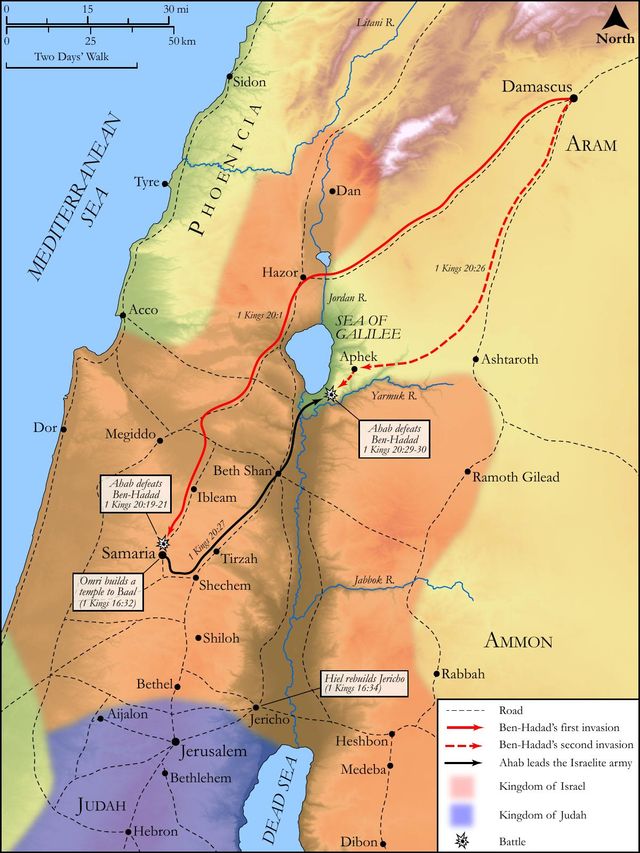
Here is, I. The threatening descent which Ben-hadad made upon Ahab's kingdom, and the siege he laid to Samaria, his royal city, Kg1 20:1. What the ground of the quarrel was we are not told; covetousness and ambition were the principle, which would never want some pretence or other. David in his time had quite subdued the Syrians and made them tributaries to Israel, but Israel's apostasy from God makes them formidable again. Asa had tempted the Syrians to invade Israel once (Kg1 15:18-20), and now they did it of their own accord. It is dangerous bringing a foreign force into the country: posterity may pay dearly for it. Ben-hadad had with him thirty-two kings, who were either tributaries to him, and bound in duty to attend him, or confederates with him, and bound in interest to assist him. How little did the title of king look when all these poor petty governors pretended to it!
II.The treaty between these two kings.
Surely Israel's defence had departed from them, or else the Syrians could not have marched so readily, and with so little opposition, to Samaria, the head and heart of the country, a city lately built, and therefore, we may suppose, not well fortified, but likely to fall quickly into the hands of the invaders; both sides are aware of this, and therefore,
1.Ben-hadad's proud spirit sends Ahab a very insolent demand, Kg1 20:2, Kg1 20:3. A parley is sounded, and a trumpeter (we may suppose) is sent into the city, to let Ahab know that he will raise the siege upon condition that Ahab become his vassal (Nay, his villain), and not only pay him a tribute out of what he has, but make over his title to Ben-hadad, and hold all at his will, even his wives and children, the godliest of them. The manner of expression is designed to gall them; "All shall be mine, without exception."
2.Ahab's poor spirit sends Ben-hadad a very disgraceful submission. It is general indeed (he cannot mention particulars in his surrender with so much pleasure as Ben-hadad did in his demand), but it is effectual: I am thine, and all that I have, Kg1 20:4. See the effect of sin.
(1.)If he had not by sin provoked God to depart from him, Ben-hadad could not have made such a demand. Sin brings men into such straits, by putting them out of divine protection. If God may not rule us, our enemies shall. A rebel to God is a slave to all besides. Ahab had prepared his silver and gold for Baal, Hos 2:8. Justly therefore is it taken from him; such an alienating amounts to a forfeiture.
(2.)If he had not by sin wronged his own conscience, and set that against him, he could not have made such a mean surrender. Guilt dispirits men, and makes them cowards. He knew Baal could not help, and had no reason to think that God would, and therefore was content to buy his life upon any terms. Skin for skin, and all that is dear to him, he will give for it; he will rather live a beggar than not die a prince.
3.Ben-hadad's proud spirit rises upon his submission, and becomes yet more insolent and imperious, Kg1 20:5, Kg1 20:6. Ahab had laid his all at his feet, at his mercy, expecting that one king would use another generously, that this acknowledgment of Ben-hadad's sovereignty would content him, the honour was sufficient for the present, and he might hereafter make use of it if he saw cause (Satis est prostrasse leoni - It suffices the lion to have laid his victim prostrate); but this will not serve.
(1.)Ben-hadad is as covetous as he is proud, and cannot go away unless he have the possession as well as the dominion. He thinks it not enough to call it his, unless he have it in his hands. He will not so much as lend Ahab the use of his own goods above a day longer.
(2.)He is as spiteful as he is haughty. Had he come himself to select what he had a mind for, it would have shown some respect to a crowned head; but he will send his servants to insult the prince, and hector over him, to rifle the palace, and strip it of all its ornaments; nay, to give Ahab the more vexation, they shall be ordered, not only to take what they please, but, if they can learn which are the persons or things that Ahab is in a particular manner fond of, to take those: Whatsoever is pleasant in thy eyes they shall take away. We are often crossed in that which we most dote upon; and that proves least safe which is most dear.
(3.)He is as unreasonable as he is unjust, and will construe the surrender Ahab made for himself as made for all his subjects too, and will have them also to lie at his mercy: "They shall search, not only thy house, but the houses of thy servants too, and plunder them at discretion." Blessed be God for peace and property, and that what we have we can call our own.
4.Ahab's poor spirit begins to rise too, upon this growing insolence; and, if it becomes not bold, yet it becomes desperate, and he will rather hazard his life than give up all thus.
(1.)How he takes advice of his privy-council, who encourage him to stand it out. He speaks but poorly (Kg1 20:7), appeals to them whether Ben-hadad be not an unreasonable enemy, and do not seek mischief. What else could he expect from one who, without any provocation given him, had invaded his country and besieged his capital city? He owns to them how he had truckled to him before, and will have them advise him what he should do in this strait; and they speak bravely (Hearken not to him, nor consent, Kg1 20:8), promising no doubt to stand by him in the refusal.
(2.)Yet he expresses himself very modestly in his denial, Kg1 20:9. He owns Ben-hadad's dominion over him: "Tell my lord the king I have no design to affront him, nor to receded from the surrender I have already made; what I offered at first I will stand to, but this thing I may not do; I must not give what is none of my own." It was a mortification to Ben-hadad that even such an abject spirit as Ahab's durst deny him; yet it should seem, by his manner of expressing himself, that he durst not have done it if his people had not animated him.
5.Ben-hadad proudly swears the ruin of Samaria. The threatening waves of his wrath, meeting with this check, rage and foam, and make a noise. In his fury, he imprecates the impotent revenge of his gods, if the dust of Samaria serve for handfuls for his army (Kg1 20:10), so numerous, so resolute, an army will be bring into the field against Samaria, and so confident is he of their success; it will be done as easily as the taking up of a handful of dust; all shall be carried away, even the ground on which the city stands. Thus confident is his pride, thus cruel is his malice; this prepares him to be ruined, though such a prince and such a people are unworthy of the satisfaction of seeing him ruined.
6.Ahab sends him a decent rebuke to his assurance, dares not defy his menaces, only reminds him of the uncertain turns of war (Kg1 20:11): "Let not him that begins a war, and is girding on his sword, his armour, his harness, boast of victory, or think himself sure of it, as if he had put it off, and had come home a conqueror." This was one of the wisest words that ever Ahab spoke, and is a good item or momento to us all; it is folly to boast beforehand of any day, since we know not what it may bring forth (Pro 27:1), but especially to boast of a day of battle, which may prove as much against us as we promise ourselves it will be for us. It is impolitic to despise an enemy, and to be too sure of victory is the way to be beaten. Apply it to our spiritual conflicts. Peter fell by his confidence. While we are here we are but girding on the harness, and therefore must never boast as though we had put it off. Happy is the man that feareth always, and is never off his watch.
Continue studying 1 Kings 20:2 across the web’s major study libraries — every link below opens this exact verse, chapter, or book on the destination site.
Read & Compare
 BibleGatewayThis verse in more than 200 translations and 70 languages.
 Bible.comThe YouVersion reader — hundreds of translations, reading plans, and highlights.
 ESV.orgCrossway's official English Standard Version reader.
 NET BibleThe NET translation with 60,000+ translators' notes on every rendering decision.
 STEP BibleTyndale House's free study tool — original text, vocabulary, and scholarly resources.
 BibliaLogos Bible Software's free web reader.
 USCCBThe New American Bible (Revised Edition) with the U.S. bishops' study notes.
Commentaries
 BibleHub CommentariesDozens of classic commentaries on this verse, gathered on one page.
 StudyLightMore than 100 commentary sets — the largest collection on the web.
 BibleRefPlain-English commentary on what this verse means, verse by verse.
 Enduring WordDavid Guzik's free commentary on this chapter, widely used by Bible teachers.
 Bible Study ToolsVerse commentary alongside Greek and Hebrew study aids.
Original Language & Research
- BibleHub InterlinearThe verse word by word — original language, transliteration, and English.
- BibleHub LexiconEvery word's original-language definition and Strong's entry.
 Blue Letter BibleDeep-study tools — Strong's numbers, concordance, and word studies.
 SefariaThe Hebrew text with Rashi and centuries of Jewish commentary.
Sermons, Hymns & Audio


TrulyRandomVerse is not affiliated with these sites and doesn’t control their content. They’re linked because they’re genuinely useful.
Summary
First Kings 20:2 serves as the pivotal introduction to a significant military and theological confrontation between the northern kingdom of Israel, under the reign of the notoriously wicked King Ahab, and the formidable Aramean (Syrian) kingdom, led by King Ben-hadad. This verse meticulously details Ben-hadad's initial diplomatic overture, delivered through his authoritative messengers to Ahab in Samaria, which is not a mere request but an imposing and non-negotiable declaration: "Thus saith Benhadad." This authoritative pronouncement immediately sets the stage for a series of events that will profoundly test Ahab's leadership, expose the volatile standing of Israel among the nations round about, and ultimately illuminate God's sovereign hand in the affairs of nations, even amidst the profound disobedience of His chosen people.
Context
ShowHideLiterary Context
First Kings 20:2 immediately follows the intense narrative arc of Elijah's prophetic ministry, which culminated in chapter 19 with the anointing of Elisha as his successor. While the preceding chapters meticulously chronicled the spiritual battle between Yahweh and Baal, primarily through Elijah's dramatic prophetic acts and confrontations, chapter 20 abruptly shifts the narrative focus back to the political and military challenges confronting Ahab's Israel. This verse acts as the inciting incident for the war between Israel and Aram, initiating a series of events that detail Ben-hadad's audacious demands and Ahab's initial, ill-advised capitulation. This initial human response stands in stark contrast to God's subsequent, surprising intervention. The entire chapter, commencing with this verse, provides a crucial test of Ahab's leadership and Israel's reliance on God in a national crisis, thereby setting the stage for the remarkable divine intervention described later in the chapter, where a prophet declares God's promise of victory in 1 Kings 20:13.
Historical & Cultural Context
During this period of Israel's history, the northern kingdom, with its capital in Samaria (established by Omri, Ahab's father), had grown into a significant regional power. However, it was frequently embroiled in conflicts with its powerful neighbor to the northeast, Aram (Syria), whose capital was Damascus. Ben-hadad, likely Ben-hadad II, was a formidable Aramean king known for his military prowess and expansionist ambitions. The act of sending messengers with a demanding message, rather than immediately launching a full-scale invasion, was a common diplomatic maneuver among the kings of that day. It served as a formal declaration of hostile intent, an assertion of dominance, and an opportunity for the weaker party to submit without a costly battle, often backed by an overwhelming military presence just outside the city. The phrase "Thus saith Benhadad" deliberately mimics the authoritative pronouncements of kings or even prophets, underscoring the non-negotiable nature of his demands and his perceived superiority over Ahab.
Key Themes
ShowHideThis verse introduces several profound themes that will be extensively developed throughout 1 Kings 20. Firstly, it starkly highlights the assertion of power and dominance by a foreign king over Israel, thereby setting up a critical test of Israel's national strength and its divine protection. Secondly, it immediately establishes the overarching theme of impending conflict and divine deliverance, as Ben-hadad's audacious challenge necessitates a response that will ultimately reveal God's absolute sovereignty over the affairs of nations, even when Israel's king is as profoundly wicked as Ahab, who did more evil than all who were before him. Thirdly, the verse subtly introduces the critical theme of leadership and discernment, as Ahab's character and decision-making will be critically examined in his response to Ben-hadad's demands, contrasting sharply with the divine wisdom that God offers through His prophets.
Exposition and Analysis
ShowHideKey Word Analysis
ShowHideThis name literally translates to "son of Hadad." Hadad was the preeminent storm and fertility god worshipped by the Arameans (Syrians), functionally equivalent to the Canaanite Baal. The very name of the Aramean king signifies the pervasive pagan religious backdrop of the Syrian kingdom and underscores the fundamental clash between the worship of Yahweh in Israel (however corrupted by Baal worship under Ahab) and the polytheistic deities of surrounding nations.
More than mere envoys or diplomatic couriers, these "messengers" (the same Hebrew word often used for angels or prophets) carried an inherently authoritative and often intimidating message directly from the king. Their official presence signified a formal, weighty, and non-negotiable declaration, demanding immediate attention and a decisive response, often with the implicit, palpable threat of overwhelming military force if the demands were not met.
This is the root verb from which the KJV "saith" is derived, forming part of the formal, authoritative declaration formula "Thus saith." This precise phrase is frequently employed throughout the Old Testament for divine pronouncements ("Thus says the LORD") or for solemn royal decrees. When used by Ben-hadad, it asserts his absolute authority and the non-negotiable nature of his demands, framing his words as an unchallengeable edict rather than a mere proposal or request.
Verse Breakdown
ShowHide"And he sent messengers"
The anonymous subject "he" refers unequivocally to Ben-hadad, the King of Aram. The deliberate act of sending messengers, rather than immediately initiating direct military action, indicates a calculated preliminary phase of diplomacy, albeit one explicitly designed to intimidate and extract submission without the immediate necessity of a direct military confrontation. It represents a shrewd, calculated move to assert dominance and test the resolve of his adversary.
"to Ahab king of Israel"
This clause precisely specifies the direct target of Ben-hadad's audacious demands, highlighting the personal challenge from one reigning monarch to another. It profoundly underscores the high-stakes nature of the impending confrontation, involving not just territories but the sovereignty, dignity, and political standing of both kingdoms and their respective rulers.
"into the city"
This refers specifically to Samaria, which was the strategically important capital city of the northern kingdom of Israel, originally established by Omri, Ahab's father. Sending messengers directly into the very heart of the capital city was a profound act of psychological warfare, a direct and audacious challenge to Ahab's seat of power and the symbolic heart of his kingdom, designed to maximize intimidation and pressure.
"and said unto him, Thus saith Benhadad,"
This final, climactic clause introduces the core content of Ben-hadad's message, emphatically emphasizing its inherently authoritative and non-negotiable nature. The formula "Thus saith Benhadad" is a declaration of absolute will, demanding immediate and unquestioning compliance and unequivocally asserting Ben-hadad's perceived superior status and dominance over King Ahab.
Literary Devices
ShowHideFirst Kings 20:2 masterfully employs Foreshadowing, immediately signaling the impending and significant military conflict between Israel and Aram, a conflict that will profoundly dominate the entire chapter's narrative. The verse also utilizes Juxtaposition, implicitly contrasting the pagan king's forceful "Thus saith Benhadad" with the ultimate and true "Thus saith the LORD," which will later be delivered by a prophet to Ahab, thereby highlighting the ultimate source of all true authority and power. The narrative technique of In Medias Res is powerfully evident, as the chapter opens directly with this confrontation, plunging the reader into the midst of rising international tensions without extensive preliminary setup, thereby significantly enhancing the dramatic impact and immediacy of the unfolding events. Furthermore, there is a palpable element of Dramatic Irony, as the discerning reader, already aware of God's overarching sovereignty and Ahab's well-documented character flaws, anticipates that Ahab's initial response to this audacious demand will be inadequate and ill-advised, and that divine intervention will ultimately be the decisive factor shaping the outcome.
Theological and Thematic Connections
ShowHideFirst Kings 20:2, though seemingly a straightforward narrative setup for a military conflict, carries profound theological weight and implications. It serves as a stark and enduring reminder of the constant spiritual and geopolitical pressures faced by God's covenant people in a fallen and hostile world. Ben-hadad's assertive declaration underscores the overarching theme of God's absolute sovereignty over all earthly rulers and nations, even pagan ones who do not acknowledge Him. This initial demand functions as a critical test for King Ahab, revealing his profound lack of discernment, his willingness to compromise under pressure, and his inherent spiritual weakness, thereby setting the stage for God's surprising and gracious intervention on behalf of His covenant people, despite their king's profound unfaithfulness. It powerfully illustrates that God's divine plan meticulously unfolds even through the pride and machinations of human kings and the complex conflicts of nations, ultimately demonstrating His omnipotent power to deliver and His unwavering faithfulness to His redemptive purposes.
Reflection and Application
ShowHideLife frequently presents us with unexpected and often overwhelming demands, challenges, or even direct threats, much like Ben-hadad's audacious and intimidating message to King Ahab. These pressures can manifest from external circumstances, difficult relationships, professional crises, or even intense spiritual opposition. This verse profoundly reminds us that our initial response to such pressures is critically important and reveals much about our core character and where our trust truly lies. Ahab's immediate reaction (which is detailed in the subsequent verses of the chapter) demonstrates a significant lack of wisdom, a profound inclination to appease rather than to seek divine counsel, and an inability to stand firm in faith. For us, this narrative highlights the profound and enduring importance of discernment, fervent prayer, and an unwavering reliance on God's wisdom when we are faced with seemingly overwhelming demands. Instead of succumbing to fear, panic, or purely human reasoning, we are called to remember God's ultimate and absolute sovereignty over all earthly powers and circumstances, trusting implicitly that He is actively at work even in the most challenging and daunting situations, perfectly capable of delivering us or graciously guiding us through them according to His perfect will.
Questions for Reflection
ShowHideFAQ
ShowHideWho was Ben-hadad?
ShowHideBen-hadad was the powerful and formidable king of Aram (Syria), a significant neighboring kingdom to Israel, with its capital city located in Damascus. His name, meaning "son of Hadad," refers to the prominent Aramean storm god, highlighting the pervasive pagan religious context of his rule. He was a significant and recurring adversary to Israel, frequently engaging in conflicts and consistently asserting his dominance over the region during this period.
Why did Ben-hadad send messengers instead of attacking directly?
ShowHideSending messengers with such a demanding message was a common and highly effective diplomatic and psychological tactic employed among the kings of that day. It served multiple strategic purposes: to formally declare intentions and specific demands, to assert dominance without immediate bloodshed, and to provide the weaker party with an opportunity to capitulate and thus avoid a potentially costly and destructive war. It was a calculated show of force and an intimidation tactic meticulously designed to secure submission before engaging in full-scale military action.
What does "Thus saith Benhadad" signify?
ShowHideThis phrase is a formal, highly authoritative declaration formula, mirroring the solemn style of royal decrees or even prophetic pronouncements ("Thus says the LORD"). When used by Ben-hadad, it unequivocally underscores his absolute authority and the non-negotiable nature of his demands. It signifies that his words are not open for negotiation or debate but are an unchallengeable edict, asserting his perceived superior status and demanding immediate and unquestioning obedience from King Ahab.
Christ-Centered Fulfillment
ShowHideFirst Kings 20:2, with Ben-hadad's audacious and intimidating assertion of power over King Ahab, provides a compelling and insightful backdrop for understanding the ultimate kingship and absolute authority of Jesus Christ. Earthly kings like Ben-hadad wielded only temporary and limited power, issuing decrees from their earthly thrones, but their "Thus saith" pales in comparison to the eternal and absolute authority of the King of kings and Lord of lords. While Ahab's profound weakness and willingness to compromise are starkly highlighted in his initial response to Ben-hadad's demands, Christ embodies perfect strength, unwavering resolve, and divine authority in the face of all opposition. The surprising divine intervention that ultimately delivers Israel in 1 Kings 20 powerfully foreshadows the ultimate and decisive deliverance achieved by Christ. He is the true and ultimate deliverer who confronts not merely an earthly king, but the powers of sin, death, and the devil themselves. His "Thus saith" carries the immeasurable weight of divine creation, providential sustenance, and eternal redemption, as profoundly seen in His authoritative teachings (e.g., Matthew 5:22) and His miraculous power over disease and demons (Mark 1:27). Through His sacrificial death on the cross and His glorious resurrection, Christ triumphed decisively over all principalities and powers (Colossians 2:15), disarming them and leading captivity captive. He is the Lamb of God who takes away the sin of the world (John 1:29), and simultaneously the Lion of Judah who conquers all adversaries, establishing a kingdom that is not of this world (John 18:36) yet will ultimately and eternally prevail over every earthly dominion and authority.