


1 Kings 20:3
- כַּסְפְּךָkas·pe·Khayour silverH3701N-msc ¦ 2msNoun Singular Masculine Constructכַּסְפְּsilverךָyour
- וּזְהָבְךָu·ze·ha·ve·Khaand your goldH2091Conj-w ¦ N-msc ¦ 2msNoun Singular Masculine Constructוּandזְהָבְgoldךָyour
- לִיli[belongs] to mePrep-l ¦ 1csSuffix Personal 1st Singular common genderלִ[belongs] toיme
- הוּאHu'itH1931Pro-3msPronoun Personal 3rd Singular Masculine
- וְנָשֶׁיךָve·na·Shei·khaand your wivesH802Conj-w ¦ N-mpc ¦ 2msNoun Plural Masculine Constructוְandנָשֶׁיwivesךָyour
- וּבָנֶיךָu·va·Nei·khaand your childrenH1121Conj-w ¦ N-mpc ¦ 2msNoun Plural Masculine Constructוּandבָנֶיchildrenךָyour
- הַטּוֹבִיםha·to·Vim<the> goodH2896Art ¦ Adj-mpAdjective Plural Masculine Absoluteהַ<the>טּוֹבִיםgood
- לִיli[belong] to mePrep-l ¦ 1csSuffix Personal 1st Singular common genderלִ[belong] toיme
- הֵםHemtheyH1992Pro-3mpPronoun Personal 3rd Plural Masculine
English is a literal word-by-word gloss of the Hebrew, not the KJV's wording. Why?
This is the original text the KJV's translators worked from — each Hebrew word with its own literal English meaning in this verse, prepared by scholars at Tyndale House, Cambridge. The KJV translates whole sentences, not word by word, so its wording differs: one Hebrew word can become several English words, and the KJV may choose “the LORD” where the gloss reads “Yahweh”. Both are faithful — they answer different questions. For the KJV's own rendering, switch to the KJV text.
Details
See on the biblical-era map
Study this verse
Public-domain commentary
Matthew Henry
From his Commentary on the Whole Bible. Henry comments on passages, not single verses — this entry covers 1 Kings 20:1–11. His three-level outline is real structure in the source text, so it is rendered as structure.
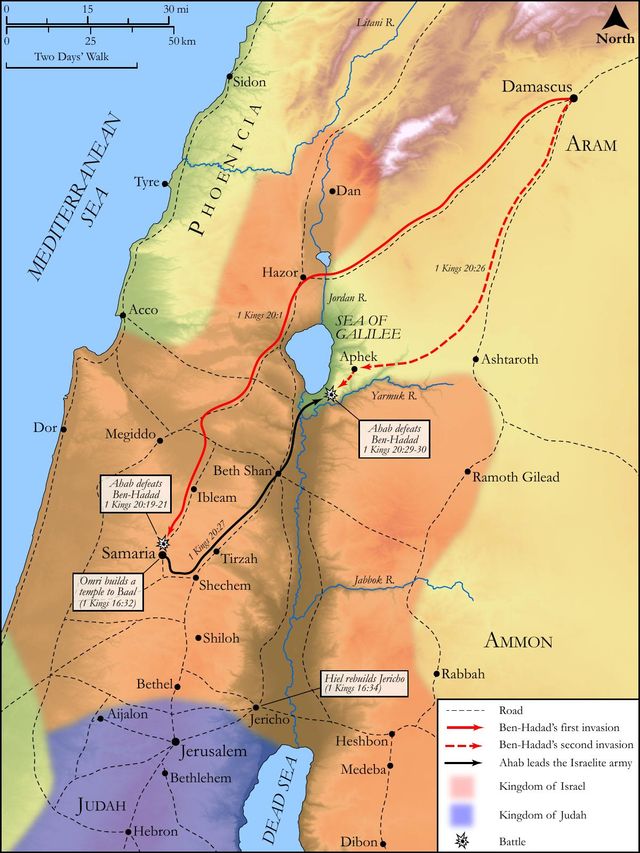
Here is, I. The threatening descent which Ben-hadad made upon Ahab's kingdom, and the siege he laid to Samaria, his royal city, Kg1 20:1. What the ground of the quarrel was we are not told; covetousness and ambition were the principle, which would never want some pretence or other. David in his time had quite subdued the Syrians and made them tributaries to Israel, but Israel's apostasy from God makes them formidable again. Asa had tempted the Syrians to invade Israel once (Kg1 15:18-20), and now they did it of their own accord. It is dangerous bringing a foreign force into the country: posterity may pay dearly for it. Ben-hadad had with him thirty-two kings, who were either tributaries to him, and bound in duty to attend him, or confederates with him, and bound in interest to assist him. How little did the title of king look when all these poor petty governors pretended to it!
II.The treaty between these two kings.
Surely Israel's defence had departed from them, or else the Syrians could not have marched so readily, and with so little opposition, to Samaria, the head and heart of the country, a city lately built, and therefore, we may suppose, not well fortified, but likely to fall quickly into the hands of the invaders; both sides are aware of this, and therefore,
1.Ben-hadad's proud spirit sends Ahab a very insolent demand, Kg1 20:2, Kg1 20:3. A parley is sounded, and a trumpeter (we may suppose) is sent into the city, to let Ahab know that he will raise the siege upon condition that Ahab become his vassal (Nay, his villain), and not only pay him a tribute out of what he has, but make over his title to Ben-hadad, and hold all at his will, even his wives and children, the godliest of them. The manner of expression is designed to gall them; "All shall be mine, without exception."
2.Ahab's poor spirit sends Ben-hadad a very disgraceful submission. It is general indeed (he cannot mention particulars in his surrender with so much pleasure as Ben-hadad did in his demand), but it is effectual: I am thine, and all that I have, Kg1 20:4. See the effect of sin.
(1.)If he had not by sin provoked God to depart from him, Ben-hadad could not have made such a demand. Sin brings men into such straits, by putting them out of divine protection. If God may not rule us, our enemies shall. A rebel to God is a slave to all besides. Ahab had prepared his silver and gold for Baal, Hos 2:8. Justly therefore is it taken from him; such an alienating amounts to a forfeiture.
(2.)If he had not by sin wronged his own conscience, and set that against him, he could not have made such a mean surrender. Guilt dispirits men, and makes them cowards. He knew Baal could not help, and had no reason to think that God would, and therefore was content to buy his life upon any terms. Skin for skin, and all that is dear to him, he will give for it; he will rather live a beggar than not die a prince.
3.Ben-hadad's proud spirit rises upon his submission, and becomes yet more insolent and imperious, Kg1 20:5, Kg1 20:6. Ahab had laid his all at his feet, at his mercy, expecting that one king would use another generously, that this acknowledgment of Ben-hadad's sovereignty would content him, the honour was sufficient for the present, and he might hereafter make use of it if he saw cause (Satis est prostrasse leoni - It suffices the lion to have laid his victim prostrate); but this will not serve.
(1.)Ben-hadad is as covetous as he is proud, and cannot go away unless he have the possession as well as the dominion. He thinks it not enough to call it his, unless he have it in his hands. He will not so much as lend Ahab the use of his own goods above a day longer.
(2.)He is as spiteful as he is haughty. Had he come himself to select what he had a mind for, it would have shown some respect to a crowned head; but he will send his servants to insult the prince, and hector over him, to rifle the palace, and strip it of all its ornaments; nay, to give Ahab the more vexation, they shall be ordered, not only to take what they please, but, if they can learn which are the persons or things that Ahab is in a particular manner fond of, to take those: Whatsoever is pleasant in thy eyes they shall take away. We are often crossed in that which we most dote upon; and that proves least safe which is most dear.
(3.)He is as unreasonable as he is unjust, and will construe the surrender Ahab made for himself as made for all his subjects too, and will have them also to lie at his mercy: "They shall search, not only thy house, but the houses of thy servants too, and plunder them at discretion." Blessed be God for peace and property, and that what we have we can call our own.
4.Ahab's poor spirit begins to rise too, upon this growing insolence; and, if it becomes not bold, yet it becomes desperate, and he will rather hazard his life than give up all thus.
(1.)How he takes advice of his privy-council, who encourage him to stand it out. He speaks but poorly (Kg1 20:7), appeals to them whether Ben-hadad be not an unreasonable enemy, and do not seek mischief. What else could he expect from one who, without any provocation given him, had invaded his country and besieged his capital city? He owns to them how he had truckled to him before, and will have them advise him what he should do in this strait; and they speak bravely (Hearken not to him, nor consent, Kg1 20:8), promising no doubt to stand by him in the refusal.
(2.)Yet he expresses himself very modestly in his denial, Kg1 20:9. He owns Ben-hadad's dominion over him: "Tell my lord the king I have no design to affront him, nor to receded from the surrender I have already made; what I offered at first I will stand to, but this thing I may not do; I must not give what is none of my own." It was a mortification to Ben-hadad that even such an abject spirit as Ahab's durst deny him; yet it should seem, by his manner of expressing himself, that he durst not have done it if his people had not animated him.
5.Ben-hadad proudly swears the ruin of Samaria. The threatening waves of his wrath, meeting with this check, rage and foam, and make a noise. In his fury, he imprecates the impotent revenge of his gods, if the dust of Samaria serve for handfuls for his army (Kg1 20:10), so numerous, so resolute, an army will be bring into the field against Samaria, and so confident is he of their success; it will be done as easily as the taking up of a handful of dust; all shall be carried away, even the ground on which the city stands. Thus confident is his pride, thus cruel is his malice; this prepares him to be ruined, though such a prince and such a people are unworthy of the satisfaction of seeing him ruined.
6.Ahab sends him a decent rebuke to his assurance, dares not defy his menaces, only reminds him of the uncertain turns of war (Kg1 20:11): "Let not him that begins a war, and is girding on his sword, his armour, his harness, boast of victory, or think himself sure of it, as if he had put it off, and had come home a conqueror." This was one of the wisest words that ever Ahab spoke, and is a good item or momento to us all; it is folly to boast beforehand of any day, since we know not what it may bring forth (Pro 27:1), but especially to boast of a day of battle, which may prove as much against us as we promise ourselves it will be for us. It is impolitic to despise an enemy, and to be too sure of victory is the way to be beaten. Apply it to our spiritual conflicts. Peter fell by his confidence. While we are here we are but girding on the harness, and therefore must never boast as though we had put it off. Happy is the man that feareth always, and is never off his watch.
Continue studying 1 Kings 20:3 across the web’s major study libraries — every link below opens this exact verse, chapter, or book on the destination site.
Read & Compare
 BibleGatewayThis verse in more than 200 translations and 70 languages.
 Bible.comThe YouVersion reader — hundreds of translations, reading plans, and highlights.
 ESV.orgCrossway's official English Standard Version reader.
 NET BibleThe NET translation with 60,000+ translators' notes on every rendering decision.
 STEP BibleTyndale House's free study tool — original text, vocabulary, and scholarly resources.
 BibliaLogos Bible Software's free web reader.
 USCCBThe New American Bible (Revised Edition) with the U.S. bishops' study notes.
Commentaries
 BibleHub CommentariesDozens of classic commentaries on this verse, gathered on one page.
 StudyLightMore than 100 commentary sets — the largest collection on the web.
 BibleRefPlain-English commentary on what this verse means, verse by verse.
 Enduring WordDavid Guzik's free commentary on this chapter, widely used by Bible teachers.
 Bible Study ToolsVerse commentary alongside Greek and Hebrew study aids.
Original Language & Research
- BibleHub InterlinearThe verse word by word — original language, transliteration, and English.
- BibleHub LexiconEvery word's original-language definition and Strong's entry.
 Blue Letter BibleDeep-study tools — Strong's numbers, concordance, and word studies.
 SefariaThe Hebrew text with Rashi and centuries of Jewish commentary.
Sermons, Hymns & Audio


TrulyRandomVerse is not affiliated with these sites and doesn’t control their content. They’re linked because they’re genuinely useful.
Summary
1 Kings 20:3 encapsulates the audacious and humiliating ultimatum delivered by Ben-hadad, king of Aram, to King Ahab of Israel during the siege of Samaria. This verse reveals Ben-hadad's absolute claim of ownership over Israel's most precious assets—its wealth, its women, and its most desirable children—signifying a demand for total subjugation and the complete dismantling of Ahab's royal lineage and sovereignty without a fight. It sets the stage for a dramatic confrontation, highlighting the immense pressure on Ahab and the perceived overwhelming power of the Aramean king.
Context
ShowHideLiterary Context
This verse serves as the opening salvo of Ben-hadad's demands, immediately following the vivid description of his formidable military might gathered for the siege of Samaria, as detailed in 1 Kings 20:1-2. It is the direct precursor to King Ahab's initial, fearful capitulation in 1 Kings 20:4, which demonstrates the immediate psychological impact of such extreme terms. The narrative then shifts to Ahab's subsequent consultation with the elders of Israel, their counsel to resist, and the surprising divine intervention that leads to Israel's unexpected victory, demonstrating God's sovereign power over seemingly insurmountable odds, even when operating through a flawed king like Ahab. The escalation of Ben-hadad's demands in 1 Kings 20:5-6 further highlights the Aramean king's insolence and sets the stage for the eventual conflict.
Historical & Cultural Context
In the ancient Near East, siege warfare was a common and brutal reality, often culminating in the imposition of harsh terms of surrender. These terms typically included heavy tribute, the establishment of vassalage, and the taking of captives. Ben-hadad II was a powerful Aramean monarch, frequently engaged in conflicts with the northern kingdom of Israel. His demand for "silver and gold," "wives," and "children" was a standard, albeit extreme, form of tribute and subjugation. Specifically, claiming the "goodliest" (most beautiful or valuable) was a calculated tactic designed to utterly humiliate the defeated king, strip him of his honor, and dismantle his dynastic future by seizing potential heirs and royal consorts. Samaria, as the capital of the Northern Kingdom, was a strategically vital target, and its fall would signify the complete defeat and subjugation of Israel. Such demands were meant to break the will of the besieged before the actual battle began.
Key Themes
ShowHideThis verse powerfully introduces themes of sovereignty and dominion, starkly contrasting Ben-hadad's arrogant assertion of absolute ownership with God's ultimate control over nations and kings. It highlights humiliation and subjugation, as the terms are meticulously designed to strip Ahab of all dignity and autonomy, reducing him to a powerless vassal. The demand also underscores the profound value of possessions and family in ancient society, where material wealth and, even more critically, wives (essential for alliances and bearing heirs) and children (crucial for dynastic continuity) represented the core of a king's power, honor, and legacy. The enemy's targeting of these foundational elements reveals the depth of his intent to destroy. Finally, it subtly introduces the overarching theme of divine intervention, as this seemingly insurmountable threat will ultimately be overturned by God's surprising deliverance, as prophesied and demonstrated later in 1 Kings 20:13-14.
Exposition and Analysis
ShowHideKey Word Analysis
ShowHideDerived from a root meaning "to be pale," this word refers to silver, often used as a medium of exchange or currency. By implication, it signifies money or wealth in general. Ben-hadad's claim over Ahab's "silver" represents a demand for complete economic control and the stripping of Israel's financial resources, rendering the kingdom utterly dependent and impoverished. It underscores the material aspect of the intended subjugation.
This term broadly refers to a son, but in its widest sense, it encompasses offspring, descendants, or even members of a group or nation. In the context of a king's household, "children" were vital for dynastic continuity, securing alliances through marriage, and ensuring the future of the royal line. Ben-hadad's demand for Ahab's children, especially "the goodliest," was a direct assault on Ahab's legacy and the very future of his royal house, aiming to dismantle his lineage and prevent any future claims to the throne.
This adjective, derived from the root ṭôwb meaning "good," "pleasant," or "beautiful," is used here in its superlative form, referring to "the best ones," "the most excellent ones," or "the most desirable ones." Applied to wives and children, it signifies those who possess exceptional beauty, royal lineage, or significant strategic value for alliances. This specific demand goes beyond mere taking of captives; it signifies a deliberate selection of the prime assets, intensifying the humiliation and the destruction of Ahab's dynastic future by targeting those most vital for his legacy and honor.
Verse Breakdown
ShowHide"Thy silver and thy gold [is] mine"
This opening clause establishes Ben-hadad's absolute claim over Ahab's material wealth. In ancient Near Eastern warfare, the victor would typically plunder the defeated after battle. However, this is a pre-emptive demand, asserting ownership even before the conflict, signifying a complete economic subjugation. It aims to strip the kingdom of its financial resources, rendering it utterly dependent and unable to fund any resistance, thereby ensuring total control.
"thy wives also and thy children, [even] the goodliest, [are] mine"
This second, more grievous clause extends the claim from inanimate material possessions to the most intimate and vital human beings in Ahab's life. The inclusion of "wives" (who could bear heirs, represent alliances, and embody a king's honor) and "children" (the future of the dynasty and the embodiment of a king's legacy) represents a total assault on Ahab's personal honor, his lineage, and the very continuity of his reign. The addition of "the goodliest" emphasizes that Ben-hadad intends to take the most valuable, beautiful, or promising individuals, effectively crippling Ahab's ability to maintain a royal line or secure future alliances through marriage. This demand is meticulously designed to break Ahab's spirit and ensure absolute, humiliating surrender, leaving him with no means of recovery or future challenge.
Literary Devices
ShowHideThe verse employs several potent literary devices to convey the gravity and audacity of Ben-hadad's demands. There is clear Hyperbole in the extremity of the ultimatum; while tribute was common, claiming all of a king's personal wealth and the "goodliest" of his family members as pre-battle terms of surrender is an over-the-top assertion of dominance, designed to psychologically crush the opponent and demonstrate overwhelming power. Symbolism is also profoundly at play: "silver and gold" symbolize the material wealth, economic power, and overall prosperity of the kingdom, while "wives and children" symbolize the king's honor, his personal legacy, and the very future and continuity of his dynasty. Ben-hadad's claim over these elements is thus a symbolic declaration of total conquest and the annihilation of Ahab's sovereignty and future. The verse also functions as Foreshadowing, setting up the immense tension and seemingly impossible odds that will be dramatically reversed by divine intervention later in the chapter, highlighting the stark contrast between human arrogance and divine power.
Theological and Thematic Connections
ShowHideThis verse, with its stark declaration of ownership, highlights the constant tension between human claims of dominion and God's ultimate sovereignty. Ben-hadad's hubris, believing he can dictate terms and claim absolute possession over another king's most cherished possessions and family, stands in stark contrast to the biblical understanding that all things ultimately belong to God. Even in moments of extreme human power and aggression, God remains the true sovereign, often using such displays of arrogance as a prelude to demonstrating His own power and faithfulness, even through unlikely means or through flawed instruments like Ahab. The demand for "wives and children" also touches upon the profound biblical value of family and lineage, which God often uses as a vehicle for His covenant promises and the continuation of His redemptive plan.
Reflection and Application
ShowHide1 Kings 20:3 presents a powerful scenario of overwhelming external pressure and unreasonable demands. While we may not face literal sieges and demands for our families, we often encounter situations where others (or even circumstances) seek to strip us of our peace, our resources, or our sense of self-worth. This verse prompts us to consider how we respond when faced with such seemingly insurmountable odds or humiliating ultimatums. Do we capitulate out of fear, as Ahab initially did, giving away what is most precious? Or do we seek wise counsel, discern the true nature of the threat, and stand firm, trusting that God can turn the tide, even when the situation seems dire and our resources appear depleted? It reminds us to vigilantly protect what is truly valuable—not just material possessions, but our spiritual integrity, the well-being of our families, and our unwavering commitment to God's truth and purposes, recognizing that these are the "goodliest" treasures that the enemy often seeks to claim or corrupt.
Questions for Reflection
ShowHideFAQ
ShowHideWhy did Ben-hadad make such an extreme demand for Ahab's wives and children?
ShowHideBen-hadad's demand for Ahab's "silver and gold," and especially his "wives and children, even the goodliest," was a deliberate and calculated act of psychological warfare and total subjugation. In ancient Near Eastern culture, a king's wealth, wives (who could bear heirs and secure alliances), and children (who represented the future of his dynasty) were central to his power, honor, and legacy. By demanding these, Ben-hadad was not merely asking for tribute; he was asserting absolute ownership and seeking to utterly humiliate Ahab, strip him of his dignity, dismantle his royal lineage, and prevent any future resistance. It was a pre-emptive declaration of complete victory and a demonstration of his perceived overwhelming power, aiming to break Ahab's spirit and secure unconditional surrender without a fight. This kind of extreme demand was designed to ensure that Ahab would become a mere vassal, utterly dependent and without any means to rebuild his kingdom or challenge Ben-hadad's authority, thereby establishing Ben-hadad's undisputed dominion over Israel. Such demands were often a prelude to a complete takeover, as seen in the warnings of Deuteronomy 28:47-48.
Christ-Centered Fulfillment
ShowHideBen-hadad's audacious claim, "Thy silver and thy gold [is] mine; thy wives also and thy children, [even] the goodliest, [are] mine," echoes the usurping claims of Satan over humanity and creation after the fall. Just as Ben-hadad sought to assert total dominion over Ahab's kingdom and family, so too did the "prince of this world" (John 14:30) claim ownership over all that was rightfully God's, holding humanity captive through sin and the fear of death (Hebrews 2:14-15). However, unlike Ahab's initial capitulation, Jesus, the true King, did not concede to the enemy's demands. Instead, He entered the enemy's territory, not to negotiate, but to reclaim what was His. Through His perfect life, atoning death, and glorious resurrection, Christ paid the ultimate price, not with silver or gold, but with His own precious blood, to purchase us back from the dominion of darkness (1 Peter 1:18-19). He triumphed over principalities and powers, disarming them and making a public spectacle of them on the cross (Colossians 2:13-15). Thus, the "goodliest" of humanity—those chosen and redeemed by grace—are now declared to be "mine" by Christ, purchased and set free to be His own possession, a royal priesthood and a holy nation (1 Corinthians 6:20; 1 Peter 2:9). In Christ, we find our true belonging and freedom from the claims of any earthly or spiritual adversary.