


1 Kings 22:32
- וַיְהִיvay·Hiand it wasH1961Conj-w ¦ V-Qal-ConsecImperf-3msVerb Qal Consecutive Imperfect 3rd Singular Masculineוַandיְהִיit was
- כִּרְאוֹתkir·'Otwhen sawH7200Prep-k ¦ V-Qal-InfVerb Qal Infinitive Constructכִּwhenרְאוֹתsaw
- שָׂרֵיsa·Rei[the] commanders ofH8269N-mpcNoun Plural Masculine Construct
- הָרֶכֶבha·Re·khevthe chariotryH7393Art ¦ N-msNoun Singular Masculine Absoluteהָtheרֶכֶבchariotry
- אֶת'et<obj.>H853DirObjMParticle Object Indicator
- יְהוֹשָׁפָטye·ho·sha·FatJehoshaphatH3092N-proper-mNoun Proper Masculine
- וְהֵמָּהve·He·mahand theyH1992Conj-w ¦ Pro-3mpPronoun Personal 3rd Plural Masculineוְandהֵמָּהthey
- אָמְרוּ'a·me·Ruthey saidH559V-Qal-Perf-3cpVerb Qal Perfect 3rd Plural common gender
- אַךְ'akhsurelyH389AdvAdverb
- מֶלֶךְMe·lekh[is] [the] king ofH4428N-mscNoun Singular Masculine Construct
- יִשְׂרָאֵלYis·ra·'ElIsraelH3478N-properNoun Proper Location
- הוּאHu'heH1931Pro-3msPronoun Personal 3rd Singular Masculine
- וַיָּסֻרוּvai·ya·Su·ruand they turned asideH5493Conj-w ¦ V-Qal-ConsecImperf-3mpVerb Qal Consecutive Imperfect 3rd Plural Masculineוַandיָּסֻרוּthey turned aside
- עָלָיו'a·Lavon himH5921Prep ¦ 3msPrepositionעָלָיonוhim
- לְהִלָּחֵםle·hi·la·Chemto do battleH3898Prep-l ¦ V-Niphal-InfVerb Niphal Infinitive Constructלְtoהִלָּחֵםdo battle
- וַיִּזְעַקvai·yiz·'Akand he cried outH2199Conj-w ¦ V-Qal-ConsecImperf-3msVerb Qal Consecutive Imperfect 3rd Singular Masculineוַandיִּזְעַקhe cried out
- יְהוֹשָׁפָטye·ho·sha·FatJehoshaphatH3092N-proper-mNoun Proper Masculine
English is a literal word-by-word gloss of the Hebrew, not the KJV's wording. Why?
This is the original text the KJV's translators worked from — each Hebrew word with its own literal English meaning in this verse, prepared by scholars at Tyndale House, Cambridge. The KJV translates whole sentences, not word by word, so its wording differs: one Hebrew word can become several English words, and the KJV may choose “the LORD” where the gloss reads “Yahweh”. Both are faithful — they answer different questions. For the KJV's own rendering, switch to the KJV text.
Details
See on the biblical-era maps
Study this verse
Public-domain commentary
Matthew Henry
From his Commentary on the Whole Bible. Henry comments on passages, not single verses — this entry covers 1 Kings 22:29–40. His two-level outline is real structure in the source text, so it is rendered as structure.
The matter in contest between God's prophet and Ahab's prophets is here soon determined, and it is made to appear which was in the right. Here,
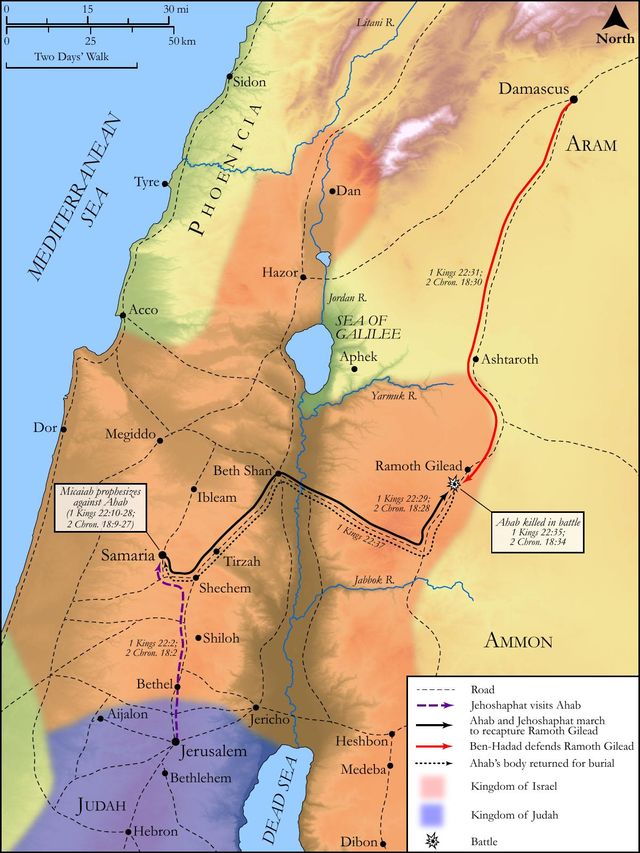
I.The two kings march with their forces to Ramoth-Gilead, Kg1 22:29.
That the king of Israel, who hated God's prophet, should so far disbelieve his admonition as to persist in his resolution, notwithstanding, is not strange; but that Jehoshaphat, that pious prince, who had desired to enquire by a prophet of the Lord, as disrelishing and discrediting Ahab's prophets, should yet proceed, after so fair a warning, is matter of astonishment. But by the easiness of his temper he was carried away with the delusion (as Barnabas was with the dissimulation, Gal 2:13) of his friends. He gave too much heed to Ahab's prophets, because they pretended to speak from God too, and in his country he had never been imposed upon by such cheats. He was ready to give his opinion with the majority, and to conclude that it was 400 to one but they should succeed. Micaiah had not forbidden them to go; nay, at first, he said, Go, and prosper. If it came to the worst, it was only Ahab's fall that was foretold, and therefore Jehoshaphat hoped he might safely venture.
II.Ahab adopts a contrivance by which he hopes to secure himself and expose his friend (Kg1 22:30):
"I will disguise myself, and go in the habit of a common soldier, but let Jehoshaphat put on his robes, to appear in the dress of a general." He pretended thereby to do honour to Jehoshaphat, and to compliment him with the sole command of the army in this action. He shall direct and give orders, and Ahab will serve as a soldier under him. But he intended,
1.To make a liar of a good prophet. Thus he hoped to elude the danger, and so to defeat the threatening, as if, by disguising himself, he could escape the divine cognizance and the judgments that pursued him.
2.To make a fool of a good king, whom he did not cordially love, because he was one that adhered to God and so condemned his apostasy. He knew that if any perished it must be the shepherd (so Micaiah had foretold); and perhaps he had intimation of the charge the enemy had to fight chiefly against the king of Israel, and therefore basely intended to betray Jehoshaphat to the danger, that he might secure himself. Ahab was marked for ruin; one would not have been in his coat for a great sum; yet he will over-persuade this godly king to muster for him. See what those get that join in affinity with vicious men, whose consciences are debauched, and who are lost to every thing that is honourable. How can it be expected that he should be true to his friend that has been false to his God?
III.Jehoshaphat, having more piety than policy, put himself into the post of honour, though it was the post of danger, and was thereby brought into the peril of his life, but God graciously delivered him. The king of Syria charged his captains to level their force, not against the king of Judah, for with him he had no quarrel, but against the king of Israel only (Kg1 22:31), to aim at his person, as if against him he had a particular enmity. Now Ahab was justly repaid for sparing Ben-hadad, who, as the seed of the serpent commonly do, stung the bosom in which he was fostered and saved from perishing. Some think that he designed only to have him taken prisoner, that he might now give him as honourable a treatment as he had formerly received from him. Whatever was the reason, this charge the officers received, and endeavoured to oblige their prince in this matter; for, seeing Jehoshaphat in his royal habit, they took him for the king of Israel, and surrounded him. Now,
1.By his danger God let him know that he was displeased with him for joining in confederacy with Ahab. Jehoshaphat had said, in compliment to Ahab (Kg1 22:4), I am as thou art; and now he was indeed taken for him. Those that associate with evil doers are in danger of sharing in their plagues.
2.By his deliverance God let him know that, though he was displeased with him, yet he had not deserted him. Some of the captains that knew him perceived their mistake, and so retired from the pursuit of him; but it is said (Ch2 18:31) that God moved them (for he has all hearts in his hand) to depart from him. To him he cried out, not in cowardice, but devotion, and from him his relief came: Ahab was in no care to succour him. God is a friend that will not fail us when other friends do.
IV.Ahab receives his mortal wound in the battle, notwithstanding his endeavours to secure himself in the habit of a private sentinel.
Let no man think to hide himself from God's judgment, no, not in masquerade. Thy hand shall find out all thy enemies, whatever disguise they are in, Kg1 22:34. The Syrian that shot him little thought of doing such a piece of service to God and his king; for he drew a bow at a venture, not aiming particularly at any man, yet God so directed the arrow that,
1.He hit the right person, the man that was marked for destruction, whom, if they had taken alive, as was designed, perhaps Ben-hadad would have spared. Those cannot escape with life whom God hath doomed to death.
2.He hit him in the right place, between the joints of the harness, the only place about him where this arrow of death could find entrance. No armour is of proof against the darts of divine vengeance. Case the criminal in steel, and it is all one, he that made him can make his sword to approach him. That which to us seems altogether casual is done by the determinate counsel and fore-knowledge of God.
V.The army is dispersed by the enemy and sent home by the king.
Either Jehoshaphat or Ahab ordered the retreat of the sheep, when the shepherd was smitten: Every man to his city, for it is to no purpose to attempt any thing more, Kg1 22:36. Ahab himself lived long enough to see that part of Micaiah's prophecy accomplished that all Israel should be scattered upon the mountains of Gilead (Kg1 22:17), and perhaps with his dying lips did himself give orders for it; for though he would be carried out of the army, to have his wounds dressed (Kg1 22:34), yet he would be held up in his chariot, to see if his army were victorious. But, when he saw the battle increase against them, his spirits sunk, and he died, but his death was so lingering that he had time to feel himself die; and we may well imagine with what horror he now reflected upon the wickedness he had committed, the warnings he had slighted, Baal's altars, Naboth's vineyard, Micaiah's imprisonment. Now he sees himself flattered into his own ruin, and Zedekiah's horns of iron pushing, not the Syrians, but himself, into destruction. Thus is he brought to the king of terrors without hope in his death.
VI.The royal corpse is brought to Samaria and buried there (Kg1 22:37), and hither are brought the bloody chariot and bloody armour in which he died, Kg1 22:38. One particular circumstance is taken notice of, because there was in it the accomplishment of a prophecy, that when they brought the chariot to the pool of Samaria, to be washed, the dogs (and swine, says the Septuagint) gathered about it, and, as is usual, licked the blood, or, as some think, the water in which it was washed, with which the blood was mingled: the dogs made no difference between royal blood and other blood. Now Naboth's blood was avenged (Kg1 21:19), and that word of David, as well as Elijah's word, was fulfilled (Psa 68:23), That thy foot may be dipped in the blood of thy enemies, and the tongue of thy dogs in the same. The dogs licking the guilty blood was perhaps designed to represent the terrors that prey upon the guilty soul after death.
Lastly, The story of Ahab is here concluded in the usual form, Kg1 22:39, Kg1 22:40. Among his works mention is made of an ivory house which he built, so called because many parts of it were inlaid with ivory; perhaps it was intended to vie with the stately palace of the kings of Judah, which Solomon built.
Continue studying 1 Kings 22:32 across the web’s major study libraries — every link below opens this exact verse, chapter, or book on the destination site.
Read & Compare
 BibleGatewayThis verse in more than 200 translations and 70 languages.
 Bible.comThe YouVersion reader — hundreds of translations, reading plans, and highlights.
 ESV.orgCrossway's official English Standard Version reader.
 NET BibleThe NET translation with 60,000+ translators' notes on every rendering decision.
 STEP BibleTyndale House's free study tool — original text, vocabulary, and scholarly resources.
 BibliaLogos Bible Software's free web reader.
 USCCBThe New American Bible (Revised Edition) with the U.S. bishops' study notes.
Commentaries
 BibleHub CommentariesDozens of classic commentaries on this verse, gathered on one page.
 StudyLightMore than 100 commentary sets — the largest collection on the web.
 BibleRefPlain-English commentary on what this verse means, verse by verse.
 Enduring WordDavid Guzik's free commentary on this chapter, widely used by Bible teachers.
 Bible Study ToolsVerse commentary alongside Greek and Hebrew study aids.
Original Language & Research
- BibleHub InterlinearThe verse word by word — original language, transliteration, and English.
- BibleHub LexiconEvery word's original-language definition and Strong's entry.
 Blue Letter BibleDeep-study tools — Strong's numbers, concordance, and word studies.
 SefariaThe Hebrew text with Rashi and centuries of Jewish commentary.
Sermons, Hymns & Audio


TrulyRandomVerse is not affiliated with these sites and doesn’t control their content. They’re linked because they’re genuinely useful.
Summary
1 Kings 22:32 vividly portrays a moment of extreme peril for King Jehoshaphat of Judah during the Battle of Ramoth-Gilead. Mistaken for King Ahab of Israel by the elite Aramean chariot captains due to his royal attire, Jehoshaphat becomes the primary target of their assault. In this desperate and life-threatening situation, he cries out, an act that immediately precedes and prompts divine intervention, powerfully highlighting God's providential care for His servant amidst the dire consequences of an unwise and unholy alliance.
Context
ShowHideLiterary Context
This verse serves as a dramatic and pivotal moment within the larger narrative of King Ahab's final, ill-fated campaign to reclaim Ramoth-Gilead from the Arameans. Despite the clear and unambiguous prophetic warning from Micaiah, who courageously foretold Ahab's death and the deceptive spirit influencing his court prophets (1 Kings 22:28), Ahab stubbornly and defiantly proceeds to battle. In a cunning but ultimately futile attempt to circumvent the prophecy, Ahab devises a plan to disguise himself as a common soldier, while foolishly persuading his ally, Jehoshaphat, to wear his own royal robes (1 Kings 22:30). The Aramean king, however, had issued a precise and direct command to his thirty-two chariot captains: "Fight with neither small nor great, but only with the king of Israel" (1 Kings 22:31). This specific and targeted order sets the stage for Jehoshaphat's near-fatal encounter, as he unwittingly becomes the primary target due to Ahab's deception and his own vulnerable, conspicuous attire, leading directly to the crisis described in this verse.
Historical & Cultural Context
The Battle of Ramoth-Gilead was a significant military engagement between the northern kingdom of Israel (allied with Judah) and Aram (Syria) over a strategically important city located in Transjordan. In the ancient Near East, chariot warfare was a dominant and highly effective military tactic, with chariot captains representing the elite, highly skilled, and often most feared warriors on the battlefield. Their primary objective was frequently to target enemy leadership, as the death or capture of a king could swiftly demoralize an army, lead to its collapse, and decisively determine the battle's outcome. The alliance between Ahab and Jehoshaphat, though politically expedient for both kingdoms, was deeply problematic from a religious standpoint. Jehoshaphat, a generally righteous king of Judah who sought the Lord, was yoking himself with the notoriously wicked Ahab, who had introduced and promoted Baal worship throughout Israel. This alliance, coupled with Jehoshaphat's willingness to wear royal attire in such a dangerous situation, vividly reflects the complex and often perilous political landscape and the personal risks associated with military campaigns in the ancient Near East.
Key Themes
ShowHideThe most prominent theme in 1 Kings 22:32 is Divine Protection, illustrating God's miraculous and sovereign intervention to safeguard Jehoshaphat despite his precarious and self-imposed position. This underscores God's unwavering faithfulness to His covenant people, even when their choices lead them into grave danger. Closely intertwined is the theme of Mistaken Identity, where the Aramean captains' critical error in judgment—seeing Jehoshaphat as Ahab—directly precipitates the crisis. This mistaken identity, ironically, becomes the very mechanism through which God's protective hand is revealed, redirecting the attack away from the intended target. Jehoshaphat's desperate Cry for Help signifies his utter reliance on a higher power in a moment of overwhelming and immediate threat, which the parallel account in 2 Chronicles 18:31 explicitly confirms as a cry to the Lord that elicits divine response. Finally, the entire episode serves as a powerful and enduring cautionary tale regarding the Consequences of Unwise Alliances, as Jehoshaphat's life is gravely endangered due to his association with the ungodly King Ahab, highlighting the critical importance of discerning spiritual and moral partnerships.
Exposition and Analysis
ShowHideKey Word Analysis
ShowHideThe Hebrew verb רָאָה (râʼâh) is a primitive root meaning "to see," encompassing both literal and figurative applications. In this context, it describes the physical act of the chariot captains observing Jehoshaphat. However, its significance extends beyond mere sight to include perception and discernment. The captains "saw" Jehoshaphat, but they mis-"perceived" his identity, demonstrating a failure of accurate discernment that ironically served God's protective purpose. This word highlights the visual trigger for the subsequent action.
The Hebrew verb סוּר (çûwr) means "to turn off" or "to turn aside," whether literally or figuratively. Here, it describes the decisive and immediate action of the Aramean chariot captains. Their "turning aside" indicates a deliberate change of course, a focused redirection of their military effort specifically towards Jehoshaphat. This swift maneuver emphasizes the suddenness and intensity of the danger Jehoshaphat faced, as the elite forces honed in on him as their perceived primary target.
The Hebrew verb זָעַק (zâʻaq) is a primitive root signifying "to shriek" or "to cry out," typically from anguish, distress, or imminent danger. It denotes a desperate appeal, often for help or deliverance, and is frequently used in the Old Testament to describe the cries of the oppressed or those in extreme peril who turn to God for intervention. Unlike a casual shout, zâʻaq implies a profound sense of urgency, helplessness, and often, a direct appeal to a higher power. In this context, Jehoshaphat's cry is not merely an expression of fear but a desperate, immediate plea for salvation, setting the stage for God's swift and decisive action.
Verse Breakdown
ShowHide"And it came to pass, when the captains of the chariots saw Jehoshaphat,"
This opening clause immediately establishes the critical moment of recognition and the impending threat. The elite Aramean chariot captains, specifically tasked by their king to target the king of Israel, visually identify Jehoshaphat, who is conspicuous in his royal robes. This initial perception, though based on a mistaken identity, is the catalyst for the ensuing dramatic confrontation.
"that they said, Surely it [is] the king of Israel."
This reveals the crucial error in judgment made by the Aramean forces. Based solely on Jehoshaphat's royal attire—a deceptive ploy orchestrated by Ahab—they confidently conclude that he is their primary target, King Ahab. This mistaken identity is central to the dramatic tension of the verse and underscores the profound irony of Ahab's self-preserving plan inadvertently endangering his ally.
"And they turned aside to fight against him:"
This clause describes the immediate, aggressive, and focused response of the chariot captains. Their action of turning "aside" implies a swift and concerted maneuver to engage Jehoshaphat directly, indicating that his life was in imminent and grave danger. The rapidity of their action highlights the suddenness and intensity of the peril, leaving Jehoshaphat with no time for strategic evasion.
"and Jehoshaphat cried out."
This is the climactic and most significant moment of the verse. Jehoshaphat's desperate cry signifies his recognition of utter helplessness in the face of overwhelming odds and certain death. While the text here does not explicitly state he cried out to God, the parallel account in 2 Chronicles 18:31 clarifies that it was indeed a cry to the Lord, to which God responded by supernaturally turning the captains away. This cry is a profound testament to his faith and immediate reliance on divine intervention in a moment of extreme duress and human impossibility.
Literary Devices
ShowHideThe narrative of 1 Kings 22:32 is replete with powerful literary devices that heighten its drama and theological impact. Central to the scene is Dramatic Irony, as Ahab's cunning scheme to disguise himself and place Jehoshaphat in his own royal robes inadvertently places his loyal ally in mortal danger. The audience is privy to Ahab's true identity and deceptive intent, making Jehoshaphat's mistaken targeting by the Arameans all the more poignant and suspenseful. There is significant Suspense and Tension meticulously built through the rapid and sequential unfolding of events: the captains' sighting of Jehoshaphat, their immediate and erroneous identification, their swift turning to attack, and Jehoshaphat's desperate, climactic cry. This moment functions as a potent Foreshadowing of divine intervention, as the very next verse (1 Kings 22:33) details how God sovereignly acted to turn the captains away, demonstrating His absolute control even amidst the chaos of battle. The narrative also employs sharp Contrast between Ahab's self-preserving deception and Jehoshaphat's vulnerable and exposed position, powerfully highlighting the perilous consequences of forming unholy alliances and compromising one's principles.
Theological and Thematic Connections
ShowHide1 Kings 22:32 profoundly illustrates the unwavering theme of divine providence and protection, even when God's people find themselves in perilous situations due to their own poor judgment or unwise decisions. Jehoshaphat's alliance with the wicked King Ahab was a clear spiritual misstep and an act of disobedience, yet God's faithfulness to His covenant with David (and thus to the lineage through which the Messiah would come) compelled Him to intervene. This pivotal moment underscores that God's protective hand is not always contingent on human perfection or faultless choices but often on His own sovereign will, His redemptive plan, and His enduring covenant promises. It powerfully teaches that in moments of extreme helplessness and overwhelming threat, a desperate and sincere cry to God is never in vain, and He is supremely capable of orchestrating even the mistakes of enemies and the chaos of battle to bring about His purposes and miraculously deliver His own.
Reflection and Application
ShowHideJehoshaphat's harrowing experience at Ramoth-Gilead offers profound and timeless lessons for contemporary believers. It serves as a stark reminder that even individuals who generally walk righteously before God can find themselves in perilous circumstances, sometimes due to unwise associations, compromised decisions, or a lack of discernment. The immediate, desperate cry of Jehoshaphat in the face of overwhelming odds serves as a powerful and exemplary model for our own response to sudden, overwhelming threats or unforeseen dangers: a direct, unreserved, and immediate appeal to God. This passage encourages us to cultivate a habit of instant prayer and an unwavering reliance on God's sovereignty when we feel helpless, targeted, or caught in circumstances beyond our control. It also serves as a poignant reminder of the critical importance of discerning our alliances and associations, both personal and spiritual, understanding that compromising relationships can lead us into situations that severely test our faith, compromise our witness, and even endanger our well-being. Ultimately, 1 Kings 22:32 is a powerful testament to God's unfailing presence, His boundless mercy, and His sovereign power to deliver, even when we are caught in the crossfire of our own mistakes or the malicious schemes of others.
Questions for Reflection
ShowHideFAQ
ShowHideWas Jehoshaphat's cry specifically to God, or just a general shout of alarm?
ShowHideWhile 1 Kings 22:32 states simply that "Jehoshaphat cried out," the parallel and more detailed account in 2 Chronicles 18:31 clarifies the nature of his cry, stating that "the Lord helped him, and God moved them to turn away from him." This strongly implies that Jehoshaphat's cry was a desperate appeal to God for divine intervention and salvation. The Hebrew word zâʻaq (זָעַק), translated "cried out," often carries the connotation of a fervent cry for help to a higher power, especially in contexts of distress, oppression, or imminent danger. Therefore, it is most accurately understood as a prayer, or at least a desperate plea for divine assistance that God heard and decisively answered.
Why did God protect Jehoshaphat, given his unwise alliance with Ahab?
ShowHideGod's protection of Jehoshaphat, despite his poor judgment in allying with the wicked King Ahab, highlights profound aspects of God's covenant faithfulness, sovereign grace, and redemptive plan. Jehoshaphat was generally a righteous king who "walked in the ways of his father David" (1 Kings 22:43), even though this particular alliance was later condemned by a prophet (2 Chronicles 19:2). God's immediate concern was to preserve the Davidic line, through which the Messiah would eventually come, thereby safeguarding His overarching redemptive purposes. God's intervention demonstrates His mercy and His unwavering commitment to His divine plan, even when His servants falter or make ill-advised choices. It powerfully illustrates that His protection is not always based on human merit or perfect obedience but on His divine purpose, His boundless grace, and His enduring covenant promises.
Christ-Centered Fulfillment
ShowHide1 Kings 22:32, with its dramatic account of Jehoshaphat's miraculous deliverance from certain death, powerfully foreshadows the ultimate and perfect deliverance found in Jesus Christ. Jehoshaphat, though dressed in royal robes, was mistakenly targeted for death, yet God sovereignly intervened to save him. In profound contrast, Jesus, the true and eternal King of Israel, willingly laid aside His divine glory and took on the humble form of a servant, becoming obedient even to death on a cross (Philippians 2:6-8). He was not mistakenly targeted but intentionally pursued and condemned, willingly offering Himself as the Lamb of God who takes away the sin of the world (John 1:29). While Jehoshaphat cried out for his own salvation from physical peril, Jesus, on the cross, cried out, "My God, my God, why have you forsaken me?" (Matthew 27:46) – a cry of ultimate dereliction that brought salvation not for Himself, but for all humanity. Christ bore the full wrath of God, standing in the gap for humanity's unwise alliances with sin and rebellion, and through His perfect sacrifice, He delivers us from eternal peril. Just as God supernaturally turned away the chariots from Jehoshaphat, Christ, through His death and glorious resurrection, has decisively disarmed the powers and authorities of darkness (Colossians 2:15) and offers ultimate protection, eternal salvation, and perfect peace to all who cry out to Him in faith (Romans 10:13).