


1 Kings 22:30
- וַיֹּאמֶרvai·yo·Merand he saidH559Conj-w ¦ V-Qal-ConsecImperf-3msVerb Qal Consecutive Imperfect 3rd Singular Masculineוַandיֹּאמֶרhe said
- מֶלֶךְMe·lekh[the] king ofH4428N-mscNoun Singular Masculine Construct
- יִשְׂרָאֵלYis·ra·'ElIsraelH3478N-properNoun Proper Location
- אֶל'eltoH413PrepPreposition
- יְהוֹשָׁפָטye·ho·sha·FatJehoshaphatH3092N-proper-mNoun Proper Masculine
- הִתְחַפֵּשׂhit·cha·PesI will disguise myselfH2664V-Hithpael-InfVerb Hithpael Infinitive Construct
- וָבֹאva·Vo'and I will goH935Conj-w ¦ V-Qal-InfVerb Qal Infinitive ConstructוָandבֹאI will go
- בַמִּלְחָמָהva·mil·cha·Mahin the battleH4421Prep-b ¦ N-fsNoun Singular Feminine Absoluteבַin theמִּלְחָמָהbattle
- וְאַתָּהve·'a·Tahand youH859Conj-w ¦ Pro-2msPronoun Personal 2nd Singular Masculineוְandאַתָּהyou
- לְבַשׁle·VashwearH3847V-Qal-Imp-2msVerb Qal Imperative 2nd Singular Masculine
- בְּגָדֶיךָbe·ga·Dei·khayour own clothesH899N-mpc ¦ 2msNoun Plural Masculine Constructבְּגָדֶיown clothesךָyour
- וַיִּתְחַפֵּשׂvai·yit·cha·Pesand he disguised himselfH2664Conj-w ¦ V-Hithpael-ConsecImperf-3msVerb Hithpael Consecutive Imperfect 3rd Singular Masculineוַandיִּתְחַפֵּשׂhe disguised himself
- מֶלֶךְMe·lekh[the] king ofH4428N-mscNoun Singular Masculine Construct
- יִשְׂרָאֵלYis·ra·'ElIsraelH3478N-properNoun Proper Location
- וַיָּבוֹאvai·ya·Vo'and he wentH935Conj-w ¦ V-Qal-ConsecImperf-3msVerb Qal Consecutive Imperfect 3rd Singular Masculineוַandיָּבוֹאhe went
- בַּמִּלְחָמָהba·mil·cha·Mahin the battleH4421Prep-b ¦ N-fsNoun Singular Feminine Absoluteבַּin theמִּלְחָמָהbattle
English is a literal word-by-word gloss of the Hebrew, not the KJV's wording. Why?
This is the original text the KJV's translators worked from — each Hebrew word with its own literal English meaning in this verse, prepared by scholars at Tyndale House, Cambridge. The KJV translates whole sentences, not word by word, so its wording differs: one Hebrew word can become several English words, and the KJV may choose “the LORD” where the gloss reads “Yahweh”. Both are faithful — they answer different questions. For the KJV's own rendering, switch to the KJV text.
Details
See on the biblical-era maps

Study this verse
Public-domain commentary
Matthew Henry
From his Commentary on the Whole Bible. Henry comments on passages, not single verses — this entry covers 1 Kings 22:29–40. His two-level outline is real structure in the source text, so it is rendered as structure.
The matter in contest between God's prophet and Ahab's prophets is here soon determined, and it is made to appear which was in the right. Here,
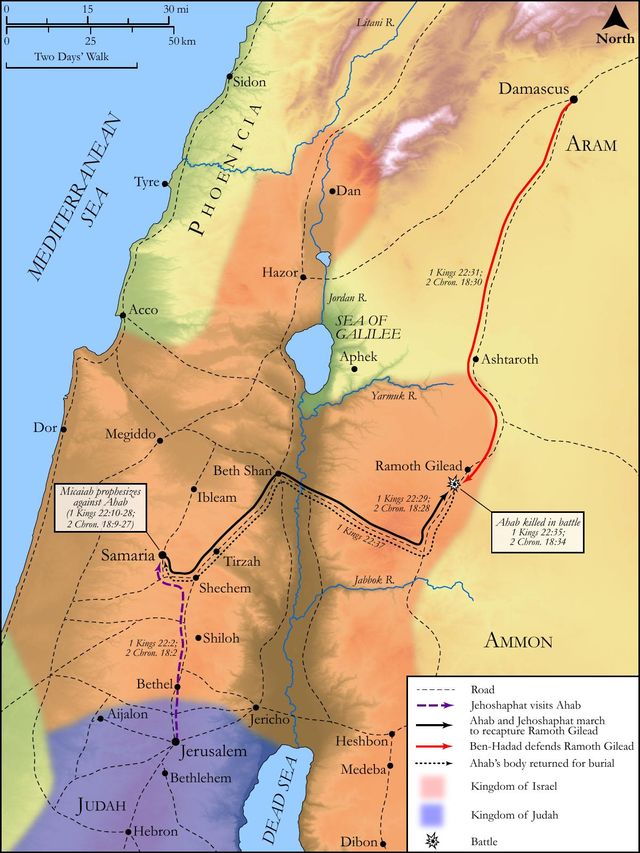
I.The two kings march with their forces to Ramoth-Gilead, Kg1 22:29.
That the king of Israel, who hated God's prophet, should so far disbelieve his admonition as to persist in his resolution, notwithstanding, is not strange; but that Jehoshaphat, that pious prince, who had desired to enquire by a prophet of the Lord, as disrelishing and discrediting Ahab's prophets, should yet proceed, after so fair a warning, is matter of astonishment. But by the easiness of his temper he was carried away with the delusion (as Barnabas was with the dissimulation, Gal 2:13) of his friends. He gave too much heed to Ahab's prophets, because they pretended to speak from God too, and in his country he had never been imposed upon by such cheats. He was ready to give his opinion with the majority, and to conclude that it was 400 to one but they should succeed. Micaiah had not forbidden them to go; nay, at first, he said, Go, and prosper. If it came to the worst, it was only Ahab's fall that was foretold, and therefore Jehoshaphat hoped he might safely venture.
II.Ahab adopts a contrivance by which he hopes to secure himself and expose his friend (Kg1 22:30):
"I will disguise myself, and go in the habit of a common soldier, but let Jehoshaphat put on his robes, to appear in the dress of a general." He pretended thereby to do honour to Jehoshaphat, and to compliment him with the sole command of the army in this action. He shall direct and give orders, and Ahab will serve as a soldier under him. But he intended,
1.To make a liar of a good prophet. Thus he hoped to elude the danger, and so to defeat the threatening, as if, by disguising himself, he could escape the divine cognizance and the judgments that pursued him.
2.To make a fool of a good king, whom he did not cordially love, because he was one that adhered to God and so condemned his apostasy. He knew that if any perished it must be the shepherd (so Micaiah had foretold); and perhaps he had intimation of the charge the enemy had to fight chiefly against the king of Israel, and therefore basely intended to betray Jehoshaphat to the danger, that he might secure himself. Ahab was marked for ruin; one would not have been in his coat for a great sum; yet he will over-persuade this godly king to muster for him. See what those get that join in affinity with vicious men, whose consciences are debauched, and who are lost to every thing that is honourable. How can it be expected that he should be true to his friend that has been false to his God?
III.Jehoshaphat, having more piety than policy, put himself into the post of honour, though it was the post of danger, and was thereby brought into the peril of his life, but God graciously delivered him. The king of Syria charged his captains to level their force, not against the king of Judah, for with him he had no quarrel, but against the king of Israel only (Kg1 22:31), to aim at his person, as if against him he had a particular enmity. Now Ahab was justly repaid for sparing Ben-hadad, who, as the seed of the serpent commonly do, stung the bosom in which he was fostered and saved from perishing. Some think that he designed only to have him taken prisoner, that he might now give him as honourable a treatment as he had formerly received from him. Whatever was the reason, this charge the officers received, and endeavoured to oblige their prince in this matter; for, seeing Jehoshaphat in his royal habit, they took him for the king of Israel, and surrounded him. Now,
1.By his danger God let him know that he was displeased with him for joining in confederacy with Ahab. Jehoshaphat had said, in compliment to Ahab (Kg1 22:4), I am as thou art; and now he was indeed taken for him. Those that associate with evil doers are in danger of sharing in their plagues.
2.By his deliverance God let him know that, though he was displeased with him, yet he had not deserted him. Some of the captains that knew him perceived their mistake, and so retired from the pursuit of him; but it is said (Ch2 18:31) that God moved them (for he has all hearts in his hand) to depart from him. To him he cried out, not in cowardice, but devotion, and from him his relief came: Ahab was in no care to succour him. God is a friend that will not fail us when other friends do.
IV.Ahab receives his mortal wound in the battle, notwithstanding his endeavours to secure himself in the habit of a private sentinel.
Let no man think to hide himself from God's judgment, no, not in masquerade. Thy hand shall find out all thy enemies, whatever disguise they are in, Kg1 22:34. The Syrian that shot him little thought of doing such a piece of service to God and his king; for he drew a bow at a venture, not aiming particularly at any man, yet God so directed the arrow that,
1.He hit the right person, the man that was marked for destruction, whom, if they had taken alive, as was designed, perhaps Ben-hadad would have spared. Those cannot escape with life whom God hath doomed to death.
2.He hit him in the right place, between the joints of the harness, the only place about him where this arrow of death could find entrance. No armour is of proof against the darts of divine vengeance. Case the criminal in steel, and it is all one, he that made him can make his sword to approach him. That which to us seems altogether casual is done by the determinate counsel and fore-knowledge of God.
V.The army is dispersed by the enemy and sent home by the king.
Either Jehoshaphat or Ahab ordered the retreat of the sheep, when the shepherd was smitten: Every man to his city, for it is to no purpose to attempt any thing more, Kg1 22:36. Ahab himself lived long enough to see that part of Micaiah's prophecy accomplished that all Israel should be scattered upon the mountains of Gilead (Kg1 22:17), and perhaps with his dying lips did himself give orders for it; for though he would be carried out of the army, to have his wounds dressed (Kg1 22:34), yet he would be held up in his chariot, to see if his army were victorious. But, when he saw the battle increase against them, his spirits sunk, and he died, but his death was so lingering that he had time to feel himself die; and we may well imagine with what horror he now reflected upon the wickedness he had committed, the warnings he had slighted, Baal's altars, Naboth's vineyard, Micaiah's imprisonment. Now he sees himself flattered into his own ruin, and Zedekiah's horns of iron pushing, not the Syrians, but himself, into destruction. Thus is he brought to the king of terrors without hope in his death.
VI.The royal corpse is brought to Samaria and buried there (Kg1 22:37), and hither are brought the bloody chariot and bloody armour in which he died, Kg1 22:38. One particular circumstance is taken notice of, because there was in it the accomplishment of a prophecy, that when they brought the chariot to the pool of Samaria, to be washed, the dogs (and swine, says the Septuagint) gathered about it, and, as is usual, licked the blood, or, as some think, the water in which it was washed, with which the blood was mingled: the dogs made no difference between royal blood and other blood. Now Naboth's blood was avenged (Kg1 21:19), and that word of David, as well as Elijah's word, was fulfilled (Psa 68:23), That thy foot may be dipped in the blood of thy enemies, and the tongue of thy dogs in the same. The dogs licking the guilty blood was perhaps designed to represent the terrors that prey upon the guilty soul after death.
Lastly, The story of Ahab is here concluded in the usual form, Kg1 22:39, Kg1 22:40. Among his works mention is made of an ivory house which he built, so called because many parts of it were inlaid with ivory; perhaps it was intended to vie with the stately palace of the kings of Judah, which Solomon built.
Continue studying 1 Kings 22:30 across the web’s major study libraries — every link below opens this exact verse, chapter, or book on the destination site.
Read & Compare
 BibleGatewayThis verse in more than 200 translations and 70 languages.
 Bible.comThe YouVersion reader — hundreds of translations, reading plans, and highlights.
 ESV.orgCrossway's official English Standard Version reader.
 NET BibleThe NET translation with 60,000+ translators' notes on every rendering decision.
 STEP BibleTyndale House's free study tool — original text, vocabulary, and scholarly resources.
 BibliaLogos Bible Software's free web reader.
 USCCBThe New American Bible (Revised Edition) with the U.S. bishops' study notes.
Commentaries
 BibleHub CommentariesDozens of classic commentaries on this verse, gathered on one page.
 StudyLightMore than 100 commentary sets — the largest collection on the web.
 BibleRefPlain-English commentary on what this verse means, verse by verse.
 Enduring WordDavid Guzik's free commentary on this chapter, widely used by Bible teachers.
 Bible Study ToolsVerse commentary alongside Greek and Hebrew study aids.
Original Language & Research
- BibleHub InterlinearThe verse word by word — original language, transliteration, and English.
- BibleHub LexiconEvery word's original-language definition and Strong's entry.
 Blue Letter BibleDeep-study tools — Strong's numbers, concordance, and word studies.
 SefariaThe Hebrew text with Rashi and centuries of Jewish commentary.
Sermons, Hymns & Audio


TrulyRandomVerse is not affiliated with these sites and doesn’t control their content. They’re linked because they’re genuinely useful.
Summary
1 Kings 22:30 captures King Ahab's desperate and ultimately futile attempt to circumvent a divine prophecy concerning his death in battle. Despite a clear warning from the prophet Micaiah, Ahab chooses to defy God's word by disguising himself to enter the battle for Ramoth-Gilead, while instructing King Jehoshaphat to maintain his royal visibility. This pivotal moment sets the stage for the dramatic and inevitable fulfillment of God's judgment against a defiant and disobedient king, underscoring the futility of human cunning and rebellion in the face of divine sovereignty.
Context
ShowHideLiterary Context
This verse is strategically placed within the climactic narrative of King Ahab's final campaign against the Arameans for control of Ramoth-Gilead. It immediately follows the chilling and unambiguous prophecy of Micaiah, who, standing alone against 400 false prophets, foretells Ahab's defeat and death, vividly describing "all Israel scattered on the hills, like sheep without a shepherd" [1 Kings 22:17 "1 Kings 22:17 - Micaiah's Prophecy of Israel Scattered"]. Enraged by this unwelcome truth, Ahab had Micaiah imprisoned [1 Kings 22:27 "1 Kings 22:27 - Ahab Imprisons Micaiah"]. Verse 30 reveals Ahab's direct, defiant response to this prophecy: a calculated act of deception, hoping to evade his prophesied fate by altering his appearance, while simultaneously placing his ally, Jehoshaphat, in a position of greater peril by having him maintain royal visibility. This act of self-preservation and cunning directly precedes the battle itself, which will swiftly and inevitably lead to the prophecy's fulfillment.
Historical & Cultural Context
The conflict over Ramoth-Gilead was a significant episode in the long-standing geopolitical struggle between the Northern Kingdom of Israel and Aram (Syria) for control of strategic territories in Transjordan. Ramoth-Gilead was a key fortified city, crucial for controlling trade routes and military access. In ancient Near Eastern warfare, kings typically led their armies from the front, identifiable by their distinctive royal regalia, which also made them primary targets for enemy forces. The practice of kings disguising themselves was not unheard of, often employed for intelligence gathering or to move undetected, but in this context, it is a desperate and defiant measure to evade a specific prophetic word of judgment. The alliance between Ahab of Israel and Jehoshaphat of Judah, though politically expedient, was religiously problematic, as Jehoshaphat, a generally righteous king, was yoking himself with a notoriously wicked one, a decision for which he would later be sternly rebuked by a prophet [2 Chronicles 19:2 "2 Chronicles 19:2 - Jehoshaphat Rebuked for Alliance"].
Key Themes
ShowHideThe verse powerfully illustrates the futility of resisting divine will. Ahab's elaborate attempt to outmaneuver God's decree underscores the ultimate sovereignty of the Almighty; human schemes, no matter how clever or desperate, cannot thwart God's purposes [Proverbs 21:30 "Proverbs 21:30 - No Wisdom Against the Lord"]. It also highlights Ahab's profound pride and deception, as he stubbornly refuses to humble himself before the Lord's word, preferring to trust in his own cunning and self-preservation. This act is a culmination of his long history of disobedience and rebellion against God, particularly his unrepentant wickedness exemplified by the murder of Naboth and the seizure of his vineyard, which had previously drawn severe judgment from the prophet Elijah [1 Kings 21:19 "1 Kings 21:19 - Elijah's Prophecy Against Ahab"]. Furthermore, the instruction to Jehoshaphat subtly introduces the theme of compromise and its dangers, as the righteous king of Judah aligns himself with a wicked king, placing himself in unnecessary and nearly fatal peril.
Exposition and Analysis
ShowHideKey Word Analysis
ShowHideThe Hebrew verb חָפַשׁ (H2664, transliterated châphas') is a primitive root meaning "to seek," "to search," or, in its causative sense, "to conceal oneself" or "to mask." In this context, it specifically denotes the deliberate act of concealing one's identity or altering one's appearance to avoid recognition. It implies a calculated effort to become unidentifiable, to blend in, or to hide one's true status. Ahab's use of this word reveals his intention to evade the specific targeting that would come with his royal identity, believing that by becoming anonymous, he could escape the prophetic judgment. This is not a casual change of clothes but a strategic act of self-concealment driven by fear and defiance against God's word.
The Hebrew verb לָבַשׁ (H3847, transliterated lâbash') means "to wrap around," or "to put on a garment" or "to clothe." It describes the act of donning attire, literally or figuratively. In this verse, it is used in contrast to Ahab's act of disguising. While Ahab strips off his royal robes, he instructs Jehoshaphat to "put on thy robes," meaning to wear his distinctive royal attire. This highlights the stark contrast in their approaches to the battle and underscores Ahab's cunning attempt to shift the target onto his ally. The word emphasizes the public display of identity that Ahab seeks to avoid for himself, but imposes upon Jehoshaphat.
Verse Breakdown
ShowHide"And the king of Israel said unto Jehoshaphat"
This opening clause establishes the direct communication and the power dynamic between Ahab, the king of the Northern Kingdom, and Jehoshaphat, the king of Judah. It highlights Ahab's initiative and authority in dictating the battle plan, but also underscores Jehoshaphat's unfortunate complicity in this ill-advised and divinely condemned alliance.
"I will disguise myself, and enter into the battle;"
This is the core of Ahab's cunning strategy to evade the prophecy of his death. By shedding his royal garments and adopting the appearance of a common soldier, he hopes to avoid being identified as the primary target by the Aramean forces. This reveals his deep-seated fear of Micaiah's prophecy, yet his simultaneous, stubborn refusal to repent or submit to God's sovereign will. It is an act of defiance, trusting in human artifice over divine decree.
"but put thou on thy robes."
This instruction to Jehoshaphat is laden with profound irony and potential treachery. Ahab, seeking to protect himself from the prophesied judgment, essentially instructs Jehoshaphat to remain conspicuously royal, making him a prime target for the enemy. This command underscores Ahab's self-preservation at the expense of his ally, and Jehoshaphat's unwise compliance, which nearly cost him his life in the ensuing battle [1 Kings 22:32-33 "1 Kings 22:32-33 - Jehoshaphat's Near Death"].
"And the king of Israel disguised himself, and went into the battle."
This concluding clause confirms Ahab's decisive execution of his plan. It emphasizes his determination to defy the divine word, marking his final act of rebellion before facing his inevitable fate. The swift action from decision to execution highlights his resolute choice to trust in his own cunning rather than in the Lord's warning.
Literary Devices
ShowHideThe verse is rich in Irony, particularly dramatic irony. Ahab attempts to evade his prophesied death by disguising himself, yet this very act sets the stage for the precise fulfillment of the prophecy, as he is struck by a "random" arrow that finds him despite his disguise [1 Kings 22:34 "1 Kings 22:34 - Ahab is Struck"]. His cunning becomes the very means of his downfall, demonstrating the futility of human schemes against divine sovereignty. There is also strong Foreshadowing in Ahab's actions; his desperate attempt to escape his fate immediately signals that the dire prophecy of Micaiah is about to unfold. The stark contrast between Ahab's disguise and Jehoshaphat's robes serves as potent Symbolism: the royal robes symbolize kingship, authority, and vulnerability in battle, while the disguise symbolizes a futile attempt to escape an inescapable destiny. This narrative technique effectively highlights the profound contrast between human will and divine sovereignty, demonstrating that God's plan cannot be thwarted by human artifice or deception.
Theological and Thematic Connections
ShowHide1 Kings 22:30 serves as a powerful testament to the unyielding sovereignty of God and the ultimate futility of human attempts to circumvent His divine decrees. Ahab's desperate act of disguise is a vivid illustration of human pride and rebellion, demonstrating a stubborn refusal to humble oneself before the revealed will of God. Despite receiving a clear and unambiguous prophecy, Ahab chooses self-reliance and deception over repentance and submission. This passage underscores that divine judgment, once declared, is inescapable, and God's purposes will ultimately prevail, regardless of human cunning or resistance. It highlights the profound principle that true wisdom lies not in devising schemes to outmaneuver God, but in humbly heeding His warnings and aligning one's life with His truth.
Reflection and Application
ShowHideThe narrative of Ahab's disguise in 1 Kings 22:30 carries profound implications for contemporary believers. It serves as a stark reminder that attempts to evade the consequences of our choices, especially those made in defiance of God's revealed will, are ultimately futile. We might try to "disguise" our true intentions, rationalize our disobedience, or hide from the truth about our spiritual condition, but God sees all and His purposes cannot be thwarted. This verse calls us to a posture of radical humility and submission, urging us to genuinely heed divine warnings and to trust in God's sovereignty, even when His word is challenging or confronts our desires. True security, peace, and flourishing are found not in clever schemes or self-protective measures, but in honest repentance, obedience, and alignment with God's perfect and wise plan for our lives. It challenges us to examine where we might be attempting to "disguise" ourselves from God or from the uncomfortable truth about our own sin, and to instead embrace His grace, guidance, and transformative power.
Questions for Reflection
ShowHideFAQ
ShowHideWhy did Ahab disguise himself before going into battle?
ShowHideAhab disguised himself to evade a specific prophecy given by the prophet Micaiah, who had unequivocally foretold his death in the upcoming battle for Ramoth-Gilead [1 Kings 22:17 "1 Kings 22:17 - Micaiah's Prophecy of Israel Scattered"]. By shedding his distinctive royal robes and appearing as a common soldier, Ahab desperately hoped to avoid being identified as the primary target by the Aramean forces, thereby circumventing the divine decree and preserving his life. It was an act born of defiance, fear, and self-preservation, trusting in human cunning rather than submitting to God's revealed will.
What was the significance of Jehoshaphat wearing his robes?
ShowHideAhab's instruction for Jehoshaphat to wear his royal robes while Ahab himself disguised himself was a deeply self-serving and potentially treacherous act. By remaining in his royal attire, Jehoshaphat would be conspicuously visible and, therefore, highly likely to become the primary target for the enemy, diverting attention and danger away from Ahab. This decision indeed nearly cost Jehoshaphat his life, as enemy chariots pursued him, mistaking him for the King of Israel [1 Kings 22:32-33 "1 Kings 22:32-33 - Jehoshaphat is Mistaken for Ahab"]. It powerfully highlights Jehoshaphat's unwise alliance with a wicked king and the inherent dangers of compromising one's principles or yoking oneself with unrighteousness.
Did Ahab's disguise succeed in saving him?
ShowHideNo, Ahab's disguise ultimately failed to save him. Despite his elaborate efforts to evade the prophecy, divine sovereignty prevailed. A "randomly shot" arrow, seemingly by chance, struck him between the joints of his armor, mortally wounding him [1 Kings 22:34 "1 Kings 22:34 - Ahab is Struck by an Arrow"]. He died later that day, fulfilling Micaiah's prophecy precisely and demonstrating the absolute futility of human attempts to thwart God's sovereign plan. This incident powerfully illustrates that divine judgment is inescapable and God's word, once declared, will always come to pass.
Christ-Centered Fulfillment
ShowHideThe futile attempt of King Ahab to evade death through disguise in 1 Kings 22:30 stands in stark and profound contrast to the willing, purposeful, and redemptive embrace of death by Jesus Christ. Ahab sought to preserve his temporal life through deception and self-protection, ultimately failing to escape the righteous judgment pronounced against him for his wickedness and rebellion. His story highlights the absolute futility of human schemes against divine sovereignty. In profound contrast, Jesus, the true and eternal King of Israel, did not disguise Himself or seek to evade His destiny. He willingly laid aside His divine glory [Philippians 2:6-7 "Philippians 2:6-7 - Christ's Humiliation"] not to hide from death, but to fully embrace it on the cross for the redemption of humanity. While Ahab's death was a consequence of his unrepentant rebellion and a demonstration of inescapable judgment, Christ's death was a substitutionary sacrifice, a voluntary act of infinite love that conquered sin and death for all who believe [Romans 5:8 "Romans 5:8 - God Shows His Love for Us"]. Unlike Ahab, who was struck down by an arrow of judgment, Jesus bore the full weight of God's wrath against sin, becoming the ultimate Lamb of God who takes away the sin of the world [John 1:29 "John 1:29 - Jesus, the Lamb of God"]. His glorious resurrection further demonstrates that God's ultimate plan, unlike human cunning, is always victorious, bringing eternal life and hope where sin brought only death and despair.