


1 Kings 20:24
Bible text: King James Version (1769 Blayney text) · Public domain
Bible text: Berean Standard Bible · Public domain
Bible text: American Standard Version (1901) · Public domain
Bible text: World English Bible, Messianic edition · Public domain
Bible text: Geneva Bible (1599) · Public domain
Bible text: Young's Literal Translation · Public domain
- וְאֶתve·'Etand <obj.>H853Conj-w ¦ DirObjMParticle Object Indicatorוְandאֶת<obj.>
- הַדָּבָרha·da·Varthe thingH1697Art ¦ N-msNoun Singular Masculine Absoluteהַtheדָּבָרthing
- הַזֶּהha·Zeh<the> thisH2088Art ¦ PrtParticle Demonstrativeהַ<the>זֶּהthis
- עֲשֵׂה'a·SehdoH6213V-Qal-Imp-2msVerb Qal Imperative 2nd Singular Masculine
- הָסֵרha·SerremoveH5493V-Hiphil-Imp-2msVerb Hiphil Imperative 2nd Singular Masculine
- הַמְּלָכִיםha·me·la·Khimthe kingsH4428Art ¦ N-mpNoun Plural Masculine Absoluteהַtheמְּלָכִיםkings
- אִישׁ'isheachH376N-msNoun Singular Masculine Absolute
- מִמְּקֹמוֹmi·me·ko·Mofrom his placeH4725Prep-m ¦ N-msc ¦ 3msNoun Singular Masculine Constructמִfromמְּקֹמplaceוֹhis
- וְשִׂיםve·Simand appointH7760Conj-w ¦ V-Qal-Imp-2msVerb Qal Imperative 2nd Singular Masculineוְandשִׂיםappoint
- פַּחוֹתpa·ChotgovernorsH6346N-fpNoun Plural Feminine Absolute
- תַּחְתֵּיהֶםtach·tei·Hemin place of themH8478N-mpc ¦ 3mpNoun Plural Masculine Constructתַּחְתֵּיin place ofהֶםthem
English is a literal word-by-word gloss of the Hebrew, not the KJV's wording. Why?
This is the original text the KJV's translators worked from — each Hebrew word with its own literal English meaning in this verse, prepared by scholars at Tyndale House, Cambridge. The KJV translates whole sentences, not word by word, so its wording differs: one Hebrew word can become several English words, and the KJV may choose “the LORD” where the gloss reads “Yahweh”. Both are faithful — they answer different questions. For the KJV's own rendering, switch to the KJV text.
Details
See on the biblical-era maps

Study this verse
Public-domain commentary
Matthew Henry
From his Commentary on the Whole Bible. Henry comments on passages, not single verses — this entry covers 1 Kings 20:22–30. His two-level outline is real structure in the source text, so it is rendered as structure.
We have here an account of another successful campaign which Ahab, by divine aid, made against the Syrians, in which he gave them a greater defeat than in the former. Strange! Ahab idolatrous and yet victorious, a persecutor and yet a conqueror! God has wise and holy ends in suffering wicked men to prosper, and glorifies his own name thereby.
I.Ahab is admonished by a prophet to prepare for another war, Kg1 20:22.
It should seem, he was now secure, and looked but a little way before him. Those that are careless of their souls are often as careless of their outwards affairs; but the prophet (to whom God made known the following counsels of the Syrians) told him they would renew their attempt at the return of the year, hoping to retrieve the honour they had lost and be avenged for the blow they had received. He therefore bade him strengthen himself, put himself into a posture of defence, and be ready to give them a warm reception. God had decreed the end, but Ahab must use the means, else he tempts God: "Help thyself, strengthen thyself, and God will help and strengthen thee." The enemies of God's Israel are restless in their malice, and, though they may take some breathing-time for themselves, yet they are still breathing out threatenings and slaughter against the church. It concerns us always to expect assaults from our spiritual enemies, and therefore to mark and see what we do.
II.Ben-hadad is advised by those about him concerning the operations of the next campaign.
1.They advised him to change his ground, Kg1 20:23. They took it for granted that it was not Israel, but Israel's gods, that beat them (so great a regard was then universally had to invisible powers); but they speak very ignorantly of Jehovah - that he was many, whereas he is one and his name one, - that he was their God only, a local deity, peculiar to that nation, whereas he is the Creator and ruler of all the world, - and that he was a God of the hills only, because David their great prophet had said, I will lift up my eyes to the hills whence cometh my help (Psa 121:1), and that his foundation was in the holy mountain (Psa 87:1; Psa 78:54), and much was said of his holy hill (Psa 15:1; Psa 24:3); supposing him altogether such a one as their imaginary deities, they fancied he was confined to his hills, and could not or would not come down from them, and therefore an army in the valley would be below his cognizance and from under his protection. Thus vain were the Gentiles in their imaginations concerning God, so wretchedly were their foolish hearts darkened, and, professing themselves to be wise, they became fools.
2.They advised him to change his officers (Kg1 20:24, Kg1 20:25), not to employ the kings, who were commanders by birth, but captains rather, who were commanders by merit, who were inured to war, would not affect to make a show like the kings, but would go through with business. Let every man be employed in that which he is brought up to and used to, and preferred to that which he is fit for. Syria, it seems, was rich and populous, when it could furnish recruits sufficient, after so great a defeat, horse for horse, chariot for chariot.
III.Both armies take the field.
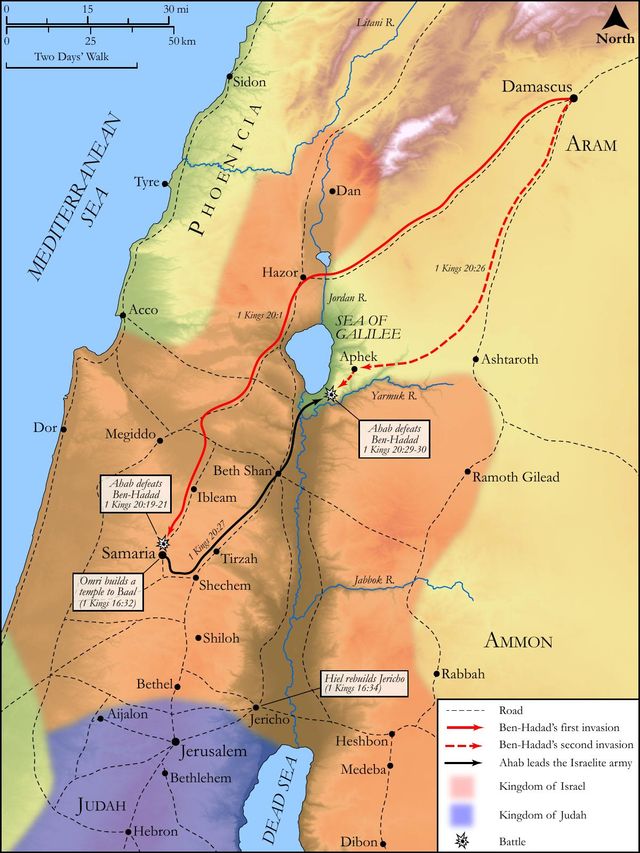
Ben-hadad, with his Syrians, encamps near Aphek, in the tribe of Asher. It is probable that Asher was a city in his own possession, one of those which his father had won (Kg1 20:34), and the country about it was flat and level, and fit for his purpose, Kg1 20:26. Ahab, with his forces, posted himself at some distance over against them, Kg1 20:27. The disproportion of numbers was very remarkable. The children of Israel, who were cantoned in two battalions, looked like two little flocks of kids, their numbers small, their equipage mean, and the figure they made contemptible; but the Syrians filled the country with their numbers, their noise, their chariots, their carriages, and their baggage.
IV.Ahab is encouraged to fight the Syrians, notwithstanding their advantages and confidence.
A man of God is sent to him, to tell him that this numerous army shall all be delivered into his hand (Kg1 20:28), but not for his sake; be it known to him, he is utterly unworthy for whom God will do this. God would not do it because Ahab had praised God or prayed to him (we do not read that he did either), but because the Syrians had blasphemed God, and had said, He is the God of the hills and not of the valleys; therefore God will do it in his own vindication, and to preserve the honour of his own name. If the Syrians had said, "Ahab and his people have forgotten their God, and so put themselves out of his protection, and therefore we may venture to attack them," God would probably have delivered Israel into their hands; but when they go upon a presumption so very injurious to the divine omnipotence, and the honour of him who is Lord of all hosts, not only in hills and valleys, but in heaven and earth, which they are willingly ignorant of, they shall be undeceived, at the expense of that vast army which is so much their pride and confidence.
V.After the armies had faced one another seven days (the Syrians, it is likely, boasting, and the Israelites trembling), they engaged, and the Syrians were totally routed, 100,000 men slain by the sword of Israel in the field of battle (Kg1 20:29), and 27,000 men, that thought themselves safe under the walls of Aphek, a fortified city (from the walls of which the shooters might annoy the enemy if they pursued them, Sa2 11:24), found their bane where they hoped for protection: the wall fell upon them, probably overthrown by an earthquake, and, the cities of Canaan being walled up to heaven, it reached a great way, and they were all killed, or hurt, or overwhelmed with dismay. Ben-hadad, who thought his city Aphek would hold out against the conquerors, finding it thus unwalled, and the remnant of his forces dispirited and dispersed, had nothing but secresy to rely upon for safety, and therefore hid himself in a chamber within a chamber, lest the pursuers should seize him. See how the greatest confidence often ends in the greatest cowardice. "Now is the God of Israel the God of the valleys or no?" He shall know now that he is forced into an inner chamber to hide himself, see Kg1 22:25.
Historical interpretation
Historical reception
3 surviving comments on this verse. Each one is dated, so this reads as a timeline rather than a list.
Select a marker to jump to its quote. Markers stagger vertically where authors wrote within a few decades of each other.
Here the Scripture relates the two battles of the king of Israel against the Arameans, at which we have already hinted, and the twin slaughters of the Arameans, of which the second caused the death of 127, men, as God took his revenge on the impious voice of the Arameans, who said about the true God worshiped by the Israelites, “The Lord is a god of the hills, but he is not a god of the valleys.”
Thus the saints go up to the Lord, the wicked go down to sin; the saints are on the mountains, the guilty in the valleys. “For he is the God of the mountains and not the God of the valleys.” Those who dwelt in the houses of the plain where God does not dwell could not have the house of God within them, for this is the house that God sought from them so that they might build up themselves and rear within themselves the temple of God from living stones of faith. He did not want buildings made with earthen walls or wooden roofs, for the hand of an enemy would have been able to overthrow them. He wanted that temple that is built in human hearts, to whom it might be said, “You are the temple of God,” in which the Lord Jesus might dwell and from there set out to redeem all humankind. There also could be prepared a sacred chamber in the womb of the Virgin where the King of heaven might live and a human body become the temple of God, which, though it was destroyed, might yet be restored to life on the third day.
Did not the Lord wish Ben-hadad, king of Syria, whom besides countless thousands of his own people, thirty-two kings and armies of the same number of kings served, to be conquered by a few foot soldiers of the princes in order that he who was the author of such victory would be acknowledged?
Continue studying 1 Kings 20:24 across the web’s major study libraries — every link below opens this exact verse, chapter, or book on the destination site.
Read & Compare
 BibleGatewayThis verse in more than 200 translations and 70 languages.
 Bible.comThe YouVersion reader — hundreds of translations, reading plans, and highlights.
 ESV.orgCrossway's official English Standard Version reader.
 NET BibleThe NET translation with 60,000+ translators' notes on every rendering decision.
 STEP BibleTyndale House's free study tool — original text, vocabulary, and scholarly resources.
 BibliaLogos Bible Software's free web reader.
 USCCBThe New American Bible (Revised Edition) with the U.S. bishops' study notes.
Commentaries
 BibleHub CommentariesDozens of classic commentaries on this verse, gathered on one page.
 StudyLightMore than 100 commentary sets — the largest collection on the web.
 BibleRefPlain-English commentary on what this verse means, verse by verse.
 Enduring WordDavid Guzik's free commentary on this chapter, widely used by Bible teachers.
 Bible Study ToolsVerse commentary alongside Greek and Hebrew study aids.
Original Language & Research
- BibleHub InterlinearThe verse word by word — original language, transliteration, and English.
- BibleHub LexiconEvery word's original-language definition and Strong's entry.
 Blue Letter BibleDeep-study tools — Strong's numbers, concordance, and word studies.
 SefariaThe Hebrew text with Rashi and centuries of Jewish commentary.
Sermons, Hymns & Audio


TrulyRandomVerse is not affiliated with these sites and doesn’t control their content. They’re linked because they’re genuinely useful.
Summary
Following a significant defeat by Israel, the Aramean king Ben-hadad's advisors offer strategic counsel in 1 Kings 20:24. This verse details their recommendation to remove the regional kings who served Ben-hadad and commanded their armies and replace them with professional captains. This human-devised military tactic aimed to centralize command and control for the impending second battle against King Ahab and Israel, a strategy rooted in the flawed theological premise that Israel's God was limited to specific geographical terrains.
Context
ShowHideLiterary Context
This verse is a crucial turning point in the narrative immediately following the Arameans' unexpected and humiliating defeat by Israel in the first battle, despite their overwhelming numerical superiority. The preceding verse, 1 Kings 20:23, explicitly reveals the Aramean advisors' profound theological miscalculation: they believed Israel's God was merely a "God of the hills" and thus limited in power to mountainous terrain. Verse 24 presents their pragmatic military response to this misconception, proposing a radical overhaul of their leadership structure and a strategic shift to a different battleground (the plains, as revealed in subsequent verses) to neutralize what they perceived as Israel's divine advantage. This sets the stage for the second confrontation, where God will definitively demonstrate His absolute sovereignty over all creation, not just specific geographical areas, thereby exposing the futility of human strategies that disregard divine omnipotence.
Historical & Cultural Context
Among the kings of that day, it was a common practice for powerful kings, such as Ben-hadad of Aram, to lead military coalitions. These forces typically comprised their own standing army augmented by contingents from kings who served them or allied cities. While this arrangement provided numerical strength, it often introduced significant challenges related to unified command, disciplined execution, and consistent loyalty, as each of these kings might prioritize his own interests or employ disparate fighting styles. The advice to replace these independent "kings" with professional "captains" (Hebrew: pachot, often translated as governors or deputies) reflects a strategic move towards a more centralized, professional, and disciplined military structure. This aimed for greater efficiency and unquestioning obedience to Ben-hadad's direct orders. This strategic shift also aligns with the widespread polytheistic belief systems of the time, where deities were frequently associated with specific lands, peoples, or natural phenomena, making the Arameans' "God of the hills" theory culturally plausible within their worldview, though utterly mistaken regarding Yahweh, the God of Israel.
Key Themes
ShowHideThe passage powerfully highlights several key themes that resonate throughout the biblical narrative. The most prominent is the Divine Sovereignty vs. Human Strategy, where the meticulous human planning of the Arameans is starkly contrasted with God's absolute control over all outcomes. Despite their military cunning and organizational adjustments, their plans are ultimately futile against the Lord's will, demonstrating that true victory belongs to God alone, as affirmed in Proverbs 21:30-31. Another crucial theme is the Misunderstanding God's Nature. The Aramean advisors' belief that Yahweh was geographically limited to the hills underscores a profound spiritual blindness and contrasts sharply with the biblical revelation of God as the sovereign Lord over all creation, who is not confined by human perception or physical terrain. This narrative also subtly touches on Pride and Presumption, as despite a recent crushing defeat, the Arameans remain confident in their own abilities to devise a winning strategy, rather than acknowledging a greater divine power at play. This overconfidence prevents them from truly understanding the spiritual dimension of their conflict, a recurring motif throughout the book of Kings.
Exposition and Analysis
ShowHideKey Word Analysis
ShowHideThis word signifies "a matter (as spoken of) or thing." In this context, it refers to the specific military proposal or course of action being advised by Ben-hadad's servants. It emphasizes the concrete nature of their strategic recommendation.
Meaning "a king." Here, it refers to the various subordinate rulers who had contributed their forces to Ben-hadad's military campaign. These were not merely commanders but independent heads of their own territories, leading their own contingents. Their removal signifies a shift from a loosely allied coalition to a more centrally controlled military.
Meaning "a prefect (of a city or small district); captain, deputy, governor." More accurately translated as "governors," "deputies," or "officials." These were appointed administrators or professional military leaders, directly accountable to Ben-hadad. Their appointment indicates a move towards a more professional, disciplined, and unified command structure, aiming to eliminate the potential for independent action or disunity among the kings.
Meaning "a standing, i.e. a spot; but used widely of a locality (general or specific); also (figuratively) of a condition (of body or mind)." The phrase "out of his place" signifies the removal of these kings from their specific military command positions or roles within the coalition. It implies a direct substitution of commanders, changing the very structure of authority.
Verse Breakdown
ShowHide"And do this thing,"
This opening phrase conveys the urgency and decisiveness of the recommendation from Ben-hadad's servants. It is presented as a clear, actionable solution to their recent military failure, indicating a resolve to implement a new strategy.
"Take the kings away, every man out of his place,"
This clause outlines the first critical component of the strategic advice: to remove the current military leaders—the regional kings—from their command positions. The emphasis on "every man out of his place" highlights a complete and systematic overhaul of the leadership structure, suggesting a perceived pervasive issue with the existing command and control.
"and put captains in their rooms:"
This clause presents the proposed replacement for the removed kings. By installing "captains" (professional, centrally appointed officers), the Arameans aimed to establish a more unified, disciplined, and effective chain of command. This was their human-devised method for improving their chances in the upcoming battle, believing it would rectify the weaknesses exposed in their previous defeat.
Literary Devices
ShowHideThe passage employs several potent literary devices that enrich its theological message. Irony is profoundly present, as the Arameans' meticulously planned human strategy, designed to overcome a perceived divine limitation, is ultimately rendered futile by the very God they misunderstand and attempt to circumvent. Their detailed military reorganization stands in stark contrast to the effortless manner in which God grants victory to Israel, highlighting the vast chasm between finite human wisdom and divine omnipotence. Furthermore, the strategic change proposed in this verse serves as a form of foreshadowing, hinting at the subsequent, even more decisive defeat of the Arameans despite their improved military organization. This reinforces the overarching theological message that God's power is not contingent on human ingenuity or military might, but is absolute and transcends all earthly limitations.
Theological and Thematic Connections
ShowHideThis verse powerfully underscores the futility of human strategic planning when it fails to account for God's absolute sovereignty. The Arameans' attempt to "out-strategize" God by changing their military structure and battlefield demonstrates a profound spiritual blindness. Their worldview, limited to regional deities, prevented them from grasping that the God of Israel is the Creator and Ruler of all things, not confined by human categories or geographical boundaries. This narrative serves as a powerful reminder that true victory and wisdom come from acknowledging and submitting to God's universal dominion, rather than relying solely on human ingenuity or strength. It teaches that while wise planning is commendable, it must always be held in submission to the ultimate will and power of the Almighty.
Reflection and Application
ShowHideThis narrative challenges believers to examine where they place their ultimate trust. Do we, like the Arameans, attempt to control outcomes through human cleverness, or do we humbly acknowledge God's overarching sovereignty? In personal struggles, professional endeavors, or even national crises, it is easy to fall into the trap of believing that the right strategy, the best personnel, or a change of environment will guarantee success. While wise planning and diligent effort are indeed important and commanded by scripture, this passage reminds us that ultimate victory and true security rest solely in God's hands. It calls us to pray, to seek God's will, and to trust that He is not limited by our circumstances or confined by our perceived "hills" or "valleys." Our confidence should be in His omnipotence, His wisdom, and His unfailing love, not in the perfection of our plans or the strength of our human resources. This requires a posture of humility and dependence, recognizing that our best efforts are only truly effective when aligned with His divine purpose and empowered by His Spirit.
Questions for Reflection
ShowHideFAQ
ShowHideWhy did the Arameans believe Israel's God was a "God of the hills"?
ShowHideFollowing their initial, unexpected defeat by Israel, the Aramean servants observed that the battle had taken place in mountainous terrain. Based on the common belief among the nations in localized deities associated with specific geographical features or nations, they concluded that Israel's God, Yahweh, was powerful in the hills but perhaps less so in the plains. This was a rationalization for their defeat, attempting to explain it without acknowledging Yahweh's universal and boundless power, as explicitly stated in 1 Kings 20:23. Their worldview was confined to a polytheistic framework that could not comprehend a single, sovereign God over all creation.
What was the strategic advantage of replacing "kings" with "captains"?
ShowHideIn ancient warfare, armies often consisted of a coalition of forces led by various regional kings or chieftains. While this brought numerical strength, it could lead to fragmented command, lack of discipline, and conflicting agendas among the independent rulers. Replacing these independent kings with centrally appointed "captains" (governors or professional military officers) would create a more unified, disciplined, and efficient chain of command. This allowed King Ben-hadad to exert greater control over his forces and implement a more cohesive strategy, moving away from a potentially unwieldy coalition towards a more professional and centralized military structure, aiming to overcome the disunity they might have perceived as a factor in their previous defeat.
Christ-Centered Fulfillment
ShowHideThe Arameans' misguided attempt to overcome their spiritual blindness with human strategy in 1 Kings 20:24 highlights a universal human tendency to seek solutions in our own wisdom rather than in divine truth. This narrative powerfully foreshadows the ultimate revelation of God's universal sovereignty in Jesus Christ. Unlike the localized deities imagined by the Arameans, Christ demonstrates God's dominion over all creation, not just "hills" or "plains," but over sin, death, and every spiritual power (Colossians 2:15). Humanity's greatest "strategic problem" is not a military one, but the pervasive reality of sin and separation from God. No amount of human ingenuity, self-improvement, or organizational change can truly address this fundamental brokenness. Only through the perfect life, atoning death, and glorious resurrection of Jesus, the Lamb of God who takes away the sin of the world, is true victory achieved. He is the Lord of lords and King of kings, whose authority transcends all earthly boundaries and human limitations, offering a salvation that no human plan could ever devise or execute (Ephesians 2:8-9). In Christ, God's sovereignty is not merely a theological concept but a lived reality, providing the ultimate solution to humanity's deepest need and demonstrating that true power belongs to Him alone, in every "place" and circumstance.