


1 Kings 18:24
Bible text: King James Version (1769 Blayney text) · Public domain
Bible text: King James Version with Strong's numbers · Public domain
Bible text: Berean Standard Bible · Public domain
Bible text: American Standard Version (1901) · Public domain
Bible text: World English Bible, Messianic edition · Public domain
Bible text: Geneva Bible (1599) · Public domain
Bible text: Young's Literal Translation · Public domain
- וּקְרָאתֶםu·ke·ra·Temand you will callH7121Conj-w ¦ V-Qal-ConsecPerf-2mpVerb Qal Consecutive Perfect 2nd Plural Masculineוּandקְרָאתֶםyou will call
- בְּשֵׁםbe·Shemon [the] name ofH8034Prep-b ¦ N-mscNoun Singular Masculine Constructבְּonשֵׁם[the] name of
- אֱלֹהֵיכֶם'e·lo·hei·Khemyour godH430N-mpc ¦ 2mpNoun Plural Masculine Constructאֱלֹהֵיgodכֶםyour
- וַאֲנִיva·'a·Niand IH589Conj-w ¦ Pro-1csPronoun Personal 1st Singular common genderוַandאֲנִיI
- אֶקְרָא'ek·Ra'I will callH7121V-Qal-Imperf-1csVerb Qal Imperfect 1st Singular common gender
- בְשֵׁםve·shemon [the] name ofH8034Prep-b ¦ N-mscNoun Singular Masculine Constructבְonשֵׁם[the] name of
- יְהוָהYah·wehYahwehH3068N-properNoun Proper Title
- וְהָיָהve·ha·Yahand he will beH1961Conj-w ¦ V-Qal-ConsecPerf-3msVerb Qal Consecutive Perfect 3rd Singular Masculineוְandהָיָהhe will be
- הָאֱלֹהִיםha·'E·lo·Himthe godH430Art ¦ N-mpNoun Plural Masculine Absoluteהָtheאֱלֹהִיםgod
- אֲשֶׁר'a·SherwhoH834RelParticle Relative
- יַעֲנֶהya·'a·Nehhe will answerH6030V-Qal-Imperf-3msVerb Qal Imperfect 3rd Singular Masculine
- בָאֵשׁva·'Eshby <the> fireH784Prep-b ¦ N-csNoun Singular common gender Absoluteבָby <the>אֵשׁfire
- הוּאhu'heH1931Pro-3msPronoun Personal 3rd Singular Masculine
- הָאֱלֹהִיםha·'E·lo·Him<the> GodH430Art ¦ N-mpNoun Plural Masculine Absoluteהָ<the>אֱלֹהִיםGod
- וַיַּעַןvai·Ya·'anand it answeredH6030Conj-w ¦ V-Qal-ConsecImperf-3msVerb Qal Consecutive Imperfect 3rd Singular Masculineוַandיַּעַןit answered
- כָּלkolallH3605N-mscNoun Singular Masculine Construct
- הָעָםha·'Amthe peopleH5971Art ¦ N-msNoun Singular Masculine Absoluteהָtheעָםpeople
- וַיֹּאמְרוּvai·yo·me·Ruand they saidH559Conj-w ¦ V-Qal-ConsecImperf-3mpVerb Qal Consecutive Imperfect 3rd Plural Masculineוַandיֹּאמְרוּthey said
- טוֹבTov[is] goodH2896Adj-msAdjective Singular Masculine Absolute
- הַדָּבָרha·da·Varthe wordH1697Art ¦ N-msNoun Singular Masculine Absoluteהַtheדָּבָרword
English is a literal word-by-word gloss of the Hebrew, not the KJV's wording. Why?
This is the original text the KJV's translators worked from — each Hebrew word with its own literal English meaning in this verse, prepared by scholars at Tyndale House, Cambridge. The KJV translates whole sentences, not word by word, so its wording differs: one Hebrew word can become several English words, and the KJV may choose “the LORD” where the gloss reads “Yahweh”. Both are faithful — they answer different questions. For the KJV's own rendering, switch to the KJV text.
Details
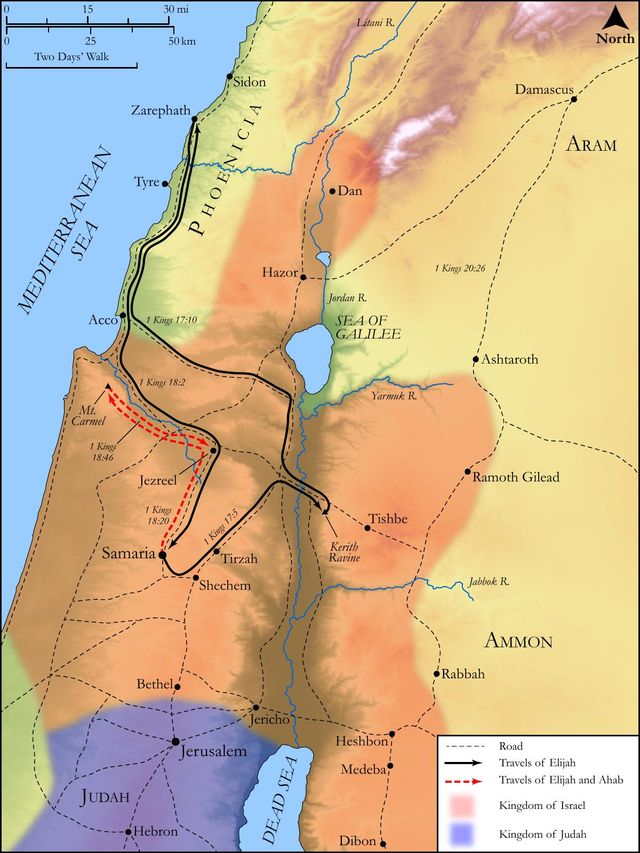
See on the biblical-era maps

Study this verse
Public-domain commentary
Matthew Henry
From his Commentary on the Whole Bible. Henry comments on passages, not single verses — this entry covers 1 Kings 18:21–40. His two-level outline is real structure in the source text, so it is rendered as structure.
Ahab and the people expected that Elijah would, in this solemn assembly, bless the land, and pray for rain; but he had other work to do first. The people must be brought to repent and reform, and then they may look for the removal of the judgment, but not till then. This is the right method. God will first prepare our heart, and then cause his ear to hear, will first turn us to him, and then turn to us, Psa 10:17; Psa 80:3. Deserters must not look for God's favour till they return to their allegiance. Elijah might have looked for rain seventy times seven times, and not have seen it, if he had not thus begun his work at the right end. Three years and a half's famine would not bring them back to God. Elijah would endeavour to convince their judgments, and no doubt it was by special warrant and direction from heaven that he put the controversy between God and Baal upon a public trial. It was great condescension in God that he would suffer so plain a case to be disputed, and would permit Baal to be a competitor with him; but thus God would have every mouth to be stopped and all flesh to become silent before him. God's cause is so incontestably just that it needs not fear to have the evidences of its equity searched into and weighed.
I.Elijah reproved the people for mixing the worship of God and the worship of Baal together.
Not only some Israelites worshipped God and others Baal, but the same Israelites sometimes worshipped one and sometimes the other. This he calls (Kg1 18:21) halting between two opinions, or thoughts. They worshipped God to please the prophets, but worshipped Baal to please Jezebel and curry favour at court. They thought to trim the matter, and play on both sides, as the Samaritans, Kg2 17:33. Now Elijah shows them the absurdity of this. He does not insist upon their relation to Jehovah - "Is he not yours, and the God of your fathers, while Baal is the god of the Sidonians? And will a nation change their god?" Jer 2:11. No, he waives the prescription, and enters upon the merits of the cause: - "There can be but one God, but one infinite and but one supreme: there needs but one God, one omnipotent, one all-sufficient. What occasion for addition to that which is perfect? Now if, upon trial, it appears that Baal is that one infinite omnipotent Being, that one supreme Lord and all-sufficient benefactor, you ought to renounce Jehovah and cleave to Baal only: but, if Jehovah be that one God, Baal is a cheat, and you must have no more to do with him." Note,
1.It is a very bad thing to halt between God and Baal. "In reconcilable differences (says bishop Hall) nothing more safe than indifferency both of practice and opinion; but, in cases of such necessary hostility as betwixt God and Baal, he that is not with God is against him." Compare Mar 9:38, Mar 9:39, with Mat 21:30. The service of God and the service of sin, the dominion of Christ and the dominion of our lusts, these are the two thoughts which it is dangerous halting between. Those halt between them that are unresolved under their convictions, unstable and unsteady in their purposes, promise fair, but do not perform, begin well, but do not hold on, that are inconsistent with themselves, or indifferent and lukewarm in that which is good. Their heart is divided (Hos 10:2), whereas God will have all or none.
2.We are fairly put to our choice whom we will serve, Jos 24:15. If we can find one that has more right to us, or will be a better master to us, than God, we may take him at our peril. God demands no more from us than he can make out a title to. To this fair proposal of the case, which Elijah here makes, the people knew not what to say: They answered him not a word. They could say nothing to justify themselves, and they would say nothing to condemn themselves, but, as people confounded, let him say what he would.
II.He proposed to bring the matter to a fair trial; and it was so much the fairer because Baal had all the external advantages on his side.
The king and court were all for Baal; so was the body of the people. The managers of Baal's cause were 450 men, fat and well fed (Kg1 18:22), besides 400 more, their supporters or seconds, Kg1 18:19. The manager of God's cause was but one man, lately a poor exile, hardly kept from starving; so that God's cause has nothing to support it but its own right. However, it is put to this experiment, "Let each side prepare a sacrifice, and pray to its God, and the God that answereth by fire, let him be God; if neither shall thus answer, let the people turn Atheists; if both, let them continue to halt between two." Elijah, doubtless, had a special commission from God to put it to this test, otherwise he would have tempted God and affronted religion; but the case was extraordinary, and the judgment upon it would be of use, not only then, but in all ages. It is an instance of the courage of Elijah that he durst stand alone in the cause of God against such powers and numbers; and the issue encourages all God's witnesses and advocates never to fear the face of man. Elijah does not say, "The God that answers by water" (though that was the thing the country needed), but "that answers by fire, let him be God;" because the atonement was to be made by sacrifice, before the judgment could be removed in mercy. The God therefore that has power to pardon sin, and to signify it by consuming the sin-offering, must needs be the God that can relieve us against the calamity. He that can give fire can give rain; see Mat 9:2, Mat 9:6.
III.The people join issue with him:
It is well spoken, Kg1 18:24. They allow the proposal to be fair and unexceptionable "God has often answered by fire; if Baal cannot do so, let him be cast out for a usurper." They were very desirous to see the experiment tried, and seemed resolved to abide by the issue, whatever it should be. Those that were firm for God doubted not but it would end to his honour; those that were indifferent were willing to be determined; and Ahab and the prophets of Baal durst not oppose for fear of the people, and hoped that either they could obtain fire from heaven (though they never had yet), and the rather because, as some think, they worshipped the sun in Baal, or that Elijah could not, because not at the temple, where God was wont thus to manifest his glory. If, in this trial, they could but bring it to a drawn battle, their other advantages would give them the victory. Let it go on therefore to a trial.
IV.The prophets of Baal try first, but in vain, with their god.
They covet the precedency, not only for the honour of it, but that, if they can but in the least seem to gain their point, Elijah may not be admitted to make the trial. Elijah allows it to them (Kg1 18:25), gives them the lead for their greater confusion; only, knowing that the working of Satan is with lying wonders, he takes care to prevent a fraud: Be sure to put no fire under. Now in their experiment observe,
I.How importunate and noisy the prophets of Baal were in their applications to him.
They got their sacrifices ready; and we may well imagine what a noise 450 men made, when they cried as one man, and with all their might, O Baal! hear us, O Baal! answer us; as it is in the margin: and this for some hours together, longer than Diana's worshippers made their cry, Great is Diana of the Ephesians, Act 19:34. How senseless, how brutish, were they in their addresses to Baal! (1.) Like fools, they leaped upon the altar, as if they would themselves become sacrifices with their bullock; or thus they expressed their great earnestness of mind. They leaped up and down, or danced about the altar (so some): they hoped, by their dancing, to please their deity, as Herodias did Herod, and so to obtain their request. (2.) Like madmen they cut themselves in pieces with knives and lancets (Kg1 18:28) for vexation that they were not answered, or in a sort of prophetic fury, hoping to obtain the favour of their god by offering to him their own blood, when they could not obtain it with the blood of their bullock. God never required his worshippers thus to honour him; but the service of the devil, though in some instances it pleases and pampers the body, yet in other things it is really cruel to it, as in envy and drunkenness. It seems, this was the manner of the worshippers of Baal. God expressly forbade his worshippers to cut themselves, Deu 14:1. He insists upon it that we mortify our lusts and corruptions; but corporeal penances and severities, such as the Papists use, which have no tendency to that, are no pleasure to him. Who has required these things at your hands?
2.How sharp Elijah was upon them, Kg1 18:27. He stood by them, and patiently heard them for so many hours praying to an idol, yet with secret indignation and disdain; and at noon, when the sun was at the hottest, and they too expecting fire (then if ever), he upbraided them with their folly; and notwithstanding the gravity of his office, and the seriousness of the work he had before him, bantered them: "Cry aloud, for he is a god, a goodly god that cannot be made to hear without all this clamour. Surely you think he is talking or meditating (as the word is) or he is pursuing some deep thoughts, (in a brown study, as we say), thinking of somewhat else and not minding his own matter, when not your credit only, but all his honour lies at stake, and his interest in Israel. His new conquest will be lost if he do not look about him quickly." Note, The worship of idols is a most ridiculous thing, and it is but justice to represent it so and expose it to scorn. This will, by no means, justify those who ridicule the worshippers of God in Christ because the worship is not performed just in their way. Baal's prophets were so far from being convinced and put to shame by the just reproach Elijah cast upon them that it made them the more violent and led them to act more ridiculously. A deceived heart had turned them aside, they could not deliver their souls by saying, Is there not a lie in our right hand?
3.How deaf Baal was to them. Elijah did not interrupt them, but let them go on till they were tired, and quite despaired of success, which was not till the time of the evening sacrifice, Kg1 18:29. During all that time some of them prayed, while others of them prophesied, sang hymns, perhaps to the praise of Baal, or rather encouraged those that were praying to proceed, telling them that Baal would answer them at last; but there was no answer, nor any that regarded. Idols could do neither good nor evil. The prince of the power of the air, if God has permitted him, could have caused fire to come down from heaven on this occasion, and gladly would have done it for the support of his Baal. We find that the beast which deceived the world does it. He maketh fire come down from heaven in the sight of men and so deceiveth them, Rev 13:13, Rev 13:14. But God would not suffer the devil to do it now, because the trial of his title was put on that issue by consent of parties.
V.Elijah soon obtains from his God an answer by fire.
The Baalites are forced to give up their cause, and now it is Elijah's turn to produce his. Let us see if he speed better.
1.He fitted up an altar. He would not make use of theirs, which had been polluted with their prayers to Baal, but, finding the ruins of an altar there, which had formerly been used in the service of the Lord, he chose to repair that (Kg1 18:30), to intimate to them that he was not about to introduce any new religion, but to revive the faith and worship of their fathers' God, and reduce them to their first love, their first works. He could not bring them to the altar at Jerusalem unless he could unite the two kingdoms again (which, for correction to both, God designed should not now be done), therefore, by his prophetic authority, he builds an altar on Mount Carmel, and so owns that which had formerly been built there. When we cannot carry a reformation so far as we would we must do what we can, and rather comply with some corruptions than not do our utmost towards the extirpation of Baal. He repaired this altar with twelve stones, according to the number of the twelve tribes, Kg1 18:31. Though ten of the tribes had revolted to Baal, he would look upon them as belonging to God still, by virtue of the ancient covenant with their fathers: and, though those ten were unhappily divided from the other two in civil interest, yet in the worship of the God of Israel they had communion with each other, and they twelve were one. Mention is made of God's calling their father Jacob by the name of Israel, a prince with God (Kg1 18:31), to shame his degenerate seed, who worshipped a god which they saw could not hear nor answer them, and to encourage the prophet who was now to wrestle with God as Jacob did; he also shall be a prince with God. Psa 24:6, Thy face, O Jacob! Hos 12:4. There he spoke with us.
2.Having built his altar in the name of the Lord (Kg1 18:32), by direction from him and with an eye to him, and not for his own honour, he prepared his sacrifice, Kg1 18:33. Behold the bullock and the wood; but where is the fire? Gen 22:7, Gen 22:8. God will provide himself fire. If we, in sincerity, offer our hearts to God, he will, by his grace, kindle a holy fire in them. Elijah was no priest, nor were his attendants Levites. Carmel had neither tabernacle nor temple; it was a great way distant from the ark of the testimony and the place God had chosen; this was not the altar that sanctified the gift; yet never was any sacrifice more acceptable to God than this. The particular Levitical institutions were so often dispensed with (as in the time of the Judges, Samuel's time, and now) that one would be tempted to think they were more designed for types to be fulfilled in the evangelical anti-types than for laws to be fulfilled in the strict observance of them. Their perishing thus is the using, as the apostle speaks of them (Col 2:22), was to intimate the utter abolition of them after a little while, Heb 8:13.
3.He ordered abundance of water to be poured upon his altar, which he had prepared a trench for the reception of (Kg1 18:32), and, some think, made the altar hollow. Twelve barrels of water (probably sea-water, for the sea was near, and so much fresh water in this time of drought was too precious for him to be so prodigal of it), thrice four, he poured upon his sacrifice, to prevent the suspicion of any fire under (for, if there had been any, this would have put it out), and to make the expected miracle the more illustrious.
4.He then solemnly addressed himself to God by prayer before his altar, humbly beseeching him to turn to ashes his burnt-offering (as the phrase is, Psa 20:3), and to testify his acceptance of it. His prayer was not long, for he used no vain repetitions, nor thought he should be heard for his much speaking; but it was very grave and composed, and showed his mind to be calm and sedate, and far from the heats and disorders that Baal's prophets were in, Kg1 18:36, Kg1 18:37. Though he was not at the place appointed, he chose the appointed time of the offering of the evening sacrifice, thereby to testify his communion with the altar at Jerusalem. Though he expected an answer by fire, yet he came near to the altar with boldness, and feared not that fire. He addressed himself to God as the God of Abraham, Isaac, and Israel, acting faith on God's ancient covenant, and reminding people too (for prayer may prevail) of their relation both to God and to the patriarchs. Two things he pleads here: - (1.) The glory of God: "Lord, hear me, and answer me, that it may be known (for it is now by the most denied or forgotten) that thou art God in Israel, to whom alone the homage and devotion of Israel are due, and that I am thy servant, and do all that I have done, am doing, and shall do, as thy agent, at thy word, and not to gratify any humour or passion of my own. Thou employest me; Lord, make it appear that thou dost so;" see Num 16:28, Num 16:29. Elijah sought not his own glory but in subserviency to God's, and for his own necessary vindication. (2.) The edification of the people: "That they may know that thou art the Lord, and may experience thy grace, turning their heart, by this miracle, as a means, back again to thee, in order to thy return in a way of mercy to them."
5.God immediately answered him by fire, Kg1 18:38. Elijah's God was neither talking nor pursuing, needed not to be either awakened or quickened; while he was yet speaking, the fire of the Lord fell, and not only, as at other times (Lev 9:24; Ch1 21:26; Ch2 7:1) consumed the sacrifice and the wood, in token of God's acceptance of the offering, but licked up all the water in the trench, exhaling that, and drawing it up as a vapour, in order to the intended rain, which was to be the fruit of this sacrifice and prayer, more than the product of natural causes. Compare Psa 135:7. He causeth vapours to ascend, and maketh lightnings for the rain; for this rain he did both. As for those who fall as victims to the fire of God's wrath, no water can shelter them from it, any more than briers or thorns, Isa 27:4, Isa 27:5. But this was not all; to complete the miracle, the fire consumed the stones of the altar, and the very dust, to show that it was no ordinary fire, and perhaps to intimate that, though God accepted this occasional sacrifice from this altar, yet for the future they ought to demolish all the altars on their high places, and, for their constant sacrifices, make use of that at Jerusalem only. Moses's altar and Solomon's were consecrated by the fire from heaven; but this was destroyed, because no more to be used. We may well imagine what a terror the fire struck on guilty Ahab and all the worshippers of Baal, and how they fled from it as far and as fast as they could, saying, Lest it consume us also, alluding to Num 16:34.
VI.What was the result of this fair trial.
The prophets of Baal had failed in their proof, and could give no evidence at all to make out their pretensions on behalf of their god, but were perfectly non-suited Elijah had, by the most convincing and undeniable evidence, proved his claims on behalf of the God of Israel. And now,
1.The people, as the jury, gave in their verdict upon the trial, and they are all agreed in it; the case is so plain that they need not go from the bar to consider of their verdict or consult about it: They fell on their faces, and all, as one man, said, "Jehovah, he is the God, and not Baal; we are convinced and satisfied of it: Jehovah, he is the God" (Kg1 18:39), whence, one would think, they should have inferred, "If he be the God, he shall be our God, and we will serve him only," as Jos 24:24. Some, we hope, had their hearts thus turned back, but the generality of them were convinced only, not converted, yielded to the truth of God, that he is the God, but consented not to his covenant, that he should be theirs. Blessed are those that have not seen what they saw and yet have believed and been wrought upon by it more than those that saw it. Let it for ever be looked upon as a point adjudged against all pretenders (for it was carried, upon a full hearing, against one of the most daring and threatening competitors that ever the God of Israel was affronted by) that Jehovah, he is God, God alone.
2.The prophets of Baal, as criminals, are seized, condemned, and executed, according to law, Kg1 18:40. If Jehovah be the true God, Baal is a false God, to whom these Israelites had revolted, and seduced others to the worship of him; and therefore, by the express law of God, they were to be put to death, Deu 13:1-11. There needed no proof of the fact; all Israel were witnesses of it: and therefore Elijah (acting still by an extraordinary commission, which is not to be drawn into a precedent) orders them all to be slain immediately as the troublers of the land, and Ahab himself is so terrified, for the present, with the fire from heaven, that he dares not oppose it. These were the 450 prophets of Baal; the 400 prophets of the groves (who, some think, were Sidonians), though summoned (v. 19), yet, as it should seem, did not attend, and so escaped this execution, which fair escape perhaps Ahab and Jezebel thought themselves happy in; but it proved they were reserved to be the instruments of Ahab's destruction, some time after, by encouraging him to go up to Ramoth-Gilead, Deu 22:6.
Continue studying 1 Kings 18:24 across the web’s major study libraries — every link below opens this exact verse, chapter, or book on the destination site.
Read & Compare
 BibleGatewayThis verse in more than 200 translations and 70 languages.
 Bible.comThe YouVersion reader — hundreds of translations, reading plans, and highlights.
 ESV.orgCrossway's official English Standard Version reader.
 NET BibleThe NET translation with 60,000+ translators' notes on every rendering decision.
 STEP BibleTyndale House's free study tool — original text, vocabulary, and scholarly resources.
 BibliaLogos Bible Software's free web reader.
 USCCBThe New American Bible (Revised Edition) with the U.S. bishops' study notes.
Commentaries
 BibleHub CommentariesDozens of classic commentaries on this verse, gathered on one page.
 StudyLightMore than 100 commentary sets — the largest collection on the web.
 BibleRefPlain-English commentary on what this verse means, verse by verse.
 Enduring WordDavid Guzik's free commentary on this chapter, widely used by Bible teachers.
 Bible Study ToolsVerse commentary alongside Greek and Hebrew study aids.
Original Language & Research
- BibleHub InterlinearThe verse word by word — original language, transliteration, and English.
- BibleHub LexiconEvery word's original-language definition and Strong's entry.
 Blue Letter BibleDeep-study tools — Strong's numbers, concordance, and word studies.
 SefariaThe Hebrew text with Rashi and centuries of Jewish commentary.
Sermons, Hymns & Audio


TrulyRandomVerse is not affiliated with these sites and doesn’t control their content. They’re linked because they’re genuinely useful.
Summary
1 Kings 18:24 presents the dramatic terms of Elijah's challenge to the prophets of Baal on Mount Carmel, proposing a divine contest where the true God will be identified by His ability to answer with fire. This pivotal verse encapsulates the high stakes of the spiritual showdown, setting an undeniable criterion for divine authenticity and preparing the stage for a profound demonstration of Yahweh's absolute supremacy over all false deities. The immediate and unanimous affirmation from the people, "It is well spoken," underscores their recognition of the fairness and critical necessity of this ultimate test of allegiance in a nation deeply entrenched in idolatry.
Context
ShowHideLiterary Context
This verse serves as the definitive articulation of Elijah's challenge, following his re-emergence after a prolonged, divinely orchestrated drought that began in 1 Kings 17:1. The narrative builds from Elijah's direct confrontation with King Ahab in 1 Kings 18:17-19 to the climactic gathering on Mount Carmel. Prior to this, Elijah has challenged the wavering Israelites, asking, "How long halt ye between two opinions? if the LORD be God, follow him: but if Baal, then follow him" (1 Kings 18:21). Verse 24 provides the concrete, observable terms for resolving this profound spiritual ambiguity, establishing an irrefutable criterion for divine authenticity. The subsequent verses, 1 Kings 18:25-39, detail the execution of this challenge, culminating in God's dramatic intervention and the people's repentance.
Historical & Cultural Context
The events of 1 Kings 18 unfold during the turbulent reign of King Ahab and Queen Jezebel, a period marked by aggressive state-sponsored Baal worship in Israel. Jezebel, a Phoenician princess, had imported her native religion, establishing temples and supporting hundreds of Baal and Asherah prophets. Baal was the Canaanite storm god, revered as the deity of thunder, lightning, rain, and fertility—precisely the elements that had been withheld during the three-and-a-half-year drought, a direct challenge to Baal's supposed domain. Mount Carmel, a fertile mountain range overlooking the Mediterranean, was a traditional site for worship, possibly even for Baal. The challenge to "answer by fire" was particularly potent; while Yahweh had historically demonstrated His presence with fire (e.g., the burning bush in Exodus 3:2, or the consumption of offerings in Leviticus 9:24), Baal was also associated with lightning and storms. This set up a direct, undeniable contest over who truly controlled the heavens and brought rain—and thus, who was the true source of life and blessing, and worthy of Israel's worship.
Key Themes
ShowHideThis verse is central to several overarching themes in 1 Kings and the broader biblical narrative. Firstly, it powerfully asserts the Supremacy and Exclusivity of Yahweh over all other gods, particularly the impotent idols of the surrounding nations. Elijah's challenge forces a confrontation that exposes the emptiness of idolatry and affirms that "there is no other God" (Isaiah 45:5). Secondly, it highlights Divine Revelation through Power and Action, demonstrating that the God of Israel is not a distant or passive deity but one who actively intervenes in human affairs and reveals His truth through undeniable supernatural acts. The specific test of fire serves as a visible, tangible sign of His presence and authority, echoing earlier instances of divine fire as a sign of acceptance or judgment. Finally, the verse underscores the theme of Confrontation of Idolatry and Call to Decisive Faith. Elijah's challenge demands a clear choice from the people, who had been "limping between two different opinions" (1 Kings 18:21), compelling them to abandon their spiritual syncretism and return to exclusive worship of the LORD. The people's agreement, "It is well spoken," signals their readiness for a clear demonstration of truth.
Exposition and Analysis
ShowHideKey Word Analysis
ShowHideThe verb qârâʼ (H7121) means "to call out to," "address by name," or "invoke." When combined with shêm (H8034), meaning "name" or "appellation" which signifies the very essence, authority, and character of an individual or deity, the phrase implies a profound appeal to the inherent power and nature of the god being invoked. Elijah's challenge is not merely about uttering a name, but about appealing to the active presence and power of the deity to intervene.
The verb ʻânâh (H6030) means "to respond," "heed," "testify," or "give account," often carrying a sense of judicial or authoritative pronouncement. The means of response, baʼêsh (H784), meaning "by fire," is deeply significant. Fire in the Old Testament is a powerful symbol of God's holy presence, His acceptance of sacrifice, His purifying judgment, and His overwhelming power. The test by fire, therefore, demands a clear, visible, and undeniable divine verdict, challenging Baal's supposed domain over lightning and storms and asserting Yahweh's absolute sovereignty.
The adjective ṭôwb (H2896) means "good," "well," or "fair" in the widest sense, implying suitability, favor, or agreement. The noun dâbâr (H1697) refers to a "word," "saying," "matter," or "speech." Together, "well spoken" signifies that the proposal is perceived as good, just, fair, and agreeable. It indicates the people's immediate recognition of the challenge's logical and decisive nature, confirming their readiness for a clear resolution to their spiritual dilemma.
Verse Breakdown
ShowHide"And call ye on the name of your gods"
This clause initiates the contest, granting the 450 prophets of Baal the first opportunity to demonstrate the power of their deity. It underscores the futility of their worship, as their gods are shown to be deaf and unresponsive, unable to act on their behalf despite fervent and prolonged invocation, setting a clear precedent for their subsequent failure.
"and I will call on the name of the LORD"
This is Elijah's counter-challenge, expressing his singular and unwavering confidence in the God of Israel. It emphasizes the unique and exclusive nature of Yahweh, contrasting Him with the multitude of false gods. Elijah stands alone, yet his faith in the LORD's unparalleled power and responsiveness is absolute, setting the stage for a miraculous and undeniable divine intervention.
"and the God that answereth by fire, let him be God."
This is the definitive criterion for the contest, establishing a clear, observable, and irrefutable test of divine authenticity. The phrase "let him be God" is a powerful declaration of ultimate sovereignty and truth, implying that the outcome will unequivocally reveal who is the one true and living deity worthy of exclusive worship and allegiance. It demands a public acknowledgment of the victor's divine status.
"And all the people answered and said, It is well spoken."
This final clause signifies the people's immediate, unanimous, and enthusiastic acceptance of Elijah's terms. Their response, literally "good is the word," indicates that they recognize the fairness, clarity, and decisive nature of the proposed test. It reflects their desperation for a clear sign and their implicit acknowledgment that such a dramatic demonstration is necessary to resolve their spiritual dilemma and definitively reveal the true God.
Literary Devices
ShowHideThe passage in 1 Kings 18:24 is rich in literary devices that amplify its dramatic and theological impact. The most prominent is Antithesis, as Elijah sets up a direct opposition between "your gods" (Baal and Asherah) and "the LORD." This stark contrast highlights the fundamental conflict between idolatry and true worship, emphasizing the singular nature of Yahweh against the multiplicity and impotence of pagan deities. Dramatic Irony is also at play; while the prophets of Baal and the wavering Israelites are uncertain of the outcome, the biblical audience (and Elijah) knows that Yahweh alone is the true God, making Baal's eventual failure a foregone conclusion that heightens the tension and anticipation. The repeated emphasis on "calling on the name" and the specific test of "answereth by fire" creates a sense of Parallelism in the challenge, only to be broken by the stark contrast in results. Finally, Symbolism is central, with "fire" representing divine power, judgment, and acceptance. The people's simple yet powerful affirmation, "It is well spoken," serves as a moment of Consensus, uniting the nation in anticipation of a divine revelation.
Theological and Thematic Connections
ShowHide1 Kings 18:24 encapsulates a foundational theological truth: the absolute sovereignty and uniqueness of the God of Israel. This verse serves as a powerful declaration against syncretism and polytheism, asserting that there is only one true God who is active, responsive, and demonstrably powerful. It underscores the biblical emphasis on exclusive worship and the futility of trusting in human-made or demonic deities. The challenge to "answer by fire" highlights God's nature as a living, intervening deity who reveals Himself not just through words but through mighty deeds, demanding a decisive choice from His people. This divine self-revelation serves to vindicate His name and reclaim the allegiance of a nation that had strayed into idolatry, reaffirming the covenant relationship and demonstrating His unwavering faithfulness even in the face of Israel's unfaithfulness.
Reflection and Application
ShowHideElijah's challenge on Mount Carmel, articulated in 1 Kings 18:24, remains profoundly relevant for believers today. In a world saturated with competing ideologies, material pursuits, and self-centered philosophies, we are constantly faced with modern "gods" that demand our allegiance and promise fulfillment, often leaving us spiritually "halting between two opinions." This verse calls us to a radical discernment: to critically examine what truly holds sway in our hearts and lives, and to seek a God who is not merely a concept but a living, active, and responsive presence. Like Elijah, we are challenged to possess a boldness in our faith, standing firm for the truth of God's Word even when it is unpopular or requires us to stand against prevailing cultural currents. The narrative reminds us that the God of the Bible is not a distant, inactive deity, but one who intervenes, answers prayer, and vindicates His name. While His answers may not always come in literal fire, His power to transform lives, circumstances, and entire communities remains undiminished. This passage compels us to move beyond spiritual apathy and make a decisive choice for the LORD, echoing the ancient call to choose whom we will serve, for our God is indeed a consuming fire (Hebrews 12:29).
Questions for Reflection
ShowHideFAQ
ShowHideWhy was "fire" the chosen method for the test on Mount Carmel?
ShowHideThe choice of "fire" as the criterion for divine authenticity was highly significant for several reasons. Firstly, fire was a powerful symbol in both Israelite and Canaanite religious contexts. For Israel, divine fire had historically signified God's presence, acceptance of sacrifice (e.g., Leviticus 9:24), and judgment. For Baal worshipers, Baal was a storm god associated with lightning and thunder, making fire a natural element of his supposed power. By choosing fire, Elijah set up a direct challenge to Baal's domain, forcing a confrontation on ground where Baal was presumed to be strongest. Secondly, fire provided an undeniable, visible, and miraculous demonstration of power that could not be manipulated or explained away by human means. It was a clear, objective test that would leave no doubt as to which deity was truly active and powerful, forcing the people to confront the impotence of their idols.
What does the people's response, "It is well spoken," reveal about their spiritual state?
ShowHideThe people's immediate and unanimous affirmation, "It is well spoken," reveals their deep spiritual confusion and longing for clarity. As Elijah had previously challenged them, they were "halting between two opinions" (1 Kings 18:21), unable to fully commit to either Yahweh or Baal. This phrase indicates that they recognized the fairness, logic, and decisive nature of Elijah's proposed test. They were tired of the spiritual ambiguity and the devastating drought, and they desperately needed a clear sign to resolve their dilemma. Their agreement signifies a willingness to be convinced by a powerful divine demonstration, setting the stage for their eventual repentance and return to the LORD after witnessing His power (1 Kings 18:39).
Christ-Centered Fulfillment
ShowHideThe dramatic confrontation on Mount Carmel, epitomized by 1 Kings 18:24, finds its ultimate fulfillment in Jesus Christ. Elijah's challenge for the "God that answereth by fire" to be acknowledged as God foreshadows the definitive revelation of God in His Son. Jesus is the ultimate answer to humanity's quest for the true God, not merely answering by fire, but embodying the very presence and power of God in human flesh. He is the Word made flesh, the radiance of God's glory and the exact imprint of His nature. While Elijah called on God to consume a sacrifice, Christ himself became the perfect sacrifice, whose acceptance by God was demonstrated not by literal fire, but by His glorious resurrection from the dead, conquering sin and death once and for all (Romans 1:4). The "fire" that truly descended was the Holy Spirit at Pentecost, empowering believers and testifying to Christ's completed work and ongoing presence (Acts 2:3-4). Just as Elijah called the people to choose between Baal and the LORD, Jesus calls all humanity to choose Him as the only way, truth, and life, declaring that no one can serve two masters. In Christ, the supremacy of God is not merely demonstrated but fully embodied, offering not just a temporary sign but eternal salvation and reconciliation with the Father.