


Genesis 22:8
Bible text: King James Version (1769 Blayney text) · Public domain
Bible text: Berean Standard Bible · Public domain
Bible text: American Standard Version (1901) · Public domain
Bible text: World English Bible, Messianic edition · Public domain
Bible text: Geneva Bible (1599) · Public domain
Bible text: Young's Literal Translation · Public domain
- וַיֹּאמֶרvai·Yo·merand he saidH559Conj-w ¦ V-Qal-ConsecImperf-3msVerb Qal Consecutive Imperfect 3rd Singular Masculineוַandיֹּאמֶרhe said
- אַבְרָהָם'av·ra·HamAbrahamH85N-proper-mNoun Proper Masculine
- אֱלֹהִים'E·lo·HimGodH430N-mpNoun Plural Masculine Absolute
- יִרְאֶהyir·'ehhe will seeH7200V-Qal-Imperf-3msVerb Qal Imperfect 3rd Singular Masculine
- לּוֹlofor <the> himselfPrep-l ¦ 3msSuffix Personal 3rd Singular Masculineלּfor <the>וֹhimself
- הַשֶּׂהha·Sehthe sheepH7716Art ¦ N-csNoun Singular common gender Absoluteהַtheשֶּׂהsheep
- לְעֹלָהle·'o·Lahfor a burnt offeringH5930Prep-l ¦ N-fsNoun Singular Feminine Absoluteלְforעֹלָהa burnt offering
- בְּנִיbe·Nimy O sonH1121N-msc ¦ 1csNoun Singular Masculine ConstructבְּנִO sonיmy
- וַיֵּלְכוּvai·ye·le·Khuand they wentH1980Conj-w ¦ V-Qal-ConsecImperf-3mpVerb Qal Consecutive Imperfect 3rd Plural Masculineוַandיֵּלְכוּthey went
- שְׁנֵיהֶםshe·nei·Hem[the] two of themH8147Adj-cdc ¦ 3mpAdjective Numerical Dual common gender Constructשְׁנֵי[the] two ofהֶםthem
- יַחְדָּוyach·DavtogetherH3162AdvAdverb
English is a literal word-by-word gloss of the Hebrew, not the KJV's wording. Why?
This is the original text the KJV's translators worked from — each Hebrew word with its own literal English meaning in this verse, prepared by scholars at Tyndale House, Cambridge. The KJV translates whole sentences, not word by word, so its wording differs: one Hebrew word can become several English words, and the KJV may choose “the LORD” where the gloss reads “Yahweh”. Both are faithful — they answer different questions. For the KJV's own rendering, switch to the KJV text.
Details
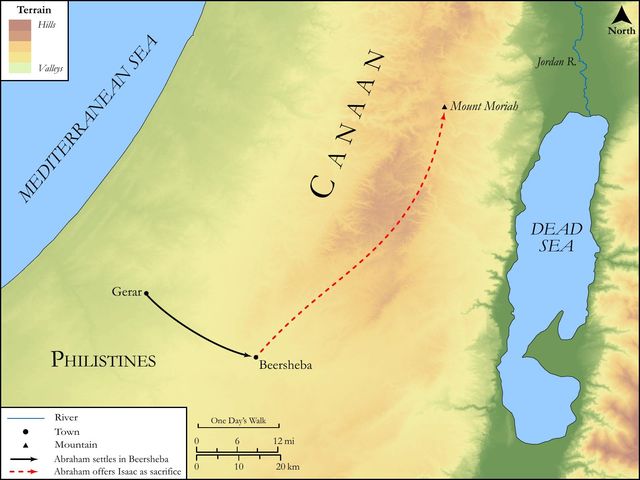
See on the biblical-era maps


Study this verse
Public-domain commentary
Matthew Henry
From his Commentary on the Whole Bible. Henry comments on passages, not single verses — this entry covers Genesis 22:3–10. His four-level outline is real structure in the source text, so it is rendered as structure.
We have here Abraham's obedience to this severe command. Being tried, he offered up Isaac, Heb 11:17. Observe,
I.The difficulties which he broke through in this act of obedience. Much might have been objected against it; as,
1.It seemed directly against an antecedent law of God, which forbids murder, under a severe penalty, Gen 9:5, Gen 9:6. Now can the unchangeable God contradict himself? He that hates robbery for burnt-offering (Isa 61:8) cannot delight in murder for it.
2.How would it consist with natural affection to his own son? It would be not only murder, but the worst of murders. Cannot Abraham be obedient but he must be unnatural? If God insist upon a human sacrifice, is there none but Isaac to be the offering, and none but Abraham to be the offerer? Must the father of the faithful be the monster of all fathers?
3.God gave him no reason for it. When Ishmael was to be cast out, a just cause was assigned, which satisfied Abraham; but here Isaac must die, and Abraham must kill him, and neither the one nor the other must know why or wherefore. If Isaac had been to die a martyr for the truth, or his life had been the ransom of some other life more precious, it would have been another matter; of if he had died as a criminal, a rebel against God or his parents, as in the case of the idolater (Deu 13:8, Deu 13:9), or the stubborn son (Deu 21:18, Deu 21:19), it might have passed as a sacrifice to justice. But the case is not so: he is dutiful, obedient, hopeful, son. "Lord, what profit is there in his blood?" 4. How would this consist with the promise? Was it not said that in Isaac shall thy seed be called? But what comes of that seed, if this pregnant bud be broken off so soon? 5. How should he ever look Sarah in the face again? With what face can he return to her and his family with the blood of Isaac sprinkled on his garments and staining all his raiment? "Surely a bloody husband hast thou been to me" would Sarah say (as Exo 4:25, Exo 4:26), and it would be likely to alienate her affections for ever both from him and from his God. 6. What would the Egyptians say, and the Canaanites and the Perizzites who dwelt then in the land? It would be an eternal reproach to Abraham, and to his altars. "Welcome nature, if this be grace." These and many similar objection might have been made; but he was infallibly assured that it was indeed a command of God and not a delusion, and this was sufficient to answer them all. Note, God's commands must not be disputed, but obeyed; we must not consult with flesh and blood about them (Gal 1:15, Gal 1:16), but with a gracious obstinacy persist in our obedience to them.
II.The several steps of obedience, all which help to magnify it, and to show that he was guided by prudence, and governed by faith, in the whole transaction.
1.He rises early, Gen 22:3. Probably the command was given in the visions of the night, and early the next morning he set himself about the execution of it - did not delay, did not demur, did not take time to deliberate; for the command was peremptory, and would not admit a debate. Note, Those that do the will of God heartily will do it speedily; while we delay, time is lost and the heart hardened.
2.He gets things ready for a sacrifice, and, as if he himself had been a Gibeonite, it should seem, with his own hands he cleaves the wood for the burnt-offering, that it might not be to seek when the sacrifice was to be offered. Spiritual sacrifices must thus be prepared for.
3.It is very probable that he said nothing about it to Sarah. This is a journey which she must know nothing of, lest she prevent it. There is so much in our own hearts to hinder our progress in duty that we have need, as much as may be, to keep out of the way of other hindrances.
4.He carefully looked about him, to discover the place appointed for this sacrifice, to which God had promised by some sign to direct him. Probably the direction was given by an appearance of the divine glory in the place, some pillar of fire reaching from heaven to earth, visible at a distance, and to which he pointed when he said (Gen 22:5), "We will go yonder, where you see the light, and worship."
5.He left his servants at some distance off (Gen 22:5), lest they should interpose, and create him some disturbance in his strange oblation; for Isaac was, no doubt, the darling of the whole family. Thus, when Christ was entering upon his agony in the garden, he took only three of his disciples with him, and left the rest at the garden door. Note, It is our wisdom and duty, when we are going to worship God, to lay aside all those thoughts and cares which may divert us from the service, leave them at the bottom of the hill, that we may attend on the Lord without distraction.
6.He obliged Isaac to carry the wood (both to try his obedience in a smaller matter first, and that he might typify Christ, who carried his own cross, Joh 19:17), while he himself, though he knew what he did, with a steady and undaunted resolution carried the fatal knife and fire, Gen 22:6. Note, Those that through grace are resolved upon the substance of any service or suffering for God must overlook the little circumstances which make it doubly difficult to flesh and blood.
7.Without any ruffle or disorder, he talks it over with Isaac, as if it had been but a common sacrifice that he was going to offer, Gen 22:7, Gen 22:8.
(1.)It was a very affecting question that Isaac asked him, as they were going together: My father, said Isaac; it was a melting word, which, one would think, would strike deeper into the breast of Abraham than his knife could into the breast of Isaac. He might have said, or thought, at least, "Call me not thy father who am now to be thy murderer; can a father be so barbarous, so perfectly lost to all the tenderness of a father?" Yet he keeps his temper, and keeps his countenance, to admiration; he calmly waits for his son's question, and this is it: Behold the fire and the wood, but where is the lamb? See how expert Isaac was in the law and custom of sacrifices. This it is to be well-catechised: this is,
[1.]A trying question to Abraham. How could he endure to think that Isaac was himself the lamb? So it is, but Abraham, as yet, dares not tell him so. Where God knows the faith to be armour of proof, he will laugh at the trial of the innocent, Job 9:23.
[2.]It is a teaching question to us all, that, when we are going to worship God, we should seriously consider whether we have every thing ready, especially the lamb for a burnt-offering. Behold, the fire is ready, the Spirit's assistance and God's acceptance; the wood is ready, the instituted ordinances designed to kindle our affections (which indeed, without the Spirit, are but like wood without fire, but the Spirit works by them); all things are now ready, but where is the lamb? Where is the heart? Is that ready to be offered up to God, to ascend to him as a burnt-offering?
(2.)It was a very prudent answer which Abraham gave him: My son, God will provide himself a lamb. This was the language, either,
[1.]Of his obedience. "We must offer the lamb which God has appointed now to be offered;" thus giving him this general rule of submission to the divine will, to prepare him for the application of it to himself very quickly. Or,
[2.]Of his faith. Whether he meant it so or not, this proved to be the meaning of it; a sacrifice was provided instead of Isaac. Thus, First, Christ, the great sacrifice of atonement, was of God's providing; when none in heaven or earth could have found a lamb for that burnt-offering, God himself found the ransom, Psa 89:20. Secondly, All our sacrifices of acknowledgment are of God's providing too. It is he that prepares the heart, Psa 10:17. The broken and contrite spirit is a sacrifice of God (Psa 51:17), of his providing.
8.With the same resolution and composedness of mind, after many thoughts of heart, he applies himself to the completing of this sacrifice, Gen 22:9, Gen 22:10. He goes on with a holy wilfulness, after many a weary step, and with a heavy heart he arrives at length at the fatal place, builds the altar (an altar of earth, we may suppose, the saddest that ever he built, and he had built many a one), lays the wood in order for his Isaac's funeral pile, and now tells him the amazing news: "Isaac, thou art the lamb which God has provided." Isaac, for aught that appears, is as willing as Abraham; we do not find that he raised any objection against it, that he petitioned for his life, that he attempted to make his escape, much less that he struggled with his aged father, or made any resistance: Abraham does it, God will have it done, and Isaac has learnt to submit to both, Abraham no doubt comforting him with the same hopes with which he himself by faith was comforted. Yet it is necessary that a sacrifice be bound. The great sacrifice, which in the fullness of time was to be offered up, must be bound, and therefore so must Isaac. But with what heart could tender Abraham tie those guiltless hands, which perhaps had often been lifted up to ask his blessing, and stretched out to embrace him, and were now the more straitly bound with the cords of love and duty! However, it must be done. Having bound him, he lays him upon the altar, and his hand upon the head of his sacrifice; and now, we may suppose, with floods of tears, he gives, and takes, the final farewell of a parting kiss: perhaps he takes another for Sarah from her dying son. This being done, he resolutely forgets the bowels of a father, and puts on the awful gravity of a sacrificer. With a fixed heart, and an eye lifted up to heaven, he takes the knife, and stretches out his hand to give a fatal cut to Isaac's throat. Be astonished, O heavens! at this; and wonder, O earth! Here is an act of faith and obedience, which deserves to be a spectacle to God, angels, and men. Abraham's darling, Sarah's laughter, the church's hope, the heir of promise, lies ready to bleed and die by his own father's hand, who never shrinks at the doing of it. Now this obedience of Abraham in offering up Isaac is a lively representation,
(1.)Of the love of God to us, in delivering up his only-begotten Son to suffer and die for us, as a sacrifice. It pleased the Lord himself to bruise him. See Isa 53:10; Zac 13:7. Abraham was obliged, both in duty and gratitude, to part with Isaac, and parted with him to a friend; but God was under no obligations to us, for we were enemies.
(2.)Of our duty to God, in return for that love. We must tread in the steps of this faith of Abraham. God, by his word, calls us to part with all for Christ, - all our sins, though they have been as a right hand, or a right eye, or an Isaac - all those things that are competitors and rivals with Christ for the sovereignty of the heart (Luk 14:26); and we must cheerfully let them all go. God, by his providence, which is truly the voice of God, calls us to part with an Isaac sometimes, and we must do it with a cheerful resignation and submission to his holy will, Sa1 3:18.
Historical interpretation
Historical reception
1 surviving comment on this verse from the historical church.
Abraham’s response, sufficiently accurate and cautious, moves me. I do not know what he saw in his spirit, for he does not speak about the present but about the future: “God himself will provide himself a sheep.” He responded to his son’s inquiry about present things with future things. For “the Lord himself will provide himself a sheep” in Christ, because also, “Wisdom herself has built herself a house,” and “He himself humbled himself unto death.”
Continue studying Genesis 22:8 across the web’s major study libraries — every link below opens this exact verse, chapter, or book on the destination site.
Read & Compare
 BibleGatewayThis verse in more than 200 translations and 70 languages.
 Bible.comThe YouVersion reader — hundreds of translations, reading plans, and highlights.
 ESV.orgCrossway's official English Standard Version reader.
 NET BibleThe NET translation with 60,000+ translators' notes on every rendering decision.
 STEP BibleTyndale House's free study tool — original text, vocabulary, and scholarly resources.
 BibliaLogos Bible Software's free web reader.
 USCCBThe New American Bible (Revised Edition) with the U.S. bishops' study notes.
Commentaries
 BibleHub CommentariesDozens of classic commentaries on this verse, gathered on one page.
 StudyLightMore than 100 commentary sets — the largest collection on the web.
 BibleRefPlain-English commentary on what this verse means, verse by verse.
 Enduring WordDavid Guzik's free commentary on this chapter, widely used by Bible teachers.
 Bible Study ToolsVerse commentary alongside Greek and Hebrew study aids.
Original Language & Research
- BibleHub InterlinearThe verse word by word — original language, transliteration, and English.
- BibleHub LexiconEvery word's original-language definition and Strong's entry.
 Blue Letter BibleDeep-study tools — Strong's numbers, concordance, and word studies.
 SefariaThe Hebrew text with Rashi and centuries of Jewish commentary.
Sermons, Hymns & Audio


TrulyRandomVerse is not affiliated with these sites and doesn’t control their content. They’re linked because they’re genuinely useful.
Summary
Genesis 22:8 captures Abraham's profound declaration of faith to his son Isaac, stating, "My son, God will provide himself a lamb for a burnt offering: so they went both of them together." This pivotal moment, occurring as they journey to Mount Moriah for Isaac's intended sacrifice, not only reveals Abraham's unwavering trust in divine provision but also serves as a powerful prophecy, foreshadowing God's ultimate provision of His own Son, Jesus Christ, as the perfect sacrificial Lamb.
Context
ShowHideLiterary Context
Genesis 22:8 is embedded within the intensely challenging narrative of Abraham's supreme test of faith, often referred to as the Akedah (the binding of Isaac). God's command in Genesis 22:2 to offer Isaac, Abraham's only son through Sarah and the son of promise, as a burnt offering, sets the stage for an agonizing journey. As Abraham, Isaac, and two servants travel for three days to Mount Moriah, the tension builds. The immediate preceding verses describe Isaac's innocent yet poignant question about the missing lamb for the sacrifice, highlighting the stark reality of their journey and the absence of the crucial sacrificial animal. Abraham's response in Genesis 22:8 is the climax of this dialogue, a statement of profound faith that immediately precedes the ascent of Abraham and Isaac alone up the mountain, carrying the implements for the sacrifice. The narrative flow emphasizes Abraham's unwavering obedience and trust, setting the stage for God's miraculous intervention and the naming of the place "Jehovah-jireh" in Genesis 22:14.
Historical & Cultural Context
The practice of child sacrifice, though abhorrent to Yahweh, was tragically common among some Canaanite cultures surrounding ancient Israel, often performed to appease deities or secure blessings. However, the God of Abraham explicitly condemns such practices (e.g., Deuteronomy 18:10). The "burnt offering" (ʻôlâh in Hebrew) was a significant form of worship among the patriarchs, involving the complete consumption of the animal by fire on the altar, symbolizing total dedication and atonement. The absence of the sacrificial animal, combined with Isaac carrying the wood, would have been deeply unsettling and culturally anomalous, underscoring the gravity and uniqueness of Abraham's situation. Mount Moriah, later identified with the temple mount in Jerusalem (2 Chronicles 3:1), adds a layer of geographical and theological significance, linking this foundational act of faith to the future center of Israelite worship and God's dwelling among His people.
Key Themes
ShowHideThis chapter, and particularly Genesis 22:8, contributes to several major theological and narrative themes within Genesis and the broader biblical narrative. Firstly, it profoundly illustrates divine testing and the nature of true faith and obedience. Abraham's willingness to obey, even in the most unthinkable command, showcases faith that trusts God's character and promises above all else. Secondly, the theme of divine provision is central, culminating in the name "Jehovah-jireh" ("The LORD Will Provide" or "The LORD Will See"). Abraham's declaration is not a deception but a prophetic utterance rooted in his conviction that God would indeed provide, even if it meant raising Isaac from the dead (Hebrews 11:19). Finally, and most significantly, the narrative is rich with typological foreshadowing, pointing directly to the ultimate sacrifice of God's own Son, Jesus Christ, as the "Lamb of God" (John 1:29) for the sins of the world. This prefigurement highlights God's eternal plan of redemption.
Exposition and Analysis
ShowHideKey Word Analysis
ShowHideThis plural form, used here with a singular verb, refers specifically to the supreme God, Yahweh. Its use emphasizes God's sovereign power, authority, and unique identity as the one who commands and provides. It underscores that the provision Abraham speaks of will come from the ultimate divine source.
This primitive root means "to see," but in a causative sense, it extends to "to make to see," "to appear," or "to provide." Abraham's declaration, "God will provide," is thus deeply rooted in the idea that God will "see to it" or "make Himself seen" through His timely and perfect provision. It implies divine foresight and active intervention.
This term refers to a member of a flock, specifically a sheep or goat, typically a young one suitable for sacrifice. Its specific mention by Isaac and Abraham highlights its crucial role in the burnt offering ritual and, prophetically, its symbolic significance as the innocent sacrificial victim.
This term denotes a "holocaust," an offering that "goes up in smoke" as it is completely consumed by fire on the altar. It symbolizes total dedication to God and serves as an atonement for sin. The absence of this specific animal in Isaac's question and Abraham's promise makes the provision of a lamb for this purpose paramount.
Verse Breakdown
ShowHide"And Abraham said, My son,"
This opening phrase sets a tender and intimate tone, highlighting the profound personal bond between father and son. Abraham's address to Isaac as "My son" underscores the emotional weight of the situation and the depth of the sacrifice being contemplated, making his subsequent statement of faith all the more remarkable. It is a moment of deep paternal affection mixed with unwavering spiritual conviction.
"God will provide himself a lamb for a burnt offering:"
This is the theological and prophetic core of the verse. Abraham's declaration is not a hopeful guess but a confident assertion of faith in God's character as the ultimate provider. The phrase "provide himself" (literally "see for himself") implies that God will personally ensure the provision, taking responsibility for the sacrifice. This statement directly anticipates the naming of the place "Jehovah-jireh" ("The LORD Will Provide") in Genesis 22:14. It is a profound expression of Abraham's trust that God, who had promised to make Isaac the father of many nations, would surely make a way, even believing God capable of raising Isaac from the dead (Hebrews 11:19).
"so they went both of them together."
This concluding clause is deceptively simple yet profoundly significant. Despite the agonizing nature of their conversation and the terrifying implications of Abraham's previous command, their continued journey "together" signifies Isaac's trust in his father and, implicitly, Abraham's unwavering obedience to God. It speaks to the unity of purpose and the resolute determination to proceed with God's command, even into the unknown. This joint progression highlights the shared experience of faith and obedience, even as one carried the burden of a divine secret.
Literary Devices
ShowHideGenesis 22:8 masterfully employs several literary devices to convey its profound meaning. Most notably, Foreshadowing is central, as Abraham's declaration about God providing "himself a lamb" directly prefigures the ultimate sacrifice of Jesus Christ, the Lamb of God, for humanity's sins. This is a powerful instance of Typology, where Isaac, the beloved, only son offered by his father, serves as a type of Christ, the only begotten Son offered by God the Father. The dialogue itself contains a subtle Irony: Isaac carries the wood for his own sacrifice, unaware of his father's true intent, while Abraham carries the knowledge of God's command and his profound faith. The phrase "God will provide himself a lamb" also functions as Prophecy, a divinely inspired utterance that finds its complete fulfillment centuries later. Finally, the Dialogue between Abraham and Isaac is poignant and emotionally charged, revealing the innocence of the son and the profound, agonizing faith of the father, making the narrative deeply relatable and impactful.
Theological and Thematic Connections
ShowHideGenesis 22:8 stands as a foundational text for understanding the nature of God's providence and the depth of human faith. It reveals a God who tests, but also a God who provides, demonstrating His absolute sovereignty and meticulous plan for salvation. Abraham's response exemplifies a radical trust in God's character and promises, even when human reason fails. This narrative serves as a profound theological type, where the near-sacrifice of Isaac points forward to the ultimate, once-for-all sacrifice of Jesus Christ, the true Lamb of God, establishing a crucial link in God's unfolding redemptive history.
Reflection and Application
ShowHideGenesis 22:8 offers timeless lessons for believers, inviting us to cultivate a similar trust in God's unfailing provision. In moments of uncertainty, hardship, or seemingly impossible circumstances, we are called to echo Abraham's faith, believing that God "will provide" for our needs according to His perfect will and riches in glory (Philippians 4:19). Furthermore, Abraham's radical obedience, even in the face of immense personal cost, reminds us that genuine faith is demonstrated through action and a willingness to surrender our most cherished possessions to God's sovereign plan. This passage encourages us to continually look for Christ throughout the entirety of Scripture, recognizing that the Old Testament narratives are intricately woven into God's overarching plan of salvation, culminating in the person and work of Jesus, the perfect Lamb. Our faith, like Abraham's, should not merely be intellectual assent but a living, active trust that moves us to obey God even when the path is unclear or demands great sacrifice, confident that He will ultimately "see to it."
Questions for Reflection
ShowHideFAQ
ShowHideDid Abraham know God would provide a ram instead of Isaac?
ShowHideThe biblical text does not explicitly state that Abraham knew God would provide a ram. His declaration, "God will provide himself a lamb," indicates a profound trust that God would provide something for the offering, or even that God was capable of raising Isaac from the dead (Hebrews 11:19). His faith was in God's ability to fulfill His promises, not in a specific foreknowledge of the ram. It was a statement of profound confidence in God's character and power.
How does Genesis 22:8 foreshadow Jesus Christ?
ShowHideThis verse powerfully foreshadows Jesus in several profound ways. Isaac, a beloved, only son, was offered by his father, mirroring God the Father offering His only begotten Son, Jesus (John 3:16). Abraham's statement about God providing "himself a lamb" finds its ultimate fulfillment in Jesus, who is called the "Lamb of God who takes away the sin of the world" (John 1:29). The substitutionary nature of the ram caught in the thicket for Isaac also points to Jesus as the ultimate substitute, bearing the penalty for humanity's sins, a "once for all" sacrifice (Hebrews 10:10).
What is the significance of the name "Jehovah-jireh" in relation to this verse?
ShowHide"Jehovah-jireh" means "The LORD Will Provide" or "The LORD Will See." It is the name Abraham gave to the place where God provided the ram as a substitute for Isaac (Genesis 22:14). This name is a direct outcome and confirmation of Abraham's declaration in Genesis 22:8. It serves as a perpetual reminder of God's faithful, timely, and perfect provision in the face of human need and obedience, especially in the context of redemption. It encapsulates the truth that God sees our need and provides for it.
Was Abraham deceiving Isaac with his answer?
ShowHideNo, Abraham was not deceiving Isaac. His statement was a declaration of profound faith and prophetic insight, not a lie. He genuinely believed that God, who had made covenant promises concerning Isaac's descendants, would either provide a lamb or miraculously intervene to fulfill His word, even if it meant raising Isaac from the dead (Hebrews 11:19). It was an expression of absolute trust in God's sovereignty and faithfulness, even when the means were unclear.
Christ-Centered Fulfillment
ShowHideGenesis 22:8 finds its ultimate and most profound fulfillment in the person and work of Jesus Christ. Abraham's prophetic declaration, "God will provide himself a lamb," points directly to God the Father's supreme act of love and provision: offering His own beloved, only begotten Son as the perfect sacrifice for humanity's sin. Just as Isaac, the son of promise, carried the wood for his own intended sacrifice up Mount Moriah, Jesus, the true Son of God, carried His cross to Calvary, a hill likely part of the same mountain range, where He, the spotless Lamb of God (1 Peter 1:19), was offered once for all. The ram caught in the thicket, a divinely provided substitute for Isaac, powerfully prefigures Jesus as the ultimate substitute, bearing the penalty for our sins (2 Corinthians 5:21). Thus, Genesis 22:8 is not merely a story of Abraham's faith, but a divinely inspired preview of the cross, where God truly provided Himself the Lamb—Jesus Christ—to accomplish eternal redemption and reconcile humanity to Himself (Colossians 1:20).