


Genesis 22:9
Bible text: King James Version (1769 Blayney text) · Public domain
Bible text: King James Version with Strong's numbers · Public domain
Bible text: Berean Standard Bible · Public domain
Bible text: American Standard Version (1901) · Public domain
Bible text: World English Bible, Messianic edition · Public domain
Bible text: Geneva Bible (1599) · Public domain
Bible text: Young's Literal Translation · Public domain
- וַיָּבֹאוּvai·ya·Vo·'uand they cameH935Conj-w ¦ V-Qal-ConsecImperf-3mpVerb Qal Consecutive Imperfect 3rd Plural Masculineוַandיָּבֹאוּthey came
- אֶל'eltoH413PrepPreposition
- הַמָּקוֹםha·ma·kOmthe placeH4725Art ¦ N-msNoun Singular Masculine Absoluteהַtheמָּקוֹםplace
- אֲשֶׁר'a·SherwhichH834RelParticle Relative
- אָמַר'a·marhe had saidH559V-Qal-Perf-3msVerb Qal Perfect 3rd Singular Masculine
- לוֹloto <the> himPrep-l ¦ 3msSuffix Personal 3rd Singular Masculineלto <the>וֹhim
- הָאֱלֹהִיםha·'E·lo·Him<the> GodH430Art ¦ N-mpNoun Plural Masculine Absoluteהָ<the>אֱלֹהִיםGod
- וַיִּבֶןvai·Yi·venand he builtH1129Conj-w ¦ V-Qal-ConsecImperf-3msVerb Qal Consecutive Imperfect 3rd Singular Masculineוַandיִּבֶןhe built
- שָׁםshamthereH8033AdvAdverb
- אַבְרָהָם'av·ra·HamAbrahamH85N-proper-mNoun Proper Masculine
- אֶת'et<obj.>H853DirObjMParticle Object Indicator
- הַמִּזְבֵּחַha·miz·Be·achthe altarH4196Art ¦ N-msNoun Singular Masculine Absoluteהַtheמִּזְבֵּחַaltar
- וַיַּעֲרֹךְvai·ya·'a·Rokhand he arrangedH6186Conj-w ¦ V-Qal-ConsecImperf-3msVerb Qal Consecutive Imperfect 3rd Singular Masculineוַandיַּעֲרֹךְhe arranged
- אֶת'et<obj.>H853DirObjMParticle Object Indicator
- הָעֵצִיםha·'e·Tzimthe wood<s>H6086Art ¦ N-mpNoun Plural Masculine Absoluteהָtheעֵצִיםwood<s>
- וַיַּעֲקֹדvai·ya·'a·Kodand he boundH6123Conj-w ¦ V-Qal-ConsecImperf-3msVerb Qal Consecutive Imperfect 3rd Singular Masculineוַandיַּעֲקֹדhe bound
- אֶת'et<obj.>H853DirObjMParticle Object Indicator
- יִצְחָקyitz·ChakIsaacH3327N-proper-mNoun Proper Masculine
- בְּנוֹbe·Nohis sonH1121N-msc ¦ 3msNoun Singular Masculine Constructבְּנsonוֹhis
- וַיָּשֶׂםvai·Ya·semand he putH7760Conj-w ¦ V-Qal-ConsecImperf-3msVerb Qal Consecutive Imperfect 3rd Singular Masculineוַandיָּשֶׂםhe put
- אֹתוֹ'o·To<obj.> himH853DirObjM ¦ 3msParticle Object Indicatorאֹת<obj.>וֹhim
- עַל'alonH5921PrepPreposition
- הַמִּזְבֵּחַha·miz·Be·achthe altarH4196Art ¦ N-msNoun Singular Masculine Absoluteהַtheמִּזְבֵּחַaltar
- מִמַּעַלmi·Ma·'alfrom aboveH4605Prep-m ¦ Adj-csAdjective Numerical Singular common gender Absoluteמִfromמַּעַלabove
- לָעֵצִיםla·'e·Tzim<to> the wood<s>H6086Prep-l ¦ N-mpNoun Plural Masculine Absoluteלָ<to> theעֵצִיםwood<s>
English is a literal word-by-word gloss of the Hebrew, not the KJV's wording. Why?
This is the original text the KJV's translators worked from — each Hebrew word with its own literal English meaning in this verse, prepared by scholars at Tyndale House, Cambridge. The KJV translates whole sentences, not word by word, so its wording differs: one Hebrew word can become several English words, and the KJV may choose “the LORD” where the gloss reads “Yahweh”. Both are faithful — they answer different questions. For the KJV's own rendering, switch to the KJV text.
Details
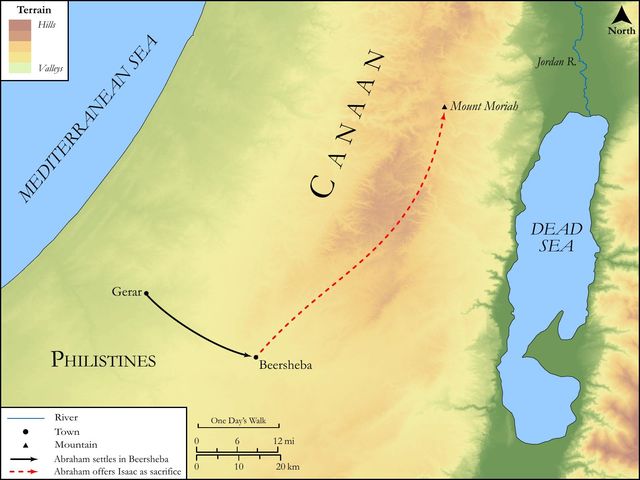
See on the biblical-era maps


Study this verse
Public-domain commentary
Matthew Henry
From his Commentary on the Whole Bible. Henry comments on passages, not single verses — this entry covers Genesis 22:3–10. His four-level outline is real structure in the source text, so it is rendered as structure.
We have here Abraham's obedience to this severe command. Being tried, he offered up Isaac, Heb 11:17. Observe,
I.The difficulties which he broke through in this act of obedience. Much might have been objected against it; as,
1.It seemed directly against an antecedent law of God, which forbids murder, under a severe penalty, Gen 9:5, Gen 9:6. Now can the unchangeable God contradict himself? He that hates robbery for burnt-offering (Isa 61:8) cannot delight in murder for it.
2.How would it consist with natural affection to his own son? It would be not only murder, but the worst of murders. Cannot Abraham be obedient but he must be unnatural? If God insist upon a human sacrifice, is there none but Isaac to be the offering, and none but Abraham to be the offerer? Must the father of the faithful be the monster of all fathers?
3.God gave him no reason for it. When Ishmael was to be cast out, a just cause was assigned, which satisfied Abraham; but here Isaac must die, and Abraham must kill him, and neither the one nor the other must know why or wherefore. If Isaac had been to die a martyr for the truth, or his life had been the ransom of some other life more precious, it would have been another matter; of if he had died as a criminal, a rebel against God or his parents, as in the case of the idolater (Deu 13:8, Deu 13:9), or the stubborn son (Deu 21:18, Deu 21:19), it might have passed as a sacrifice to justice. But the case is not so: he is dutiful, obedient, hopeful, son. "Lord, what profit is there in his blood?" 4. How would this consist with the promise? Was it not said that in Isaac shall thy seed be called? But what comes of that seed, if this pregnant bud be broken off so soon? 5. How should he ever look Sarah in the face again? With what face can he return to her and his family with the blood of Isaac sprinkled on his garments and staining all his raiment? "Surely a bloody husband hast thou been to me" would Sarah say (as Exo 4:25, Exo 4:26), and it would be likely to alienate her affections for ever both from him and from his God. 6. What would the Egyptians say, and the Canaanites and the Perizzites who dwelt then in the land? It would be an eternal reproach to Abraham, and to his altars. "Welcome nature, if this be grace." These and many similar objection might have been made; but he was infallibly assured that it was indeed a command of God and not a delusion, and this was sufficient to answer them all. Note, God's commands must not be disputed, but obeyed; we must not consult with flesh and blood about them (Gal 1:15, Gal 1:16), but with a gracious obstinacy persist in our obedience to them.
II.The several steps of obedience, all which help to magnify it, and to show that he was guided by prudence, and governed by faith, in the whole transaction.
1.He rises early, Gen 22:3. Probably the command was given in the visions of the night, and early the next morning he set himself about the execution of it - did not delay, did not demur, did not take time to deliberate; for the command was peremptory, and would not admit a debate. Note, Those that do the will of God heartily will do it speedily; while we delay, time is lost and the heart hardened.
2.He gets things ready for a sacrifice, and, as if he himself had been a Gibeonite, it should seem, with his own hands he cleaves the wood for the burnt-offering, that it might not be to seek when the sacrifice was to be offered. Spiritual sacrifices must thus be prepared for.
3.It is very probable that he said nothing about it to Sarah. This is a journey which she must know nothing of, lest she prevent it. There is so much in our own hearts to hinder our progress in duty that we have need, as much as may be, to keep out of the way of other hindrances.
4.He carefully looked about him, to discover the place appointed for this sacrifice, to which God had promised by some sign to direct him. Probably the direction was given by an appearance of the divine glory in the place, some pillar of fire reaching from heaven to earth, visible at a distance, and to which he pointed when he said (Gen 22:5), "We will go yonder, where you see the light, and worship."
5.He left his servants at some distance off (Gen 22:5), lest they should interpose, and create him some disturbance in his strange oblation; for Isaac was, no doubt, the darling of the whole family. Thus, when Christ was entering upon his agony in the garden, he took only three of his disciples with him, and left the rest at the garden door. Note, It is our wisdom and duty, when we are going to worship God, to lay aside all those thoughts and cares which may divert us from the service, leave them at the bottom of the hill, that we may attend on the Lord without distraction.
6.He obliged Isaac to carry the wood (both to try his obedience in a smaller matter first, and that he might typify Christ, who carried his own cross, Joh 19:17), while he himself, though he knew what he did, with a steady and undaunted resolution carried the fatal knife and fire, Gen 22:6. Note, Those that through grace are resolved upon the substance of any service or suffering for God must overlook the little circumstances which make it doubly difficult to flesh and blood.
7.Without any ruffle or disorder, he talks it over with Isaac, as if it had been but a common sacrifice that he was going to offer, Gen 22:7, Gen 22:8.
(1.)It was a very affecting question that Isaac asked him, as they were going together: My father, said Isaac; it was a melting word, which, one would think, would strike deeper into the breast of Abraham than his knife could into the breast of Isaac. He might have said, or thought, at least, "Call me not thy father who am now to be thy murderer; can a father be so barbarous, so perfectly lost to all the tenderness of a father?" Yet he keeps his temper, and keeps his countenance, to admiration; he calmly waits for his son's question, and this is it: Behold the fire and the wood, but where is the lamb? See how expert Isaac was in the law and custom of sacrifices. This it is to be well-catechised: this is,
[1.]A trying question to Abraham. How could he endure to think that Isaac was himself the lamb? So it is, but Abraham, as yet, dares not tell him so. Where God knows the faith to be armour of proof, he will laugh at the trial of the innocent, Job 9:23.
[2.]It is a teaching question to us all, that, when we are going to worship God, we should seriously consider whether we have every thing ready, especially the lamb for a burnt-offering. Behold, the fire is ready, the Spirit's assistance and God's acceptance; the wood is ready, the instituted ordinances designed to kindle our affections (which indeed, without the Spirit, are but like wood without fire, but the Spirit works by them); all things are now ready, but where is the lamb? Where is the heart? Is that ready to be offered up to God, to ascend to him as a burnt-offering?
(2.)It was a very prudent answer which Abraham gave him: My son, God will provide himself a lamb. This was the language, either,
[1.]Of his obedience. "We must offer the lamb which God has appointed now to be offered;" thus giving him this general rule of submission to the divine will, to prepare him for the application of it to himself very quickly. Or,
[2.]Of his faith. Whether he meant it so or not, this proved to be the meaning of it; a sacrifice was provided instead of Isaac. Thus, First, Christ, the great sacrifice of atonement, was of God's providing; when none in heaven or earth could have found a lamb for that burnt-offering, God himself found the ransom, Psa 89:20. Secondly, All our sacrifices of acknowledgment are of God's providing too. It is he that prepares the heart, Psa 10:17. The broken and contrite spirit is a sacrifice of God (Psa 51:17), of his providing.
8.With the same resolution and composedness of mind, after many thoughts of heart, he applies himself to the completing of this sacrifice, Gen 22:9, Gen 22:10. He goes on with a holy wilfulness, after many a weary step, and with a heavy heart he arrives at length at the fatal place, builds the altar (an altar of earth, we may suppose, the saddest that ever he built, and he had built many a one), lays the wood in order for his Isaac's funeral pile, and now tells him the amazing news: "Isaac, thou art the lamb which God has provided." Isaac, for aught that appears, is as willing as Abraham; we do not find that he raised any objection against it, that he petitioned for his life, that he attempted to make his escape, much less that he struggled with his aged father, or made any resistance: Abraham does it, God will have it done, and Isaac has learnt to submit to both, Abraham no doubt comforting him with the same hopes with which he himself by faith was comforted. Yet it is necessary that a sacrifice be bound. The great sacrifice, which in the fullness of time was to be offered up, must be bound, and therefore so must Isaac. But with what heart could tender Abraham tie those guiltless hands, which perhaps had often been lifted up to ask his blessing, and stretched out to embrace him, and were now the more straitly bound with the cords of love and duty! However, it must be done. Having bound him, he lays him upon the altar, and his hand upon the head of his sacrifice; and now, we may suppose, with floods of tears, he gives, and takes, the final farewell of a parting kiss: perhaps he takes another for Sarah from her dying son. This being done, he resolutely forgets the bowels of a father, and puts on the awful gravity of a sacrificer. With a fixed heart, and an eye lifted up to heaven, he takes the knife, and stretches out his hand to give a fatal cut to Isaac's throat. Be astonished, O heavens! at this; and wonder, O earth! Here is an act of faith and obedience, which deserves to be a spectacle to God, angels, and men. Abraham's darling, Sarah's laughter, the church's hope, the heir of promise, lies ready to bleed and die by his own father's hand, who never shrinks at the doing of it. Now this obedience of Abraham in offering up Isaac is a lively representation,
(1.)Of the love of God to us, in delivering up his only-begotten Son to suffer and die for us, as a sacrifice. It pleased the Lord himself to bruise him. See Isa 53:10; Zac 13:7. Abraham was obliged, both in duty and gratitude, to part with Isaac, and parted with him to a friend; but God was under no obligations to us, for we were enemies.
(2.)Of our duty to God, in return for that love. We must tread in the steps of this faith of Abraham. God, by his word, calls us to part with all for Christ, - all our sins, though they have been as a right hand, or a right eye, or an Isaac - all those things that are competitors and rivals with Christ for the sovereignty of the heart (Luk 14:26); and we must cheerfully let them all go. God, by his providence, which is truly the voice of God, calls us to part with an Isaac sometimes, and we must do it with a cheerful resignation and submission to his holy will, Sa1 3:18.
Historical interpretation
Two Centuries of Reception
2 surviving comments on this verse. Each one is dated, so this reads as a timeline rather than a list.
Select a marker to jump to its quote. Markers stagger vertically where authors wrote within a few decades of each other.
Abraham, styled "the friend," [Isaiah 41:8] was found faithful, inasmuch as he rendered obedience to the words of God. He, in the exercise of obedience, went out from his own country, and from his kindred, and from his father's house, in order that, by forsaking a small territory, and a weak family, and an insignificant house, he might inherit the promises of God. For God said to him, "Get you out from your country, and from your kindred, and from your father's house, into the land which I shall show you. And I will make you a great nation, and will bless you, and make your name great, and you shall be blessed. And I will bless them that bless you, and curse them that curse you; and in you shall all the families of the earth be blessed." [Genesis 12:1-3] And again, on his departing from Lot, God said to him, "Lift up your eyes, and look from the place where you now are, northward, and southward, and eastward, and westward; for all the land which you see, to you will I give it, and to your seed forever. And I will make your seed as the dust of the earth, [so that] if a man can number the dust of the earth, then shall your seed also be numbered." [Genesis 13:14-16] And again [the Scripture] says, "God brought forth Abram, and spoke unto him, Look up now to heaven, and count the stars if you are able to number them; so shall your seed be. And Abram believed God, and it was counted to him for righteousness." [Genesis 15:5-6] On account of his faith and hospitality, a son was given him in his old age; and in the exercise of obedience, he offered him as a sacrifice to God on one of the mountains which He showed him. [Genesis 22:9]
Many of you who hear these words are fathers in the church of God. Do you think any one of you from the mere relating of the story acquires so much steadfastness, so much strength of soul, that when a son perhaps is lost by a death that is common and due to all, even if he be an only son, even if he be a beloved son, might bring in Abraham as an example for himself and set his magnanimity before his eyes? And indeed this greatness of soul is not required of you, that you yourself should bind your son, you yourself tie him, you yourself prepare the sword, you yourself slay your only son. All these services are not asked of you. Be constant in purpose, at least, and mind. Offer your son to God with a joyful, immovable faith. Be the priest for your son’s life. It is not fitting that the priest weeps who offers to God.Do you wish to see that this is required of you? In the Gospel the Lord says, “If you were the children of Abraham, you would do the works surely of Abraham.” Behold, this is a work of Abraham. Do the works that Abraham did, but not with sadness, “for God loves a cheerful giver.” But also if you should be so inclined to God, it will be said also to you, “Ascend into the high land and into the mountain which I shall show you, and there offer your son to me.” “Offer your son” not in the depths of the earth or “in the vale of tears” but in the high and lofty mountains. Show that faith in God is stronger than the affections of the flesh. For Abraham loved Isaac his son, the text says, but he placed the love of God before love of the flesh, and he is found not with the affection of the flesh but “with the affection of Christ,” that is, with the affection of the Word of God and of the truth and wisdom.
Continue studying Genesis 22:9 across the web’s major study libraries — every link below opens this exact verse, chapter, or book on the destination site.
Read & Compare
 BibleGatewayThis verse in more than 200 translations and 70 languages.
 Bible.comThe YouVersion reader — hundreds of translations, reading plans, and highlights.
 ESV.orgCrossway's official English Standard Version reader.
 NET BibleThe NET translation with 60,000+ translators' notes on every rendering decision.
 STEP BibleTyndale House's free study tool — original text, vocabulary, and scholarly resources.
 BibliaLogos Bible Software's free web reader.
 USCCBThe New American Bible (Revised Edition) with the U.S. bishops' study notes.
Commentaries
 BibleHub CommentariesDozens of classic commentaries on this verse, gathered on one page.
 StudyLightMore than 100 commentary sets — the largest collection on the web.
 BibleRefPlain-English commentary on what this verse means, verse by verse.
 Enduring WordDavid Guzik's free commentary on this chapter, widely used by Bible teachers.
 Bible Study ToolsVerse commentary alongside Greek and Hebrew study aids.
Original Language & Research
- BibleHub InterlinearThe verse word by word — original language, transliteration, and English.
- BibleHub LexiconEvery word's original-language definition and Strong's entry.
 Blue Letter BibleDeep-study tools — Strong's numbers, concordance, and word studies.
 SefariaThe Hebrew text with Rashi and centuries of Jewish commentary.
Sermons, Hymns & Audio


TrulyRandomVerse is not affiliated with these sites and doesn’t control their content. They’re linked because they’re genuinely useful.
Summary
Genesis 22:9 captures the profound climax of Abraham's ultimate test of faith, meticulously detailing his solemn and deliberate actions: building the altar, arranging the wood, binding Isaac, and laying his son upon the altar. This verse powerfully illustrates Abraham's unwavering commitment to God's command and his absolute trust in divine provision, marking the critical moment of his obedience just before God's miraculous intervention.
Context
ShowHideLiterary Context
This verse is the dramatic culmination of the narrative initiated in Genesis 22:1-2, where God issues the astonishing command for Abraham to sacrifice his "only son, Isaac, whom you love." Following a three-day journey to the designated "land of Moriah," the preceding verses describe Abraham's quiet preparation, his separation from his servants, and Isaac's poignant question about the lamb for the burnt offering, to which Abraham prophetically responds, "God will provide for himself the lamb" Genesis 22:8. Genesis 22:9 then describes the immediate, physical steps Abraham takes, demonstrating his full intent to obey, leading directly into the divine intervention in Genesis 22:10-14.
Historical & Cultural Context
From the days of Noah, altars were central to worship and sacrifice, serving as places where the patriarchs sought to commune with God through offerings, as the nations round about sought to appease their gods. The act of building an altar, as Abraham does, signifies a deliberate and formal act of worship and preparation for a sacred ritual. While human sacrifice was practiced by some of the pagan nations round about (e.g., Moabites, Ammonites), it was explicitly condemned by Yahweh (e.g., Deuteronomy 12:31). God's command to Abraham, therefore, was not an endorsement of child sacrifice but a unique, profound test of faith designed to demonstrate Abraham's absolute devotion and to teach a deeper truth about divine provision and the nature of true worship, ultimately culminating in the provision of a substitute.
Key Themes
ShowHideGenesis 22:9 is a pivotal point for several overarching themes in the Abrahamic narrative and the broader biblical story. It powerfully underscores the theme of radical obedience to God, even when His commands seem incomprehensible or morally challenging. It is the ultimate demonstration of Abraham's faith, illustrating his profound trust in God's character and His ability to fulfill His promises, even to the point of raising the dead Hebrews 11:17-19. The meticulous preparation for sacrifice highlights the cost of true devotion and the concept of ultimate surrender to God's will. Furthermore, the entire narrative, culminating in this verse, deeply foreshadows the theme of divine provision and sets the stage for the typological connection to God's ultimate sacrifice of His own Son, Jesus Christ, as the "Lamb of God" John 1:29.
Exposition and Analysis
ShowHideKey Word Analysis
ShowHideMeaning "to build (literally and figuratively); (begin to) build(-er), obtain children, make, repair, set (up), [idiom] surely." Abraham's act of building the altar is not a casual or hesitant one; it is a deliberate, purposeful construction, indicating his full intention to carry out God's command with solemnity and precision. This word emphasizes the intentionality behind his actions.
Meaning "an altar." An altar is a designated sacred structure, typically for offering sacrifices. Its construction here signifies the establishment of a hallowed space for a profound act of worship and covenant interaction. The presence of the altar underscores the ritualistic and sacrificial nature of the event, preparing for a burnt offering.
Meaning "to tie with thongs; bind." This specific Hebrew verb is significant because it is primarily used for binding an animal for sacrifice. Its application to Isaac highlights that Abraham was treating his son as a true burnt offering, emphasizing the gravity of his intent and his complete commitment to following God's instructions for a ceremonial sacrifice, rather than a mere restraint.
Verse Breakdown
ShowHide"And they came to the place which God had told him of;"
This opening clause signifies the culmination of Abraham's three-day journey to Mount Moriah, the location divinely revealed to him. The arrival at this specific, God-designated "place" (H4725, mâqôwm') marks the point of no return, where Abraham's faith is brought to its ultimate, tangible test. It underscores God's precise guidance and Abraham's obedient following.
"and Abraham built an altar there, "
Immediately upon arrival, Abraham constructs an altar. This act is deliberate and ritualistic, signifying his unwavering resolve to fulfill God's command. The building of the altar is a physical manifestation of his internal commitment and preparation for the sacrifice, demonstrating that he is not acting impulsively but with full intent.
"and laid the wood in order, "
This detail highlights Abraham's meticulous obedience and the solemnity of the occasion. The careful arrangement of the wood (H6086, ʻêts') indicates that every step is precise and purposeful, reflecting the gravity of the intended offering and adhering to the proper procedure for a burnt sacrifice.
"and bound Isaac his son, "
This is arguably the most poignant action in the verse. The use of the specific verb "bound" (H6123, ʻâqad') implies a ritualistic binding, typically for an animal sacrifice. Isaac, as Abraham's "son" (H1121, bên') and the child of promise (H3327, Yitschâq'), is now treated as a sacrificial offering. While Isaac's explicit submission is not stated, his allowing himself to be bound by his elderly father implies either profound trust in Abraham or a shared understanding of the divine imperative.
"and laid him on the altar upon the wood."
This final, climactic act completes Abraham's preparation for the sacrifice. Laying Isaac on the altar, atop the prepared wood, demonstrates Abraham's absolute surrender and willingness to offer his only son. It is the ultimate expression of his obedience and faith, bringing the narrative to its most intense moment just before divine intervention.
Literary Devices
ShowHideGenesis 22:9 is masterfully crafted, employing several literary devices to heighten its dramatic and theological impact. The most prominent is Suspense, built through the methodical, step-by-step description of Abraham's actions. Each clause ("built an altar," "laid the wood," "bound Isaac," "laid him on the altar") meticulously details the preparations, drawing the reader closer to the seemingly inevitable, horrific climax, creating immense tension. Symbolism is rich, with the altar representing a place of ultimate surrender and communion with God, and the wood symbolizing the means of sacrifice and the burden carried by the one to be offered. The entire scene functions as profound Foreshadowing and Typology, where Isaac, the "only son" of promise, willingly laid on the altar, prefigures the ultimate sacrifice of God's "only begotten Son," Jesus Christ, who would also carry the wood of His own sacrifice. The Repetition of deliberate actions underscores Abraham's unwavering resolve and the gravity of the moment, emphasizing his obedience over his paternal instincts.
Theological and Thematic Connections
ShowHideGenesis 22:9 stands as a monumental testament to Abraham's unparalleled faith and obedience, demonstrating a trust in God so profound that he was willing to surrender his most precious possession—the son through whom all God's promises were to be fulfilled. This act reveals that true faith is not merely intellectual assent but a radical, costly obedience that trusts God's character and promises even when His commands seem contradictory or beyond human comprehension. It underscores the biblical principle that God sometimes tests His people not to discover their faith, but to refine it, reveal it, and establish it more firmly, while simultaneously teaching profound truths about His own nature as a God who provides.
Reflection and Application
ShowHideGenesis 22:9 profoundly challenges believers to examine the depth and authenticity of their own faith and obedience. It compels us to ask: What "Isaacs" do we hold onto so tightly that we are unwilling to lay them on God's altar? This narrative teaches that genuine trust in God may necessitate the surrender of our most cherished possessions, deepest hopes, or carefully laid plans, believing that God's ultimate design is always superior and His promises unfailing. It calls us to cultivate a radical trust in God's character, embracing obedient action even when it demands significant personal cost, and to anticipate God's miraculous intervention and provision in seemingly impossible situations. This verse reminds us that true worship often involves costly sacrifice, but it is always met with divine faithfulness and abundant provision.
Questions for Reflection
ShowHideFAQ
ShowHideWhy did God command Abraham to sacrifice Isaac?
ShowHideGod's command was a unique and profound test of Abraham's faith and obedience, not an endorsement of human sacrifice, which God explicitly condemned elsewhere (e.g., Deuteronomy 18:10). The purpose was to reveal the depth of Abraham's devotion, to solidify his covenant relationship with God, and to teach profound truths about God's character, His provision, and the nature of true worship. The narrative culminates in God's intervention, preventing the sacrifice and providing a substitute, thereby condemning human sacrifice while simultaneously foreshadowing the ultimate divine sacrifice of Christ.
Did Isaac willingly submit to his father?
ShowHideWhile the text does not explicitly record Isaac's words or actions of submission in Genesis 22:9, his being bound and laid upon the altar by his elderly father strongly implies a willing cooperation or profound trust. As a young man, Isaac would have possessed the physical strength to resist his elderly father, suggesting that his submission was either an act of his own faith, a deep respect for Abraham's understanding of God's will, or a combination of both. This implicit submission enhances the typological significance of the event.
What is the significance of "bound Isaac his son"?
ShowHideThe Hebrew word used for "bound" is aqad (עָקַד), which specifically means to bind an animal for sacrifice. Its use here underscores the ritualistic and sacrificial nature of Abraham's intent, emphasizing that he was treating Isaac as a genuine burnt offering, not merely restraining him. This detail highlights the gravity of Abraham's commitment to following God's instructions for a ceremonial sacrifice, making the impending divine intervention all the more dramatic and significant. It elevates the scene from a mere act of violence to a profound act of worship and obedience.
Christ-Centered Fulfillment
ShowHideThe profound narrative of Abraham's willingness to offer Isaac serves as a powerful and unparalleled type of God the Father's ultimate sacrifice of His only Son, Jesus Christ. Just as Isaac was the "only son" of promise, miraculously born, and willingly submitted to his father's will, so too did God willingly offer His beloved and "only begotten Son" John 3:16. Isaac carried the wood for his own sacrifice, a poignant parallel to Jesus carrying His own cross to Calvary John 19:17. The very location, Mount Moriah, is traditionally linked to the future site of Jerusalem and Calvary, further strengthening the connection. The moment Abraham laid Isaac on the altar, demonstrating absolute surrender, foreshadows God the Father "not sparing His own Son" but delivering Him up for us all Romans 8:32. Ultimately, the ram provided as a substitute for Isaac points directly to Christ, the true "Lamb of God, who takes away the sin of the world!" John 1:29. This Genesis account thus reveals God's heart of sacrifice and His perfect provision for humanity's redemption through Christ.