


Genesis 22:2
Bible text: King James Version (1769 Blayney text) · Public domain
Bible text: King James Version with Strong's numbers · Public domain
Bible text: Berean Standard Bible · Public domain
Bible text: American Standard Version (1901) · Public domain
Bible text: World English Bible, Messianic edition · Public domain
Bible text: Geneva Bible (1599) · Public domain
Bible text: Young's Literal Translation · Public domain
- וַיֹּאמֶרvai·Yo·merand he saidH559Conj-w ¦ V-Qal-ConsecImperf-3msVerb Qal Consecutive Imperfect 3rd Singular Masculineוַandיֹּאמֶרhe said
- קַחkachtakeH3947V-Qal-Imp-2msVerb Qal Imperative 2nd Singular Masculine
- נָאna'pleaseH4994PrtParticle Interjection
- אֶת'et<obj.>H853DirObjMParticle Object Indicator
- בִּנְךָbin·Khayour sonH1121N-msc ¦ 2msNoun Singular Masculine Constructבִּנְsonךָyour
- אֶת'et<obj.>H853DirObjMParticle Object Indicator
- יְחִידְךָye·chi·de·Khayour only [son]H3173Adj-msc ¦ 2msAdjective Singular Masculine Constructיְחִידְonly [son]ךָyour
- אֲשֶׁר'a·SherwhomH834RelParticle Relative
- אָהַבְתָּ'a·Hav·tayou loveH157V-Qal-Perf-2msVerb Qal Perfect 2nd Singular Masculine
- אֶת'et<obj.>H853DirObjMParticle Object Indicator
- יִצְחָקyitz·ChakIsaacH3327N-proper-mNoun Proper Masculine
- וְלֶךְve·lekhand goH1980Conj-w ¦ V-Qal-Imp-2msVerb Qal Imperative 2nd Singular Masculineוְandלֶךְgo
- לְךָle·Khafor <the> yourselfPrep-l ¦ 2msSuffix Personal 2nd Singular Masculineלְfor <the>ךָyourself
- אֶל'eltoH413PrepPreposition
- אֶרֶץ'E·retz[the] land ofH776N-fscNoun Singular Feminine Construct
- הַמֹּרִיָּהha·mo·ri·Yah<the> MoriahH4179Art ¦ N-properNoun Proper Locationהַ<the>מֹּרִיָּהMoriah
- וְהַעֲלֵהוּve·ha·'a·Le·huand offer up himH5927Conj-w ¦ V-Hiphil-Imp-2ms ¦ 3msVerb Hiphil Imperative 2nd Singular Masculineוְandהַעֲלֵoffer upהוּhim
- שָׁםshamthereH8033AdvAdverb
- לְעֹלָהle·'o·Lahto a burnt offeringH5930Prep-l ¦ N-fsNoun Singular Feminine Absoluteלְtoעֹלָהa burnt offering
- עַל'alonH5921PrepPreposition
- אַחַד'a·Chadone ofH259Adj-fscAdjective Numerical Singular Feminine Construct
- הֶהָרִיםhe·ha·Rimthe mountainsH2022Art ¦ N-mpNoun Plural Masculine Absoluteהֶtheהָרִיםmountains
- אֲשֶׁר'a·SherwhichH834RelParticle Relative
- אֹמַר'o·MarI will tellH559V-Qal-Imperf-1csVerb Qal Imperfect 1st Singular common gender
- אֵלֶיךָ'e·Lei·khato youH413Prep ¦ 2msPreposition Definiteאֵלֶיtoךָyou
English is a literal word-by-word gloss of the Hebrew, not the KJV's wording. Why?
This is the original text the KJV's translators worked from — each Hebrew word with its own literal English meaning in this verse, prepared by scholars at Tyndale House, Cambridge. The KJV translates whole sentences, not word by word, so its wording differs: one Hebrew word can become several English words, and the KJV may choose “the LORD” where the gloss reads “Yahweh”. Both are faithful — they answer different questions. For the KJV's own rendering, switch to the KJV text.
Details
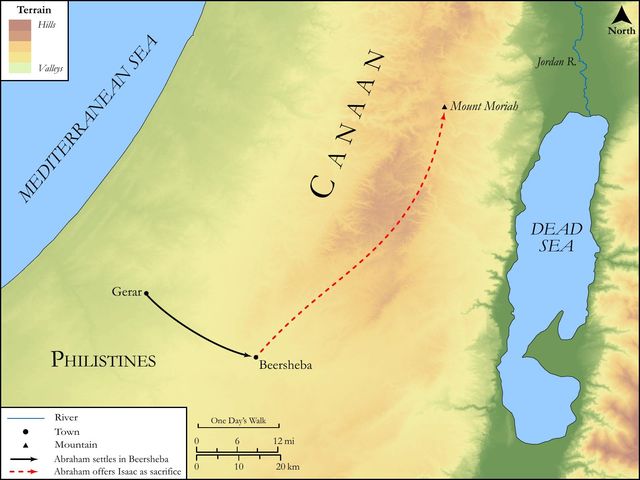
See on the biblical-era maps


Study this verse
Public-domain commentary
Matthew Henry
From his Commentary on the Whole Bible. Henry comments on passages, not single verses — this entry covers Genesis 22:1–2. His two-level outline is real structure in the source text, so it is rendered as structure.
Here is the trial of Abraham's faith, whether it continued so strong, so vigorous, so victorious, after a long settlement in communion with God, as it was at first, when by it he left his country: then it was made to appear that he loved God better than his father; now that he loved him better than his son. Observe here,
I.The time when Abraham was thus tried (Gen 22:1):
After these things, after all the other exercises he had had, all the hardships and difficulties he had gone through. Now, perhaps, he was beginning to think the storms had all blown over; but, after all, this encounter comes, which is sharper than any yet. Note, Many former trials will not supersede nor secure us from further trials; we have not yet put off the harness, Kg1 20:11. See Psa 30:6, Psa 30:7.
II.The author of the trial:
God tempted him, not to draw him to sin, so Satan tempts (if Abraham had sacrificed Isaac, he would not have sinned, his orders would have justified him, and borne him out), but to discover his graces, how strong they were, that they might be found to praise, and honour, and glory, Pe1 1:7. Thus God tempted Job, that he might appear not only a good man, but a great man. God did tempt Abraham; he did lift up Abraham, so some read it; as a scholar that improves well is lifted up, when he is put into a higher form. Note, Strong faith is often exercised with strong trials and put upon hard services.
III.The trial itself.
God appeared to him as he had formerly done, called him by name, Abraham, that name which had been given him in ratification of the promise. Abraham, like a good servant, readily answered, "Here am I; what says my Lord unto his servant?" Probably he expected some renewed promise like those, Gen 15:1, and Gen 17:1. But, to his great amazement, that which God has to say to him is, in short, Abraham, Go kill thy son; and this command is given him in such aggravating language as makes the temptation abundantly more grievous. When God speaks, Abraham, no doubt, takes notice of every word, and listens attentively to it; and every word here is a sword in his bones: the trial is steeled with trying phrases. Is it any pleasure to the Almighty that he should afflict? No, it is not; yet, when Abraham's faith is to be tried, God seems to take pleasure in the aggravation of the trial, Gen 22:2. Observe,
1.The person to be offered. (1.) "Take thy son, not thy bullocks and thy lambs;" how willingly would Abraham have parted with them by thousands to redeem Isaac! "No, I will take no bullock out of thy house, Psa 50:9. I must have thy son: not thy servant, no, not the steward of thy house, that shall not serve the turn; I must have thy son." Jephthah, in pursuance of a vow, offered a daughter; but Abraham must offer his son, in whom the family was to be built up. "Lord, let it be an adopted son;" "No, (2.) Thy only son; thy only son by Sarah." Ishmael was lately cast out, to the grief of Abraham; and now Isaac only was left, and must he go too? Yes, (3.) "Take Isaac, him, by name, thy laughter, that son indeed," Gen 17:19. Not "Send for Ishmael back, and offer him;" no, it must be Isaac. "But, Lord, I love Isaac, he is to me as my own soul. Ishmael is not, and wilt thou take Isaac also? All this is against me:" Yea, (4.) That son whom thou lovest. It was a trial of Abraham's love to God, and therefore it must be in a beloved son, and that string must be touched most upon: in the Hebrew it is expressed more emphatically, and, I think, might very well be read thus: Take now that son of thine, that only one of thine, whom thou lovest, that Isaac. God's command must overrule all these considerations.
2.The place: In the land of Moriah, three days' journey off; so that he might have time to consider it, and, if he did it, must do it deliberately, that it might be a service the more reasonable and the more honourable.
3.The manner: Offer him for a burnt-offering. He must not only kill his son, but kill him as a sacrifice, kill him devoutly, kill him by rule, kill him with all that pomp and ceremony, with all that sedateness and composure of mind, with which he used to offer his burnt-offerings.
Historical interpretation
Three Centuries of Reception
4 surviving comments on this verse. Each one is dated, so this reads as a timeline rather than a list.
Select a marker to jump to its quote. Markers stagger vertically where authors wrote within a few decades of each other.
What do you say to these things, Abraham? What kind of thoughts are stirring in your heart? A word has been uttered by God that is such as to shatter and try your faith. What do you say to these things? What are you thinking? What are you reconsidering? Are you thinking, are you turning over in your heart that if the promise has been given to me in Isaac but I offer him for a burnt offering, it remains that that promise holds no hope? Or rather do you think of those well-known words and say that it is impossible for him who promised to lie; be that as it may, the promise shall remain? But I, because “I am the least,” am not able to examine the thoughts of such a great patriarch, nor can I know what thoughts the voice of God which had proceeded to test him stirred in him, what feeling it caused, when he was ordered to slay his only son. But since “the spirit of prophets is subject to the prophets,” the apostle Paul, who, I believe, was teaching by the Spirit what feeling, what plan Abraham considered, has revealed it. He says, “By faith Abraham did not hesitate, when he offered his only son, in whom he had received the promises, thinking that God is able to raise him up even from the dead.”
The apostle therefore has reported to us the thoughts of the faithful man, that the faith in the resurrection began to be held already at that time in Isaac. Abraham therefore hoped for the resurrection of Isaac and believed in a future that had not yet happened. How then are they “sons of Abraham” who do not believe what has happened in Christ, which Abraham believed was to be in Isaac? No rather, that I may speak more clearly, Abraham knew himself to prefigure the image of future truth. He knew the Christ was to be born from his seed, who also was to be offered as a truer victim for the whole world and was to be raised from the dead.
But now meanwhile the text says, “God was testing Abraham and says to him: ‘Take your dearest son whom you love.’ ” For to have said “son” would not have been enough, but “dearest” also is added. Let this too be considered. Why is there still added also, “whom you love”? But behold the importance of the test. The affections of a father are roused by the dear and sweet appellations repeated frequently, that by awaking memories of love the paternal right hand might be slowed in slaying his son and the total warfare of the flesh might fight against the faith of the soul.“Take,” therefore, the text says, “your dearest son Isaac, whom you love.” Let it be, Lord, that you are reminding the father of the son; you add also “dearest,” whom you are commanding to be slain. Let this be sufficient for the father’s torment. You add again also, “whom you love.” Let the triple torment of the father be in this. Why is there need yet that you bring to mind also “Isaac”? Did Abraham not know that that dearest son of his, that one whom he loved, was called Isaac? But why is it added at this time? That Abraham might recall that you had said to him, “In Isaac shall your seed be called, and that in Isaac the promises shall be yours.” The reminder of the name also produces hopelessness in the promises that were made under this name. But all these things happened because God was testing Abraham.
(Chapter 22, Verse 2.) And God said to him: Take your beloved son, Isaac, whom you love, and go to the high land, and offer him there as a burnt offering on one of the mountains that I will tell you. It is difficult to translate the Hebrew language into Latin. Where it is now said, go to the high land, in Hebrew it has Moriah, which Aquila translated as 'the visible', that is, clear, and Symmachus, 'the vision', that is, sight. Therefore the Hebrews say that this mountain is the one on which the temple was later built, in the area of Ornan the Jebusite, as it is also written in the Chronicles: 'And they began to build the temple in the second month, on the second day of the month, in the mountain of Moriah' (2 Chronicles 3:1). This is interpreted as "illuminating" and "shining" because there is the Dabir, that is, the oracle of God: both the Law and the Holy Spirit, who teaches people the truth and inspires prophecies.
When Abraham offered his son Isaac, he was a type of God the Father, while Isaac prefigured our Lord and Savior.
Continue studying Genesis 22:2 across the web’s major study libraries — every link below opens this exact verse, chapter, or book on the destination site.
Read & Compare
 BibleGatewayThis verse in more than 200 translations and 70 languages.
 Bible.comThe YouVersion reader — hundreds of translations, reading plans, and highlights.
 ESV.orgCrossway's official English Standard Version reader.
 NET BibleThe NET translation with 60,000+ translators' notes on every rendering decision.
 STEP BibleTyndale House's free study tool — original text, vocabulary, and scholarly resources.
 BibliaLogos Bible Software's free web reader.
 USCCBThe New American Bible (Revised Edition) with the U.S. bishops' study notes.
Commentaries
 BibleHub CommentariesDozens of classic commentaries on this verse, gathered on one page.
 StudyLightMore than 100 commentary sets — the largest collection on the web.
 BibleRefPlain-English commentary on what this verse means, verse by verse.
 Enduring WordDavid Guzik's free commentary on this chapter, widely used by Bible teachers.
 Bible Study ToolsVerse commentary alongside Greek and Hebrew study aids.
Original Language & Research
- BibleHub InterlinearThe verse word by word — original language, transliteration, and English.
- BibleHub LexiconEvery word's original-language definition and Strong's entry.
 Blue Letter BibleDeep-study tools — Strong's numbers, concordance, and word studies.
 SefariaThe Hebrew text with Rashi and centuries of Jewish commentary.
Sermons, Hymns & Audio


TrulyRandomVerse is not affiliated with these sites and doesn’t control their content. They’re linked because they’re genuinely useful.
Summary
Genesis 22:2 presents God's momentous and deeply challenging command to Abraham: to take his uniquely beloved son, Isaac, the very child of promise, and offer him as a burnt offering upon a mountain in the distant land of Moriah. This pivotal divine instruction initiates the ultimate test of Abraham's faith, obedience, and trust in God's character and covenant promises, even when the command appears to contradict the means by which those promises were to be fulfilled.
Context
ShowHideLiterary Context
This verse immediately follows the resolution of the conflict between Abraham's two sons, Ishmael and Isaac, culminating in Ishmael's departure from Abraham's household (Genesis 21:9-21). With Ishmael gone, Isaac stands as the sole heir, the "only" son through whom God's covenant promises of a great nation and blessing to all families of the earth would be realized (Genesis 12:2-3; Genesis 17:19). The command in Genesis 22:2 thus comes at a moment when Isaac's status as the undisputed son of promise is firmly established, intensifying the profound dilemma Abraham faces. The narrative structure emphasizes the stark contrast between the recent joy of Isaac's birth and the devastating demand now placed upon his father.
Historical & Cultural Context
Burnt offerings (ʻôlâh) were a recognized form of worship from the days of Noah, symbolizing complete devotion and propitiation, where the entire animal was consumed by fire. While human sacrifice was practiced by some of the pagan nations round about (e.g., Molech worship), it was vehemently forbidden by Yahweh to Israel and considered an abomination (Deuteronomy 12:31; Jeremiah 32:35). This makes God's command to Abraham particularly shocking and unprecedented within the developing monotheistic framework. The journey to Moriah, a three-day trek, would have provided ample time for Abraham to wrestle with the command, further highlighting the deliberateness of his obedience.
Key Themes
ShowHideGenesis 22 is a foundational text for several enduring theological themes. Foremost among them is the theme of faith and obedience, as Abraham is called to trust God's character and promises even when His commands seem illogical or contradictory (Hebrews 11:17-19). The narrative also powerfully explores the theme of divine testing, revealing the depth and authenticity of Abraham's devotion. Furthermore, the passage introduces the concept of divine provision, with God ultimately providing a substitute sacrifice (Genesis 22:13-14), foreshadowing a greater redemptive provision. The unique language used to describe Isaac ("thine only son, whom thou lovest") also establishes a profound typological connection to God the Father's sacrifice of His own Son.
Exposition and Analysis
ShowHideGod's command in Genesis 22:2 is delivered with striking specificity, emphasizing the immense personal cost to Abraham and highlighting the nature of the test.
Key Word Analysis
ShowHideThis common Hebrew term (H1121) for "son" is used here to denote Isaac's literal relationship to Abraham. However, in this context, it carries immense weight, emphasizing that the command concerns not just a son, but the son, the specific individual through whom Abraham's lineage and the covenant promises were to be established. The choice of this word, rather than a more generic term for "child," highlights the direct paternal connection and the inherent pain of the request.
The Hebrew word yachid (H3173), translated as "only," means "unique," "sole," or "beloved." While Abraham had Ishmael, Isaac was his "only" son in the covenantal sense, the unique heir of the promise. This word underscores Isaac's irreplaceable status and the profound singularity of the sacrifice being requested. It conveys not merely numerical uniqueness but also a sense of preciousness and isolation, emphasizing that this son stands alone as the recipient of God's special favor and promise.
The verb ʼahab (H157) signifies deep affection, love, or endearment. God's explicit mention of Abraham's love for Isaac is crucial. It highlights that God is not asking for a casual offering, but for the most precious and cherished relationship Abraham possesses. This detail amplifies the emotional intensity of the command, making it clear that the test is not merely one of obedience, but of prioritizing God above even the deepest human affections.
Verse Breakdown
ShowHide"And he said, Take now thy son"
The opening phrase immediately establishes the divine origin and imperative nature of the command. The "he" refers to God, who speaks directly to Abraham. "Take now" conveys an urgent, immediate directive, allowing no room for delay or negotiation. This is not a suggestion but a direct, authoritative instruction that demands prompt action from Abraham.
"thine only [son] Isaac, whom thou lovest"
This clause is laden with emotional and theological significance. God precisely identifies the object of the command: Isaac. The repetition of "son," followed by the emphatic "thine only" (referring to Isaac's unique covenantal status), and the poignant addition "whom thou lovest," underscores the immense personal cost and the depth of Abraham's attachment to Isaac. It highlights that God is fully aware of the magnitude of His demand, making the test of Abraham's devotion all the more profound.
"and get thee into the land of Moriah; and offer him there for a burnt offering"
This part specifies the required action and location. "Get thee into the land of Moriah" indicates a journey to a specific, though at that moment undisclosed, destination. The command "offer him there for a burnt offering" specifies the type of sacrifice, a ʻôlâh (H5930), which involved the complete consumption of the offering by fire, symbolizing total dedication. This instruction is shocking, given that human sacrifice was anathema to God's character.
"upon one of the mountains which I will tell thee of."
This final clause adds an element of suspense and further tests Abraham's blind obedience. Abraham is not given the precise mountain immediately, requiring him to embark on the journey in faith, trusting that God will reveal the exact location at the appointed time. This detail emphasizes that the journey itself is part of the test, a period of sustained reliance on divine guidance.
Literary Devices
ShowHideThe verse employs several powerful literary devices. Emphasis is achieved through repetition and specific word choice, particularly in the description of Isaac: "thy son, thine only [son] Isaac, whom thou lovest." This triple description underscores Isaac's unique status and the profound emotional weight of the command. The use of Foreshadowing is evident in the mention of "Moriah," a location later associated with the Temple Mount in Jerusalem (2 Chronicles 3:1), subtly hinting at future acts of divine sacrifice and worship. The command itself creates a profound sense of Irony and Paradox, as God, who promised to build a great nation through Isaac, now commands his sacrifice. This tension highlights the testing nature of the command and sets the stage for God's ultimate provision.
Theological and Thematic Connections
ShowHideGenesis 22:2 stands as a monumental theological statement about the nature of faith, obedience, and God's sovereign right to demand ultimate devotion. It reveals a God who tests His chosen ones not to break them, but to refine their trust and reveal the depth of their commitment. This passage profoundly illustrates that true faith is not merely intellectual assent but a willingness to obey God's commands, even when they seem to contradict His prior promises or human logic. It underscores that God's ways are higher than human ways, and His faithfulness is unwavering, even in the most extreme circumstances.
Reflection and Application
ShowHideThe command to Abraham in Genesis 22:2 confronts us with the radical nature of biblical faith. It challenges us to examine the idols of our own hearts—those things we cherish above God, whether they be relationships, security, comfort, or even our understanding of God's promises. Abraham's willingness to obey, despite the profound cost, teaches us that genuine trust in God means relinquishing control and surrendering our most precious possessions or aspirations to His sovereign will. This passage calls us to a faith that is not merely convenient but costly, a faith that believes God is good and faithful even when His path seems inscrutable or painful. It reminds us that true worship may involve laying down what we hold dearest, trusting that God's ultimate plan is always for our good and His glory.
Questions for Reflection
ShowHideFAQ
ShowHideWhy would God command Abraham to do something seemingly so cruel and contradictory to His own character (human sacrifice)?
ShowHideThis command was a unique and ultimate test of Abraham's faith, not an endorsement of human sacrifice. God's character is fundamentally opposed to human sacrifice, as seen in the later Mosaic Law (Leviticus 18:21). The purpose of the command was to reveal the depth of Abraham's trust and obedience, demonstrating that his faith in God superseded even his deepest natural affections and understanding. God never intended for Isaac to be sacrificed, as evidenced by His timely intervention and provision of a substitute ram (Genesis 22:11-13). The test served to confirm Abraham's righteous standing and to provide a powerful prophetic type for future divine provision.
Christ-Centered Fulfillment
ShowHideGenesis 22:2 finds its ultimate and profound Christ-centered fulfillment in the sacrifice of Jesus Christ. Just as God commanded Abraham to offer his "only son, Isaac, whom thou lovest," so too did God the Father offer His "one and only Son" (John 3:16), Jesus, whom He deeply loved, as the ultimate sacrifice for the sins of humanity. The land of Moriah, traditionally identified with the Temple Mount, is geographically proximate to Golgotha, the site of Christ's crucifixion, suggesting a divinely orchestrated continuity of redemptive history. While Abraham was spared from sacrificing Isaac, God did not spare His own Son (Romans 8:32), willingly delivering Him up for us all. Isaac's carrying of the wood for the burnt offering (Genesis 22:6) foreshadows Christ carrying His own cross to Calvary (John 19:17). The ram caught in the thicket, provided by God as a substitute for Isaac (Genesis 22:13), powerfully prefigures Jesus as the "Lamb of God who takes away the sin of the world" (John 1:29), the perfect and final substitute sacrifice provided by God Himself for all who believe.