


Genesis 22:13
Bible text: King James Version (1769 Blayney text) · Public domain
Bible text: King James Version with Strong's numbers · Public domain
Bible text: Berean Standard Bible · Public domain
Bible text: American Standard Version (1901) · Public domain
Bible text: World English Bible, Messianic edition · Public domain
Bible text: Geneva Bible (1599) · Public domain
Bible text: Young's Literal Translation · Public domain
- וַיִּשָּׂאvai·yi·Sa'and he lifted upH5375Conj-w ¦ V-Qal-ConsecImperf-3msVerb Qal Consecutive Imperfect 3rd Singular Masculineוַandיִּשָּׂאhe lifted up
- אַבְרָהָם'av·ra·HamAbrahamH85N-proper-mNoun Proper Masculine
- אֶת'et<obj.>H853DirObjMParticle Object Indicator
- עֵינָיו'ei·Navhis eyesH5869N-fdc ¦ 3msNoun Dual Feminine Constructעֵינָיeyesוhis
- וַיַּרְאvai·yaR'and he sawH7200Conj-w ¦ V-Qal-ConsecImperf-3msVerb Qal Consecutive Imperfect 3rd Singular Masculineוַandיַּרְאhe saw
- וְהִנֵּהve·hi·nehand there!H2009Conj-w ¦ PrtParticle Interjectionוְandהִנֵּהthere!
- אַיִל'A·yila ramH352N-msNoun Singular Masculine Absolute
- אַחַר'a·CharbehindH310Adj-msAdjective Numerical Singular Masculine Absolute
- נֶאֱחַזne·'e·Chazit was caughtH270V-Niphal-Perf-3msVerb Niphal Perfect 3rd Singular Masculine
- בַּסְּבַךְba·se·Vakhin the thicketH5442Prep-b ¦ N-msNoun Singular Masculine Absoluteבַּin theסְּבַךְthicket
- בְּקַרְנָיוbe·kar·Navby its hornsH7161Prep-b ¦ N-fdc ¦ 3msNoun Dual Feminine Constructבְּbyקַרְנָיhornsוits
- וַיֵּלֶךְvai·Ye·lekhand he wentH1980Conj-w ¦ V-Qal-ConsecImperf-3msVerb Qal Consecutive Imperfect 3rd Singular Masculineוַandיֵּלֶךְhe went
- אַבְרָהָם'av·ra·HamAbrahamH85N-proper-mNoun Proper Masculine
- וַיִּקַּחvai·yi·Kachand he tookH3947Conj-w ¦ V-Qal-ConsecImperf-3msVerb Qal Consecutive Imperfect 3rd Singular Masculineוַandיִּקַּחhe took
- אֶת'et<obj.>H853DirObjMParticle Object Indicator
- הָאַיִלha·'A·yilthe ramH352Art ¦ N-msNoun Singular Masculine Absoluteהָtheאַיִלram
- וַיַּעֲלֵהוּvai·ya·'a·Le·huand he offered up itH5927Conj-w ¦ V-Hiphil-ConsecImperf-3ms ¦ 3msVerb Hiphil Consecutive Imperfect 3rd Singular Masculineוַandיַּעֲלֵhe offered upהוּit
- לְעֹלָהle·'o·Lahto a burnt offeringH5930Prep-l ¦ N-fsNoun Singular Feminine Absoluteלְtoעֹלָהa burnt offering
- תַּחַתTa·chatin place ofH8478N-mscNoun Singular Masculine Construct
- בְּנוֹbe·Nohis sonH1121N-msc ¦ 3msNoun Singular Masculine Constructבְּנsonוֹhis
English is a literal word-by-word gloss of the Hebrew, not the KJV's wording. Why?
This is the original text the KJV's translators worked from — each Hebrew word with its own literal English meaning in this verse, prepared by scholars at Tyndale House, Cambridge. The KJV translates whole sentences, not word by word, so its wording differs: one Hebrew word can become several English words, and the KJV may choose “the LORD” where the gloss reads “Yahweh”. Both are faithful — they answer different questions. For the KJV's own rendering, switch to the KJV text.
Details
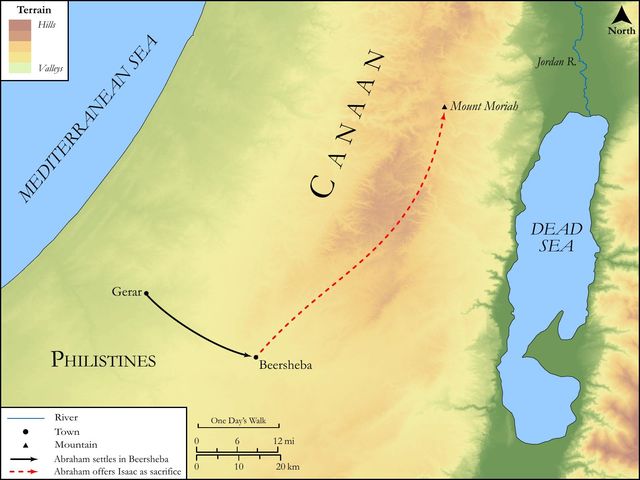
See on the biblical-era maps


Study this verse
Public-domain commentary
Matthew Henry
From his Commentary on the Whole Bible. Henry comments on passages, not single verses — this entry covers Genesis 22:11–14. His two-level outline is real structure in the source text, so it is rendered as structure.
Hitherto this story has been very melancholy, and seemed to hasten towards a most tragical period; but here the sky suddenly clears up, the sun breaks out, and a bright and pleasant scene opens. The same hand that had wounded and cast down here heals and lifts up; for, though he cause grief, he will have compassion. The angel of the Lord, that is, God himself, the eternal Word, the angel of the covenant, who was to be the great Redeemer and comforter, he interposed, and gave a happy issue to this trial.
I.Isaac is rescued, Gen 22:11, Gen 22:12.
The command to offer him was intended only for trial, and it appearing, upon trial, that Abraham did indeed love God better than he loved Isaac, the end of the command was answered; and therefore the order is countermanded, without any reflection at all upon the unchangeableness of the divine counsels: Lay not thy hand upon the lad. Note,
1.Our creature-comforts are most likely to be continued to us when we are most likely to be continued to us when we are most willing to resign them up to God's will.
2.God's time to help and relieve his people is when they are brought to the greatest extremity. The more imminent the danger is, and the nearer to be put in execution, the more wonderful and the more welcome is the deliverance.
II.Abraham is not only approved, but applauded.
He obtains an honourable testimony that he is righteous: Now know I that thou fearest God. God knew it before, but now Abraham had given a most memorable evidence of it. He needed do no more; what he had done was sufficient to prove the religious regard he had to God and his authority. Note,
1.When God, by his providence, hinders the performance of our sincere intentions in his services, he graciously accepts the will for the deed, and the honest endeavour, though it come short of finishing.
2.The best evidence of our fearing God is our being willing of serve and honour him with that which is dearest to us, and to part with all to him or for him.
III.Another sacrifice is provided instead of Isaac, Gen 22:13.
Now that the altar was built, and the wood laid in order, it was necessary that something should be offered. For,
1.God must be acknowledged with thankfulness for the deliverance of Isaac; and the sooner the better, when here is an altar ready.
2.Abraham's words must be made good: God will provide himself a lamb. God will not disappoint those expectations of his people which are of his own raising; but according to their faith it is to them. Thou shalt decree a thing, and it shall be established.
3.Reference must be had to the promised Messiah, the blessed seed. (1.) Christ was sacrificed in our stead, as this ram instead of Isaac, and his death was our discharge. "Here am I (said he,) let these go their way." (2.) Though that blessed seed was lately promised, and now typified by Isaac, yet the offering of him up should be suspended till the latter end of the world: and in the mean time the sacrifice of beasts should be accepted, as this ram was, as a pledge of that expiation which should one day be made by that great sacrifice. And it is observable that the temple, the place of sacrifice, was afterwards built upon this mount Moriah (Ch2 3:1); and mount Calvary, where Christ was crucified, was not far off.
IV.A new name is given to the place, to the honour of God, and for the encouragement of all believers, to the end of the world, cheerfully to trust in God in the way of obedience: Jehovah-jireh, The Lord will provide (Gen 22:14), probably alluding to what he had said (Gen 22:8), God will provide himself a lamb. I was not owing to any contrivance of Abraham, nor was it in answer to his prayer, though he was a distinguished intercessor; but it was purely the Lord's doing. Let it be recorded for the generations to come,
1.That the Lord will see; he will always have his eye upon his people in their straits and distresses, that he may come in with seasonable succour in the critical juncture.
2.That he will be seen, be seen in the mount, in the greatest perplexities of his people. He will not only manifest, but magnify, his wisdom, power, and goodness, in their deliverance. Where God sees and provides, he should be seen and praised. And, perhaps, it may refer to God manifest in the flesh.
Historical interpretation
Three Centuries of Reception
7 surviving comments on this verse. Each one is dated, so this reads as a timeline rather than a list.
Select a marker to jump to its quote. Markers stagger vertically where authors wrote within a few decades of each other.
We said above, I think, that Isaac represented Christ. But this ram no less also seems to represent Christ. Now it is worthwhile to know how both are appropriate to Christ, both Isaac, who is not slain, and the ram, which is slain.Christ is “the Word of God,” but “the Word was made flesh.” One aspect of Christ therefore is from above; the other is received from human nature and the womb of the Virgin. Christ suffered, therefore, but in the flesh; and he endured death, but it was the flesh, of which this ram is a type, as also John said: “Behold the Lamb of God, behold him who takes away the sin of the world.” But the Word continued “in incorruption,” which is Christ according to the spirit, of which Isaac is the image. For this reason he is victim and priest. For truly according to the spirit he offers the victim to the Father, but according to the flesh he himself is offered on the altar of the cross. As it is said of him, “Behold the Lamb of God, behold him who takes away the sin of the world,” so it is said of him, “You are a priest forever according to the order of Melchizedek.”
Thus the sacrifice was not for the sake of Isaac but for that of Abraham, who was tested by being called upon to make this offering. And of course, God accepted his intentions, but he prevented him from slaying Isaac. The death of Isaac would not buy freedom for the world. No, that could be accomplished only by the death of our Savior, by whose stripes we are all healed.
The mountain spit out the tree and the tree the ram. In the ram that hung in the tree and had become the sacrifice in the place of Abraham’s son, there might be depicted the day of him who was to hang upon the wood like a ram and was to taste death for the sake of the whole world.
Very many deny that the Sacred writers wrote according to the rules of art. Nor do we contend for the contrary; for they wrote not according to art, but according to grace, which is above all art; for they wrote that which the Spirit gave them to speak. And yet they who wrote on art made use of their writings from which to frame their art, and to compose its comments and rules.
Again, in art there are principally required, a cause, a subject, and an end. When then we read that holy Isaac said to his father, "Behold the fire and the wood, but where is the lamb for a burnt offering," which of these is wanting? For he who asks, doubts, he who answers the query pronounces and solves the doubt. "Behold the fire," that is the cause, "and the wood," that is hulē, which in Latin is 'materia,' what third thing remains but the end, which the son asked for, saying, "Where is the lamb for a burnt-offering," and the father replied, "My son, God will provide Himself a lamb for a burnt offering?"
Let us discuss for a little while the mystery. God shewed a ram hanging by his horns. Now the ram is the Word, full of tranquillity, moderation, and patience; whereby is shewn that Wisdom is a good sacrifice, and that He was well skilled in the mode of meritorious propitiation. Wherefore the Prophet also says, "Offer the sacrifice of righteousness." And so it is a sacrifice both of righteousness and of wisdom.
All this, however, happened as a type of the cross. Hence Christ too said to the Jews, “Your father Abraham rejoiced in anticipation of seeing my day; he saw it and was delighted.” How did he see it if he lived so long before? In type, in shadow. Just as in our text the sheep was offered in place of Isaac, so here the rational Lamb was offered for the world. You see, it was necessary that the truth be sketched out ahead of time in shadow. Notice, I ask you, dearly beloved, how everything was prefigured in shadow: an only-begotten son in that case, an only-begotten in this; dearly loved in that case, dearly loved in this. “This is my beloved Son,” Scripture says, in fact, “in whom I have found satisfaction.” The former was offered as a burnt offering by his father, and the latter his Father surrendered. Paul too shouts aloud in the words “He who in fact did not spare his own Son but handed him over for the sake of us all—how will he not also grant us every gift along with him?” Up to this point there is shadow, but now the truth of things is shown to be more excellent. This rational Lamb, you see, was offered for the whole world; he purified the whole world; he freed human beings from error and led them forward to the truth; he made earth into heaven, not by altering the nature of the elements but by transferring life in heaven to human beings on earth. Through him all worship of demons is made pointless; through him people no longer worship stone and wood. Nor do those endowed with reason bend the knee to material things—instead, all error has been abolished, and the light of truth has shone brightly on the world. Do you see the superiority of the truth? Do you see what shadow is, on the one hand, and truth, on the other?
(Verse 13.) And Abraham lifted up his eyes, and behold, behind him was a ram caught in a thicket by its horns. Emisenus Eusebius has spoken a silly thing in this place: Sabech, he says, is called a goat, which with straight horns is raised high to pluck the leaves from a tree. Again Aquila has interpreted as a bush, which we can call a thicket or briar: and to interpret the force of the word, dense and intertwined twigs. And Symmachus also expresses the same opinion, saying, 'And it appeared that a ram, after this, was caught in a net by its horns.' However, some have interpreted it better in this particular place, namely the Septuagint and Theodotion, who translated the word as 'Sabech,' saying, 'In the thicket Sabech with its horns.' For σύχνεων, that is, the net, which Aquila and Symmachus have used, is written with the letter 'Sin.' But here the letter 'Samech' is used. From this it is clear that the interpretation is not of thickened branches, and like the word 'Sabech' intertwined like a net with intertwined branches, but rather the name signifies a thicket, which is thus expressed in Hebrew. But in my diligent investigation, I frequently found that the letter συχνεῶνα is often written as Samech ().
But when the ram was killed and Isaac was not killed, it happened thus because Isaac was a figure and not the reality; for in him was designated what was later fulfilled in Christ. Behold, God is contending with people in great devotion. Abraham offered God his mortal son who was not to die, while God surrendered in death his immortal Son for the sake of humankind. Concerning blessed Isaac and that ram it can be further understood that in Isaac was signified the divinity of Christ, in the ram his humanity. Just as in his passion not the divinity but the humanity is believed to have been crucified, so the ram but not Isaac was immolated: the only-begotten Son of God is offered, the firstborn of the Virgin is sacrificed. Listen to another mystery. Blessed Jerome, a priest, wrote that he knew most certainly from the ancient Jews and elders that Christ our Lord was afterward crucified in the place where Isaac was offered. Last, from the place whence blessed Abraham was commanded to depart, he arrived on the third day at the place where Christ our Lord was crucified. This too is mentioned in the account of the ancients, that in the very place where the cross was fastened the first Adam once was buried. Moreover, it was called the place of Calvary for the very reason that the first head of the human race is said to have been buried there. Truly, brothers, not unfittingly is it believed that the physician was raised up where the sick man lay. It was right that divine mercy should bend down in the place where human pride had fallen. The precious blood may be believed to have corporally redeemed the ashes of the sinner of old by deigning to touch it with its drops. We have gathered these facts as well as we could, dearly beloved, from the different books of Scripture for the progress of your soul, and we suggest them to the consideration of your charity. If, with the Lord’s help, you will read over the sacred Scriptures rather frequently and heed them carefully, I believe that you can find an even better explanation.
Continue studying Genesis 22:13 across the web’s major study libraries — every link below opens this exact verse, chapter, or book on the destination site.
Read & Compare
 BibleGatewayThis verse in more than 200 translations and 70 languages.
 Bible.comThe YouVersion reader — hundreds of translations, reading plans, and highlights.
 ESV.orgCrossway's official English Standard Version reader.
 NET BibleThe NET translation with 60,000+ translators' notes on every rendering decision.
 STEP BibleTyndale House's free study tool — original text, vocabulary, and scholarly resources.
 BibliaLogos Bible Software's free web reader.
 USCCBThe New American Bible (Revised Edition) with the U.S. bishops' study notes.
Commentaries
 BibleHub CommentariesDozens of classic commentaries on this verse, gathered on one page.
 StudyLightMore than 100 commentary sets — the largest collection on the web.
 BibleRefPlain-English commentary on what this verse means, verse by verse.
 Enduring WordDavid Guzik's free commentary on this chapter, widely used by Bible teachers.
 Bible Study ToolsVerse commentary alongside Greek and Hebrew study aids.
Original Language & Research
- BibleHub InterlinearThe verse word by word — original language, transliteration, and English.
- BibleHub LexiconEvery word's original-language definition and Strong's entry.
 Blue Letter BibleDeep-study tools — Strong's numbers, concordance, and word studies.
 SefariaThe Hebrew text with Rashi and centuries of Jewish commentary.
Sermons, Hymns & Audio


TrulyRandomVerse is not affiliated with these sites and doesn’t control their content. They’re linked because they’re genuinely useful.
Summary
Genesis 22:13 marks the climactic moment in Abraham's ultimate test of faith on Mount Moriah, where God miraculously intervened to provide a ram as a substitute sacrifice. As Abraham prepared to offer his beloved son Isaac, the Lord revealed a ram caught in a thicket, which Abraham then offered as a burnt offering in Isaac's place. This divine provision underscores God's faithfulness, His sovereign ability to supply what is needed, and powerfully foreshadows the ultimate substitutionary sacrifice of Jesus Christ.
Context
ShowHideLiterary Context
Genesis 22:13 is the pivotal turning point in the narrative of Abraham's binding of Isaac, often referred to as the Akedah. This verse directly follows God's dramatic intervention through an angel, who calls out from heaven to stop Abraham's hand just as he is about to sacrifice Isaac (Genesis 22:11-12). The preceding verses meticulously build the tension, detailing Abraham's obedient journey, the preparation of the altar, and Isaac's poignant question about the lamb for the burnt offering, to which Abraham prophetically responds, "God will provide himself a lamb for a burnt offering, my son" (Genesis 22:8). Verse 13 resolves this tension, demonstrating God's immediate and perfect provision, validating Abraham's faith and revealing the Lord's character as "Jehovah-Jireh" ("The LORD Will Provide") in Genesis 22:14).
Historical & Cultural Context
The practice of child sacrifice, though abhorrent to the God of Israel, was tragically common among some Canaanite peoples, often as a desperate plea or ultimate act of devotion to their deities. God's command to Abraham, therefore, was not merely a test of obedience but also a stark contrast to these pagan practices, demonstrating that the true God does not demand human sacrifice but provides for it Himself. The concept of burnt offerings (Hebrew: 'olah) was a central element of ancient Israelite worship, signifying complete dedication and atonement, where the entire animal was consumed by fire on the altar. The "thicket" (Hebrew: sevach) would have been a familiar sight in the rocky, scrub-covered hills of the region, emphasizing the natural yet divinely orchestrated appearance of the ram.
Key Themes
ShowHideThis passage is rich with profound theological themes that resonate throughout the biblical narrative. The overarching theme is God's Provision, exemplified by the ram's appearance, which becomes the basis for the name Jehovah-Jireh. Another crucial theme is Faith and Obedience, as Abraham's willingness to obey God's seemingly impossible command, even to the point of sacrificing his son, demonstrates a profound trust in God's character and promises, including His ability to raise the dead (Hebrews 11:17-19). Furthermore, the narrative powerfully introduces the theme of Substitutionary Sacrifice, where an innocent life is offered in place of another, laying a foundational theological concept that finds its ultimate fulfillment in the New Testament.
Exposition and Analysis
ShowHideKey Word Analysis
ShowHideThis word, derived from a root signifying "strength," refers to a male sheep, particularly one known for its robustness and leadership within the flock. In this context, the ram is not merely any animal but a divinely provided, strong, and suitable offering. Its appearance signifies God's specific and powerful provision, replacing Isaac as the intended sacrifice.
This primitive root means "to seize" or "to hold in possession." The ram was not merely present or wandering, but actively "caught" or "held fast" in the thicket. This detail emphasizes the precise and intentional nature of God's intervention, ensuring the ram was readily available and immobilized for Abraham to take, highlighting divine orchestration rather than mere chance.
This word denotes "the bottom," but adverbially, it means "below," "underneath," or crucially, "in lieu of" or "in place of." Its use here is foundational for the doctrine of substitution. The ram died in the place of Isaac, bearing the penalty or fulfilling the requirement that would otherwise have fallen upon Isaac. This concept of one taking the place of another is central to the biblical understanding of atonement.
Verse Breakdown
ShowHide"And Abraham lifted up his eyes, and looked,"
This phrase signifies Abraham's shift in focus from the agonizing task of sacrificing Isaac to a new, divinely revealed sight. It implies a moment of recognition and perhaps relief, as his gaze is directed away from his son and towards God's provision.
"and behold behind [him] a ram caught in a thicket by his horns:"
The interjection "behold" (Hebrew: hinneh) emphasizes the sudden, surprising, and miraculous nature of the discovery. The ram's location "behind him" suggests it was not immediately visible, appearing only after God's intervention halted the sacrifice of Isaac. The detail of it being "caught in a thicket by his horns" highlights the divine precision: the ram was not just present, but perfectly ensnared and ready for sacrifice, demonstrating God's meticulous provision.
"and Abraham went and took the ram,"
This clause depicts Abraham's immediate and decisive action. Having received God's clear sign and provision, he promptly responds in obedience, taking the divinely supplied substitute. This act confirms his understanding that God had indeed provided the alternative sacrifice.
"and offered him up for a burnt offering in the stead of his son."
This is the theological climax of the verse. Abraham performs the ritual of the burnt offering, signifying complete dedication and atonement. Crucially, the ram is offered "in the stead of his son," directly establishing the principle of substitutionary sacrifice. The ram's life is given as a direct replacement for Isaac's, fulfilling the command without requiring the death of Abraham's beloved heir.
Literary Devices
ShowHideThe narrative of Genesis 22:13 is rich with literary devices that enhance its theological depth. Symbolism is paramount, with the ram serving as a powerful type, or prefigurement, of the ultimate sacrifice to come. Its appearance, divinely provided and perfectly ensnared, symbolizes God's sovereign hand in orchestrating salvation. The phrase "behold behind [him]" employs Divine Intervention, highlighting God's direct and timely action in the narrative, interrupting human intention with divine provision. This moment also functions as profound Foreshadowing, pointing forward to the greater sacrifice of the "Lamb of God" who would ultimately take away the sin of the world. Furthermore, the entire scene is structured around Contrast: the contrast between Abraham's willingness to sacrifice his son and God's provision of a substitute, emphasizing God's mercy and the nature of true worship.
Theological and Thematic Connections
ShowHideGenesis 22:13 is a foundational text for understanding God's character and the nature of salvation. It profoundly establishes God as "Jehovah-Jireh," the Lord who sees and provides, not merely for physical needs but for the deepest spiritual need of atonement. The ram's substitution for Isaac introduces the crucial theological principle of substitutionary sacrifice, illustrating how an innocent life can be given to redeem another. This event also underscores the importance of radical obedience to God, demonstrating that true faith is proven through action, and such obedience opens the door for God's miraculous intervention and confirmation of His covenant promises.
Reflection and Application
ShowHideGenesis 22:13 offers profound lessons for contemporary believers, inviting us to deepen our trust in God's unfailing provision. In moments of great testing or seemingly insurmountable challenges, this passage reminds us that God sees our needs before we even fully articulate them and will provide, often in unexpected and miraculous ways, to demonstrate His power and faithfulness. It compels us to reflect on the immense cost of our redemption, as the ram's substitution for Isaac powerfully illustrates the concept of an innocent life given for another, preparing our hearts to grasp the even greater sacrifice of Jesus Christ. Furthermore, Abraham's radical obedience, even to a command that defied human logic and emotion, serves as a powerful example. Our willingness to obey God, even when the path is unclear or painful, positions us to experience His miraculous intervention and blessings, affirming that genuine faith is always accompanied by obedient action. This narrative challenges us to ask: What "Isaacs" might God be asking us to lay on the altar, trusting that He will provide the "ram" or fulfill His purposes in ways beyond our comprehension?
Questions for Reflection
ShowHideFAQ
ShowHideWhy was the ram "caught in a thicket by his horns"?
ShowHideThe detail of the ram being "caught in a thicket by his horns" is highly significant, emphasizing the miraculous and precise nature of God's provision. The Hebrew word for thicket (סְבָךְ, çᵉbâk) denotes a dense, intertwined bush, meaning the ram was firmly ensnared and unable to escape. This ensured its immediate availability and suitability as the substitute sacrifice. It highlights that God's provision is not accidental or coincidental but perfectly orchestrated and timed, a testament to His sovereign control and meticulous care for Abraham and Isaac. This specific detail underscores that God had already prepared the way for their deliverance.
What is the significance of the phrase "in the stead of his son"?
ShowHideThe phrase "in the stead of his son" is profoundly significant as it introduces and illustrates the foundational theological concept of substitutionary sacrifice. It means the ram died in Isaac's place, serving as his direct replacement. Isaac was spared the fate intended for him because an innocent substitute bore the consequence. This event is a foundational biblical "type," or foreshadowing, of the ultimate sacrifice of Jesus Christ, who died as a substitute for humanity, bearing the penalty for sin so that all who believe might receive eternal life and reconciliation with God. It establishes the principle that atonement can be made through the shedding of innocent blood on behalf of the guilty.
How does this event reveal God's character?
ShowHideThis event powerfully reveals several facets of God's character:
Christ-Centered Fulfillment
ShowHideGenesis 22:13 finds its ultimate and perfect fulfillment in the person and work of Jesus Christ. The ram provided by God for Isaac's sacrifice is a profound type, or foreshadowing, of the "Lamb of God" who would ultimately take away the sin of the world (John 1:29). While Abraham was willing to offer his son, God Himself, in His infinite love and perfect wisdom, actually provided His own Son, Jesus, as the perfect and final substitutionary sacrifice for humanity (Romans 5:8). Unlike the ram, which was merely an animal, Jesus was the sinless Son of God, whose death on the cross fully atoned for sin, securing eternal life and reconciliation for all who believe (2 Corinthians 5:21). This narrative thus points forward to the Father's ultimate act of love and provision, offering Himself in Christ where no other substitute could suffice, demonstrating that God truly "provided Himself a lamb" for the redemption of humanity, a Lamb without blemish or spot (1 Peter 1:18-19).