


Genesis 22:12
Bible text: King James Version (1769 Blayney text) · Public domain
Bible text: King James Version with Strong's numbers · Public domain
Bible text: Berean Standard Bible · Public domain
Bible text: American Standard Version (1901) · Public domain
Bible text: World English Bible, Messianic edition · Public domain
Bible text: Geneva Bible (1599) · Public domain
Bible text: Young's Literal Translation · Public domain
- וַיֹּאמֶרvai·Yo·merand he saidH559Conj-w ¦ V-Qal-ConsecImperf-3msVerb Qal Consecutive Imperfect 3rd Singular Masculineוַandיֹּאמֶרhe said
- אַל'almay notH408NegParticle Negative
- תִּשְׁלַחtish·Lachyou stretch outH7971V-Qal-Imperf-2msVerb Qal Imperfect 2nd Singular Masculine
- יָדְךָya·de·Khayour handH3027N-csc ¦ 2msNoun Singular common gender Constructיָדְhandךָyour
- אֶל'elagainstH413PrepPreposition
- הַנַּעַרha·Na·'arthe ladH5288Art ¦ N-msNoun Singular Masculine Absoluteהַtheנַּעַרlad
- וְאַלve·'aland may notH408Conj-w ¦ NegParticle Negativeוְandאַלmay not
- תַּעַשׂTa·'asyou doH6213V-Qal-Imperf-2msVerb Qal Imperfect 2nd Singular Masculine
- לוֹloto <the> himPrep-l ¦ 3msSuffix Personal 3rd Singular Masculineלto <the>וֹhim
- מְאוּמָּהme·'U·mahanythingH3972N-fsNoun Singular Feminine Absolute
- כִּיkiforH3588PrtParticle Conditional
- עַתָּה'a·TahnowH6258AdvAdverb
- יָדַעְתִּיya·Da'·tiI knowH3045V-Qal-Perf-1csVerb Qal Perfect 1st Singular common gender
- כִּיkithatH3588PrtParticle Conditional
- יְרֵאye·Re'[are one] fearingH3373Adj-mscAdjective Singular Masculine Construct
- אֱלֹהִים'E·lo·Him<of> GodH430N-mpNoun Plural Masculine Absolute
- אַתָּה'A·tahyouH859Pro-2msPronoun Personal 2nd Singular Masculine
- וְלֹאve·Lo'and notH3808Conj-w ¦ NegParticle Negativeוְandלֹאnot
- חָשַׂכְתָּcha·Sakh·tayou have withheldH2820V-Qal-Perf-2msVerb Qal Perfect 2nd Singular Masculine
- אֶת'et<obj.>H853DirObjMParticle Object Indicator
- בִּנְךָbin·Khayour sonH1121N-msc ¦ 2msNoun Singular Masculine Constructבִּנְsonךָyour
- אֶת'et<obj.>H853DirObjMParticle Object Indicator
- יְחִידְךָye·chi·de·Khayour only [son]H3173Adj-msc ¦ 2msAdjective Singular Masculine Constructיְחִידְonly [son]ךָyour
- מִמֶּנִּיmi·Me·nifrom meH4480Prep ¦ 1csPreposition Definiteמִמֶּfromנִּיme
English is a literal word-by-word gloss of the Hebrew, not the KJV's wording. Why?
This is the original text the KJV's translators worked from — each Hebrew word with its own literal English meaning in this verse, prepared by scholars at Tyndale House, Cambridge. The KJV translates whole sentences, not word by word, so its wording differs: one Hebrew word can become several English words, and the KJV may choose “the LORD” where the gloss reads “Yahweh”. Both are faithful — they answer different questions. For the KJV's own rendering, switch to the KJV text.
Details
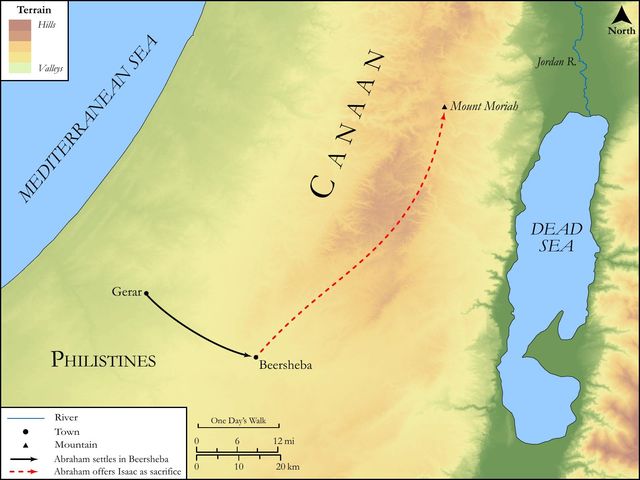
See on the biblical-era maps


Study this verse
Public-domain commentary
Matthew Henry
From his Commentary on the Whole Bible. Henry comments on passages, not single verses — this entry covers Genesis 22:11–14. His two-level outline is real structure in the source text, so it is rendered as structure.
Hitherto this story has been very melancholy, and seemed to hasten towards a most tragical period; but here the sky suddenly clears up, the sun breaks out, and a bright and pleasant scene opens. The same hand that had wounded and cast down here heals and lifts up; for, though he cause grief, he will have compassion. The angel of the Lord, that is, God himself, the eternal Word, the angel of the covenant, who was to be the great Redeemer and comforter, he interposed, and gave a happy issue to this trial.
I.Isaac is rescued, Gen 22:11, Gen 22:12.
The command to offer him was intended only for trial, and it appearing, upon trial, that Abraham did indeed love God better than he loved Isaac, the end of the command was answered; and therefore the order is countermanded, without any reflection at all upon the unchangeableness of the divine counsels: Lay not thy hand upon the lad. Note,
1.Our creature-comforts are most likely to be continued to us when we are most likely to be continued to us when we are most willing to resign them up to God's will.
2.God's time to help and relieve his people is when they are brought to the greatest extremity. The more imminent the danger is, and the nearer to be put in execution, the more wonderful and the more welcome is the deliverance.
II.Abraham is not only approved, but applauded.
He obtains an honourable testimony that he is righteous: Now know I that thou fearest God. God knew it before, but now Abraham had given a most memorable evidence of it. He needed do no more; what he had done was sufficient to prove the religious regard he had to God and his authority. Note,
1.When God, by his providence, hinders the performance of our sincere intentions in his services, he graciously accepts the will for the deed, and the honest endeavour, though it come short of finishing.
2.The best evidence of our fearing God is our being willing of serve and honour him with that which is dearest to us, and to part with all to him or for him.
III.Another sacrifice is provided instead of Isaac, Gen 22:13.
Now that the altar was built, and the wood laid in order, it was necessary that something should be offered. For,
1.God must be acknowledged with thankfulness for the deliverance of Isaac; and the sooner the better, when here is an altar ready.
2.Abraham's words must be made good: God will provide himself a lamb. God will not disappoint those expectations of his people which are of his own raising; but according to their faith it is to them. Thou shalt decree a thing, and it shall be established.
3.Reference must be had to the promised Messiah, the blessed seed. (1.) Christ was sacrificed in our stead, as this ram instead of Isaac, and his death was our discharge. "Here am I (said he,) let these go their way." (2.) Though that blessed seed was lately promised, and now typified by Isaac, yet the offering of him up should be suspended till the latter end of the world: and in the mean time the sacrifice of beasts should be accepted, as this ram was, as a pledge of that expiation which should one day be made by that great sacrifice. And it is observable that the temple, the place of sacrifice, was afterwards built upon this mount Moriah (Ch2 3:1); and mount Calvary, where Christ was crucified, was not far off.
IV.A new name is given to the place, to the honour of God, and for the encouragement of all believers, to the end of the world, cheerfully to trust in God in the way of obedience: Jehovah-jireh, The Lord will provide (Gen 22:14), probably alluding to what he had said (Gen 22:8), God will provide himself a lamb. I was not owing to any contrivance of Abraham, nor was it in answer to his prayer, though he was a distinguished intercessor; but it was purely the Lord's doing. Let it be recorded for the generations to come,
1.That the Lord will see; he will always have his eye upon his people in their straits and distresses, that he may come in with seasonable succour in the critical juncture.
2.That he will be seen, be seen in the mount, in the greatest perplexities of his people. He will not only manifest, but magnify, his wisdom, power, and goodness, in their deliverance. Where God sees and provides, he should be seen and praised. And, perhaps, it may refer to God manifest in the flesh.
Historical interpretation
Five Centuries of Reception
8 surviving comments on this verse. Each one is dated, so this reads as a timeline rather than a list.
Select a marker to jump to its quote. Markers stagger vertically where authors wrote within a few decades of each other.
In this statement it is usually thrown out against us that God says that “now” he had learned that Abraham fears God, as though he were such as not to have known previously. God knew, and it was not hidden from him, since it is he “who has known all things before they come to pass.” But these things are written on account of you, because you too indeed have believed in God. But unless you fulfill “the works of faith,” unless you are obedient to all the commands, even the more difficult ones, unless you offer sacrifice and show that you place neither father nor mother nor sons before God, you will not know that you fear God. Nor will it be said of you, “Now I know that you fear God.”And yet it must be considered that an angel is related to have spoken these words to Abraham, and subsequently this angel is clearly shown to be the Lord. Whence I think that, just as among us “he was found in appearance as a man,” so also among angels he was found in appearance as an angel. And following his example the angels in heaven rejoice “over one sinner repenting” and glory in the progress people make in their relationship with God. For they, as it were, have charge over our souls, to whom, “while we are still children we are committed,” as it were, “to tutors and governors until the time appointed by the father.” And they therefore now say about the progress of each of us, “Now I know that you fear God.” For example, I intend to be a martyr. An angel could not say to me on this basis, “Now I know that you fear God,” for an intention of the mind is known to God alone. But if I shall undertake the struggles, if I shall utter a “good confession,” if I shall bear calmly all things which are inflicted, then an angel can say, as if confirming and strengthening me, “Now I know that you fear God.”
But grant that these words are spoken to Abraham, and he is said to fear God. Why? Because he did not spare his son. But let us compare these words with those of the apostle, where he says of God: “who spared not his own Son but delivered him up for us all.” Behold God contending with people in magnificent generosity: Abraham offered God a mortal son who was not put to death; God delivered to death an immortal Son for humanity.What shall we say to these things? “What shall we render to the Lord for all the things that he has rendered to us?” God the Father, on account of us, “spared not his own son.” Who of you, do you suppose, will sometime hear the voice of an angel saying, “Now I know that you fear God, because you spared not your son,” or your daughter or wife? Or, you spared not your money or the honors of the world or the ambitions of the world, but you have despised all things and “have counted all things dung that you may gain Christ”? Or, “you have sold all things and have given to the poor and have followed the Word of God?” Who of you, do you think, will hear a word of this kind from the angels? Meanwhile Abraham hears this voice, and it is said to him, “You spared not your beloved son because of me.”
Hence we are not permitted to doubt that the knowledge of God is adapted to the time rather than to the result of a change, since in connection with that which God knew it is a question of the opportune moment to divulge what is known rather than to acquire it. [This] we are also taught by the words that were spoken to Abraham: “Do not lay your hand on the boy, and do nothing to him, for I know now that you fear your God, and have not spared your beloved son for my sake.” Accordingly, God knows now, but to know something now is an admission of previous ignorance. Since it is a contradiction for God not to know that Abraham had been previously faithful to him and of whom it had been said, “Abraham believed God, and it was credited to him as justice,” that which he knew at this moment is the time when Abraham received this testimony, and not the time when God also began to acquire this knowledge. By bringing his son as a holocaust, Abraham manifested the love that he had for God. God was aware of it then when he speaks. And, since we are not to believe that he had been ignorant of it up to that moment, we must understand that he knew of it then because he speaks of it. Of the many passages in the Old Testament that contain references to the knowledge of God, we have cited only this one as an example that we may realize that God’s ignorance of anything does not arise from a lack of knowledge but from the occasion.
Determined by motives of high devotion, Abraham, obeying the oracle of God, offered his son for a whole burnt sacrifice; and, as if destitute of natural affection, drew his sword, that no delay might obscure the brightness of the offering. But when he was commanded to spare his son he willingly sheathed his sword, and he who with this faithful intention was hastening to offer up his only son with still more zealous piety hastened to substitute a ram as a sacrifice.
He showed the ram in the thicket in the stead of the lad, that He might restore the son to his father, and yet the victim not fail the priest. And so Abraham was not stained with his son's blood, nor was God deprived of the sacrifice. The prophet spoke, and neither yielded to boastfulness nor continued obstinate, but took the ram in exchange for the lad. And by this is shown the more how piously he offered him whom he now so gladly received back.
We have heard enough on how God does not know the sinner, so we ought to consider now how the just man is known by him. God said to Abraham, “Leave your country, your kinsfolk.” Abraham accordingly came into Palestine; he was in Abramiri; he sojourned a long time in Gerar. When his son Isaac was born, he had received the promise: “In your descendants all the nations of the earth shall be blessed.” He took Isaac and offered him to God, and a voice from heaven was heard to say, Spare him. Straightway, at the very moment that he offered his son, what does God say to Abraham? “I know now that you fear the Lord, your God.” Have you just now known Abraham, Lord, with whom you have communicated for such a long time? Because Abraham had such great faith in sacrificing his own son, on that account God first began to know him. Why have we said all this? Because it is written, “For the Lord knows the way of the just.” Let us put it another way: The way, the life, and the truth is Christ; let us walk therefore in Christ, and then God the Father will know our way.
He also said, ‘The beginning and the end is the fear of the Lord. For it is written, “The fear of the Lord is the beginning of wisdom” (Ps. 111:10) and, when Abraham built an altar the Lord said to him, “Now I know that you fear God” (Gen. 22:12).’
In the same way he said to Abraham, “Now I know that you fear God,” wherein he was saying, “Now I have made people (who up to now did not know) recognize what I, in my own mind, always held to be certain, [namely], that you fear God.”
Continue studying Genesis 22:12 across the web’s major study libraries — every link below opens this exact verse, chapter, or book on the destination site.
Read & Compare
 BibleGatewayThis verse in more than 200 translations and 70 languages.
 Bible.comThe YouVersion reader — hundreds of translations, reading plans, and highlights.
 ESV.orgCrossway's official English Standard Version reader.
 NET BibleThe NET translation with 60,000+ translators' notes on every rendering decision.
 STEP BibleTyndale House's free study tool — original text, vocabulary, and scholarly resources.
 BibliaLogos Bible Software's free web reader.
 USCCBThe New American Bible (Revised Edition) with the U.S. bishops' study notes.
Commentaries
 BibleHub CommentariesDozens of classic commentaries on this verse, gathered on one page.
 StudyLightMore than 100 commentary sets — the largest collection on the web.
 BibleRefPlain-English commentary on what this verse means, verse by verse.
 Enduring WordDavid Guzik's free commentary on this chapter, widely used by Bible teachers.
 Bible Study ToolsVerse commentary alongside Greek and Hebrew study aids.
Original Language & Research
- BibleHub InterlinearThe verse word by word — original language, transliteration, and English.
- BibleHub LexiconEvery word's original-language definition and Strong's entry.
 Blue Letter BibleDeep-study tools — Strong's numbers, concordance, and word studies.
 SefariaThe Hebrew text with Rashi and centuries of Jewish commentary.
Sermons, Hymns & Audio


TrulyRandomVerse is not affiliated with these sites and doesn’t control their content. They’re linked because they’re genuinely useful.
Summary
Genesis 22:12 marks the dramatic divine intervention that halts Abraham's sacrifice of Isaac, serving as the climactic moment of God's ultimate test of faith. The Angel of the LORD's declaration, "for now I know that thou fearest God, seeing thou hast not withheld thy son, thine only [son] from me," confirms Abraham's unwavering devotion and his profound willingness to prioritize God above his most cherished possession, providing a powerful testament to radical obedience and trust in the divine.
Context
ShowHideLiterary Context
This verse is the pivotal turning point in the narrative of the Akedah, or "the Binding of Isaac," found in Genesis 22. The preceding verses detail God's shocking command to Abraham to offer Isaac as a burnt offering on Mount Moriah, Abraham's immediate and silent obedience, and their arduous three-day journey to the designated place. The tension builds as Abraham prepares the altar, binds Isaac, and raises the knife. Verse 12 represents the climax, where the divine voice breaks the silence, preventing the sacrifice and affirming Abraham's faith. This moment directly precedes God's provision of a ram as a substitute and the reiteration of the Abrahamic covenant promises, emphasizing God's faithfulness and the nature of His tests.
Historical & Cultural Context
Among the peoples of Canaan and its borders, child sacrifice, though abhorrent to Yahweh, was practiced by some of them (e.g., Moabites, Ammonites, Phoenicians, as seen in 2 Kings 3:27 and Jeremiah 32:35). This historical backdrop highlights the radical nature of God's command to Abraham, which, on the surface, seemed to align with pagan practices, yet ultimately served to distinguish Yahweh as a God who does not demand human sacrifice but provides for Himself. The concept of a "firstborn" or "only" son carrying the family lineage and inheritance was paramount in the patriarchal society, making Isaac's status as the "son of promise" (born miraculously in old age, as described in Genesis 21:1-7) even more significant and the demand for his sacrifice an unparalleled test of Abraham's loyalty.
Key Themes
ShowHideGenesis 22:12 powerfully encapsulates several core themes of the Abrahamic narrative and biblical theology. Foremost is the theme of Divine Testing, where God's purpose is not to gain new information but to reveal and strengthen faith, both for the individual and as an example. It underscores Radical Obedience and Trust, demonstrating that true faith is not merely intellectual assent but active submission to God's will, even when it seems incomprehensible. The verse also illuminates the nature of the Fear of God, defining it not as terror but as profound reverence and willing submission that prioritizes God above all else. Finally, it subtly introduces the theme of Divine Provision, setting the stage for the ram's appearance in Genesis 22:13, foreshadowing God's ultimate provision for humanity's sin.
Exposition and Analysis
ShowHideGenesis 22:12 is the divine pronouncement that definitively concludes Abraham's test of faith, revealing the profound depth of his devotion. The Angel of the LORD's voice, a manifestation of God Himself, intervenes at the critical moment, preventing the ultimate act and articulating the purpose of the trial.
Key Word Analysis
ShowHide"to know (properly, to ascertain by seeing); used in a great variety of senses, figuratively, literally, euphemistically and inferentially (including observation, care, recognition; and causatively, instruction, designation, punishment, etc.)." In this context, "now I know" is an anthropomorphism, a figure of speech where God speaks in human terms. It does not imply that God gained new information, as He is omniscient. Rather, it signifies that Abraham's faith has been publicly and demonstrably proven, made evident through his actions, both to Abraham himself and to the spiritual realm. It is an affirmation of Abraham's revealed character, not God's acquired knowledge.
"fearing; morally, reverent; afraid, fear (-ful)." This word, when applied to God, denotes a deep, reverential awe, respect, and submission to His authority and holiness, rather than mere terror or dread. Abraham's "fear of God" is demonstrated by his willingness to obey God's most difficult command, showing that he held God in the highest esteem and prioritized His will above his own natural affections and desires, even for his beloved son.
"to restrain or (reflex.) refrain; by implication, to refuse, spare, preserve." Abraham's act of "not withholding" his son signifies his complete and unreserved surrender. He held nothing back from God, demonstrating an absolute trust that God's plan and character were good, even when the command seemed to contradict the very promises God had made regarding Isaac. This is the ultimate expression of his faith and obedience.
Verse Breakdown
ShowHide"And he said, Lay not thine hand upon the lad, neither do thou any thing unto him:"
This is an immediate, emphatic, and absolute divine command, halting Abraham's action at the precipice of sacrifice. The repetition of "not thine hand" and "neither do thou any thing" underscores the finality and urgency of the intervention, confirming that the test's purpose was not the actual sacrifice of Isaac, but the demonstration of Abraham's obedience.
"for now I know that thou fearest God,"
This clause provides the divine rationale for the intervention. As discussed in the Key Word Analysis, "now I know" is an anthropomorphism, signifying that Abraham's faith has been publicly and undeniably proven. His actions have demonstrated the reality of his "fear of God"—a profound reverence, trust, and submission that places God's will above all else.
"seeing thou hast not withheld thy son, thine only [son] from me."
This final clause specifies the concrete evidence of Abraham's fear of God. The phrase "thine only [son]" (Hebrew: yachîyd, H3173, meaning "sole; by implication, beloved") emphasizes Isaac's unique and singular status as the son of promise, the heir through whom God's covenant was to be fulfilled. Abraham's willingness to surrender this most precious and singular gift, holding nothing back from God, serves as the ultimate proof of his unreserved devotion and trust.
Literary Devices
ShowHideThe passage employs several potent literary devices. Anthropomorphism is evident in the phrase "now I know," where God speaks in human terms, not to imply a lack of prior knowledge but to affirm the public manifestation of Abraham's faith. Suspense is masterfully built throughout the preceding verses, culminating in this dramatic divine intervention, which serves as the Climax of the narrative. The explicit mention of Isaac as "thine only [son]" is a form of Emphasis, highlighting the immense personal cost and magnitude of Abraham's obedience. Furthermore, the entire narrative functions as a Type or Foreshadowing, pointing forward to God's ultimate provision of a substitute sacrifice in Christ, which is a profound theological connection.
Theological and Thematic Connections
ShowHideGenesis 22:12 is a foundational text for understanding the nature of divine testing and the essence of true faith. God's tests are never arbitrary or cruel; rather, they are designed to refine, reveal, and strengthen the faith of His people, providing a tangible witness to His faithfulness and their devotion. Abraham's willingness to surrender his most precious possession demonstrates that genuine faith involves radical obedience, trusting God's character and promises even when His commands seem to contradict them. This passage underscores that the "fear of God" is not terror, but a deep, reverential awe that translates into complete submission and a desire to please Him above all earthly attachments. It also sets the stage for the theme of God's provision, as the ram immediately appears, illustrating God's faithfulness to provide for those who obey Him.
Reflection and Application
ShowHideGenesis 22:12 profoundly challenges believers to examine the true depth of their faith and what they hold most dear. While God no longer demands human sacrifice, the principle of not withholding our "only" or most cherished possessions, ambitions, relationships, or even our very lives from Him remains profoundly relevant. This passage calls us to cultivate a radical trust that surrenders all to God's sovereign will, believing in His perfect character and anticipating His faithful provision, even when His commands seem difficult, counter-intuitive, or demand a sacrifice of our deepest desires. It encourages us to develop a profound reverence for God that prioritizes Him above all else, knowing that true spiritual growth often comes through trials that test the very core of our devotion.
Questions for Reflection
ShowHideFAQ
ShowHideWhy did God test Abraham in such a seemingly cruel way?
ShowHideGod's test was not intended to be cruel, but to reveal the depth of Abraham's faith and obedience, both to Abraham himself and as an enduring example for all generations. It was a demonstration of absolute trust, proving that Abraham valued God above even his most precious possession—the son of promise through whom all God's covenant promises were to flow. God never intended for Isaac to be harmed, as evidenced by His immediate intervention and the provision of a substitute, which highlights His character as a God who provides, not one who demands human sacrifice. This test served to confirm Abraham's righteousness and solidify his role as the father of faith, as seen in Romans 4:3.
Does "now I know" imply God didn't know Abraham's heart before?
ShowHideNo, God is omniscient and knows all things—past, present, and future, including the deepest intentions of the heart (Psalm 139:1-4). The phrase "now I know" (Hebrew: ʻattâh yâdaʻtî) is an anthropomorphism, meaning God is speaking in human terms that Abraham could understand. It signifies that Abraham's faith has been publicly and demonstrably proven through his actions, providing concrete evidence of his devotion and obedience. It's about the manifestation of faith in the physical realm, not God's acquisition of new knowledge. God knew Abraham's heart, but Abraham's actions made that knowledge visible and undeniable to all, including Abraham himself.
Christ-Centered Fulfillment
ShowHideGenesis 22:12, with Abraham's ultimate act of not withholding his "only son," powerfully foreshadows God the Father's ultimate sacrifice of His "only begotten Son," Jesus Christ. The narrative of the Akedah is a profound type of the Gospel: just as Abraham was willing to sacrifice Isaac, God the Father willingly gave up His Son for the redemption of humanity (John 3:16). The provision of the ram as a substitute for Isaac (Genesis 22:13) vividly illustrates God's faithfulness to provide for Himself a sacrifice, culminating in Christ, the true Lamb of God who takes away the sin of the world (John 1:29). The very location, Mount Moriah, later identified with the temple mount and potentially the site of Golgotha, further connects this pivotal Old Testament event to Christ's crucifixion, where the ultimate sacrifice was made, fulfilling God's promise of provision and demonstrating the immeasurable depth of divine love.