


1 Kings 18:19
Bible text: King James Version (1769 Blayney text) · Public domain
Bible text: King James Version with Strong's numbers · Public domain
Bible text: Berean Standard Bible · Public domain
Bible text: American Standard Version (1901) · Public domain
Bible text: World English Bible, Messianic edition · Public domain
Bible text: Geneva Bible (1599) · Public domain
Bible text: Young's Literal Translation · Public domain
- וְעַתָּהve·'a·Tahand nowH6258Conj-w ¦ AdvAdverbוְandעַתָּהnow
- שְׁלַחshe·LachsendH7971V-Qal-Imp-2msVerb Qal Imperative 2nd Singular Masculine
- קְבֹץke·VotzgatherH6908V-Qal-Imp-2msVerb Qal Imperative 2nd Singular Masculine
- אֵלַי'e·Laito meH413Prep ¦ 1csPrepositionאֵלַtoיme
- אֶת'et<obj.>H853DirObjMParticle Object Indicator
- כָּלkolallH3605N-mscNoun Singular Masculine Construct
- יִשְׂרָאֵלYis·ra·'ElIsraelH3478N-properNoun Proper Location
- אֶל'eltoH413PrepPreposition
- הַרhar[the] mountain ofH2022N-mscNoun Singular Masculine Construct
- הַכַּרְמֶלha·kar·Mel<the> CarmelH3760Art ¦ N-properNoun Proper Locationהַ<the>כַּרְמֶלCarmel
- וְאֶתve·'Etand <obj.>H853Conj-w ¦ DirObjMParticle Object Indicatorוְandאֶת<obj.>
- נְבִיאֵיne·vi·'Ei[the] prophets ofH5030N-mpcNoun Plural Masculine Construct
- הַבַּעַלha·Ba·'al<the> BaalH1168Art ¦ N-msNoun Title Singular Masculine Absoluteהַ<the>בַּעַלBaal
- אַרְבַּע'ar·Ba'fourH702N-cscNoun Singular common gender Construct
- מֵאוֹתme·'othundred<s>H3967N-fpNoun Plural Feminine Absolute
- וַחֲמִשִּׁיםva·cha·mi·Shimand fiftyH2572Conj-w ¦ N-mpNoun Plural Masculine Absoluteוַandחֲמִשִּׁיםfifty
- וּנְבִיאֵיu·ne·vi·'Eiand [the] prophets ofH5030Conj-w ¦ N-mpcNoun Plural Masculine Constructוּandנְבִיאֵי[the] prophets of
- הָאֲשֵׁרָהha·'a·she·Rah<the> AsherahH842Art ¦ N-fsNoun Title Singular Feminine Absoluteהָ<the>אֲשֵׁרָהAsherah
- אַרְבַּע'ar·Ba'fourH702N-cscNoun Singular common gender Construct
- מֵאוֹתme·'othundred<s>H3967N-fpNoun Plural Feminine Absolute
- אֹכְלֵי'o·khe·Lei[who] eat ofH398V-Qal-Prtcpl-mpVerb Qal Participle Plural Masculine Construct
- שֻׁלְחַןshul·Chan[the] table ofH7979N-mscNoun Singular Masculine Construct
- אִיזָבֶל'i·Za·velJezebelH348N-proper-fNoun Proper Feminine
English is a literal word-by-word gloss of the Hebrew, not the KJV's wording. Why?
This is the original text the KJV's translators worked from — each Hebrew word with its own literal English meaning in this verse, prepared by scholars at Tyndale House, Cambridge. The KJV translates whole sentences, not word by word, so its wording differs: one Hebrew word can become several English words, and the KJV may choose “the LORD” where the gloss reads “Yahweh”. Both are faithful — they answer different questions. For the KJV's own rendering, switch to the KJV text.
Details
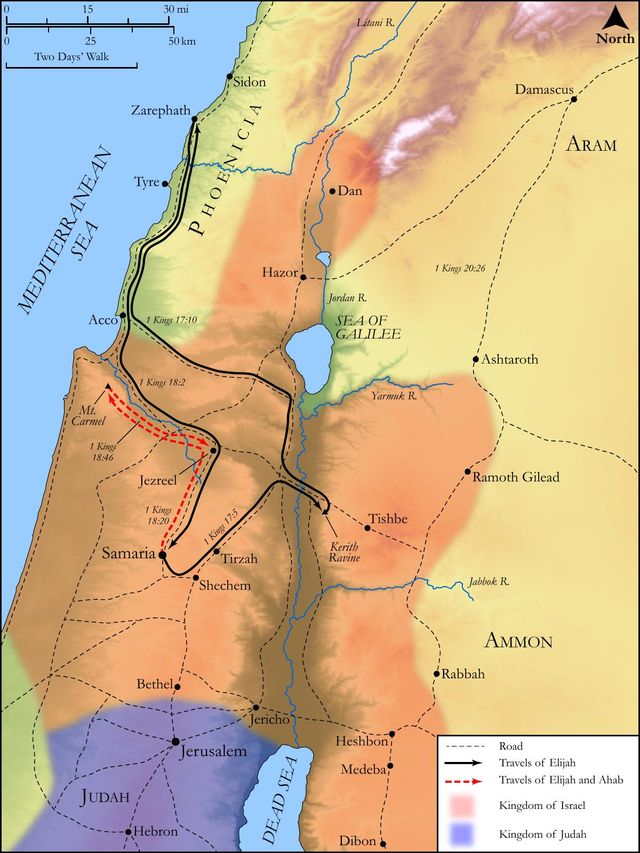
See on the biblical-era maps

Study this verse
Public-domain commentary
Matthew Henry
From his Commentary on the Whole Bible. Henry comments on passages, not single verses — this entry covers 1 Kings 18:17–20.
We have here the meeting between Ahab and Elijah, as bad a king as ever the world was plagued with and as good a prophet as ever the church was blessed with. 1. Ahab, like himself, basely accused Elijah. He durst not strike him, remembering that Jeroboam's hand withered when it was stretched out against a prophet, but gave him bad language, which was no less an affront to him that sent him. It was a very coarse compliment with which he accosted him at the first word: Art thou he that troubleth Israel? Kg1 18:17. How unlike was this to that with which his servant Obadiah saluted him (Kg1 18:7): Art thou that my lord Elijah? Obadiah feared God greatly; Ahab had sold himself to work wickedness; and both discovered their character by the manner of their address to the prophet. One may guess how people stand affected to God by observing how they stand affected to his people and ministers. Elijah now came to bring blessings to Israel, tidings of the return of the rain; yet he was thus affronted. Had it been true that he was the troubler of Israel, Ahab, as king, would have been bound to animadvert upon him. There are those who trouble Israel by their wickedness, whom the conservators of the public peace are concerned to enquire after. But it was utterly false concerning Elijah; so far was he from being an enemy to Israel's welfare that he as the stay of it, the chariots and horsemen of Israel. Note, It has been the lot of the best and most useful men to be called and counted the troublers of the land, and to be run down as public grievances. Even Christ and his apostles were thus misrepresented, Act 17:6. 2. Elijah, like himself, boldly returned the charge upon the king, and proved it upon him, that he was the troubler of Israel, Kg1 18:18. Elijah is not the Achan: "I have not troubled Israel, have neither done them any wrong nor designed them any hurt." Those that procure God's judgments do the mischief, not he that merely foretels them and gives warning of them, that the nation may repent and prevent them. I would have healed Israel, but they would not be healed. Ahab is the Achan, the troubler, who follows Baalim, those accursed things. Nothing creates more trouble to a land than the impiety and profaneness of princes and their families. 3. As one having authority immediately from the King of kings, he ordered a convention of the states to be forthwith summoned to meet at Mount Carmel, where there had been an altar built to God, Kg1 18:30. Probably on that mountain they had an eminent high place, where formerly the pure worship of God had been kept up as well as it could be any where but at Jerusalem. Thither all Israel must come, to give Elijah the meeting; and the prophets of Baal who were dispersed all the country over, with those of the groves who were Jezebel's domestic chaplains, must there make their personal appearance. 4. Ahab issued out writs accordingly, for the convening of this great assembly (Kg1 18:20), either because he feared Elijah and durst not oppose him (Saul stood in awe of Samuel more than of God), or because he hoped Elijah would bless the land, and speak the word that they might have rain, and upon those terms they would be all at his beck. Those that slighted and hated his counsels would gladly be beholden to him for his prayers. Now God made those who said they were Jews and were not, but were of the synagogue of Satan, to come, and, in effect, to worship at his feet, and to know that God had loved him, Rev 3:9.
Historical interpretation
Historical reception
1 surviving comment on this verse from the historical church.
“Have all Israel assemble for me at Mount Carmel.” Now, it is amazing how the king obeyed Elijah, who asked him for a general gathering of the people; and how also the people obeyed him humbly, even though he bitterly reproached them for their evil actions. It is also amazing how his request was granted, when he asked to be allowed to fight against the prophets of Baal. It is certain that they could not find a way to avoid meeting him, and they even looked for him, if it is true what some of the doctors say. And we also know that in our days false and deceiving people do the same. Therefore they thought that the prophets of Baal would make an altar in which they would have someone, who, at their sign, would set the fire and destroy the wood and the bull that were on the altar. And since they were confident in this scheme, they came to the fight, confident of the expected victory and in order to provoke Elijah.
Continue studying 1 Kings 18:19 across the web’s major study libraries — every link below opens this exact verse, chapter, or book on the destination site.
Read & Compare
 BibleGatewayThis verse in more than 200 translations and 70 languages.
 Bible.comThe YouVersion reader — hundreds of translations, reading plans, and highlights.
 ESV.orgCrossway's official English Standard Version reader.
 NET BibleThe NET translation with 60,000+ translators' notes on every rendering decision.
 STEP BibleTyndale House's free study tool — original text, vocabulary, and scholarly resources.
 BibliaLogos Bible Software's free web reader.
 USCCBThe New American Bible (Revised Edition) with the U.S. bishops' study notes.
Commentaries
 BibleHub CommentariesDozens of classic commentaries on this verse, gathered on one page.
 StudyLightMore than 100 commentary sets — the largest collection on the web.
 BibleRefPlain-English commentary on what this verse means, verse by verse.
 Enduring WordDavid Guzik's free commentary on this chapter, widely used by Bible teachers.
 Bible Study ToolsVerse commentary alongside Greek and Hebrew study aids.
Original Language & Research
- BibleHub InterlinearThe verse word by word — original language, transliteration, and English.
- BibleHub LexiconEvery word's original-language definition and Strong's entry.
 Blue Letter BibleDeep-study tools — Strong's numbers, concordance, and word studies.
 SefariaThe Hebrew text with Rashi and centuries of Jewish commentary.
Sermons, Hymns & Audio


TrulyRandomVerse is not affiliated with these sites and doesn’t control their content. They’re linked because they’re genuinely useful.
Summary
1 Kings 18:19 serves as the dramatic summons from the prophet Elijah, calling for a decisive spiritual confrontation on Mount Carmel. It encapsulates the bold challenge issued to a nation deeply entrenched in idolatry, demanding that King Ahab gather all Israel, along with the 450 prophets of Baal and 400 prophets of Asherah (referred to as "prophets of the groves") who were under Queen Jezebel's direct patronage. This verse meticulously sets the stage for one of the most pivotal and powerful demonstrations of divine sovereignty in biblical history, initiating a national turning point.
Context
ShowHideLiterary Context
This verse is strategically placed following a severe three-and-a-half-year drought, a direct judgment from Yahweh prophesied by Elijah in 1 Kings 17:1. The immediate preceding narrative describes Elijah's direct confrontation with King Ahab, where Elijah accuses Ahab of troubling Israel by forsaking the commandments of the Lord and following Baals, as stated in 1 Kings 18:18. Having established Yahweh's power over the elements through the drought, Elijah now escalates the spiritual battle, moving from a private confrontation with the king to a public, national showdown. This summons initiates the grand contest on Mount Carmel, detailed in 1 Kings 18:20-40, where the true God of Israel will be undeniably revealed through a miraculous display of fire and rain.
Historical & Cultural Context
The period of the Omride dynasty (King Ahab and Queen Jezebel) was marked by an aggressive promotion of Canaanite polytheism, particularly the worship of Baal and Asherah, throughout the northern kingdom of Israel. Jezebel, a Phoenician princess from Sidon, was a zealous devotee of Baal and actively persecuted the prophets of Yahweh, establishing her own cultic infrastructure with royal support. Baal was revered as the storm god, responsible for rain, thunder, and fertility, making the ongoing drought a direct challenge to his perceived power and a potent sign of his impotence. Asherah was a prominent Canaanite mother goddess, often associated with fertility and depicted by sacred poles or trees ("groves"). Mount Carmel itself was a significant high place, a fertile mountain range often used for worship due to its commanding views and natural prominence, making it an ideal, symbolically charged location for a contest between Yahweh and the false deities. The presence of 850 state-sponsored prophets underscores the pervasive and institutionalized nature of this idolatry, deeply embedded within the royal court and national life.
Key Themes
ShowHideThe verse powerfully contributes to several key themes within 1 Kings and the broader biblical narrative:
Divine Authority and Confrontation
Elijah, acting as Yahweh's sole remaining prophet, boldly asserts God's supreme authority over all false gods, challenging the prevailing idolatry directly and publicly. This confrontation highlights Yahweh's exclusive claim to worship and His active involvement in human history.
Idolatry's Pervasiveness
The sheer number of false prophets (450 of Baal, 400 of Asherah) highlights the widespread nature and deep entrenchment of pagan worship within Israel, reaching even into the royal court and permeating the national consciousness. This demonstrates the spiritual crisis facing the nation.
Jezebel's Destructive Influence
The specific mention of prophets "which eat at Jezebel's table" underscores her direct patronage, financial support, and aggressive commitment to establishing and maintaining these pagan cults. She is revealed as the primary human antagonist against Yahweh worship, actively working to supplant the covenant faith.
A Call to Decision
The gathering on Mount Carmel, initiated by this summons, is not merely a spectacle but a profound call for all Israel to choose whom they will serve—Yahweh or Baal—echoing Elijah's later challenge in 1 Kings 18:21. This theme of exclusive devotion to God is central to the covenant relationship established at Sinai.
Exposition and Analysis
ShowHideKey Word Analysis
ShowHideThe same as כַּרְמֶל; Karmel, the name of a hill and of a town in Palestine; Carmel, fruitful (plentiful) field, (place). Meaning "garden land" or "fruitful place," Mount Carmel is a fertile mountain range stretching along the Mediterranean coast. Its name itself suggests a place of lushness and abundance, making it a fitting, yet ironic, location for a contest during a severe drought. The choice of Carmel as the site for this confrontation is highly symbolic, representing the spiritual barrenness of Israel due to idolatry, and anticipating the return of rain and spiritual renewal.
The same as בַּעַל; Baal, a Phoenician deity; Baal, (plural) Baalim. This term literally means "lord" or "master" and was commonly used for the Canaanite storm and fertility god, worshipped as the provider of rain, crops, and livestock. His cult involved various rituals, including self-mutilation and ecstatic practices. The 450 prophets of Baal represent the official, state-sponsored priesthood dedicated to this specific deity, whose perceived power was directly challenged by the drought and Yahweh's impending demonstration.
Or אֲשֵׁירָה; from אָשַׁר; happy; Asherah (or Astarte) a Phoenician goddess; also an image of the same; grove. While translated as "groves" in the KJV, the Hebrew word refers to the Canaanite goddess Asherah, her cult image, or the sacred pole often associated with her worship. Asherah was a prominent mother goddess, often depicted as a consort to Baal or El, and was associated with fertility and creation. The 400 prophets of Asherah, distinct from those of Baal, indicate the dual nature of the idolatry promoted by Jezebel, who explicitly supported both cults, underscoring the comprehensive nature of Israel's spiritual apostasy.
Verse Breakdown
ShowHide"Now therefore send, [and] gather to me all Israel unto mount Carmel"
This opening phrase reveals Elijah's divine authority and direct command, issued to King Ahab. "All Israel" signifies the national scope of the spiritual crisis and the need for a public, undeniable demonstration of Yahweh's power before the entire nation. The summons to "Mount Carmel" designates the specific, symbolically charged location for the impending showdown, a place where the people would be forced to witness and make a choice regarding their ultimate allegiance.
"and the prophets of Baal four hundred and fifty"
This specifies the first, and larger, group of adversaries. The number 450 is substantial, indicating the widespread and institutionalized nature of Baal worship within Israel, likely supported by the royal treasury and deeply integrated into the national religious life. These were the official, well-established religious leaders of the false cult, representing a significant spiritual force.
"and the prophets of the groves four hundred"
This identifies the second group of false prophets, those dedicated to Asherah. Their distinct and equally large number (400) emphasizes that the idolatry in Israel was not confined to a single deity but encompassed a broader pantheon of Canaanite gods, aggressively promoted by Jezebel, demonstrating the comprehensive nature of Israel's spiritual apostasy.
"which eat at Jezebel's table"
This crucial detail highlights the direct patronage and financial support these 400 Asherah prophets received from Queen Jezebel. It signifies their privileged status within the royal court and underscores Jezebel's personal, zealous commitment to establishing and maintaining these pagan cults in Israel, making her the primary human antagonist in this spiritual conflict and revealing the deep corruption at the highest levels of power.
Literary Devices
ShowHideThe verse effectively employs several literary devices to heighten its dramatic impact and underscore its theological significance. Foreshadowing is prominent, as the detailed summons meticulously sets the stage for the epic confrontation on Mount Carmel, building anticipation for the divine revelation that is to follow. The sheer numbers provided (450 prophets of Baal, 400 prophets of the groves) serve as a form of hyperbole or exaggeration, not necessarily in strict literal count, but in emphasizing the overwhelming statistical disadvantage of Elijah and the pervasive nature of idolatry in Israel. This creates a powerful contrast between the lone prophet of Yahweh and the multitude of state-sponsored false prophets, highlighting the spiritual isolation of truth. Furthermore, Mount Carmel itself acts as symbolism, representing a battleground where the true God's power over creation (rain, fire) will be demonstrated against the impotent claims of Baal, the supposed storm god, who was believed to control the weather.
Theological and Thematic Connections
ShowHide1 Kings 18:19 is a profound theological statement on the nature of exclusive worship and the constant biblical tension between divine sovereignty and human idolatry. It encapsulates the core biblical demand for singular allegiance to Yahweh, revealing God's jealousy for His glory and His active intervention against spiritual apostasy. The verse sets the stage for a dramatic display of God's power, demonstrating that He is not merely one god among many, but the only true and living God who exercises ultimate authority over creation and history. It challenges the syncretistic tendencies of the human heart, which often seeks to combine the worship of God with the pursuit of worldly comforts or false securities, demanding a clear and decisive choice for the Lord and emphasizing the absolute incompatibility of serving both God and idols.
Reflection and Application
ShowHideThis pivotal verse from 1 Kings 18 resonates deeply with believers today, serving as a timeless reminder of the enduring spiritual battle against idolatry. While modern idols may not be physical statues of Baal or Asherah, they can manifest as anything that subtly or overtly takes God's rightful place in our lives: money, power, possessions, career, relationships, comfort, self-image, digital distractions, or even our own opinions and desires. Elijah's bold summons to Mount Carmel challenges us to identify and confront these contemporary idols, urging us to examine our allegiances and ensure that our devotion to God is singular and unwavering. It calls us to cultivate the same courage and spiritual discernment as Elijah, to stand firm for truth in a world that often compromises spiritual values, and to trust that God will ultimately reveal His power and sovereignty in our lives and in the world. This verse is a powerful call to make a clear, conscious choice, echoing the ancient challenge to live lives that honor God above all else, recognizing that true freedom and blessing come only from Him.
Questions for Reflection
ShowHideFAQ
ShowHideWhy were there so many prophets of Baal and Asherah, and why did they "eat at Jezebel's table"?
ShowHideThe large number of prophets (850 combined) underscores the pervasive and institutionalized nature of Baal and Asherah worship in Israel during Ahab and Jezebel's reign. This was not merely a fringe cult but a state-sponsored religion actively promoted by the monarchy. Jezebel, a zealous Phoenician princess, brought her devotion to Baal and Asherah with her and aggressively established their cults, even persecuting the prophets of Yahweh (see 1 Kings 18:4). The phrase "which eat at Jezebel's table" signifies that these 400 Asherah prophets (and likely the Baal prophets as well, though not explicitly stated for them here) were under royal patronage. This meant they received financial support, sustenance, and protection directly from the queen, indicating their privileged status, their integration into the court, and Jezebel's deep personal and political commitment to establishing and maintaining these false religions as the dominant faith in Israel. This royal endorsement provided them with legitimacy and resources, allowing their numbers to swell and their influence to spread throughout the kingdom, making them formidable opponents to Elijah and the worship of Yahweh.
Christ-Centered Fulfillment
ShowHide1 Kings 18:19, while a powerful Old Testament narrative, finds its ultimate Christ-centered fulfillment in the person and work of Jesus. Elijah, as a prophet, foreshadows Christ, the ultimate Prophet who perfectly reveals God's will and confronts the spiritual idolatry of humanity. The dramatic showdown on Mount Carmel, where Elijah calls for a decisive choice between Yahweh and Baal, points to the even more profound and ultimate choice presented by Jesus: "I am the way, the truth, and the life: no man cometh unto the Father, but by me," as declared in John 14:6. Just as Elijah called down fire from heaven to consume the sacrifice, demonstrating Yahweh's power, Jesus, the true Lamb of God, became the ultimate sacrifice, taking away the sin of the world (John 1:29). His death and resurrection represent the definitive victory over all false gods, spiritual principalities, and powers, disarming them and triumphing over them by the cross (Colossians 2:15). The "rain" that followed Elijah's victory symbolizes the spiritual blessings and new life that flow from Christ, who pours out the Holy Spirit upon His believers, fulfilling the prophecy that God would pour out His Spirit on all flesh (Acts 2:17-18). Ultimately, the confrontation on Carmel, where the people were called to choose whom they would serve, finds its echo in the gospel's call to repent and believe in Jesus, the one true Lord, who alone offers salvation and delivers humanity from the bondage of sin and spiritual idolatry.