


Joshua 19:26
Bible text: King James Version (1769 Blayney text) · Public domain
Bible text: King James Version with Strong's numbers · Public domain
Bible text: Berean Standard Bible · Public domain
Bible text: American Standard Version (1901) · Public domain
Bible text: World English Bible, Messianic edition · Public domain
Bible text: Geneva Bible (1599) · Public domain
Bible text: Young's Literal Translation · Public domain
- וְאַלַמֶּלֶךְve·'a·la·Me·lekhand AlammelechH487Conj-w ¦ N-properNoun Proper LocationוְandאַלַמֶּלֶךְAlammelech
- וְעַמְעָדve·'am·'Adand AmadH6008Conj-w ¦ N-properNoun Proper LocationוְandעַמְעָדAmad
- וּמִשְׁאָלu·mish·'Aland MishalH4861Conj-w ¦ N-properNoun Proper LocationוּandמִשְׁאָלMishal
- וּפָגַעu·fa·Ga'and it touchesH6293Conj-w ¦ V-Qal-ConsecPerf-3msVerb Qal Consecutive Perfect 3rd Singular Masculineוּandפָגַעit touches
- בְּכַרְמֶלbe·khar·Mel<on> CarmelH3760Prep-b ¦ N-properNoun Proper Locationבְּ<on>כַרְמֶלCarmel
- הַיָּמָּהhai·Ya·mah<the> west -wardH3220Art ¦ N-ms ¦ SfxNoun Singular Masculine Absoluteהַ<the>יָּמָּwestה-ward
- וּבְשִׁיחוֹרu·ve·shi·Chorand <on> ShihorH7884Conj-w ¦ Prep-b ¦ N-properNoun Proper Locationוּandבְ<on>שִׁיחוֹרShihor
- לִבְנָתliv·NatLibnathH7884N-properNoun Proper Location
English is a literal word-by-word gloss of the Hebrew, not the KJV's wording. Why?
This is the original text the KJV's translators worked from — each Hebrew word with its own literal English meaning in this verse, prepared by scholars at Tyndale House, Cambridge. The KJV translates whole sentences, not word by word, so its wording differs: one Hebrew word can become several English words, and the KJV may choose “the LORD” where the gloss reads “Yahweh”. Both are faithful — they answer different questions. For the KJV's own rendering, switch to the KJV text.
Details
See on the biblical-era maps
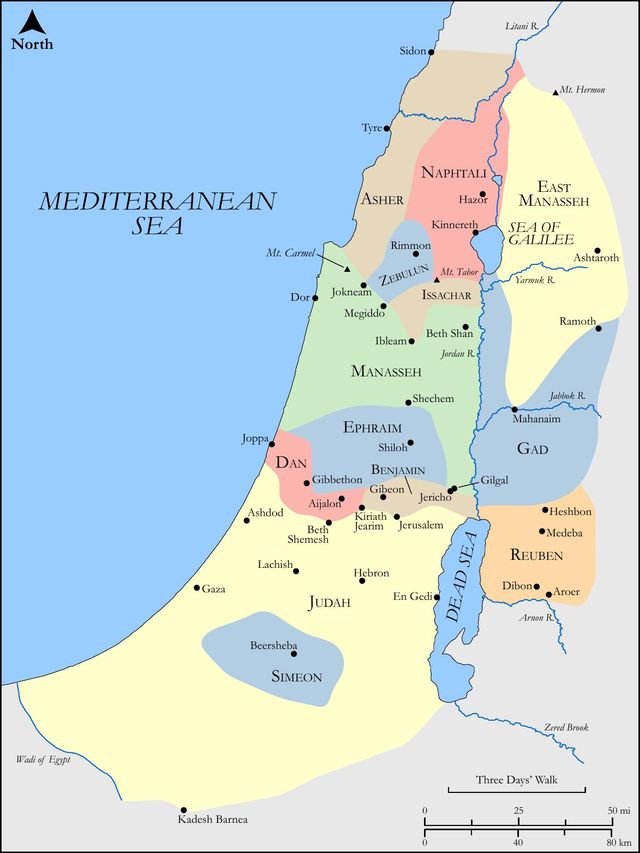
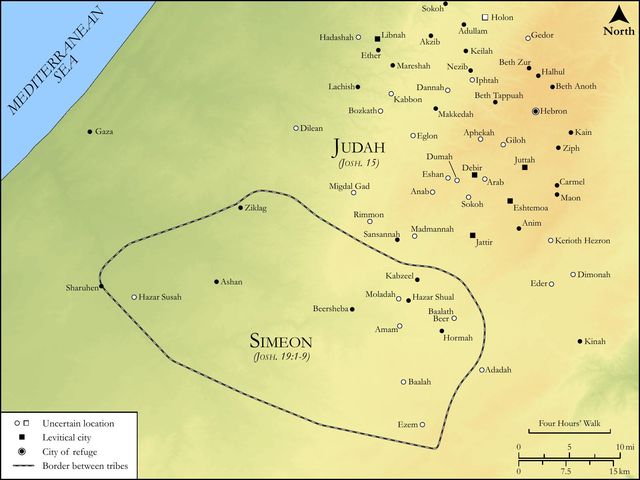
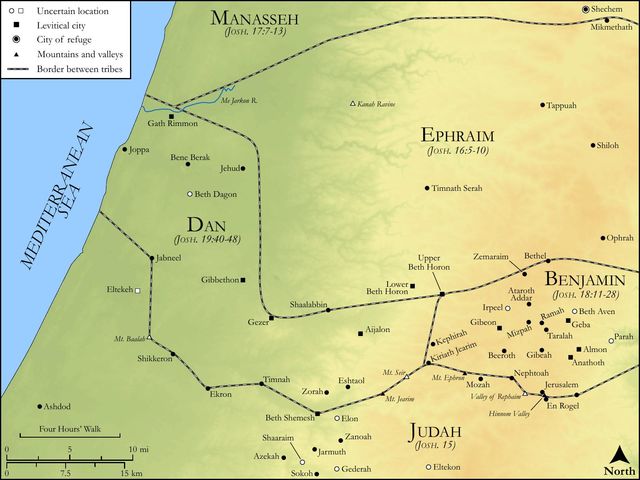
Study this verse
Public-domain commentary
Matthew Henry
From his Commentary on the Whole Bible. Henry comments on passages, not single verses — this entry covers Joshua 19:24–31.
The lot of Asher lay upon the coast of the great sea. We read not of any famous person of this tribe but Anna the prophetess, who was a constant resident in the temple at the time of our Saviour's birth, Luk 2:36. Nor were there many famous places in this tribe. Aphek (mentioned Jos 19:30) was the place near which Benhadad was beaten by Ahad, Kg1 20:30. But close adjoining to this tribe were the celebrated sea-port towns of Tyre and Sidon, which we read so much of. Tyre is called here that strong city (Jos 19:29), but Bishop Patrick thinks it was not the same Tyre that we read of afterwards, for that was built on an island; this old strong city was on the continent. And it is conjectured by some that into these two strong-holds, Sidon and Tzor, or Tyre, many of the people of Canaan fled and took shelter when Joshua invaded them.
Continue studying Joshua 19:26 across the web’s major study libraries — every link below opens this exact verse, chapter, or book on the destination site.
Read & Compare
 BibleGatewayThis verse in more than 200 translations and 70 languages.
 Bible.comThe YouVersion reader — hundreds of translations, reading plans, and highlights.
 ESV.orgCrossway's official English Standard Version reader.
 NET BibleThe NET translation with 60,000+ translators' notes on every rendering decision.
 STEP BibleTyndale House's free study tool — original text, vocabulary, and scholarly resources.
 BibliaLogos Bible Software's free web reader.
 USCCBThe New American Bible (Revised Edition) with the U.S. bishops' study notes.
Commentaries
 BibleHub CommentariesDozens of classic commentaries on this verse, gathered on one page.
 StudyLightMore than 100 commentary sets — the largest collection on the web.
 BibleRefPlain-English commentary on what this verse means, verse by verse.
 Enduring WordDavid Guzik's free commentary on this chapter, widely used by Bible teachers.
 Bible Study ToolsVerse commentary alongside Greek and Hebrew study aids.
Original Language & Research
- BibleHub InterlinearThe verse word by word — original language, transliteration, and English.
- BibleHub LexiconEvery word's original-language definition and Strong's entry.
 Blue Letter BibleDeep-study tools — Strong's numbers, concordance, and word studies.
 SefariaThe Hebrew text with Rashi and centuries of Jewish commentary.
Sermons, Hymns & Audio


TrulyRandomVerse is not affiliated with these sites and doesn’t control their content. They’re linked because they’re genuinely useful.
Summary
Joshua 19:26 meticulously details a crucial segment of the western boundary for the tribe of Asher, enumerating specific towns and natural landmarks like Alammelech, Amad, Misheal, Mount Carmel, and Shihorlibnath. This precise geographical description within the larger account of land distribution serves as a profound testament to God's unwavering faithfulness in fulfilling His ancient covenant promises, ensuring each Israelite tribe received its divinely appointed inheritance with remarkable precision and order.
Context
ShowHideLiterary Context
Joshua 19:26 is situated within the latter half of the book of Joshua, which transitions from the narratives of conquest (chapters 1-12) to the intricate division of the Promised Land among the twelve tribes of Israel (chapters 13-21). Specifically, this verse is part of the extensive description of the inheritance allocated to the tribe of Asher, following the initial distributions to Judah, Ephraim, Manasseh, Benjamin, and Simeon. The painstaking enumeration of towns, wadis, and prominent natural features throughout these chapters is not merely a dry geographical listing; rather, it underscores the profound legal and theological significance of the land allocation. It serves as a permanent, divinely sanctioned record of God's faithful fulfillment of His ancient promises to Abraham's descendants, establishing the foundational structure for the nascent nation of Israel. This exhaustive detail was crucial for clarity regarding tribal boundaries, designed to prevent future disputes and affirm the divine authority behind each tribe's portion.
Historical & Cultural Context
The division of land in ancient Israel was an undertaking of immense significance, deeply intertwined with the identity, security, and future prosperity of the Israelite tribes in the land of Canaan. Land was far more than mere property; it was a sacred inheritance, a tangible manifestation of God's covenant faithfulness to Abraham, Isaac, and Jacob. The process, as meticulously described in Joshua, involved the casting of lots before the Lord at Shiloh, a practice indicating divine oversight and approval over the entire distribution process, as seen in Joshua 18:10. This method ensured that the allocation was perceived as God's sovereign will, rather than a result of human negotiation or favoritism. Prominent geographical markers such as Mount Carmel and the potentially less identifiable Shihorlibnath were indispensable in a pre-surveying era, serving as natural, recognizable landmarks that precisely defined the extent of a tribe's dominion, safeguarding their agricultural lands, ensuring access to vital resources, and establishing strategic positions within the broader Canaanite landscape. The meticulous nature of these records highlights the paramount importance of precise boundaries for maintaining tribal identity, fostering economic stability, and preserving peace among the confederated tribes.
Key Themes
ShowHideThis verse, like the entirety of Joshua 19, contributes significantly to several overarching themes foundational to the book of Joshua and the Pentateuch. Firstly, it powerfully illustrates Divine Faithfulness, demonstrating God's unwavering commitment to His covenant promises to give the land of Canaan to the descendants of Abraham, a promise reiterated consistently throughout the Pentateuch (e.g., Genesis 15:18). The detailed fulfillment of this promise, even down to specific boundary markers, profoundly underscores God's reliability and integrity. Secondly, the Order and Precision evident in the land distribution highlights God's methodical and purposeful nature. This was not a chaotic or haphazard acquisition of territory but a divinely orchestrated allocation, ensuring equity and establishing a structured, divinely governed society. Finally, the emphasis on distinct Tribal Identity and Inheritance is paramount. Each tribe received a unique and clearly defined portion, reinforcing their individual identity and specific role within the larger Israelite confederation, yet all were united under the banner of Yahweh, possessing a common heritage in the divinely Promised Land. This meticulous record served to solidify their sense of belonging and their place within God's unfolding redemptive plan.
Exposition and Analysis
ShowHideKey Word Analysis
ShowHideFrom a primitive root meaning "to impinge," this word signifies the act of coming into contact with, meeting, or reaching a specific point. In the context of Joshua 19:26, it denotes the precise extension of Asher's boundary line, indicating that the territory's limit physically "touches" or "reaches" Mount Carmel and Shihorlibnath. This emphasizes the exactitude and defined nature of the tribal borders, leaving no ambiguity regarding the extent of their inheritance.
The same as the Hebrew word meaning "fruitful field" or "garden land," Carmel refers to a prominent mountain range that stretches from the Jezreel Valley northwest to the Mediterranean Sea. As a significant geographical landmark, its inclusion here as a westward boundary marker for Asher highlights the tribe's access to fertile lands and valuable coastal areas. Beyond its geographical importance, Carmel later gains profound spiritual significance as the site of Elijah's dramatic confrontation with the prophets of Baal, as recounted in 1 Kings 18.
This compound name, meaning "darkish whiteness," refers to a stream or wadi in Palestine. While its exact modern identification remains debated by scholars, it likely describes a watercourse characterized by dark, possibly muddy, waters contrasting with white sand or limestone, or perhaps a dark stream flowing into white sands. Its inclusion underscores the meticulous detail of the boundary descriptions, utilizing even seemingly minor natural features to precisely delineate tribal territories, thereby emphasizing the thoroughness of the land allocation and its divine sanction.
Verse Breakdown
ShowHide"And Alammelech, and Amad, and Misheal;"
These are three ancient town names that served as specific, identifiable points along the eastern or southern boundary of Asher's territory. While their precise modern identifications are debated by archaeologists and geographers, their inclusion here signifies the precise, point-by-point delineation of the tribal inheritance. These names, along with others listed in the chapter, formed a detailed "legal description" of the land, marking the extent of Asher's domain and preventing encroachment from neighboring tribes.
"and reacheth to Carmel westward,"
This clause indicates that the boundary extended from the previously mentioned towns towards the prominent Mount Carmel, specifically its western slopes or the point where it meets the sea. This establishes a clear and unmistakable geographical marker for the western extent of Asher's territory, granting them access to the Mediterranean coast, a significant economic and strategic advantage. The phrase "reacheth to" (Hebrew: pâgaʻ) emphasizes the continuous, defined, and physically verifiable nature of the boundary line.
"and to Shihorlibnath;"
This final clause specifies another significant boundary marker, likely a watercourse, completing the description of this particular segment of Asher's border. The inclusion of such a specific, perhaps even minor, geographical feature further highlights the extreme precision and thoroughness with which the land was divided. It underscores the divine order and the legal exactitude of the process, ensuring that every square foot of the Promised Land was accounted for and properly assigned by divine decree.
Literary Devices
ShowHideThe primary literary device at play in Joshua 19:26, and indeed throughout the land distribution chapters of Joshua, is Enumeration. This involves the detailed and exhaustive listing of names, places, and boundaries, creating a comprehensive and verifiable record. This enumeration serves to establish the legal and historical reality of the land's division, emphasizing the concrete fulfillment of God's promises. Coupled with this is Geographical Precision, where specific and identifiable landmarks like Mount Carmel and the watercourse of Shihorlibnath are used to create an undeniable and verifiable map of the tribal territories. This precision lends an air of authenticity and divine authority to the narrative, transforming abstract promises into tangible reality. The cumulative effect of these devices is to convey a profound sense of Divine Order and meticulous planning, reinforcing the theological truth that God is faithful to His word and executes His redemptive plans with exactitude, leaving no detail to chance in the establishment of His people in their promised inheritance.
Theological and Thematic Connections
ShowHideJoshua 19:26, though a seemingly mundane geographical detail, profoundly underscores the theological truth of God's unwavering faithfulness and meticulous fulfillment of His covenant promises. The precise demarcation of Asher's territory, alongside that of the other tribes, is a tangible demonstration that God keeps His word, even down to the most intricate details of land boundaries promised centuries earlier to Abraham. This passage serves as a powerful reminder that God's plans are not vague aspirations but concrete realities, executed with divine order and purpose. It teaches us that God's commitment to His people is absolute, providing them with a secure inheritance and a defined place within His unfolding redemptive narrative. The very act of naming these obscure towns and landmarks elevates them to monuments of divine reliability, testifying to a God who is both omnipotent in conquest and painstaking in provision.
Reflection and Application
ShowHideThe meticulous details of Joshua 19:26, while geographically specific to ancient Israel, offer profound spiritual lessons for believers today. Just as God painstakingly ensured every tribe received its precise inheritance, so too does He meticulously work in our lives, fulfilling His promises and providing for our every need. This passage invites us to reflect on the nature of God's faithfulness: if He was so precise in delivering a physical land, how much more precise and reliable is He in fulfilling His spiritual promises to us? It reminds us that our "inheritance" in Christ is not vague or uncertain, but a divinely secured reality, prepared with intentionality and love. Furthermore, the concept of defined boundaries can be applied spiritually; understanding our identity and limitations in Christ provides security and purpose, protecting us from spiritual encroachment and guiding us in our walk. We are called to trust in God's perfect plan, even when the details seem obscure, knowing that His ultimate purpose for us is one of secure belonging and abundant provision.
Questions for Reflection
ShowHideFAQ
ShowHideWhy are these geographical details so important in the Bible?
ShowHideThese geographical details are crucial because they serve several vital purposes. Firstly, they provide historical and legal validation for the Israelite claim to the land, demonstrating that the land was not simply conquered but divinely allotted. Secondly, they underscore God's faithfulness in fulfilling His ancient covenant promises to Abraham, Isaac, and Jacob, transforming a prophetic word into a tangible reality. Thirdly, these precise boundaries established tribal identities, minimized disputes, and laid the groundwork for the social and political structure of the nascent nation of Israel. They transform abstract promises into concrete, verifiable facts, emphasizing the reliability of God's word and His meticulous execution of His plans.
How was the land actually divided among the tribes?
ShowHideThe land was primarily divided by casting lots before the Lord at Shiloh, as explicitly described in Joshua 18:10. This method was understood to reveal God's sovereign will, ensuring that the allocation was seen as divinely ordained rather than a result of human negotiation or favoritism. While the general areas were likely determined by factors such as tribal size and historical settlement patterns, the specific and precise boundaries were ultimately finalized through this sacred process, ensuring both fairness and spiritual legitimacy for each tribe's inheritance.
What is the significance of Asher's territory, specifically its coastal access?
ShowHideAsher's territory, as described in Joshua 19, included significant coastal access, extending from Mount Carmel northward. This was strategically and economically important, providing access to valuable maritime trade routes and fertile plains, making it a potentially prosperous region. While the tribe of Asher did not fully dispossess all the inhabitants of their coastal cities, as noted in Judges 1:31-32, their divinely designated inheritance nonetheless highlighted God's provision of rich resources and strategic positioning for His people within the land. It also placed them at a vital crossroads of ancient trade and cultural exchange.
Christ-Centered Fulfillment
ShowHideThe meticulous land distribution in Joshua, exemplified by the precise boundaries of Joshua 19:26, finds its ultimate Christ-centered fulfillment in the spiritual inheritance and secure dwelling place that believers receive in Jesus Christ. Just as the physical land was a tangible promise to ancient Israel, Christ is the ultimate fulfillment of God's promise of rest and an eternal inheritance. He is the true "Promised Land" where weary souls find spiritual rest and security, as He invites, "Come to me, all who labor and are heavy laden, and I will give you rest". The secure and precisely defined boundaries of Asher's territory foreshadow the unshakable security of our salvation in Christ, where our spiritual "inheritance" is described as imperishable, undefiled, and unfading, kept in heaven for us by God's power (1 Peter 1:4). Furthermore, the detailed allocation of land points to the divine order and intentionality of God's grand redemptive plan, culminating in Christ, through whom we have been chosen and predestined to obtain an inheritance (Ephesians 1:11). He is not only the means of our inheritance but also the very substance of it, leading us to a heavenly city with foundations, whose architect and builder is God (Hebrews 11:10). Thus, the geographical precision of Joshua 19:26 ultimately points to the infinitely more precise and glorious spiritual reality of our secure and eternal dwelling in Christ, the Lamb of God who takes away the sin of the world and grants us access to the new creation (Revelation 21:1).