


1 Chronicles 6:74
Bible text: King James Version (1769 Blayney text) · Public domain
Bible text: Berean Standard Bible · Public domain
Bible text: American Standard Version (1901) · Public domain
Bible text: World English Bible, Messianic edition · Public domain
Bible text: Geneva Bible (1599) · Public domain
Bible text: Young's Literal Translation · Public domain
- וּמִמַּטֵּהu·mi·ma·Tehand from [the] tribe ofH4294Conj-w ¦ Prep-m ¦ N-mscNoun Singular Masculine Constructוּandמִfromמַּטֵּה[the] tribe of
- אָשֵׁר'a·SherAsherH836N-proper-mNoun Proper Masculine
- אֶת'et<obj.>H853DirObjMParticle Object Indicator
- מָשָׁלma·ShalMashalH4913N-properNoun Proper Location
- וְאֶתve·'Etand <obj.>H853Conj-w ¦ DirObjMParticle Object Indicatorוְandאֶת<obj.>
- מִגְרָשֶׁיהָmig·ra·Shei·haits pasture landsH4054N-mpc ¦ 3fsNoun Plural Masculine Constructמִגְרָשֶׁיpasture landsהָits
- וְאֶתve·'Etand <obj.>H853Conj-w ¦ DirObjMParticle Object Indicatorוְandאֶת<obj.>
- עַבְדּוֹןav·DonAbdonH5658N-properNoun Proper Location
- וְאֶתve·'Etand <obj.>H853Conj-w ¦ DirObjMParticle Object Indicatorוְandאֶת<obj.>
- מִגְרָשֶׁיהָmig·ra·Shei·haits pasture landsH4054N-mpc ¦ 3fsNoun Plural Masculine Constructמִגְרָשֶׁיpasture landsהָits
English is a literal word-by-word gloss of the Hebrew, not the KJV's wording. Why?
This is the original text the KJV's translators worked from — each Hebrew word with its own literal English meaning in this verse, prepared by scholars at Tyndale House, Cambridge. The KJV translates whole sentences, not word by word, so its wording differs: one Hebrew word can become several English words, and the KJV may choose “the LORD” where the gloss reads “Yahweh”. Both are faithful — they answer different questions. For the KJV's own rendering, switch to the KJV text.
Details
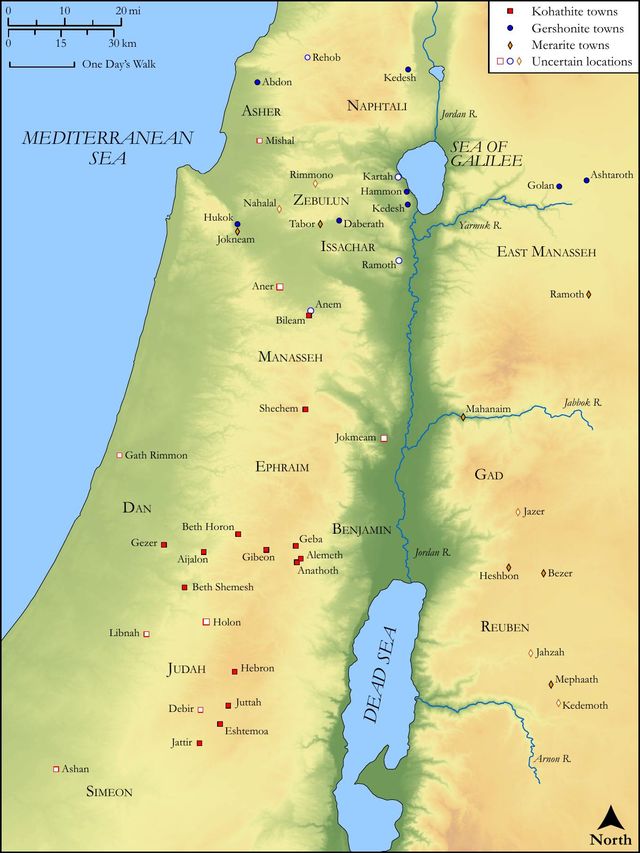
See on the biblical-era map
Study this verse
Public-domain commentary
Matthew Henry
From his Commentary on the Whole Bible. Henry comments on passages, not single verses — this entry covers 1 Chronicles 6:54–81.
We have here an account of the Levites' cities. They are here called their castles (Ch1 6:54), not only because walled and fortified, and well guarded by the country (for it is the interest of every nation to protect its ministers), but because they and their possessions were, in a particular manner, the care of the divine providence: as God was their portion, so God was their protection; and a cottage will be a castle to those that abide under the shadow of the Almighty. This account is much the same with that which we had, Jos. 21. We need not be critical in comparing them (what good will it do us?) nor will it do any hurt to the credit of the holy scripture if the names of some of the places be not spelt just the same here as they were there. We know it is common for cities to have several names. Sarum and Salisbury, Salop and Shrewsbury, are more unlike than Hilen (Ch1 6:58) and Holon (Jos 21:15), Ashan (Ch1 6:59) and Ain (Jos 21:16), Alemeth (Ch1 6:60) and Almon (Jos 21:18); and time changes names. We are only to observe that in this appointment of cities for the Levites God took care, 1. For the accomplishment of dying Jacob's prediction concerning this tribe, that it should be scattered in Israel, Gen 49:7. 2. For the diffusing of the knowledge of himself and his law to all parts of the land of Israel. Every tribe had Levites' cities in it; and so every room was furnished with a candle, so that none could be ignorant of his duty but it was either his own fault or the Levites'. 3. For a comfortable maintenance for those that ministered in holy things. Besides their tithes and offerings, they had glebe-lands and cities of their own to dwell in. Some of the most considerable cities of Israel fell to the Levites' lot. Every tribe had benefit by the Levites, and therefore every tribe must contribute to their support. Let him that is taught in the word communicate to him that teacheth, and do it cheerfully.
Historical interpretation
Historical reception
3 surviving comments on this verse. Each one is dated, so this reads as a timeline rather than a list.
The Chronicles also speak about the tabernacle because a temple of the Lord had not yet been built by either Samuel or David. The text also adds that that the holy services were held in the tabernacle. Worship was observed at that time according to the number of the days of the week. For it also says, “and their kindred who were in their villages were obliged to come in every seven days, in turn, to be with them.” With regard to the holy utensils it says, “Some of them had charge of the utensils of service, for they were required to count them when they were brought in and taken out. Others of them were appointed over the furniture, and over all the holy utensils, also over the choice flour, the wine, the oil, the incense and the spices.” And about the priests it says, “Others, of the sons of the priests, prepared the mixing of the spices.” With regard to the tomb of Saul the Chronicles gives us much information, and in the Book of Kings itself we read that his bones were gathered and buried in the land of Jabesh.
There is abundant information in the books of Chronicles which were written to continue the books of the Kings and to preserve the memory of such important events. The first book begins with a genealogy that sets out to demonstrate how the human race came from a single man. Since it focuses only on the single kingdom of Judah, it can tell us about its cities and the villages, and from where they took their names. Here we come to know Nathan, from whom the blessed Luke constructed the beginning of his genealogy of our Lord and Savior, Son of David and Solomon’s brother4 on his mother’s side: “The following children were born to him in Jerusalem: Shimeah, Shobab, Nathan and Solomon, that is, the four children he fathered with Bersabea, daughter of Ammiel.” And Rechab6 herself, who is mentioned in many books of Scripture, is said to have come from the tribe of Judah.It also clearly explains why Reuben lost his birthright and Joseph gained it and also, finally, the reason why the tribe of Judah obtained the highest honor: “The sons of Reuben the firstborn of Israel. He was the firstborn, but because he defiled his father’s bed his birthright was given to the sons of Joseph son of Israel, so that he is not enrolled in the genealogy according to the birthright; though Judah became prominent among his brothers and a ruler came from him, yet the birthright belonged to Joseph.” It also explains the reason why such a great honor was conceded to Joseph. By the will of God Judah had the dignity of receiving the Lord who was born from him according to the flesh. This is the sense tacitly expressed with the words “a leader from him.” Indeed the passage seems to assert that not only the kings of the earth derived from Judah, but also the eternal king himself who had no beginning and will never end.
It also describes the situation of the tribes beyond the Jordan, those of Reuben and Gad, and even the tribes of Manasseh which later were received into those of the Hagarites and the Itureans, and talks about the tribes of the Naphiseans, and all those peoples who entered into conflict with them. In addition the text relates how they fought and won, and made the Hagarites flee. And it also reports the reason for the victory: “When they received help against them, the Hagarites and all who were with them were given into their hands, for they cried to God in the battle, and he granted their entreaty because they trusted in him.” It also describes the amount of the spoils of war: “They captured their livestock: 50, of their camels, 250, sheep, 2, donkeys and 100, captives. Many were slain because the war was from God. And they lived in their territory until the exile.”
The genealogy of the priests and the Levites comes after this. It relates that Zadok, who was high priest at the time of David, had been the eleventh from Aaron; that Azariah, nephew of Zadok, had been the first to receive the priestly anointing in the temple built by Solomon. Among them there was also Jehozadak, who was brought to Babylon as a war prisoner. Jesus9 was his son, a high priest as well, who delivered the people from bondage together with Zerubbabel, and built a temple for the Lord. Here we also learn that Korah, who revolted against the great Moses, was a nephew of Isaar, son of Caath and brother of Amram, Aaron’s and Moses’ father. According to this lineage he was related to the first legislator. But he himself paid in the desert for his errors, although his children did not share the punishment of their father. From here Samuel13 came and then Aeman, who intoned Psalms and was a nephew of the prophet Samuel. In fact he was the son of Joel, son of Samuel. On the other hand, Asaph, one of the singers, came from the lineage of Gerson, son of Levi and brother of Caath. Aetham, who also belonged to the group of the singers, had Merari, the third son of Levi, as great-grandfather.The text also explains the difference between the priests and the Levites. It relates that the Levites were initiated into all the ministries of the holy altar of God: “But Aaron and his sons made offerings on the altar of burnt offering and on the altar of incense, doing all the work of the most holy place, to make atonement for Israel, according to all that Moses the servant of God had commanded.” It seems to me, in fact, that this book was written after the return from Babylon. For this reason it also talks about the bondage and explains its cause: “So all Israel was enrolled by genealogies; and these are written in the book of the Kings of Israel. And Judah was taken into exile in Babylon because of their unfaithfulness. Now the first to live again in their possessions in their towns were Israelites, priests, Levites, and temple servants.” These accounts show that the book was begun after the captivity. Indeed no historian ever relates facts that happened afterwards, but what happened before or during his times. And actually only the prophets have the power to foretell the future. In addition it says that also those who had inhabited that land before them had been enslaved. And actually many of them still live with them: the Canaanites, Chettites, Jebusites, who had been their companions in such a misfortune. Also the priests and the Levites were brought into captivity with the Israelites. I believe that those who were called “the saints’ servants” were then called Nathinim. Many of them, in fact, consecrated themselves to the ministries of the priests and the Levites. There were among them also those who were entrusted with the carrying of the water, the gathering of wood and other necessary duties. Indeed, if it was imposed to the Gabaonites, who were foreigners, to follow Joshua in the praises and to perform some works as porters or carpenters, this task was even more the duty of the Israelites. As a proof of this I have found in the interpretation of Hebrew names that this name means “house of Iaō,” that is, “of the God who is.” The text, in fact, mentions the children of Israel and among them Judah and Benjamin, and Ephraim18 and Manasseh. It also mentions the priests and the Levites, who inhabited those cities. About the Korēnites it says that they derived from Korah. It also says that among them there had been the guardians of the temple of God as well, and it seems that this custom had been introduced by Samuel and David. “All these, who were chosen as gatekeepers at the thresholds, were two hundred twelve. They were enrolled by genealogies in their villages. David and the prophet Samuel established them in their office of trust. So they and their descendants were in charge of the gates of the house of the Lord, that is, the house of the tent, as guards. The gatekeepers were on the four sides, east, west, north, and south.”
Continue studying 1 Chronicles 6:74 across the web’s major study libraries — every link below opens this exact verse, chapter, or book on the destination site.
Read & Compare
 BibleGatewayThis verse in more than 200 translations and 70 languages.
 Bible.comThe YouVersion reader — hundreds of translations, reading plans, and highlights.
 ESV.orgCrossway's official English Standard Version reader.
 NET BibleThe NET translation with 60,000+ translators' notes on every rendering decision.
 STEP BibleTyndale House's free study tool — original text, vocabulary, and scholarly resources.
 BibliaLogos Bible Software's free web reader.
 USCCBThe New American Bible (Revised Edition) with the U.S. bishops' study notes.
Commentaries
 BibleHub CommentariesDozens of classic commentaries on this verse, gathered on one page.
 StudyLightMore than 100 commentary sets — the largest collection on the web.
 BibleRefPlain-English commentary on what this verse means, verse by verse.
 Enduring WordDavid Guzik's free commentary on this chapter, widely used by Bible teachers.
 Bible Study ToolsVerse commentary alongside Greek and Hebrew study aids.
Original Language & Research
- BibleHub InterlinearThe verse word by word — original language, transliteration, and English.
- BibleHub LexiconEvery word's original-language definition and Strong's entry.
 Blue Letter BibleDeep-study tools — Strong's numbers, concordance, and word studies.
 SefariaThe Hebrew text with Rashi and centuries of Jewish commentary.
Sermons, Hymns & Audio


TrulyRandomVerse is not affiliated with these sites and doesn’t control their content. They’re linked because they’re genuinely useful.
Summary
1 Chronicles 6:74 serves as a precise administrative record within the extensive Levitical genealogies and city allocations. This verse specifically identifies Mashal and Abdon, two cities located within the tribal territory of Asher, which were designated as dwelling places for the Gershonite branch of the Levites, complete with their essential surrounding pasturelands. It stands as a testament to God's meticulous provision and the faithful fulfillment of His covenant promises regarding the spiritual order and sustenance of His chosen people.
Context
ShowHideLiterary Context
This verse is deeply embedded within the Chronicler's detailed account of Israel's tribal and priestly organization, specifically within 1 Chronicles 6. Following a comprehensive tracing of Levi's descendants, particularly the lineage of Aaron and the high priests (from 1 Chronicles 6:1 to 1 Chronicles 6:53), the text shifts to the practical implementation of the divine command concerning the allocation of cities to the priestly and Levitical families (starting at 1 Chronicles 6:54). Verses 1 Chronicles 6:71-76 specifically enumerate the cities assigned to the Gershonite clan of Levites. Therefore, 1 Chronicles 6:74 is not an isolated detail but a precise component of a comprehensive administrative record, meticulously demonstrating the fulfillment of God's commands regarding the tribal distribution and the Levites' unique and vital role in the spiritual life of the nation.
Historical & Cultural Context
Unlike the other tribes of Israel, the Levites did not receive a continuous territorial inheritance in the Promised Land. Instead, by divine command given through Moses (as recorded in Numbers 35:1-8), they were allotted 48 cities scattered among all the other tribes, along with their surrounding pasturelands. This unique arrangement served several crucial purposes: it prevented the Levites from becoming a land-owning, politically powerful tribe, ensured their dependence on God's provision, and crucially, facilitated their dispersed ministry throughout the nation. The "suburbs" (Hebrew: migrashim) mentioned here were not residential extensions in the modern sense but essential common pasturelands for their livestock, vital for their sustenance given their lack of agricultural land. The tribe of Asher, to whom Mashal and Abdon belonged, was located in the northern coastal plain of Canaan, bordering Phoenicia. The placement of Levitical cities within Asher's territory would have ensured a spiritual presence and the availability of Mosaic Law instruction in this geographically significant region, which often had strong ties to the pagan nations round about.
Key Themes
ShowHideThe meticulous listing of Levitical cities, including those in 1 Chronicles 6:74, underscores several profound themes central to the Chronicler's message. Firstly, it highlights Divine Provision and Order, demonstrating God's precise organization and faithful care for those set apart for His service, ensuring their livelihood and capacity for ministry. Secondly, it showcases the Fulfillment of Law and Covenant, as these allocations directly correspond to the commands given in Numbers 35 and their subsequent implementation in Joshua 21, affirming God's faithfulness to His promises. Thirdly, it emphasizes the Levitical Role and Dispersal, ensuring that spiritual instruction, legal arbitration, and oversight of the Mosaic Law were accessible across the entire nation, not just in a central sanctuary. The Levites served as teachers, judges, and caretakers of the Tabernacle and later the Temple, and their presence in all tribal territories facilitated this vital function. Finally, the detailed geographical and tribal information reinforces the Historical Accuracy and Veracity of the biblical narrative, affirming God's meticulous attention to detail and His unwavering commitment to His people.
Exposition and Analysis
ShowHideKey Word Analysis
ShowHideThis term, derived from a root meaning "to extend" or "to stretch out," refers to a branch or staff, and figuratively, to a tribe or clan. In 1 Chronicles 6:74, it specifically designates one of the twelve divisions of Israel, the "tribe of Asher." The use of maṭṭeh here underscores the organized, familial, and divinely ordained structure of the Israelite nation, within which the Levitical cities were carefully integrated.
Meaning "happy" or "blessed," Asher was one of the twelve sons of Jacob and the progenitor of the tribe bearing his name. His territory was located in the fertile northern coastal plain of Canaan, known for its rich agricultural produce. The mention of Asher's tribe in this verse specifies the geographical context for Mashal and Abdon, highlighting how the Levitical cities were distributed even in the prosperous and strategically important regions of the Promised Land, ensuring spiritual presence across the entire nation.
This is the name of a specific city located within the territory of the tribe of Asher. Also known as Mishal in other biblical texts (e.g., Joshua 19:26), its inclusion here confirms its status as one of the cities designated for the Gershonite Levites. Its mention underscores the precise geographical distribution of the Levitical settlements as recorded in the historical accounts, demonstrating the meticulous fulfillment of God's commands.
Another city situated in the territory of Asher, Abdon is also mentioned in Joshua 19:28 and explicitly listed as a Gershonite city in Joshua 21:30. The name "Abdon" derives from a root meaning "to serve," which is profoundly fitting for a city inhabited by those dedicated to the service of God and the nation, further emphasizing the Levites' unique role.
This crucial term refers to the common pasturelands, open areas, and grazing grounds surrounding the walled city. Unlike the modern understanding of "suburbs" as residential extensions, migrâsh were essential for the Levites' livelihood, as they did not receive agricultural land for farming. These lands sustained their livestock, which was a primary source of their income and sustenance. The consistent mention of "suburbs" alongside each city highlights the completeness of God's provision and the practical wisdom behind the Levitical land allocation.
Verse Breakdown
ShowHide"And out of the tribe of Asher"
This opening clause immediately establishes the geographical and tribal context for the cities that follow. It specifies that these particular Levitical cities were carved out of the territory originally allotted to the tribe of Asher, demonstrating the inter-tribal nature of the Levitical distribution and God's overarching plan for the spiritual administration of the entire nation.
"Mashal with her suburbs"
This identifies the first of the two cities from Asher's territory designated for the Levites. The phrase "with her suburbs" is critical, emphasizing that the provision was not just the city proper but also the surrounding pasturelands necessary for the Levites to sustain themselves and their families through their livestock, given their unique landless status. This detail highlights the comprehensive and practical nature of God's provision.
"and Abdon with her suburbs"
The second city from Asher's territory is named, again explicitly including its "suburbs." The repetition of "with her suburbs" reinforces the comprehensive nature of the divine provision and highlights the consistent pattern of allocation for all Levitical cities, ensuring their economic viability and enabling their full-time dedication to sacred duties. This reiteration underscores the thoroughness of the divine plan and its faithful execution.
Literary Devices
ShowHideThe primary literary device at play in 1 Chronicles 6:74, and indeed throughout the lengthy lists of Levitical cities in 1 Chronicles 6 and Joshua 21, is Enumeration. The text systematically lists each city and its associated tribe, providing a detailed catalog. This meticulous Precision and Detail serve to underscore the historical accuracy and the thoroughness with which God's commands were fulfilled. The repeated phrase "with her suburbs" functions as a form of Anaphora or Repetition, emphasizing the consistent and complete nature of the provision for each Levitical city. This seemingly dry listing also conveys a profound sense of Order and Structure, reflecting the divine blueprint for the nation of Israel and the careful administration of its spiritual infrastructure. The very act of recording these details highlights the Chronicler's intent to demonstrate God's faithfulness, His covenant keeping, and the establishment of a well-ordered society under His sovereign hand.
Theological and Thematic Connections
ShowHide1 Chronicles 6:74, though brief, is a powerful testament to God's faithfulness, meticulous planning, and unwavering commitment to His covenant people and those dedicated to His service. It illustrates the divine principle of providing for those who minister, ensuring their sustenance so they can fully devote themselves to spiritual duties without distraction. The dispersion of the Levites, with cities like Mashal and Abdon serving as spiritual outposts, underscores God's desire for His Law and instruction to permeate all corners of the nation, making spiritual guidance accessible to every tribe. This systematic allocation reflects a divine order that prioritizes the spiritual well-being of the entire community, demonstrating that God cares deeply about the details of His people's lives and the structures that support their relationship with Him, ensuring that His truth is both preserved and propagated.
Reflection and Application
ShowHideWhile 1 Chronicles 6:74 might initially appear as a mere geographical footnote, its inclusion in the inspired text invites us to reflect on profound spiritual truths. It reminds us that God is a God of incredible detail, whose plans are meticulously laid out and faithfully executed, even in what might seem like the most mundane administrative records. This verse encourages us to recognize God's hand in the seemingly small, ordinary aspects of life, revealing His overarching purpose and care, and affirming that no detail is too insignificant for His divine attention. Furthermore, the provision for the Levites serves as a timeless principle for the church today: those who dedicate their lives to spiritual ministry should be supported by the community they serve, enabling them to focus on their divine calling without undue worldly anxieties. It also challenges us to consider how spiritual resources and teaching are distributed within our own communities, ensuring that the light of God's truth reaches all, fostering spiritual growth and accessibility for every believer.
Questions for Reflection
ShowHideFAQ
ShowHideWhy were the Levites given cities instead of a tribal land inheritance like the other tribes?
ShowHideThe Levites were unique among the tribes of Israel because "the Lord God of Israel was their inheritance" (Joshua 13:33). Unlike the other tribes who received continuous tracts of land for agriculture and settlement, the Levites were set apart for sacred service in the Tabernacle and later the Temple. Their primary role involved priestly duties, teaching the Law, and judging disputes throughout Israel. To enable them to fulfill this full-time spiritual calling without being burdened by agricultural labor, God commanded that they be given 48 cities, along with their surrounding pasturelands ("suburbs"), scattered among all the other tribes. This arrangement ensured their sustenance, prevented them from accumulating political power through land ownership, and strategically dispersed spiritual leadership and instruction throughout the entire nation, making the knowledge of God's Law accessible to everyone, as detailed in Numbers 35:1-8 and fulfilled in Joshua 21. This unique distribution underscored their spiritual, rather than material, inheritance and their essential role in the religious and judicial life of Israel.
Christ-Centered Fulfillment
ShowHideThe Old Testament Levitical system, with its meticulous provision and dispersed ministry, serves as a profound foreshadowing of Christ and the New Covenant. The Levites, set apart for service and dependent on God's provision through the offerings of the people, point to Jesus Christ, our ultimate High Priest, who perfectly fulfilled all priestly duties (as described in Hebrews 4:14-16 and Hebrews 7:26-28). While the Levites were dispersed to bring the Law to Israel, Christ's sacrifice on the cross inaugurated a new covenant where God's Spirit is poured out on all believers, making them a "royal priesthood" (1 Peter 2:9) with direct access to God and empowering them for ministry. The Old Testament provision for the Levites, ensuring their sustenance and ability to minister, ultimately points to God's complete and eternal provision for us in Christ, who is our true inheritance (Ephesians 1:11 and Colossians 2:9-10). The dispersion of the Levites throughout Israel finds its ultimate fulfillment in the global mission of the church, empowered by the Holy Spirit, to carry the good news of Christ to every nation, fulfilling the Great Commission given in Matthew 28:19-20 and demonstrated by the outpouring of the Spirit in Acts 2:1-4. In Christ, the need for a geographically confined priesthood is transcended, as all believers are called to be ministers of reconciliation, spreading the knowledge of God throughout the world.