


Joshua 21:30
Bible text: King James Version (1769 Blayney text) · Public domain
Bible text: Berean Standard Bible · Public domain
Bible text: American Standard Version (1901) · Public domain
Bible text: World English Bible, Messianic edition · Public domain
Bible text: Geneva Bible (1599) · Public domain
Bible text: Young's Literal Translation · Public domain
- וּמִמַּטֵּהu·mi·ma·Tehand from [the] tribe ofH4294Conj-w ¦ Prep-m ¦ N-mscNoun Singular Masculine Constructוּandמִfromמַּטֵּה[the] tribe of
- אָשֵׁר'a·SherAsherH836N-proper-mNoun Proper Masculine
- אֶת'et<obj.>H853DirObjMParticle Object Indicator
- מִשְׁאָלmish·'AlMishalH4861N-properNoun Proper Location
- וְאֶתve·'Etand <obj.>H853Conj-w ¦ DirObjMParticle Object Indicatorוְandאֶת<obj.>
- מִגְרָשֶׁהָmig·ra·She·haits pasture landsH4054N-mpc ¦ 3fsNoun Plural Masculine Constructמִגְרָשֶׁpasture landsהָits
- אֶת'et<obj.>H853DirObjMParticle Object Indicator
- עַבְדּוֹןav·DonAbdonH5658N-properNoun Proper Location
- וְאֶתve·'Etand <obj.>H853Conj-w ¦ DirObjMParticle Object Indicatorוְandאֶת<obj.>
- מִגְרָשֶׁהָmig·ra·She·haits pasture landsH4054N-mpc ¦ 3fsNoun Plural Masculine Constructמִגְרָשֶׁpasture landsהָits
English is a literal word-by-word gloss of the Hebrew, not the KJV's wording. Why?
This is the original text the KJV's translators worked from — each Hebrew word with its own literal English meaning in this verse, prepared by scholars at Tyndale House, Cambridge. The KJV translates whole sentences, not word by word, so its wording differs: one Hebrew word can become several English words, and the KJV may choose “the LORD” where the gloss reads “Yahweh”. Both are faithful — they answer different questions. For the KJV's own rendering, switch to the KJV text.
Details
See on the biblical-era maps
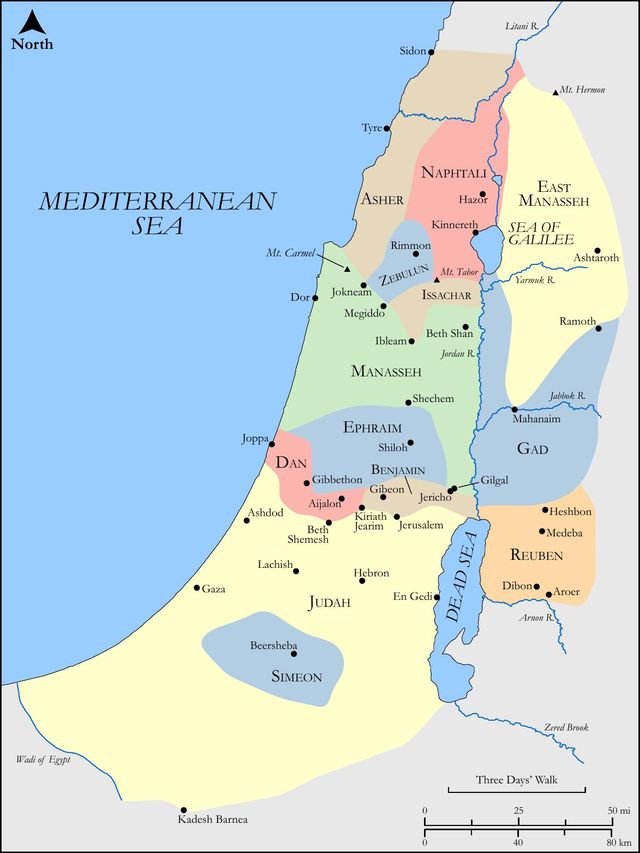
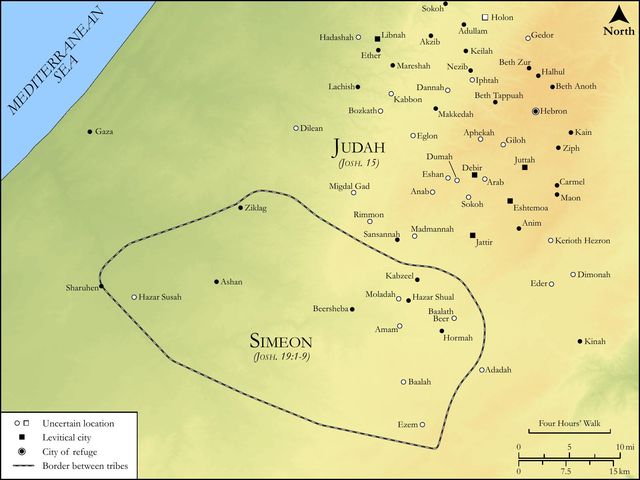
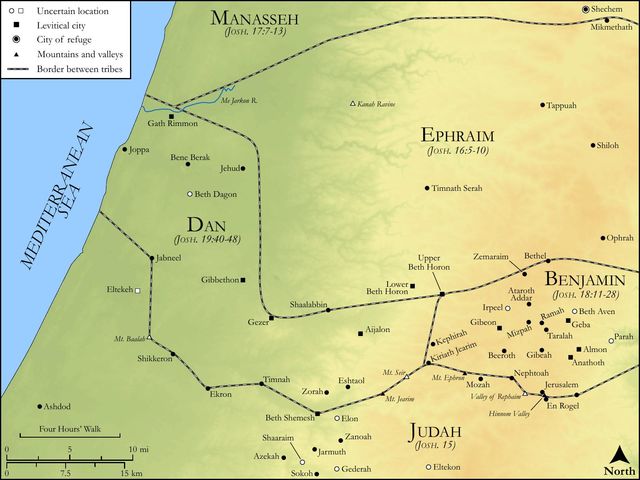
Study this verse
Public-domain commentary
Matthew Henry
From his Commentary on the Whole Bible. Henry comments on passages, not single verses — this entry covers Joshua 21:9–42. His two-level outline is real structure in the source text, so it is rendered as structure.
We have here a particular account of the cities which were given to the children of Levi out of the several tribes, not only to be occupied and inhabited by them, as tenants to the several tribes in which they lay - no, their interest in them was not dependent and precarious, but to be owned and possessed by them as lords and proprietors, and as having the same title to them that the rest of the tribes had to their cities or lands, as appears by the law which preserved the house in the Levites' cities from being alienated any longer than till the year of jubilee, Lev 25:32, Lev 25:33. Yet it is probable that the Levites having only the cities and suburbs, while the land about pertained to the tribes in which they lay, those of that tribe, for the convenience of occupying that land, might commonly rent houses of the Levites, as they could spare them in their cities, and so live among them as their tenants. Several things may be observed in this account, besides what was observed in the law concerning it, Num. 35.
I.That the Levites were dispersed into all the tribes, and not suffered to live all together in any one part of the country.
This would find them all with work, and employ them all for the good of others; for ministers, of all people, must neither be idle nor live to themselves or to one another only. Christ left his twelve disciples together in a body, but left orders that they should in due time disperse themselves, that they might preach the gospel to every creature. The mixing of the Levites thus with the other tribes would be an obligation upon them to walk circumspectly, and as became their sacred function, and to avoid every thing that might disgrace it. Had they lived all together, they would have been tempted to wink at one another's faults, and to excuse one another when they did amiss; but by this means they were made to see the eyes of all Israel upon them, and therefore saw it their concern to walk so as that their ministry might in nothing be blamed nor their high character suffer by their ill carriage.
II.That every tribe of Israel was adorned and enriched with its share of Levites' cities in proportion to its compass, even those that lay most remote. They were all God's people, and therefore they all had Levites among them.
1.To show kindness to, as God appointed them, Deu 12:19; Deu 14:29. They were God's receivers, to whom the people might give their grateful acknowledgments of God's goodness, as the occasion and disposition were.
2.To receive advice and instruction from; when they could not go up to the tabernacle, to consult those who attended there, they might go to a Levites' city, and be taught the good knowledge of the Lord. Thus God set up a candle in every room of his house, to give light to all his family; as those that attended the altar kept the charge of the Lord, to see that no divine appointment was neglected there, so those that were scattered in the country had their charge too, which was to see that no idolatrous superstitious usages were introduced at a distance and to watch for the souls of God's Israel. Thus did God graciously provide for the keeping up of religion among them, and that they might have the word nigh them; yet, blessed be God, we, under the gospel, have it yet nigher, not only Levites in every county, but Levites in every parish, whose office it is still to teach the people knowledge, and to go before them in the things of God.
III.That there were thirteen cities, and those some of the best, appointed for the priests, the sons of Aaron, Jos 21:19.
Aaron left but two sons, Eleazar and Ithamar, yet his family was now so much increased, and it was foreseen that it would in process of time grow so numerous, as to replenish all these cities, though a considerable number must of necessity be resident wherever the ark and the altar were. We read in both Testaments of such numbers of priests that we may suppose none of all the families of Israel that came out of Egypt increased afterwards so much as that of Aaron did; and the promise afterwards to the house of Aaron is, God shall increase you more and more, you and your children, Psa 115:12, Psa 115:14. He will raise up a seed to serve him.
IV.That some of the Levites' cities were afterwards famous upon other accounts.
Hebron was the city in which David began his reign, and in Manhanaim, another Levites' city (Jos 21:38), he lay, and had his headquarters when he fled from Absalom. The first Israelite that ever wore the title of king (namely, Abimelech, the son of Gideon) reigned in Shechem, another Levites' city, Jos 21:21.
V.That the number of them in all was more than of most of the tribes, except Judah, though the tribe of Levi was one of the least of the tribes, to show how liberal God is, and his people should be, to his ministers; yet the disproportion will not appear so great as at first it seems, if we consider that the Levites had cities only with their suburbs to dwell in, but the rest of the tribes, besides their cities (and those perhaps were many more than are named in the account of their lot), had many unwalled towns and villages which they inhabited, besides country houses.
Upon the whole, it appears that effectual care was taken that the Levites should live both comfortably and usefully: and those, whether ministers or others, for whom Providence has done well, must look upon themselves as obliged thereby to do good, and, according as their capacity and opportunity are, to serve their generation.
Continue studying Joshua 21:30 across the web’s major study libraries — every link below opens this exact verse, chapter, or book on the destination site.
Read & Compare
 BibleGatewayThis verse in more than 200 translations and 70 languages.
 Bible.comThe YouVersion reader — hundreds of translations, reading plans, and highlights.
 ESV.orgCrossway's official English Standard Version reader.
 NET BibleThe NET translation with 60,000+ translators' notes on every rendering decision.
 STEP BibleTyndale House's free study tool — original text, vocabulary, and scholarly resources.
 BibliaLogos Bible Software's free web reader.
 USCCBThe New American Bible (Revised Edition) with the U.S. bishops' study notes.
Commentaries
 BibleHub CommentariesDozens of classic commentaries on this verse, gathered on one page.
 StudyLightMore than 100 commentary sets — the largest collection on the web.
 BibleRefPlain-English commentary on what this verse means, verse by verse.
 Enduring WordDavid Guzik's free commentary on this chapter, widely used by Bible teachers.
 Bible Study ToolsVerse commentary alongside Greek and Hebrew study aids.
Original Language & Research
- BibleHub InterlinearThe verse word by word — original language, transliteration, and English.
- BibleHub LexiconEvery word's original-language definition and Strong's entry.
 Blue Letter BibleDeep-study tools — Strong's numbers, concordance, and word studies.
 SefariaThe Hebrew text with Rashi and centuries of Jewish commentary.
Sermons, Hymns & Audio


TrulyRandomVerse is not affiliated with these sites and doesn’t control their content. They’re linked because they’re genuinely useful.
Summary
Joshua 21:30 meticulously records the allocation of two specific cities, Mishal and Abdon, along with their essential pasturelands, from the tribal territory of Asher to the Gershonite clan of the Levites. This verse is an integral part of a comprehensive divine distribution of forty-eight cities throughout the Promised Land, ensuring that the Levites, who received no tribal land inheritance, were strategically dispersed among the Israelite tribes. This arrangement enabled them to fulfill their sacred duties as spiritual instructors, guardians of the Law, and caretakers of the Tabernacle, profoundly underscoring God's unwavering faithfulness in providing for His consecrated servants and the meticulous order of His covenantal promises.
Context
ShowHideLiterary Context
Joshua 21:30 is situated within a highly detailed and climactic chapter of the Book of Joshua, which meticulously lists the forty-eight cities allocated to the Levites from the various Israelite tribes. This chapter serves as the culmination of the land distribution narrative, following the initial tribal allotments in Joshua 13-19 and the establishment of the cities of refuge in Joshua 20. The precise enumeration of cities, including Mishal and Abdon, emphasizes the complete fulfillment of God's ancient commands (e.g., Numbers 35:1-8) and the meticulous nature of His covenantal faithfulness. The chapter concludes with a powerful declaration of God's complete fulfillment of all His promises to Israel (Joshua 21:43-45), making these seemingly mundane lists vital evidence of divine precision, reliability, and the unwavering truthfulness of God's Word.
Historical & Cultural Context
The Levites, as the priestly tribe, were uniquely consecrated to the Lord and, unlike the other eleven tribes, did not receive a continuous territorial inheritance in Canaan. Instead, the Lord Himself was declared to be their inheritance (Numbers 18:20). To sustain them and enable their widespread ministry, God commanded that they be given cities with surrounding pasturelands (Hebrew: migrash) from within the territories of the other tribes. These "suburbs" were not residential areas in the modern sense but communal grazing lands for their livestock, extending outwards from the city walls, essential for their livelihood. The strategic scattering of Levite cities, including Mishal and Abdon in the northern territory of Asher, ensured that spiritual instruction, legal arbitration, and the presence of those dedicated to the Tabernacle service were accessible throughout the entire Israelite nation, fostering religious unity and adherence to the Mosaic Law across diverse geographical regions. This arrangement underscored the Levites' unique role as spiritual guides and upholders of the covenant.
Key Themes
ShowHideThis verse, though brief, contributes to several overarching themes in the Book of Joshua and the Pentateuch. Firstly, it powerfully illustrates Divine Provision and Faithfulness. God, who promised to settle Israel in the land, meticulously provided for His dedicated servants, the Levites, even without a land inheritance, demonstrating His unwavering commitment to His covenant people and those who serve Him (Numbers 18:21-24). Secondly, the detailed listing highlights Divine Order and Organization. The precise allocation of cities reflects God's sovereign hand in establishing Israel's national and religious life, ensuring every detail, from land boundaries to the support of the priesthood, was meticulously arranged according to His perfect plan. This divine blueprint ensured the orderly functioning of the nascent nation. Finally, it underscores the theme of Levitical Service and Presence. By distributing the Levites across all tribal territories, God ensured that spiritual guidance, the teaching of the Law, and the practical administration of the covenant were embedded within every community, fostering a nation grounded in divine truth and worship (Deuteronomy 33:10).
Exposition and Analysis
ShowHideKey Word Analysis
ShowHideThe Hebrew word maṭṭeh (מַטֶּה) primarily refers to a "rod" or "staff," but figuratively, as used here, it denotes a "tribe." This connection between a staff (symbolizing authority or a leader's rod) and a tribe emphasizes the patriarchal and familial structure of Israelite society, where each tribal unit descended from a common ancestor and was led by its head. The phrase "out of the tribe of Asher" therefore identifies the specific familial and territorial unit from which these cities were designated for the Levites, highlighting the organized and divinely ordained division of the land among the descendants of Jacob.
The name Mishal (מִשְׁאָל) derives from a root meaning "request" or "to ask." While the name itself doesn't offer direct theological insight into the city's function, its inclusion here, alongside Abdon, is crucial. It signifies the precise fulfillment of God's command for the Levites to receive cities from all the tribes, not just a select few. The naming of specific cities like Mishal underscores the historical veracity and meticulous detail of the land distribution, confirming that the divine "request" for Levite provision was indeed fulfilled with concrete geographical locations.
The King James Version's translation "suburbs" for the Hebrew term migrâsh (מִגְרָשׁ) can be misleading to a modern reader. It does not refer to residential areas outside a city, but specifically to the open, communal pasturelands or common grounds surrounding a walled city. These areas were designated for the Levites' livestock (cattle, sheep, goats) and for general communal use, extending for a specified distance (typically 1,000 cubits or 2,000 cubits in some directions, as per Numbers 35:4-5). The inclusion of "with her suburbs" for Mishal and Abdon emphasizes that the Levites received not just the city structures but also the vital economic and practical resources necessary for their sustenance and the maintenance of their families and flocks, enabling them to focus on their spiritual duties without being a burden on the other tribes.
Verse Breakdown
ShowHide"And out of the tribe of Asher"
This clause precisely identifies the source of these two cities. Asher was one of the northern tribes of Israel, whose territory stretched along the Mediterranean coast and into the fertile plains of Galilee. The allocation of cities from Asher's territory to the Levites demonstrates the widespread distribution of the priestly tribe, ensuring their presence and spiritual influence reached even the northernmost parts of the Promised Land, far from the central sanctuary at Shiloh. This dispersion was vital for the spiritual health of the entire nation.
"Mishal with her suburbs"
Mishal (also called Mashal in 1 Chronicles 6:74) was a specific city located within the tribal territory of Asher. Its designation "with her suburbs" indicates that the Levites received not only the walled city itself for dwelling but also the surrounding pasturelands (migrâsh) for their livestock and communal use. This comprehensive provision highlights God's holistic care for the Levites, ensuring they had the necessary economic base for their livelihood, allowing them to focus on their sacred duties without being burdened by agricultural labor.
"Abdon with her suburbs"
Abdon was another city within Asher's territory, similarly allocated to the Levites. Like Mishal, it came with its accompanying pasturelands. The specific naming of these two cities, alongside others in the chapter, highlights the precise and meticulous nature of the land distribution. It emphasizes that every detail of God's promise and command regarding the Levites' provision was fulfilled, demonstrating divine faithfulness and the complete establishment of the covenant community in the Promised Land.
Literary Devices
ShowHideThe primary literary device at play in Joshua 21:30, and indeed throughout the entire chapter, is Catalogue or List. The meticulous enumeration of cities and their associated pasturelands serves a crucial theological purpose: to document and confirm the complete fulfillment of God's commands regarding the Levites' inheritance. This detailed listing provides irrefutable evidence of God's faithfulness and Israel's obedience in establishing the divinely ordained structure of their nation. Additionally, the Repetition of the phrase "with her suburbs" (or similar phrasing throughout the chapter, such as "and their common-land") underscores the comprehensive nature of the Levites' provision, emphasizing that their allocation included not just dwelling places but also the necessary means of sustenance. This repetition also contributes to the sense of thoroughness and divine order that permeates the entire chapter. The chapter as a whole functions as a Fulfillment Narrative, demonstrating how God's promises, articulated in earlier books like Numbers, are brought to fruition in the conquest and settlement of Canaan, thereby validating the divine authorship and reliability of the covenant.
Theological and Thematic Connections
ShowHideJoshua 21:30, as part of the detailed record of Levite cities, profoundly illustrates God's meticulous faithfulness and comprehensive provision for His people and His appointed servants. It showcases a divine order that undergirds the entire nation of Israel, ensuring that spiritual leadership and the knowledge of God's Law were accessible throughout the land. The Levites, though without a tribal land inheritance, were sustained directly by God's command through the other tribes, highlighting a principle of mutual dependence and communal support within the covenant community. This arrangement ensured that those dedicated to spiritual service could focus on their calling, while the entire nation benefited from their presence and instruction, fostering a society rooted in divine truth and worship. This divine provision for the Levites also foreshadows God's care for those who serve Him in every generation, ensuring that His work continues through those consecrated to His purposes.
Reflection and Application
ShowHideThis seemingly dry list of cities in Joshua 21:30 carries profound implications for our understanding of God's character and our role as His people today. It reveals a God who is not only grand in His sweeping redemptive plans but also meticulous in His attention to every detail, ensuring the practical needs of His servants are met so they can fulfill their sacred calling. Just as the tribes were commanded to provide for the Levites, there is a timeless principle of supporting those who dedicate their lives to spiritual service and teaching within the church today, enabling them to focus on their divine mandate without undue worldly distraction. This support can take many forms, from financial provision to prayer and practical assistance. Furthermore, the strategic scattering of the Levites throughout Israel emphasizes the importance of the presence of God's Word and spiritual guidance within every community. For us, this means that the church is called to be a visible, active, and accessible presence in its surrounding communities, bringing the light of the Gospel and the truth of God's Word to all, fostering discipleship and spiritual growth wherever people live. It encourages us to trust in God's comprehensive provision for all our needs as we faithfully serve Him, knowing He oversees even the "suburbs" of our lives.
Questions for Reflection
ShowHideFAQ
ShowHideWhy are these detailed lists of cities, like those in Joshua 21:30, included in the Bible?
ShowHideThese detailed lists are far from mere historical records; they serve several crucial theological purposes. Firstly, they provide tangible proof of God's faithfulness in fulfilling His covenant promises to Israel, specifically His pledge to give them the land of Canaan and to provide for the Levites. The meticulousness of the record underscores the divine order and precision in the establishment of the nation, demonstrating that God's word is reliable and true. Secondly, the distribution of Levite cities throughout all tribal territories highlights the strategic importance of spiritual leadership and the accessibility of God's Law to every segment of Israelite society. It demonstrates God's desire for His people to be continually discipled and guided in His ways. Finally, these lists confirm the legitimacy and authority of the Levites' role, showing that their provision and placement were divinely ordained, not merely human arrangements. They are a testament to God's comprehensive plan for His people, ensuring their spiritual and physical well-being.
Christ-Centered Fulfillment
ShowHideWhile Joshua 21:30 details the provision for the Old Testament Levites, it powerfully foreshadows the comprehensive provision and ultimate fulfillment found in Jesus Christ. The Levites, though scattered throughout Israel, served as mediators, teachers, and caretakers of the Tabernacle, pointing to the need for God's presence and instruction among His people. This finds its ultimate reality in Christ, who is the true and perfect mediator between God and humanity (1 Timothy 2:5), the embodiment of God's Word made flesh (John 1:1, John 1:14), and the very presence of God dwelling among us (Immanuel, Matthew 1:23). Just as the Levites had no earthly inheritance but the Lord himself (Numbers 18:20), believers in Christ find their ultimate inheritance not in land or material possessions, but in Christ Himself (Ephesians 1:11) and the spiritual blessings He bestows. Furthermore, the strategic scattering of the Levites across Israel to bring spiritual guidance prefigures the Great Commission, where Christ sends His disciples, the church, into all the world (Matthew 28:19-20) to be His witnesses (Acts 1:8), making God's truth and presence known to every nation, tribe, and tongue, fulfilling the ultimate purpose of God's redemptive plan through the global body of Christ.