


Isaiah 33:9
Bible text: King James Version (1769 Blayney text) · Public domain
Bible text: Berean Standard Bible · Public domain
Bible text: American Standard Version (1901) · Public domain
Bible text: World English Bible, Messianic edition · Public domain
Bible text: Geneva Bible (1599) · Public domain
Bible text: Young's Literal Translation · Public domain
- אָבַל'a·Valit has dried upH56V-Qal-Perf-3msVerb Qal Perfect 3rd Singular Masculine
- אֻמְלְלָה'um·le·Lahit has languishedH535V-Pual-Perf-3fsVerb Pual Perfect 3rd Singular Feminine
- אָרֶץ'A·retz[the] landH776N-fsNoun Singular Feminine Absolute
- הֶחְפִּירhech·Pirit has displayed shameH2659V-Hiphil-Perf-3msVerb Hiphil Perfect 3rd Singular Masculine
- לְבָנוֹןle·va·NonLebanonH3844N-properNoun Proper Location
- קָמַלka·Malit has witheredH7060V-Qal-Perf-3msVerb Qal Perfect 3rd Singular Masculine
- הָיָהha·Yahit has becomeH1961V-Qal-Perf-3msVerb Qal Perfect 3rd Singular Masculine
- הַשָּׁרוֹןha·sha·rOn<the> SharonH8289Art ¦ N-properNoun Proper Locationהַ<the>שָּׁרוֹןSharon
- כָּעֲרָבָהka·'a·ra·Vahlike <the> desert plainH6160Prep-k ¦ N-properNoun Proper Locationכָּlike <the>עֲרָבָהdesert plain
- וְנֹעֵרve·no·'Erand [is] shaking offH5287Conj-w ¦ V-Qal-Prtcpl-msVerb Qal Participle Singular Masculine Absoluteוְandנֹעֵר[is] shaking off
- בָּשָׁןba·ShanBashanH1316N-properNoun Proper Location
- וְכַרְמֶלve·khar·Meland CarmelH3760Conj-w ¦ N-properNoun Proper LocationוְandכַרְמֶלCarmel
English is a literal word-by-word gloss of the Hebrew, not the KJV's wording. Why?
This is the original text the KJV's translators worked from — each Hebrew word with its own literal English meaning in this verse, prepared by scholars at Tyndale House, Cambridge. The KJV translates whole sentences, not word by word, so its wording differs: one Hebrew word can become several English words, and the KJV may choose “the LORD” where the gloss reads “Yahweh”. Both are faithful — they answer different questions. For the KJV's own rendering, switch to the KJV text.
Details
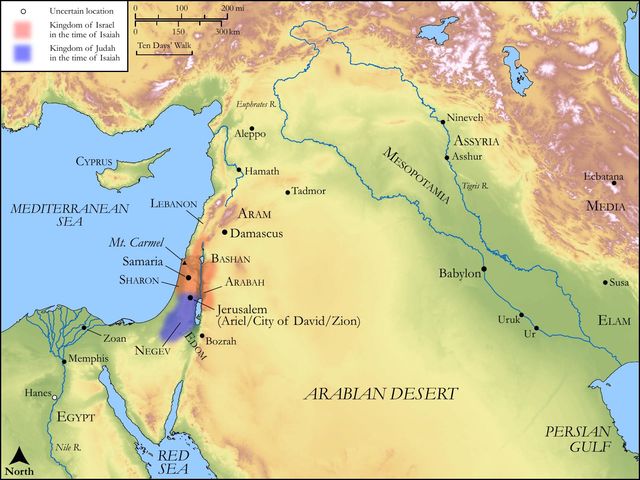
See on the biblical-era map
Study this verse
Public-domain commentary
Matthew Henry
From his Commentary on the Whole Bible. Henry comments on passages, not single verses — this entry covers Isaiah 33:1–12. His three-level outline is real structure in the source text, so it is rendered as structure.
Here we have,
I.The proud and false Assyrian justly reckoned with for all his fraud and violence, and laid under a woe, Isa 33:1. Observe,
1.The sin which the enemy had been guilty of. He had spoiled the people of God, and made a prey of them, and herein had broken his treaty of peace with them, and dealt treacherously. Truth and mercy are two such sacred things, and have so much of God in them, that those cannot but be under the wrath of God that make conscience of neither, but are perfectly lost to both, that care not what mischief they do, what spoil they make, what dissimulations they are guilty of, nor what solemn engagements they violate, to compass their own wicked designs. Bloody and deceitful men are the worst of men.
2.The aggravation of this sin. He spoiled those that had never done him any injury and that he had no pretence to quarrel with, and dealt treacherously with those that had always dealt faithfully with him. Note, The less provocation we have from men to do a wrong thing the more provocation we give to God by doing it.
3.The punishment he should fall under for this sin. He that spoiled the cities of Judah shall have his own army destroyed by an angel and his camp plundered by those whom he had made a prey of. The Chaldeans shall deal treacherously with the Assyrians and revolt from them. Two of Sennacherib's own sons shall deal treacherously with him and basely murder him at his devotions. Note, The righteous God often pays sinners in their own coin. He that leads into captivity shall go into captivity, Rev 13:10; Rev 18:6.
4.The time when he shall be thus dealt with. When he shall make an end to spoil, and to deal treacherously, not by repentance and reformation, which might prevent his ruin (Dan 4:27), but when he shall have done his worst, when he shall have gone as far as God would permit him to go, to the utmost of his tether, then the cup of trembling shall be put into his hand. When he shall have arrived at his full stature in impiety, shall have filled up the measure of his iniquity, then all shall be called over again. When he has done God will begin, for his day is coming.
II.The praying people of God earnest at the throne of grace for mercy for the land now in its distress (Isa 33:2):
"O Lord! be merciful to us. Men are cruel; be thou gracious. We have deserved thy wrath, but we entreat thy favour; and, if we may find the propitious to us, we are happy; the trouble we are in cannot hurt us, shall not ruin us. It is in vain to expect relief from creatures; we have no confidence in the Egyptians, but we have waited for thee only, resolving to submit to thee, whatever the issue of the trouble be, and hoping that it shall be a comfortable issue." Those that by faith humbly wait for God shall certainly find him gracious to them. They prayed,
1.For those that were employed in military services for them: "Be thou their arm every morning. Hezekiah, and his princes, and all the men of war, need continual supplies of strength and courage from thee; supply their need therefore, and be to them a God all-sufficient. Every morning, when they go forth upon the business of the day, and perhaps have new work to do and new difficulties to encounter, let them be afresh animated and invigorated, and, as the day, so let the strength be." In our spiritual warfare our own hands are not sufficient for us, nor can we bring any thing to pass unless God not only strengthen our arms (Gen 49:24), but be himself our arm; so entirely do we depend upon him as our arm every morning, so constantly do we depend upon his power, as well as his compassions, which are new every morning, Lam 3:23. If God leaves us to ourselves any morning, we are undone; we must therefore every morning commit ourselves to him, and go forth in his strength to do the work of the day in its day.
2.For the body of the people: "Be thou our salvation also in the time of trouble, ours who sit still, and do not venture into the high places of the field." They depend upon God not only as their Saviour, to work deliverance for them, but as their salvation itself; for, whatever becomes of their secular interests, they will reckon themselves safe and saved if they have him for their God. If he undertake to be their Saviour, he will be their salvation; for as for God his work is perfect. Some read it thus: "Thou who wast their arm every morning, who wast the continual strength and help of our fathers before us, be thou our salvation also in time of trouble. Help us as thou helpedst them; they looked unto thee and were lightened (Psa 34:5); let us then not walk in darkness."
III.The Assyrian army ruined and their camp made a rich but cheap and easy prey to Judah and Jerusalem.
No sooner is the prayer made (Isa 33:2) than it is answered (Isa 33:3), nay, it is outdone. They prayed that God would save them from their enemies; but he did more than that; he gave them victory over their enemies and abundant cause to triumph; for,
1.The strength of the Assyrian camp was broken (Isa 33:3) when the destroying angel slew so many thousands of them: At the noise of the tumult, of the shrieks of the dying men (who, we may suppose, did not die silently), the rest of the people fled, and shifted every one for his own safety. When God did thus lift up himself the several nations, or clans, of which the army was composed, were scattered. It was time to stir when such an unprecedented plague broke out among them. When God arises his enemies are scattered, Psa 68:1.
2.The spoil of the Assyrian camp is seized, by way of reprisal, for all the desolations of the defenced cities of Judah (Isa 33:4): Your spoil shall be gathered by the inhabitants of Jerusalem, like the gathering of the caterpillar, and as the running to and fro of locusts, that is, the spoilers shall as easily and as quickly make themselves masters of the riches of the Assyrians as a host of caterpillars, or locusts, make a field, or a tree, bare. Thus the wealth of the sinner is laid up for the just and Israel is enriched with the spoil of the Egyptians. Some make the Assyrians to be the caterpillars and locusts, which, when they are killed, are gathered together in heaps, as the frogs of Egypt, and are run upon, and trodden to dirt.
IV.God and his Israel glorified and exalted hereby. When the spoil of the enemy is thus gathered,
1.God will have the praise of it (Isa 33:5): The Lord is exalted. It is his honour thus to abase proud men, and hide them in the dust, together; thus he magnifies his own name, and his people give him the glory of it, as Israel when the Egyptians were drowned, Exo 15:1, Exo 15:2, etc. He is exalted as one that dwells on high, out of the reach of their blasphemies, and that has an over-ruling power over them, and wherein they deal proudly delights to show himself above them - that does what he will, and they cannot resist him.
2.His people will have the blessing of it. When God lifts up himself to scatter the nations that are in confederacy against Jerusalem (Isa 33:3) then, as a preparative for that, or as the fruit and product of it, he has filled Zion with judgment and righteousness, not only with a sense of justice, but with a zeal for it and a universal care that it be duly administered. It shall again be called, The city of righteousness, Isa 1:26. In this the grace of God is exalted, as much as his providence was in the destruction of the Assyrian army. We may conclude God has mercy in store for a people when he fills them with judgment and righteousness, when all sorts of people, and all their actions and affairs, are governed by them, and they are so full of them that no other considerations can crowd in to sway them against these. Hezekiah and his people are encouraged (Isa 33:6) with an assurance that God would stand by them in their distress. Here is,
(1.)A gracious promise of God for them to stay themselves upon: Wisdom and knowledge shall be the stability of thy times, and strength of salvation. Here is a desirable end proposed, and that is the stability of our times, that things be not disturbed and unhinged at home, and the strength of salvation, deliverance from, and success against, enemies abroad. The salvation that God ordains for his people has strength in it; it is a horn of salvation. And here are the way and means for obtaining this end - wisdom and knowledge, not only piety, but prudence. That is it which, by the blessing of God, will be the stability of our times and the strength of salvation, that wisdom which is first pure, then peaceable, and which sacrifices private interests to a public good; such prudence as this will establish truth and peace, and fortify the bulwarks in defence of them.
(2.)A pious maxim of state for Hezekiah and his people to govern themselves by: The fear of the Lord is his treasure. It is God's treasure in the world, from which he receives his tribute; or, rather, it is the prince's treasure. A good prince accounts it so (that wisdom is better than gold) and he shall find it so. Note, True religion is the true treasure of any prince or people; it denominates them rich. Those places that have plenty of Bibles, and ministers, and serious good people, are really rich; and it contributes to that which makes a nation rich in this world. It is therefore the interest of a people to support religion among them and to take heed of every thing that threatens to hinder it.
V.The great distress that Jerusalem was brought into described, that those who believed the prophet might know beforehand what troubles were coming and might provide accordingly, and that when the foregoing promise of their deliverance should have its accomplishment the remembrance of the extremity of their case might help to magnify God in it and make them the more thankful, Isa 33:7-9. It is here foretold,
1.That the enemy would be very insolent and abusive and there would be no dealing with him, either by treaties of peace (for he has broken the covenant without any hesitation, as if it were below him to be a servant to his word), or by the preparations of war, for he has despised the cities; he scorns to take notice either of their appeals to justice or of their petitions for mercy. He makes himself master of them so easily (though they are called fenced cities), and meets with so little resistance, that he despises them, and has no relentings when he puts all to the sword; for he regards no man, has no pity or concern, no, not for those that he is under particular obligations to. He neither fears God nor regards man, but is haughty and imperious to every one. There are those that take a pride in trampling upon all mankind, and have neither veneration for the honourable nor compassion for the miserable.
2.That therefore he would not be brought to any terms of reconciliation: The valiant ones of Jerusalem, being unable to make their parts good with him, must be contentedly run down with noise and insolence, which will make them cry without, because they cannot serve their country as they might have done against a fair adversary. The ambassadors sent by Hezekiah to treat of peace, finding him so haughty and unmanageable, shall weep bitterly for vexation at the disappointment they had met with in their negotiations; they shall weep like children, as despairing to find out any expedient to pacify him.
3.That the country should be made quite desolate for a time by his army.
(1.)No man durst travel the roads; so that a stop was put to trade and commerce, and (which was worse) no man could safely go up to Jerusalem, to keep the solemn feasts: The highways lie waste. While the fields lie waste, trodden like the highways, the highways lie waste, untrodden like the fields, for the traveller ceases.
(2.)No man had any profit from the grounds, Isa 33:9. The earth used to rejoice in its own productions for the service of God's Israel, but now the enemies of Israel eat them up, or tread them down: it mourns and languishes; the country looks melancholy and the country people have misery in their countenances, wanting necessary food for themselves and their families; the wonted joy of harvest is turned into lamentation, so withering and uncertain are all worldly joys. The desolation is universal. That part of the country which belonged to the ten tribes was already laid waste: "Lebanon famed for cedars, Sharon for roses, Bashan for cattle, Carmel for corn, all very fruitful, have now become like wildernesses, are ashamed to be called by their old names, they are so unlike what they were. They shake off their fruits before their time into the hand of the spoiler, which used to be gathered seasonably by the hand of the owner."
VI.God appearing, at length, in his glory against his proud invader, Isa 33:10-12. When things are brought thus to the last extremity,
1.God will magnify himself. He had seemed to sit by as an unconcerned spectator: "But now will I arise, saith the Lord; now will I appear and act, and therein I will be not only evidenced, but exalted." He will not only demonstrate that there is a God that judges in the earth, but that he is God over all, and higher than the highest. "Now will I lift up myself, will prepare for action, will act vigorously, and will be glorified in it." God's time to appear for his people is when their affairs are reduced to the lowest ebb, when their strength is gone and there is none shut up nor left, Deu 32:36. When all other helpers fail, then is God's time to help.
2.He will bring down the Assyrian: "You, O Assyrians! are big with hopes that you shall have all the wealth of Jerusalem for your own, and are in pain till it be so; but all your hopes shall come to nothing: You shall conceive chaff, and bring forth stubble, which is not only worthless and good for nothing, but combustible and proper fuel for the fire, which it cannot escape, when your own breath as fire shall devour you, that is, the breath of God's wrath, provoked against you by the breath of your sins - your malignant breath, the threatenings and slaughter you breathe out against the people of God, this shall devour you, and your blasphemous breath against God and his name." God would make their own tongues to fall upon them, and their own breath to blow the fire that should consume them; and then no wonder that the people are as the burnings of lime in a lime-kiln, all on fire together, and as thorns cut up, which are dried and withered, and therefore easily take fire and are soon burnt up. Such was the destruction of the Assyrian army; it was like the burning up of thorns, which can well be spared, or the burning of lime, which makes it good for something. The burning of that army enlightened the world with the knowledge of God's power and made his name shine brightly.
Historical interpretation
Historical reception
1 surviving comment on this verse from the historical church.
(Verse 7 and following) Behold, those who see will cry out: The angels of peace will weep bitterly. The roads are abandoned, the passer-by has ceased on the path, the pact has become void, cities have been thrown down, men have not been regarded. The land has mourned and languished, Lebanon is confused and darkened, Sharon has become like a desert, and Bashan and Carmel have been shaken. Now I will arise, says the Lord: now I will be exalted, now I will be lifted up. You will conceive chaff, you will give birth to stubble; your spirit will devour you like fire. And the peoples shall be like ashes from a fire: thorns gathered together shall be burned with fire. The Hebrew word Arellam (), which Aquila, Symmachus, and Theodotion interpreted, I will reveal to them, dividing the final syllable and reading it as Are Lahem (), the Hebrews believe it signifies Angels, and is a prophecy concerning the calling of the Gentiles, and the wealth of the Church, and the destruction of the Temple, which the Angels shall lament, not dwelling within but departing from it: and those who were previously messengers of peace shall bitterly weep. Whether the apostles themselves who were sent to announce peace to Jerusalem, to which the Lord spoke, 'If you also knew the things that are for your peace' (Luke 19:42): at which the Lord appeared to them, in order to comfort them with His presence, Jerusalem will weep, because it did not receive His preaching, because the ways have been scattered, and the one passing by the righteous path has ceased, according to what is said in the Lamentations of Jeremiah: The ways of Zion mourn, because there are none who come to the solemnity (Lamentations 1:4). The covenant with Abraham, Isaac, and Jacob was also made void: He cast out the cities of Judah: He did not consider the people, who by their own fault wanted to be beasts. The land mourned and grew weak for those who lived in it (Genesis XV and 22). Lebanon is confused and darkened, undoubtedly signifying the Temple, as we read in Zechariah. Open, Lebanon, your gates, so that fire may devour your cedars (Zechariah XI, 1). Or Jerusalem, which is called Libanus in Ezekiel, the Prophet saying: A great eagle, with great wings, which has the ability to enter into Lebanon (Ezekiel II, 3); which afterwards, the divine word interpreting, says: when Nebuchadnezzar came to Jerusalem, he clearly referred to the eagle as the king of Babylon, and to Lebanon as Jerusalem. Sharon became like a desert, and Bashan and Carmel were shaken. As for Bashan, the Seventy translated it as Galilee, a province, for one place of the province. But the region around Joppa and Lydda, also called Saron (or Saronas), is a place where wide and fertile fields extend. There is also the region of Basan beyond the Jordan, which was possessed by two and a half tribes and is interpreted as the most fertile and abundant (Deut. III): and Carmel, of which we have spoken above. Therefore, the once fertile lands of Judea will be turned into desolation, through which metaphorically the entire wealth of the Jews will be exchanged for poverty and scarcity. Therefore, since they refused to accept the words of the Apostles, Lebanon was confounded, and Sharon became a wilderness; and Bashan and Carmel were shaken. Therefore, the Lord says that either because of his excessive patience or because he will rise from the dead, he will be exalted among the nations and lifted up on the cross. And he addresses the Jews themselves, saying, 'You will conceive burning anger and bring forth stubble, and your breath will ignite a fire that will devour you as the flames consume what is conceived and born.' And there shall be, he said, the people of the Jews showing the magnitude of their misfortune through the ashes remaining from the fire. For the thorns of their sins, which have been gathered in great numbers, shall be consumed by the fire, which many interpret as referring to the ultimate captivity and destruction of Jerusalem. Others affirm that it shall happen more fully and completely in the time of judgment.
Continue studying Isaiah 33:9 across the web’s major study libraries — every link below opens this exact verse, chapter, or book on the destination site.
Read & Compare
 BibleGatewayThis verse in more than 200 translations and 70 languages.
 Bible.comThe YouVersion reader — hundreds of translations, reading plans, and highlights.
 ESV.orgCrossway's official English Standard Version reader.
 NET BibleThe NET translation with 60,000+ translators' notes on every rendering decision.
 STEP BibleTyndale House's free study tool — original text, vocabulary, and scholarly resources.
 BibliaLogos Bible Software's free web reader.
 USCCBThe New American Bible (Revised Edition) with the U.S. bishops' study notes.
Commentaries
 BibleHub CommentariesDozens of classic commentaries on this verse, gathered on one page.
 StudyLightMore than 100 commentary sets — the largest collection on the web.
 BibleRefPlain-English commentary on what this verse means, verse by verse.
 Enduring WordDavid Guzik's free commentary on this chapter, widely used by Bible teachers.
 Bible Study ToolsVerse commentary alongside Greek and Hebrew study aids.
Original Language & Research
- BibleHub InterlinearThe verse word by word — original language, transliteration, and English.
- BibleHub LexiconEvery word's original-language definition and Strong's entry.
 Blue Letter BibleDeep-study tools — Strong's numbers, concordance, and word studies.
 SefariaThe Hebrew text with Rashi and centuries of Jewish commentary.
Sermons, Hymns & Audio


TrulyRandomVerse is not affiliated with these sites and doesn’t control their content. They’re linked because they’re genuinely useful.
Summary
Isaiah 33:9 presents a poignant lament over the widespread desolation of the land, employing vivid personification of prominent natural regions to underscore the profound severity of an impending crisis. This verse paints a somber picture of the earth, Lebanon, Sharon, Bashan, and Carmel, all depicted as suffering a catastrophic loss of vitality, beauty, and productivity. It serves as a powerful testament to the devastating impact of divine judgment or foreign invasion, setting a grim stage that magnifies the subsequent prophetic promises of God's redemptive intervention and ultimate restoration.
Context
ShowHideLiterary Context
Isaiah 33 commences with a "woe oracle" directed at an oppressive "destroyer," widely understood to be the Assyrian Empire. The initial verses detail the immediate human suffering and societal collapse caused by this invader. For instance, Isaiah 33:7 describes "valiant ones cry without; the ambassadors of peace weep bitterly," while Isaiah 33:8 laments that "The highways lie waste, the wayfaring man ceaseth: he hath broken the covenant, he hath despised the cities, he regardeth no man." This preceding narrative vividly portrays a land under siege, marked by broken treaties, devastated infrastructure, and pervasive fear. Verse 9 extends this lament beyond human distress to encompass the natural world itself, demonstrating that the very landscape participates in the widespread sorrow and desolation. This expansion intensifies the portrayal of the crisis, creating a comprehensive picture of ruin that serves as a dramatic backdrop for the prophetic shift towards God's eventual deliverance and the glorious establishment of Zion.
Historical & Cultural Context
The prophecies in Isaiah 33 are firmly rooted in the historical context of the Assyrian invasion of Judah, specifically Sennacherib's campaign against King Hezekiah around 701 BCE. This period was characterized by extreme political instability, overwhelming military threats, and a profound crisis of faith for the people of Judah. The Assyrians were notorious for their brutal military strategies, which frequently involved systematic destruction of agricultural lands, cities, and vital resources to cripple their enemies. The regions enumerated in the verse—Lebanon, Sharon, Bashan, and Carmel—were celebrated throughout Israel and the nations round about for their distinct natural splendor, fertility, and agricultural abundance. Lebanon was renowned for its majestic cedars, symbolizing strength and grandeur; Sharon for its fertile coastal plains and lush pastures; Bashan for its rich grazing lands and mighty oaks; and Carmel for its verdant vineyards, olive groves, and overall lush vegetation. The transformation of these iconic, prosperous regions into a state of "mourning," "shame," and "wilderness" would have been a deeply shocking and culturally resonant image of utter ruin, signifying the complete reversal of prosperity, fertility, and divine blessing.
Key Themes
ShowHideIsaiah 33:9 significantly contributes to several profound themes woven throughout the book of Isaiah. Firstly, it powerfully illustrates the theme of Divine Judgment and Desolation, portraying the devastating consequences of human sin and rebellion, whether directly enacted by God or through the instrument of an invading army. The desolation of the land serves as a tangible motif for divine displeasure, a concept echoed elsewhere in scripture, such as in Jeremiah 12:4. Secondly, the verse highlights the Interconnectedness of Creation and Humanity's Fate, demonstrating that the natural world suffers alongside its inhabitants during times of crisis. This profound personification emphasizes the pervasive impact of human actions and divine judgment on the entire created order, reflecting a shared destiny. Finally, by depicting such extreme and widespread desolation, the verse dramatically sets the stage for the contrasting and pivotal theme of God's Ultimate Restoration and Renewal. The severity of the depicted suffering makes the subsequent promises of a transformed land—where "the wilderness and the solitary place shall be glad for them; and the desert shall rejoice, and blossom as the rose" (Isaiah 35:1)—even more potent, hopeful, and indicative of God's sovereign power to bring life out of ruin.
Exposition and Analysis
ShowHideKey Word Analysis
ShowHideA primitive root meaning "to bewail; lament, mourn." In this context, it signifies a deep, pervasive sorrow that afflicts the very earth, personifying the land as actively grieving. This is not merely a description of physical decay but an emotional response, indicating the profound and widespread impact of the calamity on the entire created order.
A primitive root meaning "to blush; figuratively, to be ashamed, disappointed; causatively, to shame, reproach." When applied to Lebanon, it suggests a profound loss of its renowned glory, majesty, and inherent dignity. It implies that Lebanon has been humiliated, stripped bare, and publicly disgraced through being "hewn down," losing its natural splendor and prominence.
A primitive root meaning "to tumble about; shake (off, out, self), overthrow, toss up and down." For Bashan and Carmel, this vividly describes the violent, forceful removal of their fruits and produce. It symbolizes a catastrophic and abrupt cessation of productivity, abundance, and their very purpose, suggesting a destructive act that leaves them barren and unproductive.
Verse Breakdown
ShowHide"The earth mourneth and languisheth:"
This opening clause establishes the pervasive and deeply felt nature of the desolation. The entire land, personified as a living entity, is depicted as experiencing profound grief and a state of weakening or decay. "Mourneth" (H56) conveys an active, audible lament, while "languisheth" (H535) suggests a gradual fading, a loss of strength, vitality, and health, as if the land itself is sick and wasting away. This sets a somber and empathetic tone for the specific examples that follow, indicating a universal suffering.
"Lebanon is ashamed and hewn down:"
Lebanon, a region celebrated for its majestic cedars and symbolic of strength, grandeur, and national pride, is here portrayed as experiencing shame (H2659) and being cut down (H7060). This signifies not only the physical destruction (the felling of its glorious trees) but also a profound loss of its inherent dignity, beauty, and former glory. It is as if Lebanon has been humiliated and stripped bare, its once-proud standing now a source of public disgrace and ruin.
"Sharon is like a wilderness;"
Sharon, known for its fertile coastal plain, lush pastures, and vibrant flora, is contrasted sharply with its current state. To become "like a wilderness" (H6160) implies a complete and devastating transformation from a place of beauty, fertility, and abundance into a barren, desolate, and unproductive wasteland. This highlights the severity of the ecological and agricultural ruin, signifying a total reversal of its natural state.
"and Bashan and Carmel shake off their fruits."
Bashan, famed for its rich grazing lands, sturdy oaks, and fertile plains, and Carmel, renowned for its lush vegetation, vineyards, and olive groves, are depicted as violently losing their produce. "Shake off their fruits" (H5287) vividly conveys a forceful, abrupt, and destructive act, resulting in barrenness and a complete cessation of their natural productivity. This signifies the utter collapse of agricultural prosperity, the loss of the very sustenance they provided, and the forceful removal of their natural abundance.
Literary Devices
ShowHideIsaiah 33:9 is profoundly enriched by its masterful use of Personification, a central literary device that imbues inanimate geographical features with human emotions and actions. The "earth mourneth and languisheth," Lebanon "is ashamed," and Bashan and Carmel "shake off their fruits," transforming these regions into sentient beings experiencing sorrow, humiliation, and distress. This technique amplifies the emotional impact of the desolation, making the suffering palpable and universal, extending the tragedy beyond human experience. The verse also employs powerful Imagery, creating vivid mental pictures of a once-flourishing land now in ruins: majestic cedars "hewn down," a fertile plain turned into a "wilderness," and abundant fruit trees violently "shaking off their fruits." This stark contrast between past glory and present devastation is a form of Juxtaposition, powerfully highlighting the catastrophic extent of the calamity. Furthermore, the selection of these specific, well-known, and highly valued regions (Lebanon, Sharon, Bashan, Carmel) serves as a Synecdoche, where these prominent parts represent the entire land of Israel, emphasizing that no part, however beautiful or fertile, is spared from the widespread judgment or destruction. The cumulative effect of these devices is a profound lament that underscores the severity and comprehensiveness of the crisis.
Theological and Thematic Connections
ShowHideIsaiah 33:9 powerfully underscores the theological principle that sin and judgment have far-reaching consequences, impacting not only human society but also the natural world itself. The widespread desolation described is a tangible manifestation of a broken covenant and divine displeasure, reflecting God's righteous response to human wickedness and the chaos it unleashes. This lament over the land's suffering aligns with broader biblical themes of creation groaning under the weight of sin, awaiting its ultimate redemption. While presenting a scene of profound despair, this verse serves as a necessary precursor to the glorious promises of restoration that follow in Isaiah, where God's ultimate plan is to bring flourishing and renewal even to the most desolate places, demonstrating His absolute sovereignty over both judgment and salvation.
Reflection and Application
ShowHideIsaiah 33:9 serves as a potent reminder of the profound interconnectedness between human actions, divine justice, and the state of the natural world. The vivid imagery of a land mourning and languishing challenges us to consider the far-reaching consequences of sin, conflict, and societal brokenness, which extend beyond human suffering to impact the very environment that sustains us. It prompts introspection on our stewardship of creation and the ways in which our collective choices, whether in disobedience or in pursuit of peace, can either bring flourishing or desolation. While the initial picture is bleak, this verse ultimately sets the stage for the powerful hope of God's redemptive work. It encourages us to lament over the brokenness of the world, to grieve its suffering, but also to look forward with unwavering faith to the promised renewal. We are called to understand that even in the deepest valleys of despair, God's ultimate plan is one of restoration and abundant life, where the wilderness will blossom and the barren places will bear fruit. This perspective calls us to cultivate hope, engage actively in acts of healing, reconciliation, and justice, and participate wholeheartedly in God's ongoing work of bringing beauty out of ashes and life out of desolation.
Questions for Reflection
ShowHideFAQ
ShowHideWhat caused the desolation described in Isaiah 33:9?
ShowHideWhile Isaiah 33:9 itself vividly describes the effects of desolation, the broader literary and historical context of Isaiah 33 points to two primary, interconnected causes. Historically, the desolation is directly attributable to the devastating impact of the Assyrian invasion of Judah during the reign of King Hezekiah (around 701 BCE), which brought widespread destruction, famine, and societal collapse to the land. The Assyrians were known for their brutal tactics, including the systematic devastation of agricultural areas to break the will of their enemies. Theologically, this desolation is also understood as a profound consequence of divine judgment against the wickedness, unfaithfulness, and covenant-breaking of God's people, as well as the oppressive actions of foreign nations. Thus, the land's suffering is presented not merely as a random calamity, but as a reflection of the spiritual and moral state of its inhabitants and the unfolding of God's righteous judgment. This dual perspective underscores that both human sin and divine response contribute to the earth's lament.
Christ-Centered Fulfillment
ShowHideWhile Isaiah 33:9 vividly portrays a land in lament and desolation under judgment, its ultimate Christ-centered fulfillment lies in the profound contrast between this fallen state and the new creation inaugurated by Jesus Christ. The "earth mourneth and languisheth" due to the curse of sin (as seen in Genesis 3:17-18), and the desolation of Lebanon, Sharon, Bashan, and Carmel symbolizes the pervasive impact of sin and judgment on all creation. However, in Christ, this lament is transformed into a song of redemption. Jesus, the true vine and source of all life, brings spiritual and ultimately physical renewal. His atoning work on the cross not only redeems humanity but also initiates the restoration of all creation, which "groans" in eager expectation, awaiting its glorious liberation from bondage to decay (Romans 8:21-22). The promised flourishing of the wilderness in Isaiah 35, where "the desert shall rejoice, and blossom as the rose," finds its ultimate reality in the new heavens and new earth, where there will be no more mourning, crying, or pain (Revelation 21:1-4). Christ's triumphant victory over sin and death ensures that the desolation depicted in Isaiah 33:9 is not the final word, but rather a prelude to the glorious, fruitful, and eternally vibrant creation that will be fully realized in His eternal kingdom, where He sovereignly declares, "Behold, I am making all things new!"