


1 Kings 18:18
- וַיֹּאמֶרvai·Yo·merand he saidH559Conj-w ¦ V-Qal-ConsecImperf-3msVerb Qal Consecutive Imperfect 3rd Singular Masculineוַandיֹּאמֶרhe said
- לֹאlo'notH3808NegParticle Negative
- עָכַרְתִּי'a·Khar·tiI have troubledH5916V-Qal-Perf-1csVerb Qal Perfect 1st Singular common gender
- אֶת'et<obj.>H853DirObjMParticle Object Indicator
- יִשְׂרָאֵלYis·ra·'ElIsraelH3478N-properNoun Proper Location
- כִּיkithatH3588PrtParticle Conditional
- אִם'imexceptH518PrtParticle Conditional
- אַתָּה'a·TahyouH859Pro-2msPronoun Personal 2nd Singular Masculine
- וּבֵיתu·Veitand [the] household ofH1004Conj-w ¦ N-mscNoun Singular Masculine Constructוּandבֵית[the] household of
- אָבִיךָ'a·Vi·khayour fatherH1N-msc ¦ 2msNoun Singular Masculine Constructאָבִיfatherךָyour
- בַּעֲזָבְכֶםba·'a·za·ve·Khembecause have forsaken youH5800Prep-b ¦ V-Qal-Inf ¦ 2mpVerb Qal Infinitive Constructבַּbecauseעֲזָבְhave forsakenכֶםyou
- אֶת'et<obj.>H853DirObjMParticle Object Indicator
- מִצְוֹתmitz·Vot[the] commandments ofH4687N-fpcNoun Plural Feminine Construct
- יְהוָהYah·wehYahwehH3068N-properNoun Proper Title
- וַתֵּלֶךְva·Te·lekhand you have walkedH1980Conj-w ¦ V-Qal-ConsecImperf-2msVerb Qal Consecutive Imperfect 2nd Singular Masculineוַandתֵּלֶךְyou have walked
- אַחֲרֵי'a·cha·ReiafterH310Adj-mpcAdjective Numerical Plural Masculine Construct
- הַבְּעָלִיםha·be·'a·Limthe BaalsH1168Art ¦ N-mpNoun Title Plural Masculine AbsoluteהַtheבְּעָלִיםBaals
English is a literal word-by-word gloss of the Hebrew, not the KJV's wording. Why?
This is the original text the KJV's translators worked from — each Hebrew word with its own literal English meaning in this verse, prepared by scholars at Tyndale House, Cambridge. The KJV translates whole sentences, not word by word, so its wording differs: one Hebrew word can become several English words, and the KJV may choose “the LORD” where the gloss reads “Yahweh”. Both are faithful — they answer different questions. For the KJV's own rendering, switch to the KJV text.
Details
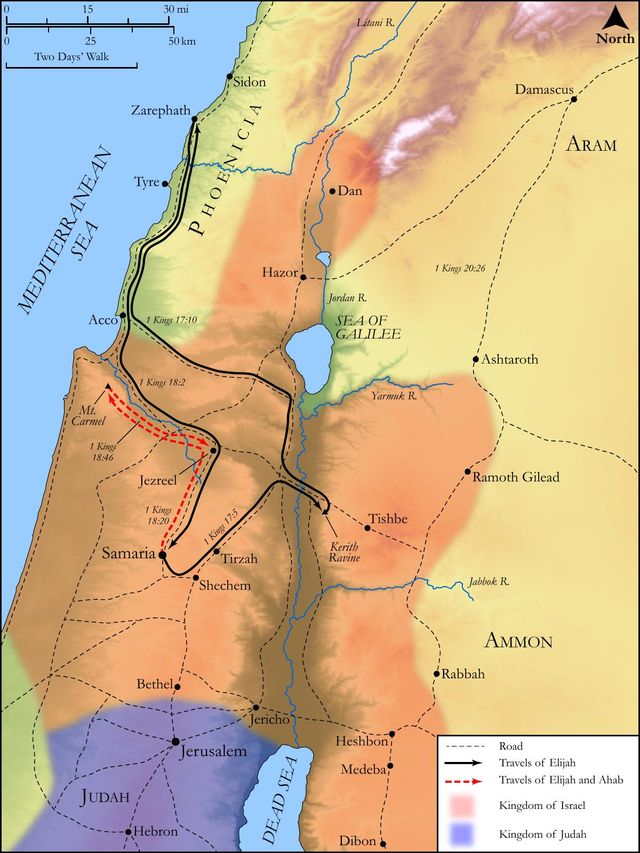
See on the biblical-era map

Study this verse
Public-domain commentary
Matthew Henry
From his Commentary on the Whole Bible. Henry comments on passages, not single verses — this entry covers 1 Kings 18:17–20.
We have here the meeting between Ahab and Elijah, as bad a king as ever the world was plagued with and as good a prophet as ever the church was blessed with. 1. Ahab, like himself, basely accused Elijah. He durst not strike him, remembering that Jeroboam's hand withered when it was stretched out against a prophet, but gave him bad language, which was no less an affront to him that sent him. It was a very coarse compliment with which he accosted him at the first word: Art thou he that troubleth Israel? Kg1 18:17. How unlike was this to that with which his servant Obadiah saluted him (Kg1 18:7): Art thou that my lord Elijah? Obadiah feared God greatly; Ahab had sold himself to work wickedness; and both discovered their character by the manner of their address to the prophet. One may guess how people stand affected to God by observing how they stand affected to his people and ministers. Elijah now came to bring blessings to Israel, tidings of the return of the rain; yet he was thus affronted. Had it been true that he was the troubler of Israel, Ahab, as king, would have been bound to animadvert upon him. There are those who trouble Israel by their wickedness, whom the conservators of the public peace are concerned to enquire after. But it was utterly false concerning Elijah; so far was he from being an enemy to Israel's welfare that he as the stay of it, the chariots and horsemen of Israel. Note, It has been the lot of the best and most useful men to be called and counted the troublers of the land, and to be run down as public grievances. Even Christ and his apostles were thus misrepresented, Act 17:6. 2. Elijah, like himself, boldly returned the charge upon the king, and proved it upon him, that he was the troubler of Israel, Kg1 18:18. Elijah is not the Achan: "I have not troubled Israel, have neither done them any wrong nor designed them any hurt." Those that procure God's judgments do the mischief, not he that merely foretels them and gives warning of them, that the nation may repent and prevent them. I would have healed Israel, but they would not be healed. Ahab is the Achan, the troubler, who follows Baalim, those accursed things. Nothing creates more trouble to a land than the impiety and profaneness of princes and their families. 3. As one having authority immediately from the King of kings, he ordered a convention of the states to be forthwith summoned to meet at Mount Carmel, where there had been an altar built to God, Kg1 18:30. Probably on that mountain they had an eminent high place, where formerly the pure worship of God had been kept up as well as it could be any where but at Jerusalem. Thither all Israel must come, to give Elijah the meeting; and the prophets of Baal who were dispersed all the country over, with those of the groves who were Jezebel's domestic chaplains, must there make their personal appearance. 4. Ahab issued out writs accordingly, for the convening of this great assembly (Kg1 18:20), either because he feared Elijah and durst not oppose him (Saul stood in awe of Samuel more than of God), or because he hoped Elijah would bless the land, and speak the word that they might have rain, and upon those terms they would be all at his beck. Those that slighted and hated his counsels would gladly be beholden to him for his prayers. Now God made those who said they were Jews and were not, but were of the synagogue of Satan, to come, and, in effect, to worship at his feet, and to know that God had loved him, Rev 3:9.
Historical interpretation
Historical reception
2 surviving comments on this verse. Each one is dated, so this reads as a timeline rather than a list.
Select a marker to jump to its quote. Markers stagger vertically where authors wrote within a few decades of each other.
“When Ahab saw Elijah, Ahab said to him, “Is it you, you troubler of Israel?” He answered, “I have not troubled Israel; but you have, and your father’s house.” “It is you and your father Omri who ruined this people, because through your abominable customs and your evil commandments you corrupted their spirit and their worship and ridiculed the holy law that God had given them, and for that reason rain and dew stopped falling from heaven, and people were overwhelmed by starvation. Therefore it is not my words, which are good, but it is your actions, which are disgusting and trouble Israel.” And this freedom of speech torments Ahab greatly, but he does not fight back or rebuke Elijah about anything, as is related in the two histories of the kings, so that you may know the authority that the Lord had given Elijah over the spirit of the king and the fear toward his prophet that he had put in [Ahab’s] heart. This is what [God] had done in the ancient times to Pharaoh through Moses and Aaron, when they spoke with harshness and afflicted him [with their actions] even more than with their words.
Were Elijah and John then lacking in boldness? Did not the one reprove Ahab, and the other Herod? The latter said, “It is not lawful for you to have your brother Philip’s wife.” And Elijah said to Ahab with boldness: “It is not I that trouble Israel, but you and your father’s house.” You see that this poverty especially produces boldness? For while the rich person is a slave, being subject and in the power of every one wishing to do him hurt, one who has nothing fears no confiscation or fine. So, if poverty had made people to lack in boldness, Christ would not have sent his disciples with poverty to a work requiring great boldness.
Continue studying 1 Kings 18:18 across the web’s major study libraries — every link below opens this exact verse, chapter, or book on the destination site.
Read & Compare
 BibleGatewayThis verse in more than 200 translations and 70 languages.
 Bible.comThe YouVersion reader — hundreds of translations, reading plans, and highlights.
 ESV.orgCrossway's official English Standard Version reader.
 NET BibleThe NET translation with 60,000+ translators' notes on every rendering decision.
 STEP BibleTyndale House's free study tool — original text, vocabulary, and scholarly resources.
 BibliaLogos Bible Software's free web reader.
 USCCBThe New American Bible (Revised Edition) with the U.S. bishops' study notes.
Commentaries
 BibleHub CommentariesDozens of classic commentaries on this verse, gathered on one page.
 StudyLightMore than 100 commentary sets — the largest collection on the web.
 BibleRefPlain-English commentary on what this verse means, verse by verse.
 Enduring WordDavid Guzik's free commentary on this chapter, widely used by Bible teachers.
 Bible Study ToolsVerse commentary alongside Greek and Hebrew study aids.
Original Language & Research
- BibleHub InterlinearThe verse word by word — original language, transliteration, and English.
- BibleHub LexiconEvery word's original-language definition and Strong's entry.
 Blue Letter BibleDeep-study tools — Strong's numbers, concordance, and word studies.
 SefariaThe Hebrew text with Rashi and centuries of Jewish commentary.
Sermons, Hymns & Audio


TrulyRandomVerse is not affiliated with these sites and doesn’t control their content. They’re linked because they’re genuinely useful.
Summary
In a moment of profound spiritual and political tension, 1 Kings 18:18 records the prophet Elijah's audacious rebuttal to King Ahab's accusation that Elijah was the source of Israel's troubles. Elijah boldly shifts the blame, asserting that the true cause of the nation's suffering—specifically the devastating drought—was the pervasive idolatry and covenant disobedience of Ahab and his royal household, who had deliberately abandoned the commandments of the LORD to follow the false gods of Baal.
Context
ShowHideLiterary Context
This verse is the dramatic climax of a direct confrontation between the prophet Elijah and King Ahab, occurring after three and a half years of a severe drought that Elijah had prophesied. Immediately preceding this, Ahab accuses Elijah of being the "troubler of Israel" in 1 Kings 18:17. Elijah's response in this verse is not a defense, but a powerful counter-accusation that sets the stage for the epic showdown on Mount Carmel, where the true God of Israel would be vindicated against the prophets of Baal. This entire narrative arc, from the initial drought prophecy in 1 Kings 17 to the confrontation and subsequent events on Mount Carmel in 1 Kings 18, highlights the central conflict between Yahweh worship and Baal worship during the reign of the Omride dynasty.
Historical & Cultural Context
The reign of King Ahab (c. 874-853 BC) and Queen Jezebel was a period of intense religious apostasy in the Northern Kingdom of Israel. Jezebel, a Phoenician princess, vigorously promoted the worship of Baal, her native deity, establishing temples and supporting hundreds of Baal and Asherah prophets. Baal was a Canaanite storm and fertility god, believed to control rain, thunder, and agricultural abundance—precisely the elements that were absent during the drought. In a land dependent on rain for agriculture, the drought was not merely a natural disaster but a direct challenge to Baal's supposed power and a clear sign of divine judgment from Yahweh, the true giver of rain. The "commandments of the LORD" refer primarily to the Mosaic covenant, particularly the first commandment against idolatry in Exodus 20:3 and the warnings in Deuteronomy 28 regarding the consequences of disobedience, including drought.
Key Themes
ShowHideThis pivotal verse encapsulates several major themes central to the book of 1 Kings and the broader Old Testament narrative. It underscores the sovereignty of Yahweh over false gods, demonstrating that the true God controls the elements and holds nations accountable for their obedience. The theme of accountability for sin is prominent, as Elijah unequivocally places the blame for Israel's suffering not on himself, but on the king and his household's deliberate choice to abandon God's law and embrace idolatry. This highlights the biblical principle that disobedience to God's covenant has dire consequences, both individually and corporately, as seen in the warnings of Deuteronomy. Furthermore, Elijah's fearless confrontation of the king, despite the immense personal risk (given Jezebel's persecution of Yahweh's prophets, as mentioned in 1 Kings 18:4), exemplifies the courage and uncompromising nature of prophetic ministry—to rebuke the powerful, regardless of the cost, and to call God's people back to covenant faithfulness.
Exposition and Analysis
ShowHideKey Word Analysis
ShowHideThis verb (H5916) literally means "to roil water" and figuratively, "to disturb" or "to afflict." It implies a deep, pervasive disturbance or calamity. Ahab uses it to accuse Elijah of being the source of Israel's distress (the drought and famine). Elijah, however, masterfully re-directs the accusation, asserting that it is Ahab's actions, not his, that have truly "troubled" Israel by bringing divine judgment upon the land. The term carries a strong sense of moral culpability for the ensuing suffering.
This word (H5800) signifies a deliberate and complete abandonment or desertion. It is not merely a passive neglect but an active turning away from something previously held or committed to. When Elijah states that Ahab and his house have "forsaken the commandments of the LORD," he is accusing them of a conscious and willful breach of their covenant obligations, a profound act of spiritual rebellion against the God who had delivered Israel and established them in the land.
This is the plural form (H1168) of "Baal," indicating not just one specific manifestation of the deity but the various local cults and numerous altars dedicated to Baal worship that had permeated Israel. It reflects the pervasive and multifaceted nature of the nation's spiritual rebellion, embracing multiple expressions of this pagan fertility god, often syncretized with Yahweh worship, which was an abomination to God. The use of the plural emphasizes the widespread and entrenched nature of idolatry throughout the kingdom.
Verse Breakdown
ShowHide"And he answered, I have not troubled Israel;"
Elijah's immediate and unequivocal denial directly refutes Ahab's accusation. This is not a defensive posture but a confident assertion of innocence regarding the charge of causing Israel's distress. Elijah understands that he is not the source of the trouble, but rather God's messenger exposing the true source.
"but thou, and thy father's house,"
Elijah pivots from denial to direct accusation, placing the blame squarely and personally on King Ahab and his entire royal lineage. This highlights the corporate responsibility of leadership and the profound influence of the king's spiritual choices on the entire nation. The "father's house" implies a generational pattern of apostasy or at least a pervasive influence of idolatry originating from the royal family.
"in that ye have forsaken the commandments of the LORD,"
This clause specifies the nature of the royal household's offense. Their "troubling" of Israel stems from a deliberate and active abandonment of Yahweh's revealed will, particularly the covenant laws given at Sinai. This includes the fundamental command to worship only Yahweh and to reject all other gods, which was the bedrock of Israel's identity and well-being.
"and thou hast followed Baalim."
This final clause provides the specific and most egregious manifestation of their forsaking God's commandments: active devotion to the plural forms of Baal worship. This was not a passive neglect but an enthusiastic embrace of pagan idolatry, which was a direct affront to Yahweh's exclusive claim on Israel's worship and a violation of the covenant that promised blessing for obedience and curses for disobedience.
Literary Devices
ShowHideThe verse is rich in literary devices that amplify its dramatic impact and theological significance. Inversion or Reversal of Blame is central, as Elijah skillfully turns Ahab's accusation back on him, revealing the true culprit of Israel's suffering. This creates Dramatic Irony, as Ahab, who believes Elijah is the problem, is unknowingly the very source of the nation's distress. The passage employs Direct Confrontation, showcasing Elijah's fearless and unyielding stance against royal power, a hallmark of prophetic literature. The drought itself functions as a powerful Symbolism, representing not only divine judgment but also the spiritual barrenness and desolation that result from abandoning the life-giving covenant with Yahweh for the empty promises of Baal. The use of "Baalim" (plural) is a form of Synecdoche or Metonymy, where the specific false god stands in for the entire system of idolatry and spiritual rebellion that permeated the nation under Ahab's rule.
Theological and Thematic Connections
ShowHideElijah's confrontation with Ahab in 1 Kings 18:18 serves as a potent reminder of the profound biblical principle that disobedience to God's covenant, particularly through idolatry, inevitably leads to national and personal distress. It underscores the concept of divine judgment, demonstrating that God actively responds to the spiritual state of His people and their leaders. The drought, far from being a random natural event or Elijah's doing, is revealed as a direct consequence of Israel's corporate sin, highlighting God's sovereignty over creation and His use of natural phenomena to call His people to repentance. This passage also reinforces the crucial role of the prophet as God's spokesperson, tasked with fearlessly exposing sin and calling for a return to covenant faithfulness, even when it means confronting the highest authorities. It is a testament to God's unwavering commitment to His covenant and His desire for His people's exclusive devotion.
Reflection and Application
ShowHideElijah's bold declaration to Ahab resonates deeply with contemporary life, challenging us to identify the true sources of "trouble" in our personal lives, communities, and nations. Often, we are quick to blame external circumstances, political opponents, or even God's messengers for the difficulties we face, much like Ahab blamed Elijah. However, this verse compels us to look inward and upward, recognizing that many of our deepest societal ills and personal struggles stem from a departure from divine principles and a pursuit of modern "Baals"—whether they be the idols of wealth, power, pleasure, self-gratification, or even political ideologies that usurp God's rightful place. It calls for radical self-examination: where have we, individually or corporately, "forsaken the commandments of the LORD" and "followed Baalim"? The courage of Elijah also serves as a powerful model, urging believers to rebuke the powerful, to lovingly confront sin, and to stand firm for God's righteousness, even when it is unpopular or costly. Ultimately, this passage reminds us that true well-being and flourishing, for both individuals and nations, are inextricably linked to faithful obedience and exclusive devotion to the one true God.
Questions for Reflection
ShowHideFAQ
ShowHideWhat does "troubled Israel" mean in this context, and why did Ahab accuse Elijah of it?
ShowHideIn this context, "troubled Israel" (Hebrew: ‘ākar) refers to bringing calamity, disaster, or severe distress upon the nation. Ahab accused Elijah of being the "troubler" because Elijah had prophesied the devastating drought in 1 Kings 17:1 that was afflicting Israel. From Ahab's perspective, Elijah's words had initiated the national suffering, and his reappearance after years of drought suggested he was the cause. However, Elijah's powerful rebuttal in 1 Kings 18:18 clarifies that the true "trouble" was not Elijah's presence or prophecy, but the king and his household's widespread idolatry and abandonment of God's commandments, which had brought divine judgment upon the land.
Why was Baal worship so prevalent in Israel during Ahab's reign?
ShowHideBaal worship became deeply entrenched in Israel primarily due to political alliances and Queen Jezebel's zealous promotion. Ahab's marriage to Jezebel, a Phoenician princess, was a political move, but it brought with it the worship of Baal, her native deity. Jezebel actively established Baal temples and supported his prophets, even persecuting the prophets of Yahweh as described in 1 Kings 18:4. Furthermore, Baal was a Canaanite fertility god, believed to control rain and agricultural abundance. In an agrarian society, the temptation to worship a deity thought to ensure good harvests was strong, leading to syncretism where some Israelites attempted to worship both Yahweh and Baal, or even replaced Yahweh with Baal altogether.
What is the significance of Elijah's reference to "thy father's house"?
ShowHideThe phrase "thy father's house" refers to King Ahab's royal dynasty and family. Its inclusion signifies that the idolatry was not merely Ahab's personal sin but a pervasive, widespread issue within the ruling elite. It highlights the corporate responsibility of leadership and the profound influence of the king's spiritual choices on the entire nation. The spiritual state of the royal household directly impacted the spiritual health and well-being of Israel, as their actions set the example and often dictated the religious policy for the kingdom. Elijah's accusation thus points to a deep-seated, generational pattern of apostasy within the ruling family that had led the nation astray.
Christ-Centered Fulfillment
ShowHideElijah's confrontation with Ahab, where he exposes the true source of Israel's trouble as sin and idolatry, powerfully foreshadows the ministry of Jesus Christ. Just as Elijah stood as God's prophet to expose the spiritual barrenness caused by Baal worship, Jesus, the ultimate Prophet, came to expose the sin that truly troubles humanity and separates us from God, as revealed in John 3:19. While Elijah called Israel back to the commandments of the LORD, Jesus did not come to abolish the Law but to fulfill it, as stated in Matthew 5:17, and to offer a new covenant of grace and truth, according to John 1:17. The drought in Elijah's day symbolized the spiritual desolation of a people who had forsaken God; Jesus, however, offers living water that quenches spiritual thirst forever, as He declared in John 4:10-14. He is the true King, unlike Ahab, who perfectly obeys the Father and leads His people in righteousness, removing the curse of sin and bringing true spiritual flourishing. Ultimately, the "trouble" that truly afflicts humanity—sin and its consequences—is not removed by a prophet's word alone, but by the Lamb of God, who takes away the sin of the world, offering reconciliation and eternal life to all who turn from their idols and follow Him.