


1 Kings 18:17
- וַיְהִיvay·Hiand it wasH1961Conj-w ¦ V-Qal-ConsecImperf-3msVerb Qal Consecutive Imperfect 3rd Singular Masculineוַandיְהִיit was
- כִּרְאוֹתkir·'otwhen sawH7200Prep-k ¦ V-Qal-InfVerb Qal Infinitive Constructכִּwhenרְאוֹתsaw
- אַחְאָב'ach·'AvAhabH256N-proper-mNoun Proper Masculine
- אֶת'et<obj.>H853DirObjMParticle Object Indicator
- אֵלִיָּהוּ'e·li·Ya·huElijahH452N-proper-mNoun Proper Masculine
- וַיֹּאמֶרvai·Yo·merand he saidH559Conj-w ¦ V-Qal-ConsecImperf-3msVerb Qal Consecutive Imperfect 3rd Singular Masculineוַandיֹּאמֶרhe said
- אַחְאָב'ach·'AvAhabH256N-proper-mNoun Proper Masculine
- אֵלָיו'e·Lavto himH413Prep ¦ 3msPrepositionאֵלָיtoוhim
- הַאַתָּהha·'a·Tah¿ youH859Interrog ¦ Pro-2msPronoun Personal 2nd Singular Masculineהַ¿אַתָּהyou
- זֶהzeh[is] thisH2088PrtParticle Demonstrative
- עֹכֵר'o·KherO [one who] troublesH5916V-Qal-Prtcpl-msVerb Qal Participle Singular Masculine Absolute
- יִשְׂרָאֵלYis·ra·'ElIsraelH3478N-properNoun Proper Location
English is a literal word-by-word gloss of the Hebrew, not the KJV's wording. Why?
This is the original text the KJV's translators worked from — each Hebrew word with its own literal English meaning in this verse, prepared by scholars at Tyndale House, Cambridge. The KJV translates whole sentences, not word by word, so its wording differs: one Hebrew word can become several English words, and the KJV may choose “the LORD” where the gloss reads “Yahweh”. Both are faithful — they answer different questions. For the KJV's own rendering, switch to the KJV text.
Details
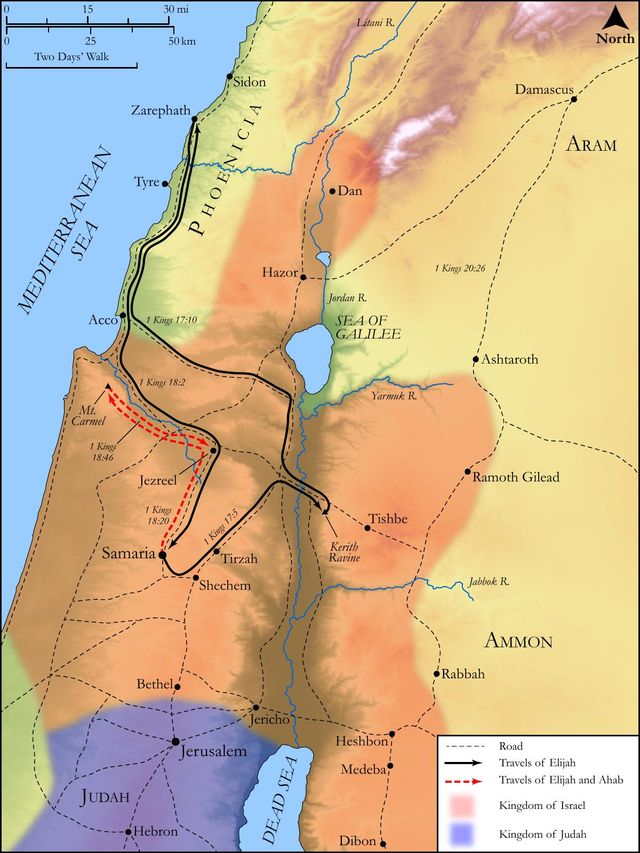
See on the biblical-era map

Study this verse
Public-domain commentary
Matthew Henry
From his Commentary on the Whole Bible. Henry comments on passages, not single verses — this entry covers 1 Kings 18:17–20.
We have here the meeting between Ahab and Elijah, as bad a king as ever the world was plagued with and as good a prophet as ever the church was blessed with. 1. Ahab, like himself, basely accused Elijah. He durst not strike him, remembering that Jeroboam's hand withered when it was stretched out against a prophet, but gave him bad language, which was no less an affront to him that sent him. It was a very coarse compliment with which he accosted him at the first word: Art thou he that troubleth Israel? Kg1 18:17. How unlike was this to that with which his servant Obadiah saluted him (Kg1 18:7): Art thou that my lord Elijah? Obadiah feared God greatly; Ahab had sold himself to work wickedness; and both discovered their character by the manner of their address to the prophet. One may guess how people stand affected to God by observing how they stand affected to his people and ministers. Elijah now came to bring blessings to Israel, tidings of the return of the rain; yet he was thus affronted. Had it been true that he was the troubler of Israel, Ahab, as king, would have been bound to animadvert upon him. There are those who trouble Israel by their wickedness, whom the conservators of the public peace are concerned to enquire after. But it was utterly false concerning Elijah; so far was he from being an enemy to Israel's welfare that he as the stay of it, the chariots and horsemen of Israel. Note, It has been the lot of the best and most useful men to be called and counted the troublers of the land, and to be run down as public grievances. Even Christ and his apostles were thus misrepresented, Act 17:6. 2. Elijah, like himself, boldly returned the charge upon the king, and proved it upon him, that he was the troubler of Israel, Kg1 18:18. Elijah is not the Achan: "I have not troubled Israel, have neither done them any wrong nor designed them any hurt." Those that procure God's judgments do the mischief, not he that merely foretels them and gives warning of them, that the nation may repent and prevent them. I would have healed Israel, but they would not be healed. Ahab is the Achan, the troubler, who follows Baalim, those accursed things. Nothing creates more trouble to a land than the impiety and profaneness of princes and their families. 3. As one having authority immediately from the King of kings, he ordered a convention of the states to be forthwith summoned to meet at Mount Carmel, where there had been an altar built to God, Kg1 18:30. Probably on that mountain they had an eminent high place, where formerly the pure worship of God had been kept up as well as it could be any where but at Jerusalem. Thither all Israel must come, to give Elijah the meeting; and the prophets of Baal who were dispersed all the country over, with those of the groves who were Jezebel's domestic chaplains, must there make their personal appearance. 4. Ahab issued out writs accordingly, for the convening of this great assembly (Kg1 18:20), either because he feared Elijah and durst not oppose him (Saul stood in awe of Samuel more than of God), or because he hoped Elijah would bless the land, and speak the word that they might have rain, and upon those terms they would be all at his beck. Those that slighted and hated his counsels would gladly be beholden to him for his prayers. Now God made those who said they were Jews and were not, but were of the synagogue of Satan, to come, and, in effect, to worship at his feet, and to know that God had loved him, Rev 3:9.
Historical interpretation
Historical reception
2 surviving comments on this verse. Each one is dated, so this reads as a timeline rather than a list.
Select a marker to jump to its quote. Markers stagger vertically where authors wrote within a few decades of each other.
“When Ahab saw Elijah, Ahab said to him, “Is it you, you troubler of Israel?” He answered, “I have not troubled Israel; but you have, and your father’s house.” “It is you and your father Omri who ruined this people, because through your abominable customs and your evil commandments you corrupted their spirit and their worship and ridiculed the holy law that God had given them, and for that reason rain and dew stopped falling from heaven, and people were overwhelmed by starvation. Therefore it is not my words, which are good, but it is your actions, which are disgusting and trouble Israel.” And this freedom of speech torments Ahab greatly, but he does not fight back or rebuke Elijah about anything, as is related in the two histories of the kings, so that you may know the authority that the Lord had given Elijah over the spirit of the king and the fear toward his prophet that he had put in [Ahab’s] heart. This is what [God] had done in the ancient times to Pharaoh through Moses and Aaron, when they spoke with harshness and afflicted him [with their actions] even more than with their words.
Were Elijah and John then lacking in boldness? Did not the one reprove Ahab, and the other Herod? The latter said, “It is not lawful for you to have your brother Philip’s wife.” And Elijah said to Ahab with boldness: “It is not I that trouble Israel, but you and your father’s house.” You see that this poverty especially produces boldness? For while the rich person is a slave, being subject and in the power of every one wishing to do him hurt, one who has nothing fears no confiscation or fine. So, if poverty had made people to lack in boldness, Christ would not have sent his disciples with poverty to a work requiring great boldness.
Continue studying 1 Kings 18:17 across the web’s major study libraries — every link below opens this exact verse, chapter, or book on the destination site.
Read & Compare
 BibleGatewayThis verse in more than 200 translations and 70 languages.
 Bible.comThe YouVersion reader — hundreds of translations, reading plans, and highlights.
 ESV.orgCrossway's official English Standard Version reader.
 NET BibleThe NET translation with 60,000+ translators' notes on every rendering decision.
 STEP BibleTyndale House's free study tool — original text, vocabulary, and scholarly resources.
 BibliaLogos Bible Software's free web reader.
 USCCBThe New American Bible (Revised Edition) with the U.S. bishops' study notes.
Commentaries
 BibleHub CommentariesDozens of classic commentaries on this verse, gathered on one page.
 StudyLightMore than 100 commentary sets — the largest collection on the web.
 BibleRefPlain-English commentary on what this verse means, verse by verse.
 Enduring WordDavid Guzik's free commentary on this chapter, widely used by Bible teachers.
 Bible Study ToolsVerse commentary alongside Greek and Hebrew study aids.
Original Language & Research
- BibleHub InterlinearThe verse word by word — original language, transliteration, and English.
- BibleHub LexiconEvery word's original-language definition and Strong's entry.
 Blue Letter BibleDeep-study tools — Strong's numbers, concordance, and word studies.
 SefariaThe Hebrew text with Rashi and centuries of Jewish commentary.
Sermons, Hymns & Audio


TrulyRandomVerse is not affiliated with these sites and doesn’t control their content. They’re linked because they’re genuinely useful.
Summary
1 Kings 18:17 marks the highly anticipated and dramatic confrontation between King Ahab and the prophet Elijah after a devastating three-and-a-half-year drought. Upon seeing Elijah, Ahab immediately levels a baseless accusation, demanding, "Art thou he that troubleth Israel?" This question, laden with profound irony, exposes Ahab's spiritual blindness and his desperate attempt to deflect blame for the national calamity, which was, in fact, a direct consequence of his own idolatry and corrupt leadership. The verse powerfully sets the stage for the epic showdown on Mount Carmel, highlighting the stark clash between divine truth and human rebellion.
Context
ShowHideLiterary Context
This verse serves as the narrative climax of a significant arc that began with Elijah's bold prophecy of drought in 1 Kings 17:1. Following this pronouncement, Elijah was miraculously sustained by ravens and later by a widow in Zarephath, demonstrating God's sovereign power to provide even amidst widespread famine. The narrative then shifts to the severe suffering caused by the drought, culminating in Ahab's desperate search for Elijah. The encounter in 1 Kings 18:17 is the direct result of God commanding Elijah to show himself to Ahab (1 Kings 18:1), a meeting facilitated by Obadiah, Ahab's God-fearing steward. This confrontation is the immediate prelude to the epic contest on Mount Carmel, where the true source of Israel's trouble—and the identity of the true God—will be definitively revealed.
Historical & Cultural Context
King Ahab, who reigned over Israel from approximately 874-853 BC, was notoriously wicked, particularly for his aggressive promotion of Baal worship. His marriage to Jezebel, a Phoenician princess and fervent devotee of Baal, solidified this idolatry as the state-sponsored religion (1 Kings 16:30-33). Baal was a prominent Canaanite storm and fertility god, believed to control rain and agricultural prosperity. The three-and-a-half-year drought was a direct divine judgment from Yahweh, demonstrating His absolute sovereignty over creation and serving as a direct challenge to Baal's supposed power. Ahab's accusatory question reflects a common ancient Near Eastern belief that prophets or "men of God" could bring blessing or curse, leading him to view Elijah as a malevolent sorcerer or a bringer of ill fortune, rather than a faithful messenger of divine judgment.
Key Themes
ShowHideThe verse powerfully introduces and reinforces several key themes that permeate the book of 1 Kings and the broader prophetic literature. Firstly, it highlights misplaced blame and spiritual blindness. Ahab, the primary architect of Israel's spiritual decline, blames the prophet who represents God's truth, illustrating humanity's pervasive propensity to deflect responsibility for self-inflicted consequences. Secondly, it underscores the theme of divine confrontation and authority. This encounter is a direct clash between the corrupt political and religious establishment of Ahab and Jezebel, and the unyielding, divinely appointed authority of Elijah, who speaks for the one true God. Finally, it emphasizes the consequences of disobedience and idolatry. The devastating drought, the national suffering, and Ahab's desperate search are all direct results of Israel's abandonment of the Lord's covenant, a consequence clearly outlined in passages like Deuteronomy 11:16-17. Ahab's question, therefore, is a testament to his profound inability to grasp the true cause of his nation's distress.
Exposition and Analysis
ShowHideKey Word Analysis
ShowHideThe name אֶחָב (ʼAchʼâb), meaning "brother (i.e. friend) of (his) father," is profoundly ironic given the character of King Ahab (H256). Far from being a faithful "brother" or "friend" to his divine Father, Yahweh, Ahab actively rebelled against God, leading Israel into deep idolatry. His name stands in stark contrast to his actions, highlighting his apostasy and misdirection of the nation. In this verse, the mention of "Ahab" immediately identifies the accuser as the very individual responsible for the nation's spiritual and physical plight.
The Hebrew verb עָכַר (ʻâkar', H5916) literally means "to roil water" and figuratively "to disturb or afflict." It implies a profound disturbance, defilement, or the bringing of disaster that results in negative consequences, often moral or spiritual. Ahab uses this word to accuse Elijah of being the instigator of national calamity, suggesting Elijah is a disruptive, harmful force. However, the profound irony lies in Elijah's immediate retort in the very next verse, where he declares that it is Ahab and his father's house who have truly "troubled Israel" by forsaking the commandments of the Lord and following Baalim (1 Kings 18:18). Thus, the word akar is central to the dramatic reversal of accusation in this pivotal exchange, revealing the true source of Israel's distress.
Verse Breakdown
ShowHide"And it came to pass, when Ahab saw Elijah"
This opening phrase emphasizes the long-awaited and highly dramatic nature of this encounter. Ahab had been actively searching for Elijah, presumably to punish him for the drought or to compel him to end it. The mere sight of Elijah, after years of drought and a desperate search, signifies a moment of intense anticipation and high stakes, setting the stage for a critical confrontation.
"that Ahab said unto him"
This simple declarative clause highlights Ahab's immediate and unhesitating reaction. There is no greeting, no inquiry about the drought's end, but an instant, direct accusation. This reveals Ahab's character: his self-righteousness, his tendency to blame others, and his profound spiritual distance from God's prophet and, by extension, from God Himself.
"[Art] thou he that troubleth Israel?"
This is a rhetorical question, framed as a direct accusation rather than a genuine inquiry. Ahab is not seeking information; he is asserting his belief that Elijah is the cause of the nation's suffering. The question is loaded with blame, reflecting Ahab's distorted perception of reality. He sees Elijah, the faithful messenger of God's truth and judgment, as the source of the problem, rather than the idolatry and disobedience that he himself championed and imposed upon the nation. This accusation is the central point of contention and sets the stage for Elijah's powerful rebuttal and the subsequent demonstration on Mount Carmel.
Literary Devices
ShowHideThe verse is exceptionally rich in Irony, which stands as its most prominent literary device. Ahab's accusation that Elijah is the "troubler of Israel" is profoundly ironic, as it is Ahab himself, through his promotion of Baal worship and abandonment of Yahweh, who has brought the devastating calamity upon the nation. This dramatic irony underscores Ahab's profound spiritual blindness and moral culpability. The encounter also exemplifies Dramatic Confrontation, building palpable tension from the long-anticipated meeting between the powerful, wicked king and the lone, courageous prophet. This direct verbal clash serves to Foreshadow the greater spiritual battle to come on Mount Carmel, where the true source of Israel's trouble and the identity of the true God will be definitively settled. Finally, Ahab's question itself functions as a Rhetorical Question, not seeking information but rather conveying a strong accusation and revealing his prejudiced and self-deceiving mindset.
Theological and Thematic Connections
ShowHideThis pivotal exchange in 1 Kings 18:17 encapsulates the timeless theological truth that humanity often blames God's messengers for the consequences of its own sin. Ahab's accusation is a classic example of deflecting responsibility, a pattern seen throughout biblical history from Adam and Eve onward. It highlights the profound spiritual blindness that results from persistent rebellion against God, where truth is inverted, and the righteous are perceived as the problem, while the wicked remain oblivious to their own culpability. This confrontation serves as a powerful reminder that true trouble stems not from God's prophets or His righteous judgments, but from human disobedience and idolatry. It underscores God's unwavering commitment to confront sin and call His people back to Himself, even through severe judgment, demonstrating His justice and His desire for repentance.
Reflection and Application
ShowHideAhab's accusation in 1 Kings 18:17 serves as a potent mirror for self-reflection, challenging us to honestly examine our own lives and our responses to difficulty. How often do we, like Ahab, seek to externalize blame, pointing fingers at circumstances, other people, or even God, rather than acknowledging our own contributions to our struggles or the consequences of our choices? True spiritual growth and genuine repentance begin with the courage to look inward, to confess our part, and to seek God's transformative grace. This verse also reminds us of the prophetic call to rebuke the powerful, even when that truth is unpopular, uncomfortable, or dangerous. Elijah's unwavering stance exemplifies the necessity of proclaiming God's word without compromise, trusting in His ultimate vindication and the power of His truth to expose and transform. Finally, Ahab's spiritual blindness is a sobering warning against the hardening effects of persistent sin, which can distort our perception of reality and prevent us from discerning God's hand in our lives, whether in judgment or in grace, thereby hindering our path to true reconciliation and blessing.
Questions for Reflection
ShowHideFAQ
ShowHideWhy did Ahab accuse Elijah of troubling Israel?
ShowHideAhab accused Elijah because he viewed him as the direct cause of the devastating three-and-a-half-year drought and famine plaguing Israel. From Ahab's limited and distorted perspective, Elijah's prophecy in 1 Kings 17:1 initiated the calamity. However, this accusation was a profound act of spiritual blindness and blame-shifting. Ahab stubbornly refused to acknowledge that the true source of Israel's trouble was his own rampant idolatry and promotion of Baal worship, which had led the entire nation away from the Lord. He attributed the consequences of his sin to God's faithful prophet, rather than to God's righteous judgment against his own wickedness (1 Kings 16:30-33).
What does "troubleth Israel" mean in this context?
ShowHideThe Hebrew word translated "troubleth" is akar (עָכַר, H5916), which means to stir up, disturb, bring disaster upon, or cause defilement. When Ahab asks, "[Art] thou he that troubleth Israel?", he is accusing Elijah of being the instigator of the national calamity—the severe drought, widespread famine, and associated suffering. He views Elijah as a malevolent force responsible for the nation's distress. However, Elijah immediately corrects this false accusation in 1 Kings 18:18, stating unequivocally that Ahab and his father's house are the true "troublers" of Israel because they have forsaken the Lord's commandments and persistently followed Baal.
How does this verse set the stage for the events on Mount Carmel?
ShowHideThis verse is the dramatic opening act for the climactic showdown on Mount Carmel described in 1 Kings 18:19-40. Ahab's direct accusation forces the central issue: who is truly responsible for Israel's suffering, and, more fundamentally, who is the true God? Elijah's sudden appearance and Ahab's immediate challenge create the necessary tension and public platform for God to definitively demonstrate His sovereignty over Baal. The contest on Mount Carmel will serve as God's powerful answer to Ahab's self-righteous question, revealing beyond doubt that Yahweh alone controls the rain and that the "trouble" is a divine judgment against idolatry, not the prophet's doing.
Christ-Centered Fulfillment
ShowHideAhab's accusatory question to Elijah, "Art thou he that troubleth Israel?", finds a profound Christ-centered fulfillment in the life and ministry of Jesus. Just as Elijah, the true prophet of God, was wrongly accused of disturbing the peace and bringing trouble, so too was Jesus. The religious authorities and political powers of His day frequently accused Jesus of subverting the nation (Luke 23:2), stirring up the people, and challenging the established order (Acts 17:6). Yet, like Elijah, Jesus was not the true "troubler" of Israel in the sense of bringing chaos through sin; rather, He was the ultimate "troubler" of sin, darkness, and the kingdom of Satan (John 8:44). He came to cast out the ruler of this world (John 12:31), bringing a division not of hatred, but of truth, separating those who follow Him from those who reject Him (Matthew 10:34). Jesus, the Lamb of God who takes away the sin of the world (John 1:29), ultimately bore the trouble and judgment that was due to humanity's sin, becoming the one "troubled" on the cross so that we might have peace with God. He is the ultimate Prophet, greater than Elijah (Hebrews 1:1-2), who brings not merely a temporary drought, but the eternal judgment against sin, and the living water of salvation to all who believe, revealing Himself as the Way, the Truth, and the Life (John 14:6).