


Joshua 7:25
Bible text: King James Version (1769 Blayney text) · Public domain
Bible text: King James Version with Strong's numbers · Public domain
Bible text: Berean Standard Bible · Public domain
Bible text: American Standard Version (1901) · Public domain
Bible text: World English Bible, Messianic edition · Public domain
Bible text: Geneva Bible (1599) · Public domain
Bible text: Young's Literal Translation · Public domain
- וַיֹּאמֶרvai·Yo·merand he saidH559Conj-w ¦ V-Qal-ConsecImperf-3msVerb Qal Consecutive Imperfect 3rd Singular Masculineוַandיֹּאמֶרhe said
- יְהוֹשֻׁעַye·ho·Shu·a'JoshuaH3091N-proper-mNoun Proper Masculine
- מֶהmehwhy?H4100InterrogPronoun Interrogative
- עֲכַרְתָּנוּ'a·khar·Ta·nuhave you brought trouble to usH5916V-Qal-Perf-2ms ¦ 1cpVerb Qal Perfect 2nd Singular Masculineעֲכַרְתָּhave you brought trouble toנוּus
- יַעְכֳּרְךָya'·kor·Khahe will bring trouble to youH5916V-Qal-Imperf-3ms ¦ 2msVerb Qal Imperfect 3rd Singular Masculineיַעְכֳּרְhe will bring trouble toךָyou
- יְהוָהYah·wehYahwehH3068N-properNoun Proper Title
- בַּיּוֹםbai·Yomon the dayH3117Prep-b ¦ N-msNoun Singular Masculine Absoluteבַּon theיּוֹםday
- הַזֶּהha·Zeh<the> thisH2088Art ¦ PrtParticle Demonstrativeהַ<the>זֶּהthis
- וַיִּרְגְּמוּvai·yir·ge·Muand they stonedH7275Conj-w ¦ V-Qal-ConsecImperf-3mpVerb Qal Consecutive Imperfect 3rd Plural Masculineוַandיִּרְגְּמוּthey stoned
- אֹתוֹ'o·To<obj.> himH853DirObjM ¦ 3msParticle Object Indicatorאֹת<obj.>וֹhim
- כָלkholallH3605N-mscNoun Singular Masculine Construct
- יִשְׂרָאֵלYis·ra·'ElIsraelH3478N-properNoun Proper Location
- אֶבֶן'E·venstone[s]H68N-fsNoun Singular Feminine Absolute
- וַיִּשְׂרְפוּvai·yis·re·Fuand they burnedH8313Conj-w ¦ V-Qal-ConsecImperf-3mpVerb Qal Consecutive Imperfect 3rd Plural Masculineוַandיִּשְׂרְפוּthey burned
- אֹתָם'o·Tam<obj.> themH853DirObjM ¦ 3mpParticle Object Indicatorאֹתָ<obj.>םthem
- בָּאֵשׁba·'Eshwith <the> fireH784Prep-b ¦ N-csNoun Singular common gender Absoluteבָּwith <the>אֵשׁfire
- וַיִּסְקְלוּvai·yis·ke·Luand they stonedH5619Conj-w ¦ V-Qal-ConsecImperf-3mpVerb Qal Consecutive Imperfect 3rd Plural Masculineוַandיִּסְקְלוּthey stoned
- אֹתָם'o·Tam<obj.> themH853DirObjM ¦ 3mpParticle Object Indicatorאֹתָ<obj.>םthem
- בָּאֲבָנִיםba·'a·va·Nimwith <the> stonesH68Prep-b ¦ N-mpNoun Plural Masculine Absoluteבָּwith <the>אֲבָנִיםstones
English is a literal word-by-word gloss of the Hebrew, not the KJV's wording. Why?
This is the original text the KJV's translators worked from — each Hebrew word with its own literal English meaning in this verse, prepared by scholars at Tyndale House, Cambridge. The KJV translates whole sentences, not word by word, so its wording differs: one Hebrew word can become several English words, and the KJV may choose “the LORD” where the gloss reads “Yahweh”. Both are faithful — they answer different questions. For the KJV's own rendering, switch to the KJV text.
Details
See on the biblical-era map
Study this verse
Public-domain commentary
Matthew Henry
From his Commentary on the Whole Bible. Henry comments on passages, not single verses — this entry covers Joshua 7:16–26. His three-level outline is real structure in the source text, so it is rendered as structure.
We have in these verses,
I.The discovery of Achan by the lot, which proved a perfect lot, though it proceeded gradually.
Though we may suppose that Joshua slept the better, and with more ease and satisfaction, when he knew the worst of the disease of that body of which, under God, he was the head, and was put into a certain method of cure, yet he rose up early in the morning (Jos 7:16), so much was his heart upon it, to put away the accursed thing. We have found Joshua upon other occasions an early riser; here it shows his zeal and vehement desire to see Israel restored to the divine favour. In the scrutiny observe,
1.That the guilty tribe was that of Judah, which was, and was to be, of all the tribes, the most honourable and illustrious; this was an alloy to their dignity, and might serve as a check to their pride: many there were who were its glories, but here was one that was its reproach. Let not the best families think it strange if there be those found in them, and descending from them, that prove their grief and shame. Judah was to have the first and largest lot in Canaan; the more inexcusable is one of that tribe it, not content to wait for his own share, he break in upon God's property. The Jews' tradition is that when the tribe of Judah was taken the valiant men of that tribe drew their swords, and professed they would not sheathe them again till they saw the criminal punished and themselves cleared who knew their own innocency.
2.That the guilty person was at length fastened upon, and the language of the lot was, Thou art the man, v. 18. It was strange that Achan, being conscious to himself of guilt, when he saw the lot come nearer and nearer to him, had not either the wit to make an escape or the grace to make a confession; but his heart was hardened through the deceitfulness of sin, and it proved to be to his own destruction. We may well imagine how his countenance changed, and what horror and confusion seized him when he was singled out as the delinquent, when the eyes of all Israel were fastened upon him, and every one was ready to say, Have we found thee, O our enemy? See here,
(1.)The folly of those that promise themselves secrecy in sin: the righteous God has many ways of bringing to light the hidden works of darkness, and so bringing to shame and ruin those that continue their fellowship with those unfruitful works. A bird of the air, when God pleases, shall carry the voice, Ecc 10:20. See Psa 94:7, etc.
(2.)How much it is our concern, when God is contending with us, to find out what the cause of action is, what the particular sin is, that, like Achan, troubles our camp. We must thus examine ourselves and carefully review the records of conscience, that we may find out the accursed thing, and pray earnestly with holy Job, Lord, show me wherefore thou contendest with me. Discover the traitor and he shall be no longer harboured.
II.His arraignment and examination, Jos 7:19.
Joshua sits judge, and, though abundantly satisfied of his guilt by the determination of the lot, yet urges him to make a penitent confession, that his soul might be saved by it in the other world, though he could not give him any encouragement to hope that he should save his life by it. Observe,
1.How He accosts him with the greatest mildness and tenderness that could be, like a true disciple of Moses. He might justly have called him "thief," and "rebel," "Raca," and "thou fool," but he call him "son;" he might have adjured him to confess, as the high priest did our blessed Saviour, or threatened him with the torture to extort a confession, but for love's sake he rather beseeches him: I pray thee make confession. This is an example to all not to insult over those that are in misery, though they have brought themselves into it by their own wickedness, but to treat even offenders with the spirit of meekness, not knowing, what we ourselves should have been and done if God had put us into the hands of our own counsels. It is likewise an example to magistrates, in executing justice, to govern their own passions with a strict and prudent hand, and never suffer themselves to be transported by them into any indecencies of behaviour or language, no, not towards those that have given the greatest provocations. The wrath of man worketh not the righteousness of God. Let them remember the judgment is God's, who is Lord of his anger. This is the likeliest method of bringing offenders to repentance.
2.What he wishes him to do, to confess the fact, to confess it to God, the party offended by the crime; Joshua was to him in god's stead, so that in confessing to him he confessed to God. Hereby he would satisfy Joshua and the congregation concerning that which was laid to his charge; his confession would also be an evidence of his repentance, and a warning to others to take heed of sinning after the similitude of his transgression: but that which Joshua aims at herein is that God might be honoured by it, as the Lord, the God of infinite knowledge and power, from whom no secrets are hid; and as the God of Israel, who, as he does particularly resent affronts given to his Israel, so he does the affronts given him by Israel. Note, In confessing sin, as we take shame to ourselves, so we give glory to God as righteous God, owning him justly displeased with us, and as a good God, who will not improve our confessions as evidences against us, but is faithful and just to forgive when we are brought to own that he would be faithful and just if he should punish. By sin we have injured God in his honour. Christ by his death has made satisfaction for the injury; but it is required that we by repentance show our good will to his honour, and, as far as in us lies, give glory to him. Bishop Patrick quotes the Samaritan chronicle, making Joshua to say here to Achan, Lift up thy eyes to the king of heaven and earth, and acknowledge that nothing can be hidden from him who knoweth the greatest secrets.
III.His confession, which now at last, when he saw it was to no purpose to conceal his crime, was free and ingenuous enough, Jos 7:20, Jos 7:21. Here is,
1.A penitent acknowledgment of fault. "Indeed I have sinned; what I am charged with is too true to be denied and too bad to be excused. I own it, I lament it; the Lord is righteous in bringing it to light, for indeed I have sinned." This is the language of a penitent that is sick of his, and whose conscience is loaded with it. "I have nothing to accuse any one else of, but a great deal to say against myself; it is with me that the accursed thing is found; I am the man who has perverted that which was right and it profited me not." And that wherewith he aggravates the sin is that it was committed against the Lord God of Israel. He was himself an Israelite, a sharer with the rest of that exalted nation in their privileges, so that, in offending the God of Israel, he offended his own God, which laid him under the guilt of the basest treachery and ingratitude imaginable.
2.A particular narrative of the fact: Thus and thus have I done. God had told Joshua in general that a part of the devoted things was alienated, but is to him to draw from Achan an account of the particulars; for, one way or other, God will make sinners' own tongues to fall upon them (Psa 64:8); if ever he bring them to repentance, they will be their own accusers, and their awakened consciences will be instead of a thousand witnesses. Note, It becomes penitents, in the confession of their sins to God, to be very particular; not only, "I have sinned," but, "In this and that instance I have sinned," reflecting with regret upon all the steps that led to the sin and all the circumstances that aggravated it and made it exceedingly sinful: thus and thus have I done. He confesses,
(1.)To the things taken. In plundering a house in Jericho he found a goodly Babylonish garment; the word signifies a robe, such as princes wore when they appeared in state, probably it belonged to the King of Jericho; it was far fetched, as we translate it, from Babylon. A garment of divers colours, so some render it. Whatever it was, in his eyes it made a very glorious show. "A thousand pities" (thinks Achan) "that it should be burnt; then it will do nobody any good; if I take it for myself, it will serve me many a year for my best garment." Under these pretences, he makes bold with this first, and things it no harm to save it from the fire; but, his hand being thus in, he proceeds to take a bag of money, two hundred shekels, that is one hundred ounces of silver, and a wwedge of gold which weighed fifty shekels, that is twenty-five ounces. He could not plead that, in taking these, he saved them from the fire (for the silver and gold were to be laid up in the treasury); but those that make a slight excuse to serve in daring to commit one sin will have their hearts so hardened by it that they will venture upon the next without such an excuse; for the way of sin is downhill. See what a peer prize it was for which Achan ran this desperate hazard, and what an unspeakable loser he was by the bargain. See Mat 16:26.
(2.)He confesses the manner of taking them. [1.] the sin began in the eye. he saw these fine things, as Eve saw the forbidden fruit, and was strangely charmed with the sight. See what comes of suffering the heart to walk after the eyes, and what need we have to make this covenant with our eyes, that if they wander they shall be sure to weep for it. Look not thou upon the wine that is red, upon the woman that is fair; close the right eye that thus offense thee, to prevent the necessity of plucking it out, and casting it from thee, Mat 5:28, Mat 5:29. [2.] It proceeded out of the heart. He owns, I coveted them. thus lust conceived and brought forth this sin. Those that would be kept from sinful actions must mortify and check in themselves sinful desires, particularly the desire of worldly wealth, which we more particularly call covetousness. O what a world of evil is the love money the root of! Had Achan looked upon these things with an eye of faith, he would have seen them accursed things, and would have dreaded them, but, looking upon them with an eye of sense only, he saw them goodly things, and coveted them. It was not the looking, but the lusting that ruined him. [3.] When he had committed it he was very industrious to conceal it. Having taken of the forbidden treasures, fearing lest any search should be made for prohibited goods, he hid them in the earth, as one that resolved to keep what he had gotten, and never to make restitution. Thus does Achan confess the whole matter, that God might be justified in the sentence passed upon him. See the deceitfulness of sin; that which is pleasing in the commission is bitter in the reflection; at the last it bites like a serpent. Particularly, see what comes of ill-gotten goods, and how those will be cheated that rob God. Job 20:15, He hath swallowed down riches, and he shall vomit them up again.
IV.His conviction.
God had convicted him by the lot; he had convicted himself by his own confession; but, that no room might be left for the most discontented Israelite to object against the process, Joshua has him further convicted by the searching of his tent, in which the goods were found which he confessed to. Particular notice is taken of the haste which the messengers made that were sent to search: They ran to the tent (Jos 7:22), not only to show their readiness to obey Joshua's orders, but to show how uneasy they were till the camp was cleared of the accursed thing, that they might regain the divine favour. Those that feel themselves under wrath find themselves concerned not to defer the putting away of sin. Delays are dangerous, and it is not time to trifle. When the stolen goods were brought they were laid out before the Lord (Jos 7:23), that all Israel might see how plain the evidence was against Achan, and might adore the strictness of God's judgments in punishing so severely the stealing of such small things, and yet the justice of his judgments in maintaining his right to devoted things, and might be afraid of ever offending in the like kind. In laying them out before the Lord they acknowledged his title to them, and waited to receive his directions concerning them. Note, Those that think to put a cheat upon God do but deceive themselves; what is taken from him he will recover (Hos 2:9) and he will be a loser by no man at last.
V.His condemnation.
Joshua passes sentence upon him (Jos 7:25): Why hast thou troubled us? There is the ground of the sentence. O, how much hast thou troubled us! so some read it. He refers to what was said when the warning was given not to meddle with the accursed thing (Jos 6:18), lest you make the camp of Israel a curse and trouble it. Note, Sin is a very troublesome thing, not only to the sinner himself, but to all about him. He that is greedy of gain, as Achan was, troubles his own house (Pro 15:27) and all the communities he belongs to. Now (says Joshua) God shall trouble thee. See why Achan was so severely dealt with, not only because he had robbed God, but because he had troubled Israel; over his head he had (as it were) this accusation written, "Achan, the troubler of Israel," as Ahab, Kg1 18:18. This therefore is his doom: God shall trouble thee. Note, the righteous God will certainly recompense tribulation to those that trouble his people, Th2 1:6. Those that are troublesome shall be troubled. Some of the Jewish doctors, from that word which determines the troubling of him to this day, infer that therefore he should not be troubled in the world to come; the flesh was destroyed that spirit might be saved, and, if so, the dispensation was really less severe than it seemed. In the description both of his sin and of his punishment, by the trouble that was in both, there is a plain allusion to his name Achan, or, as he is called, Ch1 2:7, Achar, which signifies trouble. He did too much answer his name.
VI.His execution.
No reprieve could be obtained; a gangrened member must be cut off immediately. When he is proved to be an anathema, and the troubler of the camp, we may suppose all the people cry out against him, Away with him, away with him! Stone him, stone him! Here is,
1.The place of execution. They brought him out of the camp, in token of their putting far from them that wicked person, Co1 5:13. When our Lord Jesus was made a curse for us, that by his trouble we might have peace, he suffered as an accursed thing without the gate, bearing our reproach, Heb 13:12, Heb 13:13. The execution was at a distance, that the camp which was disturbed by Achan's sin might not be defiled by his death.
2.The persons employed in his execution. It was the act of all Israel, Jos 7:24, Jos 7:25. They were all spectators of it, that they might see and fear. Public executions are public examples. Nay, they were all consenting to his death, and as many as could were active in it, in token of the universal detestation in which they held his sacrilegious attempt, and their dread of God's displeasure against them.
3.The partakers with him in the punishment; for he perished not alone in his iniquity, Jos 22:20.
(1.)The stolen goods were destroyed with him, the garment burnt, as it should have been with the rest of the combustible things in Jericho, and the silver and gold defaced, melted, lost, and buried, in the ashes of the rest of his goods under the heap of stones, so as never to be put to any other use.
(2.)All his other goods were destroyed likewise, not only his tent, and the furniture of that, but his oxen, asses, and sheep, to show that goods gotten unjustly, especially if they be gotten by sacrilege, will not only turn to no account, but will blast and waste the rest of the possessions to which they are added. The eagle in the fable, that stole flesh from the altar, brought a coal of fire with it, which burnt her nest, Hab 2:9, Hab 2:10; Zac 5:3, Zac 5:4. Those lose their own that grasp at more than their own.
(3.)His sons and daughters were put to death with him. Some indeed think that they were brought out (Jos 7:24) only to be the spectators of their father's punishment, but most conclude that they died with him, and that they must be meant Jos 7:25, where it is said they burned them with fire, after they had stoned them with stones. God had expressly provided that magistrates should not put the children to death for the fathers'; but he did not intend to bind himself by that law, and in this case he had expressly ordered (Jos 7:15) that the criminal, and all that he had, should be burnt. Perhaps his sons and daughters were aiders and abettors in the villany, had helped to carry off the accursed thing. It is very probable that they assisted in the concealment, and that he could not hide them in the midst of his tent but they must know and keep his counsel, and so they became accessaries ex post facto - after the fact; and, if they were ever so little partakers in the crime, it was son heinous that they were justly sharers in the punishment. However God was hereby glorified, and the judgment executed was thus made the more tremendous.
4.The punishment itself that was inflicted on him. He was stoned (some think as a sabbath breaker, supposing that the sacrilege was committed on the sabbath day), and then his dead body was burnt, as an accursed thing, of which there should be no remainder left. The concurrence of all the people in this execution teaches us how much it is the interest of a nation that all in it should contribute what they can, in their places, to the suppression of vice and profaneness, and the reformation of manners; sin is a reproach to any people, and therefore every Israelite indeed will have a stone to throw at it.
5.The pacifying of God's wrath hereby (Jos 7:26): The Lord turned from the fierceness of his anger. The putting away of sin by true repentance and reformation, as it is the only way, so it is a sure and most effectual way, to recover the divine favour. Take away the cause, and the effect will cease.
VII.The record of his conviction and execution.
Care was taken to preserve the remembrance of it, for warning and instruction to posterity.
1.A heap of stones was raised on the place where Achan was executed, every one perhaps of the congregation throwing a stone to the heap, in token of his detestation of the crime.
2.A new name was given to the place; it was called theValley of Achor, or trouble. This was a perpetual brand of infamy upon Achan's name, and a perpetual warning to all people not to invade God's property. By this severity against Achan, the honour of Joshua's government, now in the infancy of it, was maintained, and Israel, at their entrance upon the promised Canaan, were reminded to observe, at their peril, the provisos and limitations of the grant by which they held it. The Valley of Achor is said to be given for a door of hope, because when we put away the accursed thing then there begins to be hope in Israel, Hos 2:15; Ezr 10:2.
Historical interpretation
Historical reception
3 surviving comments on this verse. Each one is dated, so this reads as a timeline rather than a list.
Select a marker to jump to its quote. Markers stagger vertically where authors wrote within a few decades of each other.
Accordingly, I find, in taking up the Holy Scripture, that in the Old and New Testament contumacy toward God is clearly condemned, not in consideration of the number or heinousness of transgressions but in terms of a single violation of any precept whatsoever, and, further, that the judgment of God covers all forms of disobedience. In the Old Testament, I read of the frightful end of Achan and the account of the man who gathered wood on the sabbath day. Neither of these men was guilty of any other offense against God, nor had they wronged a man in any way, small or great; but the one, merely for his first gathering of wood, paid the inescapable penalty and did not have an opportunity to make amends, for, by the command of God, he was forthwith stoned by all his people. The other, only because he had pilfered some part of the sacrificial offerings, even though these had not yet been brought into the synagogue nor had been received by those who perform this function, was the cause not only of his own destruction but of that also of his wife and children and of his house and personal possessions besides. Moreover, the evil consequences of his sin would presently have spread like fire over his nation—and this, too, although the people did not know what had occurred and had not excused the sinner—unless his people, sensing the anger of God from the destruction of the men who were slain, had promptly been struck with fear, and unless Joshua, son of Nun, sprinkling himself with dust, had prostrated himself together with the ancients, and unless the culprit, discovered thus by lot, had paid the penalty mentioned above.Perhaps someone will raise the objection that these men might plausibly be suspected of other sins for which they were overtaken by these punishments, yet the Holy Scripture made mention of these sins alone as very serious and worthy of death.
Achan sinned, and the entire nation transgressed. And the Lord said to Joshua, “The children of Israel will not be able to stand before their enemies but shall flee from their adversaries, because there is a curse in their midst. And I shall no more be with you, unless the anathema is destroyed out of you.” And when they made search for the guilty person and the lot discovered him hiding, Achan, and his sons and daughters, and his asses and sheep are killed; his tent and all his possessions are destroyed by fire. Granted, that he himself committed a sin. What sin did his children commit, his oxen, his asses, his sheep? Reprehend God, why one man committed a sin and a number of people were put to death; why even he is stoned to death and all his possessions are destroyed by the avenging flame? Let us also quote the other testimony: “There was not a city,” he says, “that the Lord did not deliver to the children of Israel, except the Hivites who dwell in Gibeon; they took all by fight, because it was the sentence of the Lord that their hearts should be hardened and they should fight against Israel and be killed, and that they should not deserve any clemency and should be destroyed, as the Lord commanded Moses.” If it was done by the will of God that they should neither make peace with Israel nor obtain peace from Israel, let us say with the apostle: “Why then does he find fault? For who can resist his will?”
What compulsion commands him [Paul] to do what he dislikes? And why must he not do what he wishes but what he dislikes and does not wish? He will answer you thus: “No, but, O man, who are you that replies against God? Shall the thing formed say to him that formed it, ‘Why have you made me this way?’ Has not the potter power over the clay, of the same lump to make one vessel to honor and another to dishonor?” Bring a yet graver charge against God and ask him why, when Esau and Jacob were still in the womb, he said, “Jacob I have loved, but Esau I have hated.” Accuse him of injustice because, when Achan the son of Carmi stole part of the spoil of Jericho, he butchered so many thousands for the fault of one.
Continue studying Joshua 7:25 across the web’s major study libraries — every link below opens this exact verse, chapter, or book on the destination site.
Read & Compare
 BibleGatewayThis verse in more than 200 translations and 70 languages.
 Bible.comThe YouVersion reader — hundreds of translations, reading plans, and highlights.
 ESV.orgCrossway's official English Standard Version reader.
 NET BibleThe NET translation with 60,000+ translators' notes on every rendering decision.
 STEP BibleTyndale House's free study tool — original text, vocabulary, and scholarly resources.
 BibliaLogos Bible Software's free web reader.
 USCCBThe New American Bible (Revised Edition) with the U.S. bishops' study notes.
Commentaries
 BibleHub CommentariesDozens of classic commentaries on this verse, gathered on one page.
 StudyLightMore than 100 commentary sets — the largest collection on the web.
 BibleRefPlain-English commentary on what this verse means, verse by verse.
 Enduring WordDavid Guzik's free commentary on this chapter, widely used by Bible teachers.
 Bible Study ToolsVerse commentary alongside Greek and Hebrew study aids.
Original Language & Research
- BibleHub InterlinearThe verse word by word — original language, transliteration, and English.
- BibleHub LexiconEvery word's original-language definition and Strong's entry.
 Blue Letter BibleDeep-study tools — Strong's numbers, concordance, and word studies.
 SefariaThe Hebrew text with Rashi and centuries of Jewish commentary.
Sermons, Hymns & Audio


TrulyRandomVerse is not affiliated with these sites and doesn’t control their content. They’re linked because they’re genuinely useful.
Summary
Joshua 7:25 records the solemn execution of Achan, whose secret appropriation of forbidden spoils from Jericho brought divine judgment and military defeat upon the Israelite army at Ai. This pivotal moment underscores the severe consequences of disobedience within the covenant community, demonstrating God's unwavering holiness, the necessity of corporate purification, and the restoration of His favor as Israel continued its conquest of the Promised Land.
Context
ShowHideLiterary Context
This verse serves as the climactic resolution to the narrative in Joshua 7, which immediately follows Israel's miraculous and divinely orchestrated victory at Jericho, detailed in Joshua 6. The unexpected and humiliating defeat at Ai, described in Joshua 7:1-5, reveals that God's favor had been withdrawn due to an unconfessed sin within the camp. Joshua's desperate lament and God's subsequent revelation of Achan's transgression, culminating in the public identification of the sinner in Joshua 7:16-23, set the stage for this verse. It describes the public judgment required to purge the sin and restore the covenant relationship, thereby enabling Israel's successful second attempt to conquer Ai in Joshua 8.
Historical & Cultural Context
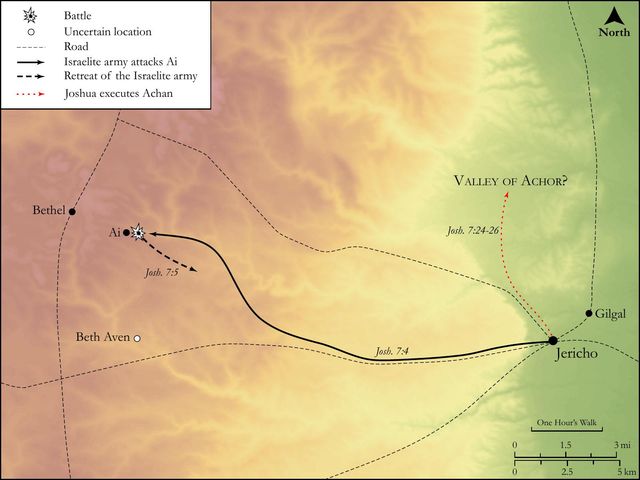
The concept of cherem (devoted things), a form of holy war, is central to understanding this event. God commanded that all spoils from Jericho, with specific exceptions, were to be utterly destroyed or consecrated to the Lord, not taken for personal gain, as detailed in Joshua 6:17-19. To violate cherem was not merely theft, but a profound act of sacrilege against God Himself, an act of rebellion that defiled the entire community and incurred divine wrath. Ancient Israel operated under a principle of corporate solidarity, where the sin of an individual could affect the entire nation, especially when it involved a breach of covenant with God. Public execution by stoning and burning was a severe form of judgment reserved for egregious offenses, often those considered an affront to God's holiness or a direct threat to the community's purity and covenant standing, such as idolatry or severe rebellion. The execution took place in the "Valley of Achor," a name meaning "trouble," which served as a lasting memorial to this event and its profound implications.
Key Themes
ShowHideThe episode of Achan's sin and punishment highlights several profound theological and narrative themes. Foremost is the consequences of disobedience, illustrating that even a single individual's hidden sin can have devastating national repercussions, leading to divine wrath, military defeat, and the loss of 36 Israelite lives at Ai. This directly underscores God's absolute holiness and justice, demonstrating that He will not tolerate sin within His covenant people and that His commands are to be obeyed without compromise. Furthermore, the narrative emphasizes the corporate solidarity and responsibility of the Israelite community; Achan's sin was "trouble" for all Israel, necessitating a communal act of purification to restore favor. The event also speaks to the purity of the camp as a prerequisite for God's presence and blessing, a theme echoed throughout the Pentateuch regarding Israel's encampment, worship, and successful conquest of the land, as seen in passages like Deuteronomy 23:14.
Exposition and Analysis
ShowHideKey Word Analysis
ShowHideThis verb, used twice in the verse, is central to the narrative's profound wordplay. Joshua's question, "Why hast thou troubled us?" and his declaration, "the LORD shall trouble thee this day," directly link Achan's action to his fate. The Hebrew root עָכַר ('âkar) means to stir up, disturb, bring trouble, or pollute. Achan's name itself (עָכָן, 'âkân) is a derivative of this root, meaning "troubler." This linguistic connection emphasizes that Achan, by his sin, became the source of trouble for Israel, and now, by divine decree, trouble (judgment) is brought upon him. The place of his execution, the Valley of Achor (עֵמֶק עָכוֹר, 'êmeq 'âkôr), literally "Valley of Trouble," serves as a permanent memorial to this event, solidifying the wordplay.
The verb רָגַם (râgam) signifies to stone, to pelt with stones. This was a common method of capital punishment in ancient Israel, often prescribed for offenses against God or the community's purity (e.g., blasphemy, idolatry, severe rebellion). The communal nature of stoning, with "all Israel" participating, underscores the corporate responsibility for purging sin from the community and affirming the justice of the verdict. It was a public act of purification and separation, ensuring the community bore witness to and participated in the removal of defilement.
The verb שָׂרַף (sâraph) means to burn or consume with fire. In this context, burning followed stoning, indicating an intensified form of judgment and complete annihilation of the offender and his possessions. For certain grievous sins, particularly those involving sacrilege or defilement of the land, burning was added to stoning to signify utter destruction and removal of the defilement. It served as a powerful visual symbol of God's consuming wrath against sin and the complete eradication of its presence, ensuring no trace remained to pollute the land or people.
Verse Breakdown
ShowHide"And Joshua said, Why hast thou troubled us?"
Joshua confronts Achan directly, echoing the collective distress, defeat, and divine disfavor Israel experienced due to Achan's hidden sin. This rhetorical question highlights the profound and far-reaching impact of individual disobedience on the entire community, emphasizing the corporate solidarity of ancient Israel. Achan's actions had literally "stirred up" or "polluted" the camp, leading to God's withdrawal of favor and the subsequent defeat at Ai.
"the LORD shall trouble thee this day."
This declaration is a solemn pronouncement of divine retribution. Joshua, acting as God's representative and mouthpiece, states that the very "trouble" Achan inflicted upon Israel will now be meted out to him by the Lord Himself. It signifies the immediate, certain, and divinely ordained nature of God's justice, demonstrating that sin, particularly a breach of covenant, will not go unpunished and demands a just recompense.
"And all Israel stoned him with stones, and burned them with fire, after they had stoned them with stones."
This clause describes the communal execution of Achan and his family/possessions. The participation of "all Israel" emphasizes the corporate responsibility for purging sin from the community and restoring God's favor, signifying their collective agreement with and participation in the divine judgment. The repetition of "stoned him with stones" followed by "burned them with fire" (referring to Achan, his family, and his possessions, as indicated in Joshua 7:24) signifies the extreme severity and totality of the judgment. Stoning was a public execution, while burning symbolized the complete eradication of the defilement and the utter destruction of the sinner and all associated with his sin, ensuring no trace remained to pollute the land or people.
Literary Devices
ShowHideThe passage makes effective use of several literary devices to amplify its profound theological and moral message. The most prominent is wordplay, specifically a pun on Achan's name. The Hebrew root עָכַר ('âkar), meaning "to trouble" or "to disturb," is directly linked to Achan's name (עָכָן, 'âkân), which means "troubler." This onomastic significance is further reinforced by the naming of the execution site as the Valley of Achor (עֵמֶק עָכוֹר, 'êmeq 'âkôr), meaning "Valley of Trouble." This linguistic thread powerfully underscores the cause-and-effect relationship between Achan's sin and the trouble it brought upon Israel, and the subsequent trouble (judgment) brought upon Achan. Additionally, the repetition of "stoned him with stones" emphasizes the communal nature and finality of the judgment, reinforcing the severity of the act. The act of stoning, followed by burning, also functions as symbolism, with stones representing communal justice and the weight of the law, and fire symbolizing divine wrath, purification, and utter destruction of defilement.
Theological and Thematic Connections
ShowHideJoshua 7:25 profoundly illustrates the gravity of sin within a covenant community and God's uncompromising holiness. Achan's transgression, though seemingly individual, was an act of rebellion against God's explicit command regarding the cherem, thereby polluting the entire camp and breaking faith with the Lord. This event underscores the principle that sin, even when hidden, has far-reaching consequences, affecting not only the individual but also those connected to them, and indeed the entire community's relationship with God. God's swift and severe judgment was not arbitrary but a necessary act to restore the purity and integrity of His people, without which they could not experience His presence or blessing. It serves as a stark reminder that God takes His covenant seriously and demands complete obedience and faithfulness from His people, demonstrating that His justice is as fundamental to His character as His mercy.
Reflection and Application
ShowHideThe story of Achan and his judgment in Joshua 7:25 offers enduring lessons for believers today. While we live under the new covenant of grace, the principles of individual accountability, the pervasive nature of sin, and the importance of communal purity remain profoundly relevant. This passage challenges us to examine our own lives for "hidden sins" – areas of disobedience, covetousness, or compromise that might hinder our walk with God and potentially impact those around us. Just as Achan's sin brought "trouble" to Israel, our unconfessed or unrepented sins can create spiritual impediments, affecting our relationship with God and our effectiveness within the body of Christ. It calls us to radical honesty before God, understanding that true blessing and spiritual progress come through wholehearted obedience and a commitment to personal and corporate holiness. We are reminded that God is holy and just, and while His grace abounds, He also calls us to live lives worthy of His calling, free from the defilement of sin, recognizing that our actions have ripple effects.
Questions for Reflection
ShowHideFAQ
ShowHideWhy was Achan's punishment so severe, including his family and possessions?
ShowHideAchan's punishment was severe because his sin was not merely theft, but a grave act of sacrilege against God's explicit command regarding the cherem (devoted things) from Jericho. This violation defiled the entire Israelite camp and broke faith with the Lord, directly leading to Israel's defeat at Ai and the death of 36 men (Joshua 7:1-5). The severity underscored God's absolute holiness and the gravity of covenant disobedience. In ancient Israel, the principle of corporate solidarity meant that the sin of an individual could bring corporate judgment upon the community. Achan's family was likely included because they were complicit in hiding the forbidden items, as implied by Achan's confession in Joshua 7:20-21 where he states he "hid them in the earth in the midst of my tent." Their shared fate served as a powerful deterrent and a complete purging of the defilement from the community. The burning of his possessions ensured that nothing tainted by his sin remained to pollute the land or people, signifying a complete eradication of the defilement.
What is the significance of the "Valley of Achor" mentioned in connection with this event?
ShowHideThe "Valley of Achor" (meaning "Valley of Trouble") is the place where Achan and all his possessions were executed and destroyed, as mentioned in Joshua 7:26. The naming of the valley directly links to the Hebrew wordplay on Achan's name and Joshua's pronouncement in Joshua 7:25. Achan, the "troubler," brought trouble upon Israel, and in that same valley, trouble (divine judgment) was brought upon him. The valley's name served as a lasting memorial and a perpetual warning to Israel about the severe consequences of disobedience and the importance of covenant faithfulness. Interestingly, later prophetic passages, like Hosea 2:15, transform the Valley of Achor from a place of judgment and trouble into a "door of hope," symbolizing God's redemptive power to turn judgment into blessing for a repentant people, pointing to a future restoration.
Christ-Centered Fulfillment
ShowHideThe narrative of Achan in Joshua 7:25, with its emphasis on sin bringing trouble, curse, and death, finds profound Christ-centered fulfillment in the New Testament. Achan's covetousness brought a curse upon Israel, leading to defeat and the need for a radical purging of sin. In stark contrast, Jesus Christ, the ultimate obedient Son, willingly took upon Himself the "trouble" and curse of our sin. While Achan's sin required stoning and burning to purify the camp, Christ willingly became the one "troubled" and "cursed" on the cross, enduring the full wrath of God for humanity's transgressions, as Galatians 3:13 powerfully declares, "Christ has redeemed us from the curse of the law, having become a curse for us." He is the true Lamb of God, who takes away the sin of the world, not by us stoning a sinner, but by His own perfect, substitutionary sacrifice, as proclaimed in John 1:29. Through His death and resurrection, Christ purifies His new covenant community, not by fire and stone, but by His precious blood, making us holy and blameless before God (Ephesians 1:4). The "trouble" that sin causes is ultimately dealt with in Him, transforming the valley of our trouble into a door of hope and reconciliation with God, offering forgiveness and new life to all who believe.