


Hosea 10:2
- חָלַקcha·Lakit is slipperyH2505V-Qal-Perf-3msVerb Qal Perfect 3rd Singular Masculine
- לִבָּםli·Bamtheir heartH3820N-msc ¦ 3mpNoun Singular Masculine Constructלִבָּheartםtheir
- עַתָּה'a·TahnowH6258AdvAdverb
- יֶאְשָׁמוּye'·Sha·muthey will be held guiltyH816V-Qal-Imperf-3mpVerb Qal Imperfect 3rd Plural Masculine
- הוּאhu'heH1931Pro-3msPronoun Personal 3rd Singular Masculine
- יַעֲרֹףya·'a·Rofhe will breakH6202V-Qal-Imperf-3msVerb Qal Imperfect 3rd Singular Masculine
- מִזְבְּחוֹתָםmiz·be·cho·Tamtheir altarsH4196N-fpc ¦ 3mpNoun Plural Feminine Constructמִזְבְּחוֹתָaltarsםtheir
- יְשֹׁדֵדye·sho·Dedhe will destroyH7703V-Piel-Imperf-3msVerb Piel Imperfect 3rd Singular Masculine
- מַצֵּבוֹתָםma·tze·vo·Tamtheir sacred pillarsH4676N-fpc ¦ 3mpNoun Plural Feminine Constructמַצֵּבוֹתָsacred pillarsםtheir
English is a literal word-by-word gloss of the Hebrew, not the KJV's wording. Why?
This is the original text the KJV's translators worked from — each Hebrew word with its own literal English meaning in this verse, prepared by scholars at Tyndale House, Cambridge. The KJV translates whole sentences, not word by word, so its wording differs: one Hebrew word can become several English words, and the KJV may choose “the LORD” where the gloss reads “Yahweh”. Both are faithful — they answer different questions. For the KJV's own rendering, switch to the KJV text.
Details
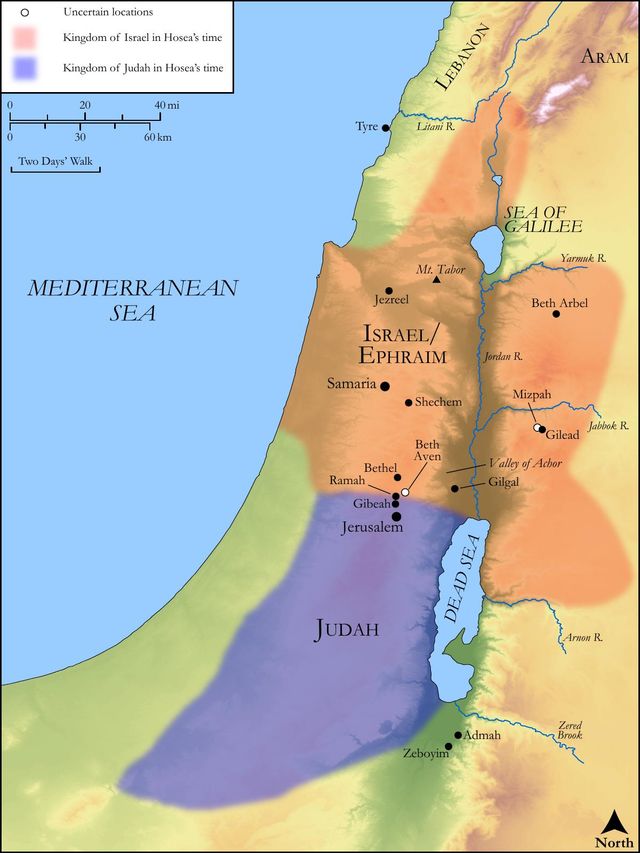
See on the biblical-era map
Study this verse
Public-domain commentary
Matthew Henry
From his Commentary on the Whole Bible. Henry comments on passages, not single verses — this entry covers Hosea 10:1–8. His four-level outline is real structure in the source text, so it is rendered as structure.
Observe, I. What the sins are which are here laid to Israel's charge, the national sins which bring down national judgment. The prophet deals plainly with them; for what good would it do them to be flattered?
1.They were not fruitful in the fruits of righteousness to the glory of God. Here all their other wickedness began (Hos 10:1): Israel is an empty vine. The church of God is fitly compared to a vine, weak, and of an unpromising outside, yet spreading and fruitful; believers are branches of that vine, and partake of its root and fatness. But this was the character of Israel, they were as an empty vine, a vine that had no sap or virtue in it, and therefore none of those good fruits produced by it that were expected from it, with which God and man should be honoured. Note, There are many who, though they have not become degenerate vines, are yet empty vines, have no good in them. A vine is of all trees least serviceable if it do not bear fruit. It is thenceforth good for nothing, Eze 15:3, Eze 15:5. And those that bring forth no grapes will soon come to bring forth wild grapes; those that do no good will do hurt. He is an empty vine, for he brings forth fruit to himself. What good there is in him is not directed to the glory of God, but he takes the praise of it to himself, and prides himself in it. Christians live not to themselves (Rom 14:6), but hypocrites make self their centre; they eat and drink to themselves, Zac 7:5, Zac 7:6. Or Israel is by the judgments of God emptied and spoiled of all his wealth, because he made use of it in the service of his lusts, and not to the honour of God who gave it to him. Note, What we do not rightly employ we may justly expect to be emptied of.
2.They multiplied their altars and images, and the more bountiful God's providence was to them the more prodigal they were in serving their idols: According to the multitude of his fruit which his land brought forth he has increased the altars, and according to the goodness of his land they have made goodly images. Note, It is a great affront to God, and an abuse of his goodness, when the more mercies we receive from him the more sins we commit against him, and when the more wealth men have the more mischief they do. Should not we be thus abundant in the service of our God, as they were in the service of their idols? As we find our estates increasing, we should proportionably abound the more in works of piety and charity.
3.Their hearts were divided, Hos 10:2.
(1.)They were divided among themselves. They were at variance about their idols, some for one, some for another, at variance about their kings, whose separate interests made parties in the kingdom, and in them their very hearts were divided, and alienated one from another, and there was no such thing as cordial friendship to be found among them; it follows therefore, Now shall they be found faulty. Note, The divisions and animosities of a people are the causes of much sin and the presages of ruin.
(2.)They were divided between God and their idols. They had a remaining affection in their hearts for God, but a reigning affection for their idols. They halted between God and Baal, that was the dividing of their heart. But God is the sovereign of the heart and he will by no means endure a rival; he will either have all or none. Satan, like the pretended mother, says, Let it be neither mine nor thine, but divide it; but, if this be yielded to, God says, Nay, let him take it all. A heart thus divided will be found faulty, and be rejected as treacherous in covenanting with God. Note, A heart divided between God and mammon, though it may trim the matter so as to appear plausible, will, in the day of discovery, be found faulty.
4.They made no conscience of what they said and what they did in the most solemn manner, Hos 10:4.
(1.)Not of what they said in swearing, which is the most solemn speaking: They have spoken words, and words only, for they meant not as they said; they did verba dare - give words. They swore falsely in making a covenant; they were deceitful in their covenanting with God, the covenant of circumcision, the fair promises they made of reformation when they were in distress; and no marvel if those that were false to their God were false to all mankind. They contracted such a habit of treachery that they broke through the most sacred bonds, and made nothing of them; subjects violated their oaths of allegiance and their kings their coronation-oaths; they broke their leagues with the nations they were in alliance with, nor was any conscience made of contracts between private persons.
(2.)Nor of what they did in judgment, which is the most solemn acting. Justice could not take place when men made nothing of forswearing themselves; for thus judgment, which should have been a healing medicinal plant and of a sweet smell, sprang up as hemlock, which is both nauseous and noxious, in the furrows of the field, in the field that was ploughed and furrowed for good corn. Note, God is greatly offended with corruptions, not only in his own worship, but in the administration of justice between man and man, and the dishonesty of a people shall be the ground of his controversy with them as well as their idolatry and impiety; for God's laws are intended for man's benefit and the good of the community, as well as for God's honour, and the profanation of courts of justice shall be avenged as surely as the profanation of temples.
II.What the judgments are with which Israel should be punished for these sins; they sinned both in civil and religious matters, and in both they shall be punished.
1.They shall have no joy of their kings and of their government. Because justice is turned into oppression, therefore those who are entrusted with the administration of it, and should be blessings to the state, shall be complained of as the burdens of it (Hos 10:3), and those that would not rule their people well shall not be able to protect them: Now they shall say, "We have no king, that is, we are as if we had none, we have none to do us any good nor stand us in any stead, none to keep us from destroying ourselves or being destroyed by our enemies, none to preserve the public peace nor to fight our battles; and justly has this come to us. Because we feared not the Lord, when we were safe under the protection of our kings, therefore we are rejected by him, and then what shall a king do for us? What good can we expect from a king when we have forfeited the favour of our God?" Note, Those that cast off the fear of God are not likely to have joy of any of their creature-comforts; nor will men's loyalty to their prince befriend them without religion, for, though that may engage him to be for them, what good will that do them if God be against them? Those that keep themselves in the fear and favour of God may say, with triumph, "What can the greatest of men do against us?" But those that throw themselves out of his protection must say, with despair, "What can the greatest of men do for us?" He was a king that said, If the Lord do not help thee, whence should I help thee? Yet he is a fool that says, If a king cannot help us, we must perish (as these intimate here), for God can do that for us which kings cannot. Time was when they doted upon having a king; but now what can a king (who, they thought, could do any thing) do for them? God can make people sick of those creature-confidences which they were most fond of. This is their complaint when their king is disabled to help them, yet this is not the worst; their civil government shall not only be weakened, but quite destroyed (Hos 10:7): As for Samaria, the royal city, which is now almost all that is left, her king is cut off as the foam from the water. The foam swims uppermost, and makes a great show upon the face of the water, yet it is but a heap of bubbles raised by the troubling of the water. Such were the kings of Israel, after their revolt from the house of David, a mere scum; their government had no foundation. No better are the greatest of kings when they set up in opposition to God; when God comes to contend with them by his judgments he can as easily disperse and dissolve them, and bring them to nothing, as the froth upon the water.
2.They shall have no joy of their idols and of their worship of them. And miserable is the case of that people whose gods fail them when their kings do.
(1.)The idols they had made, and the altars they had set up in honour of them, should be broken down, and spoiled, and carried away, as common plunder, by the victorious enemy: He shall break down their altars. God shall do it by the hand of the Assyrians: the Assyrians shall do it by order from God. He shall spoil their images, Hos 10:2. Note, What men make idols of it is just with God to break down and spoil. But the calf at Bethel was the sovereign idol; it was this that the inhabitants of Samaria doted most upon; now it is here foretold that this should be destroyed: The glory of it has departed from it (Hos 10:5) when it is thrown down and defaced, no more to be worshipped; but this is not all: It shall also be carried to Assyria (as some think that the calf at Dan was some time before) for a present to king Jareb. It was carried to him as a rich booty (for it was a golden calf, and probably adorned with the gifts and offerings of its worshippers) and as a trophy of victory over their enemies: and what more glorious trophy could they bring than this, or more incontestable proof of an absolute conquest? Thus it is said, The sin of Israel shall be destroyed (Hos 10:8), that is, the idols which they made the matter of their sin; it is said of them, They became a sin to all Israel, Kg1 12:30. Note, If the grace of God prevail not to destroy the love of sin in us, it is just that the providence of God should destroy the food and fuel of sin about us. With the idols, the high places shall be destroyed, the high places of Aven, that is, of Bethaven (Hos 10:5) or Bethel; it was called the house of God (so Bethel signifies), but now it is called the house of iniquity, nay, iniquity itself. The kings did not, as they ought to have done, take away the high places by the sword of justice, and therefore God will take them away by the sword of war; so that the thorn and the thistle shall come up on their altars, that is, they shall lie in ruins. Their altars, while they stood, were as thorns and thistles, offensive to God and good men, and fruits of sin and the curse; justly therefore are they buried in thorns and thistles.
(2.)The destruction of their idols, their altars, and their high places, shall be the occasion of sorrow, and shame, and terror to them.
[1.]It shall be an occasion of sorrow to them. When the calf at Bethel is broken the people thereof shall mourn over it. They looked upon the calf to be the protector of their nation, and, when that was gone, thought they must all be undone, which made the poor ignorant people that were deluded into the love of it lament bitterly, as Micah did (Jdg 18:24), You have taken away my gods, and what have I more? The priests that had rejoiced in it shall now mourn for it with the people. Note, Whatever men make a god of they will mourn for the loss of; and an inordinate sorrow for the loss of any worldly good is a sign we made an idol of it. They used to be very merry in the worship of their idols, but now they shall mourn over them; for sinful mirth shall, sooner or later, be turned into mourning.
[2.]It shall be an occasion of shame to them (Hos 10:6): Ephraim shall receive shame when he sees the gods he trusted to carried into captivity, and Israel shall be ashamed of his own counsel, in putting such confidence in them and paying such adoration to them. God's ark and altars were never thrown down till the people rejected them; but the idolatrous altars were thrown down when the people were doting on them, which shows that the contempt of the former, and the veneration for the latter, were the sins for which God visited them.
[3.]It shall be an occasion of fear to them (Hos 10:5): The inhabitants of Samaria shall fear; they shall be in pain for their gods and afraid of losing them; or, rather, they shall be in pain for themselves and their children and families, when they see the judgments of God breaking in upon them and beginning with their idols, as he executed judgment against the gods of Egypt, Exo 12:12. Thus idolaters are brought in trembling when God arises to shake terribly the earth, Isa 2:21. And here (Hos 10:8), They shall say to the mountains, Cover us; and to the hills, Fall on us. The supporters of idolatry (Rev 6:15, Rev 6:16) are brought in calling thus in vain to rocks and mountains to shelter them from God's wrath.
Historical interpretation
Historical reception
1 surviving comment on this verse from the historical church.
Their heart is divided; now they shall perish: he shall break down their idols, he shall lay waste their altars." LXX: "They have divided their hearts: now shall they perish: he shall break down their altars, he shall distress their statues." The Hebrews hand down a similar story, confirming their suspicion with the authority of Scripture: captivity did not come until both kings and peoples alike adored golden calves and were united in impiety. The last king of the ten tribes was Hoshea, about whom it is written (4 Kings 17) that indeed he did evil in the sight of the Lord, but not as the kings of Israel who were before him, in whose ninth year Salmanazar, king of the Assyrians, captured the people of Israel, and led them into the Assyrians, and made them dwell near the river Gozan in the cities of the Medes. Therefore, it is asked why they were not captured under the worst kings, but under him who had begun to turn in some way to better things? To which they add these things: at first the people excused themselves, saying, "We obey the commands of the kings, nor can we resist their tyranny; we worship calves which we are compelled to adore." But in the days of Hosea the same king commanded that the calves should not be worshiped with such zeal, but that whoever wished should go to Jerusalem and offer sacrifice there to God; to this, they say, the people objected. And this is what he says now: "their heart is divided," that is, the heart of the king and the people, and with no excuse remaining, now they will perish and be delivered to eternal captivity; for as soon as the people dissented from the king, destruction came. And what follows: "He himself will break their images," speaks about God: "And he shall destroy their altars," not because God himself did this with his own hand, but because his will was fulfilled through his enemies. The hearts of heretics are divided among themselves and they resist each other's opinions, which they do not deny, while they feel different. Hence they will be dispersed, and the Lord will break or dig out their images, or altars, which they invented in their own hearts, and will destroy the titles by which each is called by their own names, and they called their names over their lands, so they may not be said to belong to Christ's Church, but to those of this or that.
Continue studying Hosea 10:2 across the web’s major study libraries — every link below opens this exact verse, chapter, or book on the destination site.
Read & Compare
 BibleGatewayThis verse in more than 200 translations and 70 languages.
 Bible.comThe YouVersion reader — hundreds of translations, reading plans, and highlights.
 ESV.orgCrossway's official English Standard Version reader.
 NET BibleThe NET translation with 60,000+ translators' notes on every rendering decision.
 STEP BibleTyndale House's free study tool — original text, vocabulary, and scholarly resources.
 BibliaLogos Bible Software's free web reader.
 USCCBThe New American Bible (Revised Edition) with the U.S. bishops' study notes.
Commentaries
 BibleHub CommentariesDozens of classic commentaries on this verse, gathered on one page.
 StudyLightMore than 100 commentary sets — the largest collection on the web.
 BibleRefPlain-English commentary on what this verse means, verse by verse.
 Enduring WordDavid Guzik's free commentary on this chapter, widely used by Bible teachers.
 Bible Study ToolsVerse commentary alongside Greek and Hebrew study aids.
Original Language & Research
- BibleHub InterlinearThe verse word by word — original language, transliteration, and English.
- BibleHub LexiconEvery word's original-language definition and Strong's entry.
 Blue Letter BibleDeep-study tools — Strong's numbers, concordance, and word studies.
 SefariaThe Hebrew text with Rashi and centuries of Jewish commentary.
Sermons, Hymns & Audio


TrulyRandomVerse is not affiliated with these sites and doesn’t control their content. They’re linked because they’re genuinely useful.
Summary
Hosea 10:2 delivers a stark prophetic indictment against the Northern Kingdom of Israel, exposing their spiritual duplicity and the inevitable judgment that follows. The verse reveals that Israel's heart is not wholly devoted to Yahweh but is divided between Him and idolatrous practices, leading to their guilt. Consequently, God promises to dismantle the very altars and images through which they sought false security, signifying the complete destruction of their idolatrous system and its associated false hopes.
Context
ShowHideLiterary Context
This verse is situated within a broader section of Hosea (chapters 7-14) that details Israel's persistent unfaithfulness, particularly their reliance on foreign alliances and idolatry, and the impending divine judgment. Immediately preceding this verse, Hosea 10:1 describes Israel as "an empty vine" producing fruit only for itself, highlighting their self-serving prosperity that paradoxically fueled their idolatry. The proliferation of altars and images, mentioned in Hosea 10:1, directly sets the stage for God's promised destruction of these very symbols in Hosea 10:2. The subsequent verses continue to elaborate on the consequences of their sin, including the desolation of their land and the collapse of their political structures, underscoring the comprehensive nature of God's judgment.
Historical & Cultural Context
Hosea prophesied during the tumultuous final decades of the Northern Kingdom of Israel (8th century BCE), a period marked by political instability, assassinations of kings, and a desperate oscillation between alliances with Assyria and Egypt. Economically, Israel had experienced periods of prosperity, but this wealth often led to moral decay and a syncretistic blend of Yahweh worship with Canaanite Baal worship. The "altars" and "images" (often standing stones or pillars, matstsêbâh) mentioned in the verse were central to Canaanite fertility cults, where Israelites sought material blessings and security from deities like Baal, believing they controlled crops and livestock. This practice was a direct violation of the Mosaic covenant, which demanded exclusive worship of Yahweh, as articulated in the first two commandments.
Key Themes
ShowHideHosea is fundamentally a book about God's covenant love (hesed) for Israel despite their spiritual adultery. A central theme is Israel's Unfaithfulness and Spiritual Harlotry, vividly portrayed by Hosea's own marriage to Gomer. Their "divided heart" in Hosea 10:2 perfectly encapsulates this theme, demonstrating their inability or unwillingness to offer wholehearted devotion to God. This leads directly to the theme of Divine Judgment, where God, as a righteous judge, must punish their idolatry and covenant breaking. However, woven throughout the book is also the theme of God's Enduring Love and Future Restoration, suggesting that even in judgment, God's ultimate purpose is to bring His people back to Himself, as seen in passages like Hosea 11:8-9.
Exposition and Analysis
ShowHideKey Word Analysis
ShowHideThis word, lêb, refers not merely to the physical organ but, more profoundly, to the inner being of a person—their intellect, will, emotions, and moral character. In this context, it signifies the core of Israel's spiritual and moral identity, indicating that their fundamental disposition and allegiance are compromised. A "divided heart" thus points to a deep-seated spiritual ailment, a lack of singular devotion.
The root châlaq means "to be smooth," "to apportion," or "to separate." Here, it implies a splitting or portioning out of loyalty, rather than a unified, wholehearted commitment. It can also carry a nuance of flattery or duplicity, suggesting that Israel's worship of Yahweh was superficial, perhaps an attempt to appease God while simultaneously pursuing other gods for perceived benefits. Their heart was not singularly devoted but was "apportioned" between competing allegiances.
This verb, ʼâsham, means "to be guilty," "to be punished," or "to perish." It denotes a state of culpability before God, indicating that Israel's divided heart is not merely a spiritual misalignment but a direct transgression that incurs divine judgment. The consequence of their spiritual duplicity is a legal declaration of guilt, leading inevitably to punishment and desolation.
Verse Breakdown
ShowHide"Their heart is divided"
This clause reveals the core spiritual problem of Israel. Their inner being, the seat of their affections, will, and intellect, is not singularly devoted to Yahweh. Instead, it is split, attempting to serve both God and the pagan deities (Baals) of the surrounding cultures, a direct violation of the covenant's demand for exclusive worship. This spiritual duplicity is the root cause of their unfaithfulness.
"now shall they be found faulty"
The division of their heart leads directly to their culpability. Because their devotion is not wholehearted, they stand condemned before God. This signifies a divine pronouncement of guilt, indicating that their actions and internal state are in direct opposition to God's righteous standards and covenant expectations, making them liable for judgment.
"he shall break down their altars"
This marks the beginning of God's active judgment against Israel's idolatry. The altars, which were central to their pagan worship and symbols of their false security, will be violently dismantled and destroyed by God Himself. This action underscores God's absolute intolerance for idolatry and His commitment to purifying His people and land from such abominations.
"he shall spoil their images"
Following the destruction of the altars, God promises to "spoil" or devastate their images. These images (often sacred pillars or Asherah poles) represented the pagan deities and were objects of their misplaced trust. The spoiling implies a complete and utter destruction, rendering them useless and demonstrating the impotence of the false gods they represented. This act signifies the complete dismantling of Israel's idolatrous system and its accompanying false hopes.
Literary Devices
ShowHideHosea 10:2 employs several potent literary devices to convey its message of judgment. The phrase "Their heart is divided" is a powerful Metaphor for spiritual duplicity and lack of wholehearted devotion, contrasting with the singular loyalty God demands. The Personification of the "heart" as something capable of being "divided" emphasizes the internal, volitional nature of Israel's sin. The subsequent actions of God—"he shall break down their altars, he shall spoil their images"—utilize Divine Judgment as a central theme, expressed through vivid, active verbs that convey the forceful and destructive nature of God's response. The imagery of altars and images being "broken down" and "spoiled" serves as Symbolism, representing the complete collapse of Israel's false religious system and the futility of their trust in anything other than Yahweh.
Theological and Thematic Connections
ShowHideHosea 10:2 profoundly illustrates the biblical principle that God demands exclusive, wholehearted devotion from His people. A "divided heart" is an affront to His holiness and covenant faithfulness, leading inevitably to guilt and judgment. This principle is foundational to the Old Testament, where idolatry is consistently portrayed as spiritual adultery, breaking the covenant relationship. The destruction of altars and images is not merely punitive but also a redemptive act, aiming to remove the obstacles to true worship and restore Israel to a singular relationship with their God. This verse reminds us that true worship is not merely external ritual but an internal posture of complete surrender and loyalty.
Reflection and Application
ShowHideHosea 10:2 serves as a timeless mirror for believers today, challenging us to honestly examine the state of our own hearts. Is our devotion to God truly undivided, or are there competing loyalties that subtly draw our affections and priorities away from Him? Modern "altars" and "images" may not be physical idols, but they can manifest as an excessive pursuit of wealth, status, comfort, or even self-righteousness, all of which can subtly usurp God's rightful place in our lives. The call to an undivided heart is a call to radical discipleship, where every aspect of our being—our thoughts, desires, resources, and time—is submitted to Christ. When our hearts are divided, we become "faulty" in God's sight, hindering our spiritual growth and effectiveness. This verse urges us to identify and dismantle any "altars" of compromise or "images" of false security in our lives, trusting solely in God for our provision, identity, and ultimate hope.
Questions for Reflection
ShowHideFAQ
ShowHideWhat does "their heart is divided" mean in a spiritual sense?
ShowHideIn a spiritual sense, "their heart is divided" means that Israel's loyalty and devotion were split between Yahweh, the one true God, and the pagan deities (like Baal and Asherah) worshipped by the surrounding nations. It signifies a lack of singular, exclusive commitment to God, which is a core requirement of the Mosaic Covenant as highlighted in passages like Deuteronomy 6:5. Instead of wholehearted worship, they practiced syncretism, attempting to serve two masters, which the Bible consistently condemns as spiritual adultery and unfaithfulness.
Why did God promise to "break down their altars" and "spoil their images"?
ShowHideGod promised to "break down their altars" and "spoil their images" as an act of divine judgment against Israel's pervasive idolatry and spiritual unfaithfulness. These altars and images were not merely religious symbols; they represented Israel's rebellion against the covenant and their misplaced trust in false gods for prosperity and security. By destroying them, God was demonstrating His absolute sovereignty, the impotence of the idols, and His intolerance for anything that competed with His exclusive claim on His people's worship. This act was both punitive and purifying, aiming to remove the sources of their spiritual corruption and restore the possibility of true worship, as seen in similar actions throughout Israel's history, such as the destruction of the golden calf in Exodus 32:20.
Christ-Centered Fulfillment
ShowHideHosea 10:2, with its indictment of Israel's divided heart and the subsequent judgment on their idolatry, finds its ultimate fulfillment and resolution in Jesus Christ. The Old Covenant demanded an undivided heart, yet Israel consistently failed, demonstrating humanity's inherent inability to perfectly love God with all their heart, soul, and might (Deuteronomy 6:5). Jesus, however, perfectly embodied this undivided heart, living a life of complete obedience and singular devotion to the Father (John 8:29). Furthermore, Christ's atoning sacrifice on the cross broke down the "altars" of sin and the "images" of self-reliance and false worship that divide our hearts. Through His death, He took away the guilt (being "found faulty") that results from our spiritual adultery (2 Corinthians 5:21). The New Covenant, inaugurated by Christ's blood, promises a new heart—a heart of flesh instead of stone—that is enabled by the Holy Spirit to truly love and obey God (Ezekiel 36:26-27). Thus, what Israel could not achieve through the Law, believers now receive by grace through faith in Christ: the power to serve God with an undivided heart, worshipping Him in spirit and truth (John 4:23-24).