


Revelation 13:14
“The Beast from the Earth (The False Prophet)”Revelation 13:11–18
Bible text: King James Version (1769 Blayney text) · Public domain
Bible text: King James Version with Strong's numbers · Public domain
Bible text: Berean Standard Bible · Public domain
Bible text: American Standard Version (1901) · Public domain
Bible text: World English Bible, Messianic edition · Public domain
Bible text: Geneva Bible (1599) · Public domain
Bible text: Young's Literal Translation · Public domain
- καὶkaiAndG2532CONJConjunction
- πλανᾷplanait deceivesG4105V-PAI-3SVerb Present Active Indicative 3rd Singular
- τοὺςtousthoseG3588T-APMDefinite article Accusative Plural Masculine
- τοὺςtouswhoG3588T-APMDefinite article Accusative Plural Masculine
- κατοικοῦνταςkatoikountasdwellingG2730V-PAP-APMVerb Present Active Participle Accusative Plural Masculine
- ἐπὶepionG1909PREPPreposition
- τῆςtēstheG3588T-GSFDefinite article Genitive Singular Feminine
- γῆςgēsearthG1093N-GSFNoun Genitive Singular Feminine
- διὰdiathroughG1223PREPPreposition
- τὰtatheG3588T-APNDefinite article Accusative Plural Neuter
- σημεῖαsēmeiasignsG4592N-APNNoun Accusative Plural Neuter
- ἃhathatG3739R-NPNRelative pronoun Nominative Plural Neuter
- ἐδόθηedothēwere givenG1325V-API-3SVerb Aorist Passive Indicative 3rd Singular
- αὐτῷautōto itG846P-DSNPersonal pronoun Dative Singular Neuter
- ποιῆσαιpoiēsaito performG4160V-AANVerb Aorist Active Infinitive
- ἐνώπιονenōpionbeforeG1799PREPPreposition
- τοῦtoutheG3588T-GSNDefinite article Genitive Singular Neuter
- θηρίουthērioubeastG2342N-GSNNoun Genitive Singular Neuter
- λέγωνlegōntellingG3004V-PAP-NSMVerb Present Active Participle Nominative Singular Masculine
- τοῖςtoisto thoseG3588T-DPMDefinite article Dative Plural Masculine
- κατοικοῦσινkatoikousindwellingG2730V-PAP-DPMVerb Present Active Participle Dative Plural Masculine
- ἐπὶepionG1909PREPPreposition
- τῆςtēstheG3588T-GSFDefinite article Genitive Singular Feminine
- γῆςgēsearthG1093N-GSFNoun Genitive Singular Feminine
- ποιῆσαιpoiēsaito makeG4160V-AANVerb Aorist Active Infinitive
- εἰκόναeikonaan imageG1504N-ASFNoun Accusative Singular Feminine
- τῷtōto theG3588T-DSNDefinite article Dative Singular Neuter
- θηρίῳthēriōbeastG2342N-DSNNoun Dative Singular Neuter
- ὃςhosthatG3739R-NSMRelative pronoun Nominative Singular Masculine
- ἔχειecheihasG2192V-PAI-3SVerb Present Active Indicative 3rd Singular
- τὴνtēntheG3588T-ASFDefinite article Accusative Singular Feminine
- πληγὴνplēgēnwoundG4127N-ASFNoun Accusative Singular Feminine
- τῆςtēsof theG3588T-GSFDefinite article Genitive Singular Feminine
- μαχαίρηςmachairēsswordG3162N-GSFNoun Genitive Singular Feminine
- καὶkaiandG2532CONJConjunction
- ἔζησενezēsenhas livedG2198V-AAI-3SVerb Aorist Active Indicative 3rd Singular
English is a literal word-by-word gloss of the Greek, not the KJV's wording. Why?
This is the Greek text the KJV’s translators worked from, with each word given its own literal English meaning in this verse. The word-by-word meanings were prepared by scholars at Tyndale House, Cambridge. The KJV translates whole sentences rather than single words, so its wording often differs: one Greek word can become several English words, and the KJV may say “charity” where the word-by-word meaning reads “love”. The two are made for different purposes, and both are faithful to the Greek. To read the KJV’s own wording, switch to the KJV text.
Words in [ ] are added by the English.
Details
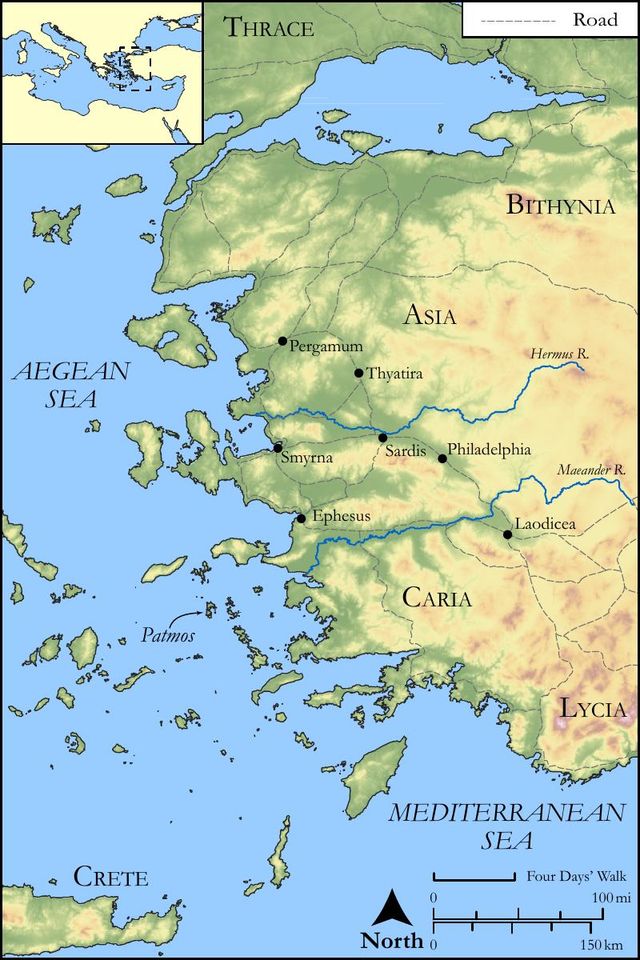
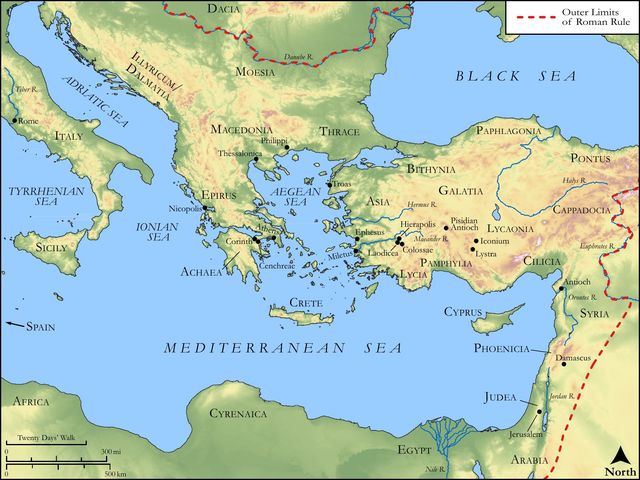
See on the biblical-era maps
Study this verse
Public-domain commentary
Matthew Henry
From his Commentary on the Whole Bible. Henry wrote on whole passages, and this entry covers Revelation 13:11–18.
Those who think the first beast signifies Rome pagan by this second beast would understand Rome papal, which promotes idolatry and tyranny, but in a more soft and lamb-like manner: those that understand the first beast of the secular power of the papacy take the second to intend its spiritual and ecclesiastical powers, which act under the disguise of religion and charity to the souls of men. Here observe,
I.The form and shape of this second beast:
He had two horns like a lamb, but a mouth that spoke like the dragon. All agree that this must be some great impostor, who, under a pretence of religion, shall deceive the souls of men. The papists would have it to be Apollonius Tyranaeus; but Dr. More has rejected that opinion, and fixes it upon the ecclesiastical powers of the papacy. The pope shows the horns of a lamb, pretends to be the vicar of Christ upon earth, and so to be vested with his power and authority; but his speech betrays him, for he gives forth those false doctrines and cruel decrees which show him to belong to the dragon, and not to the Lamb.
II.The power which he exercises:
All the power of the former beast (Revelation 13:12); he promotes the same interest, pursues the same design in substance, which is, to draw men off from worshipping the true God to worshipping those who by nature are no gods, and subject the souls and consciences of men to the will and authority of men, in opposition to the will of God. This design is promoted by the popery as well as by paganism, and by the crafty arts of popery as well as by the secular arm, both serving the interests of the devil, though in a different manner.
III.The methods by which this second beast carried on his interests and designs; they are of three sorts:
- 1. Lying wonders, pretended miracles, by which they should be deceived, and prevailed with to worship the former beast in this new image or shape that was now made for him; they would pretend to bring down fire from heaven, as Elias did, and God sometimes permits his enemies, as he did the magicians of Egypt, to do things that seem very wonderful, and by which unwary persons may be deluded. It is well known that the papal kingdom has been long supported by pretended miracles. 2. Excommunications, anathemas, severe censures, by which they pretend to cut men off from Christ, and cast them into the power of the devil, but do indeed deliver them over to the secular power, that they may be put to death; and thus, notwithstanding their vile hypocrisy, they are justly charged with killing those whom they cannot corrupt. 3. By disfranchisement, allowing none to enjoy natural, civil, or municipal rights, who will not worship that papal beast, that is, the image of the pagan beast. It is made a qualification for buying and selling the rights of nature, as well as for places of profit and trust, that they have the mark of the beast in their forehead and in their right hand, and that they have the name of the beast and the number of his name. It is probable that the mark, the name, and the number of the beast, may all signify the same thing - that they make an open profession of their subjection and obedience to the papacy, which is receiving the mark in their forehead, and that they oblige themselves to use all their interest, power, and endeavour, to promote the papal authority, which is receiving the mark in their right hands. We are told that pope Martin V. in his bull, added to the council of Constance, prohibits Roman catholics from suffering any heretics to dwell in their countries, or to make any bargains, use any trades, or bear any civil offices, which is a very clear interpretation of this prophecy.
IV.We have here the number of the beast, given in such a manner as shows the infinite wisdom of God, and will sufficiently exercise all the wisdom and accuracy of men: The number is the number of a man, computed after the usual manner among men, and it is 666. Whether this be the number of the errors and heresies that are contained in popery, or rather, as others, the number of the years from its rise to its fall, is not certain, much less what that period is which is described by these prophetic numbers. The most admired dissertation on this intricate subject is that of Dr. Potter, where the curious may find sufficient entertainment. It seems to me to be one of those seasons which God has reserved in his own power; only this we know, God has written Mene Tekel upon all his enemies; he has numbered their days, and they shall be finished, but his own kingdom shall endure for ever.
Historical interpretation
Five Centuries of Reception
8 surviving comments on this verse. Each one is dated, so this reads as a timeline rather than a list.
Select a marker to jump to its quote. Markers stagger vertically where authors wrote within a few decades of each other.
Let no one imagine that he performs these wonders by divine power, but by the working of magic. And we must not be surprised if, since the demons and apostate spirits are at his service, he through their means performs wonders, by which he leads the inhabitants of the earth astray. John says further: "And he shall order an image of the beast to be made, and he shall give breath to the image, so that the image shall speak; and he shall cause those to be slain who will not adore it." He says also: "And he will cause a mark to be put in the forehead and in the right hand, that no one may be able to buy or sell, unless he who has the mark of the name of the beast or the number of his name; and the number is six hundred and sixty-six," that is, six times a hundred, six times ten, and six units.
But as it is incumbent on us to discuss this matter of the beast more exactly, and in particular the question how the Holy Spirit has also mystically indicated his name by means of a number, we shall proceed to state more clearly what bears upon him. John then speaks thus: "And I beheld another beast coming up out of the earth; and he had two horns, like a lamb, and he spake as a dragon. And he exercised all the power of the first beast before him; and he made the earth and them which dwell therein to worship the first beast, whose deadly wound was healed. And he did great wonders, so that he maketh fire come down from heaven on the earth in the sight of men, and deceiveth them that dwell on the earth by means of those miracles which he had power to do in the sight of the beast, saying to them that dwell on the earth, that they should make an image to the beast which had the wound by a sword and did live. And he had power to give life unto the image of the beast, that the image of the beast should both speak, and cause that as many as would not worship the image of the beast should be killed. And he caused all, both small and great, rich and poor, free and bond, to receive a mark in their right hand or in their forehead; and that no man might buy or sell, save he that had the mark, the name of the beast, or the number of his name. Here is wisdom. Let him that hath understanding count the number of the beast; for if is the number of a man, and his number is six hundred threescore and six."
By the beast, then, coming up out of the earth, he means the kingdom of Antichrist; and by the two horns he means him and the false prophet after him. And in speaking of "the horns being like a lamb," he means that he will make himself like the Son of God, and set himself forward as king. And the terms, "he spake like a dragon," mean that he is a deceiver, and not truthful. And the words, "he exercised all the power of the first beast before him, and caused the earth and them which dwell therein to worship the first beast, whose deadly wound was healed," signify that, after the manner of the law of Augustus, by whom the empire of Rome was established, he too will rule and govern, sanctioning everything by it, and taking greater glory to himself. For this is the fourth beast, whose head was wounded and healed again, in its being broken up or even dishonoured, and partitioned into four crowns; and he then (Antichrist) shall with knavish skill heal it, as it were, and restore it. For this is what is meant by the prophet when he says, "He will give life unto the image, and the image of the beast will speak." For he will act with vigour again, and prove strong by reason of the laws established by him; and he will cause all those who will not worship the image of the beast to be put to death. Here the faith and the patience of the saints will appear, for he says: "And he will cause all, both small and great, rich and poor, free and bond, to receive a mark in their right hand or in their forehead; that no man might buy or sell, save he that had the mark, the name of the beast, or the number of his name." For, being full of guile, and exalting himself against the servants of God, with the wish to afflict them and persecute them out of the world, because they give not glory to him, he will order incense-pans to be set up by all everywhere, that no man among the saints may be able to buy or sell without first sacrificing; for this is what is meant by the mark received upon the right hand. And the word-"in their forehead"-indicates that all are crowned, and put on a crown of fire, and not of life, but of death. For in this wise, too, did Antiochus Epiphanes the king of Syria, the descendant of Alexander of Macedon, devise measures against the Jews. He, too, in the exaltation of his heart, issued a decree in those times, that "all should set up shrines before their doors, and sacrifice, and that they should march in procession to the honour of Dionysus, waving chaplets of ivy; "and that those who refused obedience should be put to death by strangulation and torture. But he also met his due recompense at the hand of the Lord, the righteous Judge and all-searching God; for he died eaten up of worms. And if one desires to inquire into that more accurately, he will find it recorded in the books of the Maccabees.
“That he give them a mark on the right hand or on the forehead.” He speaks of the mystery of deception. For the saints who are in the church receive Christ in the hand and on the forehead. The hypocrites, however, receive the beast under the name of Christ. “Those who do not worship the beast … will be slain.” It is not inconsistent with the faith that the beast be understood as the city of the impious itself, that is, as the congregation or conspiracy of all those who are impious or filled with hubris. This city is called “Babylon,” which is interpreted as “Confusion,” and to it belong all who desire to work that which is worthy of confusion. He himself is the citizenry of unfaithful persons who are the opposite of the faithful people, that is, the city of God. His image is an imitation, that is, among those people who confess the catholic faith but live the life of infidelity. For they feign to be what they are not, and they are called Christians, not by way of the true image but by way of a false image. Of such persons the apostle wrote, “holding the form of religion but denying the power of it.” Not a small number of these persons are within the catholic church. However, the righteous do not worship the beast, that is, they do not assent to him, nor do they submit to him, nor do they receive his mark, the mark of sin, on their forehead, on account of the confession, and on their hand, on account of works.
And deceives, it says, those who dwell upon the earth by the signs. For he makes signs indeed, but by charming the eyes of those who see, just as the magicians also did before Pharaoh; for they were directed by one and the same deceiving demon, both those and this one. And it says well that he makes the signs in the presence of the beast. For since he will erect an image for it, which he will also force all to worship, he will perform the signs supposedly by it, as deifying the image, because indeed from it he has the power to do these things.
It is as though he had said that the deception had succeeded to such an extent that the earthly, led astray by the wonders of the beast, gave their full miserable assent to the beast and by a mutual devotion encouraged each other to make an image of the beast in the fraudulence of their hearts. And so they believe that there is no room for doubt but are convinced by the evidence of the fire that [the beast] is indeed the Christ, although the devil is in the antichrist and the same malignant spirit has taken the form of the Spirit and, with divine permission, lays down such seductive snares. Therefore, he is said “to give breath to the image of the beast so that the image of the beast should even speak.” This may be interpreted in two ways. Either the whole body of evil persons are persuaded by the demonstrations of power, since the devil is working and the leaders are urging the people, so that there is for everyone the same confession and that all are to proclaim it by a uniform formula, so that should anyone not speak this through the image of the beast, that is, through a mutual imitation, he should be killed.… Or, just as through conversation with a woman the first man was led astray by the mouth of a serpent, so then he deludes many by a similar fraud, when he causes his followers to receive messages by consulting an image, that is, the antichrist, to whom they believe honor is due, as to a god, although he is “the man of sin and the son of perdition.” … “And he causes all … to be marked on the right hand or the forehead.” He here distinguishes the individual members, although more often he includes them as a whole in the body or the person of the beast. The “hand” indicates works, and it is the right hand to simulate the truth. The “forehead” symbolizes the confession of faith. Since they are defrauded in regard to both of these good things, they are said to be marked on both.
[The beast] deceives those who continually dwell upon the earth in their hearts. For those who possess their citizenship in heaven are not deceived by fake appearances, since they have been sufficiently fortified by the prediction of his coming.… It is reported that demons often speak by sorcery through images and statues and trees and streams, also through Apollonius and others, and I think, even through dead bodies. For example, in the presence of Peter, Simon the Magician showed the Romans a dead body that he was moving. However, the apostle unmasked his deception by showing through those whom he himself raised how the dead were raised [by Simon]. And so there is nothing strange in the fact that working through demons, this standardbearer of the antichrist should make an image for the beast and contrive to show it speaking and see to it that those who did not worship it were killed. And he will eagerly strive to place the mark of the ruinous name of the apostate upon everyone. He will make the mark upon their right hands to bring to an end the doing of good works, and upon their foreheads in order to teach those deceived to be bold in their deception and darkness. But those who have had their faces sealed with the divine light will not receive the mark. He will undertake to spread the mark of the beast everywhere through buying and selling, so that a violent death might come to all who do have the mark from the lack of necessities.
Saying to those who dwell on the earth, that they should make an image to the beast, etc. That is, to be like him and thus to make an image to him, as another version says: As it has the wound of the sword and lived. That is, they should say they have died and risen with the Antichrist by that falsehood, just as he claims to constitute himself as God and mediator between himself and his followers, unlike our Lord Jesus Christ, who has no other mediator between himself and his followers.
And he deceives those who dwell on the earth, etc. For his coming will be, as it is said, according to the working of Satan with all power, and signs, and lying wonders (2 Thessalonians II). It is often debated whether these are called signs and lying wonders because he will deceive mortal senses through phantasms so that what he does not actually do, he will appear to do; or because even if they are true wonders, they will lead those who believe them into falsehood, thinking they could not be done except by divine power, not knowing the power of the devil, who consumed such a great household of holy Job with such large herds by not phantasmal but real fire and whirlwind. Whether they are called signs of falsehood in this or that manner, it is without doubt in this that the temptation will appear greatest to all when the pious martyr both subjects his body to torments and yet performs so many miracles before his eyes.
Continue studying Revelation 13:14 across the web’s major study libraries — every link below opens this exact verse, chapter, or book on the destination site.
Read & Compare
 BibleGatewayThis verse in more than 200 translations and 70 languages.
 Bible.comThe YouVersion reader — hundreds of translations, reading plans, and highlights.
 ESV.orgCrossway's official English Standard Version reader.
 NET BibleThe NET translation with 60,000+ translators' notes on every rendering decision.
 STEP BibleTyndale House's free study tool — original text, vocabulary, and scholarly resources.
 BibliaLogos Bible Software's free web reader.
 USCCBThe New American Bible (Revised Edition) with the U.S. bishops' study notes.
Commentaries
 BibleHub CommentariesDozens of classic commentaries on this verse, gathered on one page.
 StudyLightMore than 100 commentary sets — the largest collection on the web.
 BibleRefPlain-English commentary on what this verse means, verse by verse.
 Enduring WordDavid Guzik's free commentary on this chapter, widely used by Bible teachers.
 Bible Study ToolsVerse commentary alongside Greek and Hebrew study aids.
Original Language & Research
- BibleHub InterlinearThe verse word by word — original language, transliteration, and English.
- BibleHub LexiconEvery word's original-language definition and Strong's entry.
 Blue Letter BibleDeep-study tools — Strong's numbers, concordance, and word studies.
 CNTR CollationThe earliest Greek manuscripts of this verse, collated letter by letter.
Sermons, Hymns & Audio


TrulyRandomVerse is not affiliated with these sites and does not control their content.
Written with AI assistance. Always check it against Scripture.
This verse
By the signs he was given power to do, the second beast leads the world astray and tells people to make an image of the beast that was wounded by the sword and lived.
“And deceiveth them that dwell on the earth”
Planáō, he leads them astray.
“by the means of those miracles which he had power to do in the sight of the beast;”
The power to do them was given him, and he uses it before the first beast and for its glory.
“saying to them that dwell on the earth, that they should make an image to the beast,”
The people make the idol themselves at his word.
“which had the wound by a sword, and did live.”
The máchaira was a short sword or dagger. The beast’s survival is held up as its credential.
Passage studyRevelation 13:11–18
The Beast from the Earth Deceives the World
Summary
After the beast from the sea, John sees a second beast come up out of the earth. It has two horns like a lamb and speaks like the dragon, and later in Revelation it is called the false prophet. It wields all the authority of the first beast and turns it to one purpose, to make the whole world worship that beast. It does great signs, even bringing fire down from heaven, and by them it leads the people of the earth to make an image of the beast. It gives the image breath to speak, has those who refuse to worship it put to death, and makes people of every rank take a mark on the right hand or the forehead, so that only those with the mark, the beast’s name or the number of his name may buy or sell. John ends with a call for wisdom: the number is the number of a man, six hundred threescore and six. The passage shows God’s people that the most dangerous lie comes in the likeness of the Lamb, and that every power the beast holds is borrowed, counted and brief.
Who is the beast from the earth?
“And I beheld another beast coming up out of the earth.” The word for beast, thēríon, is diminutive in form and means a wild beast or animal, and in Revelation it names the two powers that stand against God and his people. “Another” is állos, which marks a second figure distinct from the first. The first beast rose out of the sea and received its power, its throne and great authority from the dragon (Revelation 13:1–10). This one comes “out of the earth”, ek (“out of”) with gē, the word for earth, land or ground. The sea often pictures the restless mass of nations and peoples, so the earth may point to a power that grows up from within settled human life, out of its religion, its thought and its institutions, and that looks familiar and legitimate to the people around it. Daniel was shown beasts as a picture of kingdoms, “These great beasts, which are four, are four kings” (Daniel 7:1–28), and Revelation builds on that picture.
Two horns like a lamb
The beast “had two horns like a lamb”. Dýo is the plain number two, horns (kéras) are a sign of power and authority, and “like” is hómoios. The word for lamb, arníon, is a diminutive, “a lambkin”, and it is the word Revelation uses again and again for Jesus Christ, the Lamb who stands “as it had been slain” (Revelation 5:6). So this beast bears a likeness to the Lamb. It carries itself with an air of innocence, goodwill and Christ-like spiritual authority, and that likeness is what wins people’s trust.
He spake as a dragon
Then the beast opens its mouth, “and he spake as a dragon.” The verb is laléō, the general word for talking or uttering words, and “as” is hōs. The dragon, drákōn, is named plainly in Revelation as “that old serpent, called the Devil, and Satan, which deceiveth the whole world” (Revelation 12:9). Whatever the beast looks like, its words, teaching and decrees come from Satan and lead people into idolatry and rebellion against God.
Jesus warned of the same thing: “Beware of false prophets, which come to you in sheep’s clothing, but inwardly they are ravening wolves” (Matthew 7:15). Paul says that “Satan himself is transformed into an angel of light” (2 Corinthians 11:14). So John tells believers, “believe not every spirit, but try the spirits whether they are of God: because many false prophets are gone out into the world” (1 John 4:1). A teacher is tested by whether his message agrees with God’s truth and leads to the Lamb, whatever spiritual air he carries.
The false prophet and the unholy trinity
Later Revelation calls this figure “the false prophet” (Revelation 16:13), where unclean spirits come out of his mouth along with the dragon’s and the beast’s. The dragon of Revelation 12 gives power to both beasts, and the three together form an unholy trinity, a mockery of the Father, the Son and the Holy Spirit: the dragon is the source of power, the first beast claims authority and worship, and the second beast enforces it. In the end the devil is cast into the lake of fire “where the beast and the false prophet are” (Revelation 20:10).
Why does the second beast make the world worship the first?
“And he exerciseth all the power of the first beast before him.” The verb behind both “exerciseth” and “causeth” in this verse is poiéō, to make or do, a word of very wide use. Here it is the second beast who makes things happen, and the rest of the chapter shows that he compels as well as persuades. “Power” is exousía, which covers authority and plain power alike, and it is the first beast’s own. The second beast wields it “before him”, enṓpion, in his presence. Everything the second beast holds belongs to the first, so he acts as its agent and enforcer.
His aim is to make “the earth and them which dwell therein” worship the first beast. The verb is proskynéō, to bow down or prostrate oneself in homage, to do reverence. Scripture keeps that honour for God alone. “Thou shalt fear the LORD thy God, and serve him” (Deuteronomy 6:13), and when Satan offered Jesus all the kingdoms of the world for one act of worship, Jesus answered from that verse, “Thou shalt worship the Lord thy God, and him only shalt thou serve” (Matthew 4:8–10). The commandments forbid other gods and graven images made to be bowed down to (Exodus 20:3–5). So this chapter turns on one question, who will receive the world’s worship, and the angel of the next chapter calls every nation to “worship him that made heaven, and earth, and the sea, and the fountains of waters” (Revelation 14:7). Deceit that draws people to worship something other than God goes back to the serpent in Genesis 3.
The deadly wound that was healed
The first beast is the one “whose deadly wound was healed”, which points back to Revelation 13:3. Its recovery is Satan’s counterfeit of the resurrection of Christ, staged to make the world wonder, and the second beast uses it as the reason the world should worship. Paul speaks of the lawless one “whose coming is after the working of Satan with all power and signs and lying wonders”, and of those who perish “because they received not the love of the truth” (2 Thessalonians 2:9–12). Christ’s resurrection is real and final: “Christ being raised from the dead dieth no more; death hath no more dominion over him” (Romans 6:9–10). John’s first readers may have heard in the healed wound an echo of Nero, whose return after his death was widely rumoured, or of the Roman Empire’s recovery from its own times of upheaval.
What are the great signs and the fire from heaven?
“And he doeth great wonders”, megala sēmeia, great signs. A sēmeîon is a sign, mark or token, “an indication, especially ceremonially or supernaturally”, and the KJV renders it “wonders” here and “miracles” in verse 14. God has given his own signs to confirm his word, and here the same kind of sign is put to the service of a lie. The greatest of them is named: “he maketh fire come down from heaven on the earth in the sight of men.” Pŷr is the ordinary word for fire. Poiéō appears again for “doeth” and “maketh”.
Fire from heaven was the sign by which God answered Elijah when he faced the prophets of Baal on Mount Carmel (1 Kings 18). “Then the fire of the LORD fell, and consumed the burnt sacrifice” (1 Kings 18:38), and the people knew that the LORD is God. Elijah later called down fire on the soldiers sent to take him (2 Kings 1:10–12). The beast copies the very sign that once proved who the true God is, so that anyone who knows those stories is drawn to trust him.
“In the sight of men” makes this a public act, done before a watching world. John describes something people see happen, and its whole power to deceive lies in being seen, so it is best taken as a real event done by power that comes from Satan.
How can we tell God’s signs from the beast’s?
We tell them apart by where they lead. Moses gave the test long ago: if a prophet’s sign comes to pass and he says, “Let us go after other gods”, Israel was to refuse him, “for the LORD your God proveth you” (Deuteronomy 13:1–5). Jesus warned that “there shall arise false Christs, and false prophets, and shall shew great signs and wonders; insomuch that, if it were possible, they shall deceive the very elect” (Matthew 24:24). So a sign is weighed by its source, its message and its fruit. The works of God confirm his word and lead people to repent and believe in Christ, and the beast’s signs lead to worship of the creature and to bondage. “Ye shall know them by their fruits” (Matthew 7:15–20). Jesus pointed to his own works so that people might “know, and believe, that the Father is in me, and I in him” (John 10:38), and his power was shown in humility, as he emptied himself and went to the cross (Philippians 2:5–8).
How does he lead the world to make an image?
“And deceiveth them that dwell on the earth.” Planáō means to cause to wander, to lead astray, so that people leave God’s path for a false and ruinous one. “Them that dwell on the earth” is Revelation’s name for the people of this world, set against those whose names are written in the Lamb’s book of life. He deceives them “by the means of those miracles which he had power to do”. “Had power” renders a form of dídōmi, to give: each sign was given him to do. He does them “in the sight of the beast”, before the first beast and for its glory.
Then he tells the people “that they should make an image to the beast”. Eikṓn is a likeness, a representation or a statue. Among the Greeks and Romans an image of a god or an emperor was the focus of worship, so the command is a call to idolatry, a demand for something people can see and bow to. The people themselves make it at his word.
The beast it honours is the one “which had the wound by a sword, and did live.” The wound is plēgḗ, a stroke or blow, the sword is máchaira, a short sword or dagger, and “did live” is záō, to live, be alive. The beast’s survival is held up as its credential, a copy of death and resurrection. Against it stands Christ, who is “the image of the invisible God” (Colossians 1:15), so that whoever has seen him has seen the Father (John 14:9).
What does it mean that the image speaks and kills?
“And he had power to give life unto the image of the beast.” The word the KJV renders “life” is pneûma, breath or wind, and by extension a spirit. The common Greek word for life, zōē, is absent here. The second beast gives the image breath, so that it appears alive and carries authority, a demonic counterfeit of God’s power to give life. The image is made to “speak”, the same verb laléō that described the dragon’s voice in verse 11, and what it speaks are the beast’s demands and decrees.
The image then causes “that as many as would not worship the image of the beast should be killed.” Here the worship of verse 12 is enforced by death. Nebuchadnezzar did the same with his golden image in Daniel 3, where it was decreed: “whoso falleth not down and worshippeth shall the same hour be cast into the midst of a burning fiery furnace” (Daniel 3:5–6). Revelation later shows the souls of those who were beheaded and “had not worshipped the beast, neither his image”, and they live and reign with Christ (Revelation 20:4–6). Faithfulness may cost a believer his life, and the Lord honours it.
Is the image a statue or a symbol?
The image may be a real object, a statue like those of the imperial cult, set up as a test of loyalty. It also stands for the whole system of idolatrous worship the beast demands. On either reading it carries the first beast’s authority, and it becomes the place where each person must choose whom to worship.
What John’s first readers knew
John wrote at a time of hard persecution, likely under the emperor Domitian, and the Roman Empire demanded worship of the emperor. Emperors were treated as gods, their statues stood in temples and public squares, and citizens offered incense or homage before them as a sign of loyalty to the state. Refusing was counted as treason and could end in death. Spectacle and propaganda were the empire’s tools, and here the false prophet adds signs from heaven. A spiritual power that presses people to worship political power, and kills those who refuse, would have been all too familiar to the churches that first read this chapter.
What is the mark on the right hand or the forehead?
“And he causeth all”, poiéō once more, with pâs, “all”. The list that follows, “both small and great, rich and poor, free and bond”, sets out three pairs that together take in every rank of society, the powerful and the weak, the wealthy and the destitute, the free and the enslaved. The demand reaches everyone.
They are made “to receive a mark”. The verb behind “receive” is dídōmi, to give, so the mark is given to them. The word for mark is cháragma, from a verb meaning to scratch or engrave. It is an engraved or stamped impression, the kind of thing found on a coin, branded on an animal or pressed onto an official document as a seal, and here it is a visible sign of ownership and allegiance to the beast.
People in John’s day knew such marks. Slaves were sometimes branded with their master’s mark, soldiers might bear a tattoo of their commander or god, and devotees of some cults, such as those of Isis or Serapis, took marks to show their devotion. The emperors’ images were stamped on the coins everyone needed for trade.
The mark goes “in their right hand, or in their foreheads”. The right hand stands for action, labour, trade and power, and the forehead for thought, belief and open identity. The beast claims both what a person does and what a person confesses. God’s people knew this pairing from the law, where his words were to be bound “for a sign upon thine hand, and they shall be as frontlets between thine eyes” (Deuteronomy 6:8). Before this, John saw God’s servants sealed: “till we have sealed the servants of our God in their foreheads” (Revelation 7:3). The beast’s mark is the counterfeit of that seal. Those who worship the beast and receive his mark face God’s wrath, and in the same place John says, “Here is the patience of the saints: here are they that keep the commandments of God, and the faith of Jesus” (Revelation 14:9–12).
Why can no one buy or sell without the mark?
“And that no man might buy or sell.” “Man” renders tìs, anyone at all, and “might” is dýnamai, to be able. Every kind of trade, from daily bread to great commerce, is shut to anyone who lacks the beast’s token. The one exception is “save he that had the mark”. Ei mḗ means “if not”, “except” or “save”, and échō is to have or hold. The token may be the mark, “or the name of the beast, or the number of his name”. Ónoma is name, arithmós is number, and thēríon is again the beast. The three belong to one system of allegiance, and the number is given in the next verse.
So the beast reaches for control of every part of life, the wish behind the old boast, “I will be like the most High” (Isaiah 14:14). Under Rome, refusing the cult of the emperor could bring ruin, and people in trade and public office were often pressed to take part in it. Here each person must choose between keeping a livelihood and keeping faith. Jesus said, “Ye cannot serve God and mammon” (Luke 16:13), and he told his disciples that the Father who feeds the birds and clothes the lilies knows what they need (Matthew 6:25–34).
Will believers be unable to buy or sell?
John describes a real shutting out from trade for everyone who refuses the mark, and believers differ on the form it takes. Some hold that it will be a literal, worldwide economic blockade near the end. Others take it as the exclusion, persecution and pressure that powers hostile to Christ bring on his people in every age. On either reading, loyalty to Christ costs something real, and the Lord’s promise to provide for his own is the answer to it.
What does the number 666 mean?
“Here is wisdom.” Sophía is wisdom of every kind, worldly or spiritual, human or divine, and here it is the insight needed to see the beast for what it is. The same call comes again in Revelation 17:9: “And here is the mind which hath wisdom.” God gives such wisdom to those who ask him (James 1:5), and Christ himself is “the power of God, and the wisdom of God” (1 Corinthians 1:24).
“Let him that hath understanding count the number of the beast.” Understanding is noûs, the mind. The verb “count”, psēphízō, means to reckon with pebbles, to calculate, and it appears only here and in Luke 14:28, where a man sits down and “counteth the cost” before he builds a tower. So the reader is asked to work something out with care.
“For it is the number of a man.” The number lies within human reckoning, and it belongs to humanity, whether that means one man, a human system or humanity in its rebellion against God. For all the beast’s borrowed power and its source in Satan, it is human and limited. In Greek the letters also serve as numerals, and the number is written as three letters, chi, xi and stigma (chx stigma), standing for 600, 60 and 6.
Counting the letters of a name
In the ancient Jewish and Greek world it was common to add up the values of the letters in a name, a practice called gematria. That may have let John’s first readers recognise the beast without its name being written openly. Early Christian readers tried adding up the letters of names, and they arrived at different ones. One often proposed is Nero Caesar, whose name written in Hebrew letters adds up to 666. Many other names have been put forward through the centuries, from Roman emperors to later political and religious leaders.
Some also read the number for its own meaning. Seven often stands for completeness in Scripture, as in the seventh day on which God rested, and six falls one short of it. On this reading 666 is human imperfection three times over, the full failure of man when he sets himself against God, or a mocking copy of the Trinity by the dragon and his two beasts. The idea of 666 as a visible code to be found on people or products is a modern speculation that loses sight of the call to wisdom and the question of allegiance at the heart of the verse.
Who is the beast?
Believers differ on who the beast is, and there are four main readings. On the first it is a ruler of John’s own time. On the second it is a power or line of powers running through the history of the church, and on this reading some Protestants have named the papacy. On the third it is a single person who will arise near the end. On the fourth it is the pattern of every human power that sets itself against God, and some join this to the third, holding that the pattern recurs through history and comes to a final head at the end. No reading is agreed by all, so none should be stated as settled. All of them agree on what the verse says: the number is the number of a man, and it calls for understanding.
How is Christ the true Lamb?
Everything the beast from the earth does is a copy of something true, and the true thing is Christ. The beast has horns like a lamb. Jesus is “the Lamb of God, which taketh away the sin of the world” (John 1:29), “the Lamb slain from the foundation of the world” (Revelation 13:8), whose blood redeemed people from every nation (Revelation 5:6–10). The beast speaks with the dragon’s voice. Jesus says, “I am the way, the truth, and the life” (John 14:6), and “My sheep hear my voice, and I know them, and they follow me: And I give unto them eternal life” (John 10:27–28).
The first beast’s wound was healed for a show. Christ died and rose, and he says, “I am he that liveth, and was dead; and, behold, I am alive for evermore” (Revelation 1:18). Through death he destroyed “him that had the power of death, that is, the devil” (Hebrews 2:14–15). The image receives a borrowed breath, and of Christ it is written, “In him was life” (John 1:4). He came “that they might have life, and that they might have it more abundantly” (John 10:10).
The beast wields borrowed authority. Christ says, “All power is given unto me in heaven and in earth” (Matthew 28:18), and heaven declares the Lamb worthy to receive power and riches and wisdom and honour and glory (Revelation 5:12–13). The beast compels worship by fear and trade. Christ’s kingdom “is not of this world” (John 18:36), and he calls disciples to deny themselves, take up the cross and follow him (Matthew 16:24). His people bear their own mark, for they are “sealed with that holy Spirit of promise” (Ephesians 1:13–14), and he promises to write on the one who overcomes the name of his God and his own new name (Revelation 3:12).
The end of the story belongs to the Lamb. John next sees the Lamb on mount Sion with a company “having his Father’s name written in their foreheads” (Revelation 14:1), who “follow the Lamb whithersoever he goeth” (Revelation 14:4). He sees “them that had gotten the victory over the beast, and over his image, and over his mark, and over the number of his name” standing with “the harps of God” (Revelation 15:2). The King of kings rides out, and the beast and the false prophet are taken and cast alive into the lake of fire (Revelation 19:11–21). “The kingdoms of this world are become the kingdoms of our Lord, and of his Christ; and he shall reign for ever and ever” (Revelation 11:15).
Wisdom for those who follow the Lamb
This passage gives God’s people a clear sight of how deception works. It comes with the look of the Lamb, it brings real signs, it holds out the world’s worship as proof, and in the end it backs its claims with the loss of a livelihood or of life. Against all of that God gives his word as the measure of every voice, and the call of verse 18 is a call to the understanding he gives.
It also shows who God is. Every power the beasts hold is given to them, used for a time and counted, and the number of the beast is only the number of a man. God seals his servants before the trouble comes, he knows their needs, and he sets those who keep faith beside the Lamb with harps in their hands. Jesus put it plainly: “fear not them which kill the body, but are not able to kill the soul” (Matthew 10:28), and “he that loseth his life for my sake shall find it” (Matthew 10:39). Paul’s word to the churches fits the same hour: “be not conformed to this world: but be ye transformed by the renewing of your mind” (Romans 12:2), and “Stand fast therefore in the liberty wherewith Christ hath made us free” (Galatians 5:1). The way through is to keep looking to Jesus, “the author and finisher of our faith” (Hebrews 12:2).
Revelation 13:11
“And I beheld another beast”
Állos, another, marks a second figure beside the beast from the sea of verse 1.
“coming up out of the earth;”
The first beast rose from the sea. This one rises from the land, from within the world people already know.
“and he had two horns like a lamb,”
Horns are a sign of power, and the likeness to the Lamb of Revelation 5 is the disguise.
“and he spake as a dragon.”
His voice gives him away, for the dragon is Satan (Revelation 12:9).
Revelation 13:12
“And he exerciseth all the power of the first beast before him,”
He acts in the first beast’s presence and by its authority, as its agent.
“and causeth the earth and them which dwell therein to worship the first beast,”
His reach is the whole earth, and his aim is worship.
“whose deadly wound was healed.”
The healed wound of Revelation 13:3 is the first beast’s claim to be worshipped.
Revelation 13:13
“And he doeth great wonders,”
In Greek megala sēmeia, great signs, done to win belief.
“so that he maketh fire come down from heaven”
The sign God gave through Elijah on Carmel, copied by the enemy.
“on the earth in the sight of men,”
Done in the open, before a watching world.
Revelation 13:14 This verse
“And deceiveth them that dwell on the earth”
Planáō, he leads them astray.
“by the means of those miracles which he had power to do in the sight of the beast;”
The power to do them was given him, and he uses it before the first beast and for its glory.
“saying to them that dwell on the earth, that they should make an image to the beast,”
The people make the idol themselves at his word.
“which had the wound by a sword, and did live.”
The máchaira was a short sword or dagger. The beast’s survival is held up as its credential.
Revelation 13:15
“And he had power to give life unto the image of the beast,”
Literally breath, pneûma, is given to the image.
“that the image of the beast should both speak,”
The image speaks, so that it appears alive and carries the beast’s authority.
“and cause that as many as would not worship the image of the beast should be killed.”
Refusal costs life, as it did before Nebuchadnezzar’s golden image (Daniel 3:5–6).
Revelation 13:16
“And he causeth all,”
Pâs, all, so every person is pressed to take the mark.
“both small and great, rich and poor, free and bond,”
Three pairs that together take in every rank of society.
“to receive a mark”
Cháragma, an engraved or stamped mark, given to them.
“in their right hand, or in their foreheads:”
The hand for what a person does, the forehead for what a person confesses. God seals his servants in their foreheads (Revelation 7:3).
Revelation 13:17
“And that no man might buy or sell,”
All trade is shut to anyone who lacks the beast’s token.
“save he that had the mark,”
Ei mḗ, “save”, the single exception.
“or the name of the beast, or the number of his name.”
Three tokens of one allegiance, and the number is given in the next verse.
Revelation 13:18
“Here is wisdom.”
A call to think carefully, which comes again at Revelation 17:9.
“Let him that hath understanding count the number of the beast:”
Psēphízō, to reckon, as a builder counts the cost.
“for it is the number of a man;”
The beast’s number is human and lies within human reckoning.
“and his number is Six hundred threescore and six.”
In Greek, three letters standing for 600, 60 and 6.
Last revised