


1 Kings 22:18
- וַיֹּאמֶרvai·Yo·merand he saidH559Conj-w ¦ V-Qal-ConsecImperf-3msVerb Qal Consecutive Imperfect 3rd Singular Masculineוַandיֹּאמֶרhe said
- מֶלֶךְMe·lekh[the] king ofH4428N-mscNoun Singular Masculine Construct
- יִשְׂרָאֵלYis·ra·'ElIsraelH3478N-properNoun Proper Location
- אֶל'eltoH413PrepPreposition
- יְהוֹשָׁפָטye·ho·sha·FatJehoshaphatH3092N-proper-mNoun Proper Masculine
- הֲלוֹאha·lO'¿ notH3808Interrog ¦ NegParticle Negativeהֲ¿לוֹאnot
- אָמַרְתִּי'a·Mar·tidid I sayH559V-Qal-Perf-1csVerb Qal Perfect 1st Singular common gender
- אֵלֶיךָ'e·Lei·khato youH413Prep ¦ 2msPrepositionאֵלֶיtoךָyou
- לוֹאlo'notH3808NegParticle Negative
- יִתְנַבֵּאyit·na·Be'he prophesiesH5012V-Hithpael-Imperf-3msVerb Hithpael Imperfect 3rd Singular Masculine
- עָלַי'a·Laion meH5921Prep ¦ 1csPrepositionעָלַonיme
- טוֹבTovgoodH2896Adj-msAdjective Singular Masculine Absolute
- כִּיkithatH3588PrtParticle Conditional
- אִם'imexceptH518PrtParticle Conditional
- רָעRa'evilH7451Adj-msAdjective Singular Masculine Absolute
English is a literal word-by-word gloss of the Hebrew, not the KJV's wording. Why?
This is the original text the KJV's translators worked from — each Hebrew word with its own literal English meaning in this verse, prepared by scholars at Tyndale House, Cambridge. The KJV translates whole sentences, not word by word, so its wording differs: one Hebrew word can become several English words, and the KJV may choose “the LORD” where the gloss reads “Yahweh”. Both are faithful — they answer different questions. For the KJV's own rendering, switch to the KJV text.
Details
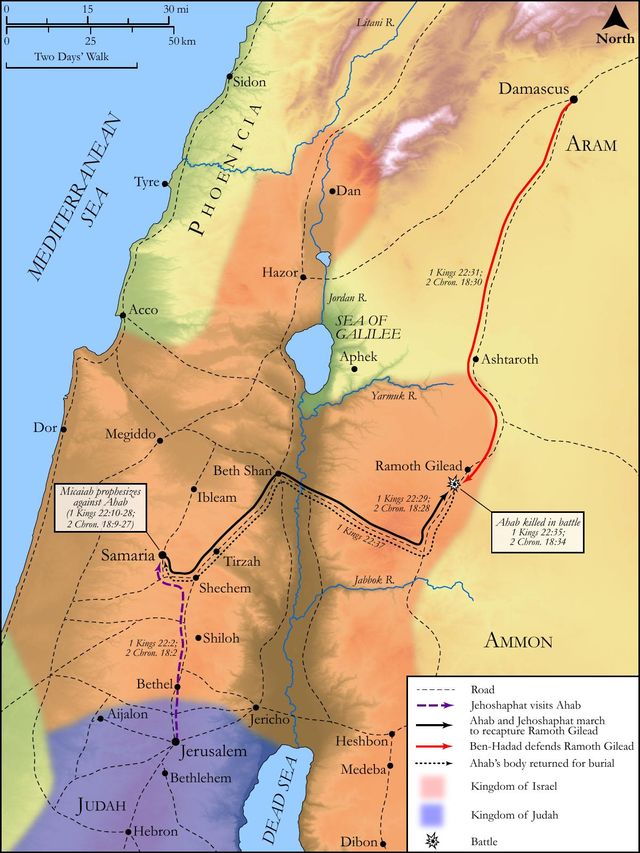
See on the biblical-era map

Study this verse
Public-domain commentary
Matthew Henry
From his Commentary on the Whole Bible. Henry comments on passages, not single verses — this entry covers 1 Kings 22:15–28. His three-level outline is real structure in the source text, so it is rendered as structure.
Here Micaiah does well, but, as is common, suffers ill for so doing.
I.We are told how faithfully he delivered his message, as one that was more solicitous to please God than to humour either the great or the many. In three ways he delivers his message, and all displeasing to Ahab: -
1.He spoke as the rest of the prophets had spoken, but ironically: Go, and prosper, Kg1 22:15. Ahab put the same question to him that he had put to his own prophets (Shall we go, or shall we forbear?) seeming desirous to know God's mind, when, like Balaam, he was strongly bent to do his own, which Micaiah plainly took notice of when he bade him go, but with such an air and pronunciation as plainly showed he spoke it by way of derision; as if he had said, "I know you are determined to go, and I hear your own prophets are unanimous in assuring you of success; go then and take what follows. They say, The Lord shall deliver it into the hand of the king; but I do not tell thee that thus saith the Lord; no, he saith otherwise." Note, Those deserve to be bantered that love to be flattered; and it is just with God to give up those to their own counsels that give up themselves to their own lusts. Ecc 11:9. In answer to this Ahab adjured him to tell him the truth, and not to jest with him (v. 16), as if he sincerely desired to know both what God would have him to do and what he would do with him, yet intending to represent the prophet as a perverse ill-humoured man, that would not tell him the truth till he was thus put to his oath, or adjured to do it.
2.Being thus pressed, he plainly foretold that the king would be cut off in this expedition, and his army scattered, Kg1 22:17. He saw them in a vision, or in a dream, dispersed upon the mountains, as sheep that had no one to guide them. Smite the shepherd, and the sheep will be scattered, Zac 13:7. This intimates,
(1.)That Israel should be deprived of their king, who was their shepherd. God took notice of it, These have no master.
(2.)That they would be obliged to retire re infecta - without accomplishing their object. He does not foresee any great slaughter in the army, but that they should make a dishonorable retreat. Let them return every man to his house in peace, put into disorder indeed for the present, but no great losers by the death of their king; he shall fall in war, but they shall go home in peace. Thus Micaiah, in his prophecy, testified what he had seen and heard (let them take it how they pleased), while the others prophesied merely out of their own hearts; see Jer 23:28. "The prophet that has a dream let him tell that, and so quote his authority; and he that has my word, let him speak my word faithfully, and not his own; for what is the chaff to the wheat?" Now Ahab finds himself aggrieved, turns to Jehoshaphat, and appeals to him whether Micaiah had not manifestly a spite against him, Kg1 22:18. Those that bear malice to others are generally willing to believe that others bear malice to them, though they have no cause for it, and therefore to put the worst constructions upon all they say. What evil did Micaiah prophesy to Ahab in telling him that, if he proceeded in this expedition, it would be fatal to him, while he might choose whether he would proceed in it or no? The greatest kindness we can do to one that is going a dangerous way is to tell him of his danger.
3.He informed the king how it was that all his prophets encouraged him to proceed, that God permitted Satan by them to deceive him into his ruin, and he by vision knew of it; it was represented to him, and he represented it to Ahab, that the God of heaven had determined he should fall at Ramoth-Gilead (Kg1 22:19, Kg1 22:20), that the favour he had wickedly shown to Ben-hadad might be punished by him and his Syrians, and that he being in some doubt whether he should go to Ramoth-Gilead or no, and resolving to be advised by his prophets, they should persuade him to it and prevail (Kg1 22:21, Kg1 22:22); and hence it was that they encouraged him with so much assurance (Kg1 22:23); it was a lie from the father of lies, but by divine permission. This matter is here represented after the manner of men. We are not to imagine that God is ever put upon new counsels, or is ever at a loss for means whereby to effect his purposes, nor that he needs to consult with angels, or any creature, about the methods he should take, nor that he is the author of sin or the cause of any man's either telling or believing a lie; but, besides what was intended by this with reference to Ahab himself, it is to teach us, (1.) That God is a great king above all kings, and has a throne above all the thrones of earthly princes. "You have your thrones," said Micaiah to these two kings, "and you think you may do what you will, and we must all say as you would have us; but I saw the Lord sitting upon his throne, and every man's judgment proceeding from him, and therefore I must say as he says; he is not a man, as you are." (2.) That he is continually attended and served by an innumerable company of angels, those heavenly hosts, who stand by him, ready to go where he sends them and to do what he bids them, messengers of mercy on his right hand, of wrath on his left hand. (3.) That he not only takes cognizance of, but presides over, all the affairs of this lower world, and overrules them according to the counsel of his own will. The rise and fall of princes, the issues of war, and all the great affairs of state, which are the subject of the consultations of wise and great men, are no more above God's direction than the meanest concerns of the poorest cottages are below his notice. (4.) That God has many ways of bringing about his own counsels, particularly concerning the fall of sinners when they are ripe for ruin; he can do it either in this manner or in that manner. (5.) That there are malicious and lying spirits which go about continually seeking to devour, and, in order to that, seeking to deceive, and especially to put lies into the mouths of prophets, by them to entice many to their destruction. (6.) It is not without the divine permission that the devil deceives men, and even thereby God serves his own purposes. With him are strength and wisdom, the deceived and the deceivers are his, Job 12:16. When he pleases, for the punishment of those who receive not the truth in the love of it, he not only lets Satan loose to deceive them (Rev 20:7, Rev 20:8), but gives men up to strong delusions to believe him, Th2 2:11, Th2 2:12. (7.) Those are manifestly marked for ruin that are thus given up. God has certainly spoken evil concerning those whom he had given up to be imposed upon by lying prophets. Thus Micaiah gave Ahab fair warning, not only of the danger of proceeding in this war, but of the danger of believing those that encouraged him to proceed. Thus we are warned to beware of false prophets, and to try the spirits; the lying spirit never deceives so fatally as in the mouth of prophets.
II.We are told how he was abused for delivering his message thus faithfully, thus plainly, in a way so very proper both to convince and to affect.
1.Zedekiah, a wicked prophet, impudently insulted him in the face of the court, smote him on the cheek, to reproach him, to silence him and stop his mouth, and to express his indignation at him (thus was our blessed Saviour abused, Mat 26:67, that Judge of Israel, Mic 5:1); and as if he not only had the spirit of the Lord, but the monopoly of this Spirit, that he might not go without his leave, he asks, Which way went the Spirit of the Lord from me to speak to thee? Kg1 22:24. The false prophets were always the worst enemies the true prophets had, and not only stirred up the government against them, but were themselves abusive to them, as Zedekiah here. To strike within the verge of the court, especially in the king's presence, is looked upon by our law as a high misdemeanour; yet this wicked prophet gives this abuse to a prophet of the Lord, and is not reprimanded nor bound to his good behaviour for it. Ahab was pleased with it, and Jehoshaphat had not courage to appear for the injured prophet, pretending it was out of his jurisdiction; but Micaiah, though he returns not his blow (God's prophets are not strikers nor persecutors, dare not avenge themselves, render blow for blow, or be in any way accessory to the breach of the peace), yet, since he boasted so much of the Spirit, as those commonly do that know least of his operations, he leaves him to be convinced of his error by the event: Thou shalt know when thou hidest thyself in an inner chamber, Kg1 22:25. It is likely Zedekiah went with Ahab to the battle, and took his horns of iron with him to encourage the soldiers, to see with pleasure the accomplishment of his prophecy, and return in triumph with the king; but, the army being routed, he fled among the rest from the sword of the enemy, sheltered himself as Ben-hadad had done in a chamber within a chamber (Kg1 20:30), lest he should perish, as he knew he deserved to do, with those whom he had deluded, as Balaam did (Num 31:8), and lest the blind prophet should fall into the ditch with the blinded prince whom he had misled. Note, Those that will not have their mistakes rectified in time by the word of God will be undeceived, when it is too late, by the judgments of God.
2.Ahab, that wicked king, committed him to prison (Kg1 22:27), not only ordered him to be taken into custody, or remitted to the prison whence he came, but to be fed with bread and water, coarse bread and puddle-water, till he should return, not doubting but that he should return a conqueror, and then he would put him to death for a false prophet (Kg1 22:27) - hard usage for one that would have prevented his ruin! But by this it appeared that God had determined to destroy him, as Ch2 25:16. How confident is Ahab of success. He doubts not but he shall return in peace, forgetting what he himself had reminded Ben-hadad of, Let not him that girdeth on the harness boast; but there was little likelihood of his coming home in peace when he left one of God's prophets behind him in prison. Micaiah put it upon the issue, and called all the people to be witnesses that he did so: "If thou return in peace, the Lord has not spoken by me, Kg1 22:28. Let me incur the reproach and punishment of a false prophet, if the king come home alive." He ran no hazard by this appeal, for he knew whom he had believed; he that is terrible to the kings of the earth, and treads upon princes as mortar, will rather let thousands of them fall to the ground than one jot or tittle of his own word; he will not fail to confirm the word of his servants, Isa 44:26.
Continue studying 1 Kings 22:18 across the web’s major study libraries — every link below opens this exact verse, chapter, or book on the destination site.
Read & Compare
 BibleGatewayThis verse in more than 200 translations and 70 languages.
 Bible.comThe YouVersion reader — hundreds of translations, reading plans, and highlights.
 ESV.orgCrossway's official English Standard Version reader.
 NET BibleThe NET translation with 60,000+ translators' notes on every rendering decision.
 STEP BibleTyndale House's free study tool — original text, vocabulary, and scholarly resources.
 BibliaLogos Bible Software's free web reader.
 USCCBThe New American Bible (Revised Edition) with the U.S. bishops' study notes.
Commentaries
 BibleHub CommentariesDozens of classic commentaries on this verse, gathered on one page.
 StudyLightMore than 100 commentary sets — the largest collection on the web.
 BibleRefPlain-English commentary on what this verse means, verse by verse.
 Enduring WordDavid Guzik's free commentary on this chapter, widely used by Bible teachers.
 Bible Study ToolsVerse commentary alongside Greek and Hebrew study aids.
Original Language & Research
- BibleHub InterlinearThe verse word by word — original language, transliteration, and English.
- BibleHub LexiconEvery word's original-language definition and Strong's entry.
 Blue Letter BibleDeep-study tools — Strong's numbers, concordance, and word studies.
 SefariaThe Hebrew text with Rashi and centuries of Jewish commentary.
Sermons, Hymns & Audio


TrulyRandomVerse is not affiliated with these sites and doesn’t control their content. They’re linked because they’re genuinely useful.
Summary
King Ahab's cynical declaration, uttered to King Jehoshaphat immediately after Micaiah's dire prophecy, serves as a poignant encapsulation of his profound spiritual blindness and hardened heart. Far from expressing surprise or a desire for repentance, Ahab's statement—"Did I not tell thee that he would prophesy no good concerning me, but evil?"—is a self-vindicating confirmation of his deep-seated resistance to divine truth. It reveals a monarch so enslaved by his own desires and self-serving delusions that he would rather anticipate and embrace negative outcomes from God's true prophet than humble himself, heed the warning, and align with God's sovereign will, tragically setting the stage for his inevitable demise.
Context
ShowHideLiterary Context
This verse is a critical juncture in the dramatic narrative of 1 Kings 22, which culminates in King Ahab's death at the Battle of Ramoth-gilead. The preceding verses establish the alliance between Ahab, King of Israel, and Jehoshaphat, King of Judah, to reclaim the strategic city of Ramoth-gilead from Aram. Jehoshaphat, a more righteous king, insists on consulting a prophet of the Lord before battle, despite Ahab having already gathered 400 court prophets who unanimously predicted victory. Ahab's initial disdain for Micaiah is made clear in 1 Kings 22:8, where he complains that Micaiah "doth not prophesy good concerning me, but evil." When Micaiah, after an initial sarcastic affirmation of the false prophets' message, delivers the true, devastating prophecy of Israel's defeat and Ahab's death in 1 Kings 22:17, Ahab's words in verse 18 are not a lament of fate, but a bitter "I told you so" directed at Jehoshaphat. This utterance solidifies Ahab's rejection of divine warning, underscoring his unrepentant heart and sealing his tragic fate. The immediate context powerfully contrasts true prophecy with deceptive flattery, highlighting the dire consequences of ignoring God's authoritative word.
Historical & Cultural Context
During the period of the divided monarchy in ancient Israel, prophets served as vital intermediaries between God and His people, often addressing kings and national affairs. However, a significant distinction existed between true prophets, who faithfully delivered God's unvarnished message regardless of its popularity, and false or court prophets, who often tailored their messages to please the monarch or align with popular sentiment. Ahab's reign (c. 874-853 BC) was notoriously marked by widespread idolatry, particularly the state-sponsored worship of Baal, which directly challenged Yahweh's exclusive claim to worship in Israel. The alliance with Judah was a political and military strategy to recover Ramoth-gilead, a key city on the northern border. Kings like Ahab frequently preferred prophecies that validated their military ambitions and personal agendas, making true prophets like Micaiah, who delivered uncomfortable truths, highly unpopular and often persecuted. This historical and cultural backdrop illuminates the spiritual corruption prevalent in Ahab's court and the challenging environment for genuine divine revelation, where truth was often suppressed in favor of self-serving lies.
Key Themes
ShowHideAhab's statement in 1 Kings 22:18 and the broader narrative of 1 Kings 22 contribute to several profound theological and narrative themes. The Rejection of Truth is paramount, as Ahab consistently resists and resents divine truth when it contradicts his personal desires or political agenda, preferring flattering lies. This highlights the universal human tendency to close one's ears to uncomfortable realities that demand repentance. Closely related is the Preference for Flattery over Truth, starkly demonstrated by Ahab's embrace of the 400 false prophets' optimistic but deceitful messages, contrasted with Micaiah's honest but grim prophecy. This illustrates the dangerous allure of pleasant falsehoods over harsh truths, a theme echoed in the prophetic warnings against false teachers (e.g., Jeremiah 14:14). Furthermore, the narrative illuminates The Nature of True Prophecy, demonstrating that genuine prophets, like Micaiah, are often unpopular precisely because they speak God's unvarnished word, which frequently challenges human pride and plans, not always delivering "good" news in a worldly sense, but always delivering truth. Finally, the verse foreshadows the Consequences of Disobedience, as Ahab's persistent rejection of divine warnings ultimately leads to his downfall, fulfilling Micaiah's prophecy and serving as a stark reminder that ignoring God's word carries severe repercussions, as seen throughout the historical books of the Old Testament (e.g., Deuteronomy 28).
Exposition and Analysis
ShowHideKey Word Analysis
ShowHideThis term denotes a sovereign ruler, one who exercises authority. In this context, it refers to Ahab, the king of Israel, whose position grants him immense power but also carries significant responsibility before God. His identity as "king" underscores the gravity of his choices and the impact of his spiritual rebellion on the nation.
This primitive root means "to speak (or sing) by inspiration," encompassing both prediction and simple discourse. It signifies the act of delivering a message from God. Ahab's use of this word highlights his understanding that Micaiah is indeed a prophet, yet he dismisses the divine origin of the message, attributing it instead to Micaiah's personal animosity.
This word signifies that which is pleasant, prosperous, favorable, or beneficial in the widest sense. In Ahab's context, it refers to a prophecy of success, victory, and personal well-being. He desires a message that affirms his plans and promises a positive outcome for his military venture. His complaint is that Micaiah never delivers such a prophecy for him.
While raʿ can denote moral wickedness, in this specific context, it refers to calamity, disaster, misfortune, or adversity. Ahab is not accusing Micaiah of moral evil, but of consistently prophesying ill-fortune, defeat, or negative outcomes for him. His concern is pragmatic: he dislikes the bad news and its implications for his reign and life, rather than any moral failing on his part.
Verse Breakdown
ShowHide"And the king of Israel said unto Jehoshaphat"
This opening clause immediately establishes the speaker and the audience for this pivotal statement. Ahab's words are directed specifically to Jehoshaphat, who had insisted on consulting a true prophet of the Lord, thereby highlighting Ahab's attempt to justify his initial skepticism about Micaiah and perhaps to save face after Micaiah's devastating prophecy. It frames the statement as a personal, defensive retort rather than a humble inquiry.
"Did I not tell thee"
This is a rhetorical question, not genuinely seeking confirmation from Jehoshaphat but rather serving as a dismissive and self-vindicating utterance. Ahab is asserting his own cynical foresight and confirming his preconceived notions about Micaiah. It powerfully reveals his hardened and unteachable spirit, unwilling to consider the possibility that Micaiah's prophecy might be God's truth, but instead framing it as a predictable, personal vendetta from the prophet. His tone is one of exasperated confirmation, not surprise.
"that he would prophesy no good concerning me, but evil?"
This is the core of Ahab's complaint and the essence of his spiritual blindness. He characterizes Micaiah's prophecies as consistently negative, always predicting disaster rather than prosperity or favorable outcomes. This statement underscores Ahab's profound resistance to divine correction and his preference for messages that align with his own desires and ambitions. It dramatically highlights the stark contrast between the flattering words of the 400 false prophets, who promised "good" (victory), and the unvarnished truth delivered by Micaiah, which Ahab perceives as "evil" because it contradicts his will and promises misfortune and death.
Literary Devices
ShowHideThe verse is rich in Characterization, vividly portraying King Ahab as obstinate, cynical, and deeply resistant to divine truth. His rhetorical question, "Did I not tell thee," immediately reveals his hardened heart and his dismissive attitude towards God's messenger, emphasizing his unteachability. There is profound Irony at play; Ahab's statement, intended to discredit Micaiah and confirm his own jaded view, actually serves to validate the prophet's integrity. By complaining that Micaiah only prophesies "evil," Ahab inadvertently confirms that Micaiah speaks only what the Lord commands, regardless of the king's preference, unlike the sycophantic false prophets. The king's words also serve as powerful Foreshadowing, as his cynical expectation of "evil" concerning himself will indeed be tragically fulfilled in the ensuing battle, leading to his death. This self-fulfilling prophecy, driven by his own rejection of truth, adds a layer of dramatic inevitability to his fate and underscores the theme of divine judgment.
Theological and Thematic Connections
ShowHideAhab's lament in 1 Kings 22:18 serves as a profound theological warning against the human tendency to reject divine truth when it is uncomfortable or contradicts personal desires. It underscores the inherent conflict between God's unvarnished word and the human heart's inclination towards self-deception and flattery. The "evil" that Micaiah prophesies is not a personal vendetta, but the just consequence of Ahab's persistent disobedience, idolatry, and rejection of God's covenant. This verse highlights that God's warnings, though unpleasant to the hearer, are acts of divine grace, intended to call humanity to repentance and avert disaster. To dismiss such warnings, as Ahab does, is to choose a path of self-destruction, demonstrating a spiritual blindness that prioritizes immediate gratification and worldly success over eternal truth and the will of the Almighty. It reveals the dangerous delusion of those who would rather believe a comforting lie than a challenging truth.
Reflection and Application
ShowHideKing Ahab's stubborn declaration in 1 Kings 22:18 offers a timeless and sobering mirror for self-reflection. It challenges us to examine our own hearts: are we truly open to hearing truth, even when it is uncomfortable, critical, or contrary to our plans and desires? In an age saturated with information and echo chambers, it is alarmingly easy to gravitate towards voices that simply affirm our biases and tell us what we want to hear, rather than seeking genuine, discerning counsel that might expose our flaws, challenge our assumptions, or call us to a higher, more righteous standard. This verse compels us to cultivate a spirit of humility and teachability, recognizing that divine warnings, though they may feel like "evil" or adversity in the moment, are often profound expressions of God's loving concern, designed to steer us away from ultimate disaster and toward true flourishing and eternal life. Our spiritual maturity is often measured not by our ability to avoid difficult truths, but by our willingness to embrace them, even when they challenge our most cherished assumptions or expose our profound need for repentance and transformation.
Questions for Reflection
ShowHideFAQ
ShowHideWhy did Ahab consult Micaiah if he already knew what he would say?
ShowHideAhab's consultation of Micaiah was not born out of a genuine desire for divine guidance or a repentant heart, but rather due to the insistence of King Jehoshaphat. Jehoshaphat, a more righteous king from Judah, refused to go to battle without first consulting a prophet of the Lord, as seen in 1 Kings 22:5. Ahab had already gathered his 400 court prophets who gave a unanimous, positive prophecy of victory. However, Jehoshaphat, sensing their insincerity or perhaps their lack of genuine divine inspiration, pressed for a true prophet of Yahweh. Ahab reluctantly acquiesced, knowing Micaiah's track record of delivering unfavorable prophecies concerning him, as he explicitly admits in 1 Kings 22:8. His statement in 1 Kings 22:18 is therefore less about surprise at Micaiah's message and more about a cynical, self-fulfilling confirmation of his expectation, reinforcing his rejection of God's true messenger. He brought Micaiah in under duress, not out of faith or a desire for truth, but to satisfy Jehoshaphat, only to find his own hardened heart confirmed by the prophet's words.
Christ-Centered Fulfillment
ShowHideKing Ahab's bitter rejection of Micaiah, the prophet who spoke God's unvarnished truth, powerfully foreshadows humanity's ultimate rejection of Jesus Christ, the quintessential Prophet and embodiment of truth. Just as Micaiah was unpopular because his message was perceived as "evil" (calamitous) to Ahab's self-serving plans, so too was Jesus rejected by those who preferred their own agendas, traditions, and worldly power over His challenging words. Jesus declared Himself to be the way, the truth, and the life, yet He was not received by His own people, for He came to His own, and His own people did not receive Him. The "evil" that Micaiah prophesied was physical death and national defeat, a consequence of sin. Christ, however, came to address the ultimate "evil"—sin itself—and to deliver humanity from its eternal consequences. He spoke truth that exposed the hypocrisy of the religious leaders (Matthew 23:13-36) and called for radical repentance and self-denial (Luke 9:23), a message often perceived as "no good" by those comfortable in their self-righteousness or worldly pursuits. Ultimately, the very "evil" of the cross, where Christ suffered and died as a perceived criminal (Isaiah 53:3-5), was the means by which God brought about the ultimate "good" of salvation, reconciliation, and eternal life for all who believe, transforming the world's perceived calamity into the greatest victory over sin and death (Romans 5:8).