


Job 1:6
Bible text: King James Version (1769 Blayney text) · Public domain
Bible text: Berean Standard Bible · Public domain
Bible text: American Standard Version (1901) · Public domain
Bible text: World English Bible, Messianic edition · Public domain
Bible text: Geneva Bible (1599) · Public domain
Bible text: Young's Literal Translation · Public domain
- וַיְהִיvay·Hiand it wasH1961Conj-w ¦ V-Qal-ConsecImperf-3msVerb Qal Consecutive Imperfect 3rd Singular Masculineוַandיְהִיit was
- הַיּוֹםhai·Yomthe dayH3117Art ¦ N-msNoun Singular Masculine Absoluteהַtheיּוֹםday
- וַיָּבֹאוּvai·ya·Vo·'uand they cameH935Conj-w ¦ V-Qal-ConsecImperf-3mpVerb Qal Consecutive Imperfect 3rd Plural Masculineוַandיָּבֹאוּthey came
- בְּנֵיbe·Nei[the] sons ofH1121N-mpcNoun Plural Masculine Construct
- הָאֱלֹהִיםha·'E·lo·Him<the> GodH430Art ¦ N-mpNoun Plural Masculine Absoluteהָ<the>אֱלֹהִיםGod
- לְהִתְיַצֵּבle·hit·ya·Tzevto present themselvesH3320Prep-l ¦ V-Hithpael-InfVerb Hithpael Infinitive Constructלְtoהִתְיַצֵּבpresent themselves
- עַל'alonH5921PrepPreposition
- יְהוָהYah·wehYahwehH3068N-properNoun Proper Title
- וַיָּבוֹאvai·ya·Vo'and he cameH935Conj-w ¦ V-Qal-ConsecImperf-3msVerb Qal Consecutive Imperfect 3rd Singular Masculineוַandיָּבוֹאhe came
- גַםgamalsoH1571AdvAdverb
- הַשָּׂטָןha·sa·Tanthe adversaryH7854Art ¦ N-msNoun Title Singular Masculine Absoluteהַtheשָּׂטָןadversary
- בְּתוֹכָםbe·to·Khamin midst of themH8432Prep-b ¦ N-msc ¦ 3mpNoun Singular Masculine Constructבְּinתוֹכָmidst ofםthem
English is a literal word-by-word gloss of the Hebrew, not the KJV's wording. Why?
This is the original text the KJV's translators worked from — each Hebrew word with its own literal English meaning in this verse, prepared by scholars at Tyndale House, Cambridge. The KJV translates whole sentences, not word by word, so its wording differs: one Hebrew word can become several English words, and the KJV may choose “the LORD” where the gloss reads “Yahweh”. Both are faithful — they answer different questions. For the KJV's own rendering, switch to the KJV text.
Details
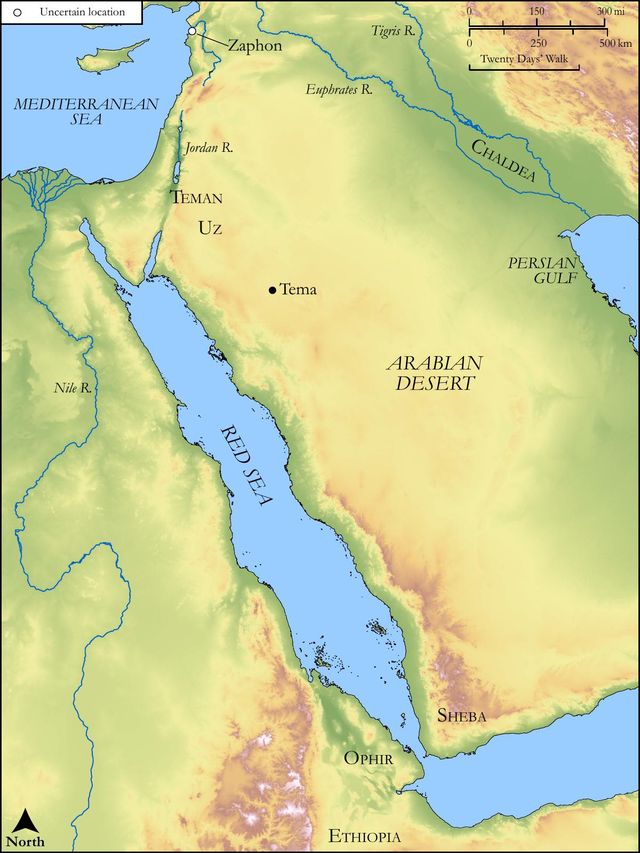
See on the biblical-era map
Study this verse
Public-domain commentary
Matthew Henry
From his Commentary on the Whole Bible. Henry comments on passages, not single verses — this entry covers Job 1:6–12. His three-level outline is real structure in the source text, so it is rendered as structure.
Job was not only so rich and great, but withal so wise and good, and had such an interest both in heaven and earth, that one would think the mountain of his prosperity stood so strong that it could not be moved; but here we have a thick cloud gathering over his head, pregnant with a horrible tempest. We must never think ourselves secure from storms while we are in this lower region. Before we are told how his troubles surprised and seized him here in this visible world, we are here told how they were concerted in the world of spirits, that the devil, having a great enmity to Job for his eminent piety, begged and obtained leave to torment him. It does not at all derogate from the credibility of Job's story in general to allow that this discourse between God and Satan, in these verses, is parabolical, like that of Micaiah (Kg1 22:19, etc.), and an allegory designed to represent the malice of the devil against good men and the divine check and restraint which that malice is under; only thus much further is intimated, that the affairs of this earth are very much the subject of the counsels of the unseen world. That world is dark to us, but we lie very open to it. Now here we have,
I.Satan among the sons of God (Job 1:6), an adversary (so Satan signifies) to God, to men, to all good:
he thrust himself into an assembly of the sons of God that came to present themselves before the Lord. This means either,
1.A meeting of the saints on earth. Professors of religion, in the patriarchal age, were called sons of God (Gen 6:2); they had then religious assemblies and stated times for them. The King came in to see his guests; the eye of God was on all present. But there was a serpent in paradise, a Satan among the sons of God; when they come together he is among them, to distract and disturb them, stands at their right hand to resist them. The Lord rebuke thee, Satan! Or,
2.A meeting of the angels in heaven. They are the sons of God, Job 38:7. They came to give an account of their negotiations on earth and to receive new instructions. Satan was one of them originally; but how hast thou fallen, O Lucifer! He shall no more stand in that congregation, yet he is here represented, as coming among them, either summoned to appear as a criminal or connived at, for the present, though an intruder.
II.His examination, how he came thither (Job 1:7):
The Lord said unto Satan, Whence comest thou? He knew very well whence he came, and with what design he came thither, that as the good angels came to do good he came for a permission to do hurt; but he would, by calling him to an account, show him that he was under check and control. Whence comest thou? He asks this,
1.As wondering what brought him thither. Is Saul among the prophets? Satan among the sons of God? Yes, for he transforms himself into an angel of light (Co2 11:13, Co2 11:14), and would seem one of them. Note, It is possible that a man may be a child of the devil and yet be found in the assemblies of the sons of God in this world, and there may pass undiscovered by men, and yet be challenged by the all-seeing God. Friend, how camest thou in hither? Or,
2.As enquiring what he had been doing before he came thither. The same question was perhaps put to the rest of those that presented themselves before the Lord, "Whence came you?" We are accountable to God for all our haunts and all the ways we traverse.
III.The account he gives of himself and of the tour he had made. I come (says he) from going to and fro on the earth.
1.He could not pretend he had been doing any good, could give no such account of himself as the sons of God could, who presented themselves before the Lord, who came from executing his orders, serving the interest of his kingdom, and ministering to the heirs of salvation.
2.He would not own he had been doing any hurt, that he had been drawing men from the allegiance to God, deceiving and destroying souls; no. I have done no wickedness, Pro 30:20. Thy servant went nowhere. In saying that he had walked to and fro through the earth, he intimates that he had kept himself within the bounds allotted him, and had not transgressed his bounds; for the dragon is cast out into the earth (Rev 12:9) and not yet confined to his place of torment. While we are on this earth we are within his reach, and with so much subtlety, swiftness, and industry, does he penetrate into all the corners of it, that we cannot be in any place secure from his temptations.
3.He yet seems to give some representation of his own character.
(1.)Perhaps it is spoken proudly, and with an air of haughtiness, as if he were indeed the prince of this world, as if the kingdoms of the world and the glory of them were his (Luk 4:6), and he had now been walking in circuit through his own territories.
(2.)Perhaps it is spoken fretfully, and with discontent. He had been walking to and fro, and could find no rest, but was as much a fugitive and a vagabond as Cain in the land of Nod.
(3.)Perhaps it is spoken carefully: "I have been hard at work, going to and fro," or (as some read it) "searching about in the earth," really in quest of an opportunity to do mischief. He walks abut seeking whom he may devour. It concerns us therefore to be sober and vigilant.
IV.The question God puts to him concerning Job (Job 1:8):
Hast thou considered my servant Job? As when we meet with one that has been in a distant place, where we have a friend we dearly love, we are ready to ask, "You have been in such a place; pray did you see my friend there?" Observe,
1.How honourably God speaks of Job: He is my servant. Good men are God's servants, and he is pleased to reckon himself honoured in their services, and they are to him for a name and a praise (Jer 13:11) and a crown of glory, Isa 62:3. "Yonder is my servant Job; there is none like him, none I value like him, of all the princes and potentates of the earth; one such saint as he is worth them all: none like him for uprightness and serious piety; many do well, but he excelleth them all; there is not to be found such great faith, no, not in Israel." Thus Christ, long after, commended the centurion and the woman of Canaan, who were both of them, like Job, strangers to that commonwealth. The saints glory in God - Who is like thee among the gods? and he is pleased to glory in them - Who is like Israel among the people? So here, none like Job, none in earth, that state of imperfection. Those in heaven do indeed far outshine him; those who are least in that kingdom are greater than he; but on earth there is not his like. There is none like him in that land; so some good men are the glory of their country.
2.How closely he gives to Satan this good character of Job: Hast thou set thy heart to my servant Job? designing hereby,
(1.)To aggravate the apostasy and misery of that wicked spirit: "How unlike him are thou!" Note, The holiness and happiness of the saints are the shame and torment of the devil and the devil's children.
(2.)To answer the devil's seeming boast of the interest he had in this earth. "I have been walking to and fro in it," says he, "and it is all my own; all flesh have corrupted their way; they all sit still, and are at rest in their sins," Zac 1:10, Zac 1:11. "Nay, hold," saith God, "Job is my faithful servant." Satan may boast, but he shall not triumph.
(3.)To anticipate his accusations, as if he had said, "Satan, I know thy errand; thou hast come to inform against Job; but hast thou considered him? Does not his unquestionable character give thee the lie?" Note, God knows all the malice of the devil and his instruments against his servants; and we have an advocate ready to appear for us, even before we are accused.
V.The devil's base insinuation against Job, in answer to God's encomium of him.
He could not deny but that Job feared God, but suggested that he was a mercenary in his religion, and therefore a hypocrite (Job 1:9): Doth Job fear God for nought? Observe,
1.How impatient the devil was of hearing Job praised, though it was God himself that praised him. Those are like the devil who cannot endure that any body should be praised but themselves, but grudge the just share of reputation others have, as Saul (Sa1 18:5, etc.) and the Pharisees, Mat 21:15.
2.How much at a loss he was for something to object against him; he could not accuse him of any thing that was bad, and therefore charged him with by-ends in doing good. Had the one half of that been true which his angry friends, in the heat of dispute, charged him with (Job 15:4, Job 22:5), Satan would no doubt have brought against him now; but no such thing could be alleged, and therefore,
3.See how slyly he censured him as a hypocrite, not asserting that he was so, but only asking, "Is he not so?" This is the common way of slanderers, whisperers, backbiters, to suggest that by way of query which yet they have no reason to think is true. Note, It is not strange if those that are approved and accepted of God be unjustly censured by the devil and his instruments; if they are otherwise unexceptionable, it is easy to charge them with hypocrisy, as Satan charged Job, and they have no way to clear themselves, but patiently to wait for the judgment of God. As there is nothing we should dread more than being hypocrites, so there is nothing we need dread less that being called and counted so without cause.
4.How unjustly he accused him as mercenary, to prove him a hypocrite. It was a great truth that Job did not fear God for nought; he got much by it, for godliness is great gain: but it was a falsehood that he would not have feared God if he had not got this by it, as the event proved. Job's friends charged him with hypocrisy because he was greatly afflicted, Satan because he greatly prospered. It is no hard matter for those to calumniate that seek an occasion. It is not mercenary to look at the eternal recompence in our obedience; but to aim at temporal advantages in our religion, and to make it subservient to them, is spiritual idolatry, worshipping the creature more than the Creator, and is likely to end in a fatal apostasy. Men cannot long serve God and mammon.
VI.The complaint Satan made of Job's prosperity, Job 1:10. Observe,
1.What God had done for Job. He had protected him, made a hedge about him, for the defence of his person, his family, and all his possessions. Note, God's peculiar people are taken under his special protection, they and all that belong to them; divine grace makes a hedge about their spiritual life, and divine providence about their natural life, so they are safe and easy. He had prospered him, not in idleness or injustice (the devil could not accuse him of them), but in the way of honest diligence: Thou hast blessed the work of his hands. Without that blessing, be the hands ever so strong, ever so skilful, the work will not prosper; but, with that, his substance has wonderfully increased in the land. The blessing of the Lord makes rich: Satan himself owns it.
2.What notice the devil took of it, and how he improved it against him. The devil speaks of it with vexation. "I see thou hast made a hedge about him, round about;" as if he had walked it round, to see if he could spy a single gap in it, for him to enter in at, to do him a mischief; but he was disappointed: it was a complete hedge. The wicked one saw it and was grieved, and argued against Job that the only reason why he served God was because God prospered him. "No thanks to him to be true to the government that prefers him, and to serve a Master that pays him so well."
VII.The proof Satan undertakes to give of the hypocrisy and mercenariness of Job's religion, if he might but have leave to strip him of his wealth. "Let it be put to this issue," says he (Job 1:11); "make him poor, frown upon him, turn thy hand against him, and then see where his religion will be; touch what he has and it will appear what he is. If he curse thee not to thy face, let me never be believed, but posted for a liar and false accuser. Let me perish if he curse thee not;" so some supply the imprecation, which the devil himself modestly concealed, but the profane swearers of our age impudently and daringly speak out. Observe, 1. How slightly he speaks of the affliction he desired that Job might be tried with: "Do but touch all that he has, do but begin with him, do but threaten to make him poor; a little cross will change his tone." 2. How spitefully he speaks of the impression it would make upon Job: "He will not only let fall his devotion, but turn it into an open defiance - not only think hardly of thee, but even curse thee to thy face." The word translated curse is barac, the same that ordinarily, and originally, signifies to bless; but cursing God is so impious a thing that the holy language would not admit the name: but that where the sense requires it it must be so understood is plain form Kg1 21:10-13, where the word is used concerning the crime charged on Naboth, that he did blaspheme God and the king. Now, (1.) It is likely that Satan did think that Job, if impoverished, would renounce his religion and so disprove his profession, and if so (as a learned gentleman has observed in his Mount of Spirits) Satan would have made out his own universal empire among the children of men. God declared Job the best man then living: now, if Satan can prove him a hypocrite, it will follow that God had not one faithful servant among men and that there was no such thing as true and sincere piety in the world, but religion was all a sham, and Satan was king de facto - in fact, over all mankind. But it appeared that the Lord knows those that are his and is not deceived in any. (2.) However, if Job should retain his religion, Satan would have the satisfaction to see him sorely afflicted. He hates good men, and delights in their griefs, as God has pleasure in their prosperity.
VIII.The permission God gave to Satan to afflict Job for the trial of his sincerity.
Satan desired God to do it: Put forth thy hand now. God allowed him to do it (Job 1:12): "All that he has is in thy hand; make the trial as sharp as thou canst; do thy worst at him." Now,
1.It is a matter of wonder that God should give Satan such a permission as this, should deliver the soul of his turtle-dove into the hand of the adversary, such a lamb to such a lion; but he did it for his own glory, the honour of Job, the explanation of Providence, and the encouragement of his afflicted people in all ages, to make a case which, being adjudged, might be a useful precedent. He suffered Job to be tried, as he suffered Peter to be sifted, but took care that his faith should not fail (Luk 22:32) and then the trial of it was found unto praise, and honour, and glory, Pe1 1:7. But,
2.It is a matter of comfort that God has the devil in a chain, in a great chain, Rev 20:1. He could not afflict Job without leave from God first asked and obtained, and then no further than he had leave: "Only upon himself put not forth thy hand; meddle not with his body, but only with his estate." It is a limited power that the devil has; he has no power to debauch men but what they give him themselves, nor power to afflict men but what is given him from above.
IX.Satan's departure from this meeting of the sons of God.
Before they broke up, Satan went forth (as Cain, Gen 4:16) from the presence of the Lord; no longer detained before him (as Doeg was, Sa1 21:7) than till he had accomplished his malicious purpose. He went forth,
1.Glad that he had gained his point, proud of the permission he had to do mischief to a good man; and,
2.Resolved to lose no time, but speedily to put his project in execution. He went forth now, not to go to and fro, rambling through the earth, but with a direct course, to fall upon poor Job, who is carefully going on in the way of his duty, and knows nothing of the matter. What passes between good and bad spirits concerning us we are not aware of.
Historical interpretation
Four Centuries of Reception
4 surviving comments on this verse. Each one is dated, so this reads as a timeline rather than a list.
Select a marker to jump to its quote. Markers stagger vertically where authors wrote within a few decades of each other.
Was there ever a time when the angels did not stand before the Lord? Was it not written about them that “a thousand thousands served him, and ten thousand times ten thousand stood before him”? But this coming, in our opinion, is that of the angels who had been sent to serve human beings. Paul actually says, “Are not all angels ministering spirits sent to serve those who will inherit salvation?”
34. It is first to be made out, wherefore any thing is said to be done on a particular day before the Lord, whereas with Him the progress of time is never marked by the variation of day and night. For neither does that light, which without coming enlighteneth whatsoever it chooseth, and without going forsaketh those things which it rejects, admit any imperfection of mutability; for, while it abideth unchangeable in itself, it orders all things that are subject to change, and has in such sort created all transient beings in itself, that in it they are incapable of transition, nor is there inwardly in His sight any lapse of time, which with us, without Him, has its course. Whence it comes to pass that those revolutions of the world remain fixed in His eternity, which, having no fixedness out of Him issue into existence [emanant]. Why then in relation to Him is it said, one day, in that His one day is His eternity? Which same the Psalmist perceived to be closed by no ending, and to open with no beginning, where he says, One day in Thy courts is better than a thousand. [Ps. 84, 10. Vulg.]
35. But as Holy Scripture speaks to those who are brought forth in time, it is meet that it should use words significant of time, in order that it may lift us up by so condescending, and that while it relates something that belongs to eternity after the manner of time, it may gradually transfer to the eternal world those who are habituated to the things of time, and that that eternity, which is unknown, while it amuses [blanditur] us with words that are known, may successfully impart itself to our minds. And what wonder is it, if in Holy Writ God is not overhasty to disclose the unchangeableness of His Nature to the mind of man, since after He had celebrated the triumph [solemnitate] of His Resurrection, it was by certain progressive steps that He made known the incorruptibility of the Body which He resumed again. For we have learnt from the testimony of Luke, that He first sent Angels to some, that were seeking for Him in the tomb; and again to the disciples who were talking of Him by the way, He Himself appeared, yet not so as to be known by them, Who indeed after the delay of an exhortation did show Himself to be known of them in the breaking of bread; but at last, entering suddenly, He not only presented Himself to be known by sight, but to be handled also. For because the disciples still carried about with them faint hearts, in coming to the knowledge of this marvellous mystery they were to be nourished by such a method of its dispensation, that by little and little in seeking they might find some portion, that finding they might gain growth, and growing they might hold the faster the truths which they had learnt. Inasmuch then as we are not led to the eternal world at once, but by a progression of cases and of words as though by so many steps, this or that is said to be done on a certain day before Him within, Who views even time itself also out of time.
36. Or forasmuch as Satan too was there, was it the aim of Holy Scripture, when it says that this was done on a certain day, to point out that in the light God beheld the darkness? For we are unable to embrace light and darkness in one and the same view, in that when the eye is fixed upon darkness, the light is put to flight, and when the eye is directed to the glittering rays of light, the shades of darkness disappear. But to that Power, Which in unchangeableness beholds all things changeable, Satan was present as in the day, in that It embraces undimmed the darkness of the apostate Angel. We, as we have said, cannot survey at one view both the objects which we choose in approval, and those which we condemn in disapproval; for while the mind is directed to the one subject, it is withdrawn from the other, and when it is brought back to this latter it is taken off from that, to which it had attached itself.
37. But forasmuch as God without changing beholds all things at the same instant, and without extension embraces all, i.e. both the good that He aids, and the evil that He judges; both that which thus aiding He rewards, and that which so judging He condemns; He is not Himself different in the things which He sets in different order. Accordingly Satan is said to have come before Him on a day, in that the light of His eternity is proof against the overclouding of any change; and herein, that the darkness is made present to Him, he is said to have presented himself among the sons of God, because in fact the impure spirit is penetrated by the self-same Power of Righteousness, wherewith the hearts of pure spirits are replenished; and that being is pierced through with the same ray of light, which is so shed abroad in them as that they shine.
38. He came among the sons of God, in that, though they serve God in rendering aid to the elect, he does this, in putting them to trial. He presented himself among the sons of God, in that, although they dispense the succours of mercy to all that labour in this present life, this one unwittingly serves the ends of His secret justice, while he strives to accomplish the ministry of their condemnation. Whence it is justly said by the Prophet in the books of Kings, I saw the Lord sitting upon His throne, and all the host of Heaven standing by Him, on His right hand and on His left. And it was said, Wherewith shall I deceive Ahab, that he may go up and fall at Ramoth Gilead; And one said on this manner, and another said on that manner. And there came forth one and stood before the Lord, and said, I will deceive him. And it was said, Wherewith? and he said, I will go forth, and I will be a lying spirit in the mouth of all his prophets. [1 Kings 22, 19]
For what is the throne of the Lord, unless we understand the Angelic Powers, in whose minds enthroned on high He disposeth all things below? And what is the host of heaven, unless the multitude of ministering Angels is set forth? Why then is it, that the host of heaven is said to stand on His right hand and on His left? For God, Who is in such sort within all things, that He is also without all, is neither bounded on the right hand nor on the left. However, the right hand of God is the elect portion of the Angels, and the left hand of God signifies the reprobate portion of Angels. For not alone do the good serve God by the aid which they render, but likewise the wicked by the trials which they inflict; not only they who lift upward them that are turning back from transgression, but they who press down those who refuse to turn back. Nor because it is called the host of heaven, are we hindered from understanding therein the reprobate portion of the Angels, for whatsoever birds we know to be poised in the air, we call them ‘the birds of heaven.’ And it is of these same spirits that Paul saith, Against spiritual wickedness in high places. [Ephes. 6, 12] And describing their head, he says, According to the prince of the power of the air. [Ephes. 2, 2] On the right hand and on the left hand of God, then, stands the Angelic Host, forasmuch as both the will of the elect spirits harmonizes with Divine mercy, and the mind of the reprobate, in serving their own evil ends, obeys the judgment of His strict decrees. Hence too it is said, that a spirit of falsehood immediately leaped forth in the midst, to deceive king Ahab, as his deserts called for. For it is not right to imagine that a good spirit would ever have served the ends of deceit, so as to say, I will go forth, and I will be a, lying spirit in the mouth of all his prophets. But because king Ahab by his previous sins had made himself worthy to be cursed with such deception, in order that he who had many times willingly fallen into sin, might for once unwillingly be caught for his punishment, leave is given by a secret justice to the evil spirits, that those whom with willing minds they strangle in the noose of sin, they may drag to the punishment of that sin even against their will. What then it is there to describe the Host of heaven as having stood on the right hand and on the left hand of God, the same it is here to declare Satan to have presented himself among the sons of God. So on the right hand of God there stood Angels, for that the sons of God are named; so on His left hand angels are standing, because Satan presented himself among them.
39. But as we have determined to search out the hidden senses of the allegory, we not unfitly take it to mean, that the Lord beheld Satan in the day, in that He restrained his ways in the Incarnation of His Wisdom; as though it were not to have seen him, to have for so long borne with his wickedness in the ruin of the human race. Whence it is straightway said to him by the voice of God,
2. It is interesting to observe the method followed by Holy Writ in delineating, at the commencement of its relations, the qualities and the issues of the particular cases. For one while by the position of the place, now by the posture of the body, now by the temperature of the air, and now by the character of the time, it marks out what it has coming after concerning the action which is to follow; as by the position of the place Divine Scripture sets forth the merits of the circumstances that follow, and the results of the case, as where it relates of Israel that they could not hear the words of God in the mount [Ex. 19, 17], but received the commandments on the plain; doubtless betokening the subsequent weakness of the people who could not mount up to the top, but enfeebled themselves by living carelessly in the lowest things. By the posture of the body it tells of future events, as where in the Acts of the Apostles, Stephen discloses that he saw Jesus, Who sitteth at the right hand of the Power of God [Acts 7, 55, 56], in a standing posture; for standing is the posture of one in the act of rendering aid, and rightly is He discerned standing, Who gives succour in the press of the conflict. By the temperature of the air, the subsequent event is shown, as when the Evangelist was telling that none out of Judaea were at that time to prove believers in our Lord's preaching, he prefaced it by saying, and it was winter, for it is written, Because iniquity shall abound, the love of many shall wax cold. [John 10, 22. Mat. 24, 12.] Therefore he took care to particularize the winter season, to indicate that the frost of wickedness was in the hearers' hearts. Hence it is that it is beforehand remarked of Peter, when on the point of denying our Lord, that it was cold, and Peter stood with them, and warmed himself. [John 18, 18] For he was now inwardly unenlivened by the warmth of Divine love, but to the love of this present life he was warming up, as though his weakness were set boiling by the persecutors' coals. By the character of the time moreover the issue of the transaction is set forth, as it is related of Judas, who was never to be restored to pardon, that he went out at night to the treachery of his betrayal, where upon his going out, the Evangelist says, And it was night. [John 13, 30] Hence too it is declared to the wicked rich man, This night shall thy soul be required of thee; for that soul which is conveyed to darkness, is not recorded as required in the day time, but in the night. Hence it is that Solomon who received the gift of wisdom, but was not to persevere, is said to have received her in dreams and in the night. Hence it is that the Angels visit Abraham at midday, but when proposing to punish Sodom, they are recorded to have come thither at eventide, Therefore, because the trial of blessed Job is carried on to victory, it is related to have begun by day, it being said,
Now there was a day, when the sons of God came to present themselves before the Lord, and Satan came also among them.
3. Now who are called the sons of God, saving the elect Angels? and as we know of them that they wait on the eyes of His Majesty, it is a worthy subject of inquiry, whence they come to present themselves before God. For it is of these that it is said by the voice of Truth, Their angels do always behold the face of My Father, Which is in heaven? [Mat. 18. 10] Of these the Prophet saith, thousand thousands ministered unto Him, and ten thousand times ten thousand stood before Him. [Dan. 7, 10] If then they ever behold and ever stand nigh, we must carefully and attentively consider whence they are come, who never go from Him; but since Paul says of them, Are they not all ministering spirits, sent forth to minister to them that shall be heirs of salvation? [Heb. 1, 14] in this, that we learn that they are sent, we discover whence they are come. But see, we add question to question, and as it were while we strive to unloose the loop, we are only fastening a knot. For how can they either always be in presence, or always behold the face of the Father, of they are sent upon external ministration for our salvation? Which will however be the sooner believed, if we think of how great subtlety is the angelical nature. For they never so go forth apart from the vision of God, as to be deprived of the joys of interior contemplation; for if when they went forth they lost the vision of the Creator, they could neither have raised up the fallen, nor announced the truth to those in ignorance; and that fount of light, which by departing they were themselves deprived of, they could in no wise proffer to the blind. Herein then is the nature of Angels distinguished from the present condition of our own nature, that we are both circumscribed by space, and straitened by the blindness of ignorance; but the spirits of Angels are indeed bounded by space, yet their knowledge extends far above us beyond comparison; for they expand by external and internal knowing, since they contemplate the very source of knowledge itself. For of those things which are capable of being known, what is there that they know not, who know Him, to Whom all things are known? So that their knowledge when compared with ours is vastly extended, yet in comparison with the Divine knowledge it is little. In like manner as their very spirits in comparison indeed with our bodies are spirits, but being compared with the Supreme and Incomprehensible Spirit, they are Body. Therefore they are both sent from Him, and stand by Him too, since both in that they are circumscribed, they go forth, and in this, that they are also entirely present, they never go away. Thus they at the same time always behold the Father's face, and yet come to us; because they both go forth to us in a spiritual presence, and yet keep themselves there, whence they had gone out, by virtue of interior contemplation; it may then be said, The sons of God came to present themselves before the Lord; inasmuch as they come back thither by a return of the spirit, whence they never depart by any withdrawal of the mind.
And Satan came also among them.
4. It is a very necessary enquiry, how Satan could be present among the elect Angels, he who had a long time before been damned and banished from their number, as his pride required. Yet he is well described as having been present among them; for though he lost his blessed estate, yet he did not part with a nature like to theirs, and though his deserts sink him, he is lifted up by the properties of his subtle nature. And so he is said to have come before God among the sons of God, for Almighty God, with that eye with which He regards all spiritual things, beholds Satan also in the rank of a more subtle nature, as Scripture testifies, when it says, The eyes of the Lord are in every place, beholding the evil and the good; [Prov. 15, 3] but this, viz. that Satan is said to have come before the presence of God, comes under a grave question with us; for it is written, Blessed are the pure in heart, for they shall see God. [Matt. 5, 8] But Satan, who can never be of a pure heart, how could he have presented himself to see the Lord?
5. But it is to be observed, that he is said to have come before the Lord, but not that he saw the Lord. For he came to be seen, and not to see. He was in the Lord's sight, but the Lord was not in his sight; as when a blind man stands in the sun, he is himself bathed indeed in the rays of light, yet he sees nothing of the light, by which he is brightened. In like manner then Satan also appeared in the Lord's sight among the Angels. For the Power of God, which by a look penetrates all objects, beheld the impure spirit, who saw not Him. For because even those very things which flee from God's face cannot be hidden, in that all things are naked to the view of the Most High, Satan being absent came to Him, Who was present.
There was never a special meeting where Satan dared to speak, to formulate questions and receive answers—nothing of the sort—but these facts are reported in a narrative style for the edification of the listeners.… They never took place in reality, and here the devil did not address God or pose questions; Satan never had the faculty to speak to God or to see him who is the one that “the creatures of fire and spirit” cannot see, but [the devil] meditated in his heart, and God, “who searches the hearts and examines the mind,” knew the devil’s malice.
Continue studying Job 1:6 across the web’s major study libraries — every link below opens this exact verse, chapter, or book on the destination site.
Read & Compare
 BibleGatewayThis verse in more than 200 translations and 70 languages.
 Bible.comThe YouVersion reader — hundreds of translations, reading plans, and highlights.
 ESV.orgCrossway's official English Standard Version reader.
 NET BibleThe NET translation with 60,000+ translators' notes on every rendering decision.
 STEP BibleTyndale House's free study tool — original text, vocabulary, and scholarly resources.
 BibliaLogos Bible Software's free web reader.
 USCCBThe New American Bible (Revised Edition) with the U.S. bishops' study notes.
Commentaries
 BibleHub CommentariesDozens of classic commentaries on this verse, gathered on one page.
 StudyLightMore than 100 commentary sets — the largest collection on the web.
 BibleRefPlain-English commentary on what this verse means, verse by verse.
 Enduring WordDavid Guzik's free commentary on this chapter, widely used by Bible teachers.
 Bible Study ToolsVerse commentary alongside Greek and Hebrew study aids.
Original Language & Research
- BibleHub InterlinearThe verse word by word — original language, transliteration, and English.
- BibleHub LexiconEvery word's original-language definition and Strong's entry.
 Blue Letter BibleDeep-study tools — Strong's numbers, concordance, and word studies.
 SefariaThe Hebrew text with Rashi and centuries of Jewish commentary.
Sermons, Hymns & Audio


TrulyRandomVerse is not affiliated with these sites and doesn’t control their content. They’re linked because they’re genuinely useful.
Summary
Job 1:6 dramatically shifts the narrative from Job's exemplary earthly piety to a celestial assembly, introducing the "sons of God" and, surprisingly, Satan. This pivotal verse unveils the unseen spiritual realm where decisions of eternal significance are made, setting the stage for the profound trials Job is about to endure and revealing that human suffering can be intricately linked to a divine council and the adversary's accusations, all operating under God's ultimate sovereignty.
Context
ShowHideLiterary Context
The preceding verses (Job 1:1-5) meticulously establish Job's unparalleled righteousness, immense wealth, and diligent spiritual practices, portraying him as a paragon of piety in the land of Uz. This detailed introduction of Job's blameless character serves as a crucial backdrop, making the sudden transition in Job 1:6 to a heavenly scene all the more striking. The narrative abruptly moves from the earthly prosperity of a righteous man to a divine assembly, immediately introducing the spiritual forces that will directly challenge and test Job's integrity. This abrupt shift signals to the reader that Job's impending suffering is not merely a random misfortune but is rooted in an unseen drama, a direct consequence of a heavenly deliberation. The verse acts as a narrative pivot, setting the stage for the ensuing dialogue between God and Satan that will determine the course of Job's trials and introduce the central theological questions of the book.
Historical & Cultural Context
The concept of a "divine council" or heavenly assembly, where God presides over celestial beings, is not unique to Job but finds parallels in other biblical texts. Among the nations round about, it was common to envision a pantheon of gods or lesser divine beings who convened with the chief deity. While the Bible firmly establishes Yahweh's singular supremacy, passages like Psalm 82:1 and 1 Kings 22:19-23 suggest a heavenly court where God interacts with His angelic host. The Book of Job itself is set in the land of Uz, a region likely east of Israel, indicating a non-Israelite setting for Job's personal story, yet the theological truths presented are universal. The cultural understanding of an order over all things, where unseen forces influence earthly events, would have resonated with the original audience, preparing them for the profound spiritual dimensions of Job's suffering and the unique role of "the Satan" as an accuser within this divine framework.
Key Themes
ShowHideJob 1:6 is pivotal in introducing several overarching themes that permeate the book. Firstly, it unveils the theme of divine sovereignty, demonstrating that even the forces of evil, personified by Satan, operate under God's ultimate authority and permission, not as independent, co-equal powers. God remains firmly in control of all heavenly and earthly affairs, as seen throughout the book of Job. Secondly, the verse introduces the theme of unseen spiritual conflict, revealing that human suffering and experiences can be deeply intertwined with a larger, invisible battle between good and evil. Job's impending trials are shown not to be random but part of a test initiated in the heavenly realm. This foreshadows the New Testament concept of spiritual warfare, where believers contend not against flesh and blood but against principalities and powers, as articulated in Ephesians 6:12. Finally, it highlights the theme of the nature of righteousness and suffering, setting up the central question of the book: Does Job serve God for nothing? This celestial dialogue challenges the conventional retribution theology prevalent in Job's friends' worldview, suggesting that suffering can occur for reasons beyond direct sin, prompting deeper theological reflection on God's justice and wisdom.
Exposition and Analysis
ShowHideKey Word Analysis
ShowHideThis compound phrase, derived from H1121 (bên) meaning "son" and H430 (ʼĕlôhîym) referring to "God" or "gods," consistently refers to angelic or divine beings in the Old Testament, distinct from human beings. In contexts like Job 1:6, Job 2:1, and Job 38:7, they are depicted as members of God's heavenly court, presenting themselves before Him. Their presence signifies a celestial assembly, emphasizing the divine, non-human participants in this heavenly drama and God's interaction with His created spiritual beings.
This word, H3068 (Yᵉhôvâh), is the covenant name of God, often transliterated as "Yahweh" and rendered "the LORD" in English translations. It signifies "the self-Existent" or "the Eternal One," emphasizing God's unchanging, sovereign, and relational nature. In Job 1:6, the "sons of God" and Satan present themselves "before the LORD," underscoring His supreme authority and position as the ultimate judge and ruler of both the earthly and heavenly realms.
In Job 1:6, "Satan" (H7854, śāṭân) appears with the definite article "the" (הַשָּׂטָן, haśśāṭān), indicating a title or function rather than a proper name. It means "the adversary," "the accuser," or "the opposer." This figure acts as a prosecuting attorney in the heavenly court, challenging God's assessment of Job and serving as a divine agent permitted to test humanity's integrity. His role here is not as an independent evil deity but as a created being operating within God's sovereign boundaries, albeit with malicious intent.
Verse Breakdown
ShowHide"Now there was a day when the sons of God came to present themselves before the LORD"
This clause establishes the setting: a specific, designated "day" for a divine convocation. The "sons of God," understood as angelic beings, are seen fulfilling a regular duty, appearing before Yahweh (H3068, Yᵉhôvâh), the supreme God. This imagery evokes a heavenly court or administrative assembly, where celestial beings report or receive instructions from the ultimate divine authority. It underscores God's active governance over the spiritual realm and the orderliness of His heavenly administration.
"and Satan came also among them"
This is the startling and pivotal element of the verse. The inclusion of "Satan" (H7854, śāṭân), the adversary, among the loyal angelic host is unexpected and immediately introduces tension. It signifies that the accuser has access to God's presence, not as an equal, but as a subordinate permitted to participate in the heavenly proceedings. His presence foreshadows his role as the instigator of Job's trials, highlighting that even the forces of evil operate under divine oversight and within God's sovereign plan, unable to act without His ultimate permission.
Literary Devices
ShowHideJob 1:6 employs several potent literary devices to set the stage for the unfolding drama. The most prominent is Juxtaposition, where the established earthly righteousness of Job (from verses 1-5) is sharply contrasted with the sudden revelation of a celestial assembly. This abrupt shift from the human realm to the divine court creates immediate dramatic tension and signals a profound shift in perspective, elevating the narrative from a biographical account to a heavenly drama. The introduction of "Satan" among the "sons of God" is a powerful use of Foreshadowing, hinting at the unseen conflict and the source of Job's impending suffering, preparing the reader for the unexpected trials to come. Satan's presence as "the accuser" also functions as Personification, giving a concrete, active role to the abstract concept of opposition or adversity within the divine order, making the spiritual conflict tangible. Furthermore, the scene itself acts as Symbolism, representing the unseen spiritual realities that often influence human experience, reminding the reader that there is more at play than meets the eye than mere earthly circumstances. The entire verse functions as a Narrative Hook, drawing the reader into the profound theological and eternal stakes of Job's story.
Theological and Thematic Connections
ShowHideJob 1:6 offers a profound glimpse into the biblical understanding of divine sovereignty and the nature of evil. It clearly demonstrates that God's authority extends over all creation, including the spiritual realm and even the adversary himself. Satan is not an independent, co-equal force opposing God, but a created being who must present himself before the LORD and operates only within the bounds of divine permission. This foundational truth reassures believers that even in the face of intense spiritual opposition or suffering, God remains ultimately in control, orchestrating or allowing events for His greater purposes. It challenges any dualistic worldview that posits two equally powerful forces of good and evil, firmly establishing Yahweh's singular, supreme dominion over all things, visible and invisible.
Reflection and Application
ShowHideJob 1:6 invites us to consider the unseen dimensions of our lives and trials. It reminds us that while our experiences are deeply personal, they can also be part of a larger spiritual narrative, often beyond our immediate comprehension. The presence of Satan in God's court, operating under divine permission, underscores that even the most malicious intentions of the adversary are ultimately subservient to God's sovereign will. This truth can be both challenging and profoundly comforting: challenging because it suggests that suffering may not always be a direct consequence of personal sin, and comforting because it assures us that no evil force can act outside of God's ultimate control. When we face inexplicable hardships, this verse encourages us to look beyond immediate circumstances and trust in God's overarching plan, knowing that He permits nothing that is not ultimately for His glory and our good, even if the path is arduous. It calls us to maintain our integrity and faith, just as Job did, even when the reasons for our trials remain hidden and the spiritual battle rages unseen.
Questions for Reflection
ShowHideFAQ
ShowHideDoes Job 1:6 imply that Satan is an equal to God?
ShowHideAbsolutely not. Job 1:6, along with the entire biblical narrative, consistently portrays Satan as a created being, subordinate to God, not His equal. The phrase "came to present themselves before the LORD" clearly indicates an assembly where God is the supreme authority, and all beings, including Satan, are accountable to Him. Satan's presence is not one of an independent deity but rather that of an agent operating under divine permission, serving a specific, albeit malicious, function within God's sovereign plan. He is "the adversary" or "the accuser," but he is always subject to God's ultimate control and boundaries, as explicitly shown in Job 1:12 and Job 2:6. His power is limited, and his actions are ultimately constrained by the will of the Almighty.
Christ-Centered Fulfillment
ShowHideJob 1:6, by introducing the spiritual conflict and Satan's role as the accuser in the heavenly court, profoundly foreshadows the ultimate triumph of Christ over the powers of darkness. While Satan seeks to accuse and destroy, challenging the integrity of God's people, Jesus Christ emerges as the perfect, righteous one who stands in our place. He is the true Lamb of God who takes away the sin of the world, offering Himself as the ultimate sacrifice to disarm the accuser's charges. The New Testament reveals that through His death and resurrection, Christ has triumphed over principalities and powers, rendering Satan's accusations powerless against those who are in Him. Furthermore, Jesus Himself faced and overcame the temptations of Satan in the wilderness, demonstrating His perfect obedience where humanity failed, as recorded in Matthew 4:1-11. He is not merely our advocate against the accuser, as described in 1 John 2:1, but the one who has definitively crushed the serpent's head, fulfilling the promise of Genesis 3:15. Thus, Job 1:6 sets the stage for a drama of eternal significance that finds its glorious resolution and ultimate victory in the person and work of Jesus Christ, who delivers us from the domain of darkness and brings us into His marvelous light.