


2 Chronicles 18:11
- וְכָלve·kholand allH3605Conj-w ¦ N-mscNoun Singular Masculine Constructוְandכָלall
- הַנְּבִאִיםha·ne·vi·'Imthe prophetsH5030Art ¦ N-mpNoun Plural Masculine Absoluteהַtheנְּבִאִיםprophets
- נִבְּאִיםni·be·'Im[were] prophesyingH5012V-Niphal-Prtcpl-mpVerb Niphal Participle Plural Masculine Absolute
- כֵּןkenthusH3651AdvAdverb
- לֵאמֹרle·Mor<to> sayingH559Prep-l ¦ V-Qal-InfVerb Qal Infinitive Constructלֵ<to>אמֹרsaying
- עֲלֵה'a·Lehgo upH5927V-Qal-Imp-2msVerb Qal Imperative 2nd Singular Masculine
- רָמֹתra·MotRamothH7418N-properNoun Proper Location
- גִּלְעָדgil·'AdGileadH1568N-properNoun Proper Location
- וְהַצְלַחve·hatz·Lachand succeedH6743Conj-w ¦ V-Hiphil-Imp-2msVerb Hiphil Imperative 2nd Singular Masculineוְandהַצְלַחsucceed
- וְנָתַןve·na·Tanand he will give [it]H5414Conj-w ¦ V-Qal-ConsecPerf-3msVerb Qal Consecutive Perfect 3rd Singular Masculineוְandנָתַןhe will give [it]
- יְהוָהYah·wehYahwehH3068N-properNoun Proper Title
- בְּיַדbe·Yadin [the] hand ofH3027Prep-b ¦ N-cscNoun Singular common gender Constructבְּinיַד[the] hand of
- הַמֶּלֶךְha·Me·lekhthe kingH4428Art ¦ N-msNoun Singular Masculine Absoluteהַtheמֶּלֶךְking
English is a literal word-by-word gloss of the Hebrew, not the KJV's wording. Why?
This is the original text the KJV's translators worked from — each Hebrew word with its own literal English meaning in this verse, prepared by scholars at Tyndale House, Cambridge. The KJV translates whole sentences, not word by word, so its wording differs: one Hebrew word can become several English words, and the KJV may choose “the LORD” where the gloss reads “Yahweh”. Both are faithful — they answer different questions. For the KJV's own rendering, switch to the KJV text.
Details
See on the biblical-era map
Study this verse
Public-domain commentary
Matthew Henry
From his Commentary on the Whole Bible. Henry comments on passages, not single verses — this entry covers 2 Chronicles 18:4–27.
This is almost word for word the same with what we had, 1 Kings 22. We will not repeat what was there said, nor have we much to add, but may take occasion to think, 1. Of the great duty of acknowledging God in all our ways and enquiring at his word, whatever we undertake. Jehoshaphat was not willing to proceed till he had done this, Ch2 18:4. By particular believing prayer, by an unbiased consultation of the scripture and our own consciences, and by an observant regard to the hints of providence, we may make such enquiries and very much to our satisfaction. 2. Of the great danger of bad company even to good men. Those that have more wisdom, grace, and resolution, cannot be sure that they can converse familiarly with wicked people and get no hurt by them. Jehoshaphat here, in complaisance to Ahab, sits in his robes, patiently hearing the false prophets speaking lies in the name of the Lord (Ch2 18:9), can scarcely find in his heart to give him a too mild and gentle reproof for hating a prophet of the Lord (Ch2 18:7), and dares not rebuke that false prophet who basely abused the faithful seer nor oppose Ahab who committed him to prison. Those who venture among the seats of the scornful cannot come off without a great deal of the guilt attaching to at least the omission of their duty, unless they have such measures of wisdom and courage as few can pretend to. 3. Of the unhappiness of those who are surrounded with flatterers, especially flattering prophets, who cry peace to them and prophesy nothing but smooth things. Thus was Ahab cheated into his ruin, and justly; for he hearkened to such, and preferred those that humoured him before a good prophet that gave him fair warning of his danger. Those do best for themselves that give their friends leave, and particularly their ministers, to deal plainly and faithfully with them, and take their reproofs not only patiently, but kindly. That counsel is not always best for us that is most pleasing to us. 4. Of the power of Satan, by the divine permission, in the children of disobedience. One lying spirit can make 400 lying prophets and make use of them to deceive Ahab, Ch2 18:21. The devil becomes a murderer by being a liar and destroys men by deceiving them. 5. Of the justice of God in giving those up to strong delusions, to believe a lie, who will not receive the love of the truth, but rebel against it, Ch2 18:21. Let the lying spirit prevail to entice those to their ruin that will not be persuaded to their duty and happiness. 6. Of the hard case of faithful ministers, whose lot it has often been to be hated, and persecuted, and ill-treated, for being true to their God and just and kind to the souls of men. Micaiah, for discharging a good conscience, was buffeted, imprisoned, and condemned to the bread and water of affliction. But he could with assurance appeal to the issue, as all those may do who are persecuted for their faithfulness, Ch2 18:27. The day will declare who is in the right and who in the wrong, when Christ will appear, to the unspeakable consolation of his persecuted people and the everlasting confusion of their persecutors, who will be made to see in that day (Ch2 18:24) what they will not now believe.
Continue studying 2 Chronicles 18:11 across the web’s major study libraries — every link below opens this exact verse, chapter, or book on the destination site.
Read & Compare
 BibleGatewayThis verse in more than 200 translations and 70 languages.
 Bible.comThe YouVersion reader — hundreds of translations, reading plans, and highlights.
 ESV.orgCrossway's official English Standard Version reader.
 NET BibleThe NET translation with 60,000+ translators' notes on every rendering decision.
 STEP BibleTyndale House's free study tool — original text, vocabulary, and scholarly resources.
 BibliaLogos Bible Software's free web reader.
 USCCBThe New American Bible (Revised Edition) with the U.S. bishops' study notes.
Commentaries
 BibleHub CommentariesDozens of classic commentaries on this verse, gathered on one page.
 StudyLightMore than 100 commentary sets — the largest collection on the web.
 BibleRefPlain-English commentary on what this verse means, verse by verse.
 Enduring WordDavid Guzik's free commentary on this chapter, widely used by Bible teachers.
 Bible Study ToolsVerse commentary alongside Greek and Hebrew study aids.
Original Language & Research
- BibleHub InterlinearThe verse word by word — original language, transliteration, and English.
- BibleHub LexiconEvery word's original-language definition and Strong's entry.
 Blue Letter BibleDeep-study tools — Strong's numbers, concordance, and word studies.
 SefariaThe Hebrew text with Rashi and centuries of Jewish commentary.
Sermons, Hymns & Audio


TrulyRandomVerse is not affiliated with these sites and doesn’t control their content. They’re linked because they’re genuinely useful.
Summary
Second Chronicles 18:11 powerfully captures the moment when King Ahab's 400 court prophets, in a display of calculated flattery and collective deception, unanimously proclaimed a false prophecy of victory. They assured Ahab that his military campaign against the Arameans at Ramoth-Gilead would prosper, claiming divine endorsement for an endeavor God had not ordained. This verse stands as a stark biblical warning against the perils of prioritizing agreeable falsehoods over uncomfortable truths, setting the stage for the solitary, authentic, and ultimately vindicated word of the Lord delivered by Micaiah.
Context
ShowHideLiterary Context
This verse is a critical turning point within a dramatic narrative that highlights the tension between human will and divine decree, and between false consensus and singular truth. It immediately follows the formation of an ill-advised alliance between King Ahab of Israel and King Jehoshaphat of Judah, driven by Ahab's ambition to reclaim the strategic city of Ramoth-Gilead from Aram 2 Chronicles 18:1-3. Jehoshaphat, demonstrating a commendable, albeit compromised, piety, insists on seeking the Lord's counsel before engaging in battle 2 Chronicles 18:4-5. In response, Ahab convenes his multitude of court prophets, who, as described in this verse, deliver a unified and overwhelmingly positive message, promising success and divine favor. This collective, deceptive pronouncement serves as a stark literary foil to the subsequent, unpopular, yet ultimately true prophecy of Micaiah, son of Imlah, who courageously reveals God's devastating judgment upon Ahab 2 Chronicles 18:12-27. The immediate narrative flow thus builds suspense, contrasting the deceptive chorus with the singular voice of truth, culminating in Ahab's tragic demise at Ramoth-Gilead 2 Chronicles 18:33-34.
Historical & Cultural Context
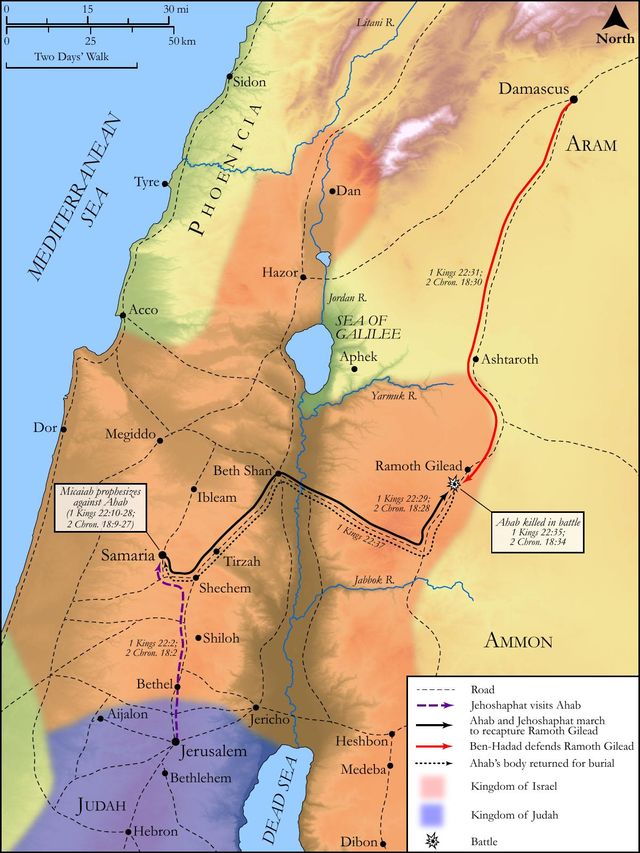
The events of 2 Chronicles 18 unfold during the turbulent 9th century BCE, a period of divided monarchy in Israel. King Ahab ruled the northern kingdom of Israel, notorious for his idolatry, particularly his promotion of Baal worship under the influence of his Phoenician wife, Jezebel. In contrast, King Jehoshaphat governed the southern kingdom of Judah, largely adhering to the worship of YHWH, though his alliance with Ahab represents a significant spiritual and political compromise. Ramoth-Gilead was a strategically vital city located in the Transjordan region, a frequent point of contention between Israel and the Aramean kingdom of Damascus due to its military and trade significance. In ancient Near Eastern royal courts, prophets often functioned as official advisors, tasked with interpreting divine will for the monarch, especially concerning military campaigns. While genuine prophets of YHWH existed, many also prophesied out of self-interest, fear of the king, or under the influence of pagan deities. The scene depicted in 2 Chronicles 18 vividly illustrates the widespread practice of consulting prophets before battle, but more significantly, it exposes the deep corruption and prevalence of false prophecy within Ahab's idolatrous court, where even those claiming to speak for "the LORD" (YHWH) were demonstrably out of alignment with His true, righteous will.
Key Themes
ShowHideSecond Chronicles 18:11 profoundly contributes to several overarching theological and narrative themes within the book and the broader biblical canon. The most prominent theme is the stark contrast between True and False Prophecy, underscoring the vital necessity of Spiritual Discernment. The unanimous declaration of the 400 prophets highlights that Unanimity Does Not Guarantee Truth; a multitude of voices, even if in complete agreement, can be profoundly misleading if not rooted in authentic divine revelation. The prophets' message, meticulously crafted to please King Ahab, powerfully illustrates the dangers of Flattery and Seeking Affirmation Over Truth, particularly for leaders who prefer comforting lies to challenging realities. Furthermore, the passage subtly reinforces the theme of Divine Sovereignty, as even the pronouncements of these false prophets inadvertently serve God's ultimate purpose of judgment upon Ahab, demonstrating that God's plans will prevail despite human deception and resistance. This narrative also touches upon the theme of Consequences of Compromise, exemplified by Jehoshaphat's alliance with Ahab, which nearly cost him his life 2 Chronicles 18:31.
Exposition and Analysis
ShowHideKey Word Analysis
ShowHideThe Hebrew noun נָבִיא (nâbîy') refers to a "prophet" or "inspired man," someone who speaks on behalf of a divine being. While the term itself is neutral regarding the truthfulness of the message, in this context, these are clearly identified as false prophets. Their sheer number (400) creates a deceptive sense of authority and consensus, yet their inspiration is not from YHWH, but from a "lying spirit" permitted by God to deceive Ahab, as revealed by Micaiah 2 Chronicles 18:21-22.
The Hebrew verb נָבָא (nâbâʼ') means "to prophesy," "to speak by inspiration," or "to act as a prophet." While it can describe genuine divine inspiration, as used for true prophets like Micaiah, in this specific context, it denotes a false or self-generated inspiration. The repeated action ("prophesied so") emphasizes the collective, uniform, yet ultimately deceitful nature of their pronouncements, a stark contrast to the singular, authentic voice of God's true messenger.
The Hebrew verb נָתַן (nâthan') is a common and versatile word meaning "to give," "to place," "to put," or "to deliver." Here, it is used to assert that "the LORD shall deliver [it] into the hand of the king," implying divine authorization and assistance for Ahab's conquest of Ramoth-Gilead. This claim of divine backing is the most insidious part of their false prophecy, as it misrepresents God's character and will, attributing a lie directly to Him to lend credibility to their deceptive words.
Verse Breakdown
ShowHide"And all the prophets prophesied so, saying,"
This opening clause immediately establishes the overwhelming consensus among Ahab's 400 court prophets. The phrase "prophesied so" indicates that they all delivered the same message, in agreement with one another and likely in accordance with what they knew the king desired to hear. This unanimity, far from being a sign of truth, is presented as a dangerous collective delusion, a powerful demonstration that popular opinion or widespread agreement does not validate a message if it is not rooted in divine truth.
"Go up to Ramothgilead, and prosper:"
This is the direct command and promise issued by the prophets. "Go up" is an imperative, a direct instruction to engage in the military campaign. The subsequent "and prosper" is a confident assurance of success and victory. This part of the prophecy is precisely what Ahab wanted to hear, confirming his strategic ambitions and bolstering his confidence, yet it stands in stark opposition to God's actual plan for him, as revealed through Micaiah.
"for the LORD shall deliver [it] into the hand of the king."
This final clause provides the purported divine justification for their optimistic prophecy. By invoking "the LORD" (YHWH), they attempt to lend ultimate authority and infallibility to their words, claiming that God Himself has guaranteed the city of Ramoth-Gilead's conquest and its delivery into Ahab's power. This attribution of a lie to God is the essence of false prophecy and demonstrates the profound spiritual deception at play in Ahab's court, where divine endorsement is falsely claimed to legitimize human ambition.
Literary Devices
ShowHideThe verse employs several potent Literary Devices to convey its message and foreshadow the unfolding drama. Irony is profoundly present, as the prophets, claiming to speak for the LORD (YHWH), deliver a message that is diametrically opposed to God's true will, ultimately leading to the king's demise rather than the promised prosperity. This sets up a dramatic Foreshadowing of Ahab's tragic end at Ramoth-Gilead, despite the optimistic pronouncements. The collective voice of "all the prophets" creates a powerful Contrast with the solitary, unpopular, yet truthful voice of Micaiah, who later reveals God's true message, emphasizing the often-lonely nature of genuine prophetic truth. The Repetition implied by "prophesied so" (all speaking the same message) highlights the overwhelming, yet ultimately false, consensus, illustrating the danger of an echo chamber where inconvenient truths are suppressed in favor of agreeable lies, and demonstrating the corrupting influence of a desire to please human authority over divine truth.
Theological and Thematic Connections
ShowHideThis passage serves as a profound theological warning against the dangers of false prophecy and the critical importance of spiritual discernment. It underscores that God's truth often runs counter to popular opinion, personal desires, or even the consensus of religious authorities. The willingness of these prophets to speak a lie in the name of the LORD, motivated by fear, self-interest, or a desire for royal favor, highlights the corrupting influence of power and the human tendency to prefer comforting affirmations over challenging truths. This narrative compels believers to rigorously test all claims of divine revelation against the established Word of God, recognizing that genuine spiritual prosperity comes not from hearing what we want to hear, but from humbly submitting to what God has truly spoken, regardless of its popularity or personal cost. It reminds us that truth is not determined by majority vote but by divine revelation.
Reflection and Application
ShowHideThe scene in 2 Chronicles 18:11 offers timeless lessons for believers today, particularly in an age saturated with information and diverse voices. The ability to discern truth from falsehood is not merely an academic exercise but a spiritual imperative for navigating life faithfully. We are constantly barraged by messages, both secular and spiritual, that promise prosperity, comfort, or success, often appealing directly to our desires rather than challenging our assumptions. This passage calls us to cultivate a profound spiritual sensitivity, recognizing that the most agreeable message is not always the most truthful, nor is the most popular voice necessarily the voice of God. It warns against the allure of echo chambers, where we surround ourselves only with those who validate our existing beliefs, thereby insulating ourselves from potentially uncomfortable but necessary truths. True wisdom and spiritual growth often come from engaging with voices that challenge us, always weighing them against the unchanging standard of God's revealed Word, which is the ultimate arbiter of truth. Our ultimate allegiance must be to God's truth, even when it is unpopular, inconvenient, or demands a radical reorientation of our lives.
Questions for Reflection
ShowHideFAQ
ShowHideWhy did King Ahab listen to these 400 prophets if they were false?
ShowHideKing Ahab likely listened to these prophets because their message perfectly aligned with his desires and strategic ambitions. He desperately wanted to reclaim Ramoth-Gilead, and they promised him success and divine backing. Human nature, especially for those in positions of power, often inclines towards hearing comforting lies that affirm existing plans rather than challenging truths that might require a change of course or expose unpleasant realities. Ahab had a long history of rejecting true prophets like Elijah and Micaiah, whose messages often brought condemnation or unfavorable news. The 400 false prophets, by contrast, were "yes-men" who knew how to appease the king, possibly out of fear or for personal gain, thereby creating an environment where truth was unwelcome and deception flourished.
What was the significance of Ramoth-Gilead in this narrative?
ShowHideRamoth-Gilead was a strategically important city located in the Transjordan region, east of the Jordan River. It was part of the territory originally allocated to the tribe of Gad and was designated as a city of refuge Deuteronomy 4:43. At this time, it was under Aramean (Syrian) control, and Ahab sought to reclaim it as part of Israel's territory. Its significance was not just geographical or military; it represented a point of national pride and a frequently contested border. The battle for Ramoth-Gilead became the focal point where the clash between false prophecy and divine truth played out, ultimately leading to Ahab's demise as prophesied by Micaiah, making it a place of both strategic importance and divine judgment.
How does this passage relate to King Jehoshaphat's character?
ShowHideThis passage highlights a complex and somewhat contradictory aspect of King Jehoshaphat's character. On one hand, his insistence on inquiring of the LORD before battle 2 Chronicles 18:4 demonstrates his piety and commitment to seeking divine guidance, a commendable trait that sharply contrasts with Ahab's general disregard for YHWH. This action is consistent with his overall righteous reign, during which he removed idolatry and promoted the worship of God in Judah 2 Chronicles 17:3-6. However, his willingness to form an alliance with the wicked King Ahab in the first place, and his initial acceptance of the 400 false prophets' message, reveals a significant compromise of his principles. While he sought the Lord, he also put himself in a compromising position by aligning with a king who consistently defied God, leading to a near-fatal encounter for Jehoshaphat himself in the battle 2 Chronicles 18:31, serving as a warning against unholy alliances.
Christ-Centered Fulfillment
ShowHideThe deceptive chorus of prophets in 2 Chronicles 18:11, promising prosperity and divine favor that never materialized, stands in stark contrast to Jesus Christ, the ultimate and true Prophet. While these 400 voices spoke what Ahab wanted to hear, leading him to destruction, Jesus consistently spoke the unvarnished truth, even when it was challenging or unpopular, leading His followers to eternal life. He is the one whom God raised up, as foretold in Deuteronomy 18:15, and whose words are "spirit and life" John 6:63. Unlike the false prophets who claimed divine backing for their own agenda, Jesus perfectly embodied and revealed the Father's will, declaring, "I am the way, and the truth, and the life; no one comes to the Father except through me" John 14:6. He exposed the lies of the devil, the "father of lies" John 8:44, and offered a kingdom not of this world, where true prosperity is found not in earthly conquest but in spiritual transformation and reconciliation with God through His sacrifice John 18:36. In Christ, we find the definitive voice of God, never flattering, always truthful, and eternally life-giving, fulfilling the longing for a prophet who would truly deliver God's word without deception, and ultimately securing eternal victory for all who believe.