


2 Chronicles 18:12
- וְהַמַּלְאָךְve·ha·mal·'Akhand the messengerH4397Conj-w ¦ Art ¦ N-msNoun Singular Masculine Absoluteוְandהַtheמַּלְאָךְmessenger
- אֲשֶׁר'a·SherwhoH834RelParticle Relative
- הָלַךְha·Lakhhe had goneH1980V-Qal-Perf-3msVerb Qal Perfect 3rd Singular Masculine
- לִקְרֹאlik·Ro'to summonH7121Prep-l ¦ V-Qal-InfVerb Qal Infinitive Constructלִtoקְרֹאsummon
- לְמִיכָיְהוּle·mi·Kha·ye·hu<to> MicaiahH4321Prep-l ¦ N-proper-mNoun Proper Masculineלְ<to>מִיכָיְהוּMicaiah
- דִּבֶּרdi·Berhe spokeH1696V-Piel-Perf-3msVerb Piel Perfect 3rd Singular Masculine
- אֵלָיו'e·Lavto himH413Prep ¦ 3msPrepositionאֵלָיtoוhim
- לֵאמֹרle·Mor<to> sayingH559Prep-l ¦ V-Qal-InfVerb Qal Infinitive Constructלֵ<to>אמֹרsaying
- הִנֵּהhi·Nehhere!H2009PrtParticle Interjection
- דִּבְרֵיdiv·Rei[the] words ofH1697N-mpcNoun Plural Masculine Construct
- הַנְּבִאִיםha·ne·vi·'Imthe prophetsH5030Art ¦ N-mpNoun Plural Masculine Absoluteהַtheנְּבִאִיםprophets
- פֶּהpeha mouthH6310N-msNoun Singular Masculine Absolute
- אֶחָד'e·ChadoneH259N-fsNoun Singular Feminine Absolute
- טוֹבTov[is] goodH2896Adj-msAdjective Singular Masculine Absolute
- אֶל'elconcerningH413PrepPreposition
- הַמֶּלֶךְha·Me·lekhthe kingH4428Art ¦ N-msNoun Singular Masculine Absoluteהַtheמֶּלֶךְking
- וִיהִיvi·hiand let it beH1961Conj-w ¦ V-Qal-Imperf-3msVerb Qal Imperfect 3rd Singular Masculineוִandיהִיlet it be
- נָאna'pleaseH4994PrtParticle Interjection
- דְבָרְךָde·va·re·Khayour wordH1697N-msc ¦ 2msNoun Singular Masculine Constructדְבָרְwordךָyour
- כְּאַחַדke·'a·Chadlike oneH259Prep-k ¦ N-fsNoun Singular Feminine Absoluteכְּlikeאַחַדone
- מֵהֶםme·Hemfrom themPrep-m ¦ 3mpSuffix Personal 3rd Plural Masculineמֵfromהֶםthem
- וְדִבַּרְתָּve·di·Bar·taand you will speakH1696Conj-w ¦ V-Piel-ConsecPerf-2msVerb Piel Consecutive Perfect 2nd Singular Masculineוְandדִבַּרְתָּyou will speak
- טּוֹבTovgoodH2896Adj-msAdjective Singular Masculine Absolute
English is a literal word-by-word gloss of the Hebrew, not the KJV's wording. Why?
This is the original text the KJV's translators worked from — each Hebrew word with its own literal English meaning in this verse, prepared by scholars at Tyndale House, Cambridge. The KJV translates whole sentences, not word by word, so its wording differs: one Hebrew word can become several English words, and the KJV may choose “the LORD” where the gloss reads “Yahweh”. Both are faithful — they answer different questions. For the KJV's own rendering, switch to the KJV text.
Details
See on the biblical-era map
Study this verse
Public-domain commentary
Matthew Henry
From his Commentary on the Whole Bible. Henry comments on passages, not single verses — this entry covers 2 Chronicles 18:4–27.
This is almost word for word the same with what we had, 1 Kings 22. We will not repeat what was there said, nor have we much to add, but may take occasion to think, 1. Of the great duty of acknowledging God in all our ways and enquiring at his word, whatever we undertake. Jehoshaphat was not willing to proceed till he had done this, Ch2 18:4. By particular believing prayer, by an unbiased consultation of the scripture and our own consciences, and by an observant regard to the hints of providence, we may make such enquiries and very much to our satisfaction. 2. Of the great danger of bad company even to good men. Those that have more wisdom, grace, and resolution, cannot be sure that they can converse familiarly with wicked people and get no hurt by them. Jehoshaphat here, in complaisance to Ahab, sits in his robes, patiently hearing the false prophets speaking lies in the name of the Lord (Ch2 18:9), can scarcely find in his heart to give him a too mild and gentle reproof for hating a prophet of the Lord (Ch2 18:7), and dares not rebuke that false prophet who basely abused the faithful seer nor oppose Ahab who committed him to prison. Those who venture among the seats of the scornful cannot come off without a great deal of the guilt attaching to at least the omission of their duty, unless they have such measures of wisdom and courage as few can pretend to. 3. Of the unhappiness of those who are surrounded with flatterers, especially flattering prophets, who cry peace to them and prophesy nothing but smooth things. Thus was Ahab cheated into his ruin, and justly; for he hearkened to such, and preferred those that humoured him before a good prophet that gave him fair warning of his danger. Those do best for themselves that give their friends leave, and particularly their ministers, to deal plainly and faithfully with them, and take their reproofs not only patiently, but kindly. That counsel is not always best for us that is most pleasing to us. 4. Of the power of Satan, by the divine permission, in the children of disobedience. One lying spirit can make 400 lying prophets and make use of them to deceive Ahab, Ch2 18:21. The devil becomes a murderer by being a liar and destroys men by deceiving them. 5. Of the justice of God in giving those up to strong delusions, to believe a lie, who will not receive the love of the truth, but rebel against it, Ch2 18:21. Let the lying spirit prevail to entice those to their ruin that will not be persuaded to their duty and happiness. 6. Of the hard case of faithful ministers, whose lot it has often been to be hated, and persecuted, and ill-treated, for being true to their God and just and kind to the souls of men. Micaiah, for discharging a good conscience, was buffeted, imprisoned, and condemned to the bread and water of affliction. But he could with assurance appeal to the issue, as all those may do who are persecuted for their faithfulness, Ch2 18:27. The day will declare who is in the right and who in the wrong, when Christ will appear, to the unspeakable consolation of his persecuted people and the everlasting confusion of their persecutors, who will be made to see in that day (Ch2 18:24) what they will not now believe.
Continue studying 2 Chronicles 18:12 across the web’s major study libraries — every link below opens this exact verse, chapter, or book on the destination site.
Read & Compare
 BibleGatewayThis verse in more than 200 translations and 70 languages.
 Bible.comThe YouVersion reader — hundreds of translations, reading plans, and highlights.
 ESV.orgCrossway's official English Standard Version reader.
 NET BibleThe NET translation with 60,000+ translators' notes on every rendering decision.
 STEP BibleTyndale House's free study tool — original text, vocabulary, and scholarly resources.
 BibliaLogos Bible Software's free web reader.
 USCCBThe New American Bible (Revised Edition) with the U.S. bishops' study notes.
Commentaries
 BibleHub CommentariesDozens of classic commentaries on this verse, gathered on one page.
 StudyLightMore than 100 commentary sets — the largest collection on the web.
 BibleRefPlain-English commentary on what this verse means, verse by verse.
 Enduring WordDavid Guzik's free commentary on this chapter, widely used by Bible teachers.
 Bible Study ToolsVerse commentary alongside Greek and Hebrew study aids.
Original Language & Research
- BibleHub InterlinearThe verse word by word — original language, transliteration, and English.
- BibleHub LexiconEvery word's original-language definition and Strong's entry.
 Blue Letter BibleDeep-study tools — Strong's numbers, concordance, and word studies.
 SefariaThe Hebrew text with Rashi and centuries of Jewish commentary.
Sermons, Hymns & Audio


TrulyRandomVerse is not affiliated with these sites and doesn’t control their content. They’re linked because they’re genuinely useful.
Summary
2 Chronicles 18:12 vividly portrays the intense pressure exerted upon the prophet Micaiah by a royal messenger, who urges him to align his prophetic declaration with the unanimous, favorable pronouncements of 400 other prophets. This pivotal moment sets the stage for a profound confrontation between divine truth and human consensus, highlighting the perennial temptation to prioritize agreeable messages over challenging realities and underscoring the vital nature of authentic spiritual integrity in the face of political and social expediency.
Context
ShowHideLiterary Context
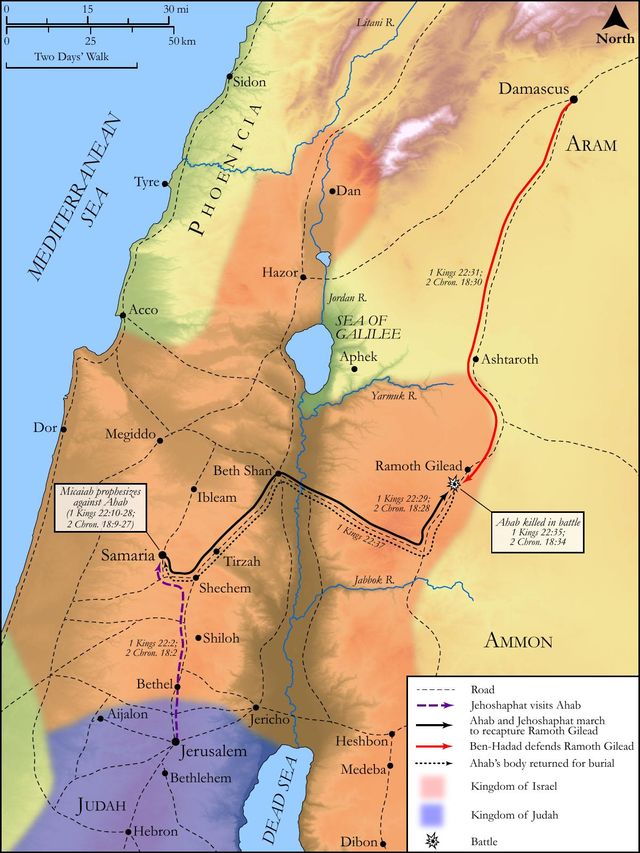
This verse is strategically placed within the dramatic narrative of Kings Ahab of Israel and Jehoshaphat of Judah's proposed military alliance to reclaim Ramoth-Gilead. King Jehoshaphat, known for his righteousness, insists on inquiring of the Lord before committing to battle, despite Ahab's 400 court prophets having already delivered a unified message of victory. Ahab, who despises Micaiah for consistently speaking unpleasant truths, reluctantly agrees to summon him. The messenger's direct appeal to Micaiah in this verse occurs as Micaiah is being brought before the kings, serving as a critical attempt to manipulate the prophetic outcome and ensure a politically convenient message. This scene immediately precedes Micaiah's initial sarcastic agreement with the false prophets, followed by his devastatingly true prophecy of Ahab's defeat and death, as detailed in 2 Chronicles 18:16-27. The narrative tension is palpable, building towards the inevitable clash between truth and deception.
Historical & Cultural Context
In ancient Israel, prophets held a unique and often precarious position as God's direct spokespersons, frequently challenging the authority of kings and popular opinion. Monarchs often maintained court prophets, whose loyalty and messages could be compromised by their dependence on royal patronage. The confrontation in 2 Chronicles 18 exemplifies the inherent tension between true prophets, who delivered Yahweh's unvarnished word, and false prophets, who often prophesied what was politically expedient or personally pleasing to the ruler. Culturally, there was an expectation for prophets to bless military campaigns, especially when kings sought divine approval for their ventures. Ramoth-Gilead itself was a strategically vital city in Transjordan, a frequent point of contention between Israel and Aram (Syria), making its recapture a significant political and military objective for Ahab. The messenger's words underscore the immense social and political pressure on Micaiah to conform to the prevailing narrative, a pressure that could have severe consequences, including imprisonment or worse, for non-compliance.
Key Themes
ShowHideThe central themes illuminated by this verse are the nature of true prophecy versus false prophecy, emphasizing that God's word frequently runs counter to human desires, political convenience, or popular consensus. It powerfully illustrates the pressure to conform, showing how individuals, even those in positions of spiritual authority, can be swayed by the desire for approval, fear of rejection, or the allure of an easy path. The messenger's plea highlights the danger of seeking agreeable messages over uncomfortable truths, a timeless human inclination that can lead to self-deception and disastrous outcomes. Furthermore, it foreshadows the cost of integrity for those who choose to speak God's truth, regardless of the consequences, as Micaiah's subsequent imprisonment demonstrates in 2 Chronicles 18:26. This moment also subtly introduces the theme of divine sovereignty over human plans and deceptive schemes, as God's true word, delivered through Micaiah, ultimately prevails over the multitude of false prophecies and human machinations, leading to Ahab's downfall as prophesied in 2 Chronicles 18:34.
Exposition and Analysis
ShowHideKey Word Analysis
ShowHideThe KJV translates "with one assent" from the Hebrew phrase peh echad (פֶּה אֶחָד), which literally means "one mouth" or "united mouth." The word peh (H6310) refers to the mouth, often figuratively representing speech or utterance, while echad (H259) means "one" or "united." This combination emphasizes the remarkable and suspicious unanimity of the 400 prophets. It suggests a coordinated, singular voice, which, while seemingly impressive and persuasive to the messenger, is presented in the broader narrative as a sign of their deception. True divine revelation often challenges human expectations and popular opinion, rarely manifesting as such a convenient, uncritical consensus. The messenger uses this collective agreement to pressure Micaiah, implying that such widespread affirmation must be correct and should not be gainsaid.
The word ṭôwb (טוֹב) is a broad term meaning "good," "pleasant," "favorable," "beneficial," or "prosperous." In this context, it refers to the content of the prophecy: a declaration of success and victory for the king. The messenger's insistence that Micaiah "speak thou good" reveals a desire not for objective truth, but for a message that is palatable, politically advantageous, and comforting to the king. This superficial "good" stands in stark contrast to the profound, often uncomfortable, "good" of God's true word, which aims for ultimate righteousness, justice, and spiritual well-being, even if it brings immediate hardship or confronts sin.
The verb dâbar (דָּבַר) is a primitive root meaning "to speak," "to declare," "to command," or "to arrange words." It encompasses the act of verbal communication in a wide variety of applications. In this verse, it is used imperatively, "speak thou good," forming a direct command or earnest plea to Micaiah to utter a favorable prophecy. This encapsulates the core of the messenger's persuasive attempt: to manipulate Micaiah into delivering a message that aligns with the consensus and pleases the king, rather than one rooted in independent, divine revelation. The messenger is not asking Micaiah to genuinely seek God's word, but to conform his utterance to a predetermined, desirable outcome.
Verse Breakdown
ShowHide"And the messenger that went to call Micaiah spake to him, saying,"
This opening clause establishes the immediate dramatic setting and introduces the agent of pressure. The messenger is not merely a neutral summons-bearer but an active participant in the attempt to influence Micaiah. His direct address highlights the urgency and the personal nature of the impending confrontation, underscoring that Micaiah is about to enter a high-stakes environment where his words will have significant consequences.
"Behold, the words of the prophets [declare] good to the king with one assent;"
This is the crux of the messenger's argument and the foundation of his plea. He presents the unanimous positive declarations of the 400 court prophets as an undeniable truth or a compelling precedent. The phrase "with one assent" (literally "with one mouth") emphasizes the absolute, unified agreement among them, implying that such a united front must be divinely sanctioned or, at the very least, politically wise to emulate. This statement serves as both a factual report and a subtle, yet powerful, form of intimidation, suggesting that any deviation would be seen as contrarian, disloyal, or even foolish.
"let thy word therefore, I pray thee, be like one of theirs, and speak thou good."
This is the direct, explicit plea for conformity. The messenger explicitly asks Micaiah to abandon his independent prophetic voice and instead echo the pleasing, favorable message of the other prophets. The addition of "I pray thee" adds a layer of earnestness, perhaps even desperation, to the request, underscoring the high stakes involved for the king and, by extension, for the messenger himself. The repetition of "speak thou good" reinforces the singular desire for a favorable outcome, regardless of its truthfulness, revealing a profound misunderstanding or deliberate subversion of the prophetic office.
Literary Devices
ShowHideThe verse is rich with Dramatic Irony, as the audience knows (or will soon discover) that the unanimous "good" spoken by the 400 prophets is a lie, orchestrated by a lying spirit from God (as revealed in 2 Chronicles 18:22). The messenger's earnest plea for Micaiah to "speak thou good" thus becomes tragically ironic, as it unwittingly urges him towards deception rather than truth. The verse also employs Foreshadowing, subtly hinting at the dramatic confrontation to come between Micaiah's singular, truthful prophecy and the collective falsehood of the court prophets. The Contrast between the "one assent" of the many false prophets and the anticipated singular, dissenting voice of Micaiah is stark and deliberate, setting up the central conflict of the chapter. Finally, the messenger's words are a clear example of Persuasion, attempting to manipulate Micaiah through an appeal to consensus, social pressure, and the desire for royal favor, rather than through an appeal to divine truth or prophetic integrity.
Theological and Thematic Connections
ShowHide2 Chronicles 18:12 serves as a profound theological statement on the nature of truth, the integrity of prophetic ministry, and the dangers of human consensus overriding divine revelation. It underscores that God's truth is not determined by popular vote, political expediency, or human comfort. The immense pressure exerted on Micaiah highlights the constant human temptation to suppress uncomfortable truths in favor of agreeable falsehoods, a tendency that can corrupt both individuals and institutions. True prophecy, and by extension, all authentic spiritual leadership, demands unwavering faithfulness to God's revealed word, even when it incurs personal cost or societal rejection. This verse challenges believers to cultivate deep discernment, rigorously testing all messages against the unchanging standard of God's Word, rather than succumbing to the allure of popular consensus or personal convenience. It reminds us that genuine spiritual nourishment often comes through challenging, rather than merely comforting, truths, and that integrity in proclaiming God's message is paramount.
Reflection and Application
ShowHideThis verse offers timeless lessons for believers navigating a world often hostile to truth. Like Micaiah, we frequently face immense pressure to conform our words or actions to prevailing opinions, whether in our workplaces, social circles, or even within religious communities. The messenger's plea reminds us that the desire for "good" news, however superficial or self-serving, can easily overshadow the pursuit of genuine, sometimes challenging, truth. This calls us to cultivate a deep commitment to biblical discernment, rigorously testing all messages against the unchanging standard of God's Word, rather than succumbing to the allure of popular consensus or personal convenience. It challenges us to consider the cost of integrity and to be willing to stand alone for what is right, even when it means facing opposition, discomfort, or rejection. Ultimately, 2 Chronicles 18:12 encourages us to prioritize faithfulness to God above all else, trusting that His truth, though sometimes difficult, is always ultimately for our true good and His glory, leading to genuine flourishing even amidst adversity.
Questions for Reflection
ShowHideFAQ
ShowHideWhy did the messenger try to influence Micaiah?
ShowHideThe messenger's attempt to influence Micaiah stemmed primarily from a desire to maintain the political stability and military morale of the allied kings, particularly King Ahab. Having witnessed the unanimous, positive prophecies of the 400 court prophets, the messenger likely believed that a dissenting voice from Micaiah would disrupt the perceived divine favor and potentially undermine the kings' confidence in their military campaign against Ramoth-Gilead. He was probably acting out of loyalty to the king and a practical concern for the immediate political climate, rather than a malicious intent to deceive. He wanted Micaiah to deliver a message that was "good" (favorable) and consistent with the prevailing narrative, thereby avoiding any uncomfortable truths that might displease the king or jeopardize the alliance, as detailed in 2 Chronicles 18:11. His actions reflect the common human tendency to prefer pleasant illusions over harsh realities.
What was the significance of "one assent" in the messenger's plea?
ShowHideThe phrase "one assent" (Hebrew: peh echad, "one mouth") highlights the absolute unanimity of the 400 prophets in their declaration of victory for King Ahab. This collective agreement served as a powerful rhetorical device for the messenger. In ancient cultures, a unified voice often carried significant weight, implying divine consensus or overwhelming certainty. The messenger used this apparent solidarity to pressure Micaiah, suggesting that such widespread agreement must be correct and that Micaiah should not contradict it. Theologically, however, this "one assent" is ironically a sign of their falsehood, as true prophecy often stands alone against popular opinion, challenging the status quo, as Micaiah's subsequent truthful, yet unpopular, prophecy demonstrates in 2 Chronicles 18:16-27. The narrative uses this unanimity to underscore the deceptive nature of the false prophets and the unique courage of the true prophet.
Christ-Centered Fulfillment
ShowHideThe prophetic integrity displayed by Micaiah in 2 Chronicles 18:12, despite immense pressure to conform, powerfully foreshadows the ultimate prophet, Jesus Christ. Micaiah was urged to "speak good" and align his message with the pleasing consensus of the many, yet he chose to speak the truth, even though it led to his imprisonment and Ahab's demise. Similarly, Jesus, the very embodiment of truth, consistently spoke the Father's words, which often challenged the religious and political establishments of His day. He did not seek to please men, as He declares in John 8:45 and John 14:6, but rather declared the full counsel of God, even when it meant confronting hypocrisy (Matthew 23) or foretelling His own suffering and death (Mark 8:31). Like Micaiah, Christ's message was often rejected by the majority (John 1:11), and He faced the ultimate consequence for speaking God's unvarnished truth: crucifixion. Yet, through His unwavering faithfulness, Jesus became the Lamb of God who takes away the sin of the world (John 1:29), demonstrating that true "good" from God often comes through confrontation with sin and costly sacrifice, leading to ultimate victory and eternal life for all who believe, as promised in John 3:16).