


Joshua 9:2
Bible text: King James Version (1769 Blayney text) · Public domain
Bible text: Berean Standard Bible · Public domain
Bible text: American Standard Version (1901) · Public domain
Bible text: World English Bible, Messianic edition · Public domain
Bible text: Geneva Bible (1599) · Public domain
Bible text: Young's Literal Translation · Public domain
- וַיִּתְקַבְּצוּvai·yit·ka·be·Tzuand they gathered togetherH6908Conj-w ¦ V-Hithpael-ConsecImperf-3mpVerb Hithpael Consecutive Imperfect 3rd Plural Masculineוַandיִּתְקַבְּצוּthey gathered together
- יַחְדָּוyach·Davall togetherH3162AdvAdverb
- לְהִלָּחֵםle·hi·la·Chemto wage warH3898Prep-l ¦ V-Niphal-InfVerb Niphal Infinitive Constructלְtoהִלָּחֵםwage war
- עִם'imwithH5973PrepPreposition
- יְהוֹשֻׁעַye·ho·Shu·a'JoshuaH3091N-proper-mNoun Proper Masculine
- וְעִםve·'imand withH5973Conj-w ¦ PrepPrepositionוְandעִםwith
- יִשְׂרָאֵלYis·ra·'ElIsraelH3478N-properNoun Proper Location
- פֶּהpehmouthH6310N-msNoun Singular Masculine Absolute
- אֶחָד'e·ChadoneH259Adj-fsAdjective Numerical Singular Feminine Absolute
English is a literal word-by-word gloss of the Hebrew, not the KJV's wording. Why?
This is the original text the KJV's translators worked from — each Hebrew word with its own literal English meaning in this verse, prepared by scholars at Tyndale House, Cambridge. The KJV translates whole sentences, not word by word, so its wording differs: one Hebrew word can become several English words, and the KJV may choose “the LORD” where the gloss reads “Yahweh”. Both are faithful — they answer different questions. For the KJV's own rendering, switch to the KJV text.
Details
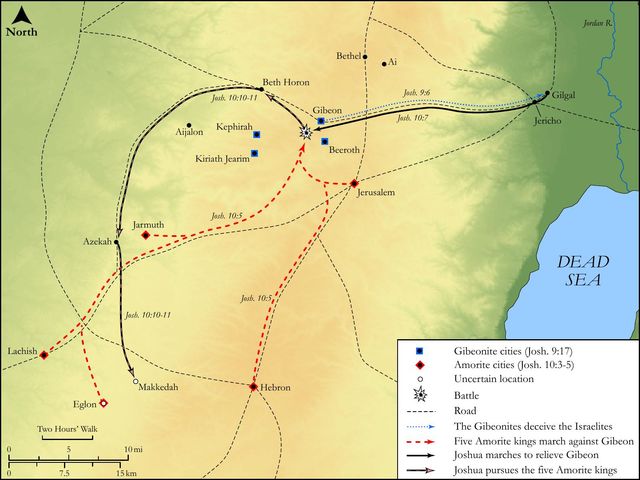
See on the biblical-era map
Study this verse
Public-domain commentary
Matthew Henry
From his Commentary on the Whole Bible. Henry comments on passages, not single verses — this entry covers Joshua 9:1–2.
Hitherto the Canaanites had acted defensively; the Israelites were the aggressors upon Jericho and Ai. But here the kings of Canaan are in consultation to attack Israel, and concert matters for a vigorous effort of their united forces to check the progress of their victorious arms. Now, 1. It was strange they did not do this sooner. They had notice long since of their approach; Israel's design upon Canaan was no secret; one would have expected that a prudent concern for their common safety would put them upon taking some measures to oppose their coming over Jordan, and maintain that pass against them, or to give them a warm reception as soon as they were over. It was strange they did not attempt to raise the siege of Jericho, or at least fall in with the men of Ai, when they had given them a defeat. But they were, either through presumption or despair, wonderfully infatuated and at their wits' end. Many know not the things that belong to their peace till they are hidden from their eyes. 2. It was more strange that they did it now. Now that the conquest of Jericho had given such a pregnant proof of God's power, and that of Ai of Israel's policy, one would have thought the end of their consultation should be, not to fight with Israel, but to make peace with them, and to gain the best terms they could for themselves. This would have been their wisdom (Luk 14:32), but their minds were blinded, and their hearts hardened to their destruction. Observe, (1.) What induced them now at last to enter upon this consultation. When they heard thereof (Jos 9:1), not only of the conquest of Jericho and Ai, but of the convention of the states of Mount Ebal, of which we have an account immediately before, - when they heard that Joshua, as if he thought himself already completely master of the country, had had all his people together, and had read the laws to them by which they must be governed, and taken their promises to submit to those laws, - then they perceived the Israelites were in good earnest, and thought it was high time for them to bestir themselves. The pious devotion of God's people sometimes provokes and exasperates their enemies more than any thing else. (2.) How unanimous they were in their resolves. Though they were many kings of different nations, Hittites, Amorites, Perizzites, etc., doubtless of different interests, and that had often been at variance one with another, yet they determined, nemine contradicente - unanimously, to unite against Israel. O that Israel would learn this of Canaanites, to sacrifice private interests to the public welfare, and to lay aside all animosities among themselves, that they may cordially unite against the common enemies of God's kingdom among men!
Historical interpretation
Historical reception
1 surviving comment on this verse from the historical church.
The narrative of the exploits is clear, and what is plainly expressed does not need explanation. Nevertheless, out of these visible things that were done, let us consider the wars and triumphs that the Lord Jesus, our Savior, led, although we may also perceive these things to be visibly fulfilled in him. For the kings of the earth have assembled together, the senate and the people and the leaders of Rome, to blot out the name of Jesus and Israel at the same time. For they have decreed in their laws that there be no Christians. Every city, every class, attacks the name of Christians. But just as at that time all those kings assembling against Jesus [Joshua] were able to do nothing, so even now, whether princes or those opposing authorities, they have been able to do nothing to prevent the race of Christians from being propagated more widely and profusely. For it is written, “The more greatly they abased them, the more they multiplied and they increased mightily.”
Continue studying Joshua 9:2 across the web’s major study libraries — every link below opens this exact verse, chapter, or book on the destination site.
Read & Compare
 BibleGatewayThis verse in more than 200 translations and 70 languages.
 Bible.comThe YouVersion reader — hundreds of translations, reading plans, and highlights.
 ESV.orgCrossway's official English Standard Version reader.
 NET BibleThe NET translation with 60,000+ translators' notes on every rendering decision.
 STEP BibleTyndale House's free study tool — original text, vocabulary, and scholarly resources.
 BibliaLogos Bible Software's free web reader.
 USCCBThe New American Bible (Revised Edition) with the U.S. bishops' study notes.
Commentaries
 BibleHub CommentariesDozens of classic commentaries on this verse, gathered on one page.
 StudyLightMore than 100 commentary sets — the largest collection on the web.
 BibleRefPlain-English commentary on what this verse means, verse by verse.
 Enduring WordDavid Guzik's free commentary on this chapter, widely used by Bible teachers.
 Bible Study ToolsVerse commentary alongside Greek and Hebrew study aids.
Original Language & Research
- BibleHub InterlinearThe verse word by word — original language, transliteration, and English.
- BibleHub LexiconEvery word's original-language definition and Strong's entry.
 Blue Letter BibleDeep-study tools — Strong's numbers, concordance, and word studies.
 SefariaThe Hebrew text with Rashi and centuries of Jewish commentary.
Sermons, Hymns & Audio


TrulyRandomVerse is not affiliated with these sites and doesn’t control their content. They’re linked because they’re genuinely useful.
Summary
Joshua 9:2 describes the unified and resolute response of the Canaanite kings and peoples upon hearing of Israel's formidable victories at Jericho and Ai. This verse marks a pivotal moment, illustrating the widespread fear and the desperate, collective decision of these diverse nations to set aside their internal conflicts and form a grand alliance to militarily confront Joshua and the Israelites "with one accord." It establishes the primary human opposition that Israel would face in its divinely mandated task of possessing the land, contrasting sharply with the Gibeonites' later strategy of deception.
Context
ShowHideLiterary Context
This verse immediately follows the list of Canaanite peoples and kings who heard of Israel's conquests, as detailed in Joshua 9:1. Specifically, the narrative refers to the miraculous fall of Jericho and the strategic victory at Ai. The narrative flow establishes the widespread terror and awe that Israel's God-backed power inspired throughout the land. While the previous chapters detailed Israel's offensive actions, Joshua 9:2 shifts the focus to the unified defensive reaction of the indigenous inhabitants. This collective decision to fight stands in stark contrast to the Gibeonites' subsequent cunning strategy of deception, which is introduced in the very next verses, highlighting the various forms of opposition Israel encountered in its conquest.
Historical & Cultural Context
The land of Canaan in the days of Joshua was not a unified empire but a collection of independent city-states, each ruled by its own king. These city-states often engaged in rivalries and conflicts amongst themselves, making large-scale, unified military alliances rare and difficult to sustain. The formation of such a grand alliance, as described in Joshua 9:2, was an extraordinary event, driven by an existential threat. The news of Israel's devastating victories, particularly the supernatural elements involved (like the collapse of Jericho's walls), would have spread quickly via trade routes and messengers, instilling profound fear. The cultural context suggests that such a unified military response, overcoming traditional rivalries, underscored the sheer desperation and perceived overwhelming power of the invading Israelites.
Key Themes
ShowHideJoshua 9:2 powerfully illustrates several key themes within the book of Joshua. Firstly, it highlights the unified opposition to God's plan for Israel to inherit the land. Despite their internal divisions, the Canaanite kings' "one accord" demonstrates a concerted, human-orchestrated resistance against divine will. Secondly, it underscores the desperation and fear that Israel's God-empowered advance instilled in the inhabitants. This fear, born from the destruction of Jericho and Ai, compelled disparate nations to unite for survival. Finally, the verse subtly introduces the theme of human resistance vs. divine sovereignty. Even the most formidable human alliance, as formidable as it appeared, would ultimately prove incapable of thwarting God's unwavering purpose to give the land to His chosen people, a theme echoed throughout the conquest narratives (e.g., Joshua 11:20).
Exposition and Analysis
ShowHideKey Word Analysis
ShowHideMeaning "to grasp, i.e. collect; assemble (selves), gather (bring) (together, selves together, up), heap, resort, [idiom] surely, take up." This verb indicates a deliberate, organized assembly of various kings and peoples. It implies a strategic convocation, not a spontaneous or chaotic gathering, highlighting the intentionality behind their unified front. The act of "gathering" signifies the initial step in forming their formidable alliance.
Meaning "to feed on; figuratively, to consume; by implication, to battle (as destruction); devour, eat, [idiom] ever, fight(-ing), overcome, prevail, (make) war(-ring)." This word clearly defines the aggressive, destructive intent of the Canaanite alliance. It emphasizes that their gathering was not for negotiation or retreat, but for direct military confrontation, aiming to consume or destroy the Israelite threat. This highlights the existential nature of the conflict from their perspective.
Meaning "the mouth (as the means of blowing), whether literal or figurative (particularly speech); specifically edge, portion or side; adverbially (with preposition) according to; accord(-ing as, -ing to), after, appointment, assent, collar, command(-ment), [idiom] eat, edge, end, entry, [phrase] file, hole, [idiom] in, mind, mouth, part, portion, [idiom] (should) say(-ing), sentence, skirt, sound, speech, [idiom] spoken, talk, tenor, [idiom] to, [phrase] two-edged, wish, word." In the phrase "with one accord" (Hebrew, k'peh echad'), the word peh literally means "mouth." The idiom "as one mouth" or "with one mouth" (combining peh with ʼechâd, H259 "one") signifies complete unanimity, a singular purpose, and a shared voice in their decision-making. It implies a deep, collective resolve and a unified strategy, transcending the typical rivalries of Canaanite city-states. This phrase emphasizes the extraordinary nature of their unity in the face of an existential threat, making their opposition particularly formidable.
Verse Breakdown
ShowHide"That they gathered themselves together,"
This clause describes the physical assembly of the various kings and peoples mentioned in Joshua 9:1. The verb "gathered" implies a deliberate, organized convocation, likely involving diplomatic efforts and agreements among previously independent or even antagonistic entities, driven by the common threat of Israel. This was a strategic mobilization, not a chaotic flight.
"to fight with Joshua and with Israel,"
This phrase clearly states the explicit, aggressive purpose of their gathering: military confrontation. It identifies the target of their unified aggression as both Joshua, as the leader and military commander, and the entire nation of Israel, signifying a total war against the invading force. This highlights the direct challenge posed to God's plan for His people to possess the land, framing the conflict as a direct clash of wills.
"with one accord."
As discussed in the key word analysis, this powerful idiom underscores the absolute unanimity and singular purpose of this alliance. It emphasizes that the decision to fight was not a fragmented or reluctant one but a unified, determined resolve among all parties. This collective will makes their opposition particularly significant and sets the stage for the unfolding events, including the unique response of the Gibeonites, who chose a different path.
Literary Devices
ShowHideJoshua 9:2 employs several literary devices to enhance its meaning and impact. Foreshadowing is prominent, as this verse sets the stage for the major military campaigns that will follow in the book of Joshua, particularly the southern and northern campaigns where these alliances are confronted and defeated. The phrase "with one accord" serves as a powerful instance of Hyperbole, emphasizing the extraordinary and almost unbelievable unity achieved by disparate peoples, which would typically be difficult to maintain. It also creates a strong Contrast with the Gibeonites, who, instead of joining this unified opposition, choose a path of deception and alliance, highlighting the varied responses to Israel's advance. Furthermore, there is an element of Irony in their "one accord," as this human unity, intended to thwart God's plan, ultimately serves to magnify God's power when He inevitably overcomes their combined strength, demonstrating His sovereignty.
Theological and Thematic Connections
ShowHideJoshua 9:2 serves as a profound theological statement about the nature of opposition to God's purposes. The "one accord" of the Canaanite kings, though born of fear and self-preservation, represents a unified human resistance against the divine will for Israel to inherit the land. This collective defiance underscores the spiritual battle at play, where human efforts, no matter how organized or formidable, are ultimately futile against the sovereign plan of God. It highlights the recurring biblical theme that while humanity may conspire against the Lord and His anointed, His counsel will stand, and He will accomplish all His purpose. This verse sets the stage for God to demonstrate His faithfulness and power in overcoming even the most concerted human opposition, affirming His ultimate control over history and human affairs.
Reflection and Application
ShowHideThe unified opposition faced by Joshua and Israel in Joshua 9:2 offers a timeless spiritual lesson for believers today. Just as the Canaanite kings banded together against God's people and His plan, we can expect to encounter organized and seemingly overwhelming resistance when we seek to live out God's purposes in a fallen world. This opposition may come from spiritual forces, societal pressures, or even human systems that are fundamentally at odds with divine truth. This verse reminds us that such unity against God's will, while appearing formidable, is ultimately destined to fail. It calls us to courageous faith, knowing that the God who fought for Israel against a united front is the same God who empowers us. Our strength is not in our numbers or strategies, but in His sovereign power and unwavering faithfulness to His promises. We are encouraged to stand firm, trusting that God's purposes will prevail, even when the forces arrayed against us seem to act "with one accord."
Questions for Reflection
ShowHideFAQ
ShowHideWhy did the Canaanite kings unite, given their usual rivalries?
ShowHideThe Canaanite kings, typically independent and often in conflict with one another, united "with one accord" due to the overwhelming and existential threat posed by Israel's recent, divinely-empowered victories at Jericho and Ai. News of Israel's destructive power and the miraculous elements of their conquests (like the collapse of Jericho's walls) spread rapidly, instilling profound fear throughout the region. This common, dire threat compelled them to set aside their traditional rivalries and form an unprecedented alliance out of desperation for survival. Their unity was a testament to the immense terror inspired by Israel's God and His formidable, conquering people.
Christ-Centered Fulfillment
ShowHideJoshua 9:2, with its depiction of a unified human opposition against God's people and His plan, finds its ultimate fulfillment and resolution in the person and work of Jesus Christ. Just as the Canaanite kings conspired "with one accord" against Joshua and Israel, so too did the powers of this world—both human and spiritual—unite against the Son of God. Psalm 2:1-2 prophetically speaks of kings and rulers taking counsel together against the Lord and His Anointed, a prophecy explicitly applied to the crucifixion of Jesus in Acts 4:27-28. Herod, Pilate, the Gentiles, and the people of Israel all conspired against Jesus, demonstrating a "one accord" of opposition to God's ultimate plan of redemption. Yet, just as God's sovereignty prevailed over the Canaanite alliance, so too did His divine purpose triumph through Christ's crucifixion and resurrection. The cross, intended by human and demonic forces to be Jesus' defeat, became the very means by which He disarmed the principalities and powers, triumphing over them (Colossians 2:15). Thus, the unified opposition in Joshua foreshadows the greater, yet ultimately futile, opposition to the Messiah, whose victory secures the true and eternal inheritance for all who believe (Hebrews 9:15).