


2 Chronicles 18:22
- וְעַתָּהve·'a·Tahand nowH6258Conj-w ¦ AdvAdverbוְandעַתָּהnow
- הִנֵּהhi·Nehhere!H2009PrtParticle Interjection
- נָתַןna·Tanhe has putH5414V-Qal-Perf-3msVerb Qal Perfect 3rd Singular Masculine
- יְהוָהYah·wehYahwehH3068N-properNoun Proper Title
- רוּחַRu·acha spirit ofH7307N-fscNoun Singular Feminine Construct
- שֶׁקֶרShe·kerfalsehoodH8267N-msNoun Singular Masculine Absolute
- בְּפִיbe·Fiin [the] mouth ofH6310Prep-b ¦ N-mscNoun Singular Masculine Constructבְּinפִי[the] mouth of
- נְבִיאֶיךָne·vi·'Ei·khayour prophetsH5030N-mpc ¦ 2msNoun Plural Masculine Constructנְבִיאֶיprophetsךָyour
- אֵלֶּה'E·lehtheseH428PrtParticle Demonstrative
- וַיהוָהva·Yah·wehand YahwehH3068Conj-w ¦ N-properNoun Proper TitleוַandיהוָהYahweh
- דִּבֶּרdi·Berhe has spokenH1696V-Piel-Perf-3msVerb Piel Perfect 3rd Singular Masculine
- עָלֶיךָ'a·Lei·khaon youH5921Prep ¦ 2msPrepositionעָלֶיonךָyou
- רָעָהra·'AhcalamityH7451N-fsNoun Singular Feminine Absolute
English is a literal word-by-word gloss of the Hebrew, not the KJV's wording. Why?
This is the original text the KJV's translators worked from — each Hebrew word with its own literal English meaning in this verse, prepared by scholars at Tyndale House, Cambridge. The KJV translates whole sentences, not word by word, so its wording differs: one Hebrew word can become several English words, and the KJV may choose “the LORD” where the gloss reads “Yahweh”. Both are faithful — they answer different questions. For the KJV's own rendering, switch to the KJV text.
Details
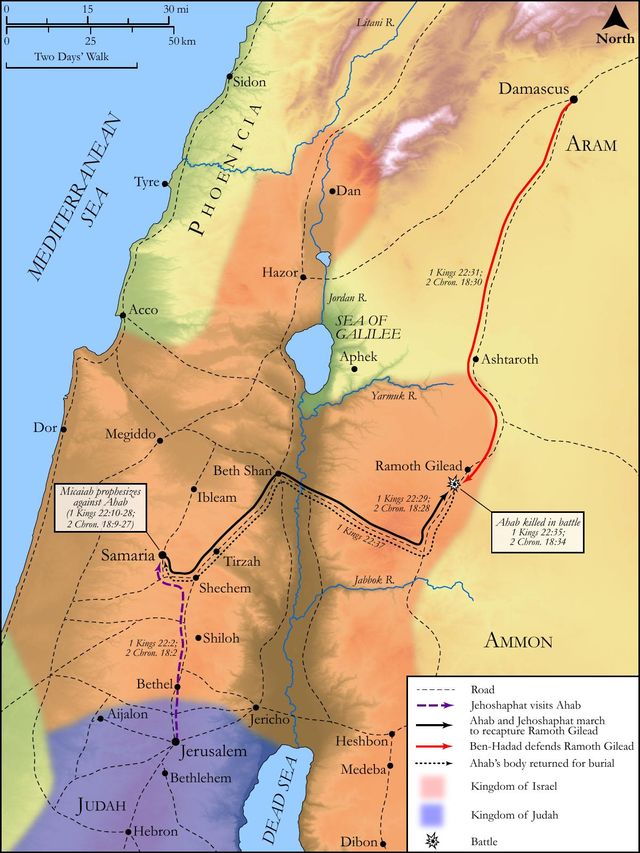
See on the biblical-era map
Study this verse
Public-domain commentary
Matthew Henry
From his Commentary on the Whole Bible. Henry comments on passages, not single verses — this entry covers 2 Chronicles 18:4–27.
This is almost word for word the same with what we had, 1 Kings 22. We will not repeat what was there said, nor have we much to add, but may take occasion to think, 1. Of the great duty of acknowledging God in all our ways and enquiring at his word, whatever we undertake. Jehoshaphat was not willing to proceed till he had done this, Ch2 18:4. By particular believing prayer, by an unbiased consultation of the scripture and our own consciences, and by an observant regard to the hints of providence, we may make such enquiries and very much to our satisfaction. 2. Of the great danger of bad company even to good men. Those that have more wisdom, grace, and resolution, cannot be sure that they can converse familiarly with wicked people and get no hurt by them. Jehoshaphat here, in complaisance to Ahab, sits in his robes, patiently hearing the false prophets speaking lies in the name of the Lord (Ch2 18:9), can scarcely find in his heart to give him a too mild and gentle reproof for hating a prophet of the Lord (Ch2 18:7), and dares not rebuke that false prophet who basely abused the faithful seer nor oppose Ahab who committed him to prison. Those who venture among the seats of the scornful cannot come off without a great deal of the guilt attaching to at least the omission of their duty, unless they have such measures of wisdom and courage as few can pretend to. 3. Of the unhappiness of those who are surrounded with flatterers, especially flattering prophets, who cry peace to them and prophesy nothing but smooth things. Thus was Ahab cheated into his ruin, and justly; for he hearkened to such, and preferred those that humoured him before a good prophet that gave him fair warning of his danger. Those do best for themselves that give their friends leave, and particularly their ministers, to deal plainly and faithfully with them, and take their reproofs not only patiently, but kindly. That counsel is not always best for us that is most pleasing to us. 4. Of the power of Satan, by the divine permission, in the children of disobedience. One lying spirit can make 400 lying prophets and make use of them to deceive Ahab, Ch2 18:21. The devil becomes a murderer by being a liar and destroys men by deceiving them. 5. Of the justice of God in giving those up to strong delusions, to believe a lie, who will not receive the love of the truth, but rebel against it, Ch2 18:21. Let the lying spirit prevail to entice those to their ruin that will not be persuaded to their duty and happiness. 6. Of the hard case of faithful ministers, whose lot it has often been to be hated, and persecuted, and ill-treated, for being true to their God and just and kind to the souls of men. Micaiah, for discharging a good conscience, was buffeted, imprisoned, and condemned to the bread and water of affliction. But he could with assurance appeal to the issue, as all those may do who are persecuted for their faithfulness, Ch2 18:27. The day will declare who is in the right and who in the wrong, when Christ will appear, to the unspeakable consolation of his persecuted people and the everlasting confusion of their persecutors, who will be made to see in that day (Ch2 18:24) what they will not now believe.
Continue studying 2 Chronicles 18:22 across the web’s major study libraries — every link below opens this exact verse, chapter, or book on the destination site.
Read & Compare
 BibleGatewayThis verse in more than 200 translations and 70 languages.
 Bible.comThe YouVersion reader — hundreds of translations, reading plans, and highlights.
 ESV.orgCrossway's official English Standard Version reader.
 NET BibleThe NET translation with 60,000+ translators' notes on every rendering decision.
 STEP BibleTyndale House's free study tool — original text, vocabulary, and scholarly resources.
 BibliaLogos Bible Software's free web reader.
 USCCBThe New American Bible (Revised Edition) with the U.S. bishops' study notes.
Commentaries
 BibleHub CommentariesDozens of classic commentaries on this verse, gathered on one page.
 StudyLightMore than 100 commentary sets — the largest collection on the web.
 BibleRefPlain-English commentary on what this verse means, verse by verse.
 Enduring WordDavid Guzik's free commentary on this chapter, widely used by Bible teachers.
 Bible Study ToolsVerse commentary alongside Greek and Hebrew study aids.
Original Language & Research
- BibleHub InterlinearThe verse word by word — original language, transliteration, and English.
- BibleHub LexiconEvery word's original-language definition and Strong's entry.
 Blue Letter BibleDeep-study tools — Strong's numbers, concordance, and word studies.
 SefariaThe Hebrew text with Rashi and centuries of Jewish commentary.
Sermons, Hymns & Audio


TrulyRandomVerse is not affiliated with these sites and doesn’t control their content. They’re linked because they’re genuinely useful.
Summary
Micaiah the prophet delivers a stark and direct message to King Ahab, explaining that the unanimous prophecy of victory from Ahab's 400 prophets is a divinely orchestrated deception. This verse reveals that the LORD has permitted a "lying spirit" to influence these false prophets, thereby ensuring Ahab's downfall at Ramoth-gilead. It underscores God's absolute sovereignty, even over malevolent forces, in executing His righteous judgment against a disobedient king who consistently rejected divine truth for flattering lies.
Context
ShowHideLiterary Context
This verse is the climactic declaration by the prophet Micaiah, following a dramatic confrontation with King Ahab and his 400 court prophets. Ahab, seeking counsel on whether to attack Ramoth-gilead, had received a unanimous, positive prophecy from his own prophets. However, King Jehoshaphat of Judah, discerning the lack of true divine inspiration, insisted on consulting a genuine prophet of the LORD. Micaiah, known for speaking uncomfortable truths, was reluctantly summoned. After an initial sarcastic affirmation of the false prophets' message, Micaiah, under oath, revealed a profound vision of a heavenly council where a "lying spirit" volunteered to deceive Ahab's prophets. This verse, 2 Chronicles 18:22, is Micaiah's direct explanation of the source of the false prophecies, explicitly stating God's permission and purpose behind the deception, culminating in the pronouncement of judgment against Ahab. This account parallels the narrative found throughout 1 Kings 22.
Historical & Cultural Context
The setting is Samaria, the capital of the northern kingdom of Israel, during the reign of King Ahab (c. 874-853 BC). Ahab was one of Israel's most wicked kings, notorious for promoting Baal worship and persecuting true prophets of the LORD, as seen in his conflict with Elijah in 1 Kings 18. Jehoshaphat, the righteous king of Judah, had formed an ill-advised alliance with Ahab through marriage (Jehoshaphat's son Jehoram married Ahab's daughter Athaliah), which set the stage for this joint military venture. Prophets often served at the courts of kings as advisors, and court prophets were expected to deliver messages favorable to the king. Micaiah, however, stood in the tradition of independent, often confrontational, prophets who spoke God's unvarnished word, regardless of the king's desires or the consequences to themselves. The practice of seeking divine counsel before battle was common, but Ahab's preference for flattering words over divine truth highlights his spiritual blindness and rebellion.
Key Themes
ShowHideThis verse powerfully illustrates several significant themes. Firstly, Divine Sovereignty in Judgment is paramount; God maintains ultimate control, even over malevolent spiritual forces, to bring about His righteous purposes. While God is not the author of evil, He can permit or orchestrate circumstances, including the actions of a "lying spirit," to execute judgment on those who persistently reject His truth. Secondly, the passage highlights The Danger of False Prophets, represented by the 400 who spoke what Ahab wanted to hear. Their lies, though divinely permitted for a specific judgment, underscore the peril of seeking counsel that merely affirms one's desires rather than guiding to righteousness, a warning echoed in Jeremiah 14:14. Thirdly, it reveals the Consequences of Rejecting Truth. Ahab's long history of idolatry and wickedness, exemplified by his coveting of Naboth's vineyard in 1 Kings 21:1-19, made him ripe for divine judgment. His persistent rejection of God's genuine prophets and his preference for flattering lies ultimately led to his downfall, as prophesied by Micaiah. Finally, the narrative showcases God's Unwavering Justice. Despite the appearance of deception, the underlying theme is God's justice being executed upon a king who had repeatedly defied Him.
Exposition and Analysis
ShowHideKey Word Analysis
ShowHideThis primitive root verb signifies "to give," "to place," or "to permit/allow." In this context, when the LORD "hath put" a lying spirit, it does not mean God created the lie or the spirit's malicious intent. Rather, it indicates divine permission and orchestration, where God dispatches or allows an existing spirit inclined to falsehood to act as an instrument to fulfill His sovereign purposes of judgment. This highlights God's ultimate control over all spiritual forces, even those that are malevolent, to accomplish His righteous will.
Derived from a root meaning "to deceive," this noun refers to an untruth, falsehood, or deceit. When applied to the "spirit," it characterizes the nature of its influence as deceptive and untrue. The spirit's inherent disposition is towards falsehood, and God permits this disposition to manifest in the prophets' words as a judgment against Ahab, who had consistently rejected divine truth.
In the phrase "the LORD hath spoken evil against thee," this word refers to calamity, disaster, or misfortune, not moral wickedness. It signifies the decreed judgment or punishment that God has determined for Ahab, a direct consequence of his persistent disobedience and rejection of God's ways. This is a common biblical usage where "evil" denotes the adverse consequences of sin, often in the form of divine judgment or affliction.
Verse Breakdown
ShowHide"Now therefore, behold, the LORD hath put a lying spirit in the mouth of these thy prophets,"
Micaiah directly addresses Ahab, revealing the divine origin of the deception. The "lying spirit" is not an independent entity acting against God's will, but rather an agent permitted and dispatched by the LORD to influence Ahab's 400 court prophets. This permission serves as a judgment upon Ahab, who had consistently rejected true prophets and preferred flattery. It demonstrates God's sovereign ability to use even malevolent forces to achieve His righteous ends, allowing Ahab to be deceived into a situation that would lead to his predetermined destruction.
"and the LORD hath spoken evil against thee."
This second clause is the direct declaration of God's judgment. The "evil" here refers to the disaster, defeat, and ultimately, death that awaits Ahab at Ramoth-gilead. It is a pronouncement of divine retribution, a just consequence for Ahab's persistent idolatry, wickedness, and rejection of God's truth. Micaiah confirms that the false prophecies are not merely random errors but part of God's deliberate plan to bring about the "evil" (calamity) that Ahab's actions have warranted.
Literary Devices
ShowHideThe passage employs several potent literary devices. Irony is prominent, as Ahab, seeking a favorable prophecy, receives one that is divinely sanctioned but ultimately leads to his doom. The very words of comfort from his prophets become instruments of his destruction. Foreshadowing is also evident, as Micaiah's vision and direct pronouncement vividly anticipate Ahab's death in battle, a fate he attempts to avoid but cannot. The narrative also uses Divine Sovereignty as a central theme, portraying God not as the author of evil, but as the ultimate orchestrator who can permit and direct even a "lying spirit" to fulfill His righteous judgment. This highlights God's absolute control over all spiritual realms and human affairs. Finally, the entire encounter functions as Prophetic Discourse, where Micaiah's words are not merely human opinion but a direct, divinely inspired message, contrasting sharply with the false prophecies of Ahab's court.
Theological and Thematic Connections
ShowHideThis verse profoundly illustrates the biblical truth of God's absolute sovereignty, even over the forces of deception and evil. It demonstrates that God can permit or even orchestrate circumstances, including the actions of malevolent spirits, to bring about His righteous judgment upon those who persistently reject His truth and choose a path of rebellion. This is not to say God is the author of sin or lies, but that He is ultimately in control, using all things—even the wicked intentions of others—to fulfill His divine purposes and execute justice. Ahab's stubborn refusal to heed God's genuine prophets made him ripe for such a judgment, where his own preference for flattering lies became the very means of his downfall.
Reflection and Application
ShowHideThe chilling clarity of Micaiah's prophecy in 2 Chronicles 18:22 serves as a timeless warning for all who seek guidance, whether spiritual or practical. It compels us to cultivate a deep discernment, recognizing that not all voices, even those claiming divine authority, speak truth. We are challenged to examine our own hearts: do we genuinely desire God's unvarnished truth, even when it is uncomfortable or contradicts our preconceived notions and desires? Or do we, like Ahab, surround ourselves with voices that merely affirm our biases and flatter our egos? True wisdom often lies in embracing the challenging truths that call us to repentance and alignment with God's will, rather than seeking convenient falsehoods. This passage reminds us that God remains sovereign over all circumstances, even in the midst of deception, ultimately bringing His just purposes to pass. Our ultimate safety and flourishing lie in humble obedience to His revealed word, not in cleverly avoided truths.
Questions for Reflection
ShowHideFAQ
ShowHideDoes God truly put a "lying spirit" into people, or is this a metaphor?
ShowHideThe text states that "the LORD hath put a lying spirit," which indicates divine permission and orchestration, not necessarily direct authorship of the lie itself. The Hebrew verb "put" (נָתַן, nâthan) can mean to "give," "place," or "permit." This passage illustrates God's absolute sovereignty, where He can allow or even commission existing malevolent forces to fulfill His righteous judgments. It's not that God creates evil or lies, but that He can use the inclinations of a "lying spirit" as an instrument of judgment against those who have consistently rejected His truth and chosen deception. This is a profound theological statement about God's control over all spiritual realms, even those opposed to Him, to achieve His purposes, as seen in other passages where God "hardens" hearts in Exodus 4:21 or "sends" a spirit in Judges 9:23.
How does this passage reconcile with God's character as truth and light?
ShowHideThis passage does not imply that God is the author of lies or that He is morally deceptive. Instead, it highlights His justice and sovereignty. Ahab had a long history of rejecting God's true prophets and embracing idolatry and wickedness. In His righteous judgment, God allowed Ahab to be deceived by the very kind of flattery he preferred, leading him to his deserved doom. God's character as truth and light remains untarnished because the "lying spirit" acted within the bounds of God's permissive will to accomplish a just outcome for a king who had repeatedly defied Him. It's an act of divine justice, not divine deception, where the consequences of Ahab's choices are brought to bear through a divinely permitted means. This aligns with the principle that God sometimes gives people over to their own desires or deceptions as a form of judgment, as described in Romans 1:24-28.
Christ-Centered Fulfillment
ShowHideThe narrative of 2 Chronicles 18:22, with its stark portrayal of divine judgment enacted through permitted deception, finds its ultimate resolution and contrast in Christ. While Ahab faced a "lying spirit" leading to his demise, Jesus Christ is the embodiment of absolute truth, the very Word of God made flesh, as declared in John 1:14. He is the true prophet who speaks only what the Father commands, as He Himself stated in John 12:49-50, never flattering, always revealing the uncomfortable but saving truth. Where Ahab's preference for lies led to his destruction, Christ's followers are called to love the truth and be set free by it, a promise found in John 8:32. Furthermore, the sovereignty of God over all spiritual forces, even malevolent ones, is fully demonstrated in Christ's victory over sin, death, and the devil. He disarmed the spiritual powers and authorities, triumphing over them by the cross, as powerfully stated in Colossians 2:15, establishing His kingdom where deception has no lasting power. Ultimately, Christ is the righteous judge who will expose all lies and bring every hidden thing to light, ensuring that God's justice and truth prevail, not through permitted deception, but through His perfect and redemptive work on the cross and His glorious resurrection, as we await the day when He will judge the secrets of men, according to 1 Corinthians 4:5.