


Mark 14:21
Bible text: King James Version (1769 Blayney text) · Public domain
Bible text: King James Version with Strong's numbers · Public domain
Bible text: Berean Standard Bible · Public domain
Bible text: American Standard Version (1901) · Public domain
Bible text: World English Bible, Messianic edition · Public domain
Bible text: Geneva Bible (1599) · Public domain
Bible text: Young's Literal Translation · Public domain
- ὁho<the>G3588T-NSMDefinite article Nominative Singular Masculine
- μὲνmenindeedG3303PRTParticle or Disjunctive
- υἱὸςhuiosthe SonG5207N-NSM-TNoun Nominative Singular Masculine Title
- τοῦtou<the>G3588T-GSMDefinite article Genitive Singular Masculine
- ἀνθρώπουanthrōpouof ManG444N-GSM-TNoun Genitive Singular Masculine Title
- ὑπάγειhupageigoesG5217V-PAI-3SVerb Present Active Indicative 3rd Singular
- καθὼςkathōseven asG2531CONJConjunction
- γέγραπταιgegraptaiit has been writtenG1125V-RPI-3SVerb Perfect Passive Indicative 3rd Singular
- περὶpericoncerningG4012PREPPreposition
- αὐτοῦautouHimG846P-GSMPersonal pronoun Genitive Singular Masculine
- οὐαὶouaiwoeG3759INJInterjection
- δὲdehoweverG1161CONJConjunction
- τῷtōto theG3588T-DSMDefinite article Dative Singular Masculine
- ἀνθρώπῳanthrōpōmanG444N-DSMNoun Dative Singular Masculine
- ἐκείνῳekeinōthat [one]G1565D-DSMDemonstrative pronoun Dative Singular Masculine
- δι᾽di᾽throughG1223PREPPreposition
- οὗhouwhomG3739R-GSMRelative pronoun Genitive Singular Masculine
- ὁhotheG3588T-NSMDefinite article Nominative Singular Masculine
- υἱὸςhuiosSonG5207N-NSM-TNoun Nominative Singular Masculine Title
- τοῦtou<the>G3588T-GSMDefinite article Genitive Singular Masculine
- ἀνθρώπουanthrōpouof ManG444N-GSM-TNoun Genitive Singular Masculine Title
- παραδίδοται·paradidotaiis betrayedG3860V-PPI-3SVerb Present Passive Indicative 3rd Singular
- καλὸνkalonbetterG2570A-NSNAdjective Nominative Singular Neuter
- ἦνēnwasG1510V-IAI-3SVerb Imperfect Active Indicative 3rd Singular
- αὐτῷautōfor himG846P-DSMPersonal pronoun Dative Singular Masculine
- εἰeiifG1487CONDConjunction
- οὐκouknotG3756PRT-NNegative Particle Negative
- ἐγεννήθηegennēthēwas bornG1080V-API-3SVerb Aorist Passive Indicative 3rd Singular
- ὁhotheG3588T-NSMDefinite article Nominative Singular Masculine
- ἄνθρωποςanthrōposmanG444N-NSMNoun Nominative Singular Masculine
- ἐκεῖνοςekeinosthatG1565D-NSMDemonstrative pronoun Nominative Singular Masculine
English is a literal word-by-word gloss of the Greek, not the KJV's wording. Why?
This is the original text the KJV's translators worked from — each Greek word with its own literal English meaning in this verse, prepared by scholars at Tyndale House, Cambridge. The KJV translates whole sentences, not word by word, so its wording differs: one Greek word can become several English words, and the KJV may choose “charity” where the gloss reads “love”. Both are faithful — they answer different questions. For the KJV's own rendering, switch to the KJV text.
Details
See on the biblical-era maps
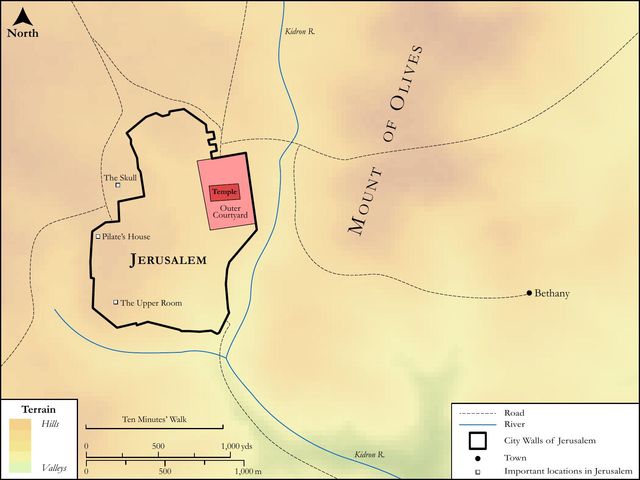
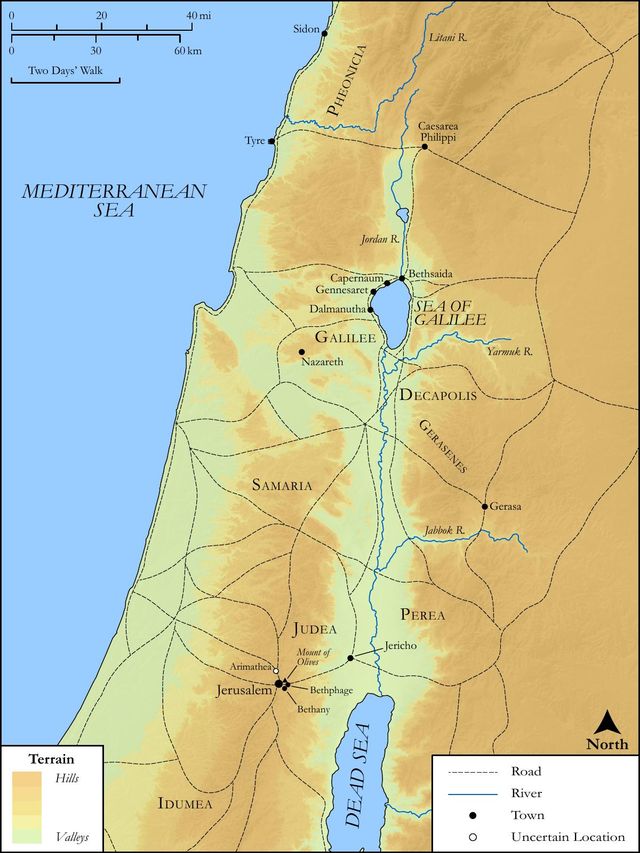
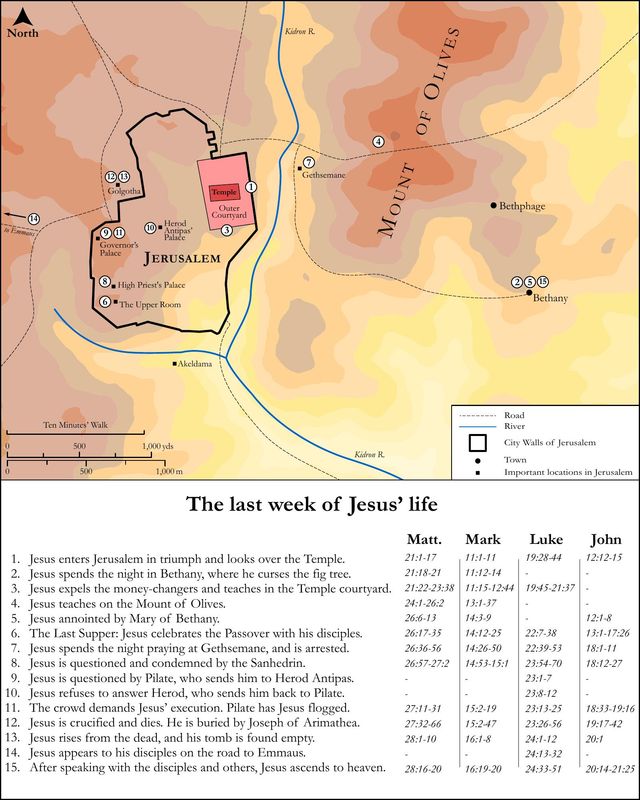
Study this verse
Public-domain commentary
Matthew Henry
From his Commentary on the Whole Bible. Henry comments on passages, not single verses — this entry covers Mark 14:12–31. His three-level outline is real structure in the source text, so it is rendered as structure.
In these verses we have,
I.Christ's eating the passover with his disciples, the night before he died, with the joys and comforts of which ordinance he prepared himself for his approaching sorrows, the full prospect of which did not indispose him for that solemnity. Note, No apprehension of trouble, come or coming, should put us by, or put us out of frame for, our attendance on holy ordinances, as we have opportunity for it.
1.Christ ate the passover at the usual time when the other Jews did, as Dr. Whitby had fully made out, and not, as Dr. Hammond would have it, the night before. It was on the first day of that feast, which (taking in all the eight days of the feast) was called, The feast of unleavened bread, even that day when they killed the passover, Mar 14:12.
2.He directed his disciples how to find the place where he intended to eat the passover; and hereby gave such another proof of his infallible knowledge of things distant and future (which to us seem altogether contingent), as he had given when he sent them for the ass on which he rode in triumph (Mar 11:6); "Go into the city (for the passover must be eaten in Jerusalem), and there shall meet you a man bearing a pitcher of water (a servant sent for water to clean the rooms in his master's house); follow him, go in where he goes, enquire for his master, the good man of the house (Mar 14:14), and desire him to show you a room." No doubt, the inhabitants of Jerusalem had rooms fitted up to be let out, for this occasion, to those that came out of the country to keep the passover, and one of those Christ made use of; not any friend's house, nor any house he had formerly frequented, for then he would have said, "Go to such a friend," or, "You know where we used to be, go thither and prepare." Probably he went where he was not known, that he might be undisturbed with his disciples. Perhaps he notified it by a sign, to conceal it from Judas, that he might not know till he came to the place; and by such a sign to intimate that he will dwell in the clean heart, that is, washed as with pure water. Where he designs to come, a pitcher of water must go before him; see Isa 1:16-18.
3.He ate the passover in an upper room furnished, estrōmenon - laid with carpets (so Dr. Hammond); it would seem to have been a very handsome dining-room. Christ was far from affecting any thing that looked stately in eating his common meals; on the contrary, he chose that which was homely, sat down on the grass: but, when he was to keep a sacred feast, in honour of that he would be at the expense of as good a room as he could get. God looks not at outward pomp, but he looks at the tokens and expressions of inward reverence for a divine institution, which, it is to be feared, those want, who, to save charges, deny themselves decencies in the worship of God.
4.He ate it with the twelve, who were his family, to teach those who have the charge of families, not only families of children, but families of servants, or families of scholars, or pupils, to keep up religion among them, and worship God with them. If Christ came with the twelve, then Judas was with them, though he was at this time contriving to betray his Master; and it is plain by what follows (Mar 14:20), that he was there: he did not absent himself, lest he could have been suspected; had his seat been empty at this feast, they would have said, as Saul of David, He is not clean, surely he is not clean, Sa1 20:26. Hypocrites, though they know it is at their peril, yet crowd into special ordinances, to keep up their repute, and palliate their secret wickedness. Christ did not exclude him from the feast, though he knew his wickedness, for it was not as yet become public and scandalous. Christ, designing to put the keys of the kingdom of heaven into the hands of men, who can judge only according to outward appearance, would hereby both direct and encourage them in their admissions to his table, to be satisfied with a justifiable profession, because they cannot discern the root of bitterness till it springs up.
II.Christ's discourse with his disciples, as they were eating the passover.
It is probable that they had discourse, according to the custom of the feast, of the deliverance of Israel out of Egypt, and the preservation of the first-born, and were as pleasant as they used to be together on this occasion, till Christ told them that which would mix trembling with their joys.
1.They were pleasing themselves with the society of their Master; but he tells them that they must now presently lose him; The Son of man is betrayed; and they knew, for he had often told them, what followed - If he be betrayed, the next news you will hear of him, is, that he is crucified and slain; God hath determined it concerning him, and he agrees to it; The Son of man goes, as it is written of him, Mar 14:21. It was written in the counsels of God, and written in the prophecies of the Old Testament, not one jot or tittle of either of which can fall to the ground.
2.They were pleasing themselves with the society one of another, but Christ casts a damp upon the joy of that, by telling them, One of you that eateth with me shall betray me, Mar 14:18. Christ said this, if it might be, to startle the conscience of Judas, and to awaken him to repent of his wickedness, and to draw back (for it was not too late) from the brink of the pit. But for aught that appears, he who was most concerned in the warning, was least concerned at it. All the rest were affected with it.
(1.)They began to be sorrowful. As the remembrance of our former falls into sin, so the fear of the like again, doth often much embitter the comfort of our spiritual feasts, and damp our joy. Here were the bitter herbs, with which this passover-feast was taken.
(2.)They began to be suspicious of themselves; they said one by one, Is it I? And another said, Is it I? They are to be commended for their charity, that they were more jealous of themselves than of one another. It is the law of charity, to hope the best (Co1 13:5-7), because we assuredly know, therefore we may justly suspect, more evil by ourselves than by our brethren. They are also to be commended for their acquiescence in what Christ said; they trusted more to his words than to their own hearts; and therefore do not say, "I am sure it is not I," but, "Lord, is it I? see if there be such a way of wickedness in us, such a root of bitterness, and discover it to us, that we may pluck up that root, and stop up that way."
Now, in answer to their enquiry, Christ saith that, [1.] Which would make them easy; "It is not you, or you; it is this that now dips with me in the dish; the adversary and enemy is this wicked Judas." [2.] Which, one would think, should make Judas very uneasy. If he go on in his undertaking, it is upon the sword's point, for woe to that many by whom the Son of man is betrayed; he is undone, for every undone; his sin will soon find him out; and it were better for him that he had never been born, and had never had a being than such a miserable one as he must have. It is very probable that Judas encouraged himself in it with this thought, that his Master had often said he must be betrayed; "And if it must be done, surely God will not find fault with him that doth it, for who hath resisted his will?" As that objector argues, Rom 9:19. But Christ tells him that this will be no shelter or excuse to him; The Son of man indeed goes; as it is written of him, as a lamb to the slaughter; but woe to that man by whom he is betrayed. God's decree to permit the sins of men, and bring glory to himself out of them, do neither necessitate their sins, nor determine to them, nor will they be any excuse of the sin, or mitigation of the punishment. Christ was delivered indeed by the determinate counsel and fore-knowledge of God; but, notwithstanding that, it is with wicked hands that he is crucified and slain, Act 2:23.
III.The institution of the Lord's supper.
1.It was instituted in the close of a supper, when they were sufficiently fed with the paschal lamb, to show that in the Lord's supper there is no bodily repast intended; to preface it with such a thing, is to revive Moses again. But it is food for the soul only, and therefore a very little of that which is for the body, as much as will serve for a sign, is enough. It was at the close of the passover-supper, which by this was evangelized, and then superseded and set aside. Much of the doctrine and duty of the eucharist is illustrated to us by the law of the passover (Ex. 12); for the Old Testament institutions, though they do not bind us, yet instruct us, by the help of a gospel-key to them. And these two ordinances lying here so near together, it may be good to compare them, and observe how much shorter and plainer the institution of the Lord's supper is, than that of the passover was. Christ's yoke is easy in comparison with that of the ceremonial law, and his ordinances are more spiritual.
2.It was instituted by the example of Christ himself; not with the ceremony and solemnity of a law, as the ordinance of baptism was, after Christ's resurrection (Mat 28:19), with, Be it enacted by the authority aforesaid, by a power given to Christ in heaven and on earth (Mat 28:18); but by the practice of our Master himself, because intended for those who are already his disciples, and taken into covenant with him: but it has the obligation of the law, and was intended to remain in full force, power, and virtue, till his second coming.
3.It was instituted with blessing and giving of thanks; the gifts of common providence are to be so received (Ti1 4:4, Ti1 4:5), much more than the gifts of special grace. He blessed (Mar 14:22), and gave thanks, Mar 14:23. At his other meals, he was wont to bless, and give thanks (Mar 6:41; Mar 8:7) so remarkably, that he was known by it, Luk 24:30, Luk 24:31. And he did the same at this meal.
4.It was instituted to be a memorial of his death; and therefore he broke the bread, to show how it pleased the Lord to bruise him; and he called the wine, which is the blood of the grape, the blood of the New Testament. The death Christ died was a bloody death, and frequent mention is made of the blood, the precious blood, as the pride of our redemption; for the blood is the life, and made atonement for the soul, Lev 17:11-14. The pouring out of the blood was the most sensible indication of the pouring out of his soul, Isa 53:12. Blood has a voice (Gen 4:10); and therefore blood is so often mentioned, because it was to speak, Heb 12:24. It is called the blood of the New Testament; for the covenant of grace became a testament, and of force by the death of Christ, the testator, Heb 9:16. It is said to be shed for many, to justify many (Isa 53:11), to bring many sons to glory, Heb 2:10. It was sufficient for many, being of infinite value; it has been of use to many; we read of a great multitude which no man could number, that had all washed their robes, and made them white in the blood of the Lamb (Rev 7:9-14); and still it is a fountain opened. How comfortable is this to poor repenting sinners, that the blood of Christ is shed for many! And if for many, why not for me? If for sinners, sinners of the Gentiles, the chief of sinners, then why not for me?
5.It was instituted to be a ratification of the covenant made with us in him, and a sign of the conveyance of those benefits to us, which were purchased for us by his death; and therefore he broke the bread to them (Mar 14:22), and said, Take, eat of it: he gave the cup to them, and ordered them to drink of it, Mar 14:23. Apply the doctrine of Christ crucified to yourselves, and let it be meat and drink to your souls, strengthening, nourishing, and refreshing, to you, and the support and comfort of your spiritual life.
6.It was instituted with an eye to the happiness of heaven, and to be an earnest and fore-taste of that, and thereby to put our mouths out of taste for all the pleasures and delights of sense (Mar 14:25); I will drink no more of the fruit of the vine, as it is a bodily refreshment. I have done with it. No one, having tasted spiritual delights, straightway desires sensitive ones, for he saith, The spiritual is better (Luk 5:39); but every one that hath tasted spiritual delights, straightway desires eternal ones, for he saith, Those are better still; and therefore let me drink no more of the fruit of the vine, it is dead and flat to those that have been made to drink of the river of God's pleasures; but, Lord, hasten the day, when I shall drink it new and fresh in the kingdom of God, where it shall be for ever new, and in perfection.
7.It was closed with a hymn, Mar 14:26. Though Christ was in the midst of his enemies, yet he did not, for fear of them, omit this sweet duty of singing psalms. Paul and Silas sang, when the prisoners heard them. This was an evangelical song, and gospel times are often spoken of in the Old Testament, as times of rejoicing, and praise is expressed by singing. This was Christ's swan-like song, which he sung just before he entered upon his agony; probably, that which is usually sung, Psa 113:1-9 to 118.
IV.Christ's discourse with his disciples, as they were returning to Bethany by moonlight.
When the had sung the hymn, presently they went out. It was now near bedtime, but our Lord Jesus had his heart so much upon his suffering, that he would not come into the tabernacle of his house, norgo up into his bed, nor give sleep to his eyes, when that work was to be done, Psa 132:3, Psa 132:4. The Israelites were forbidden to go out of their houses the night that they ate the passover, for fear of the sword of the destroying angel, Exo 12:22, Exo 12:23. But because Christ, the great shepherd, was to be smitten, he went out purposely to expose himself to the sword, as a champion; they evaded the destroyer, but Christ conquered him, and brought destructions to a perpetual end.
1.Christ here foretels that in his sufferings he should be deserted by all his disciples; "You will all be offended because of me, this night. I know you will (Mar 14:27), and what I tell you now, is no other than what the scripture has told you before; I will smite the shepherd, and then the sheep will be scattered." Christ knew this before, and yet welcomed them at his table; he sees the falls and miscarriages of his disciples, and yet doth not refuse them. Nor should we be discouraged from coming to the Lord's supper, by the fear of relapsing into sin afterward; but, the greater of our danger is, the more need we have to fortify ourselves by the diligent conscientious use of holy ordinances. Christ tells them that they would be offended in him, would begin to question whether he were the Messiah or no, when they saw him overpowered by his enemies. Hitherto, they had continued with him in his temptations; though they had sometimes offended him, yet they had not been offended in him, nor turned the back upon him; but now the storm would be so great, that they would all slip their anchors, and be in danger of shipwreck. Some trials are more particular (as Rev 2:10, The devil shall cast some of you into prison); but others are more general, an hour of temptation, which shall come upon all the world, Rev 3:10. The smiting of the shepherd is often the scattering of the sheep: magistrates, ministers, masters of families, if these are, as they should be, shepherds to those under their charge, when any thing comes amiss to them, the whole flock suffers for it, and is endangered by it.
But Christ encourages them with a promise that they shall rally again, shall return both to their duty and to their comfort (Mar 14:28); "After I am risen, I will gather you in from all the places wither you are scattered, Eze 34:12. I will go before you into Galilee, will see our friends, and enjoy one another there."
2.He foretels that he should be denied particularly by Peter. When they went out to go to the mount of Olives, we may suppose that they dropped Judas (he stole away from them), whereupon the rest began to think highly of themselves, that they stuck to their Master, when Judas quitted him. But Christ tells them, that though they should be kept by his grace from Judas's apostasy, yet they would have no reason to boast of their constancy. Note, Though God keeps us from being as bad as the worst, yet we may well be ashamed to think that we are not better than we are.
(1.)Peter is confident that he should not do so ill as the rest of his disciples (Mar 14:29); Though all should be offended, all his brethren here present, yet will not I. He supposes himself not only stronger than others, but so much stronger, as to be able to receive the shock of a temptation, and bear up against it, all alone; to stand, though nobody stood by him. It is bred in the bone with us, to think well of ourselves, and trust to our own hearts.
(2.)Christ tells him that he will do worse than any of them. They will all desert him, but he will deny him; not once, but thrice; and that presently; "This day, even this night before the cock crow twice, thou wilt deny that ever thou hadst any knowledge of me, or acquaintance with me, as one ashamed and afraid to own me."
(3.)He stands to his promise; "If I should die with thee, I will not deny thee; I will adhere to thee, though it cost me my life:" and, no doubt, he thought as he said. Judas said nothing like this, when Christ told him he would betray him. He sinned by contrivance, Peter by surprise; he devised the wickedness (Mic 2:1), Peter was overtaken in this fault, Gal 6:1. It was ill done of Peter, to contradict his Master. If he had said, with fear and trembling, "Lord, give me grace to keep me from denying thee, lead me not into this temptation, deliver me from this evil," it might have been prevented: but they were all thus confident; they who said, Lord, is it I? now said, It shall never be me. Being acquitted from their fear of betraying Christ, they were now secure. But he that thinks he stands, must learn to take heed lest he fall; and he that girdeth on the harness, not boast as though he had put it off.
Historical interpretation
Nine Centuries of Reception
10 surviving comments on this verse. Each one is dated, so this reads as a timeline rather than a list.
Select a marker to jump to its quote. Markers stagger vertically where authors wrote within a few decades of each other.
The evening of the day points out the evening of the world; for the last, who are the first to receive the penny of eternal life, come about the eleventh hour. All the disciples then are touched by the Lord; so that there is amongst them the harmony of the harp, all the well attuned strings answer with accordant tone; for it goes on: And they began to be sorrowful, and to say unto him one by one, Is it I? One of them however, unstrung, and steeped in the love of money, said, Is it I, Lord? as Matthew testifies.
Again, He says, One out of the twelve, as it were separate from them, for the wolf carries away from the flock the sheep which he has taken, and the sheep which quits the fold lies open to the bite of the wolf. But Judas does not withdraw his foot from his traitorous design though once and again pointed at, wherefore his punishment is foretold, that the death denounced upon him might correct him, whom shame could not overcome; wherefore it goes on: The Son of man indeed goeth, as it is written of him.
But because many do good, in the way that Judas did, without its profiting them, there follows: Woe to that man by whom the Son of man is betrayed! good were it for that man if he had never been born.
That is, hidden in his mother's inmost womb, for it is better for a man not to exist than to exist for torments.
But Judas having been once for all cast away, never returns into the number of the disciples; otherwise a different person would not have been chosen to fill his place. Besides, the Lord also declared regarding him, "Woe to the man by whom the Son of man shall be betrayed;" and, "It were better for him if he had never been born;" and he was called the "son of perdition" by Him.
As if it has not been necessary also that there should be evil! It was even necessary that the Lord should be betrayed; but woe to the traitor! So that no man may from this defend heresies.
There was another by whom he was betrayed, namely, the devil, of whom Judas was the instrument. The “woe” is not only for Judas, but for all who betray Christ.
(ubi sup.) Where it is evident that He did not proclaim him openly to all, lest He should make him the more shameless; at the same time He did not altogether keep it silent, lest thinking that he was not discovered, he should boldly hasten to betray Him.
It would have been good for him if that man had not been born. This should not be thought to mean that he existed before he was born, for it cannot be well for anyone, except for him who has been. But it is simply said, it is much better not to exist than to exist badly.
And indeed, the Son of Man goes as it is written of him. But woe to that man by whom the Son of Man is betrayed. Neither at first nor second admonished does he withdraw his foot from betrayal, but the patience of the Lord nourishes his impudence, and he treasures up wrath for himself in the day of wrath. He predicts punishment, so that whom shame did not conquer, the announced torments might correct. But today also and forever, woe to that man who malignantly approaches the table of the Lord, who with schemes hidden in mind and some crime polluting his innermost heart, does not fear to partake in the holy sacrifices of the mysteries of Christ. For even he in the example of Judas betrays the Son of Man, not indeed to sinful Jews, but yet to sinners, namely his own members, with which he presumes to desecrate that inestimable and inviolable sacrament of the Lord's body and blood. He sells God, who, neglecting His fear and love, is convicted of valuing and caring for earthly and perishable things, indeed even criminal things, in place of Him.
(ubi sup.) The Lord who had foretold His Passion, prophesied also of the traitor, in order to give him room for repentance, that understanding that his thoughts were known, he might repent. Wherefore it is said, And in the evening he cometh with the twelve. And as they sat and did eat, Jesus said, Verily I say unto you, One of you which eateth with me shall betray me.
(ubi sup.) That is, Judas, who when the others were sad and held back their hands, puts forth his hand with his Master into the dish. And because He had before said, One of you shall betray me, and yet the traitor perseveres in his evil, He accuses him more openly, without however pointing out his name.
(ubi sup.) Woe too to that man, to-day and for ever, who comes to the Lord's table with an evil intent. For he, after the example of Judas, betrays the Lord, not indeed to Jewish sinners, but to his own sinning members. It goes on: Good were it for that man if he had never been born.
Knowledge is of what exists and foreknowledge is of what will surely exist in the future. For simple being comes first and then good or evil being. But if the very existence of those, who through the goodness of God are in the future to exist, were to be prevented by the fact that they were to become evil of their own choice, evil would have prevailed over the goodness of God. In this way God makes all his works good, but each becomes of its own choice good or evil. Although, then, the Lord said, “Good were it for that man that he had never been born,” he said it in condemnation not of his own creation but of the evil which his own creature had acquired by his own choice and through his own heedlessness.
But how could they eat reclining, when the law ordered that standing and upright they should eat the Passover? It is probable that they had first fulfilled the legal Passover, and had reclined, when He began to give them His own Passover.
But the other disciples began to be saddened on account of the word of the Lord; for although they were free from this passion, yet they trust Him who knows all hearts, rather than themselves. It goes on: And he answered and said unto them, It is one of the twelve, that dippeth with me in the dish.
The word here used, goeth, shows that the death of Christ was not forced but voluntary.
For as respects the end for which he was designed, it would have been better for him to have been born, if he had not been the betrayer, for God created him for good works; but after he had fallen into such dreadful wickedness, it would have been better for him never to have been born.
Continue studying Mark 14:21 across the web’s major study libraries — every link below opens this exact verse, chapter, or book on the destination site.
Read & Compare
 BibleGatewayThis verse in more than 200 translations and 70 languages.
 Bible.comThe YouVersion reader — hundreds of translations, reading plans, and highlights.
 ESV.orgCrossway's official English Standard Version reader.
 NET BibleThe NET translation with 60,000+ translators' notes on every rendering decision.
 STEP BibleTyndale House's free study tool — original text, vocabulary, and scholarly resources.
 BibliaLogos Bible Software's free web reader.
 USCCBThe New American Bible (Revised Edition) with the U.S. bishops' study notes.
Commentaries
 BibleHub CommentariesDozens of classic commentaries on this verse, gathered on one page.
 StudyLightMore than 100 commentary sets — the largest collection on the web.
 BibleRefPlain-English commentary on what this verse means, verse by verse.
 Enduring WordDavid Guzik's free commentary on this chapter, widely used by Bible teachers.
 Bible Study ToolsVerse commentary alongside Greek and Hebrew study aids.
Original Language & Research
- BibleHub InterlinearThe verse word by word — original language, transliteration, and English.
- BibleHub LexiconEvery word's original-language definition and Strong's entry.
 Blue Letter BibleDeep-study tools — Strong's numbers, concordance, and word studies.
 CNTR CollationThe earliest Greek manuscripts of this verse, collated letter by letter.
Sermons, Hymns & Audio


TrulyRandomVerse is not affiliated with these sites and doesn’t control their content. They’re linked because they’re genuinely useful.
Summary
Mark 14:21 presents Jesus' profound and somber declaration during the Last Supper, simultaneously affirming the divine necessity of His suffering and death as prophesied in Scripture, and pronouncing a severe judgment upon the individual who would betray Him. This pivotal statement underscores God's sovereign plan for redemption while highlighting the dire, eternal consequences of human sin and treachery, particularly against the Son of God.
Context
ShowHideLiterary Context
This verse is a direct continuation of Jesus' startling announcement to His disciples that one of them would betray Him, a revelation that plunged them into deep sorrow and confusion as they questioned, "Is it I?" Mark 14:19. Spoken within the intimate setting of the Passover meal, which Jesus reinterprets as the institution of the New Covenant through His body and blood Mark 14:22-25, this prophecy of betrayal sets a dark tone for the events immediately following. It precedes Jesus' departure to Gethsemane Mark 14:26, where the betrayal by Judas Iscariot will indeed occur, leading directly to Jesus' arrest and passion. The parallel accounts in Matthew 26:24 and Luke 22:22 underscore the significance of this declaration within the Synoptic Gospels.
Historical & Cultural Context
The Passover meal itself was a deeply significant annual Jewish celebration commemorating God's deliverance of Israel from slavery in Egypt Exodus 12. Jesus' reinterpretation of this meal, transforming its elements into symbols of His impending sacrifice, would have been profoundly impactful for His Jewish disciples. Betrayal, especially by a close associate, was considered a heinous act in Israel, violating sacred bonds of hospitality and loyalty. The "woe" pronouncement carries the weight of prophetic denunciation, common in Old Testament prophetic literature against those who defied God or committed grave injustices. The phrase "good were it for that man if he had never been born" is an ancient idiom expressing the most extreme form of regret or condemnation, signifying a fate so terrible that non-existence would be preferable.
Key Themes
ShowHideMark 14:21 contributes significantly to several overarching themes within Mark's Gospel and broader biblical theology. Firstly, it powerfully reinforces the theme of Divine Sovereignty and Prophetic Fulfillment. Jesus' suffering and death are presented not as a tragic accident or a failure, but as the predetermined will of God, explicitly "as it is written of him." This points to the fulfillment of Old Testament prophecies concerning the suffering Messiah, such as those found in Isaiah 53 and Psalm 22. Secondly, the verse highlights the Gravity of Sin and Personal Culpability. Despite God's sovereign plan, Judas's act of betrayal is presented as a morally reprehensible choice for which he bears full personal responsibility and faces severe judgment. This underscores the reality of human free will within God's overarching purposes. Lastly, it powerfully illustrates the Eternal Consequences of Rejecting Christ and Committing Grave Sin. The stark pronouncement regarding the betrayer's fate serves as a solemn warning about the ultimate, catastrophic outcome for those who decisively turn away from God's light and grace.
Exposition and Analysis
ShowHideKey Word Analysis
ShowHideThis interjection is a primary exclamation of grief, sorrow, and often a prophetic denunciation or curse. In this context, it signifies impending judgment and severe misfortune, not merely an expression of regret but a solemn declaration of divine condemnation upon the betrayer.
From pará (alongside) and dídōmi (to give), this verb means "to surrender," "yield up," "entrust," or "transmit." While it can have neutral meanings (e.g., delivering someone to prison), in this context, it specifically refers to the act of handing over Jesus to His enemies, implying a malicious and treacherous act of surrender.
This verb means "to procreate," "beget," or "be born." Figuratively, it can also mean "to regenerate." In this verse, it refers to the physical act of being brought into existence, emphasizing the profound and irreversible nature of the betrayer's fate, where non-existence would be preferable to the judgment awaiting him.
Verse Breakdown
ShowHide"The Son of man indeed goeth, as it is written of him:"
This clause affirms the divine necessity and preordained nature of Jesus' suffering and death. "The Son of man" is Jesus' favorite self-designation, emphasizing both His humanity and His messianic authority and role as the suffering servant prophesied in the Old Testament Daniel 7:13. The phrase "goeth" (Greek hypágō) implies a deliberate, purposeful departure towards His destiny, not a reluctant or accidental one. "As it is written of him" explicitly links His impending passion to the fulfillment of Scripture, emphasizing God's sovereign plan for redemption.
"but woe to that man by whom the Son of man is betrayed!"
Here, Jesus shifts from divine necessity to human culpability. The conjunction "but" (Greek dé) introduces a sharp contrast. The "woe" (Greek ouaí) is a pronouncement of severe judgment and condemnation. It highlights the profound wickedness of betraying the Son of Man, especially by one of His own disciples. This part of the verse underscores that while God's plan was fixed, the human agent's choice to betray was still a free, morally accountable act.
"good were it for that man if he had never been born."
This powerful, idiomatic expression emphasizes the catastrophic and eternal consequences awaiting the betrayer. It signifies a fate so terrible, so utterly miserable, that non-existence would be a merciful alternative. This is not a statement about annihilation, but about a state of profound and unending suffering and separation from God, indicating the ultimate ruin brought about by such a grave sin against the Son of God.
Literary Devices
ShowHideMark 14:21 employs several potent literary devices. Prophecy and Fulfillment are central, as Jesus explicitly states His path is "as it is written of him," directly linking His passion to Old Testament Scriptures. A stark Contrast is drawn between the divine necessity of Jesus' suffering and the moral culpability of the betrayer. While Jesus' path is ordained, the betrayer's actions are presented as a choice leading to severe judgment. The phrase "good were it for that man if he had never been born" is a powerful example of Hyperbole or a strong Idiom, emphasizing the extreme and irreversible nature of the betrayer's damnation. It is not meant literally as a wish for non-existence, but rather to convey the utter wretchedness of his future state. The repetition of "Son of man" also serves as a form of Emphasis, reinforcing Jesus' identity and the gravity of the offense against Him. The entire verse also functions as Foreshadowing, setting the stage for the imminent betrayal by Judas Iscariot.
Theological and Thematic Connections
ShowHideMark 14:21 profoundly illustrates the paradox of divine sovereignty and human responsibility. While God's redemptive plan for humanity, culminating in Christ's atoning sacrifice, was immutably established and foretold in Scripture, the human agents involved in bringing about that plan, particularly the betrayer, remain fully accountable for their sinful choices. This tension highlights that God can use even the darkest human sin to accomplish His righteous purposes without diminishing the gravity or culpability of that sin. The "woe" pronounced upon Judas serves as a stark reminder of the eternal consequences of rejecting divine truth and betraying the Son of God, emphasizing the infinite value of Christ's person and the severity of sin committed against Him.
Reflection and Application
ShowHideMark 14:21 calls us to a profound self-examination regarding our allegiance to Christ. It challenges us to consider the weight of our own choices and the potential for spiritual betrayal in our lives, not necessarily through overt acts like Judas, but through subtle compromises, lukewarm faith, or prioritizing self over Christ. The verse reminds us that even within God's sovereign plan, our individual choices have eternal ramifications. It urges us to live in conscious awareness of God's perfect will, aligning our lives with His purposes and actively resisting any temptation to betray Him through our actions or attitudes. We are called to cultivate genuine devotion, recognizing the immense privilege of knowing Christ and the dire consequences of turning away from Him. This passage serves as a powerful call to repentance, faithfulness, and unwavering commitment to the One who "goeth" to the cross for our salvation.
Questions for Reflection
ShowHideFAQ
ShowHideWas Judas's betrayal predetermined, making him a mere puppet in God's plan?
ShowHideWhile Mark 14:21 states that Jesus "goeth, as it is written of him," indicating God's sovereign plan and the fulfillment of prophecy concerning the Messiah's suffering, this does not negate Judas's personal responsibility. The verse explicitly pronounces "woe to that man by whom the Son of man is betrayed," highlighting his culpability. The biblical narrative consistently presents Judas's actions as his own free, wicked choices, driven by greed and a hardened heart John 12:6. God's foreknowledge and sovereign plan do not coerce human will but rather incorporate human choices, both righteous and sinful, into the unfolding of His ultimate redemptive purposes. Judas was not forced to betray Jesus, but his betrayal, though wicked, was foreseen and used by God to accomplish the greater good of salvation.
Christ-Centered Fulfillment
ShowHideMark 14:21, though a stark warning, ultimately points to the profound Christ-centered fulfillment of God's redemptive plan. Jesus, the "Son of man," willingly "goeth" to His suffering and death, not as a victim of circumstance, but as the sovereign Lamb of God, fulfilling all that was "written of him" in the Old Testament. This includes the prophecies of the suffering servant in Isaiah 53, who would be "pierced for our transgressions" and "crushed for our iniquities," and the betrayal by a close friend foretold in Psalm 41:9. The betrayal, while an act of profound human wickedness, paradoxically served as the catalyst for the ultimate act of divine love: Christ's sacrifice on the cross. His being "betrayed" and delivered up was the very means by which He became the atoning sacrifice for the sins of the world, taking upon Himself the "woe" that humanity deserved. Thus, the terrifying "good were it for that man if he had never been born" stands in stark contrast to the eternal life and blessing offered to those who believe in the Son of Man, who gave His life as a ransom for many Mark 10:45. Jesus' journey to the cross, though initiated by betrayal, was the path to our salvation, demonstrating that God's love triumphs even over the darkest human sin Romans 5:8.