


Mark 14:22
Bible text: King James Version (1769 Blayney text) · Public domain
Bible text: King James Version with Strong's numbers · Public domain
Bible text: Berean Standard Bible · Public domain
Bible text: American Standard Version (1901) · Public domain
Bible text: World English Bible, Messianic edition · Public domain
Bible text: Geneva Bible (1599) · Public domain
Bible text: Young's Literal Translation · Public domain
- καὶkaiAndG2532CONJConjunction
- ἐσθιόντωνesthiontōnwhen are eatingG2068V-PAP-GPMVerb Present Active Participle Genitive Plural Masculine
- αὐτῶνautōntheyG846P-GPMPersonal pronoun Genitive Plural Masculine
- λαβὼνlabōnhaving takenG2983V-2AAP-NSMVerb 2nd Aorist Active Participle Nominative Singular Masculine
- ὁho<the>G3588T-NSMDefinite article Nominative Singular Masculine
- ἸησοῦςIēsousJesusG2424N-NSM-PNoun Nominative Singular Masculine Individual
- ἄρτονartonbreadG740N-ASMNoun Accusative Singular Masculine
- εὐλογήσαςeulogēsashaving spoken a blessingG2127V-AAP-NSMVerb Aorist Active Participle Nominative Singular Masculine
- ἔκλασενeklasenHe brokeG2806V-AAI-3SVerb Aorist Active Indicative 3rd Singular
- καὶkaiandG2532CONJConjunction
- ἔδωκενedōkenHe gave [it]G1325V-AAI-3SVerb Aorist Active Indicative 3rd Singular
- αὐτοῖςautoisto themG846P-DPMPersonal pronoun Dative Plural Masculine
- καὶkaiandG2532CONJConjunction
- εἶπεν·eipensaidG2036V-2AAI-3SVerb 2nd Aorist Active Indicative 3rd Singular
- λάβετεlabetedo takeG2983V-2AAM-2PVerb 2nd Aorist Active Imperative 2nd Plural
- φάγετεphagetedo eatG5315V-2AAM-2PVerb 2nd Aorist Active Imperative 2nd Plural
- τοῦτόtoutothisG3778D-NSNDemonstrative pronoun Nominative Singular Neuter
- ἐστινestinisG1510V-PAI-3SVerb Present Active Indicative 3rd Singular
- τὸtotheG3588T-NSNDefinite article Nominative Singular Neuter
- σῶμάsōmabodyG4983N-NSNNoun Nominative Singular Neuter
- μουmouof MeG3165P-1GSPersonal pronoun Genitive 1st Singular
English is a literal word-by-word gloss of the Greek, not the KJV's wording. Why?
This is the original text the KJV's translators worked from — each Greek word with its own literal English meaning in this verse, prepared by scholars at Tyndale House, Cambridge. The KJV translates whole sentences, not word by word, so its wording differs: one Greek word can become several English words, and the KJV may choose “charity” where the gloss reads “love”. Both are faithful — they answer different questions. For the KJV's own rendering, switch to the KJV text.
Details
See on the biblical-era maps
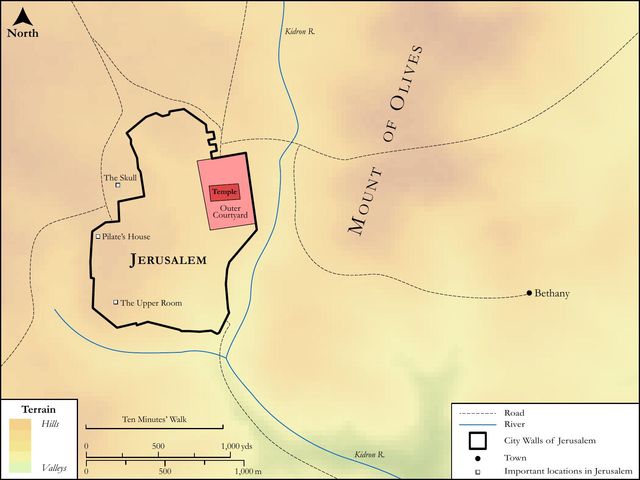
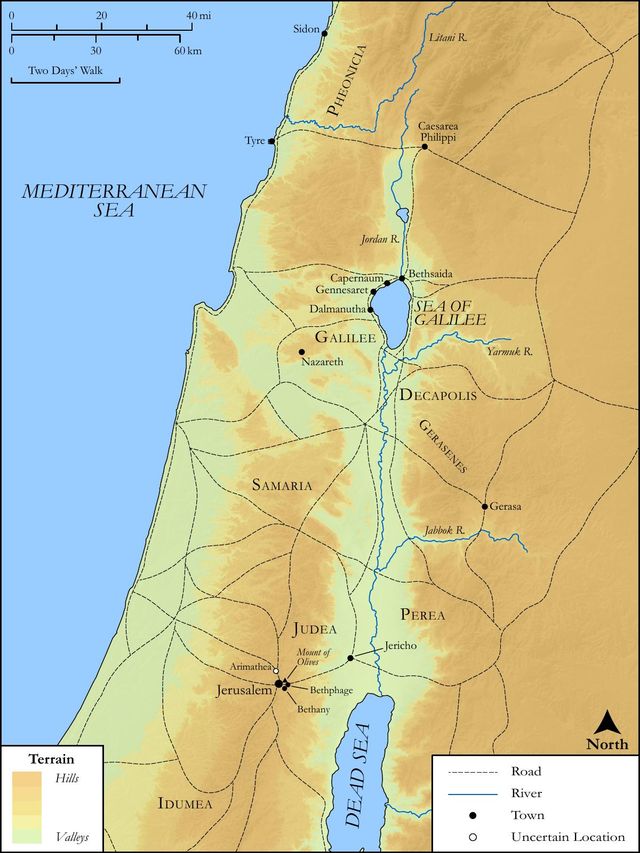
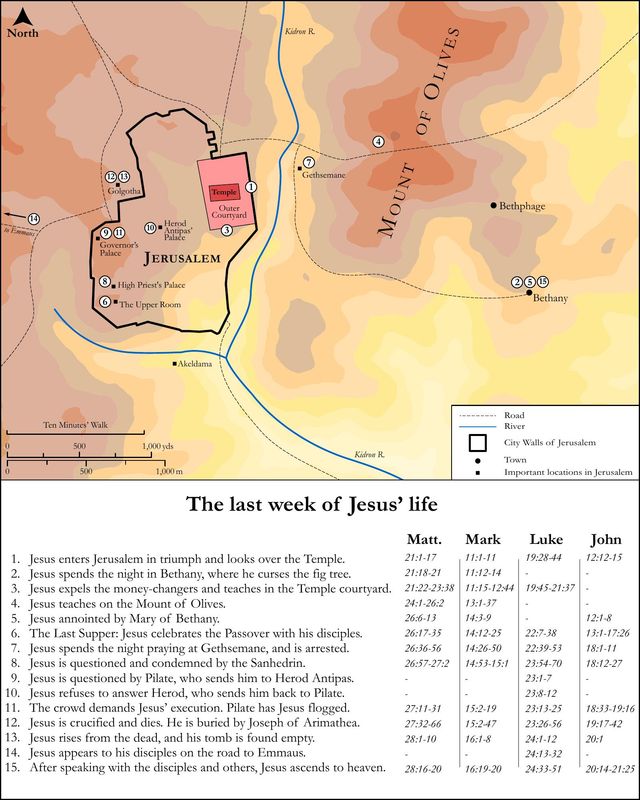
Study this verse
Public-domain commentary
Matthew Henry
From his Commentary on the Whole Bible. Henry comments on passages, not single verses — this entry covers Mark 14:12–31. His three-level outline is real structure in the source text, so it is rendered as structure.
In these verses we have,
I.Christ's eating the passover with his disciples, the night before he died, with the joys and comforts of which ordinance he prepared himself for his approaching sorrows, the full prospect of which did not indispose him for that solemnity. Note, No apprehension of trouble, come or coming, should put us by, or put us out of frame for, our attendance on holy ordinances, as we have opportunity for it.
1.Christ ate the passover at the usual time when the other Jews did, as Dr. Whitby had fully made out, and not, as Dr. Hammond would have it, the night before. It was on the first day of that feast, which (taking in all the eight days of the feast) was called, The feast of unleavened bread, even that day when they killed the passover, Mar 14:12.
2.He directed his disciples how to find the place where he intended to eat the passover; and hereby gave such another proof of his infallible knowledge of things distant and future (which to us seem altogether contingent), as he had given when he sent them for the ass on which he rode in triumph (Mar 11:6); "Go into the city (for the passover must be eaten in Jerusalem), and there shall meet you a man bearing a pitcher of water (a servant sent for water to clean the rooms in his master's house); follow him, go in where he goes, enquire for his master, the good man of the house (Mar 14:14), and desire him to show you a room." No doubt, the inhabitants of Jerusalem had rooms fitted up to be let out, for this occasion, to those that came out of the country to keep the passover, and one of those Christ made use of; not any friend's house, nor any house he had formerly frequented, for then he would have said, "Go to such a friend," or, "You know where we used to be, go thither and prepare." Probably he went where he was not known, that he might be undisturbed with his disciples. Perhaps he notified it by a sign, to conceal it from Judas, that he might not know till he came to the place; and by such a sign to intimate that he will dwell in the clean heart, that is, washed as with pure water. Where he designs to come, a pitcher of water must go before him; see Isa 1:16-18.
3.He ate the passover in an upper room furnished, estrōmenon - laid with carpets (so Dr. Hammond); it would seem to have been a very handsome dining-room. Christ was far from affecting any thing that looked stately in eating his common meals; on the contrary, he chose that which was homely, sat down on the grass: but, when he was to keep a sacred feast, in honour of that he would be at the expense of as good a room as he could get. God looks not at outward pomp, but he looks at the tokens and expressions of inward reverence for a divine institution, which, it is to be feared, those want, who, to save charges, deny themselves decencies in the worship of God.
4.He ate it with the twelve, who were his family, to teach those who have the charge of families, not only families of children, but families of servants, or families of scholars, or pupils, to keep up religion among them, and worship God with them. If Christ came with the twelve, then Judas was with them, though he was at this time contriving to betray his Master; and it is plain by what follows (Mar 14:20), that he was there: he did not absent himself, lest he could have been suspected; had his seat been empty at this feast, they would have said, as Saul of David, He is not clean, surely he is not clean, Sa1 20:26. Hypocrites, though they know it is at their peril, yet crowd into special ordinances, to keep up their repute, and palliate their secret wickedness. Christ did not exclude him from the feast, though he knew his wickedness, for it was not as yet become public and scandalous. Christ, designing to put the keys of the kingdom of heaven into the hands of men, who can judge only according to outward appearance, would hereby both direct and encourage them in their admissions to his table, to be satisfied with a justifiable profession, because they cannot discern the root of bitterness till it springs up.
II.Christ's discourse with his disciples, as they were eating the passover.
It is probable that they had discourse, according to the custom of the feast, of the deliverance of Israel out of Egypt, and the preservation of the first-born, and were as pleasant as they used to be together on this occasion, till Christ told them that which would mix trembling with their joys.
1.They were pleasing themselves with the society of their Master; but he tells them that they must now presently lose him; The Son of man is betrayed; and they knew, for he had often told them, what followed - If he be betrayed, the next news you will hear of him, is, that he is crucified and slain; God hath determined it concerning him, and he agrees to it; The Son of man goes, as it is written of him, Mar 14:21. It was written in the counsels of God, and written in the prophecies of the Old Testament, not one jot or tittle of either of which can fall to the ground.
2.They were pleasing themselves with the society one of another, but Christ casts a damp upon the joy of that, by telling them, One of you that eateth with me shall betray me, Mar 14:18. Christ said this, if it might be, to startle the conscience of Judas, and to awaken him to repent of his wickedness, and to draw back (for it was not too late) from the brink of the pit. But for aught that appears, he who was most concerned in the warning, was least concerned at it. All the rest were affected with it.
(1.)They began to be sorrowful. As the remembrance of our former falls into sin, so the fear of the like again, doth often much embitter the comfort of our spiritual feasts, and damp our joy. Here were the bitter herbs, with which this passover-feast was taken.
(2.)They began to be suspicious of themselves; they said one by one, Is it I? And another said, Is it I? They are to be commended for their charity, that they were more jealous of themselves than of one another. It is the law of charity, to hope the best (Co1 13:5-7), because we assuredly know, therefore we may justly suspect, more evil by ourselves than by our brethren. They are also to be commended for their acquiescence in what Christ said; they trusted more to his words than to their own hearts; and therefore do not say, "I am sure it is not I," but, "Lord, is it I? see if there be such a way of wickedness in us, such a root of bitterness, and discover it to us, that we may pluck up that root, and stop up that way."
Now, in answer to their enquiry, Christ saith that, [1.] Which would make them easy; "It is not you, or you; it is this that now dips with me in the dish; the adversary and enemy is this wicked Judas." [2.] Which, one would think, should make Judas very uneasy. If he go on in his undertaking, it is upon the sword's point, for woe to that many by whom the Son of man is betrayed; he is undone, for every undone; his sin will soon find him out; and it were better for him that he had never been born, and had never had a being than such a miserable one as he must have. It is very probable that Judas encouraged himself in it with this thought, that his Master had often said he must be betrayed; "And if it must be done, surely God will not find fault with him that doth it, for who hath resisted his will?" As that objector argues, Rom 9:19. But Christ tells him that this will be no shelter or excuse to him; The Son of man indeed goes; as it is written of him, as a lamb to the slaughter; but woe to that man by whom he is betrayed. God's decree to permit the sins of men, and bring glory to himself out of them, do neither necessitate their sins, nor determine to them, nor will they be any excuse of the sin, or mitigation of the punishment. Christ was delivered indeed by the determinate counsel and fore-knowledge of God; but, notwithstanding that, it is with wicked hands that he is crucified and slain, Act 2:23.
III.The institution of the Lord's supper.
1.It was instituted in the close of a supper, when they were sufficiently fed with the paschal lamb, to show that in the Lord's supper there is no bodily repast intended; to preface it with such a thing, is to revive Moses again. But it is food for the soul only, and therefore a very little of that which is for the body, as much as will serve for a sign, is enough. It was at the close of the passover-supper, which by this was evangelized, and then superseded and set aside. Much of the doctrine and duty of the eucharist is illustrated to us by the law of the passover (Ex. 12); for the Old Testament institutions, though they do not bind us, yet instruct us, by the help of a gospel-key to them. And these two ordinances lying here so near together, it may be good to compare them, and observe how much shorter and plainer the institution of the Lord's supper is, than that of the passover was. Christ's yoke is easy in comparison with that of the ceremonial law, and his ordinances are more spiritual.
2.It was instituted by the example of Christ himself; not with the ceremony and solemnity of a law, as the ordinance of baptism was, after Christ's resurrection (Mat 28:19), with, Be it enacted by the authority aforesaid, by a power given to Christ in heaven and on earth (Mat 28:18); but by the practice of our Master himself, because intended for those who are already his disciples, and taken into covenant with him: but it has the obligation of the law, and was intended to remain in full force, power, and virtue, till his second coming.
3.It was instituted with blessing and giving of thanks; the gifts of common providence are to be so received (Ti1 4:4, Ti1 4:5), much more than the gifts of special grace. He blessed (Mar 14:22), and gave thanks, Mar 14:23. At his other meals, he was wont to bless, and give thanks (Mar 6:41; Mar 8:7) so remarkably, that he was known by it, Luk 24:30, Luk 24:31. And he did the same at this meal.
4.It was instituted to be a memorial of his death; and therefore he broke the bread, to show how it pleased the Lord to bruise him; and he called the wine, which is the blood of the grape, the blood of the New Testament. The death Christ died was a bloody death, and frequent mention is made of the blood, the precious blood, as the pride of our redemption; for the blood is the life, and made atonement for the soul, Lev 17:11-14. The pouring out of the blood was the most sensible indication of the pouring out of his soul, Isa 53:12. Blood has a voice (Gen 4:10); and therefore blood is so often mentioned, because it was to speak, Heb 12:24. It is called the blood of the New Testament; for the covenant of grace became a testament, and of force by the death of Christ, the testator, Heb 9:16. It is said to be shed for many, to justify many (Isa 53:11), to bring many sons to glory, Heb 2:10. It was sufficient for many, being of infinite value; it has been of use to many; we read of a great multitude which no man could number, that had all washed their robes, and made them white in the blood of the Lamb (Rev 7:9-14); and still it is a fountain opened. How comfortable is this to poor repenting sinners, that the blood of Christ is shed for many! And if for many, why not for me? If for sinners, sinners of the Gentiles, the chief of sinners, then why not for me?
5.It was instituted to be a ratification of the covenant made with us in him, and a sign of the conveyance of those benefits to us, which were purchased for us by his death; and therefore he broke the bread to them (Mar 14:22), and said, Take, eat of it: he gave the cup to them, and ordered them to drink of it, Mar 14:23. Apply the doctrine of Christ crucified to yourselves, and let it be meat and drink to your souls, strengthening, nourishing, and refreshing, to you, and the support and comfort of your spiritual life.
6.It was instituted with an eye to the happiness of heaven, and to be an earnest and fore-taste of that, and thereby to put our mouths out of taste for all the pleasures and delights of sense (Mar 14:25); I will drink no more of the fruit of the vine, as it is a bodily refreshment. I have done with it. No one, having tasted spiritual delights, straightway desires sensitive ones, for he saith, The spiritual is better (Luk 5:39); but every one that hath tasted spiritual delights, straightway desires eternal ones, for he saith, Those are better still; and therefore let me drink no more of the fruit of the vine, it is dead and flat to those that have been made to drink of the river of God's pleasures; but, Lord, hasten the day, when I shall drink it new and fresh in the kingdom of God, where it shall be for ever new, and in perfection.
7.It was closed with a hymn, Mar 14:26. Though Christ was in the midst of his enemies, yet he did not, for fear of them, omit this sweet duty of singing psalms. Paul and Silas sang, when the prisoners heard them. This was an evangelical song, and gospel times are often spoken of in the Old Testament, as times of rejoicing, and praise is expressed by singing. This was Christ's swan-like song, which he sung just before he entered upon his agony; probably, that which is usually sung, Psa 113:1-9 to 118.
IV.Christ's discourse with his disciples, as they were returning to Bethany by moonlight.
When the had sung the hymn, presently they went out. It was now near bedtime, but our Lord Jesus had his heart so much upon his suffering, that he would not come into the tabernacle of his house, norgo up into his bed, nor give sleep to his eyes, when that work was to be done, Psa 132:3, Psa 132:4. The Israelites were forbidden to go out of their houses the night that they ate the passover, for fear of the sword of the destroying angel, Exo 12:22, Exo 12:23. But because Christ, the great shepherd, was to be smitten, he went out purposely to expose himself to the sword, as a champion; they evaded the destroyer, but Christ conquered him, and brought destructions to a perpetual end.
1.Christ here foretels that in his sufferings he should be deserted by all his disciples; "You will all be offended because of me, this night. I know you will (Mar 14:27), and what I tell you now, is no other than what the scripture has told you before; I will smite the shepherd, and then the sheep will be scattered." Christ knew this before, and yet welcomed them at his table; he sees the falls and miscarriages of his disciples, and yet doth not refuse them. Nor should we be discouraged from coming to the Lord's supper, by the fear of relapsing into sin afterward; but, the greater of our danger is, the more need we have to fortify ourselves by the diligent conscientious use of holy ordinances. Christ tells them that they would be offended in him, would begin to question whether he were the Messiah or no, when they saw him overpowered by his enemies. Hitherto, they had continued with him in his temptations; though they had sometimes offended him, yet they had not been offended in him, nor turned the back upon him; but now the storm would be so great, that they would all slip their anchors, and be in danger of shipwreck. Some trials are more particular (as Rev 2:10, The devil shall cast some of you into prison); but others are more general, an hour of temptation, which shall come upon all the world, Rev 3:10. The smiting of the shepherd is often the scattering of the sheep: magistrates, ministers, masters of families, if these are, as they should be, shepherds to those under their charge, when any thing comes amiss to them, the whole flock suffers for it, and is endangered by it.
But Christ encourages them with a promise that they shall rally again, shall return both to their duty and to their comfort (Mar 14:28); "After I am risen, I will gather you in from all the places wither you are scattered, Eze 34:12. I will go before you into Galilee, will see our friends, and enjoy one another there."
2.He foretels that he should be denied particularly by Peter. When they went out to go to the mount of Olives, we may suppose that they dropped Judas (he stole away from them), whereupon the rest began to think highly of themselves, that they stuck to their Master, when Judas quitted him. But Christ tells them, that though they should be kept by his grace from Judas's apostasy, yet they would have no reason to boast of their constancy. Note, Though God keeps us from being as bad as the worst, yet we may well be ashamed to think that we are not better than we are.
(1.)Peter is confident that he should not do so ill as the rest of his disciples (Mar 14:29); Though all should be offended, all his brethren here present, yet will not I. He supposes himself not only stronger than others, but so much stronger, as to be able to receive the shock of a temptation, and bear up against it, all alone; to stand, though nobody stood by him. It is bred in the bone with us, to think well of ourselves, and trust to our own hearts.
(2.)Christ tells him that he will do worse than any of them. They will all desert him, but he will deny him; not once, but thrice; and that presently; "This day, even this night before the cock crow twice, thou wilt deny that ever thou hadst any knowledge of me, or acquaintance with me, as one ashamed and afraid to own me."
(3.)He stands to his promise; "If I should die with thee, I will not deny thee; I will adhere to thee, though it cost me my life:" and, no doubt, he thought as he said. Judas said nothing like this, when Christ told him he would betray him. He sinned by contrivance, Peter by surprise; he devised the wickedness (Mic 2:1), Peter was overtaken in this fault, Gal 6:1. It was ill done of Peter, to contradict his Master. If he had said, with fear and trembling, "Lord, give me grace to keep me from denying thee, lead me not into this temptation, deliver me from this evil," it might have been prevented: but they were all thus confident; they who said, Lord, is it I? now said, It shall never be me. Being acquitted from their fear of betraying Christ, they were now secure. But he that thinks he stands, must learn to take heed lest he fall; and he that girdeth on the harness, not boast as though he had put it off.
Historical interpretation
Ten Centuries of Reception
16 surviving comments on this verse. Each one is dated, so this reads as a timeline rather than a list.
Select a marker to jump to its quote. Markers stagger vertically where authors wrote within a few decades of each other.
But in a mystical sense, the Lord transfigures into bread His body, which is the present Church, which is received in faith, is blessed in its number, is broken in its sufferings, is given in its examples, is taken in its doctrines; and He forms His Blood (formans sanguinem suum ap. Pseudo-Hier.) in the chalice of water and wine mingled together, that by one we may be purged from our sins, by the other redeemed from their punishment. For by the blood of the lamb our houses are preserved from the smiting of the Angel, and our enemies perish in the waters of the Red sea, which are the sacraments of the Church of Christ. Wherefore it goes on: And he took the cup, and when he had given thanks, he gave it to them. For we are saved by the grace of the Lord, not by our own deserts.
Happy intoxication, saving fulness, which the more we drink gives the greater sobriety of mind!
Judas therefore drinks and is not satisfied, nor can he quench the thirst of the everlasting fire, because he unworthily partakes of the mysteries of Christ. There are some in the Church whom the sacrifice does not cleanse, but their foolish thought draws them on to sin, for they have plunged themselves in the stinking slough of cruelty.
For it does not cleanse all. It goes on: Verily I say unto you, I will drink no more of the fruit of the vine, until that day that I drink it new in the kingdom of God.
But we must consider that here the Lord changes the sacrifice without changing the time; so that we never celebrate the Cæna Domini before the fourteenth moon. He who celebrates the resurrection on the fourteenth moon, will celebrate the Cæna Domini on the eleventh moon, which was never done in either Old or New Testament.
Now concerning the Thanksgiving (Eucharist), thus give thanks. First, concerning the cup: We thank thee, our Father, for the holy vine of David Thy servant, which Thou madest known to us through Jesus Thy Servant; to Thee be the glory for ever. And concerning the broken bread: We thank Thee, our Father, for the life and knowledge which Thou modest known to us through Jesus Thy Servant; to Thee be the glory for ever. Even as this broken bread was scattered over the hills, and was gathered together and became one, so let Thy Church be gathered together from the ends of the earth into Thy kingdom; for Thine is the glory and the power through Jesus Christ for ever. But let no one eat or drink of your Thanksgiving (Eucharist), but they who have been baptized into the name of the Lord; for concerning this also the Lord hath said, Give not that which is holy to the dogs.
But after ye are filled, thus give thanks: We thank Thee, holy Father, for Thy holy name which Thou didst cause to tabernacle in our hearts, and for the knowledge and faith and immortality, which Thou modest known to us through Jesus Thy Servant; to Thee be the glory for ever. Thou, Master almighty, didst create all things for Thy name's sake; Thou gavest food and drink to men for enjoyment, that they might give thanks to Thee; but to us Thou didst freely give spiritual food and drink and life eternal through Thy Servant. Before all things we thank Thee that Thou art mighty; to Thee be the glory for ever. Remember, Lord, Thy Church, to deliver it from all evil and to make it perfect in Thy love, and gather it from the four winds, sanctified for Thy kingdom which Thou hast prepared for it; for Thine is the power and the glory for ever. Let grace come, and let this world pass away. Hosanna to the God (Son) of David! If any one is holy, let him come; if any one is not so, let him repent. Maran atha. Amen. But permit the prophets to make Thanksgiving as much as they desire.
And this food is called among us Εὐχαριστία [the Eucharist], of which no one is allowed to partake but the man who believes that the things which we teach are true, and who has been washed with the washing that is for the remission of sins, and unto regeneration, and who is so living as Christ has enjoined. For not as common bread and common drink do we receive these; but in like manner as Jesus Christ our Saviour, having been made flesh by the Word of God, had both flesh and blood for our salvation, so likewise have we been taught that the food which is blessed by the prayer of His word, and from which our blood and flesh by transmutation are nourished, is the flesh and blood of that Jesus who was made flesh. For the apostles, in the memoirs composed by them, which are called Gospels, have thus delivered unto us what was enjoined upon them; that Jesus took bread, and when He had given thanks, said, "This do ye in remembrance of Me, this is My body;" and that, after the same manner, having taken the cup and given thanks, He said, "This is My blood;" and gave it to them alone.
Giving directions to his disciples to offer to God the first fruits of his creatures—not as if he stood in need of them, but that they might be themselves neither unfruitful nor ungrateful—he took that created thing, bread, and gave thanks, and said, “This is my body.” And the cup likewise, which is part of the creation to which we belong, he confessed to be his blood, and taught the new offering of the new covenant. This is what the church has received from the apostles and throughout the whole world offers to God, who affords us nourishment as the first fruits of his gifts in the New Testament.
Then having taken the bread and given it to his disciples, he made it his own body by saying “This is my body,” that is, the figure of my body. A figure, however, there could not have been, unless there had first been a palpable body. A phantom or mere void is not capable of embodying a figure. But Marcion would claim that Jesus only pretended that the bread was his body because he presumably had no bodily substance, so in the absence of his body he gives us bread. It wouldn’t change his theory of a phantom body much if we stretched the point to say that the bread was crucified! But in that case why would we need to call his body bread? Why not rather come up with some more interesting edible thing, like a melon, which maybe Marcion had in place of a heart!
That bread which God the Word confesses to be his own body is the Word that nourishes souls, the Word proceeding from God, the very bread that comes from the living bread which is set out upon our table of which was written: “Thou preparest a table before me in the presence of my enemies.” That drink which God the Word confesses to be his blood is the Word that gives refreshment and exhilarates the heart.… This drink is the fruit of the true vine, the blood of that grape cast in the winepress of the passion. So also the bread is the word of Christ made from that corn which, falling onto the good ground, brought forth much fruit. He was not speaking of the visible bread alone which he was holding in his hands as he called it his body. It is the word in the mystery of which that bread was to be broken. Nor did he call that visible drink as such his blood, but the word in the mystery of which that drink was to be poured out. For to what else could the body and blood of the Lord refer other than the atoning Word that nourishes and gladdens the heart? Why did he not say, “This is my bread of the New Testament” just as he said, “This is my blood of the New Testament?” Because the bread is the word of righteousness, by the eating of which souls are nourished. The drink is the word of knowledge of Christ according to the mystery of his birth and passion.
Being mindful, therefore, of those things that He endured for our sakes, we give You thanks, O God Almighty, not in such a manner as we ought, but as we are able, and fulfil His constitution: "For in the same night that He was betrayed, He took bread" [1 Corinthians 11:23] in His holy and undefiled hands, and, looking up to You His God and Father, "He broke it, and gave it to His disciples, saying, This is the mystery of the new covenant: take of it, and eat. This is my body, which is broken for many, for the remission of sins." In like manner also "He took the cup," and mixed it of wine and water, and sanctified it, and delivered it to them, saying: "Drink all of this; for this is my blood which is shed for many, for the remission of sins: do this in remembrance of me. For as often as you eat this bread and drink this cup, you do show forth my death until I come." Being mindful, therefore, of His passion, and death, and resurrection from the dead, and return into the heavens, and His future second appearing, wherein He is to come with glory and power to judge the quick and the dead, and to recompense to every one according to his works, we offer to You, our King and our God, according to His constitution, this bread and this cup, giving You thanks, through Him, that You have thought us worthy to stand before You, and to sacrifice to You; and we beseech You that You will mercifully look down upon these gifts which are here set before You, O God, who standest in need of none of our offerings. And accept them, to the honour of Your Christ, and send down upon this sacrifice Your Holy Spirit, the Witness of the Lord Jesus' sufferings, that He may show this bread to be the body of Your Christ, and the cup to be the blood of Your Christ, that those who are partakers thereof may be strengthened for piety, may obtain the remission of their sins, may be delivered from the devil and his deceit, may be filled with the Holy Ghost, may be made worthy of Your Christ, and may obtain eternal life upon Your reconciliation to them, O Lord Almighty.
Do you want to know why it is consecrated with heavenly words? Receive the words. The priest says: 'Make this offering written, ratified, reasonable, acceptable, which is the figure of the body and blood of our Lord Jesus Christ. Who, on the day before he suffered, took bread into his holy hands, looked up to you, holy Father almighty, eternal God, giving thanks, he blessed it, broke it, and gave it to his apostles and disciples, saying: Take and eat all of you from this; for this is my body which will be broken for many.'
He took bread in his holy hands the day before he suffered. Before it is consecrated, it is bread; but when the words of Christ have been spoken, it becomes the body of Christ.
(ubi sup.) Even now also that Christ is close to us; He who prepared that table, Himself also consecrates it. For it is not man who makes the offerings to be the Body and Blood of Christ, but Christ who was crucified for us. The words are spoken by the mouth of the Priest, and are consecrated by the power and the grace of God. By this word which He spoke, This is my body, the offerings are consecrated; and as that word which says, Increase and multiply, and fill the earth, (Gen. 1:28) was sent forth but once, yet has its effect throughout all time, when nature does the work of generation; so also that voice was spoken once, yet gives confirmation to the sacrifice through all the tables of the Church even to this day, even to His advent.
(ubi sup.) For Christ offered His blood to him who betrayed Him, that he might have remission of his sins, if he had chosen to cease to be wicked.
(ubi sup.) Let there not be therefore a Judas at the table of the Lord; this sacrifice is spiritual food, for as bodily food, working on a belly filled with humours which are opposed to it, is hurtful, so this spiritual food if taken by one polluted with wickedness, rather brings him to perdition, not by its own nature, but through the fault of the recipient. Let therefore our mind be pure in all things, and our thought pure, for that sacrifice is pure. There follows: And he said unto them, This is my blood of the New Testament, which is shed for many.
You hold the sacraments in their order. First, after the prayer, you are admonished to lift up your hearts; this befits the members of Christ. For if you have become members of Christ, where is your head? Members have a head. If the head had not gone before, the members would not follow. Where did our head go? What did you recite in the Creed? On the third day, He rose again from the dead, He ascended into heaven, He sits at the right hand of the Father. Therefore, our head is in Heaven. Thus when it is said: Lift up your hearts, you answer: We have them with the Lord. And so that you do not attribute the fact that you have your hearts with the Lord to your own strengths, merits, or labors—for it is a gift of God to have your heart lifted up to Him—the bishop or the priest who offers the sacrifice continues and says—when the people respond: We have them with the Lord—: Let us give thanks to the Lord our God, because we have our hearts with the Lord. Let us give thanks because if he did not give it, we would have our hearts on earth. And you attest by saying: It is right and just, that we should give thanks to Him who made us have our hearts lifted up to our head. Then, after the sanctification of God's sacrifice, because he willed that we ourselves should be his sacrifice—this was shown when the first sacrifice of God was laid down and we—meaning the sign of the reality—which we are; behold where the sanctification has been accomplished, we say the Lord’s Prayer, which you have received and rendered. After it has been said: Peace be with you, and the Christians give each other a holy kiss. It is a sign of peace: as the lips show, let it be done in conscience, that is, just as your lips approach your brother’s lips, let your heart not depart from his heart. Great indeed are the sacraments and very great indeed. Do you wish to know how they are commended? The Apostle says: Whosoever shall eat of the body of Christ or drink of the cup of the Lord unworthily, shall be guilty of the body and blood of the Lord. What does it mean to receive unworthily? To receive it contemptuously, to receive it scoffingly. Do not make it seem cheap to you, because you see it. What you see passes away, but what is signified, the invisible, does not pass, but remains. Behold, it is received, eaten, consumed. Does the body of Christ perish? Does the Church of Christ perish? Do the members of Christ perish? By no means. Here they are cleansed, there they are crowned. Therefore, what is signified remains, even though that which signifies might seem to pass away.
Daniel the disciple of Arsenius used to talk also about a hermit in Scetis, saying that he was a great man but simple in the faith, and in his ignorance he thought and said that the bread which we receive is not in very truth the Body of Christ, but a symbol of His Body. Two of the monks heard what he said but because they knew of his sublime works and labours, they imagined that he had said it in innocence and simple-mindedness; and so they came to him and said unto him, ‘Abba, someone told us something that we do not believe; he said that this bread that we receive is not in very truth the Body of Christ, but a mere symbol.’ He said to them, ‘I said that.’ They begged him, saying, ‘You mustn’t say that, abba; according to what the Catholic Church has handed down to us, even so do we believe, that is to say, this bread is the Body of Christ in very truth, and is not a mere symbol. It is the same as when God took dust from the earth, and made man in His image; just as no one can say that he is not the image of God, so also with the bread of which He said, “This is My Body” is not to be regarded as a merely commemorative thing; we believe that it is indeed the Body of Christ.’ The hermit said, ‘Unless I can be convinced by the thing itself I will not listen to this.’ Then the monks said to him, ‘Let us pray to God all week about this mystery, and we believe that He will reveal the truth to us.’ The hermit agreed to this with great joy, and each went to his cell. Then the hermit prayed, saying, ‘O Lord, you know that it is not out of wickedness that I do not believe, so in order that I may not go astray through ignorance, reveal to me, Lord Jesus Christ, the truth of this mystery.’ The other two brothers prayed to God and said, ‘Lord Jesus Christ, give this hermit understanding about this mystery, and we believe that he will not be lost.’ God heard the prayer of the two monks. When the week was over they came to the church, and the three of them sat down by themselves on one seat, the hermit between the other two. The eyes of their understanding were opened, and when the time of the mysteries arrived, and the bread was laid upon the holy table, there appeared to the three of them as it were a child on the table. Then the priest stretched out his hand to break the bread, and behold the angel of the Lord came down from heaven with a knife in his hand, and he killed the child and pressed out his blood into the cup. When the priest broke off from the bread small pieces, the hermit went forward to receive communion and a piece of living flesh smeared and dripping with blood was given to him. Now when he saw this he was afraid and he cried out loudly, saying, ‘Lord, I believe that the bread is Your Body, and that the cup is Your Blood.’ At once the flesh that was in his hand became bread, and he took it and gave thanks to God. The brothers said to him, ‘God knows the nature of men, and that we are unable to eat living flesh, and so He turneth His Body into bread, and His Blood into wine for those who receive Him in faith.’ Then they gave thanks to God for the hermit, because He had not let Satan destroy him, and the three of them went back to their cells joyfully.
(Mor. ii. 37) When His Passion was approaching, He is said to have taken bread and given thanks. He therefore gave thanks, who took upon Him the stripes of other men's wickedness; He who did nothing worthy of smiting, humbly gives a blessing in His Passion, to show us, what each should do when beaten for his own sins, since He Himself bore calmly the stripes due to the sin of others; furthermore to show us, what we who are the subjects of the Father should do under correction, when He who is His equal gave thanks under the lash.
And as they were eating, Jesus took bread, and blessing it, broke it, and gave it to them, and said: Take, this is my body. When the solemnities of the old Passover, which were celebrated in remembrance of the ancient liberation of God's people from Egypt, were finished, he moved on to the new which he wanted the Church to observe in memory of his own redemption, so that he might substitute, in place of the flesh and blood of the lamb, the sacrament of his body and blood, and show himself to be: To whom the Lord swore and will not repent: You are a priest forever according to the order of Melchizedek (Psalm 110). He himself breaks the bread which he gives to the disciples, to show that his body's breaking would not come without his own volition and preparation, but as he says elsewhere, he has the power to lay down his life, and he has the power to take it up again. Indeed, he blessed the bread with the grace of a certain sacrament before breaking it, because the human nature he took on, which he was to suffer, he, together with the Father and the Holy Spirit, filled with the grace of divine power. He blessed and broke the bread, because he deigned to submit the assumed man to death in such a way that he might truly demonstrate that he had within him the power of divine immortality, and thus teach that he would quickly be raised from death.
(ubi sup.) When the rites of the old Passover were finished, He passed to the new, in order, that is, to substitute the Sacrament of His own Body and Blood, for the flesh and blood of the lamb. Wherefore there follows: And as they did eat, Jesus took bread; that is, in order to show that He Himself is that person to whom the Lord swore, Thou art a Priest for ever after the order of Melchizedec. (Ps. 110:4) There follows: And blessed, and brake it.
(ubi sup.) He Himself also breaks the bread, which He gives to His disciples, to show that the breaking of His Body was to take place, not against His will, nor without His intervention; He also blessed it, because He with the Father and the Holy Spirit filled His human nature, which He took upon Him in order to suffer, with the grace of Divine power. He blessed bread and brake it, because He deigned to subject to death His manhood, which He had taken upon Him, in such a way as to show that there was within it the power of Divine immortality, and to teach them that therefore He would the more quickly raise it from the dead. There follows: And gave to them, and said, Take, eat: this is my body.
(ubi sup.) The wine of the Lord's cup is mixed with water, because we should remain in Christ and Christ in us. For on the testimony of John, the waters are the people, and it is not lawful for any one to offer either wine alone, or water alone, lest such an oblation should mean that the head may be severed from the members, and either that Christ could suffer without love for our redemption, and that we can be saved or be offered to the Father without His Passion. (Apoc. 17:15) It goes on: And they all drank of it.
(ubi sup.) This refers to the different circumstances of the Old Testament, which was consecrated by the blood of calves and of goats; and the lawgiver said in sprinkling it, This is the blood of the Testament which God hath injoined unto you. (Heb. 9:20. vide Ex. 24:8) It goes on: Which is shed for many.
(ubi sup.) Or else, Isaiah testifies that the synagogue is called the vine or the vineyard of the Lord, saying, The vineyard of the Lord of hosts is the house of Israel. (Is. 5:7) The Lord therefore when about to go to His Passion, says, I will drink no more of the fruit of the vine, as if He had said openly, I will no longer delight in the carnal rites of the synagogue, in which also these rites of the Paschal Lamb have held the chief place. For the time of my resurrection shall come, that day shall come, when in the kingdom of heaven, that is, raised on high with the glory of immortal life, I will be filled with a new joy, together with you, for the salvation of the same people born again of the fountain of spiritual grace.
Human beings have a compound nature: body and spirit. So it is fitting that the new birth should correspond to that compound nature, and also that the food of faith be compound. We were therefore given a birth both by water and by the Spirit, that is, in holy baptism, and with it food that is the very bread of life, even our Lord Jesus Christ, who came down from heaven. For when he was about to take on himself a voluntary death for our sakes, on the night on which he gave himself up, he offered a new covenant to his holy disciples and apostles, and through them to all who believe on him. In an upper chamber, then, on holy and glorious Zion, after he had eaten the ancient Passoverwith his disciples and had fulfilled the ancient covenant, he washed his disciples’ feet in token of the holy baptism. Then having broken bread he gave it to them saying, “Take, eat, this is my body broken for you for the remission of sins.”
That is, giving thanks, He brake it, which we also do, with the addition of some prayers.
That, namely, which I now give and which ye take. But the bread is not a mere figure of the Body of Christ, but is changed into the very Body of Christ. For the Lord said, The bread which I give you is my flesh. But the flesh of Christ is veiled from our eyes on account of our weakness, for bread and wine are things to which we are accustomed, if however we saw flesh and blood we could not bear to take them. For this reason the Lord bending Himself to our weakness keeps the forms of bread and wine, but changes the bread and wine into the reality of His Body and Blood.
Some say that Judas did not partake in these mysteries, but that he went out before the Lord gave the Sacrament. Some again say that He gave him also of that Sacrament.
As if He had said, I will not drink wine until the resurrection; for He calls His resurrection the kingdom, as He then reigned over death. But after His resurrection He ate and drank with His disciples, showing that it was He Himself who had suffered. But He drank it new, that is, in a new and strange manner, for He had not a body subject to suffering, and requiring food, but immortal and incorruptible. We may also understand it in this way. The vine is the Lord Himself, by the offspring1 of the vine is meant mysteries, and the secret understanding, which He Himself begets2, who teaches man knowledge. But in the kingdom of God, that is, in the world to come, He will drink with His disciples mysteries and knowledge, teaching us new things, and revealing what He now hides.
Continue studying Mark 14:22 across the web’s major study libraries — every link below opens this exact verse, chapter, or book on the destination site.
Read & Compare
 BibleGatewayThis verse in more than 200 translations and 70 languages.
 Bible.comThe YouVersion reader — hundreds of translations, reading plans, and highlights.
 ESV.orgCrossway's official English Standard Version reader.
 NET BibleThe NET translation with 60,000+ translators' notes on every rendering decision.
 STEP BibleTyndale House's free study tool — original text, vocabulary, and scholarly resources.
 BibliaLogos Bible Software's free web reader.
 USCCBThe New American Bible (Revised Edition) with the U.S. bishops' study notes.
Commentaries
 BibleHub CommentariesDozens of classic commentaries on this verse, gathered on one page.
 StudyLightMore than 100 commentary sets — the largest collection on the web.
 BibleRefPlain-English commentary on what this verse means, verse by verse.
 Enduring WordDavid Guzik's free commentary on this chapter, widely used by Bible teachers.
 Bible Study ToolsVerse commentary alongside Greek and Hebrew study aids.
Original Language & Research
- BibleHub InterlinearThe verse word by word — original language, transliteration, and English.
- BibleHub LexiconEvery word's original-language definition and Strong's entry.
 Blue Letter BibleDeep-study tools — Strong's numbers, concordance, and word studies.
 CNTR CollationThe earliest Greek manuscripts of this verse, collated letter by letter.
Sermons, Hymns & Audio


TrulyRandomVerse is not affiliated with these sites and doesn’t control their content. They’re linked because they’re genuinely useful.
Summary
Mark 14:22 records the pivotal moment during the Last Supper when Jesus instituted the sacred meal that would become known as the Lord's Supper or Holy Communion. In this profound act, Jesus took bread, blessed it, broke it, and declared it to be His body, thereby establishing a new covenant ceremony that would forever serve as a memorial of His imminent sacrifice and the foundation of Christian worship.
Context
ShowHideLiterary Context
This verse is situated within Mark's detailed account of Jesus' Passion, specifically the events leading up to His crucifixion. Immediately preceding this passage, Jesus has made preparations for the Passover meal with His disciples (Mark 14:12-16), and has solemnly announced that one of them will betray Him (Mark 14:17-21). The institution of the bread (Mark 14:22) is followed directly by the institution of the cup (Mark 14:23-25), sealing the new covenant in His blood. This entire sequence underscores the gravity and intentionality of Jesus' actions, framing the Last Supper not as an ordinary meal, but as a deeply significant, pre-ordained event that redefines the very nature of sacrifice and covenant.
Historical & Cultural Context
The setting is the Passover Seder, an annual Jewish feast commemorating God's deliverance of Israel from slavery in Egypt, particularly the sparing of the firstborn through the blood of the lamb (Exodus 12). The meal involved specific elements, including unleavened bread (matzah) and wine, consumed according to prescribed rituals. Jesus, as a devout Jew, observed this tradition. However, in Mark 14:22 and the subsequent verses, He reinterprets these traditional elements, imbuing them with new, profound meaning that points to His own sacrificial death as the ultimate act of redemption. The bread, typically a symbol of haste and affliction in the Exodus narrative, now becomes a symbol of His broken body, offered for the sins of the world. This reinterpretation marks a dramatic shift from the Old Covenant, established through the Law and animal sacrifices, to the New Covenant, inaugurated by Christ's self-sacrifice.
Key Themes
ShowHideMark 14:22 powerfully contributes to several overarching themes in Mark's Gospel and broader biblical theology. It is the foundational moment for the Institution of the Lord's Supper, establishing a sacred ordinance for the church to observe throughout history, serving as a perpetual memorial of Christ's atoning work. The declaration "this is my body" introduces the theme of Sacrificial Atonement, clearly linking Jesus' physical body to the offering made for sin, foreshadowing His suffering and death on the cross as the ultimate payment for humanity's redemption. This act also highlights the theme of New Covenant, as Jesus redefines the Passover meal to point to a new relationship between God and humanity, mediated not by the blood of animals, but by His own blood (Mark 14:24). Furthermore, it reinforces the theme of Discipleship and Remembrance, calling believers to continually remember and participate in the saving work of Christ.
Exposition and Analysis
ShowHideKey Word Analysis
ShowHideThis verb (G2983) means "to take, to get hold of." In this context, it signifies Jesus' deliberate and authoritative action. He doesn't merely happen upon the bread; He purposefully "takes" it, initiating the sacred ritual. This act of taking is an intentional setting apart of the common element for a holy purpose.
The Greek word (G2127) means "to speak well of, to praise, to invoke a benediction upon." Here, it indicates Jesus offering a prayer of thanksgiving and consecration over the bread. This blessing transforms the ordinary bread into a sacred symbol, set apart for a specific, holy use in the new covenant. It is an act of acknowledging God's provision and sanctifying the elements.
This term (G4983) refers to the physical body, a sound whole. Jesus' declaration, "this is my body," directly links the bread to His physical self, which would soon be broken on the cross. This is not merely a metaphorical statement but a profound identification that underscores the reality of His incarnation and the tangible nature of His sacrifice. The "body" here points to His entire person, offered completely for redemption.
Verse Breakdown
ShowHide"And as they did eat"
This phrase establishes the immediate context of the event, placing it within the Passover meal that Jesus was sharing with His disciples. It emphasizes that this profound revelation and institution occurred during a communal, traditional meal, giving it a familiar yet reinterpreted setting.
"Jesus took bread, and blessed, and brake [it], and gave to them"
This sequence of four actions by Jesus is highly significant. "Took" highlights intentionality; "blessed" signifies a prayer of thanksgiving and consecration; "brake [it]" vividly foreshadows the breaking of His body in suffering and death; and "gave to them" emphasizes the communal nature of the gift and the invitation to participate in His sacrifice. Each action is deliberate and symbolic, preparing the disciples for the profound meaning of His words.
"and said, "Take, eat: this is my body.""
These are the interpretive words of Jesus, giving meaning to His actions. "Take, eat" is an imperative, a command to participate actively. The declaration "this is my body" is the theological core of the verse. The Greek word "is" (G2076, estí) is direct, indicating a profound identification between the bread and His person. While theological traditions interpret the exact nature of this identification differently (e.g., literal presence, symbolic representation, sacramental union), the statement unequivocally links the physical bread to His personal, sacrificial offering, making the meal a profound act of remembrance and participation in His saving work.
Literary Devices
ShowHideMark 14:22 is rich in literary devices that amplify its theological significance. Symbolism is paramount, as the physical bread is transformed into a potent symbol of Jesus' body, offered for humanity. This act serves as powerful Foreshadowing, with the breaking of the bread vividly predicting the breaking of Jesus' body on the cross. The entire event is an Institution, marking the establishment of a new ritual that would become central to Christian worship. The concise and direct nature of Jesus' declaration, "This is my body," employs Eucharistic Language, which is both declarative and invitational, drawing the disciples (and future believers) into the profound reality of His sacrifice. The simplicity of the narrative belies the immense theological weight of the moment, creating a scene of solemn gravity and eternal consequence.
Theological and Thematic Connections
ShowHideMark 14:22 serves as the foundational text for the Christian sacrament of the Eucharist or Holy Communion, profoundly linking the physical elements of bread and wine to the spiritual realities of Christ's sacrifice and the New Covenant. It underscores the concept of substitutionary atonement, where Jesus' body is given as a ransom for many, fulfilling the Old Testament sacrificial system. This act transforms the Passover from a memorial of physical liberation into a celebration of spiritual redemption, inviting believers into a new relationship with God through Christ's broken body and shed blood. The meal becomes a tangible expression of remembrance, participation in Christ's suffering and victory, and anticipation of His return.
Reflection and Application
ShowHideMark 14:22 calls believers to a profound engagement with the reality of Christ's sacrifice every time they partake in the Lord's Supper. It is a tangible reminder of the immense cost of our salvation and Jesus' selfless willingness to give His body for us. This act of remembrance should lead to deep gratitude and renewed commitment. Beyond mere ritual, it is an invitation to participate spiritually in the benefits of His atoning work, fostering unity within the body of Christ as we share in one bread. It also serves as a moment for solemn self-examination, prompting us to reflect on our relationship with God and with one another, ensuring we approach this sacred meal with reverence and a repentant heart. Ultimately, the Lord's Supper is not only a look back at the cross but also a forward look to the glorious return of Christ and the consummation of His kingdom.
Questions for Reflection
ShowHideFAQ
ShowHideWhat is the theological significance of Jesus declaring, "This is my body," over the bread?
ShowHideJesus' declaration, "this is my body," is central to Christian theology regarding the Eucharist or Lord's Supper. Theologically, it signifies a profound identification between the physical bread and Jesus' own person, particularly His body that would be broken on the cross. While interpretations vary among Christian traditions (e.g., transubstantiation, consubstantiation, symbolic representation, spiritual presence), all agree that this statement establishes the bread as a powerful, sacred sign that points directly to Christ's atoning sacrifice. It means that in partaking of the bread, believers are not merely remembering an event, but are spiritually participating in the benefits of His broken body, which was given for the forgiveness of sins and the establishment of the New Covenant. It underscores the real, tangible nature of His self-offering for humanity's redemption.
Christ-Centered Fulfillment
ShowHideMark 14:22 stands as a profound Christ-centered fulfillment of Old Testament types and shadows, particularly the Passover. Just as the Passover lamb's blood protected Israel from death, Jesus, the true Lamb of God, offers His body as the ultimate sacrifice, establishing a new and eternal covenant. His declaration, "this is my body," reveals that He is the living bread, the very sustenance for eternal life, as He taught in John 6:35. The breaking of the bread vividly foreshadows the physical suffering and death He would endure on the cross, through which He took on the sins of humanity. This act of giving His body fulfills the prophetic yearning for a perfect sacrifice, making atonement for sin once and for all (Hebrews 10:5-10). Through His broken body, believers are reconciled to God (Colossians 1:22) and healed from sin's wounds (1 Peter 2:24), demonstrating that in Christ, the Old Covenant's shadows find their glorious, life-giving reality.