


1 Corinthians 10:17
Bible text: King James Version (1769 Blayney text) · Public domain
Bible text: Berean Standard Bible · Public domain
Bible text: American Standard Version (1901) · Public domain
Bible text: World English Bible, Messianic edition · Public domain
Bible text: Geneva Bible (1599) · Public domain
Bible text: Young's Literal Translation · Public domain
- ὅτιhotiBecause [there is]G3754CONJConjunction
- εἷςheisoneG1520A-NSMAdjective Nominative Singular Masculine
- ἄρτοςartosloafG740N-NSMNoun Nominative Singular Masculine
- ἓνhenoneG1520A-NSNAdjective Nominative Singular Neuter
- σῶμαsōmabodyG4983N-NSNNoun Nominative Singular Neuter
- οἱhoitheG3588T-NPMDefinite article Nominative Plural Masculine
- πολλοίpolloimanyG4183A-NPMAdjective Nominative Plural Masculine
- ἐσμεν·esmenwe areG1510V-PAI-1PVerb Present Active Indicative 1st Plural
- οἱhoi<the>G3588T-NPMDefinite article Nominative Plural Masculine
- γὰρgarforG1063CONJConjunction
- πάντεςpantesallG3956A-NPMAdjective Nominative Plural Masculine
- ἐκekofG1537PREPPreposition
- τοῦtoutheG3588T-GSMDefinite article Genitive Singular Masculine
- ἑνὸςhenosoneG1520A-GSMAdjective Genitive Singular Masculine
- ἄρτουartouloafG740N-GSMNoun Genitive Singular Masculine
- μετέχομενmetechomenwe partakeG3348V-PAI-1PVerb Present Active Indicative 1st Plural
English is a literal word-by-word gloss of the Greek, not the KJV's wording. Why?
This is the original text the KJV's translators worked from — each Greek word with its own literal English meaning in this verse, prepared by scholars at Tyndale House, Cambridge. The KJV translates whole sentences, not word by word, so its wording differs: one Greek word can become several English words, and the KJV may choose “charity” where the gloss reads “love”. Both are faithful — they answer different questions. For the KJV's own rendering, switch to the KJV text.
Details
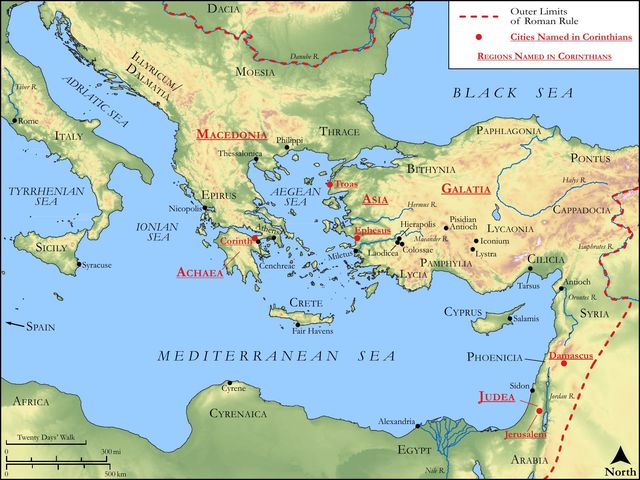
See on the biblical-era maps

Study this verse
Public-domain commentary
Matthew Henry
From his Commentary on the Whole Bible. Henry comments on passages, not single verses — this entry covers 1 Corinthians 10:15–22. His two-level outline is real structure in the source text, so it is rendered as structure.
In this passage the apostle urges the general caution against idolatry, in the particular case of eating the heathen sacrifices as such, and out of any religious respect to the idol to whom they were sacrificed.
I.He prefaces his argument with an appeal to their own reason and judgment:
"I speak to wise men, judge you what I say, Co1 10:15. You are great pretenders to wisdom, to close reasoning and argument; I can leave it with your own reason and conscience whether I do not argue justly." Note, It is no dishonour to an inspired teacher, nor disadvantage to his argument, to appeal for the truth of it to the reason and consciences of his hearers. It comes upon them with the greater force when it comes with this conviction. Paul, an inspired apostle, would yet, in some cases, leave it with the Corinthians to judge whether what he taught was not conformable to their own light and sense.
II.He lays down his argument from the Lord's supper:
The cup which we bless, is it not the communion of the blood of Christ? The bread which we break, is it not the communion of the body of Christ? Is not this sacred rite an instrument of communion with God? Do we not therein profess to be in friendship, and to have fellowship, with him? Is it not a token whereby we professedly hold communion with Christ, whose body was broken, and blood shed, to procure remission of our sins, and the favour of God? And can we be in alliance with Christ, or friendship with God, without being devoted to him? In short, the Lord's supper is a feast on the sacrificed body and blood of our Lord, epulum ex oblatis. And to eat of the feast is to partake of the sacrifice, and so to be his guests to whom the sacrifice was offered, and this in token of friendship with him. Thus to partake of the Lord's table is to profess ourselves his guests and covenant people. This is the very purpose and intention of this symbolical eating and drinking; it is holding communion with God, and partaking of those privileges, and professing ourselves under those obligations, which result from the death and sacrifice of Christ; and this in conjunction with all true Christians, with whom we have communion also in this ordinance. Because the bread is one, we, being many, are one body, for we are made partakers of one bread, or loaf (Co1 10:17), which I think is thus more truly rendered: "By partaking of one broken loaf, the emblem of our Saviour's broken body, who is the only true bread that came down from heaven, we coalesce into one body, become members of him and one another." Those who truly partake by faith have this communion with Christ, and one another; and those who eat the outward elements make profession of having this communion, of belonging to God and the blessed fraternity of his people and worshippers. This is the true meaning of this holy rite.
III.He confirms this from the Jewish worship and customs:
Behold Israel after the flesh: are not those who eat of the sacrifices partakers of the altar, that is, of the sacrifice offered upon it? Those who were admitted to eat of the offerings were reckoned to partake of the sacrifice itself, as made for them, and to be sanctified thereby; and therefore surely to worship God, and be in alliance or covenant with him, even the God of Israel, to whom the sacrifice was made: this was a symbol or token of holding communion with him.
IV.He applies this to the argument against feasting with idolaters on their sacrifices, and to prove those that do so idolaters. This he does,
1.By following the principle on which they would argue it to be lawful, namely, that an idol was nothing. Many of them were nothing at all, none of them had any divinity in them. What was sacrificed to idols was nothing, no way changed from what it was before, but was every whit as fit for food, considered in itself. They indeed seem to argue that, because an idol was nothing, what was offered was no sacrifice, but common and ordinary food, of which they might therefore eat with as little scruple. Now the apostle allows that the food was not changed as to its nature, was as fit to be eaten as common food, where it was set before any who knew not of its having been offered to an idol. But,
2.He proves that the eating of it as a part of a heathen sacrifice was, (1.) A partaking with them in their idolatry. It was having fellowship with devils, because what the Gentiles sacrificed they sacrificed to devils; and to feast with them upon these sacrifices was to partake in the sacrifice, and therefore to worship the god to whom it was made, and have fellowship or communion with him just as he who eats the Lord's supper is supposed to partake in the Christian sacrifice; or as those who ate the Jewish sacrifices partook of what was offered on their altar. But heathens sacrificed to devils: "Therefore do not feast on their sacrifices. Doing it is a token of your having fellowship with the demons to whom they are offered. I would not have you be in communion with devils." (2.) It was a virtual renouncing of Christianity: You cannot drink the cup of the Lord, and the cup of devils: you cannot be partakers of the Lord's table, and the table of devils, Co1 10:21. To partake of this Christian feast was to have communion with Christ: to partake of the feasts made in honour of the heathen idols, and made of things sacrificed to them, was to have communion with devils. Now this was to compound contraries; it was by no means consistent. Communion with Christ, and communion with devils, could never be had at once. One must be renounced, if the other was maintained. He who held communion with Christ must renounce that with devils; he who held communion with devils must by that very deed renounce communion with Christ. And what a manifest self-contradiction must that man's conduct be that would partake of the Lord's table, and yet partake of the table of demons! God and mammon can never be served together, nor fellowship be at once had with Christ and Satan. Those who communicate with devils must virtually renounce Christ. This may also intimate that such as indulge themselves in gluttony or drunkenness, and by so doing make their own table the table of devils, or keep up fellowship with Satan by a course of known and wilful wickedness, cannot partake truly of the cup and table of the Lord. They may use the sign, but do not the thing signified thereby. For a man can never be at once in communication with Christ and his church and yet in fellowship with Satan. Note, How much reason have we to look to it that every sin and idol be renounced by us, when we eat and drink at the Lord's table.
V.He warns them, upon the whole, against such idolatry, by signifying to them that God is a jealous God (Co1 10:22):
Do we provoke the Lord to jealousy? Are we stronger than he? It is very probable that many among the Corinthians made light of being at these heathen feasts, and thought there was no harm in it. But the apostle bids them beware. The reason with which the second commandment is enforced is, I am a jealous God. God cannot endure a rival in matter of worship; nor give his glory, nor suffer it to be given, to another. Those who have fellowship with other gods provoke him to jealousy, Deu 32:16. And, before this be done, persons should consider whether they are stronger than he. It is a dangerous thing to provoke God's anger, unless we could withstand his power. But who can stand before him when he is angry? Nah 1:6. This should be considered by all who continue in the love and liking of sin, and in league with it, while yet they profess to keep up communion with Christ. Is not this the way to provoke his jealousy and indignation? Note, Attention to the greatness of God's power should restrain us from provoking his jealousy, from doing any thing to displease him. Shall we rouse almighty wrath? And how shall we withstand it? Are we a match for God? Can we resist his power, or control it? And, if not, shall we arm it against us, by provoking him to jealousy? No, let us fear his power, and let this restrain us from all provocation.
Historical interpretation
Historical reception
4 surviving comments on this verse. Each one is dated, so this reads as a timeline rather than a list.
Select a marker to jump to its quote. Markers stagger vertically where authors wrote within a few decades of each other.
Wherefore every soul which receives that bread which comes down from heaven is the house of bread, that is, the Bread of Christ, being nourished and supported and having its heart strengthened by that heavenly bread which dwells within it. Hence Paul also says, For we being many are one bread. Every faithful soul is Bethlehem, as Jerusalem also is said to be, which has the peace and tranquillity of that Jerusalem which is above, in heaven. That is the true Bread which, when broken into pieces, fed all men.
"For we, who are many, are one bread, one body." "For why speak I of communion?" saith he, "we are that self-same body." For what is the bread? The Body of Christ. And what do they become who partake of it? The Body of Christ: not many bodies, but one body. For as the bread consisting of many grains is made one, so that the grains no where appear; they exist indeed, but their difference is not seen by reason of their conjunction; so are we conjoined both with each other and with Christ: there not being one body for thee, and another for thy neighbor to be nourished by, but the very same for all. Wherefore also he adds,
"For we all partake of the one bread." Now if we are all nourished of the same and all become the same, why do we not also show forth the same love, and become also in this respect one? For this was the old way too in the time of our forefathers: "for the multitude of them that believed," saith the text, "were of one heart and soul." Not so, however, now, but altogether the reverse. Many and various are the contests betwixt all, and worse than wild beasts are we affected towards each other's members. And Christ indeed made thee so far remote, one with himself: but thou dost not deign to be united even to thy brother with due exactness, but separatest thyself, having had the privilege of so great love and life from the Lord. For he gave not simply even His own body; but because the former nature of the flesh which was framed out of earth, had first become deadened by sin and destitute of life; He brought in, as one may say, another sort of dough and leaven, His own flesh, by nature indeed the same, but free from sin and full of life; and gave to all to partake thereof, that being nourished by this and laying aside the old dead material, we might be blended together unto that which is living and eternal, by means of this table.
So by bread you are instructed as to how you ought to cherish unity. Was that bread made of one grain of wheat? Were there not, rather, many grains? However, before they became bread, these grains were separate. They were joined together in water after a certain amount of crushing. For unless the grain is ground and moistened with water, it cannot arrive at that form which is called bread. So, too, you were previously ground, as it were, by the humiliation of your fasting and by the sacrament of exorcism. Then came the baptism of water. You were moistened, as it were, so as to arrive at the form of bread. But without fire, bread does not yet exist.
The one who is properly said to eat the body of Christ and to drink his blood is the one who is incorporated into the unity of his body. Heretics and schismatics can receive the sacrament but to no avail—in fact, to their harm—since the result is to increase their pain rather than to curtail the length of their punishment.
Continue studying 1 Corinthians 10:17 across the web’s major study libraries — every link below opens this exact verse, chapter, or book on the destination site.
Read & Compare
 BibleGatewayThis verse in more than 200 translations and 70 languages.
 Bible.comThe YouVersion reader — hundreds of translations, reading plans, and highlights.
 ESV.orgCrossway's official English Standard Version reader.
 NET BibleThe NET translation with 60,000+ translators' notes on every rendering decision.
 STEP BibleTyndale House's free study tool — original text, vocabulary, and scholarly resources.
 BibliaLogos Bible Software's free web reader.
 USCCBThe New American Bible (Revised Edition) with the U.S. bishops' study notes.
Commentaries
 BibleHub CommentariesDozens of classic commentaries on this verse, gathered on one page.
 StudyLightMore than 100 commentary sets — the largest collection on the web.
 BibleRefPlain-English commentary on what this verse means, verse by verse.
 Enduring WordDavid Guzik's free commentary on this chapter, widely used by Bible teachers.
 Bible Study ToolsVerse commentary alongside Greek and Hebrew study aids.
Original Language & Research
- BibleHub InterlinearThe verse word by word — original language, transliteration, and English.
- BibleHub LexiconEvery word's original-language definition and Strong's entry.
 Blue Letter BibleDeep-study tools — Strong's numbers, concordance, and word studies.
 CNTR CollationThe earliest Greek manuscripts of this verse, collated letter by letter.
Sermons, Hymns & Audio


TrulyRandomVerse is not affiliated with these sites and doesn’t control their content. They’re linked because they’re genuinely useful.
Summary
1 Corinthians 10:17 profoundly articulates the supernatural unity of believers in Christ, drawing a powerful connection to their shared participation in the Lord's Supper. Paul asserts that despite their individual diversity, Christians are collectively "one bread" and "one body," a truth made manifest and sustained through their common partaking of the communion bread, which symbolizes their corporate identity and spiritual nourishment in Christ. This verse serves as a foundational statement on ecclesial unity, contrasting the unifying power of Christ's table with the divisive nature of idolatry.
Context
ShowHideLiterary Context
This verse is deeply embedded within Paul's extended discourse on Christian freedom, responsibility, and the dangers of idolatry, spanning from 1 Corinthians 8 to 1 Corinthians 10. Paul has just used the history of Israel in the wilderness as a cautionary tale, highlighting their spiritual privileges (baptism in the cloud and sea, spiritual food and drink) and their subsequent failures due to idolatry and disobedience (1 Corinthians 10:1-13). He then transitions to a direct warning against participation in pagan sacrifices, emphasizing the incompatibility of "the cup of the Lord" and "the cup of demons," and "the Lord's table" and "the table of demons" (1 Corinthians 10:21). Immediately preceding verse 17, 1 Corinthians 10:16 establishes the Lord's Supper as a "communion" (koinonia) with the blood and body of Christ, setting the stage for the declaration of unity in verse 17. Thus, the unity described in verse 17 is not merely an abstract theological concept but a concrete reality experienced and expressed through the shared meal of communion, which stands in stark contrast to any fellowship with idolatry.
Historical & Cultural Context
Ancient Corinth was a bustling, cosmopolitan port city, a melting pot of diverse cultures, religions, and philosophical schools. Pagan temple worship was prevalent, often involving communal meals where meat sacrificed to idols was consumed. These meals were not merely social events but acts of religious devotion and fellowship with the deity. The Corinthian church itself was characterized by significant internal divisions, including factions based on allegiance to different leaders (1 Corinthians 1:10-13), social stratification evident in their observance of the Lord's Supper (1 Corinthians 11:17-22), and disputes over spiritual gifts. Against this backdrop of external pagan influences and internal disunity, Paul's emphasis on "one bread" and "one body" served as a powerful corrective and a call to radical unity, asserting that Christian fellowship through the Lord's Supper was fundamentally different from and incompatible with pagan feasting.
Key Themes
ShowHideThe overarching theme in this section of 1 Corinthians is the nature of Christian fellowship and worship, particularly as it relates to the Lord's Supper and the avoidance of idolatry. Paul emphasizes that the Lord's Supper is not merely a symbolic ritual but a profound act of communion with Christ and, by extension, communion with one another. This leads directly to the theme of the unity of the Church, which Paul consistently portrays as the Body of Christ throughout his epistles, notably in 1 Corinthians 12 and Romans 12. The "one bread" serves as a tangible symbol of this spiritual reality, signifying that diverse individuals are made one in Christ through their shared participation in His life and sacrifice. This unity is presented as both a theological truth and a practical imperative, demanding that believers live in harmony and avoid practices that would undermine their shared identity in Christ.
Exposition and Analysis
ShowHideKey Word Analysis
ShowHideDerived from a root meaning "to lift" or "to raise," referring to bread as something lifted up (from the ground, or dough that rises). In this context, ártos refers to a loaf of bread, specifically the bread used in the Lord's Supper. It is a tangible, singular item that is nevertheless composed of many grains, symbolizing the unity formed from diverse individuals. Its singular nature ("one bread") underscores the corporate identity of believers.
A primary numeral meaning "one." Its repeated use ("one bread," "one body," "that one bread") powerfully emphasizes the singular, unified nature of the Christian community. It speaks to an essential, indivisible unity that transcends individual differences, highlighting the profound spiritual reality of being united in Christ.
From metá (with) and échō (to have), meaning "to share or participate; by implication, to belong to, eat (or drink)." This word denotes a deep, communal participation and sharing. It's not merely individual consumption but a mutual sharing that binds participants together. The act of partaking in the "one bread" signifies a shared identity and a common spiritual experience that unites all believers into one body.
Verse Breakdown
ShowHide"For we being many are one bread,"
Paul begins by stating a profound paradox: despite the numerical multiplicity of believers ("we being many"), they are fundamentally unified as "one bread." This metaphor draws directly from the nature of bread itself—many individual grains of wheat are crushed, mixed, and baked together to form a single loaf. Similarly, diverse individuals, through their faith in Christ and participation in the Lord's Supper, are transformed into a singular, unified entity. The "one bread" here primarily refers to the communion bread, which serves as a visible symbol and means of their corporate spiritual identity.
"[and] one body
": This clause extends the metaphor from "one bread" to "one body," a concept central to Paul's ecclesiology. The Church is not merely a collection of individuals but an organic, unified organism, the "body of Christ." The transition from "bread" to "body" reinforces the idea that the unity symbolized by the communion bread is the very unity of the Church itself. Just as a physical body has many members but functions as a single unit, so too the Church, composed of many believers, is one cohesive spiritual entity.
"for we are all partakers of that one bread."
This final clause provides the theological rationale and experiential basis for the preceding declarations of unity. The reason believers are "one bread" and "one body" is precisely because they "all partakers of that one bread." The act of common participation in the Lord's Supper is not merely symbolic; it is the means by which their spiritual unity is affirmed, deepened, and expressed. It signifies a shared life in Christ and a common spiritual nourishment that binds them together into an indivisible whole. The repetition of "one bread" underscores its centrality to this unity.
Literary Devices
ShowHidePaul employs several significant literary devices in 1 Corinthians 10:17 to convey his message of unity. The primary device is Metaphor, where the Church is directly equated with "one bread" and "one body." The image of "one bread" is a powerful and tangible metaphor for unity, as many grains are combined to form a single loaf, symbolizing how many diverse individuals are united into one Christian community. This is immediately followed by the well-known Pauline metaphor of the Church as the Body of Christ, reinforcing the organic and interdependent nature of believers. The phrase "one bread" also functions as a Synecdoche, where the part (the communion bread) represents the whole (the entire act of the Lord's Supper and the unity it signifies). Furthermore, Paul uses Repetition of the phrase "one bread" and "one" (applied to both bread and body) to emphasize the core concept of unity. This repetition, combined with the Parallelism between "one bread" and "one body," creates a rhythmic and memorable statement that underscores the singular, unified identity of the Christian community.
Theological and Thematic Connections
ShowHide1 Corinthians 10:17 stands as a cornerstone for understanding the nature of the Church's unity, rooted in its shared participation in Christ. This unity is not merely organizational or social, but deeply spiritual, forged by the Holy Spirit and expressed in the communal act of the Lord's Supper. It reflects the very nature of God as a unified Trinity, and the new covenant reality where believers, regardless of their background, are brought together into one family. The verse highlights that communion is not just a remembrance of Christ's sacrifice, but an active participation in His body and blood, which inherently binds believers to one another. This shared life in Christ transcends all human divisions, calling believers to live out the practical implications of their spiritual oneness.
Reflection and Application
ShowHide1 Corinthians 10:17 offers a profound theological truth with immense practical implications for believers today. It calls us to recognize that our shared participation in the Lord's Supper is not just an individual act of remembrance, but a corporate affirmation of our profound, spiritual oneness in Christ. This means that divisions, strife, and disunity within the church directly contradict the very essence of what the "one bread" represents. We are challenged to actively pursue harmony, mutual love, and respect, cherishing the unity that Christ has already established. When we gather at the Lord's Table, we are reminded that our individual identities are subsumed into a greater, unified identity as the Body of Christ. This should compel us to live out our faith in ways that demonstrate this unity to a watching world, serving one another, bearing one another's burdens, and working together for the advancement of God's kingdom, rather than allowing personal preferences or worldly distinctions to fracture the sacred bond we share.
Questions for Reflection
ShowHideFAQ
ShowHideWhat does Paul mean by "one bread" in this verse?
ShowHideWhen Paul speaks of "one bread," he is primarily referring to the single loaf of bread used in the Christian practice of the Lord's Supper, also known as communion or the Eucharist. This "one bread" serves as a powerful symbol and a tangible expression of the profound unity of all believers. Just as many individual grains of wheat are ground, mixed, and baked to form a single loaf, so too are many diverse individuals united by faith in Christ to form one spiritual body. Their shared partaking of this single loaf signifies their common life in Christ and their corporate identity as the Church. It emphasizes that their unity is not merely an ideal but a lived reality, made manifest in their communal worship and shared spiritual nourishment from Christ. This concept is deeply tied to Paul's broader teaching on the Church as the Body of Christ.
How does 1 Corinthians 10:17 relate to the concept of the "Body of Christ"?
ShowHide1 Corinthians 10:17 is a foundational verse for understanding Paul's concept of the Church as the "Body of Christ." The verse explicitly states, "For we being many are one bread, and one body." Paul draws a direct parallel between the "one bread" of communion and the "one body" of believers. The act of partaking in the single loaf of communion bread symbolizes and actualizes the spiritual reality that all believers, despite their individual differences, are organically united as one spiritual body, with Christ as its head. This unity is not just metaphorical; it is a profound theological truth that has practical implications for how believers relate to one another. Just as a physical body has many parts that function together for the good of the whole, so too are individual believers members of the one Body of Christ, called to mutual interdependence, service, and harmony (Romans 12:4-5). This verse underscores that the Lord's Supper is a corporate act that reinforces and expresses this essential unity of the Body of Christ.
Christ-Centered Fulfillment
ShowHide1 Corinthians 10:17 finds its ultimate fulfillment and meaning in Jesus Christ, who is the very "one bread" and the head of the "one body." Christ is the true bread of life who came down from heaven, giving His flesh for the life of the world (John 6:51). His broken body on the cross, symbolized by the communion bread, is the singular sacrifice that unites all believers, breaking down dividing walls of hostility (Ephesians 2:14). Through His Spirit, Christ baptizes all believers into this one body, whether Jew or Gentile, slave or free, making them all to drink of one Spirit (1 Corinthians 12:13). Thus, the unity described in 1 Corinthians 10:17 is not a human achievement but a divine reality, inaugurated by Christ's atoning work, sustained by His ongoing presence through the Spirit, and expressed in the communal meal that points back to His sacrifice and forward to His return. He is the unifying principle, the very lifeblood of the Church, ensuring that though we are many, we are truly one in Him.