


2 Chronicles 25:18
- וַיִּשְׁלַחvai·yish·Lachand he sentH7971Conj-w ¦ V-Qal-ConsecImperf-3msVerb Qal Consecutive Imperfect 3rd Singular Masculineוַandיִּשְׁלַחhe sent
- יוֹאָשׁyo·'AshJoashH3101N-proper-mNoun Proper Masculine
- מֶלֶךְMe·lekh[the] king ofH4428N-mscNoun Singular Masculine Construct
- יִשְׂרָאֵלYis·ra·'ElIsraelH3478N-properNoun Proper Location
- אֶל'eltoH413PrepPreposition
- אֲמַצְיָהוּ'a·matz·Ya·huAmaziahH558N-proper-mNoun Proper Masculine
- מֶלֶךְMe·lekh[the] king ofH4428N-mscNoun Singular Masculine Construct
- יְהוּדָהye·hu·DahJudahH3063N-properNoun Proper Location
- לֵאמֹרle·Mor<to> sayingH559Prep-l ¦ V-Qal-InfVerb Qal Infinitive Constructלֵ<to>אמֹרsaying
- הַחוֹחַha·Cho·achthe thornbushH2336Art ¦ N-msNoun Singular Masculine Absoluteהַtheחוֹחַthornbush
- אֲשֶׁר'a·SherwhichH834RelParticle Relative
- בַּלְּבָנוֹןba·le·va·Non[was] in <the> LebanonH3844Prep-b ¦ N-properNoun Proper Locationבַּ[was] in <the>לְּבָנוֹןLebanon
- שָׁלַחSha·lachit sentH7971V-Qal-Perf-3msVerb Qal Perfect 3rd Singular Masculine
- אֶל'eltoH413PrepPreposition
- הָאֶרֶזha·'E·rezthe cedarH730Art ¦ N-msNoun Singular Masculine Absoluteהָtheאֶרֶזcedar
- אֲשֶׁר'a·SherwhichH834RelParticle Relative
- בַּלְּבָנוֹןba·le·va·nOn[was] in <the> LebanonH3844Prep-b ¦ N-properNoun Proper Locationבַּ[was] in <the>לְּבָנוֹןLebanon
- לֵאמֹרle·Mor<to> sayingH559Prep-l ¦ V-Qal-InfVerb Qal Infinitive Constructלֵ<to>אמֹרsaying
- תְּנָהte·nahgive !H5414V-Qal-Imp-2ms ¦ SfxVerb Qal Imperative 2nd Singular Masculineתְּנָgiveה!
- אֶת'et<obj.>H853DirObjMParticle Object Indicator
- בִּתְּךָbi·te·Khayour daughterH1323N-fsc ¦ 2msNoun Singular Feminine Constructבִּתְּdaughterךָyour
- לִבְנִיliv·Nito my sonH1121Prep-l ¦ N-msc ¦ 1csNoun Singular Masculine Constructלִtoבְנִsonיmy
- לְאִשָּׁהle·'i·Shahto a wifeH802Prep-l ¦ N-fsNoun Singular Feminine Absoluteלְtoאִשָּׁהa wife
- וַתַּעֲבֹרva·ta·'a·Vorand it passed byH5674Conj-w ¦ V-Qal-ConsecImperf-3fsVerb Qal Consecutive Imperfect 3rd Singular Feminineוַandתַּעֲבֹרit passed by
- חַיַּתchai·Yat[the] animal ofH2416N-fscNoun Singular Feminine Construct
- הַשָּׂדֶהha·sa·Dehthe fieldH7704Art ¦ N-msNoun Singular Masculine Absoluteהַtheשָּׂדֶהfield
- אֲשֶׁר'a·SherwhichH834RelParticle Relative
- בַּלְּבָנוֹןba·le·va·Non[was] in <the> LebanonH3844Prep-b ¦ N-properNoun Proper Locationבַּ[was] in <the>לְּבָנוֹןLebanon
- וַתִּרְמֹסva·tir·Mosand it trampledH7429Conj-w ¦ V-Qal-ConsecImperf-3fsVerb Qal Consecutive Imperfect 3rd Singular Feminineוַandתִּרְמֹסit trampled
- אֶת'et<obj.>H853DirObjMParticle Object Indicator
- הַחוֹחַha·Cho·achthe thornbushH2336Art ¦ N-msNoun Singular Masculine Absoluteהַtheחוֹחַthornbush
English is a literal word-by-word gloss of the Hebrew, not the KJV's wording. Why?
This is the original text the KJV's translators worked from — each Hebrew word with its own literal English meaning in this verse, prepared by scholars at Tyndale House, Cambridge. The KJV translates whole sentences, not word by word, so its wording differs: one Hebrew word can become several English words, and the KJV may choose “the LORD” where the gloss reads “Yahweh”. Both are faithful — they answer different questions. For the KJV's own rendering, switch to the KJV text.
Details
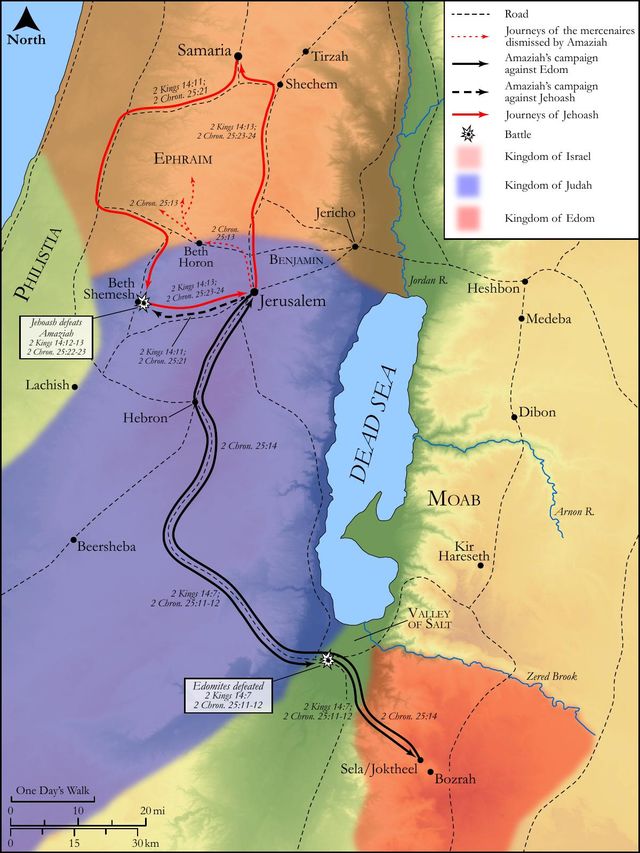
See on the biblical-era map
Study this verse
Public-domain commentary
Matthew Henry
From his Commentary on the Whole Bible. Henry comments on passages, not single verses — this entry covers 2 Chronicles 25:17–28. His three-level outline is real structure in the source text, so it is rendered as structure.
We have here this degenerate prince mortified by his neighbour and murdered by his own subjects.
I.Never was proud prince more thoroughly mortified than Amaziah was by Joash king of Israel.
1.This part of the story (which was as fully related Kg2 14:8, etc., as it is here) - embracing the foolish challenge which Amaziah sent to Joash (Ch2 25:17), his haughty scornful answer to it (Ch2 25:18), with the friendly advice he gave him to sit still and know when he was well off, (Ch2 25:19), - his wilfully persisting in his challenge (Ch2 25:20, Ch2 25:21), the defeat that was given him (Ch2 25:22), and the calamity he brought upon himself and his city thereby (Ch2 25:23, Ch2 25:24), - verifies two of Solomon's proverbs: - (1.) That a man's pride will bring him low, Pro 29:23. It goes before his destruction; not only procures it meritoriously, but is often the immediate occasion of it. He that exalteth himself shall be abased. (2.) That he that goes forth hastily to strive will probably not know what to do in the end thereof, when his neighbour has put him to shame, Pro 25:8. He that is fond of contention may have enough of it sooner than he thinks of.
2.But there are two passages in this story which we had not before in the Kings.
(1.)That Amaziah took advice before he challenged the king of Israel, Ch2 25:17. But of whom? Not of the prophet - he was not made of the king's counsel; but of his statesmen that would flatter him and bid him go up and prosper. It is good to take advice, but then it must be of those that are fit to advise us. Those that will not take advice from the word of God, which would guide them aright, will justly be left to the bad advice of those that will counsel them to their destruction. Let those be made fools that will not be made wise.
(2.)Amaziah's imprudence is here made the punishment of his impiety (Ch2 25:20): It was of the Lord; he left him to himself to act thus foolishly, that he and his people might be delivered into the hands of their enemies, because they had forsaken God and sought after the gods of Edom. Those that will not persuaded to do well for their souls will justly be given up to their own counsels to do ill for themselves even in their outward affairs.
II.Never was poor prince more violently pursued by his own subjects.
From the time that he departed from the Lord (so it may be read, Ch2 25:27) the hearts of his subjects departed from him, and they began to form a design against him in Jerusalem. It is probable they were exasperated against him more for his rashly engaging in a war against Israel than for his worshipping the gods of Edom. But at length the ferment grew so high, and he perceived the plot to be laid so deeply, that he thought fit to quit his royal city and flee to Lachish, either as a private place where he might be hid or as a strong place where he might be guarded; but they sent after him thither, and slew him there. By this the putting of him to death seems to have been done deliberately, and to have been the act, not of a disgusted servant or two, but of a considerable body that durst avow it. How unrighteous soever they were herein, God was righteous.
Continue studying 2 Chronicles 25:18 across the web’s major study libraries — every link below opens this exact verse, chapter, or book on the destination site.
Read & Compare
 BibleGatewayThis verse in more than 200 translations and 70 languages.
 Bible.comThe YouVersion reader — hundreds of translations, reading plans, and highlights.
 ESV.orgCrossway's official English Standard Version reader.
 NET BibleThe NET translation with 60,000+ translators' notes on every rendering decision.
 STEP BibleTyndale House's free study tool — original text, vocabulary, and scholarly resources.
 BibliaLogos Bible Software's free web reader.
 USCCBThe New American Bible (Revised Edition) with the U.S. bishops' study notes.
Commentaries
 BibleHub CommentariesDozens of classic commentaries on this verse, gathered on one page.
 StudyLightMore than 100 commentary sets — the largest collection on the web.
 BibleRefPlain-English commentary on what this verse means, verse by verse.
 Enduring WordDavid Guzik's free commentary on this chapter, widely used by Bible teachers.
 Bible Study ToolsVerse commentary alongside Greek and Hebrew study aids.
Original Language & Research
- BibleHub InterlinearThe verse word by word — original language, transliteration, and English.
- BibleHub LexiconEvery word's original-language definition and Strong's entry.
 Blue Letter BibleDeep-study tools — Strong's numbers, concordance, and word studies.
 SefariaThe Hebrew text with Rashi and centuries of Jewish commentary.
Sermons, Hymns & Audio


TrulyRandomVerse is not affiliated with these sites and doesn’t control their content. They’re linked because they’re genuinely useful.
Summary
Second Chronicles 25:18 vividly recounts King Joash of Israel's cutting and prophetic parable, delivered in response to King Amaziah of Judah's audacious challenge to war. Through the imagery of a lowly thistle presumptuously seeking a marriage alliance with a majestic cedar, only to be effortlessly trampled by a passing wild beast, Joash masterfully conveys his disdain for Amaziah's inflated pride and foreshadows the swift and devastating defeat that awaits Judah. This parable serves as a stark condemnation of Amaziah's hubris, which was fueled by a recent military victory, and a chilling premonition of the humiliation and destruction his kingdom would soon endure.
Context
ShowHideLiterary Context
This verse is strategically placed within the narrative of Amaziah's reign, immediately following his decisive victory over Edom. Emboldened by this success, and perhaps misinterpreting divine favor as an endorsement of his own strength, Amaziah foolishly sends a challenge to Joash, King of Israel, proposing a direct confrontation, as recorded in 2 Chronicles 25:17. Joash's response in 2 Chronicles 25:18 is not a direct acceptance or refusal, but a calculated, condescending parable designed to humiliate Amaziah and warn him of the inevitable outcome. The subsequent verses, 2 Chronicles 25:20-24, detail the disastrous war, Amaziah's capture, and the plundering of Jerusalem, confirming the parable's prophetic accuracy and Joash's shrewd assessment.
Historical & Cultural Context
The period of the divided monarchy (Israel in the north, Judah in the south) was characterized by a complex interplay of political alliances, religious divergences, and intermittent warfare. Both kingdoms shared a common heritage but often found themselves in conflict. In the ancient Near East, Lebanon was renowned for its magnificent cedars, which symbolized strength, majesty, and enduring power, frequently associated with royalty and powerful nations. Conversely, thistles were common, easily eradicated weeds, representing insignificance, vulnerability, and contempt. The use of parables and fables, often featuring animals or plants, was a common didactic and rhetorical tool in this era, enabling rulers to communicate potent, often veiled, messages with profound impact and authority, particularly in diplomatic exchanges or challenges.
Key Themes
ShowHideThe most prominent theme illuminated by this verse is the perilous nature of pride and its destructive consequences. Amaziah's arrogance, inflated by his military triumph, blinds him to wisdom and leads him to challenge a superior power, ultimately resulting in his downfall. This aligns perfectly with broader biblical wisdom literature, which consistently warns against hubris, as famously articulated in Proverbs 16:18. Another significant theme is divine judgment, as Amaziah's defeat is not merely a political mishap but is implicitly linked to his earlier idolatry and his rejection of God's prophetic warning, as detailed in 2 Chronicles 25:14-16. The parable also powerfully underscores the power dynamics between the two kingdoms, with Israel asserting its dominant position and perceived superiority over Judah.
Exposition and Analysis
ShowHideKey Word Analysis
ShowHideThis term (H2336) refers to a prickly, thorny plant, often a weed, easily broken or trampled. In Joash's parable, it symbolizes King Amaziah and the kingdom of Judah, whom Joash views as presumptuous, lacking true strength, and ultimately contemptible despite their recent victory over Edom. The thistle's audacious ambition to marry into the cedar's family highlights Amaziah's absurd attempt to elevate his status through a challenge that is far beyond his station.
The cedar of Lebanon (H730) was celebrated throughout the ancient world for its immense size, strength, longevity, and majestic appearance. It served as a powerful symbol of enduring power, nobility, and stability, frequently used in biblical texts to represent mighty kings, powerful nations, or even God's own majesty. Here, the cedar represents King Joash and the kingdom of Israel, emphasizing their perceived formidable power and inherent superiority compared to Judah. The repeated phrase "in Lebanon" further reinforces this image of grandeur, rooted strength, and established authority within their shared region.
This word (H2416), often used in the phrase "wild beast of the field" (chayyat hassadeh), denotes an untamed, destructive animal. In the parable, the "wild beast" symbolizes an unforeseen, overwhelming, and irresistible force. It represents the inevitable and crushing defeat that awaits Amaziah, suggesting that even if the "cedar" (Israel) did not directly engage the "thistle" (Judah) in a formal alliance or battle, the thistle's arrogance would lead to its destruction by some other, perhaps less expected, means. In the immediate historical context, Joash's army would indeed fulfill the role of this "wild beast," easily trampling Amaziah's forces and devastating Judah.
Verse Breakdown
ShowHide"And Joash king of Israel sent to Amaziah king of Judah, saying,"
This opening clause establishes the formal nature of the communication between the two rival monarchs. It sets the scene for a significant diplomatic exchange that precedes any military action, highlighting that Joash's response is a deliberate and calculated message, not an impulsive retort.
"The thistle that [was] in Lebanon sent to the cedar that [was] in Lebanon, saying, Give thy daughter to my son to wife:"
This is the central allegorical proposition. The "thistle" (Amaziah), though also "in Lebanon" (implying a shared regional identity), presumptuously proposes a marriage alliance with the "cedar" (Joash/Israel). This request for a marital union signifies an audacious attempt to gain status, legitimacy, or power through association. From the perspective of the superior party, it is an insulting and absurd proposition, as a lowly weed has no rightful place seeking kinship with a majestic tree.
"and there passed by a wild beast that [was] in Lebanon, and trode down the thistle."
This final clause delivers the parable's devastating punchline and its prophetic warning. Before any alliance could be formed or even seriously considered, an external, powerful, and destructive force—a "wild beast"—appears and effortlessly crushes the arrogant thistle. This vividly illustrates the fragility and vulnerability of the presumptuous thistle (Amaziah) and foreshadows the swift, decisive, and humiliating defeat that Joash's forces would inflict upon Judah, fulfilling the role of the "wild beast." The repeated phrase "in Lebanon" subtly emphasizes that this destruction occurs within the very region where the thistle sought to elevate itself.
Literary Devices
ShowHideThe primary literary device employed in 2 Chronicles 25:18 is Allegory, functioning as a highly developed Parable. In this structure, the characters and actions within the narrative directly represent other entities and events in the real world. The thistle, the cedar, and the wild beast are not merely illustrative figures but direct symbolic representations of Amaziah, Joash/Israel, and the impending destruction, respectively. This allegorical framework allows Joash to convey a profound and deeply insulting message without resorting to direct confrontation, thereby maintaining a certain kingly decorum while delivering a devastating psychological blow. Central to this allegory is the pervasive use of Symbolism, where the thistle embodies insignificance and arrogance, the cedar signifies power and majesty, and the wild beast represents an overwhelming, destructive force. The imagery is drawn directly from Nature, making the parable immediately relatable and impactful to an agrarian society. Furthermore, the parable contains a potent element of Foreshadowing, as it accurately predicts the tragic outcome of the impending conflict between Judah and Israel.
Theological and Thematic Connections
ShowHideJoash's parable in 2 Chronicles 25:18 powerfully illustrates the timeless biblical principle that pride precedes a fall. Amaziah's hubris, fueled by his recent military success and perhaps a misinterpretation of God's favor, led him to challenge a superior power, resulting in his humiliation and the devastation of his kingdom. This narrative serves as a stark warning against the dangers of self-exaltation and overconfidence, particularly when one's strength is perceived rather than genuinely possessed or divinely granted. The parable underscores that true wisdom lies in humility and an accurate assessment of one's position, rather than in arrogant posturing. It also implicitly highlights the consequences of turning away from God, as Amaziah's pride was compounded by his idolatry, inviting divine judgment upon himself and his people.
Reflection and Application
ShowHideThe timeless message of 2 Chronicles 25:18 resonates deeply in contemporary life, serving as a powerful caution against the insidious nature of pride, especially in the wake of success. Whether in personal achievements, professional advancements, or spiritual growth, the temptation to become arrogant can lead to foolish decisions and devastating consequences. Amaziah's story reminds us that true strength is not found in self-exaltation or in challenging others out of hubris, but in humility, wisdom, and a sober assessment of our capabilities and limitations. It calls us to cultivate a spirit of gratitude for successes, attributing them to divine grace rather than personal prowess, and to approach challenges with discernment rather than reckless bravado. Recognizing that "a wild beast" can emerge in many forms—unforeseen circumstances, the consequences of poor judgment, or even the natural outworking of our own arrogance—prompts us to walk humbly and wisely before God and others, understanding that our true security lies not in our perceived might but in our reliance on God.
Questions for Reflection
ShowHideFAQ
ShowHideWhat is the significance of the "thistle" and the "cedar" in Joash's parable?
ShowHideThe "thistle" (Hebrew: chôwach) symbolizes King Amaziah of Judah, representing his perceived insignificance, weakness, and presumptuousness. Despite his recent victory over Edom, Joash views him as a common weed easily trampled. The "cedar" (Hebrew: ʼerez) from Lebanon, by contrast, symbolizes King Joash and the kingdom of Israel, representing their immense power, majesty, and established strength. The parable's core message is that the lowly thistle (Amaziah) has no business presuming equality or alliance with the mighty cedar (Joash), and such arrogance will lead to its destruction. This imagery was common in ancient Near Eastern literature to convey power dynamics and warnings. The ultimate outcome of the war, where Israel decisively defeats Judah and plunders Jerusalem (2 Chronicles 25:21-24), confirms Joash's assessment.
Why did Joash respond with a parable instead of a direct refusal or acceptance of Amaziah's challenge?
ShowHideJoash's use of a parable was a highly effective and culturally sophisticated way to respond to Amaziah's challenge. Firstly, it allowed him to deliver a scathing insult and a prophetic warning without engaging in direct, undignified verbal sparring. By using an allegory, Joash could convey his contempt for Amaziah's arrogance and his certainty of Judah's defeat in a memorable and humiliating way. Secondly, it demonstrated Joash's wisdom and strategic thinking, contrasting sharply with Amaziah's impulsive pride. The parable served as a psychological weapon, designed to undermine Amaziah's confidence and foreshadow his inevitable downfall, thereby asserting Israel's superior position and power even before the battle began. It also provided a clear justification for the subsequent military action, framing it as a necessary response to Amaziah's foolish provocation.
Christ-Centered Fulfillment
ShowHideWhile 2 Chronicles 25:18 stands as a stark warning against human pride and its destructive consequences, it also implicitly points to the ultimate King who perfectly embodies the opposite of Amaziah's folly. Jesus Christ, the true King of kings, did not come in earthly pomp and power, but in profound humility, demonstrating that true strength is found not in self-exaltation but in self-abasement. Unlike the thistle seeking to elevate itself, Christ, though truly divine, "did not count equality with God a thing to be grasped, but emptied himself, by taking the form of a servant, being born in the likeness of men" (Philippians 2:6-7). He is the majestic "Cedar" of God's eternal kingdom, yet He willingly allowed Himself to be "trodden down" by the forces of sin and death on the cross, enduring humiliation and suffering. Through His sacrificial death and glorious resurrection, He decisively crushed the true "wild beast" of spiritual evil, sin, and death (Colossians 2:15), offering salvation to all who believe. Amaziah's pride led to his downfall, but Christ's perfect humility led to His ultimate exaltation and the redemption of humanity, powerfully fulfilling the wisdom that "whoever humbles himself will be exalted" (Matthew 23:12). He is the humble Lamb who is also the conquering Lion, perfectly balancing divine power with profound meekness, offering a stark contrast to the tragic pride of Amaziah.